
To import plywood from Vietnam, fix one order line, approve a sample, book one 40HC and pay a 30% deposit; the mill produces to the agreed schedule and loads at Hai Phong, and the 70% balance follows the scanned B/L. Skip the written line and the first container becomes an argument. Truc Mai runs every repeat order from that same line.
What is the MOQ for a first container of Vietnamese plywood?
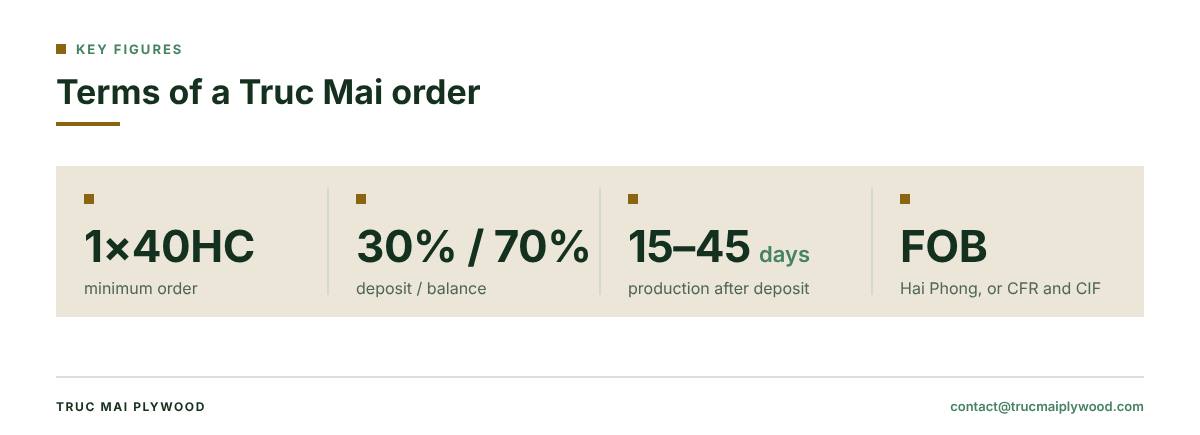
The MOQ for a first container of Vietnamese plywood at Truc Mai is one 40HC. Most first containers hold one or two products, but up to six can travel together if agreed, which lets an importer try a carcass panel, a back panel and a drawer stock on the same booking. There is no smaller trial order than one container.
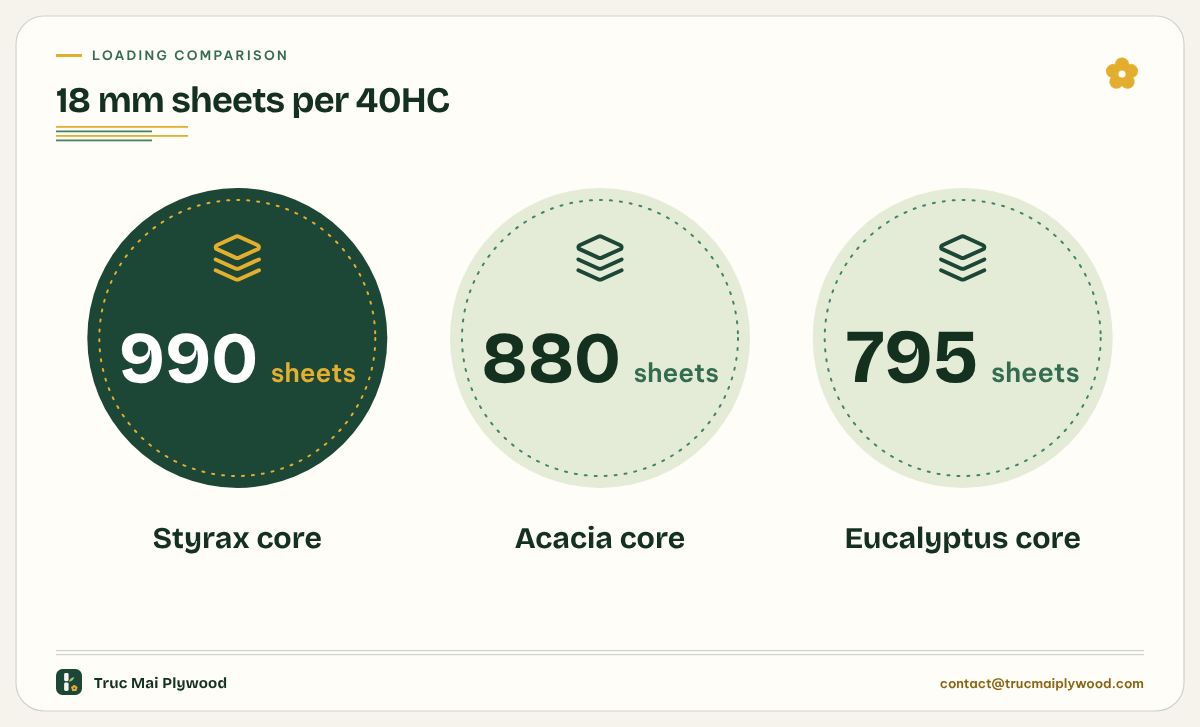
One 40HC is the natural unit because freight, port and customs costs are charged per container. A part-load pays those costs on fewer m³, and a mixed load spreads them over every product on board. On the planning model, a 40HC holds 990 sheets of 18 mm plywood on Styrax core (about 53 m³), 880 on Acacia or 795 on Eucalyptus, at 1220 × 2440 mm.
A mixed first container also tells the buyer more. Each product’s face, core and tolerance can be checked on arrival, and the next order can keep what worked and change what did not. The mix is fixed before production starts, because it changes the pack plan.
Truc Mai is a large-volume manufacturer in Ha Hoa, Phu Tho, making around 60,000 m³ a year and around 5,000 m³ in an average month. A monthly programme of one or two 40HC sits inside that output.
How to import plywood from Vietnam: the steps in order
How to import plywood from Vietnam comes down to ten steps: write the specification, ask for quotes against it, check the mill, approve a sample, confirm the order and pay the deposit, let the mill produce, check the loading, approve draft documents, pay the balance against the B/L, and clear customs at destination.
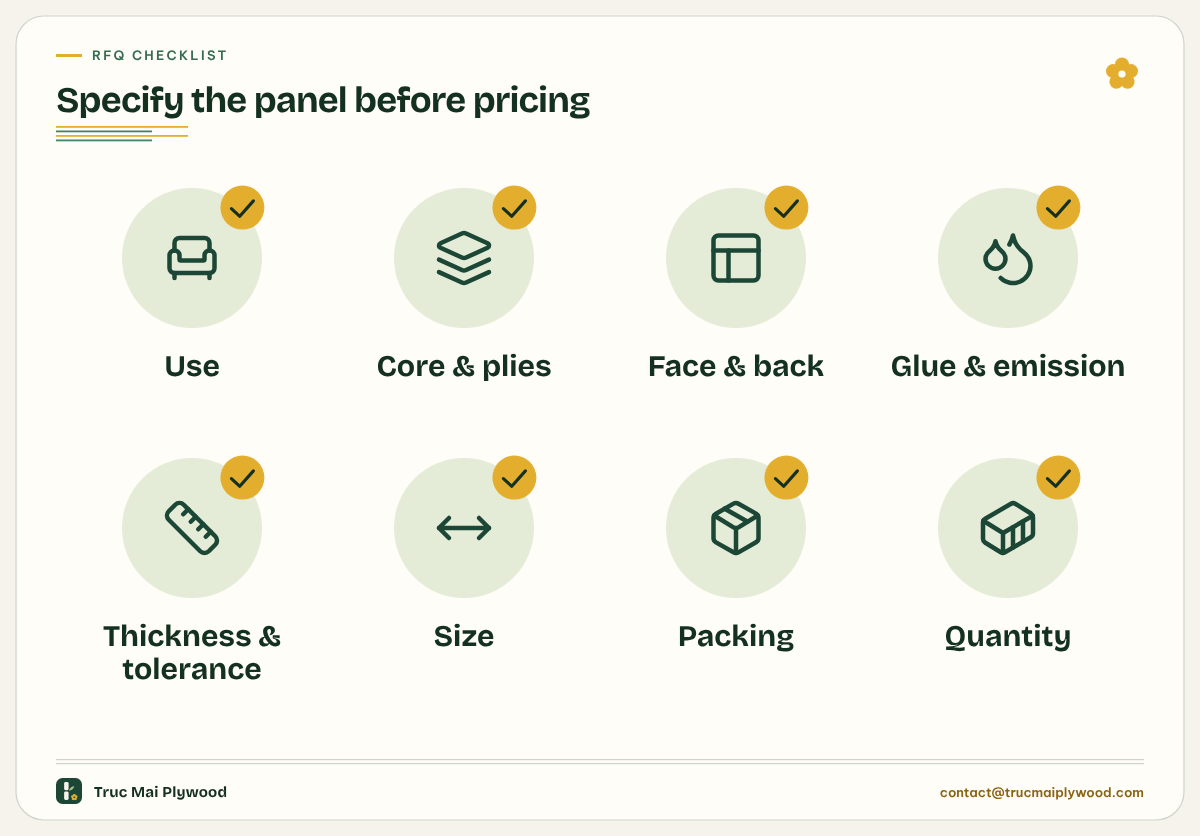
- Write the order line: use, core, plies, face and back, glue and emission, thickness and tolerance, size, packing, quantity.
- Send the same line to every mill you compare and ask for a quote per m³ and per sheet.
- Check each shortlisted mill: certificates, the build it quotes, its answers on documents.
- Approve a free sample of the exact build.
- Confirm the order and pay the 30% deposit.
- Production runs to the agreed schedule, depending on quantity.
- Loading at the mill: the pack count and loading plan follow the booked payload.
- Draft shipping documents go to the buyer for approval after loading.
- Pay the 70% balance (T/T, or an irrevocable sight L/C) when the scanned B/L arrives.
- The vessel sails from Hai Phong; the buyer’s broker clears customs and the panels go to the warehouse.
The order line in step 1 does most of the work. It is the document the mill builds to, the inspector checks against and the buyer repeats every month. A first import that skips it turns every later step into a discussion about what was meant.
Which plywood does a Vietnamese mill make, and what does Truc Mai not make?
Vietnamese mills make hardwood-core plywood: Eucalyptus, Acacia, Styrax, Pine or combined cores, with local or imported face veneers. Truc Mai makes furniture and interior plywood, commercial plywood and packing plywood from 3–40 mm, plus UV-ready, melamine-, HPL- and paper-overlay-faced panels and non-structural LVL. It does not make marine, structural or film-faced formwork panels.
An importer can choose almost any face: EV (engineered veneer), poplar, bleached poplar, birch, okoume, bintangor, pine, eucalyptus, gurjan or sapele, with others on request. A birch face is imported and laid on a Vietnamese core, so the import papers should say birch-faced plywood, never all-birch. Vietnamese plywood has no poplar or birch cores, and there is no rubberwood core in the Truc Mai range.
| Line | Core build | Surface | Tolerance | Typical buyer |
|---|---|---|---|---|
| Furniture and interior | A-grade core, stitched | Sanded and calibrated | ±0.3 mm | Cabinet and furniture factories |
| Commercial | AB core, loose-laid or jointed | Unsanded or lightly sanded | ±0.5 mm | Distributors, joinery, fit-out |
| Packing | AB core, loose-laid | Unsanded, usually E2 | ±0.5–1.0 mm | Crate and pallet makers |
Standard sheets come in 1220 × 2440, 1220 × 2280 and 1250 × 2500 mm. Other sizes can be made up to 1250 × 2500 mm, and an importer that needs smaller parts can have each sheet cut into 2, 3, 4 or 6 panels at the mill before it is packed. The furniture and interior plywood range and the commercial panels pages show the builds per product.
How do you write the specification before asking for a price?
Write the specification from the use outward: application first, then core, glue and emission, face and back, sheet size and tolerance, packing and quantity. Each line closes a choice the mill would otherwise make for you, and each one changes the price. A complete line lets every mill quote the same panel.
An importer comparing Vietnamese quotes will often see one product name on two panels that are built differently. Five things separate them: the grade of the core, how the core veneers are joined, how the face is prepared, which adhesive is used and what tolerance is held. The how plywood is priced guide shows what each one does to the price. “18 mm poplar plywood, E0” can describe an EV-faced, A-grade stitched, calibrated furniture panel or an unsanded commercial panel on a loose-laid core.
| Line | Example for a furniture buyer | Why it matters |
|---|---|---|
| Use | Kitchen carcasses | Sets the build and the grade |
| Core | Styrax, A-grade, stitched, 11 plies | Screw hold, weight, m³ per 40HC |
| Glue and emission | UF glue at E0 emission | Two separate lines, never “E0 glue” |
| Face and back | White poplar EV / poplar, paint grade | Graded against the approved sample |
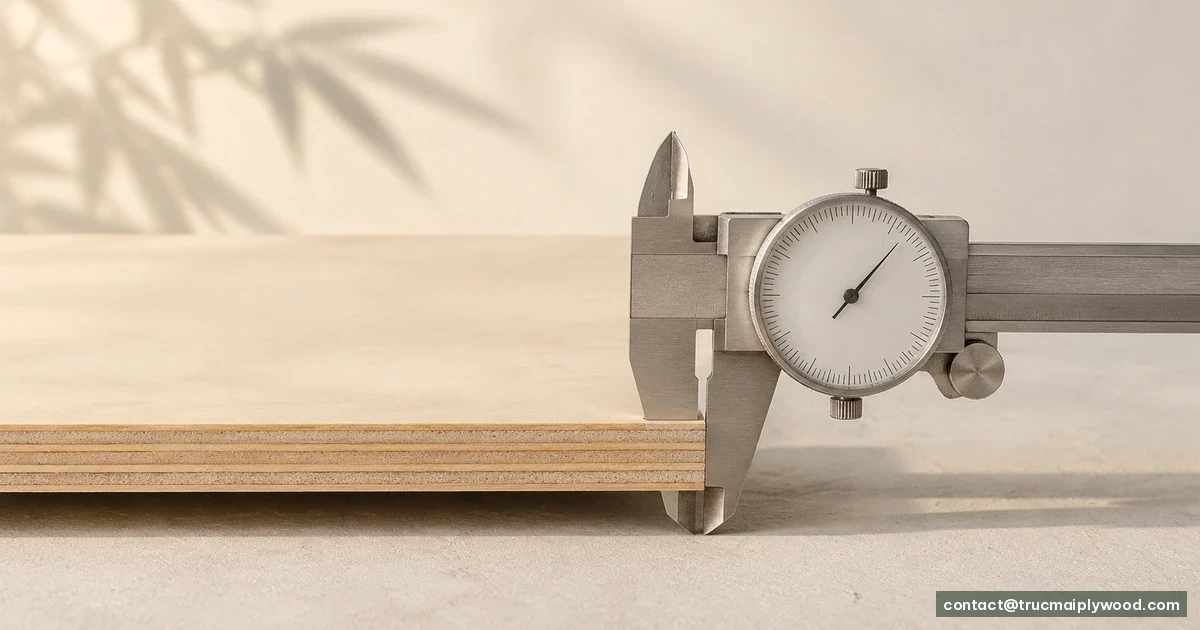
| Thickness and tolerance | 18 mm ±0.3 mm, sanded and calibrated | CNC and hinge fit |
| Size | 1220 × 2440 mm, ±2 mm | Cutting yield |
| Packing | Export packs about 1,000 mm high | Pallet strength, handling |
| Quantity | 990 sheets, 1×40HC, monthly | Container plan and price |
Glue type and emission class are separate items. The default build is UF glue at E0 emission, which resists about 6 hours of boiling; a 12-hour boil needs melamine-fortified glue, with emission then usually E1. The how plywood is priced guide shows how each line moves the quote.
How are samples handled before a first order?
Samples come before the first order and become the grading reference for every later one. They are free; a new importer only pays the courier, and gets that back as a credit on its first real order (see ordering samples).
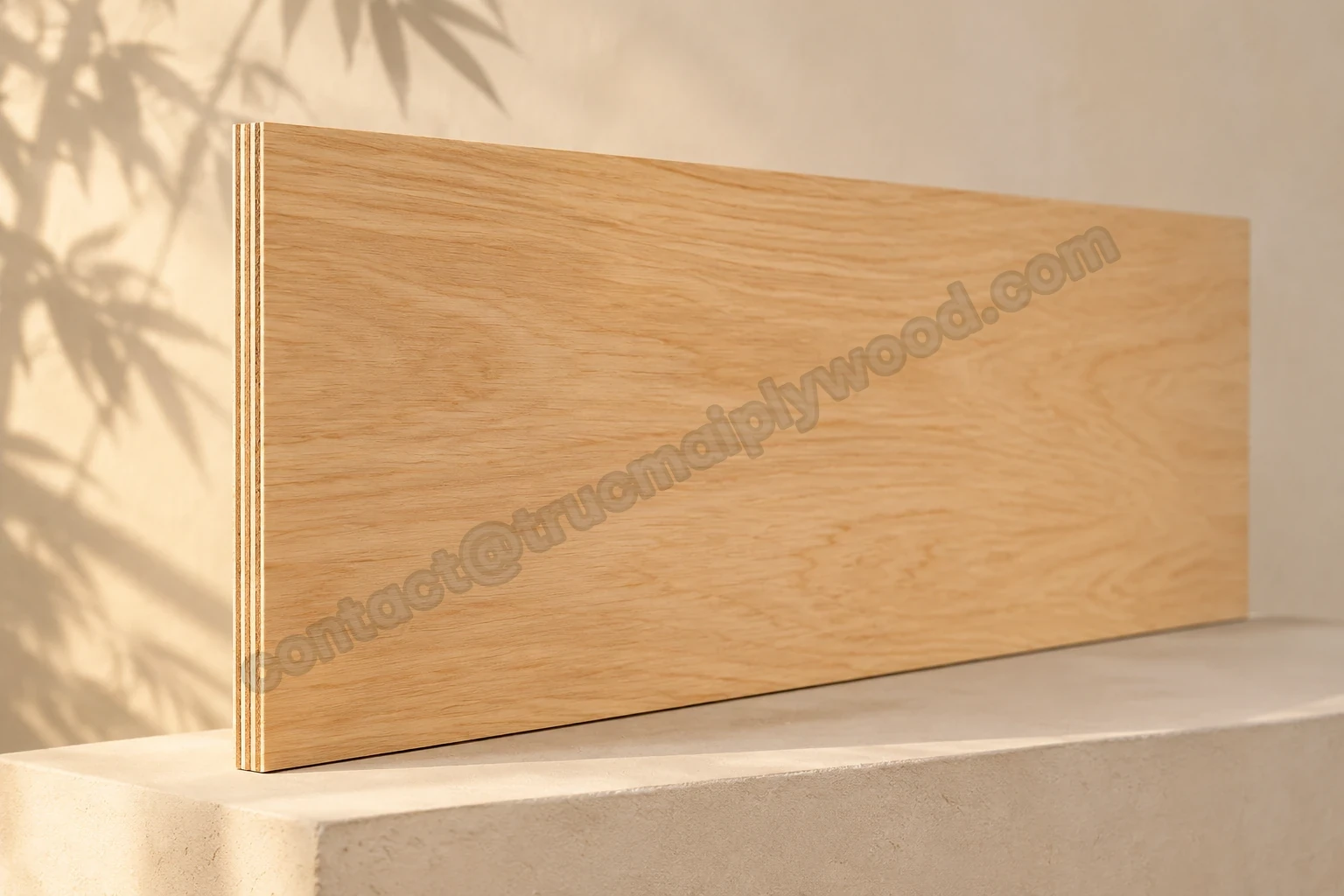
Ask for a sample of the exact build you will order: the same core, ply count, face and back pair, glue and thickness. A pretty face sample on a different core proves nothing about the container. Ask for an edge cut as well, so the core can be judged, and keep one piece unopened as the reference.
At Truc Mai the face grade written on the order is the grade of the approved sample, and the back grade is always quoted with it as a pair. When the first container arrives, the inspector compares the sheets with that sample, not with a description. When a repeat order comes, the same sample is still the reference.
How do you check a Vietnamese mill before paying a deposit?
Check a mill before the deposit by testing its paperwork and its answers against your order line. Ask for certificate numbers you can verify, the build it will quote, its standard terms, the documents it sends with each container and a sample of the exact panel. A mill that answers every line in writing is a mill that can repeat it.
- Certificates: ask for numbers, not logos. Truc Mai’s are FSC-C196493 / SA-COC-014545, CARB/EPA 26053 (mill ICTT-26053, certifier TPC-43), ISO 9001:2015 W2012 and ISO 14001:2015 W2012E.
- Scope: check each certificate’s scope against your product. Truc Mai’s CARB P2 / TSCA certificate covers hardwood plywood with veneer core, 3–25 mm, so 30 and 40 mm panels are outside it.
- Build: ask the mill to confirm core grade, stitching, ply count and tolerance in writing.
- Terms: deposit, balance, production time and delivery terms.
- Documents: the list it sends with each container, and when certificate files arrive.
- Sample: the exact build, with an edge cut.
Truc Mai’s FSC licence is for FSC 100% only; there is no FSC Mix. An importer sees the claim on the invoice and shipping papers, and only for products listed on the current schedule, so it is never automatic for every panel. Ask the mill which of your products carry the claim before you rely on it.
Visiting the mill is the strongest check of all. The planned visiting Ha Hoa page sets out what a buyer can see on site.
Which payment and delivery terms apply?
An importer pays Truc Mai in two parts, a 30% deposit when ordering and the 70% balance once the B/L has been scanned and sent, either by T/T or by irrevocable L/C at sight; delivery is FOB Hai Phong, CFR (CNF) or CIF. The deposit and balance terms page explains how each step protects both sides. The mill quotes those three terms only; destination port charges, import duty and inland delivery stay with the buyer.
| Term | Mill pays | Buyer pays |
|---|---|---|
| FOB Hai Phong | Panels, packing, export clearance, loading on board | Ocean freight, insurance, destination costs, duty |
| CFR (CNF) | As FOB plus ocean freight to the named port | Insurance, destination costs, duty |
| CIF | As CFR plus marine insurance | Destination costs, duty |
An importer with its own forwarder and freight rates usually takes FOB; one that prefers a single delivered price to its port asks for CFR or CIF. The balance against the scanned B/L means the buyer pays once the goods are on board and the documents exist, and the original B/L is released after payment.
L/C at sight adds bank fees and paperwork but protects a first order; T/T is usual once both sides have shipped together. The planned MOQ, payment and FOB page sets out the terms in one place.
How long does production take after the deposit?
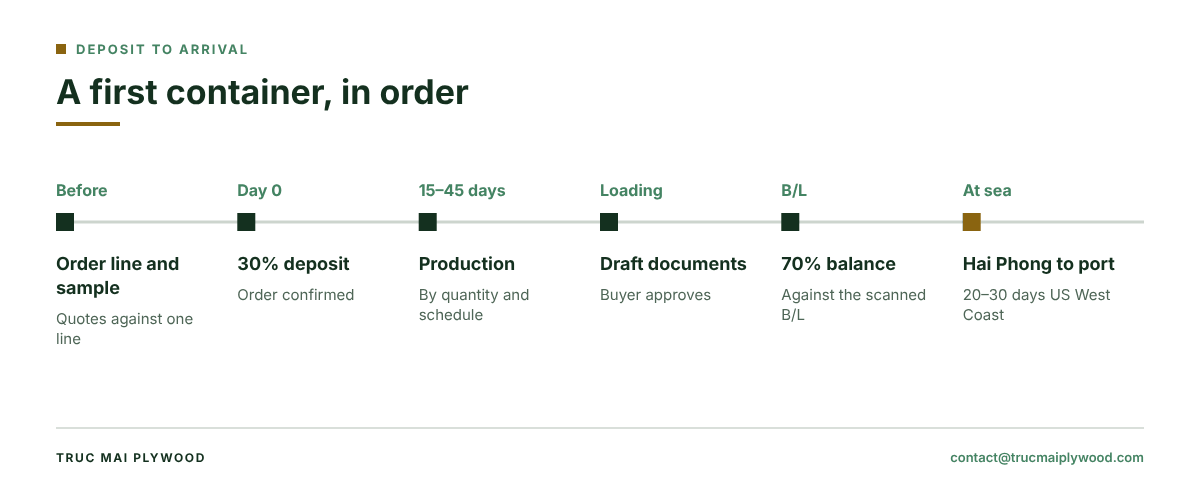
The production window, shown in the table below, starts with the 30% deposit and depends on quantity, production conditions and the agreed schedule. A single-product container of a standard build sits at the short end; a mixed container, a special size or thin panels can take longer, because good thin veneer is scarce and 4 mm panels can need more time.
The timeline of a first order, from approved sample to arrival:
| Stage | Typical time |
|---|---|
| Quotes against the order line, sample approved | Before the order |
| Order confirmed, 30% deposit paid | Day 0 |
| Production | 15–45 days |
| Loading at the mill, draft documents to the buyer | After production |
| 70% balance against the scanned B/L | After loading |
| Sea leg from Hai Phong | By destination, see the sea-leg table |
| Customs clearance and delivery | Destination |
A repeat programme shortens the cycle in practice. The build, the documents and the pack plan are already agreed, so the mill can schedule the next container as soon as the deposit arrives. Monthly buyers often confirm the next order while the previous one is still at sea.
What is loaded in a 40HC, and how is it packed?
A 40HC of plywood is loaded as export packs about 1,000 mm high on pallets, up to 18 packs on Styrax core, 16 on Acacia and 15 on Eucalyptus, under a 28,000 kg cargo payload. For an importer the pack count is a planning number: the pack height divided by the thickness gives a first figure, rounded down, and weight then trims it; the 18 mm loading and spec page works one thickness through in full.
| 1220 × 2440 mm, planning figure | Styrax core | Acacia core | Eucalyptus core |
|---|---|---|---|
| 9 mm | 1,998 sheets, 53.5 m³ | 1,776 sheets, 47.6 m³ | 1,605 sheets, 43.0 m³ |
| 12 mm | 1,494 sheets, 53.4 m³ | 1,328 sheets, 47.4 m³ | 1,200 sheets, 42.9 m³ |
| 15 mm | 1,188 sheets, 53.0 m³ | 1,056 sheets, 47.2 m³ | 960 sheets, 42.9 m³ |
| 18 mm | 990 sheets, 53.0 m³ | 880 sheets, 47.2 m³ | 795 sheets, 42.6 m³ |
Read the table as a budget, not a booking: panels only, container tare left out, and on Eucalyptus the weight limit, not the space, sets the count. What your carrier and route allow is the figure that counts, so book that first. Before the final plan the mill weighs real sheets, and your packing list shows those weights next to the planned sheet count, which is what customs and the forwarder will see.
Solid-wood pallets, battens and dunnage shipped with the panels fall under ISPM 15, while plywood itself is processed wood and sits outside it. Overfilling packs to win sheets breaks pallet feet; the model caps packs by weight for that reason. The full table is in the 40HC load calculator, and the planned loading a 40HC page shows how a load is built.
What documents come with each container?
The shipping set per container is the commercial invoice, the packing list and the bill of lading, a certificate of origin (an EUR.1 when the lot goes to the EU), the phytosanitary and fumigation papers, and the insurance certificate when the term is CIF. The order’s certificate documents travel too: the FSC claim on sales documents, the emission certificate, test reports for the agreed configuration and the EUDR file set for EU lots.
| Document | What it proves | Who uses it |
|---|---|---|
| Commercial invoice | Value, product, terms | Customs, bank |
| Packing list | Packs, sheets, m³, weights | Warehouse, customs |
| Bill of lading | Goods on board, title | Carrier, bank, buyer |
| Certificate of origin, EUR.1 | Vietnamese origin | Customs, preferential duty |
| Phytosanitary and fumigation | Plant health of packing wood | Border inspection |
| Insurance certificate (CIF) | Cargo cover | Buyer, insurer |
| FSC claim on sales documents | FSC 100% chain of custody | Buyer’s own FSC chain |
| Emission certificate | E0, E1 or CARB P2 / TSCA | Regulator, customer |
| EUDR file set | Plot geolocation, core and face | EU operator’s DDS |
Certificate files are sent before the order is confirmed, so the buyer’s compliance team can approve them in advance. Draft shipping documents go to the buyer for approval after loading. The planned papers per container guide covers each document in detail.
What does an EU importer need on file?
An EU importer of plywood needs a due-diligence statement under the EU Deforestation Regulation before the customs declaration, a panel that meets the REACH formaldehyde limit for the articles it goes into, and the usual origin and plant-health papers. Truc Mai supplies with the EU file set: FSC claim where agreed, emission certificate and EUDR data for core and face.
EUDR
For plywood importers the EUDR date is 30 December 2026: it covers large and medium operators, and also micro and small operators that were already under EUTR. Only the remaining micro and small operators get until 30 June 2027; the EUDR dates for panel buyers page tracks each change. The deforestation cut-off date stays 31 December 2020.
Regulation (EU) 2023/1115 asks for the geolocation of every production plot, using at least six decimal digits, and polygons for plots of more than 4 hectares. The EU importer of plywood is the operator and files the due-diligence statement; one statement can cover several shipments, and its reference must exist before the customs declaration. Records are kept five years.
Vietnam is classed low risk. Simplified due diligence applies only when every commodity in the product comes from low-risk countries, so an imported face veneer from another country brings its own origin into the file. A plywood panel has two origins, the core logs and the face veneer, and Truc Mai supplies origin records and GeoJSON files for both. See the planned EUDR geolocation data page.
REACH formaldehyde and packaging
Formaldehyde became entry 77 of REACH Annex XVII through Regulation (EU) 2023/1464. Since 6 August 2026 an importer may not place furniture or wood-based articles on the EU market when they emit more than 0.062 mg/m³ of formaldehyde, tested under the conditions of Appendix 14.
Packaging is a separate file. Since 12 August 2026, Regulation (EU) 2025/40, the Packaging and Packaging Waste Regulation, caps the sum of lead, cadmium, mercury and hexavalent chromium in packaging at 100 mg/kg. Truc Mai holds a PPWR packaging test; it covers the packaging materials, not the panel.
Truc Mai panels are non-structural furniture, interior, commercial and packing plywood, not construction products. The planned EU import steps guide covers customs codes and the order of filings.
What does a US importer need on file?
A US importer of hardwood plywood needs a CARB Phase 2 / TSCA Title VI certified panel with the certificate number on the documents, a plant product declaration for the wood species and country of harvest, and the antidumping and countervailing duty deposit for products in scope. Truc Mai’s certificate is CARB/EPA 26053.
A US importer has to meet 0.05 ppm formaldehyde, the federal limit that 40 CFR 770.10 sets for hardwood plywood with a veneer core. Truc Mai holds that certification in its own name as mill ICTT-26053, issued through ICTT Corporation (third-party certifier TPC-43); the scope is veneer-core hardwood plywood of 3–25 mm with 3–15 plies, under CCR sections 93120–93120.12 and 40 CFR part 770. Panels of 30 and 40 mm are outside that scope.
The plant product declaration under the Lacey Act names the genus and species of each wood in the panel and its country of harvest. A birch-faced panel on Styrax core therefore lists both woods and both origins. The EUDR file set Truc Mai supplies for EU lots holds the same origin facts, which makes the US declaration easier to fill.
The planned US import steps guide covers the entry, the bond and the duty deposit in order.
Is there anti-dumping duty on plywood from Vietnam?
Yes, in the United States. Vietnamese hardwood and decorative plywood falls under both an antidumping and a countervailing duty case there, with a Vietnam-wide antidumping rate of 90.12% and a countervailing all-others rate of 47.68% in Commerce’s final determinations. In the EU there is no anti-dumping duty on plywood made in Vietnam.
Import duty on plywood from Vietnam: United States
For hardwood and decorative plywood from China, Indonesia and Vietnam, the US International Trade Commission voted in the affirmative, which means “Commerce will issue antidumping and countervailing duty orders”. Imports of softwood structural plywood were judged negligible, so those investigations ended.
The customs broker filing the entry will ask for two case numbers: A-552-851, the Commerce final antidumping determination for Vietnam, and C-552-852, the final countervailing duty determination. Both cover hardwood and decorative plywood from the Socialist Republic of Vietnam.
| Case (Vietnamese hardwood and decorative plywood) | Final determination rate |
|---|---|
| Antidumping, Vietnam-wide entity | 90.12%, cash deposit 84.95% |
| Countervailing duty, all others | 47.68% |
Out of scope are structural PS 1 and PS 2 plywood, phenolic film-faced plyform, flooring and ready-to-assemble furniture. The rate that applies to a given exporter and product is set in the order notice; a US buyer reads it before comparing origins and adds the deposit to its landed cost.
Import duty on plywood from Vietnam: European Union
Plywood made in Vietnam carries no EU anti-dumping duty. The duty in Regulation (EU) 2025/2333 targets Chinese hardwood plywood, at 86.8% for most companies and 43.3% for one named exporter, charged on the net free-at-Union-frontier price. Plywood sits under heading 4412 of the Combined Nomenclature, “plywood, veneered panels and similar laminated wood”, and the ordinary customs duty follows the exact CN code; the EUR.1 certificate of origin supports a preferential rate under the EU–Vietnam trade agreement where the goods qualify.
These rates are stated as facts for a landed-cost sheet, not as a reason to choose an origin.
How long is the sea leg from Hai Phong?
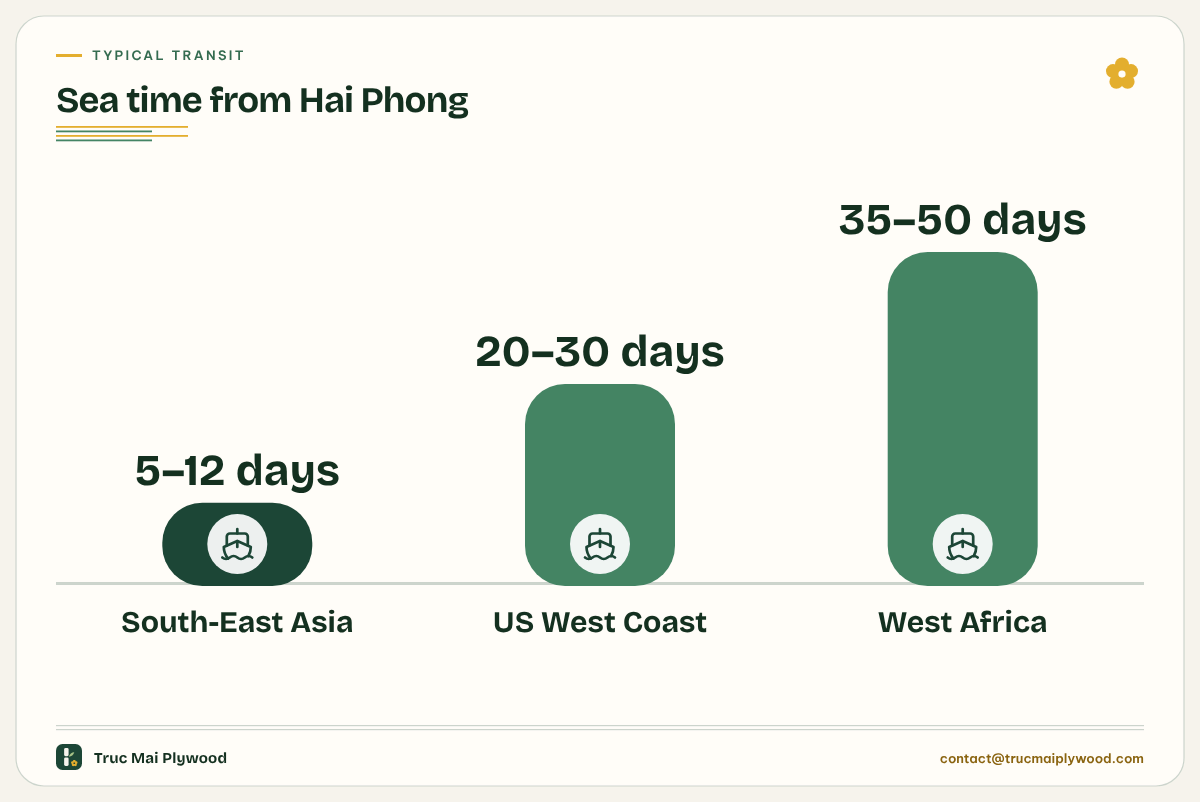
The sea leg from Hai Phong typically takes 5–12 days to South-East Asia, 15–25 days to the Middle East, 20–30 days to the US West Coast, 25–35 days to the Mediterranean, 30–40 days to Northern Europe, 35–45 days to the US East Coast and 35–50 days to West Africa. Carrier and route change those figures.
| Market | Port range from Hai Phong | Days at sea, typical |
|---|---|---|
| Europe | Northern Europe | 30–40 |
| Europe | Mediterranean | 25–35 |
| Africa | West Africa | 35–50 |
| United States | US East Coast | 35–45 |
| United States | US West Coast | 20–30 |
| Asia | Middle East | 15–25 |
| Asia | South-East Asia | 5–12 |
Add the sea leg to the production window to plan the arrival month. A monthly programme to Northern Europe has two or three containers on the water at once, so the buyer’s stock plan, and its cash, should allow for that pipeline. See the planned shipping hub for destination notes.
What does a first container cost to land?
A first container costs the mill price plus freight, insurance, destination port charges, customs entry, import duty, inland haulage and the cost of the cash tied up from deposit to sale. The mill price is fixed by the order line; the other lines are fixed by the term, the destination and the product’s duty status.
| Cost line | Who sets it | Under FOB | Under CIF |
|---|---|---|---|
| Panels, packed and loaded | Mill | Mill price | Mill price |
| Ocean freight | Carrier | Buyer’s contract | In the CIF price |
| Marine insurance | Insurer | Buyer | In the CIF price |
| Destination port and handling | Port, terminal | Buyer | Buyer |
| Customs entry and broker | Broker | Buyer | Buyer |
| Import duty and any AD/CVD deposit | Customs authority | Buyer | Buyer |
| Inland haulage | Haulier | Buyer | Buyer |
| Cash tied up | Buyer’s bank | Deposit to sale | Deposit to sale |
The core choice moves several lines at once. On the planning model, a 40HC carries 990 sheets of 18 mm plywood on Styrax core against 795 on Eucalyptus, so every per-container cost is spread over 24.5% more sheets on Styrax. The how plywood is priced guide works through the arithmetic.
What goes wrong on a first import, and how is it avoided?
Most first-import problems come from an order line that left something open: a missing tolerance, a face grade with no sample, a core not named, glue and emission written as one item, or a certificate assumed to cover a product it does not. Each is avoided by writing the line in full and checking the first container against it.
| What goes wrong | How it is avoided |
|---|---|
| Thickness out of what the CNC line accepts | Write the tolerance, for example ±0.3 mm sanded and calibrated |
| Face “not as expected” | Approve a sample and grade against it |
| Heavier sheets and fewer m³ than planned | Name the core species and grade |
| Wrong emission for the market | Write glue and emission as two lines |
| A certificate that does not cover the product | Check scope: CARB P2 / TSCA 3–25 mm; FSC on the product schedule |
| Broken pallets at the discharge port | Packs capped by weight, never overfilled |
| Customs hold for missing papers | Approve draft documents before the balance |
| EUDR statement filed late | Ask for the file set before the order is confirmed |
Check the first container on arrival before it is unpacked into stock: faces against the sample, thickness at several points, the core on a cut edge and the pack count against the packing list. Photos of what was found, with pack numbers, settle any difference quickly.
How is the same spec held on repeat orders?
The same spec is held on repeat orders by writing the order line once, keeping the approved sample as the grading reference, and using the first container’s packing list as the reference for counts and weights. Every repeat order copies the line and changes only the quantity or a named item.
- Keep the approved sample and a copy of the first order line.
- Copy the line onto every new order without rewording it.
- Change one item at a time, by name: “face changes to birch”, not “same as last time but nicer”.
- Check each container against the line, and send differences with the pack number.
- Review the line once a year with the mill: sizes, packs and documents.
At Truc Mai, face and back grades are quoted as pairs against the approved sample. Each line keeps its build until the importer asks for a change; a furniture line runs on a stitched A-grade core with sanded faces, a commercial line on an AB core. The planned repeat spec control page shows how the order line is held at the mill.
How does a first order become a monthly programme?
A first order becomes a monthly programme when the first container passes its arrival check and the buyer confirms the next one on the same line. From then on the order is a rhythm: one or two 40HC a month, the next deposit sent while the previous container is at sea, and the documents approved in the same way each time.
In an average month the Ha Hoa mill ships around 5,000 m³ of panel, which adds up to about 60,000 m³ over a year. A programme of one or two 40HC a month sits inside that output without changing the build. The planned monthly container programmes page sets out how a standing order is scheduled.
What should the first RFQ say?
The first RFQ should say the use, core, plies, face and back, glue and emission, thickness and tolerance, size, packing, quantity, delivery term and port, and the certificates and file sets the order needs. With all of it written, the reply is a quote for a real panel and the first step of a repeat order.
CIF Northern European port, mixed 1×40HC: 18 mm carcass panels plus 9 mm backs. Files: FSC 100% claim, EUDR set with geolocation for core and face. Carcass build: Styrax core, A-grade, stitched, 11 plies; white poplar EV face, poplar back, paint grade; UF glue, E0 emission; sanded and calibrated. Free sample of this build before the order.
The tolerances, size and pack height for that 18 mm line are spelled out on 18 mm loading and spec; a first RFQ can copy them from there.
A US buyer changes the emission line to CARB P2 / TSCA Title VI, certificate CARB/EPA 26053, and names its port. Send the RFQ to the quotation desk or to contact@trucmaiplywood.com.
Questions buyers ask
What is the minimum order for plywood from Vietnam?
One 40HC at Truc Mai. Most importers load one or two products in it; three to six can share the container when agreed beforehand.
How long does it take to import plywood from Vietnam?
Production takes 15–45 days after the 30% deposit, then the sea leg from Hai Phong takes about 20–30 days to the US West Coast, 30–40 days to Northern Europe and 35–45 days to the US East Coast, varying by carrier and route.
What payment terms apply to Vietnamese plywood?
30% is paid as a deposit when the order is placed; the other 70% follows on the scanned B/L, by T/T or an irrevocable sight L/C.
Which Incoterms does Truc Mai quote?
FOB Hai Phong, CFR (CNF) or CIF. Import duty, destination port charges and inland delivery stay with the buyer.
Are samples free?
Yes, samples cost nothing. A first-time importer books the courier, and that courier cost is credited once a real order follows; the [ordering samples](/resources/ordering-samples/) guide has the steps.
What documents come with a plywood container from Vietnam?
The invoice, packing list and B/L; a certificate of origin, which is an EUR.1 for EU lots; phytosanitary and fumigation papers; insurance when shipped CIF; and whatever certificate documents and EUDR file set the order calls for.
Is there anti-dumping duty on plywood from Vietnam in the US?
For in-scope hardwood and decorative plywood entering the US, yes. In the final determinations Commerce set the antidumping rate for the Vietnam-wide entity at 90.12% (cash deposit 84.95%) and the countervailing rate for all others at 47.68%.
Is there anti-dumping duty on Vietnamese plywood in the EU?
No. Regulation (EU) 2025/2333 sets an anti-dumping duty on Chinese hardwood plywood only; panels made in Vietnam are outside it.
Is Truc Mai Plywood a construction product for the EU?
No. Truc Mai panels are non-structural furniture, interior, commercial and packing plywood; they are supplied with the EU file set: FSC claim where agreed, emission certificate and EUDR data.
When does EUDR apply to plywood importers?
From 30 December 2026 for large and medium operators and for micro and small operators already under EUTR, which includes plywood importers; from 30 June 2027 for other micro and small operators.
Is Vietnamese plywood CARB P2 compliant for the US?
Truc Mai is certified to CARB Phase 2 and TSCA Title VI, certificate CARB/EPA 26053, for hardwood plywood with veneer core from 3–25 mm.
Can I mix thicknesses in one container?
Yes. Three to six products can share one 40HC by agreement, for example 18 mm carcass panels with 9 mm backs.
How is the same specification kept on repeat orders?
The order line is written once, the approved face sample stays the grading reference, and the first container's packing list becomes the reference for counts and weights.