
Resources · inside the mill
How plywood is made guides: from peeled veneer to a loaded 40HC container
How plywood is made guides begin at the lathe: plywood is made by peeling logs into veneer, drying it, laying core plies across each other, gluing and hot pressing the stack at 110–120 °C for UF glue, then sanding, trimming and packing. At Truc Mai an 18 mm furniture panel usually has 11 plies, built on 1.4–2.0 mm core veneer, and every step changes the spec the buyer receives.
Truc Mai makes about 60,000 m³ a year in Ha Hoa, Phu Tho, where plantation forest nearby supplies core wood at low cost. This hub follows a panel through the mill and shows the numbers that decide quality and lead time. The photographs on this page are of faces and veneer; process illustrations are labelled as illustrations.
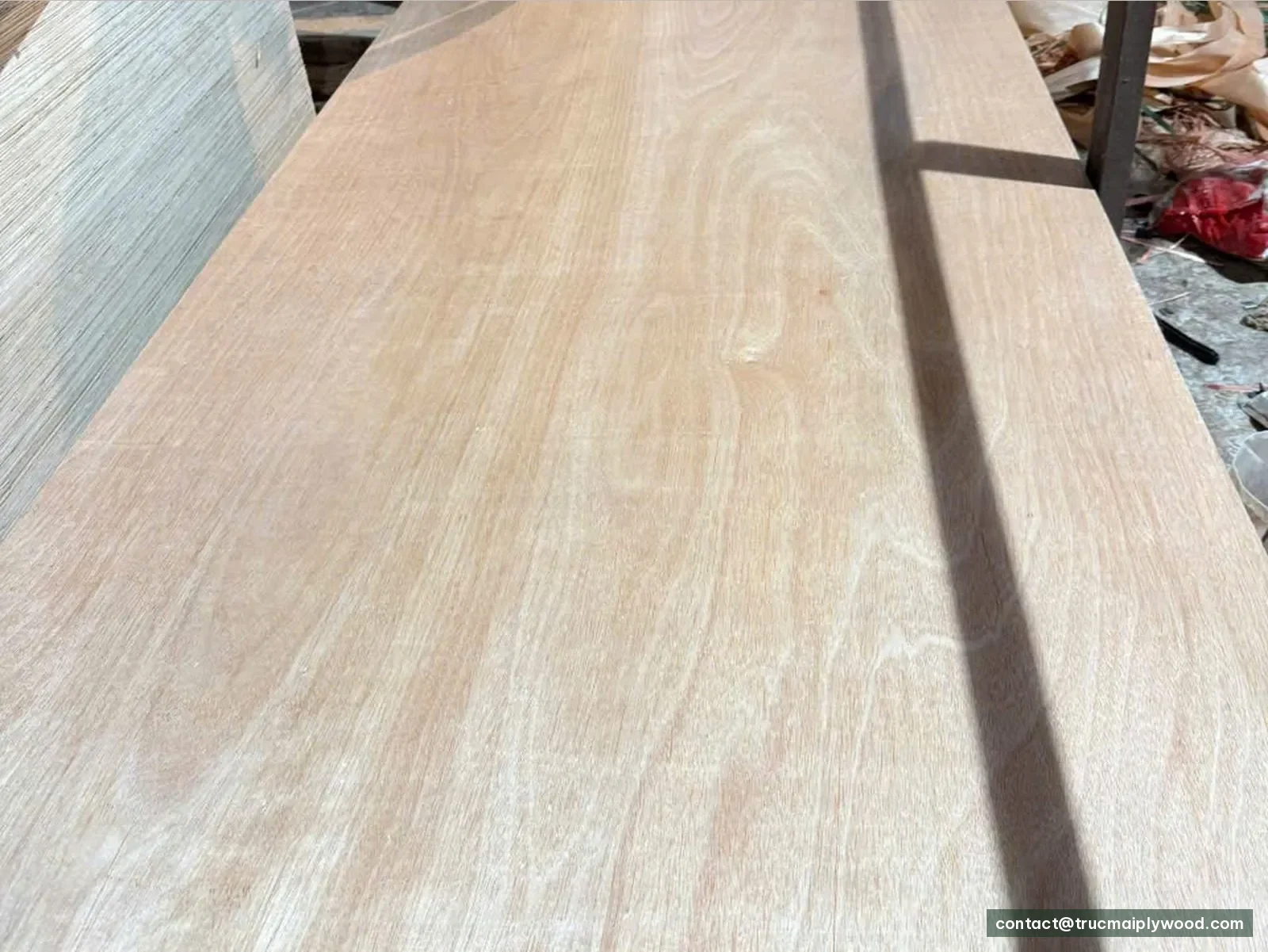
- 60,000 m³plywood a year, about 5,000 m³ in an average month
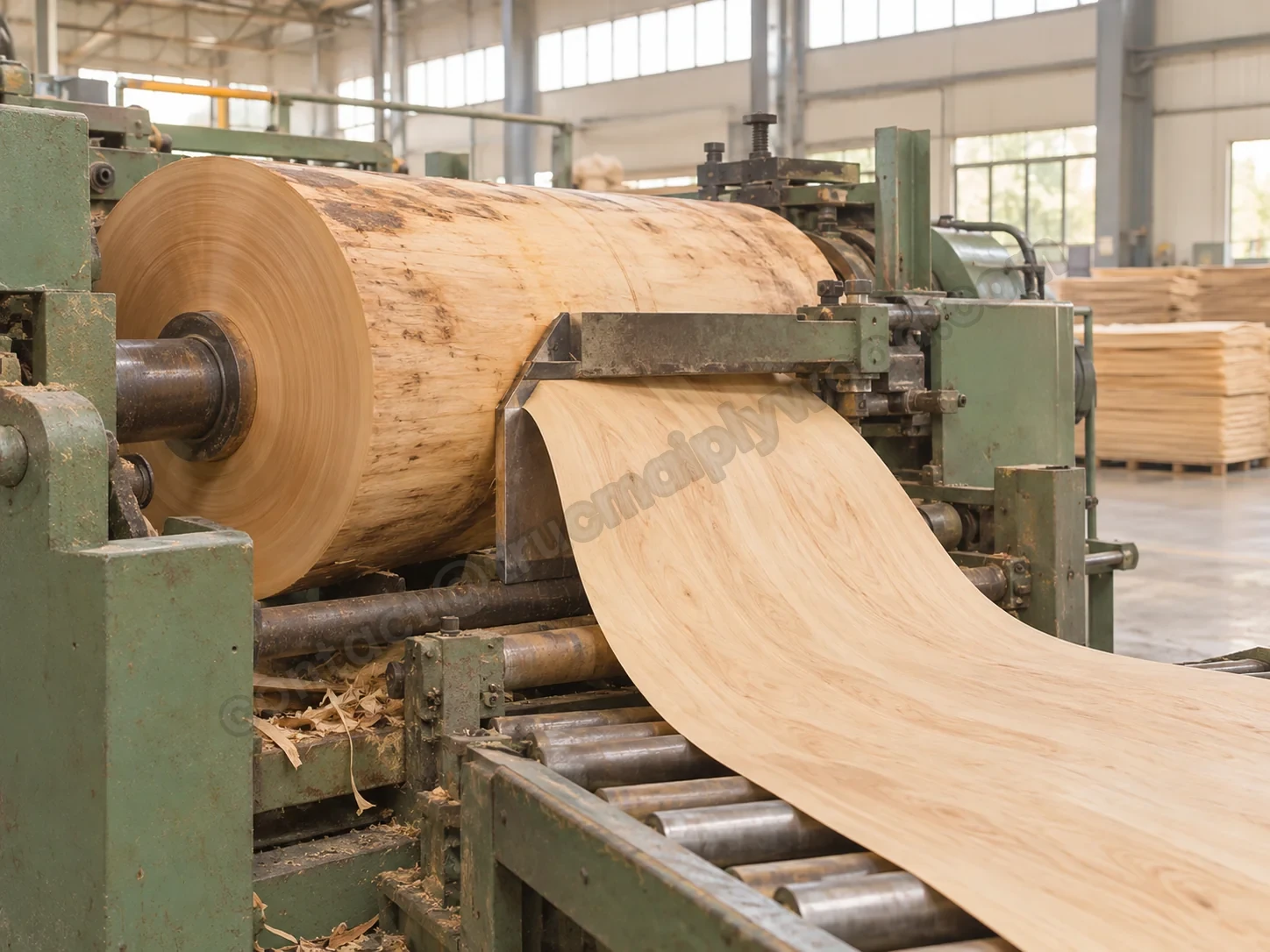
- 1.4–2.0 mmcore veneer; face veneer 0.2–0.5 mm
- 110–120 °Chot press for UF glue; WBP 130–145 °C
- 11 plies18 mm panel, the usual build
Process illustrations show the method in general; they are not pictures of a specific order.
Answer and key facts
How plywood is made guides: how is plywood made step by step?
Eight steps turn a log into a sealed container: peel, dry, grade and clip, lay up and stitch, glue, hot press, sand and calibrate, then trim, pack and load. The glue and the press fix strength, the lay-up fixes flatness, and the sanding fixes the thickness the buyer measures.
A buyer does not need every machine setting. They need to know which steps make the specification: core veneer thickness, ply count, glue and emission, sanding allowance and the packing plan. Each of those is a line on the order.
Press and glue figures here are the mill's own; the rules they are measured against come from the US EPA, the California Air Resources Board, FSC International and, for EU lots, Regulation (EU) 2023/1115 on EUR-Lex.
| Step | What happens | Number that matters |
|---|---|---|
| Peeling | Logs turn against a knife and a continuous veneer ribbon comes off the lathe | Core veneer usually 1.4–2.0 mm; face veneer 0.2–0.5 mm |
| Drying and grading | Veneer is dried to a stable moisture content and sorted | Moisture is checked with a meter on the core veneer |
| Lay-up and stitching | Plies are laid with grain crossing; the outer plies are stitched | Stitched across and along; usually outer 2–4 plies, all plies on request |
| Gluing | Glue is spread between plies | UF glue at E0 emission by default |
| Hot press | Heat and pressure cure the glue | About 110–120 °C for MR and UF glue; 130–145 °C for WBP |
| Sanding | Faces are sanded and calibrated | Tolerance ±0.3–0.5 mm per order |
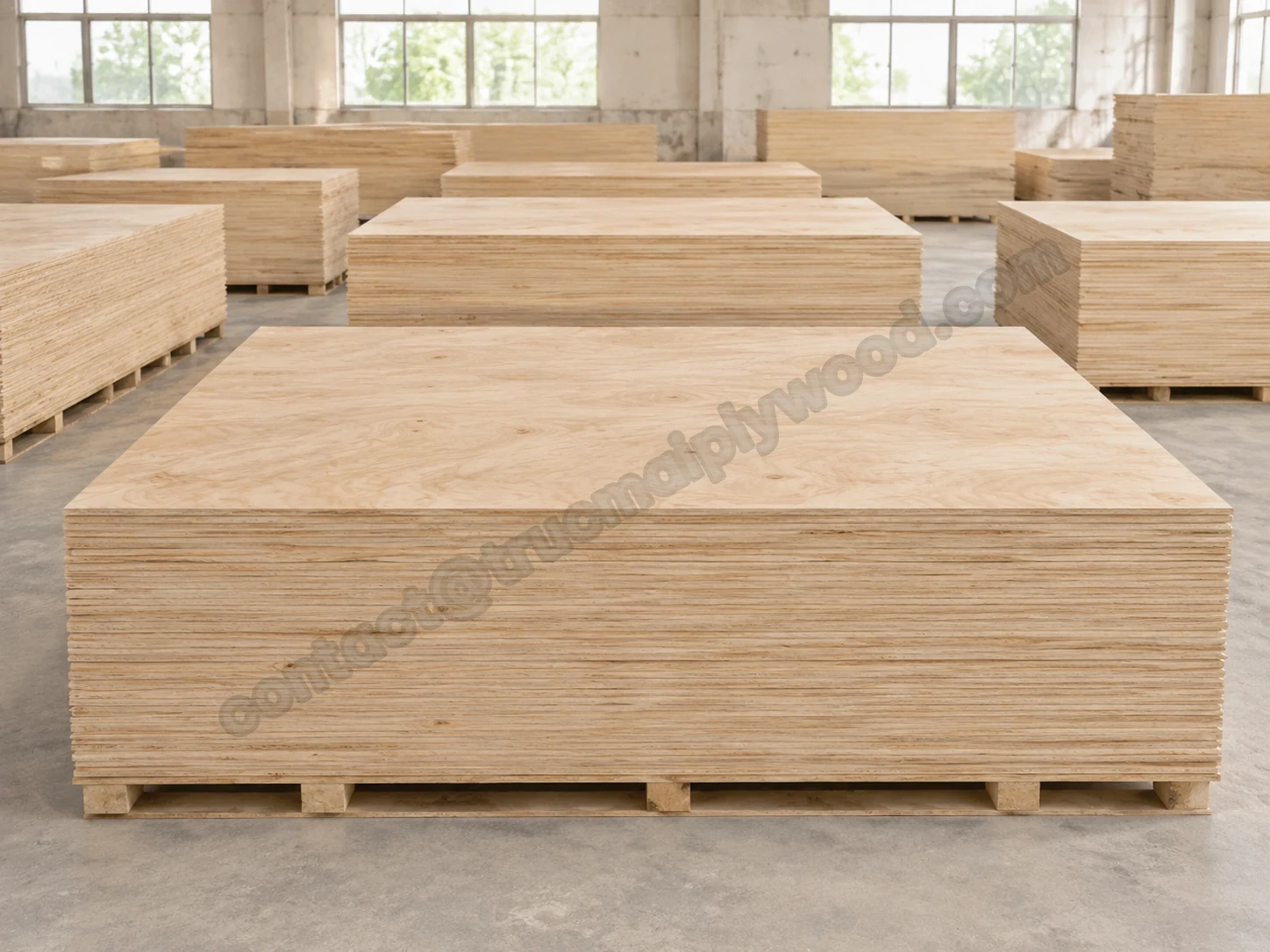
| Trim, pack, load | Sheets are cut to size and packed in 1,000 mm packs | At most 18 packs of Styrax core in a 40HC |
Veneer and core
Plywood manufacturing process step by step: core veneer thickness and plies
Core veneer is usually 1.4–2.0 mm, and an 18 mm panel is built from it with a face and back of 0.2–0.5 mm. That is usually 11 plies, and 12 or 13 on order. A 4 mm panel uses 1.3 mm core veneer in three core plies.
Thin veneer is the scarce input. Good veneer at 1.3 mm is harder to peel and dry flat, which is why 4 mm panels can take longer than 18 mm panels inside the usual 15–45 days after the deposit. The mill clips defects, patches or rejects veneer before lay-up, and the grade of the core ply, A-grade for furniture and AB for commercial and packing, is set by the product line.
Lay-up and press
What core stitching does and at what temperature UF-glued plywood is pressed
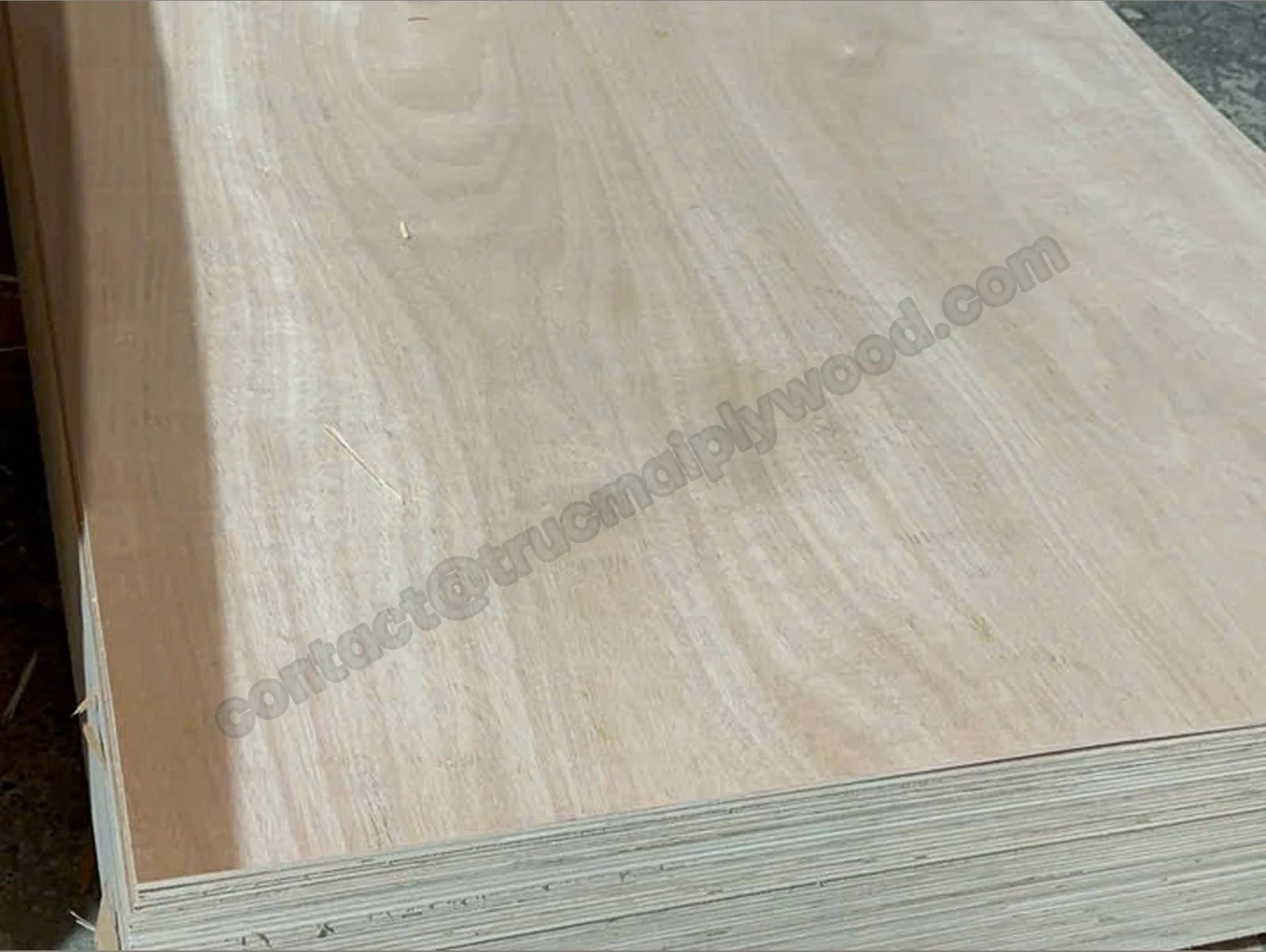
Core stitching holds the narrow core veneers together across and along the sheet so they do not open up before pressing. It runs across and along, usually on the outer two to four plies, and on all plies on request. UF-glued plywood is pressed at about 110–120 °C.
Furniture and interior panels use an A-grade, stitched core and sanded faces. Commercial panels use an AB core, loose-laid or jointed, unsanded or lightly sanded. Packing panels use an AB loose-laid core, usually at E2 emission. The press temperature rises to 130–145 °C when the glue is WBP, which is the melamine-fortified route for damp rooms.
The press is also where a good panel is made flat: even glue spread, even pressure and a balanced lay-up, one reason core species and ply count are written on the order.
Checks
Which mill steps a buyer can check on arrival
Four of the steps leave a mark a buyer can measure on a sample or on an arrival sheet: thickness, ply count, flatness and the face. Each one traces back to a step above and to a line on the order.
Thickness comes from sanding and calibration and is checked with a caliper against the tolerance written on the order. The ply count and the glue lines show on the cut edge: eleven thin layers of near-equal thickness at 18 mm, with thin, even glue lines and no gaps. Flatness reflects lay-up and pressing: a sheet laid on a flat surface should not rock, and a straight edge laid across it should show no gap. The face is checked against the approved sample for colour band, knots and patches.
None of these checks needs a laboratory. They are the same four checks the mill runs, and the repeat spec control page lists them in the order a receiving warehouse can run them.
Location
Why the mill sits in Ha Hoa, Phu Tho
Plantation forest near Ha Hoa supplies core wood at low cost, and skilled labour costs less than in other regions, so mills there can price the same quality lower. That is the structural reason for the price of a Truc Mai container.
The output is about 60,000 m³ a year, and about 5,000 m³ in an average month, which fits monthly container buyers: one or two products each month sit comfortably in a regular slot. The last step, sanding and calibration, fixes the thickness a buyer measures with a caliper, ±0.3 mm on calibrated furniture panels and ±0.5 mm on commercial ones.
Related pages
Inside-the-mill guides
Process pages and guides that follow each step in detail.
- Calibrated plywood at ±0.3 mm: sanding to a written thickness
Calibration is a sanding step held to a tolerance written per order: ±0.3 mm on sanded, calibrated furniture panels, ±0.5 mm on commercial and ±0.5–1.0 mm on packing.
- Ha Hoa, Phu Tho: the northern plywood cluster explained
Why Phu Tho has plantation logs, peeling yards and large mills, seen from a mill based there.
This page follows one 18 mm furniture panel through the Ha Hoa mill: Styrax or Eucalyptus core veneer at 1.4–2.0 mm, a stitched core, UF glue at E0 emission pressed at.
- Stitched or whole-piece core veneer: how cores are jointed
What core stitching does to flatness and voids and how to write the core quality on a commercial order.
Checks follow the build each line promises: A-grade stitched core and sanded faces for furniture, AB loose-laid core for commercial, thickness measured against the.
Output, lines and certificates.
Packs, weighing and sealing.
Arrival checks and the reference sample.
Why 4 mm veneer is scarce.
FAQ
Questions about how plywood is made
How is plywood made step by step at a Vietnamese mill?
Logs are peeled into veneer, dried and graded, laid up with crossing grain and stitched, glued, hot pressed, sanded and calibrated, then trimmed, packed and loaded. At Truc Mai UF glue at E0 emission is the default and the press runs at about 110–120 °C.
How many plies does an 18 mm furniture panel have?
Usually 11, with 12 or 13 on order. Thin panels of 3, 4 and 5 mm have five plies. Eleven thin layers of near-equal thickness is what the edge of an 18 mm sample should show.
What core veneer thickness goes into a panel?
Usually 1.4–2.0 mm. A 4 mm panel uses 1.3 mm core veneer in three core plies. Face veneer is 0.2–0.5 mm, usually 0.3 mm for Europe.
At what temperature is UF-glued plywood pressed?
About 110–120 °C for MR and UF glue. WBP glue is pressed hotter, at 130–145 °C.
What does core stitching do and how many plies are stitched?
Stitching holds the narrow core veneers together, across and along the sheet, so they stay in place until the press. Usually the outer 2–4 plies are stitched, and all plies on request.
Why can 4 mm panels take longer to produce?
Good thin veneer is scarce and the 4 mm panel uses 1.3 mm core veneer, so supply of suitable veneer limits the run. The delay sits inside the 15–45 days after the deposit and is planned when the 4 mm line is stated in the quote.
Quotation
Ask how your specification would be built
Send core, thickness, glue, face and sheet size; the reply states the build, ply count and tolerance.
State the product, thickness, core, glue and emission class, face and back grade, tolerance and quantity. The reply states plies, tolerance and the planning load per 40HC.