
Quality · batch checks
Plywood quality control on every batch: the checks from core veneer to the loaded container
Plywood quality control at Truc Mai follows the build each line promises, and every check is measured against the written order. Core veneer is sorted before pressing, thickness is held to the ±0.3–0.5 mm on the order, and the UF glue at E0 emission is boil-tested. The face is matched to the approved sample, and real sheets are weighed before loading.
This page is for the buyer who reorders the same panel every month and needs container ten to match container one. It walks one batch through the mill in Ha Hoa, Phu Tho, shows what is measured at each stop and what the buyer can measure again on arrival. The certificates behind the system are on quality and compliance; the full production route is on how our plywood is made.
- ±0.3 mmthickness tolerance on sanded, calibrated furniture panels
- ~6 hoursboil resistance of UF glue at E0 emission; melamine-fortified glue twelve
- 2–4 pliesouter core plies stitched on furniture panels, all plies on request
- 28,000 kgplanning payload checked against weighed sheets before loading
Every tolerance on this page is the one written on the order; a buyer can ask for the tighter furniture tolerance on any sanded line.
Certificates
Which certificates frame the batch checks?
FSC, CARB P2, ISO 9001 and ISO 14001, plus EU file sets.
- FSC 100% FSC-C196493 · SA-COC-014545
- CARB P2 and TSCA Title VI CARB/EPA 26053 · TPC-43
- ISO 9001:2015 W2012 · WCERT
- ISO 14001:2015 W2012E · WCERT
The check table
What is plywood quality control on a batch, and where does each check happen?
Plywood quality control is the set of measured checks that tie each sheet in a batch to the lines written on its order. At Truc Mai a batch passes six stations; each one either releases the sheets or sends them back one step.
Each station has one owner and one record. A sheet that fails is not argued over at the end of the line; it is pulled at the station where the fault is cheapest to fix, which is why most corrections happen before the press, not after it.
| Station | What is checked | Tool or record | Measured against |
|---|---|---|---|
| Core veneer intake | Splits, holes, overlaps, dryness, thickness of the core sheets | Visual sort, hand meter, caliper | Core grade on the order (A or AB) |
| Lay-up and stitching | Ply count, grain direction, joints, stitching of the outer plies | Lay-up sheet per press load | Build on the order |
| Hot press | Glue spread, temperature, press time; boil sample | Press log, boil test record | Glue type and emission class on the order |
| Sanding and calibration | Thickness at several points, flatness | Caliper, straightedge | Tolerance on the order |
| Face grading | Face and back against the approved sample | Sample board, grade tag | Face pair on the order |
| Packing and loading | Sheets per pack, pack height, weight of real sheets | Pack list, scale | Pack plan and planning payload |
By product line
How do the batch checks differ between furniture, commercial and packing plywood?
The same six stations run on every line, but the pass mark moves with the build the line promises. Furniture panels are checked hardest on the face and thickness; packing panels on bond and count.
LVL is checked on different defects and has its own page, LVL checks. Thin furniture sheets of 3–5 mm are always five plies, so a missing or doubled cross-band shows at once in the ply count at the edge.
On packing-grade panels a buyer pays for a sound bond and the right count, not for a face, so the face is not graded against a sample; length and width are still held to ±2 mm, because a short sheet stops a crate line.
| Line | Default build | Thickness tolerance | Check that decides release |
|---|---|---|---|
| Furniture and interior | A-grade core, stitched, sanded faces | ±0.3 mm sanded and calibrated | Face against the sample; thickness at every measuring point |
| Commercial | AB core, loose-laid or jointed, unsanded or lightly sanded | ±0.5 mm | Core gaps at the edge; bond in the boil sample |
| Packing grade | AB loose-laid core, usually E2 emission | ±0.5–1.0 mm | Sheet count per pack; bond |
| Non-structural LVL | All veneers parallel, for parts, door and frame stock, bed slats | Per order | Straightness and glue lines along the length |
Step by step
How is one batch checked from core veneer to the sealed container?
Six steps, in the order the sheets meet them. Each step names what is measured, the number it is held to and the check list the station works from.
- Check core veneer before pressing
Core veneer of 1.4–2.0 mm is sorted sheet by sheet: open splits, holes and overlapping edges go to the patching table or to a lower core grade. Sheets are checked for dryness before the glue spreader, because wet core is the main cause of blisters after pressing. For 4 mm panels the core is 1.3 mm and good thin veneer is scarce, so this sort is slower. Check list: no open split wider than the core grade allows, no overlap, dry to the touch and to the meter, even thickness across the sheet.
- Lay up and stitch the core
The lay-up sheet for each press load states the ply count and the core grade. On furniture panels the outer two to four plies are stitched across and along the sheet, and all plies when the order asks for it, so the core cannot shift under the press. Check list: ply count against the order, grain direction alternating, joints tight, stitching on the plies the order names.
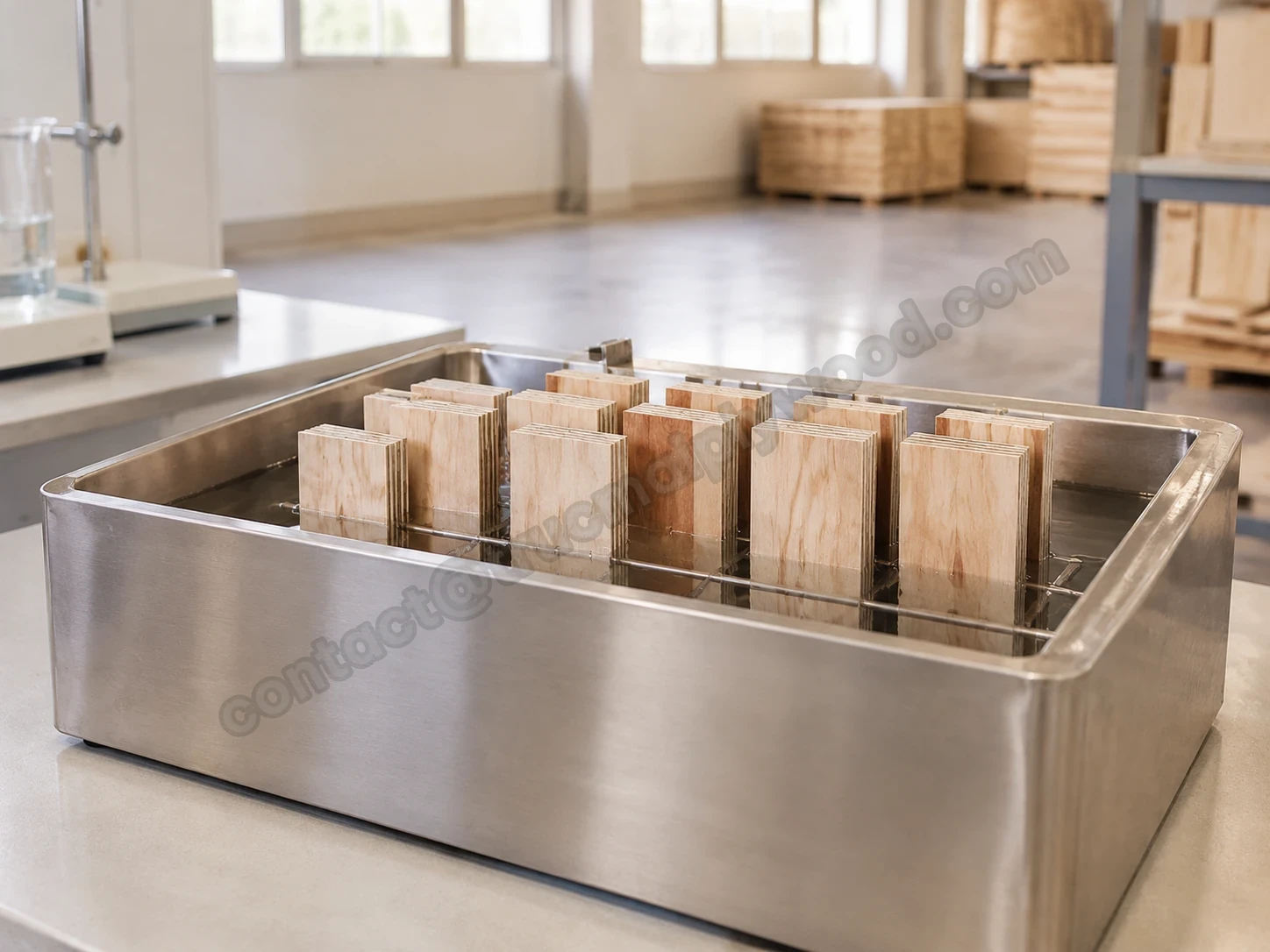
- Plywood boil test of the glue line
UF glue at E0 emission is pressed at about 110–120 °C. A sample cut from the batch is boiled: UF glue holds about six hours, melamine-fortified glue about twelve. A glue line that opens before its time stops the batch until the press log is checked. Check list: spread weight on the press log, platen temperature, press time, boil result recorded against the batch.
- Plywood thickness tolerance check after sanding
Furniture panels are sanded and calibrated and measured with a caliper at several points across each checked sheet, against ±0.3 mm. Commercial panels are held to ±0.5 mm and packing grade to ±0.5–1.0 mm. Length and width are held to ±2 mm, and flatness is checked with a straightedge across the diagonal. Check list: every point inside the tolerance, no thin corner, no step at the sanding edge, sheet lies flat.
- Grade the face against the approved sample
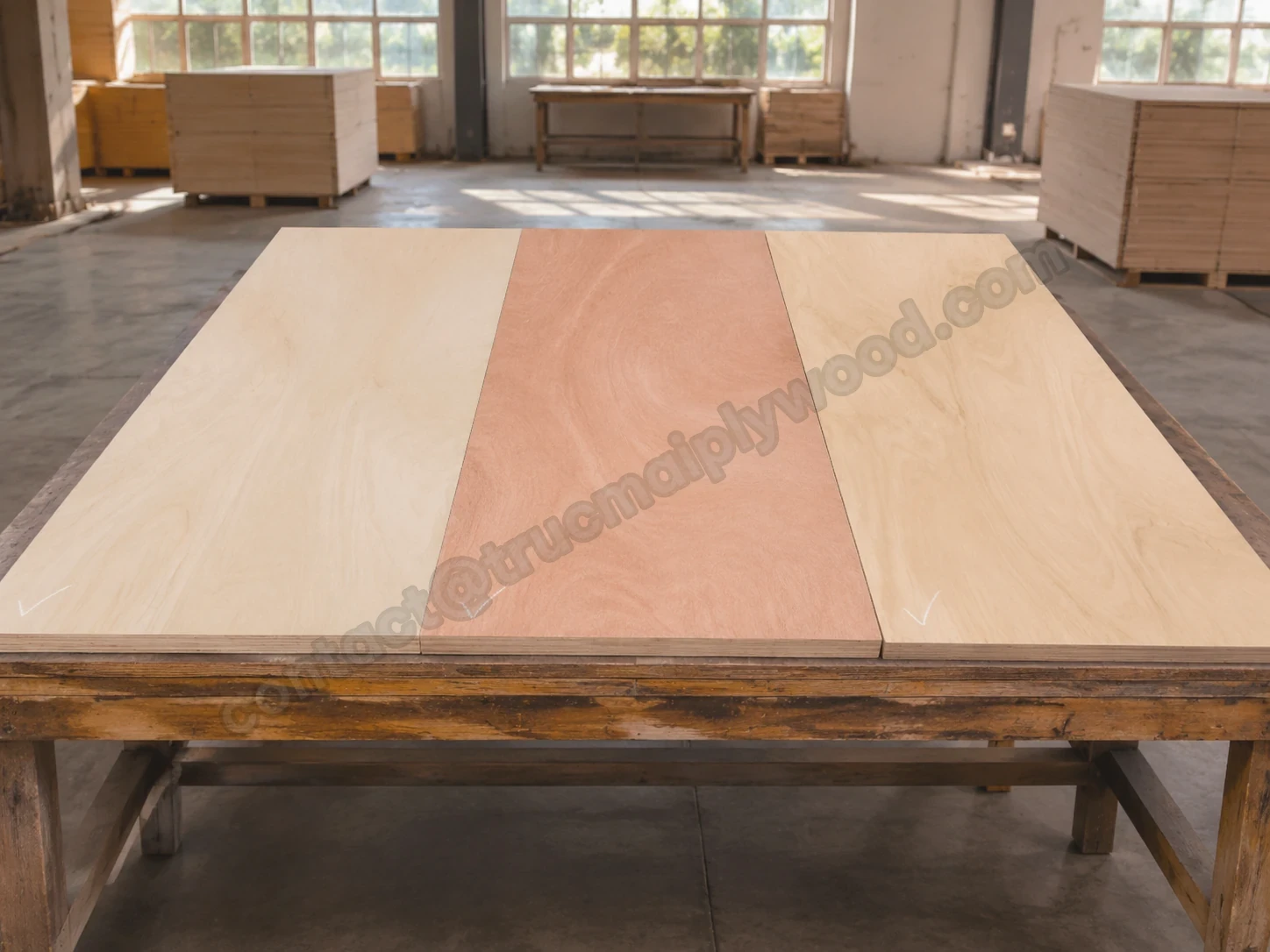
On the face grading line each face and back is laid next to the sample the buyer approved. Colour band, knots, patches and joints are compared, and a sheet that does not match is moved down a grade before it reaches a pack. Check list: face and back match the agreed pair, no open defect on the face side, colour inside the sample's band.
- Weigh real sheets, then load
Packs are built about 1,000 mm high, sheets per pack set by thickness and capped by weight. Before final loading, real sheets are weighed, because a Eucalyptus core measured at 650–750 kg/m³ can be heavier than the planning density. The pack plan is then checked against the planning payload of 28,000 kg, and the loading is shown step by step on loading a 40HC. Check list: sheets per pack, pack height, sheet weight, pack count against the packing list.
What the checks look at
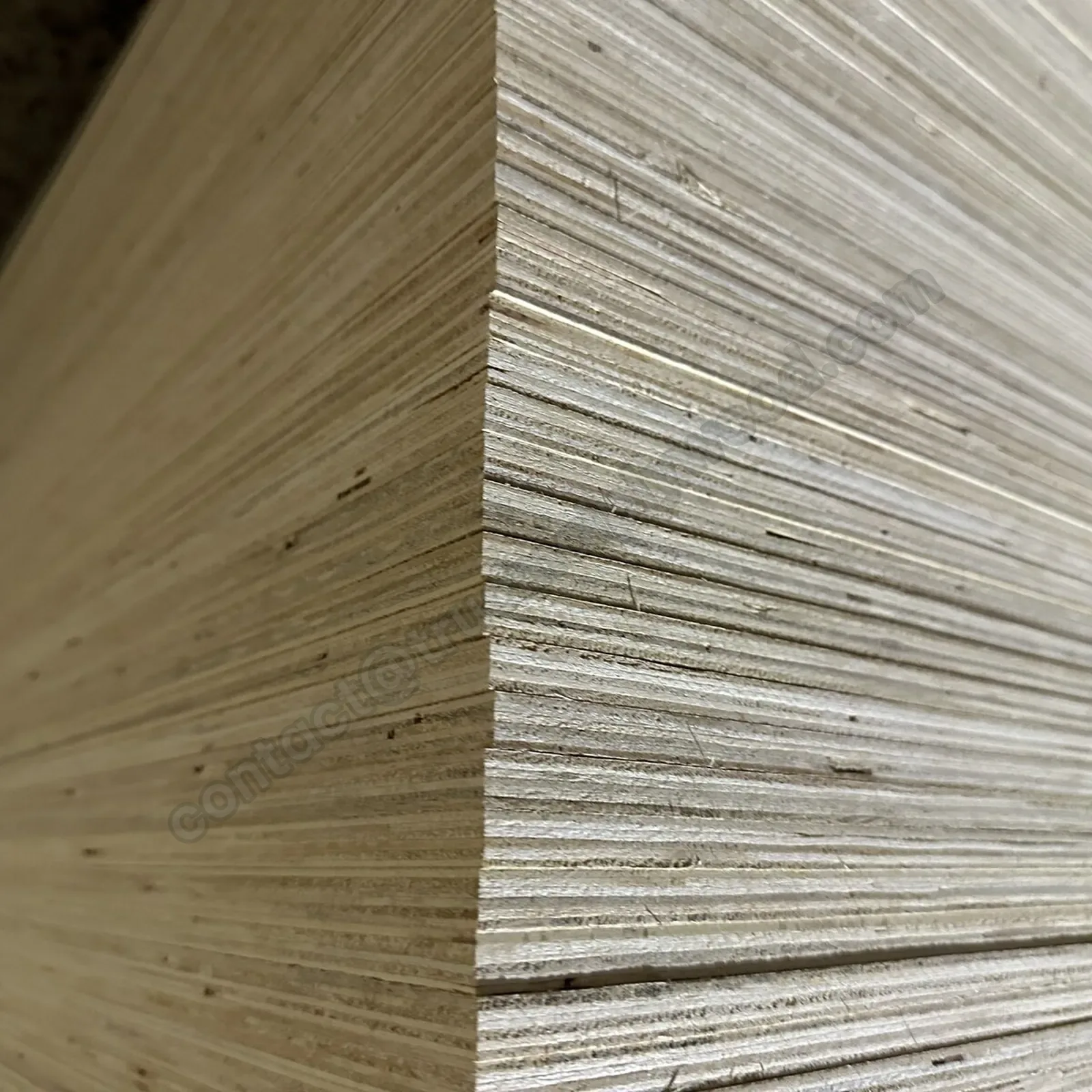
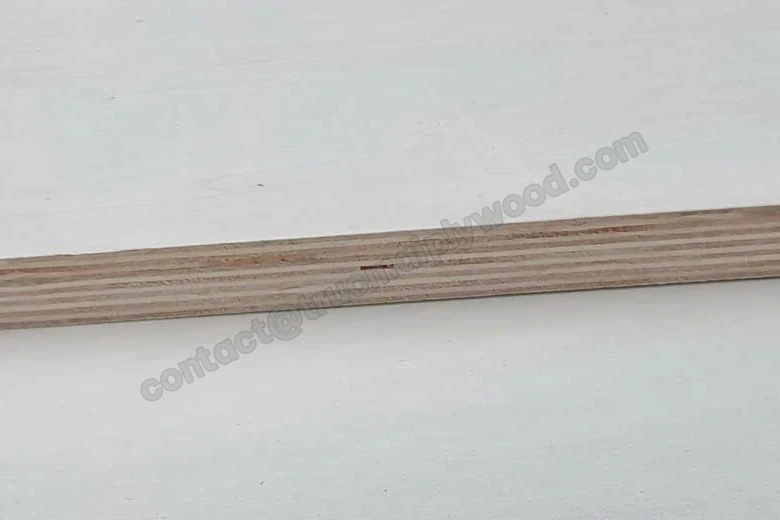
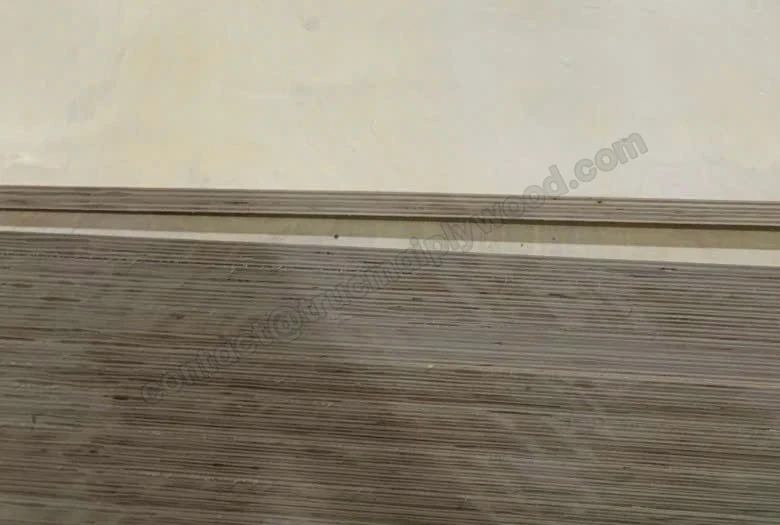
What does a passed batch look like at the edge?
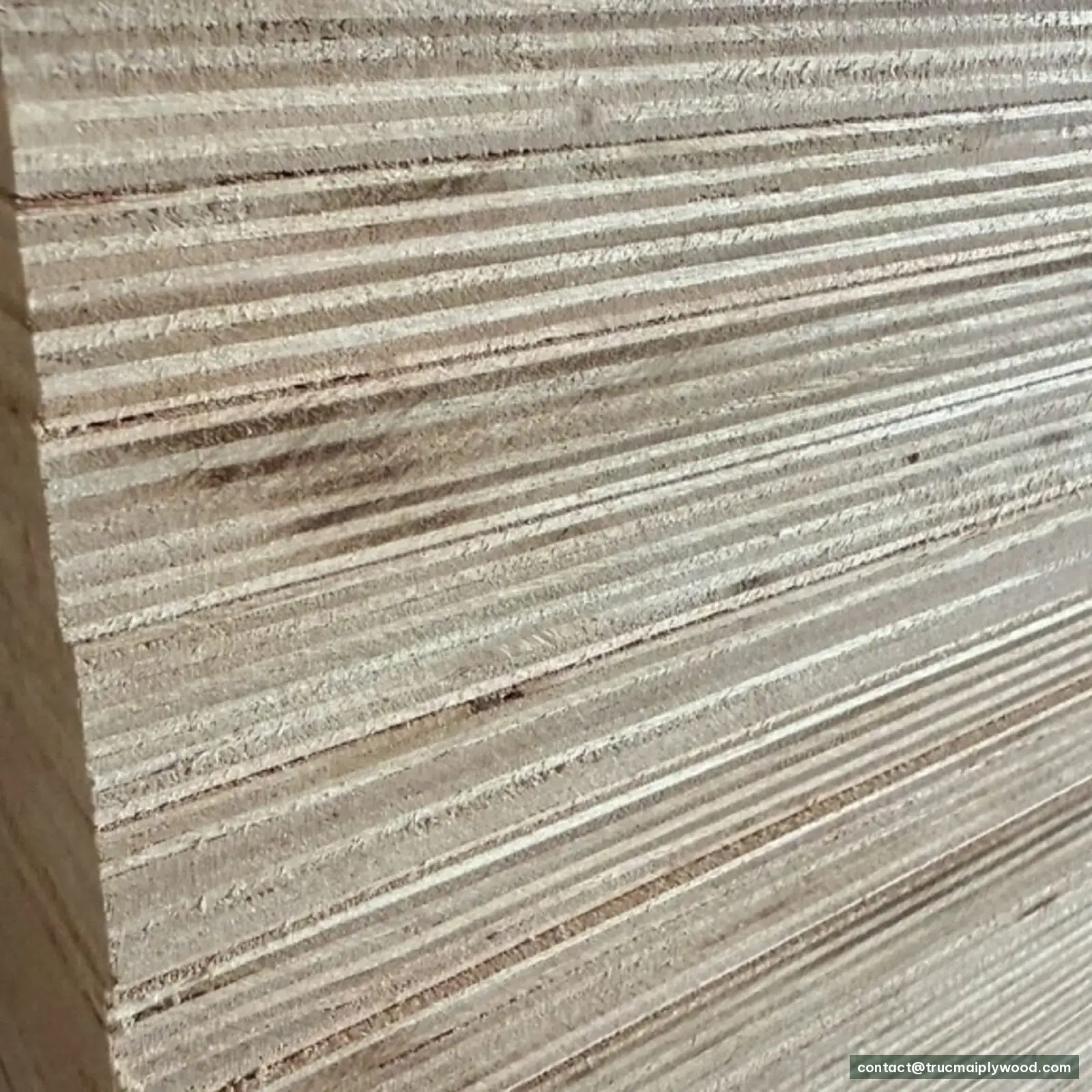
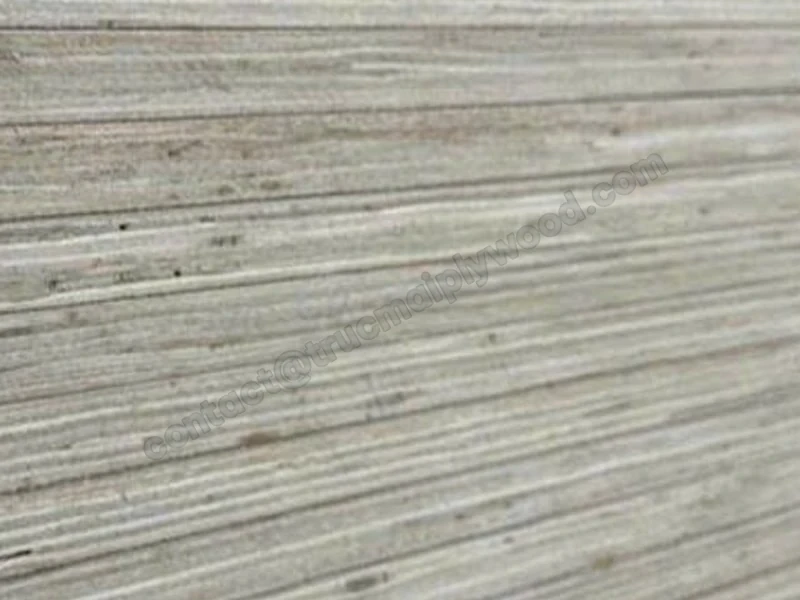
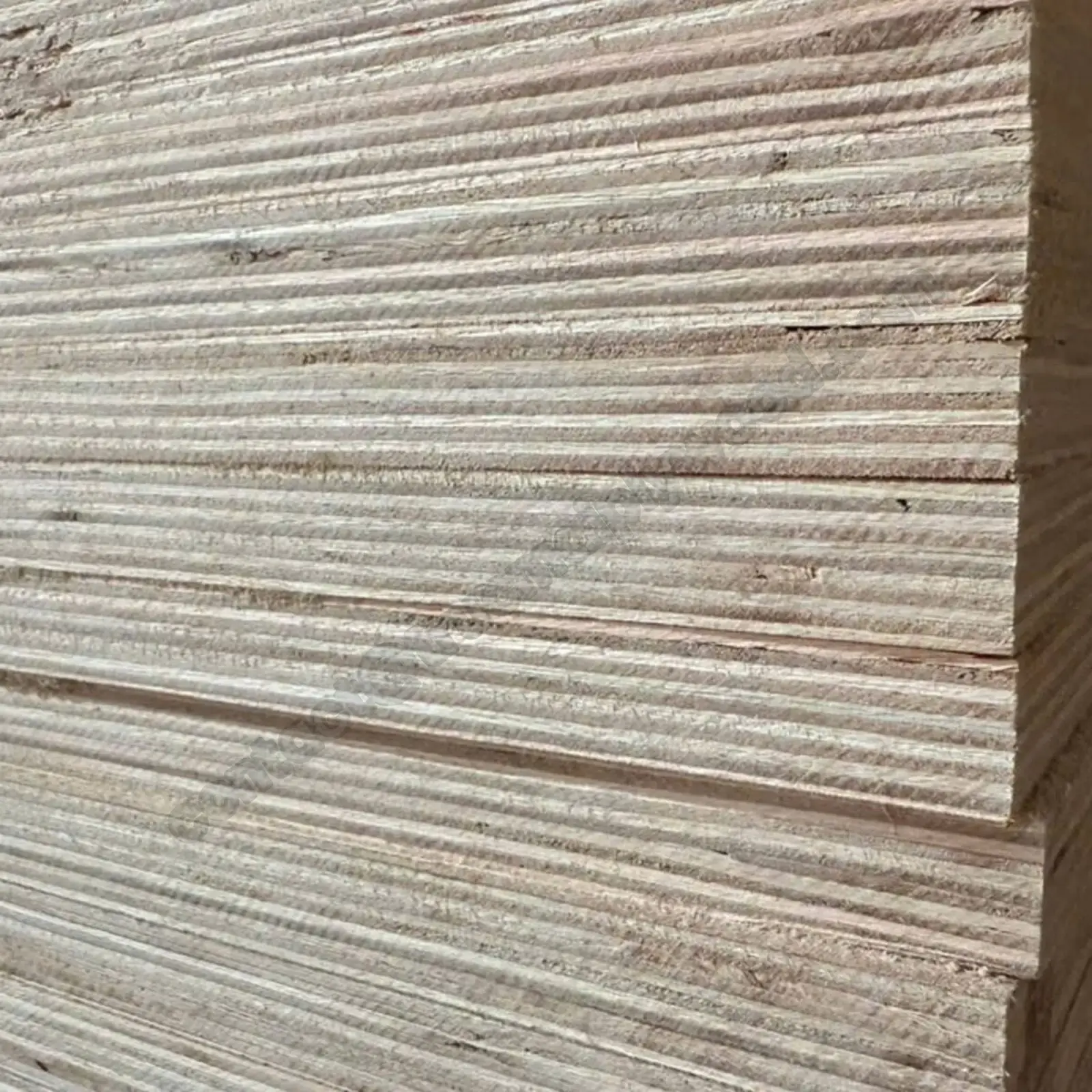
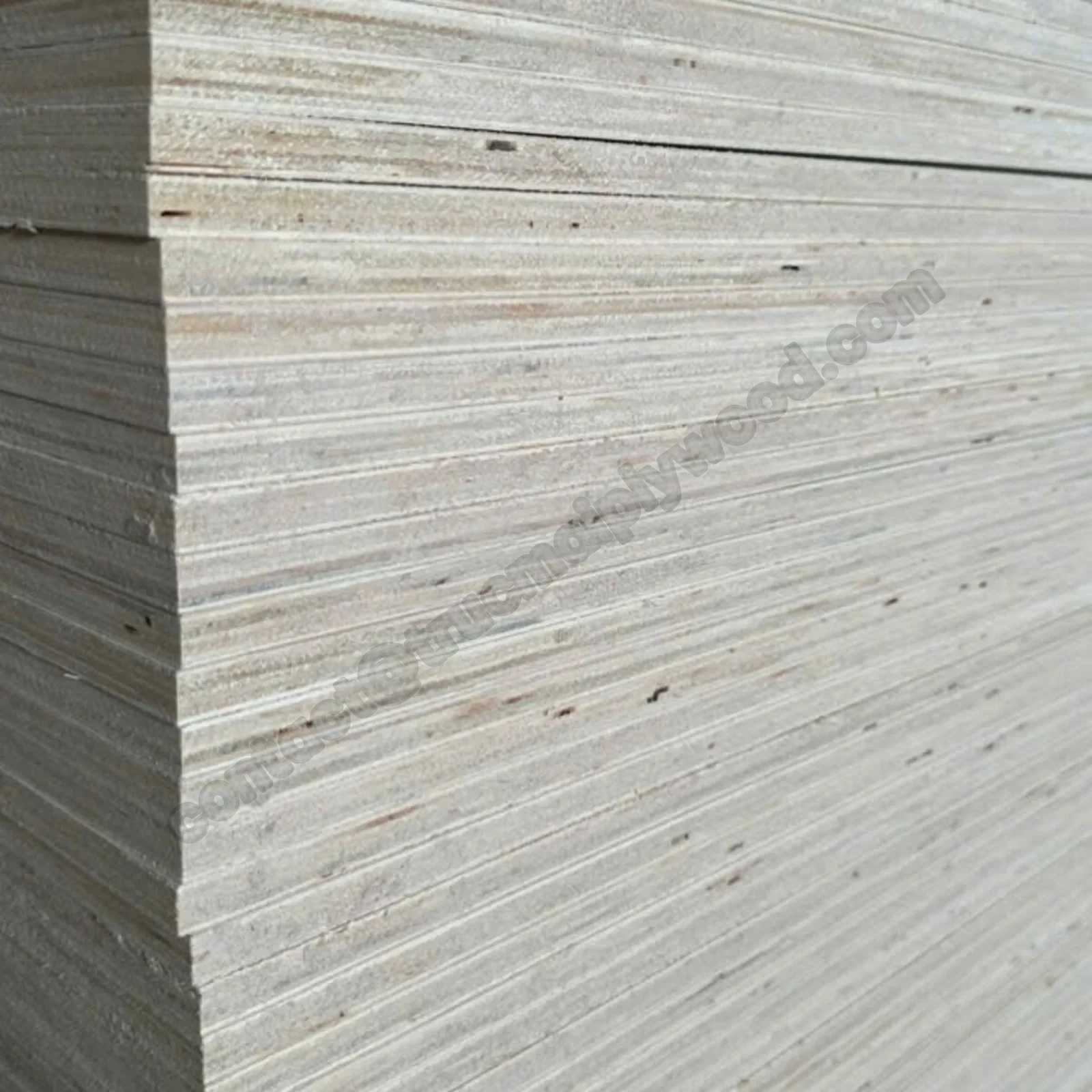
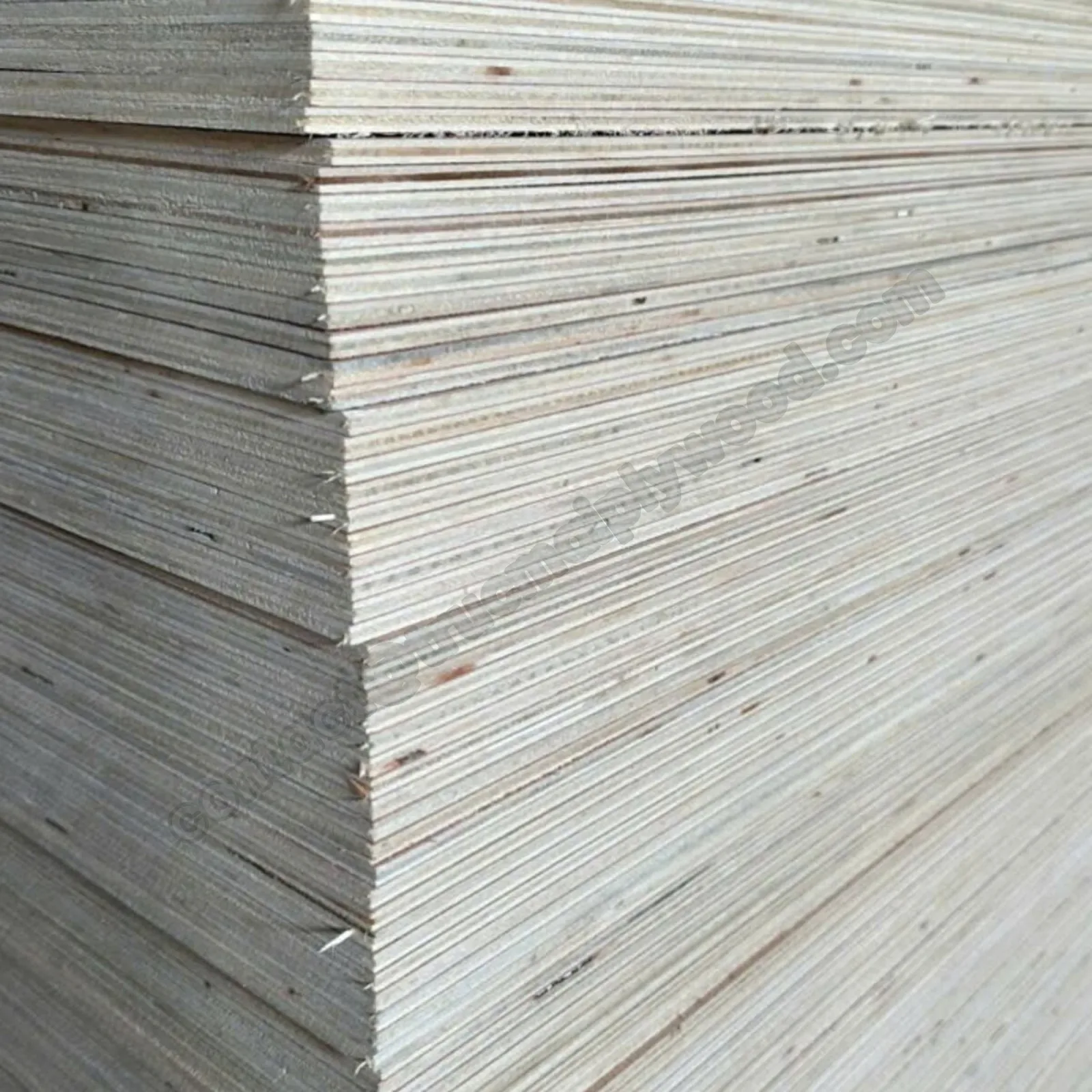
Most of what a batch check finds shows at the edge of the stack: closed plies, even glue lines, flush sheets. These photos are what a buyer's own receiving team should see when a pack is opened.
Photos of the packs and the loaded container are sent with the draft documents, so the buyer sees the same edges before the balance is paid.
Defects
Which plywood defects does a batch check catch, and where?
Every defect below has a cause upstream of where it shows. The table names the station that catches it, so a buyer knows which record to ask for when a fault appears.
| Defect | Usual cause | Caught at | What prevents it |
|---|---|---|---|
| Core gap or overlap at the edge | Core veneer laid short or doubled | Lay-up, then the edge check after trimming | Core sort before pressing; stitched outer plies |
| Blister or bubble | Wet core veneer or too little glue | Hot press, sanding | Dryness check at intake; spread weight on the press log |
| Glue line opens in water | Wrong glue for the use, or under-cured | Boil test of the batch sample | Glue and emission class written on the order; press temperature logged |
| Thin corner or uneven thickness | Uneven core, uneven sanding | Caliper at several points | Calibrated sanding; tolerance on the order |
| Bow or twist | Unbalanced lay-up, moisture difference | Straightedge on the diagonal | Symmetric ply build; dry, balanced veneer |
| Face out of the sample's band | Mixed veneer bundles | Face grading line | Approved sample kept at the mill |
| Pack heavier than planned | Core denser than the reference | Scale before loading | Weighing real sheets; pack cap by weight |
The numbers
Which numbers does a plywood batch check hold, and under which conditions?
One table of the numbers the stations measure. Each number is the default; the order can tighten or change it, and then the order wins.
Glue type and emission class are two separate lines on the order: the default is UF glue at E0 emission, and a melamine-fortified glue for damp rooms usually gives E1. How each class is chosen is on emission class per order; the build of the thinnest sheets is on thin panels.
| Item | Value | Condition |
|---|---|---|
| Face veneer | 0.2–0.5 mm | Usually 0.3 mm for Europe |
| Core veneer | 1.4–2.0 mm | 1.3 mm in 4 mm panels |
| Plies, 3–5 mm panels | 5 plies | Always, on thin panels |
| Plies, 18 mm | 11–13 plies | Most often eleven |
| Thickness, furniture | ±0.3 mm | Sanded and calibrated |
| Thickness, commercial | ±0.5 mm | Unsanded or lightly sanded |
| Thickness, packing grade | ±0.5–1.0 mm | Loose-laid core |
| Length and width | ±2 mm | All lines |
| Press temperature, UF | 110–120 °C | MR and UF glue |
| Press temperature, WBP | 130–145 °C | Melamine-fortified glue |
| Boil resistance | About six hours UF; twelve melamine-fortified | Batch sample |
| Pack height | About 1,000 mm | Sheets per pack = 1,000 ÷ thickness, then capped by weight |
On arrival
How can a buyer tell if plywood is good quality when the container is opened?
Good quality plywood is plywood that matches its order. Open two or three packs from different parts of the container and repeat four of the mill's own checks; it takes an hour and a caliper.
A small offcut boiled in water shows the glue bond: a UF glue line should hold for hours, not minutes. For furniture and interior plywood the face check matters most; for commercial panels the edge and the bond.
| Arrival check | Pass | If it fails |
|---|---|---|
| Ply count | Same as the order | Send photos of the edge with the pack number |
| Thickness | Inside the written tolerance | Record the readings per pack and sheet |
| Flatness | Sheet lies still on a flat floor | Note the pack position in the container |
| Face | Inside the sample's colour band | Photograph next to the sample in daylight |
- Count and read the edge
Count the plies on a few sheets and compare with the order; look along the edge for core gaps or overlaps.
- Measure thickness
Measure each test sheet at several points, corners and middle, against the tolerance on the order, not against the nominal size.
- Check flatness and size
Lay a straightedge across the diagonal, and measure length and width against ±2 mm.
- Compare the face
Hold the face of a few sheets next to your copy of the approved sample, in daylight.
Proof
What does a buyer receive that proves the batch was checked?
The proof is the paper trail of the stations, sent with the draft documents before the balance is paid.
On a repeat order the same records are filed against the same sample, so the buyer can compare container to container; how that is held is on repeat spec control.
- Before production The approved sample and the written spec lines: core, build, glue and emission class, tolerance, face pair
- During production Boil test result and thickness readings of the batch, on request
- After loading Photos of packs and edges, pack list with sheets per pack, draft invoice, packing list and B/L
- With the shipment Originals, with the FSC 100% claim and emission class written where the order names them
Records
Which records come out of a batch check?
These records are kept inside the ISO 9001 system, certificate W2012, and can be shown to the buyer's own inspector at the mill before loading. The standard, ISO 9001:2015, asks for this kind of documented information to be kept and retrievable.
- Lay-up sheet
Ply count, core grade and stitching for each press load.
- Press log
Glue type, spread, temperature and press time per load.
- Boil test record
Result of the batch sample against six hours for UF or twelve for melamine-fortified glue.
- Thickness readings
Caliper readings at several points on the checked sheets, against the order's tolerance.
- Face grade tags
Grade given at the face grading line against the approved sample.
- Pack list and weights
Sheets per pack, pack count and the weighed sheet mass used for the loading plan.
Volume
Do batch checks slow down a monthly container?
No. The checks run inside the line, not after it. The mill makes around 60,000 m³ a year, about 5,000 m³ in an average month, and every batch passes the same six stations at that pace.
What changes the time is the build, not the checking: thin 4 mm panels wait for scarce thin core veneer, and a six-product container needs more face sorting than a one-product load. Production stays inside 15–45 days after the deposit; how output is planned month by month is on monthly output.
For the order
Which six check lines belong in a plywood purchase order?
Write these six lines and every station above has a number to measure against.
Core species and core grade, with stitching if the panel is for furniture.
Number of plies for each thickness ordered.
Glue type and emission class, as two separate lines.
Thickness tolerance, for example ±0.3 mm sanded and calibrated, and ±2 mm on length and width.
Face and back grade as a pair, tied to the approved sample.
Pack plan: sheets per pack and packs per container, as a planning figure.
FAQ
Plywood quality control: buyer questions
Short answers, each with the number the mill works to.
What does the mill check on core veneer before pressing?
Each core sheet of 1.4–2.0 mm is sorted for open splits, holes and overlapping edges and checked for dryness. Faulty sheets are patched or moved to a lower core grade, because wet or overlapped core causes blisters and gaps after pressing.
How is thickness tolerance measured against the order?
With a caliper at several points across each checked sheet, corners and middle, after sanding. Furniture panels are held to ±0.3 mm, commercial panels to ±0.5 mm and packing grade to ±0.5–1.0 mm, as written on the order.
How long does UF glue at E0 emission hold in a boil test?
About six hours. Melamine-fortified glue holds about twelve hours and usually brings the panel to E1 emission. The boil sample is cut from the batch and its result is recorded against that batch.
How is face grade checked against the approved sample?
On the face grading line every face and back is laid next to the sample the buyer approved and compared for colour band, knots, patches and joints. A sheet that does not match is moved down a grade before packing.
Why are sheets weighed before final loading?
Because real cores can be denser than the planning density: Eucalyptus is planned at 650 kg/m³ but measures 650–750 kg/m³. Weighing keeps the pack plan under the 28,000 kg planning payload, which the carrier and route finally decide.
How to tell if plywood is good quality?
Check that it matches its order: ply count at the edge, thickness at several points inside the written tolerance, a flat sheet, a face inside the sample's band and a glue line that holds in boiling water. A panel that passes all five is good for the use it was ordered for.
Which plies are stitched in a furniture core?
Usually the outer two to four core plies, stitched across and along the sheet so the core cannot move in the press. All plies can be stitched when the order asks for it.
Are thin 3 mm panels checked differently from 18 mm?
The stations are the same, but a 3–5 mm panel is always five plies, so the ply count and flatness weigh more. An 18 mm panel is usually eleven plies, where core gaps and thickness at the corners are the main checks.
Why can a 4 mm order take longer than other thicknesses?
A 4 mm panel uses 1.3 mm core veneer, and good thin veneer is scarce. Sorting enough sound core sheets for a full container takes longer than for thicker panels.
Who checks the batch, the mill or the buyer?
The mill checks every batch at six stations and keeps the records. The buyer can send its own inspector to see the same checks before loading, and repeats the arrival checks when the container is opened.
Quotation
Send the six check lines with your RFQ
Core, ply count, glue and emission class, tolerance, face pair and pack plan: with these six lines the quotation and the batch checks use the same numbers.
Send the six lines and, if you have one, a sample. The reply confirms each line and the production window.