
E0 · E1 · Formaldehyde · Vietnam
E0 plywood from Vietnam: the formaldehyde emission class is written on every order
Yes, Truc Mai supplies E0 plywood. The default build is UF glue at E0 emission, and the class, E0, E1 or E2, is its own line on the quotation and the order, separate from the glue type. For the US the CARB P2 and TSCA Title VI certificate covers 3–25 mm.
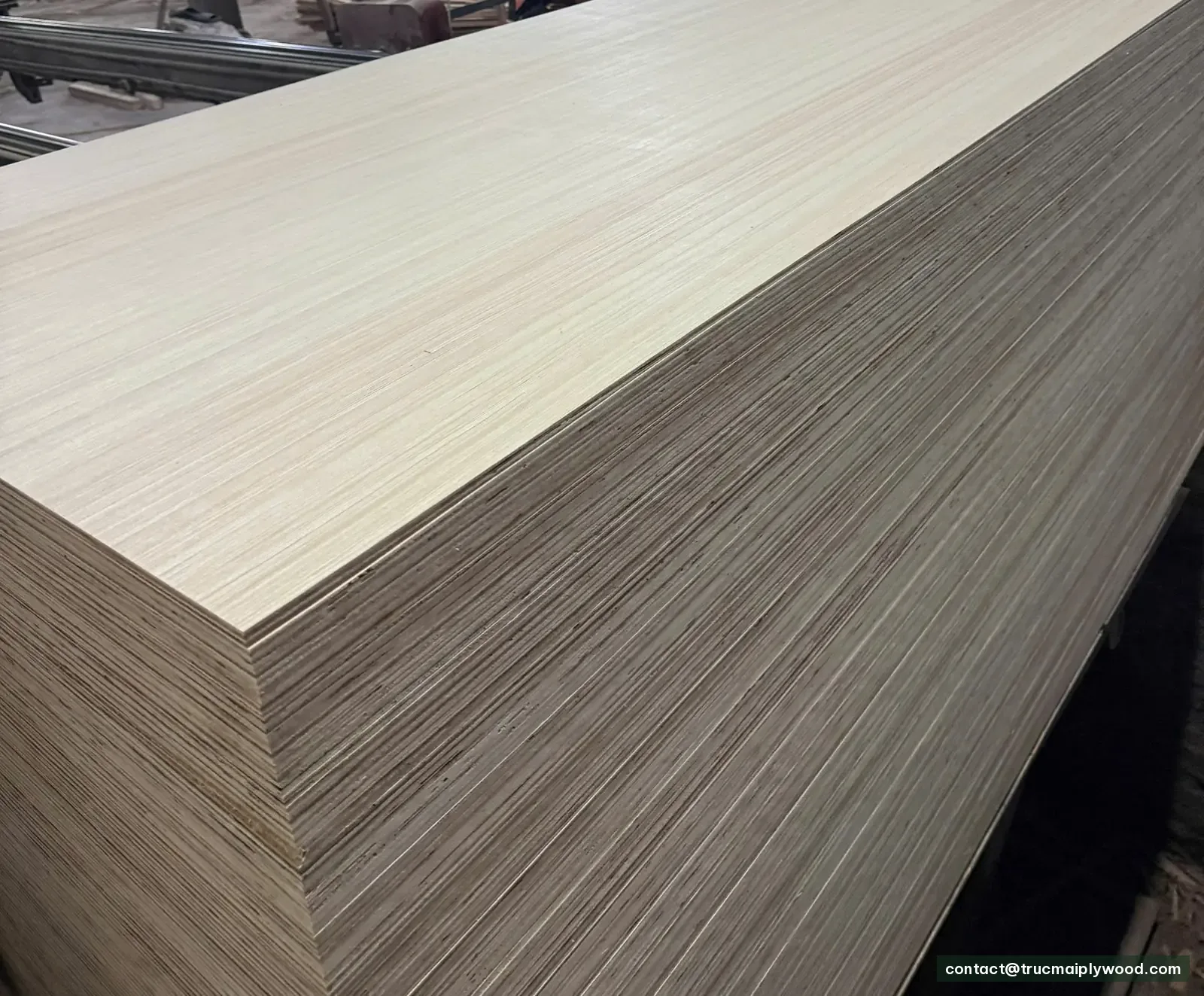
- E0default emission class
- UF gluedefault glue
- E1with melamine-fortified glue
- E2usual on packing panels
- CARB/EPA 26053US certificate
Updated 12 November 2026
Film
This certificate in a short film
Short answer
What is E0 plywood, and how does Truc Mai write the formaldehyde class?
E0 plywood is plywood with a very low formaldehyde release, the lowest of the common classes E0, E1 and E2. Truc Mai builds with UF glue at E0 emission as the default and writes the class as a separate line on every quotation, so the buyer sees the class and the glue type apart.
Formaldehyde comes from the resin that bonds the plies. A class such as E0 or E1 is a specification label that sorts panels by how much formaldehyde they release in a standard test. Each class has its own limit and its own test method, so the label is only as good as the method behind it. In short, E0 vs E1 plywood is a question of how much a panel releases under a named method.
At Truc Mai the glue and the emission class are two lines of the specification. UF glue at E0 emission is the default for furniture and interior panels. A 12-hour boil for outdoor use needs melamine-fortified glue, and emission is then usually E1. Packing panels are usually E2. Never read E0 as a glue name: the glue is UF, the emission is E0.
The class is not a legal limit by itself. In the US the legal file is the CARB P2 and TSCA Title VI certificate, and in the EU it is the REACH limit of 0.062 mg/m³ for wood-based articles placed on the market after 6 August 2026. The class on the order tells the mill what to build, and the legal file tells the importer what it can sell.
This page shows the classes side by side, what is written on the order, how the legal limits compare and how to ask for a chamber test.
- Default build UF glue at E0 emission, about 6 hours boil resistance
- Outdoor use 12-hour boil needs melamine-fortified glue; emission usually E1
- Packing panels Usually E2
- Class on the order A separate line from the glue type
- US certificate CARB/EPA 26053, hardwood plywood with veneer core, 3–25 mm
- Panels over 25 mm Outside the US certificate
- Where it appears Quotation, order confirmation and packing list
The emission class is chosen with the glue system before production starts, not after pressing.
Document held
Which emission document does Truc Mai hold?
The emission certificate Truc Mai holds is the CARB Phase 2 and TSCA Title VI certificate for the US. It states the emission level of the product type and the rules it follows, and it is shown here as issued.
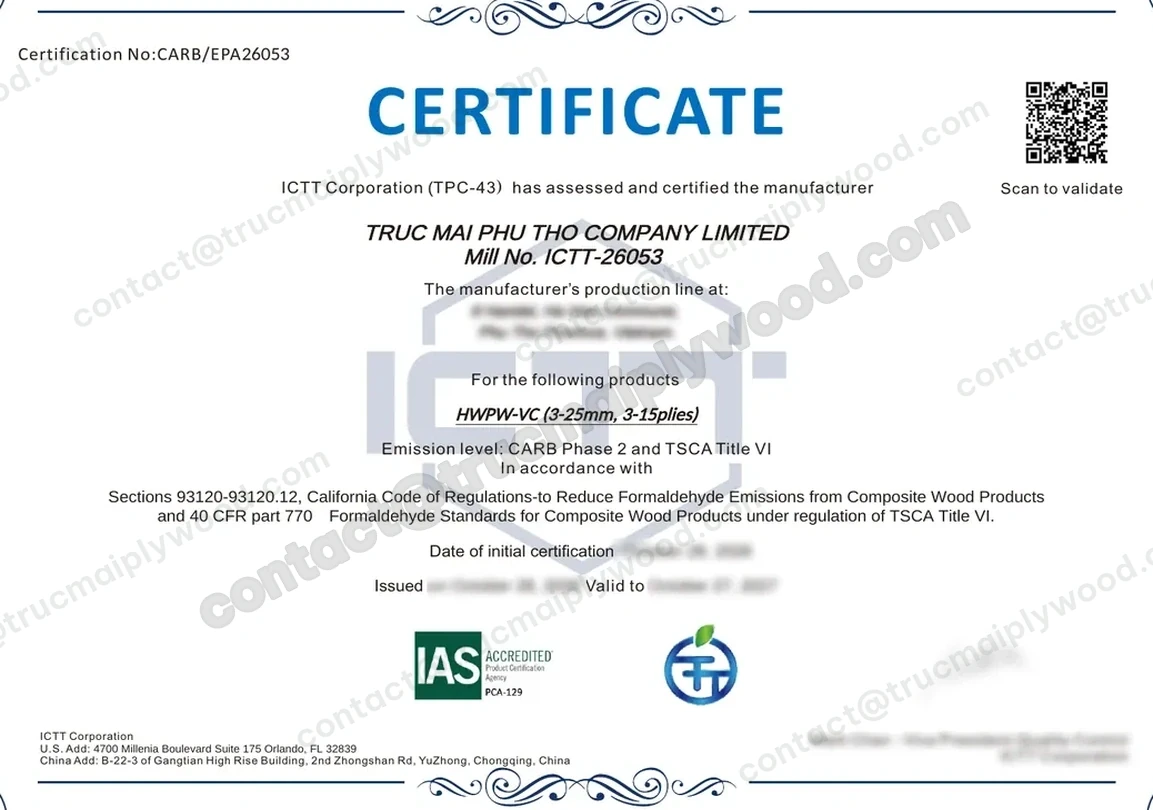 CARB Phase 2 and TSCA Title VI certificate
CARB/EPA 26053 · HWPW-VC, 3–25 mm · issued by ICTT Corporation (TPC-43)
Classes
What is the difference between E0, E1 and E2 plywood: E0 vs E1 plywood?
The three classes are a ladder. E0 is the lowest release and E2 the highest of the three. The table shows how each is used on a Truc Mai order.
| Class | Where it is used | Glue on a Truc Mai order | Typical Truc Mai line |
|---|---|---|---|
| E0 | Furniture and interior panels, and buyers with strict emission specifications | UF glue, about 6 hours boil resistance | Furniture and interior panels, default |
| E1 | Panels needing a 12-hour boil for outdoor use, and buyers who specify E1 | Melamine-fortified glue | Outdoor-use lines on request |
| E2 | Packing and non-visible uses | UF glue, packing build | Packing panels, usually |
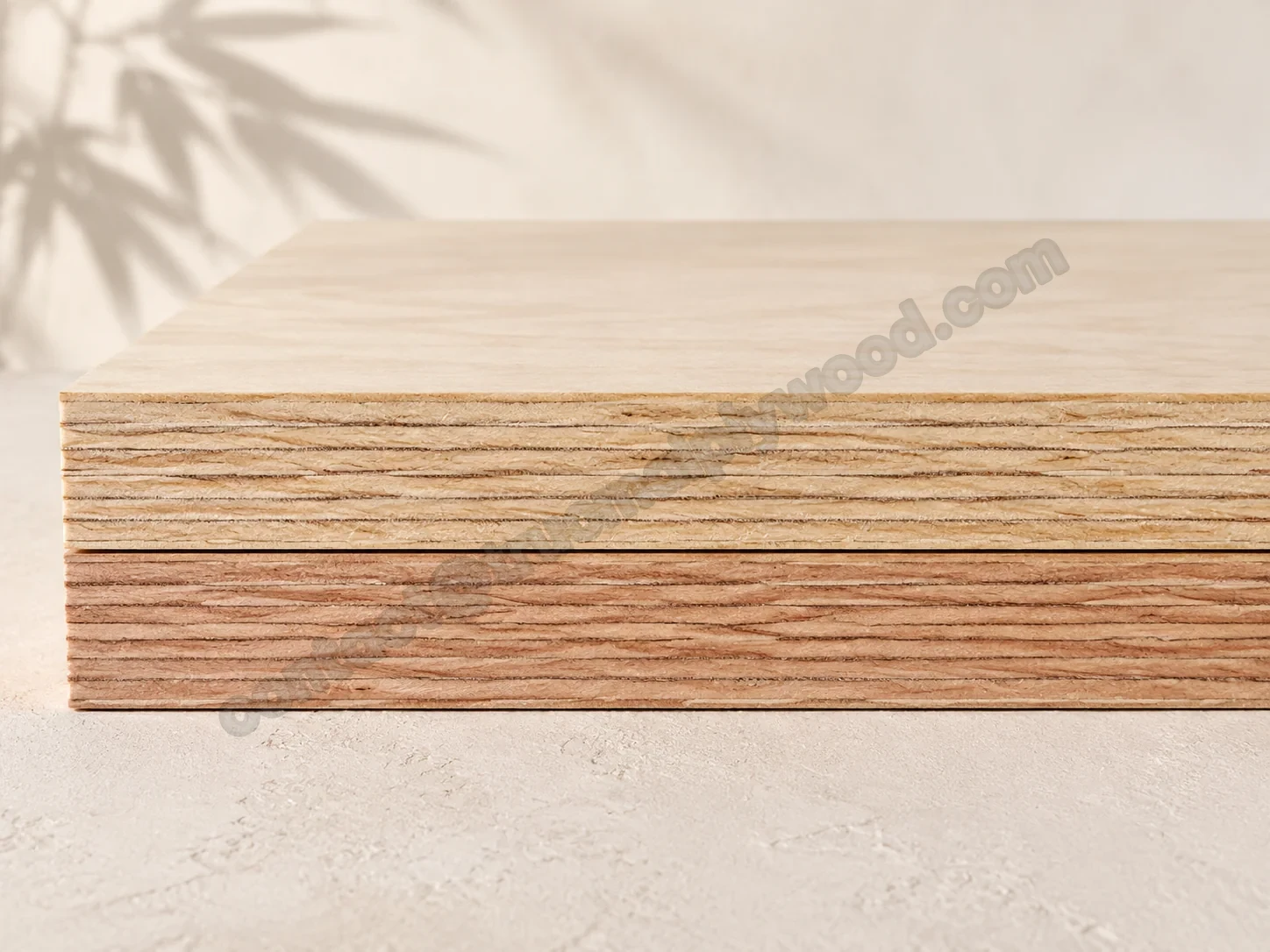
Classes are set by the standard the buyer names, and the numeric limit differs between standards. A class on the order and a chamber result are two separate statements. Truc Mai does not publish one emission value for all panels; the class is written per order and the test is named by the buyer.
The limits
What formaldehyde limits apply in the US and the EU?
Two numbers matter to an importer. They are not the same measurement, and neither is a class name.
| Rule | Limit | Test conditions | Applies to |
|---|---|---|---|
| TSCA Title VI and CARB Phase 2 | 0.05 ppm for hardwood plywood with veneer core | ASTM E1333 large chamber, or ASTM D6007 | Plywood sold in the US; certificate CARB/EPA 26053 covers 3–25 mm |
| REACH Annex XVII entry 77 | 0.062 mg/m³ for furniture and wood-based articles; 0.080 mg/m³ for other articles | 23 °C, 45% humidity, loading 1 m²/m³, steady state within 28 days | Articles placed on the EU market after 6 August 2026 |
The EU rule has exemptions, including articles for exclusively outdoor use and second-hand articles. The importer reads the entry for its own case. Checked 12 November 2026 against Regulation (EU) 2023/1464, the EPA page and 40 CFR 770.10.
E0 and the EU limit
Is E0 plywood enough for the EU formaldehyde limit?
A class name does not answer it. The REACH limit is a chamber result in mg/m³ under fixed conditions, and the label E0 is not defined by that rule.
Entry 77 of REACH Annex XVII restricts articles by what they release in a test chamber: at most 0.062 mg/m³ for furniture and wood-based articles. The conditions are fixed: 23 °C, 45% relative humidity, a loading of 1 m² of test piece per m³ of chamber and one air change an hour, with the steady-state concentration read within 28 days.
So an EU order that must meet the limit should name it, and the mill builds the panel to a class that the buyer's chamber report can confirm. The class on the order is the plan. The report is the proof.
Truc Mai writes the class and the glue on the quotation, and the buyer states the method and the limit its own customers need. A buyer who needs a chamber report to a named method says so at enquiry, so it can be arranged before production.
The same panel can be sold into the US on the CARB/EPA certificate and into the EU on the buyer's chamber report, because the two markets measure the product in different ways.
- Class
A specification label on the order: E0, E1 or E2.
- Limit
0.062 mg/m³ in the EU; 0.05 ppm for US plywood with veneer core.
- Proof
A chamber report for the EU; the CARB/EPA certificate for the US.
- Name it
State the market and the method at enquiry.
Markets
Which emission class does each market ask for?
Each market has its own way to specify formaldehyde. The class on the order is how Truc Mai translates the buyer's specification into a build.
| Market | How emission is specified | Typical class asked | What Truc Mai supplies |
|---|---|---|---|
| USA | TSCA Title VI and CARB P2, certified and labelled | The certified limit, not a class name | CARB/EPA 26053 for 3–25 mm and the label |
| EU | REACH limit 0.062 mg/m³ for wood-based articles; buyer class E0 or E1 | E0 or E1 | Class on the order and the chamber report the buyer names |
| UK | Buyer specification | E0 or E1 | Class on the order and certificate copy |
| Canada | Federal composite wood rules and buyer specification | The certified limit or E1 | Class on the order and certificate copy |
| Australia and Middle East | Buyer specification by class | E0 or E1 | Class on the order |
The legal rule in each market is the importer's to read. The class is a spec line, not a legal certificate.
E0 plywood formaldehyde
How does E0 plywood formaldehyde release differ by glue system?
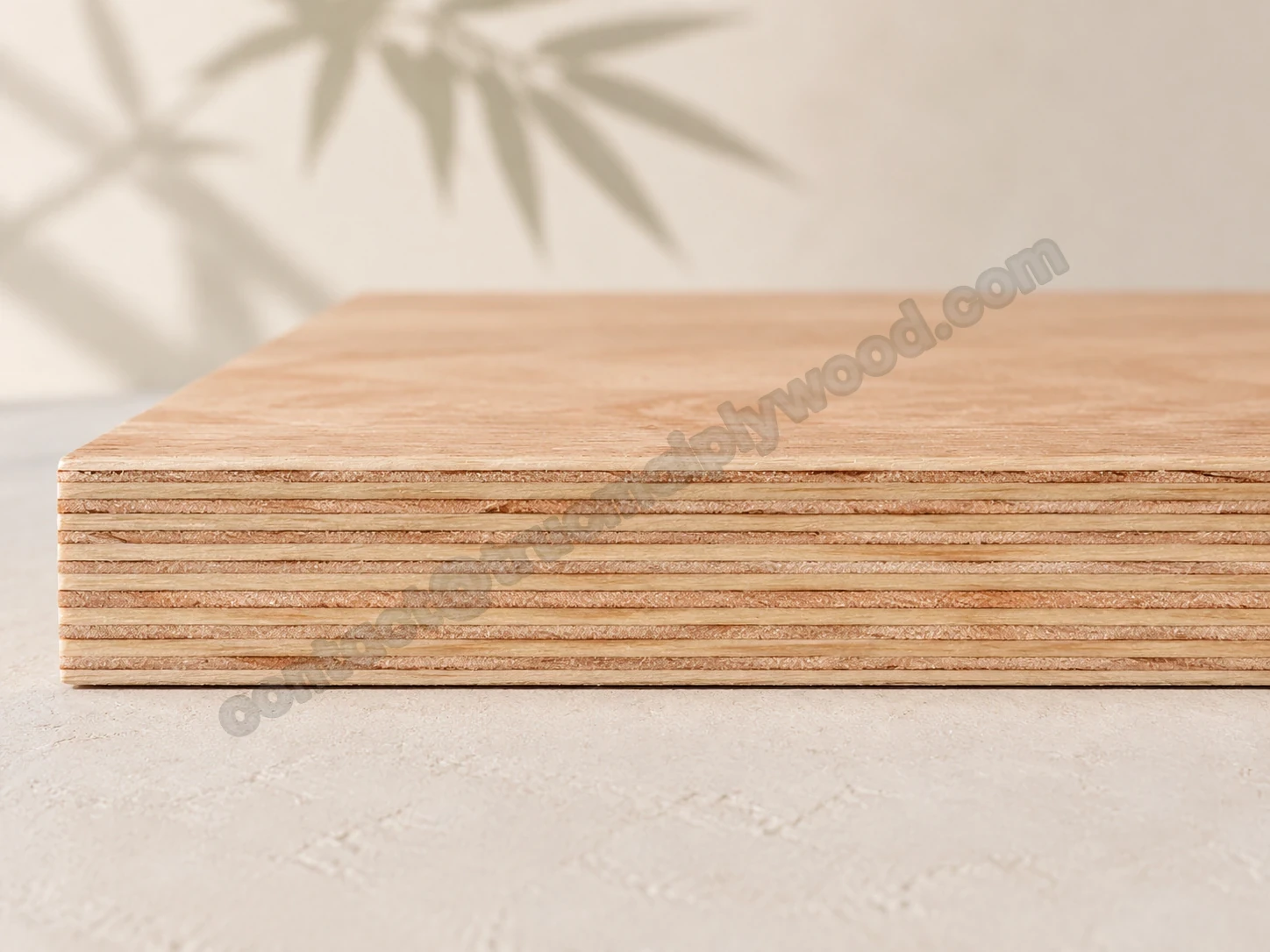
The glue system and the pressing set the emission. The core species, the face and the thickness do not.
Urea-formaldehyde glue, UF, is the usual interior glue because it cures fast and costs little. Built and pressed correctly, it reaches E0 emission, which is Truc Mai's default for furniture and interior panels. Hot pressing runs about 110–120 °C for MR and UF glue, and 130–145 °C for WBP glue.
A 12-hour boil, needed for outdoor use, takes melamine-fortified glue. That glue is more durable under water but its emission is usually E1, so a buyer who needs both a long boil and the lowest emission should say so, and the order can be planned as two lines.
Because the class comes from the glue and the press, it cannot be added to a finished sheet. It is chosen before production, which is why it is the first line on the order.
A buyer comparing E0 vs E1 plywood from different mills should compare the method and the conditions behind each label, and ask for a chamber report to the buyer's own method when the number matters.
Scope
Which Truc Mai panels are built at E0, E1 or E2?
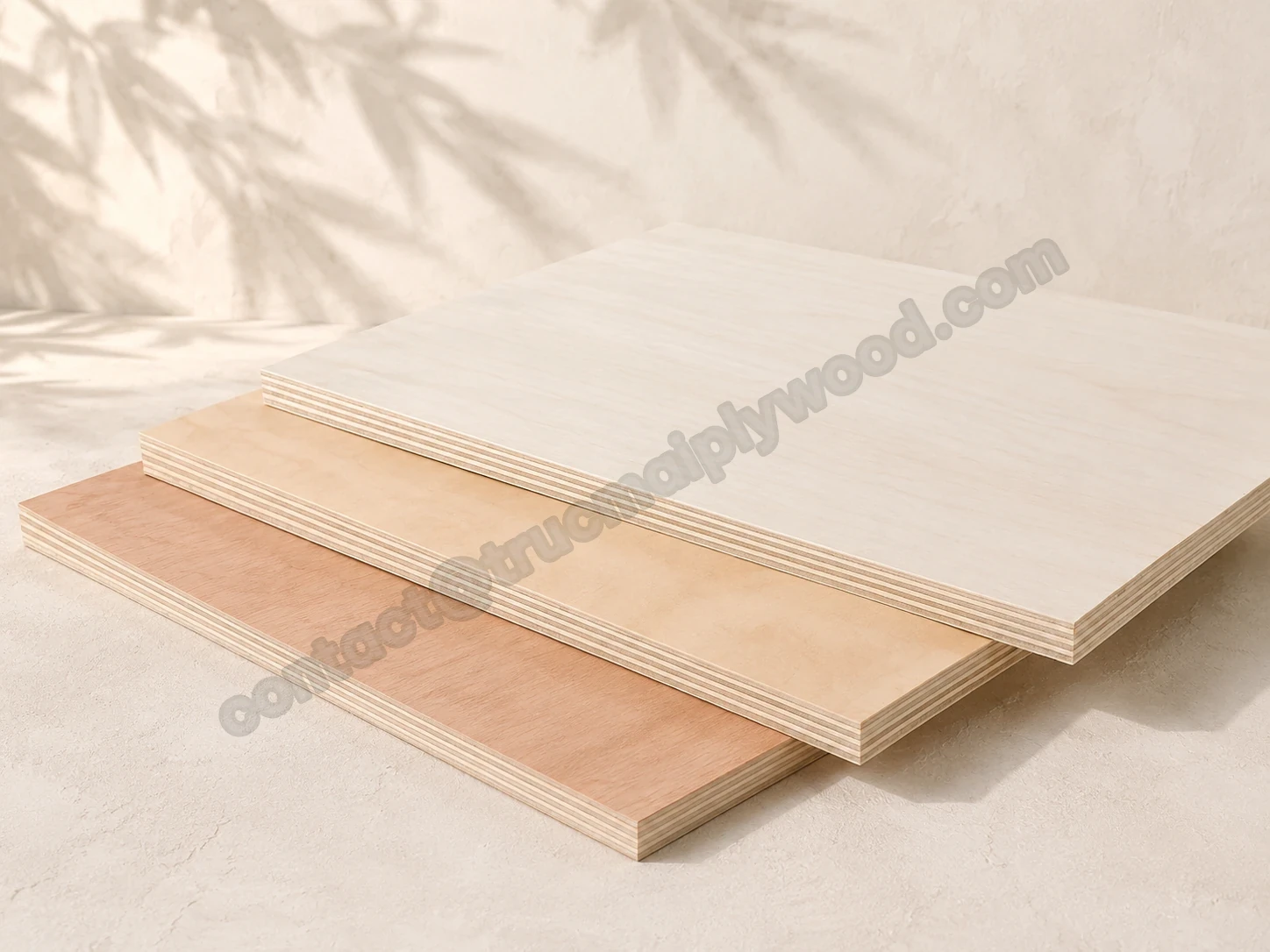
The class follows the line and the use. Furniture and interior panels are E0 by default, outdoor-use panels are E1 with melamine-fortified glue and packing panels are usually E2.
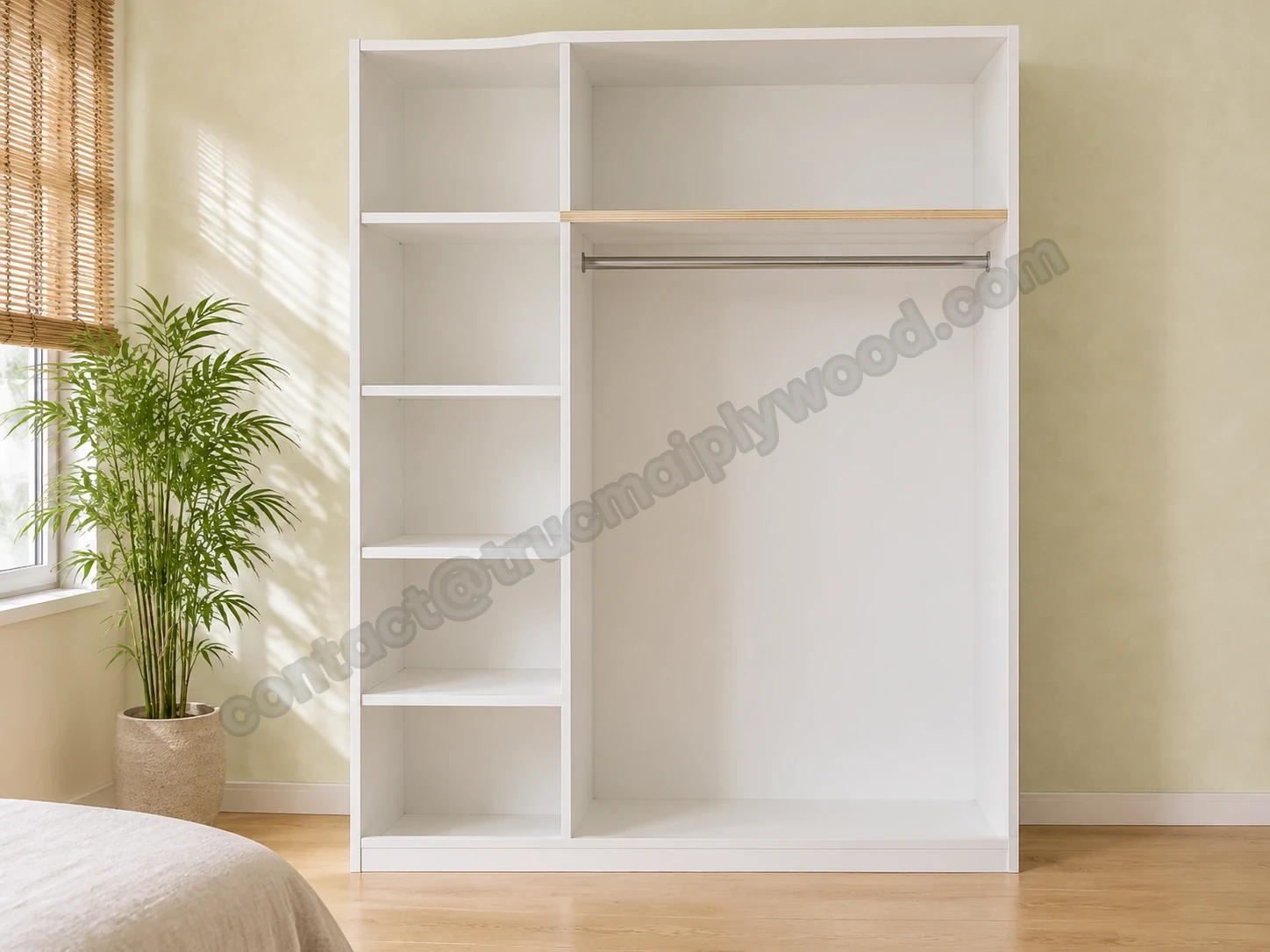
Furniture and interior panels use an A-grade core, a stitched core and sanded faces, with UF glue at E0 emission. These are the panels that go into cabinets, wardrobes and shelving, where the end user sits close to the panel and the buyer asks for the lowest class. A buyer who sells into several markets from one order can ask for the lines to be written with the class each market needs, and the packing list then shows which pack belongs to which market.
Commercial panels have an AB core, loose-laid or jointed, unsanded or lightly sanded. They are quoted with the class the buyer names, and E0 can be written for them like any other line.
Packing panels have an AB loose-laid core and are usually E2. They are used for crates and packaging, not for interiors.
The class does not depend on the face, the core species or the thickness. It depends on the glue system and the pressing, so a single order that mixes thicknesses can carry one class on all lines, or a different class per line if the lines are booked that way. A buyer who orders several lines in one container can keep one class on all lines or ask for a different class per line; each line is then named on the packing list with its class.
- Furniture and interior
UF glue at E0 emission, A-grade core, sanded faces.
- Commercial
AB core, class as the buyer names it, E0 available.
- Outdoor use
12-hour boil with melamine-fortified glue, usually E1.
- Packing
AB loose-laid core, usually E2.
Documents
Which emission documents come with an order?
The class is written at the start and carried through every document, so it can be traced from enquiry to packing list.
- Before you order The CARB/EPA 26053 certificate copy for the US, and the class and glue defaults described on this page
- With the quotation Class and glue as two lines per panel, so the specification is clear
- Order confirmation The class, glue, thickness tolerance and any chamber test the buyer asked for
- Chamber report If the buyer named a method and a limit at enquiry, the report arranged for the order
- Packing list The class per line, matched to the pack labels
- Shipment papers B/L, certificate of origin and the usual export papers
Verify
How do you verify an emission class?
A class on a quotation is a claim. These steps turn it into proof.
- Read the class and glue
Check that the order has the class and the glue as separate lines.
- Name the limit
Write the limit and the method your market needs, such as 0.062 mg/m³ for the EU or 0.05 ppm for US plywood.
- Ask for the report
A chamber report must name the method, the conditions and the specimen.
- Read the certificate
For the US, check CARB/EPA 26053, the product type HWPW-VC and the range 3–25 mm.
- Match the lot
The lot on the pack label must be the lot on the packing list.
- Test on arrival
If the buyer's own policy requires it, send a sample from the delivered lot for a chamber test.
Ask for the file: We send the certificate copy and the class and glue lines with your quotation.
Common mistakes
Which E0 and E1 claims should a buyer question?
Emission claims are easy to write and hard to test. These are the cases to watch for.
- E0 glue
E0 is an emission level. The glue is UF, MR, WBP or another type. Ask for both lines.
- E1 certified
A class is not a certification. A single tested specimen is a result, not a certificate.
- A class without a method
A report must name its method and conditions. E1 under one method is not E1 under another.
- US certificate used for thick panels
CARB/EPA 26053 covers 3–25 mm. Panels at 30 and 40 mm are outside it.
- E0 used as the EU limit
The EU limit is 0.062 mg/m³ under fixed conditions. State it on the order.
Checklist
How to order by emission class: checklist
Use this list before you order and again before the container ships.
- Name the class
E0, E1 or E2, written as its own line next to the glue.
- Name the market
USA, EU, UK or another market, so the right legal file is planned.
- Name the method
The limit and test method your customers need, if a chamber report is required.
- Give the panel
Face, core, thickness, sheet size and quantity.
- Approve the sample
The free sample is pressed with the glue for the class you named. New buyers send their courier account, and the charge is deducted once an order follows.
- Check the documents
After loading, check class and lot on the draft packing list.
Terms: MOQ one 40HC, 15–45 days after the 30% deposit, FOB Hai Phong, CFR or CIF.
FAQ
E0 plywood questions
What is E0 plywood?
Plywood with a very low formaldehyde release, the lowest of the common classes E0, E1 and E2. Truc Mai's default is UF glue at E0 emission.
Is E0 a type of glue?
No. E0 is the emission class. The glue is a separate line, UF by default.
What is the difference between E0 and E1 plywood?
E0 releases less formaldehyde than E1. On a Truc Mai order E0 comes with UF glue, and E1 usually comes with melamine-fortified glue for outdoor-use boil resistance.
Is E2 plywood used?
Yes, usually on packing panels.
Does Truc Mai write the class on every order?
Yes. The class is its own line on the quotation, the order confirmation and the packing list.
Is E0 enough for the EU formaldehyde limit?
The EU limit is 0.062 mg/m³ in a chamber test under fixed conditions. State it on the enquiry so the panel is built and proved to it.
What is the US limit?
0.05 ppm for hardwood plywood with a veneer core, under TSCA Title VI and CARB Phase 2.
Which thicknesses does the US certificate cover?
3 to 25 mm. Panels of 30 and 40 mm are outside it.
Can I ask for a chamber test?
Yes. Name the method and the limit at enquiry, and the report is arranged for the order.
Does the class change the price?
The glue system and the pressing set the cost. The quotation names the class per line so you can compare lines.
Need the emission file? Write to Lucy at contact@trucmaiplywood.com and we will send it with your quotation.
Quotation
Request E0 plywood with the class on the quotation
Send the panel, the market and the class you need. We reply with a quotation that writes class and glue as two lines.