
Mill · 40HC loading
Plywood container loading in Vietnam: what one 40HC holds
Plywood container loading in Vietnam is set by the core before the sheet count. On the Truc Mai planning model a 40HC takes 18 packs of Styrax core, 16 of Acacia or 15 of Eucalyptus. At 18 mm and 1220 × 2440 mm that is 990, 880 or 795 sheets, about 53, 47 or 43 m³. These are planning figures until real sheets are weighed.
This page shows how the mill in Ha Hoa, Phu Tho plans, builds, weighs and loads a container of furniture and interior plywood, and it carries the full planning table for every thickness from 3 to 40 mm. The order of work is the last stage of how our plywood is made, and each step below has a check a buyer can repeat on arrival.
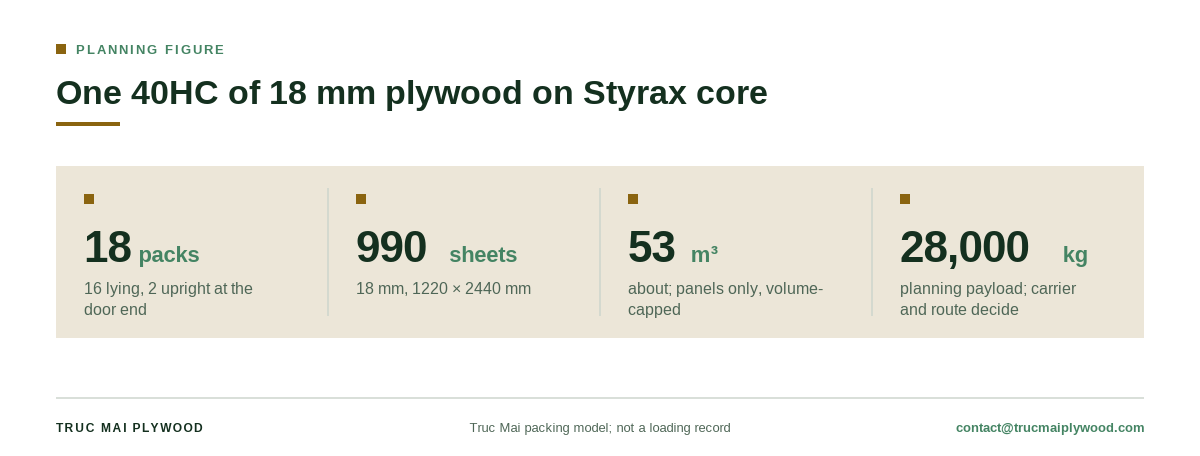
- 18 packsStyrax core per 40HC, 16 Acacia, 15 Eucalyptus
- 990 sheets18 mm Styrax, 1220 × 2440 mm, about 53 m³
- 28,000 kgplanning payload of cargo, tare excluded
- ~1,000 mmheight of each pack, sheets = 1,000 ÷ thickness
Planning figure: computed from the Truc Mai packing model, panels only, not a measured loading record.
Paperwork that travels with the load
Which certificates cover the panels in a Truc Mai container?
FSC, CARB P2, ISO 9001 and ISO 14001, plus EU file sets.
- FSC 100% chain of custody FSC-C196493 · SA-COC-014545
- CARB P2 and TSCA Title VI CARB/EPA 26053 · ICTT-26053
- ISO 9001:2015 W2012 · WCERT
- ISO 14001:2015 W2012E · WCERT
Check the FSC 100% claim in the FSC database with code FSC-C196493, the formaldehyde listing with the California Air Resources Board, and the federal rule in the US formaldehyde standards.
At a glance
Plywood container loading in Vietnam: how does a mill load a 40HC?
A plywood container is loaded in five stages: plan the packs from the core and thickness, weigh real sheets, build and strap packs about 1,000 mm high, load them to the plan, then close the packing list. At Truc Mai the plan comes from the order, and the weight check decides the final count.
Container loading is the step where the order's numbers meet the truck. A 40HC has a fixed inside volume and a payload that the carrier and route set, so the same plan holds for 1220 × 2440 and 1250 × 2500 mm sheets, and the core species decides whether volume or weight runs out first.
| Stage | What happens | Where | Who | Record |
|---|---|---|---|---|
| Plan | Packs per core and thickness from the order; mixed products sequenced | Sales office | Order planner | Loading plan per container |
| Weigh | Sample sheets from the batch weighed against the planning kg/sheet | Packing area | QC | Weight sheet |
| Build | Packs about 1,000 mm high, counted, labelled and strapped | Packing area | Packing crew | Pack label and count |
| Load | Lying packs first, upright packs at the door end | Loading bay | Loading crew | Row photos, seal number |
| Close | Packing list per pack, drafts to the buyer | Sales office | Export desk | Draft packing list and B/L |
By core and product line
Does plywood core type affect container loading?
Yes. Styrax at about 500 kg/m³ fills the container by volume, so 18 packs fit. Acacia at about 580 kg/m³ takes 16 packs and Eucalyptus at about 650 kg/m³ takes 15, because weight runs out before space. Moving a furniture order from Acacia to Styrax core usually gives a better face, a lighter sheet and more m³ per container.
The sheet size changes less than buyers expect. At 18 mm, 1250 × 2500 mm sheets on Styrax still load 990 sheets in 18 packs, but each sheet is larger, so the load rises to about 55.7 m³. On Acacia and Eucalyptus the larger sheet hits the weight cap, and the sheet count drops to 848 and 765.
Thin 3–6 mm panels pack many more sheets per pack: 333 sheets of 3 mm in a 1,000 mm pack. Eucalyptus-core panels reach the 28,000 kg planning payload at every thickness, so their packs are filled by weight, not height. For panels cut at the mill, one sheet is split into 2, 3, 4 or 6 parts before packing, and the pack plan follows the cut size.
| Product line and build | Packs | Sheets | m³ | kg per sheet |
|---|---|---|---|---|
| Furniture, 18 mm Styrax, 1220 × 2440 mm | 18 | 990 | 53.0 | 26.8 |
| Furniture, 18 mm Styrax, 1250 × 2500 mm | 18 | 990 | 55.7 | 28.1 |
| Furniture, 18 mm Acacia, 1220 × 2440 mm | 16 | 880 | 47.2 | 31.1 |
| Commercial, 18 mm Eucalyptus, 1220 × 2440 mm | 15 | 795 | 42.6 | 34.8 |
| Thin panel, 3 mm Styrax, 1220 × 2440 mm | 18 | 5,994 | 53.5 | 4.5 |
| Thick panel, 40 mm Styrax, 1220 × 2440 mm | 18 | 450 | 53.6 | 59.5 |
Steps
What happens to a plywood order between the press and the sealed container?
Eight steps take a finished batch into a sealed 40HC: plan, weigh, count, build, strap, load, record and send the drafts. Each one has a check, so the sheet count on the packing list is the count in the box.
- Plan the load from the order
The planner reads core, thickness, sheet size and product mix from the order and sets packs per container: 18 on Styrax, 16 on Acacia, 15 on Eucalyptus. Check: one or two products per container is the norm; three to six products need the mix written on the order.
- Weigh real sheets
Sample sheets from the batch go on the scale and are compared with the planning weight, for example 26.8 kg for an 18 mm Styrax sheet. Check: Eucalyptus is measured at 650–750 kg/m³, so a heavy batch lowers the sheet count before packing starts.
- Set sheets per pack
Sheets per pack = 1,000 mm ÷ thickness, rounded down, then capped by weight: 55 sheets of 18 mm, 83 of 12 mm, 333 of 3 mm. Check: the pack never exceeds the weight cap for its core.
- Count and label each pack
Each pack carries a label with product, thickness, sheet size, face grade, sheet count and the order reference. Check: the count is taken twice, at stacking and at labelling.
- Strap and protect
Packs sit on pallet feet, are strapped and get edge protection; the pallets, wraps and straps are the materials covered by the PPWR packaging test. Check: overfilled packs break pallet feet, so the pack height stays at about 1,000 mm.
- Load to the plan
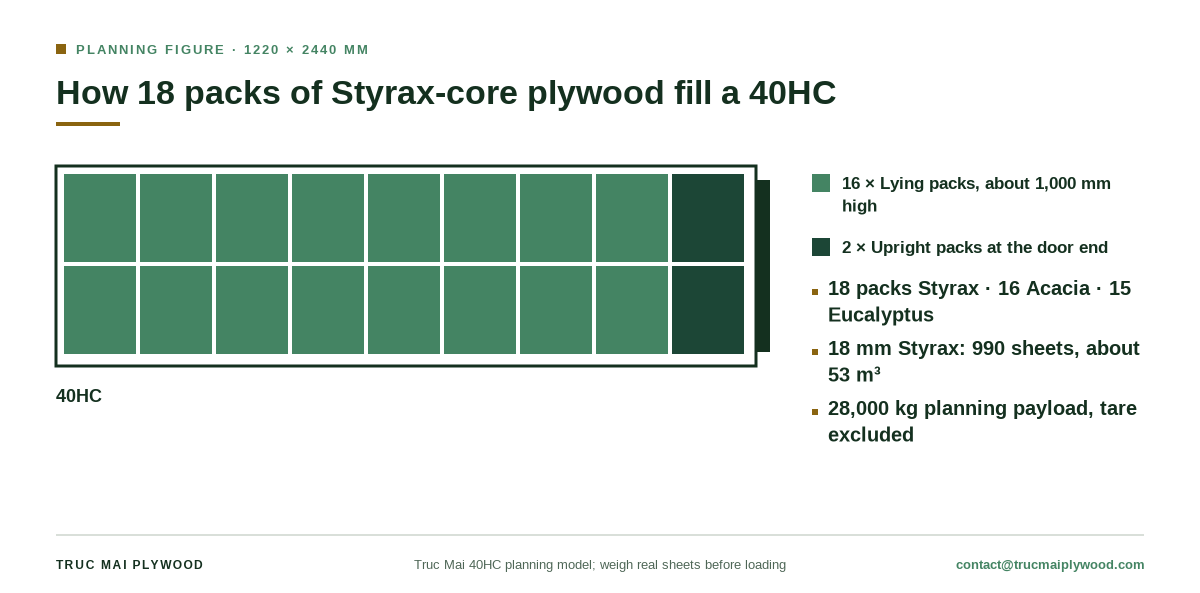
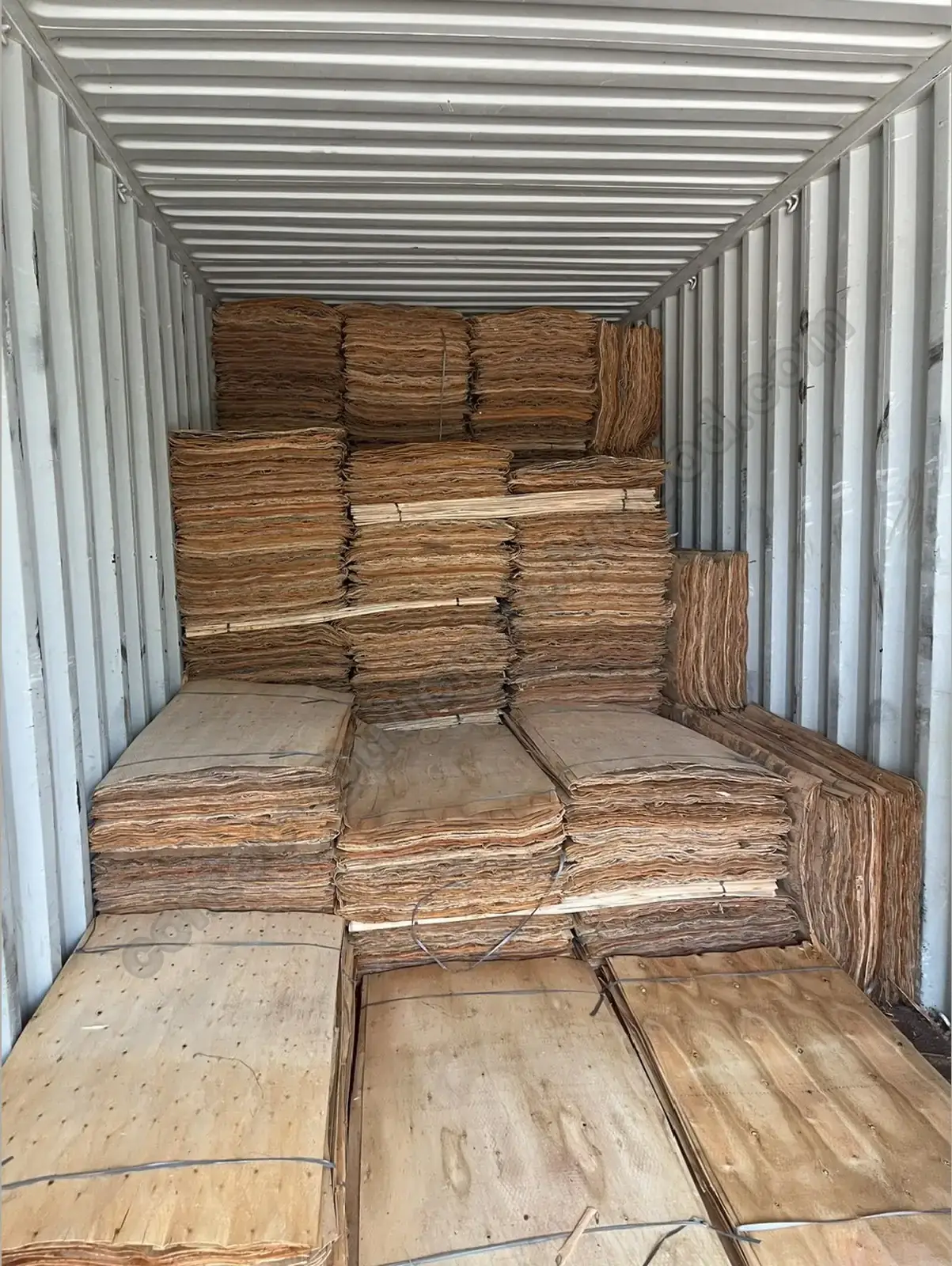
On Styrax, 16 packs go in lying and the last 2 stand upright at the door end. Check: packs are seated flat and tight, with no gap that lets them shift at sea.
- Photograph and seal
The crew photographs each row, the full door end and the seal number. Check: the seal number goes on the draft B/L and the packing list.
- Close the packing list
The export desk writes the packing list pack by pack and sends draft shipping documents to the buyer for approval after loading. Check: total sheets, m³ and gross weight match the pack labels.
Loading photos
Which loading photos does a buyer receive for each 40HC?
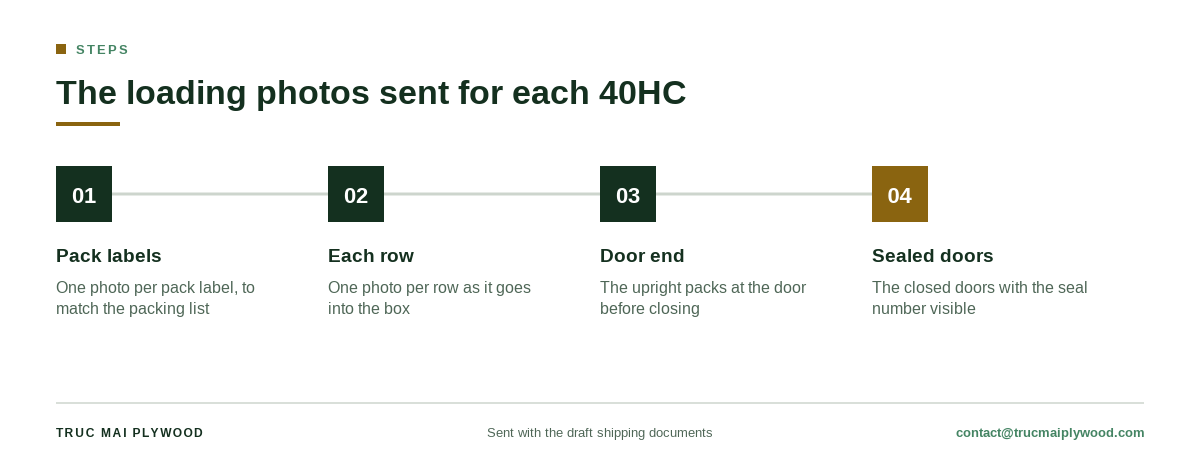
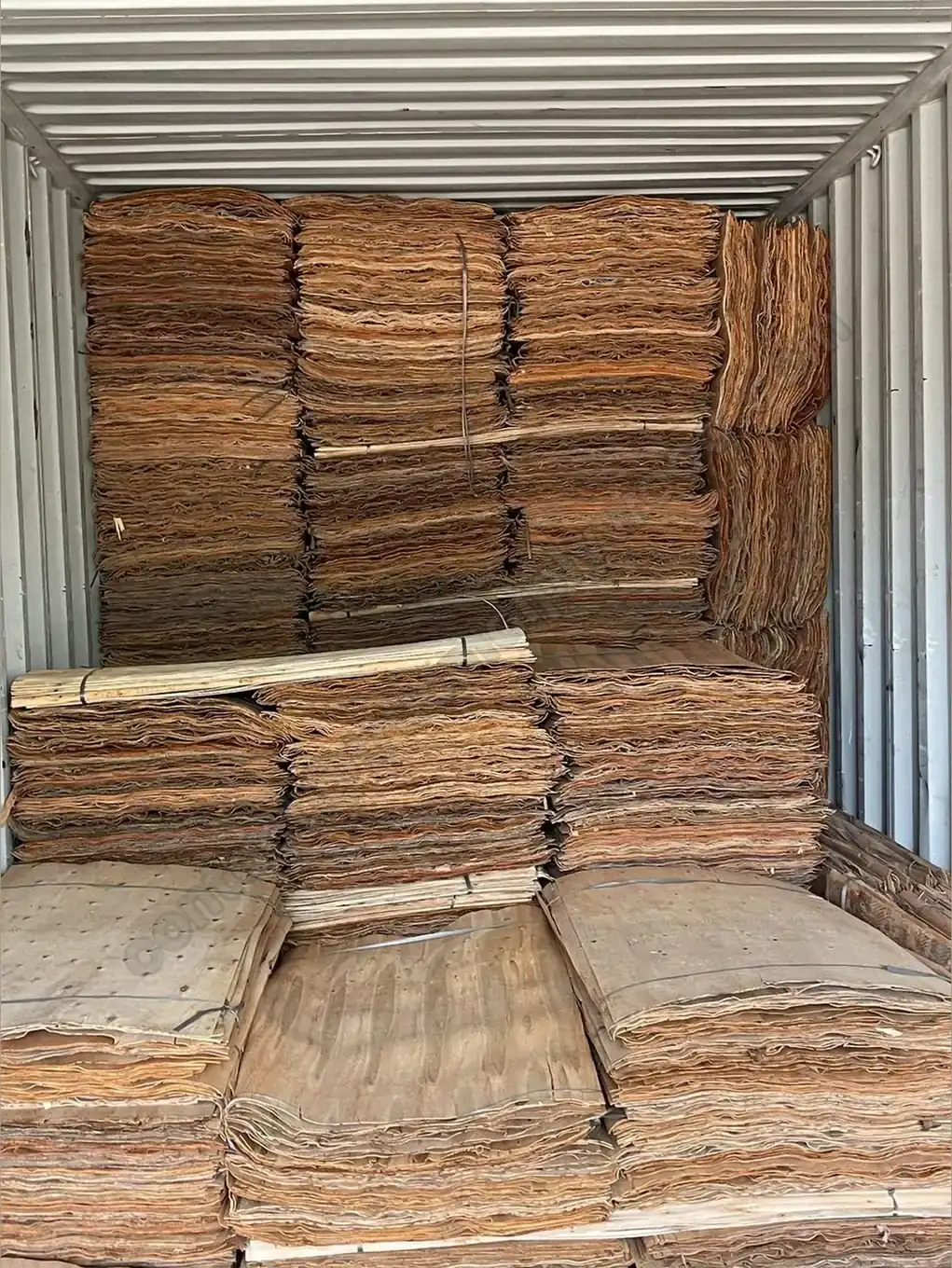
Every container comes with photos of the packs, each loaded row, the door end before closing and the seal, sent with the draft documents. They let a buyer match pack labels to the packing list without waiting for the box to arrive.
Photos follow the loading sequence: one per pack label, one per row as it goes in, one of the upright packs at the door, one of the closed doors with the seal visible. Buyers who order every month can ask for the same angles each time, so two loads are easy to compare.
Loading damage
What goes wrong when plywood is loaded, and how is it prevented?
Most loading damage comes from four causes: packs built too high, loads that can shift, weight over the route limit and counts that drift between pack and paper. Each has a fixed check at the mill.
| Problem | Cause | How the mill prevents or catches it |
|---|---|---|
| Broken pallet feet | Pack filled above its planned height or weight | Pack height held at about 1,000 mm and weight capped per core |
| Crushed edges and corners | Forklift contact or straps without protection | Edge protection under straps; packs lifted from the pallet, not the sheets |
| Load shift at sea | Gaps between packs or loose door packs | Packs seated tight; 2 upright packs close the door end |
| Overweight container | Dense batch loaded to the planning count | Real sheets weighed before final loading; count lowered when heavier |
| Packing list mismatch | Sheets counted once, or pack swapped at loading | Double count, pack labels, row photos and a list written pack by pack |
| Face marks on the top sheet | Straps or forks pressing the face | Cover sheet or board on top under the straps |
Planning table
How many plywood sheets fit in a 40HC, by core, size and thickness?
At 18 mm and 1220 × 2440 mm a 40HC takes 990 Styrax, 880 Acacia or 795 Eucalyptus sheets. The tables give every thickness from 3 to 40 mm for both sheet sizes. Every figure is a planning figure from the Truc Mai packing model: panels only, 28,000 kg of cargo, container tare excluded.
Each cell reads total sheets (packs × sheets per pack), m³ per container and kg per sheet. Weight cap marks a load filled by weight before volume. Reference densities: Styrax 500, Acacia 580, Eucalyptus 650 kg/m³. The 40HC load calculator runs the same model for a mixed order, and the 18 mm loading guide explains the most common build.
| Thickness | Styrax core | Acacia core | Eucalyptus core |
|---|---|---|---|
| 3 mm | 5,994 sheets (18 × 333) · 53.5 m³ · 4.5 kg | 5,328 sheets (16 × 333) · 47.6 m³ · 5.2 kg | 4,815 sheets (15 × 321) · 43.0 m³ · 5.8 kg · weight cap |
| 4 mm | 4,500 sheets (18 × 250) · 53.6 m³ · 6.0 kg | 4,000 sheets (16 × 250) · 47.6 m³ · 6.9 kg | 3,615 sheets (15 × 241) · 43.0 m³ · 7.7 kg · weight cap |
| 5 mm | 3,600 sheets (18 × 200) · 53.6 m³ · 7.4 kg | 3,200 sheets (16 × 200) · 47.6 m³ · 8.6 kg | 2,880 sheets (15 × 192) · 42.9 m³ · 9.7 kg · weight cap |
| 6 mm | 2,988 sheets (18 × 166) · 53.4 m³ · 8.9 kg | 2,656 sheets (16 × 166) · 47.4 m³ · 10.4 kg | 2,400 sheets (15 × 160) · 42.9 m³ · 11.6 kg · weight cap |
| 9 mm | 1,998 sheets (18 × 111) · 53.5 m³ · 13.4 kg | 1,776 sheets (16 × 111) · 47.6 m³ · 15.5 kg | 1,605 sheets (15 × 107) · 43.0 m³ · 17.4 kg · weight cap |
| 12 mm | 1,494 sheets (18 × 83) · 53.4 m³ · 17.9 kg | 1,328 sheets (16 × 83) · 47.4 m³ · 20.7 kg | 1,200 sheets (15 × 80) · 42.9 m³ · 23.2 kg · weight cap |
| 15 mm | 1,188 sheets (18 × 66) · 53.0 m³ · 22.3 kg | 1,056 sheets (16 × 66) · 47.2 m³ · 25.9 kg | 960 sheets (15 × 64) · 42.9 m³ · 29.0 kg · weight cap |
| 18 mm | 990 sheets (18 × 55) · 53.0 m³ · 26.8 kg | 880 sheets (16 × 55) · 47.2 m³ · 31.1 kg | 795 sheets (15 × 53) · 42.6 m³ · 34.8 kg · weight cap |
| 21 mm | 846 sheets (18 × 47) · 52.9 m³ · 31.3 kg | 752 sheets (16 × 47) · 47.0 m³ · 36.3 kg | 675 sheets (15 × 45) · 42.2 m³ · 40.6 kg · weight cap |
| 25 mm | 720 sheets (18 × 40) · 53.6 m³ · 37.2 kg | 640 sheets (16 × 40) · 47.6 m³ · 43.2 kg | 570 sheets (15 × 38) · 42.4 m³ · 48.4 kg · weight cap |
| 30 mm | 594 sheets (18 × 33) · 53.0 m³ · 44.7 kg | 528 sheets (16 × 33) · 47.2 m³ · 51.8 kg | 480 sheets (15 × 32) · 42.9 m³ · 58.0 kg · weight cap |
| 40 mm | 450 sheets (18 × 25) · 53.6 m³ · 59.5 kg | 400 sheets (16 × 25) · 47.6 m³ · 69.1 kg | 360 sheets (15 × 24) · 42.9 m³ · 77.4 kg · weight cap |
| Thickness | Styrax core | Acacia core | Eucalyptus core |
|---|---|---|---|
| 3 mm | 5,958 sheets (18 × 331) · 55.9 m³ · 4.7 kg · weight cap | 5,136 sheets (16 × 321) · 48.2 m³ · 5.4 kg · weight cap | 4,590 sheets (15 × 306) · 43.0 m³ · 6.1 kg · weight cap |
| 4 mm | 4,464 sheets (18 × 248) · 55.8 m³ · 6.3 kg · weight cap | 3,856 sheets (16 × 241) · 48.2 m³ · 7.3 kg · weight cap | 3,435 sheets (15 × 229) · 42.9 m³ · 8.1 kg · weight cap |
| 5 mm | 3,582 sheets (18 × 199) · 56.0 m³ · 7.8 kg · weight cap | 3,088 sheets (16 × 193) · 48.3 m³ · 9.1 kg · weight cap | 2,745 sheets (15 × 183) · 42.9 m³ · 10.2 kg · weight cap |
| 6 mm | 2,970 sheets (18 × 165) · 55.7 m³ · 9.4 kg · weight cap | 2,560 sheets (16 × 160) · 48.0 m³ · 10.9 kg · weight cap | 2,295 sheets (15 × 153) · 43.0 m³ · 12.2 kg · weight cap |
| 9 mm | 1,980 sheets (18 × 110) · 55.7 m³ · 14.1 kg · weight cap | 1,712 sheets (16 × 107) · 48.2 m³ · 16.3 kg · weight cap | 1,530 sheets (15 × 102) · 43.0 m³ · 18.3 kg · weight cap |
| 12 mm | 1,476 sheets (18 × 82) · 55.4 m³ · 18.8 kg · weight cap | 1,280 sheets (16 × 80) · 48.0 m³ · 21.8 kg · weight cap | 1,140 sheets (15 × 76) · 42.8 m³ · 24.4 kg · weight cap |
| 15 mm | 1,188 sheets (18 × 66) · 55.7 m³ · 23.4 kg | 1,024 sheets (16 × 64) · 48.0 m³ · 27.2 kg · weight cap | 915 sheets (15 × 61) · 42.9 m³ · 30.5 kg · weight cap |
| 18 mm | 990 sheets (18 × 55) · 55.7 m³ · 28.1 kg | 848 sheets (16 × 53) · 47.7 m³ · 32.6 kg · weight cap | 765 sheets (15 × 51) · 43.0 m³ · 36.6 kg · weight cap |
| 21 mm | 846 sheets (18 × 47) · 55.5 m³ · 32.8 kg | 720 sheets (16 × 45) · 47.3 m³ · 38.1 kg · weight cap | 645 sheets (15 × 43) · 42.3 m³ · 42.7 kg · weight cap |
| 25 mm | 702 sheets (18 × 39) · 54.8 m³ · 39.1 kg · weight cap | 608 sheets (16 × 38) · 47.5 m³ · 45.3 kg · weight cap | 540 sheets (15 × 36) · 42.2 m³ · 50.8 kg · weight cap |
| 30 mm | 594 sheets (18 × 33) · 55.7 m³ · 46.9 kg | 512 sheets (16 × 32) · 48.0 m³ · 54.4 kg · weight cap | 450 sheets (15 × 30) · 42.2 m³ · 60.9 kg · weight cap |
| 40 mm | 432 sheets (18 × 24) · 54.0 m³ · 62.5 kg · weight cap | 384 sheets (16 × 24) · 48.0 m³ · 72.5 kg · weight cap | 330 sheets (15 × 22) · 41.3 m³ · 81.3 kg · weight cap |
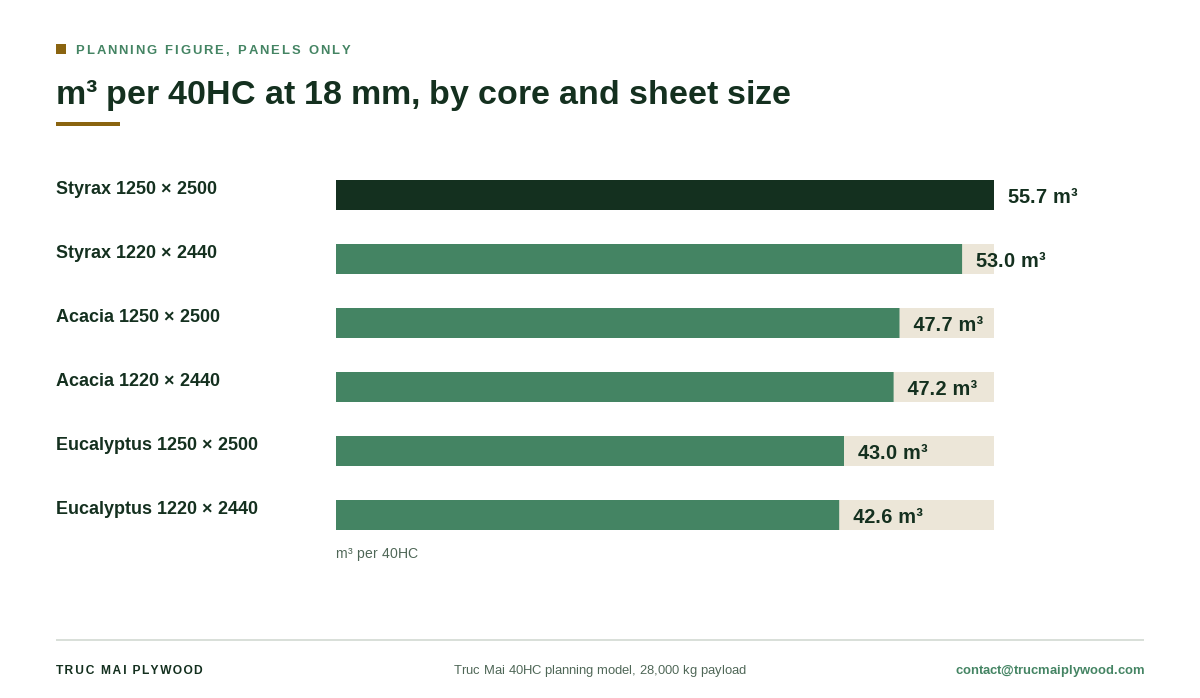
Planning figure, not a loading record: Truc Mai packing lists have not yet been checked against this table. The carrier and the route set the real payload, and real sheets are weighed before final loading.
Buyer guide
What decides plywood m3 per container, and how do you check it on arrival?
Plywood m3 per container is decided by core density and the payload limit: light Styrax fills the volume at about 53–54 m³, dense Eucalyptus stops at about 43 m³ because weight runs out first. On arrival, a buyer checks the load with four counts against the packing list.
A buyer pricing per m³ should compare quotes on the same core, because a Eucalyptus container carries about a fifth less volume than a Styrax one at the same weight. A buyer pricing per sheet should compare sheets per container at the agreed thickness. Either way the payload stays with the carrier, so the figure to ask for is the gross weight on the draft B/L.
| Check | How | Compare with |
|---|---|---|
| Pack count | Count packs at unloading | Packs on the packing list |
| Sheets per pack | Count two packs fully | Pack label and 1,000 ÷ thickness rule |
| Sheet weight | Weigh three sheets | Planning kg per sheet for the core |
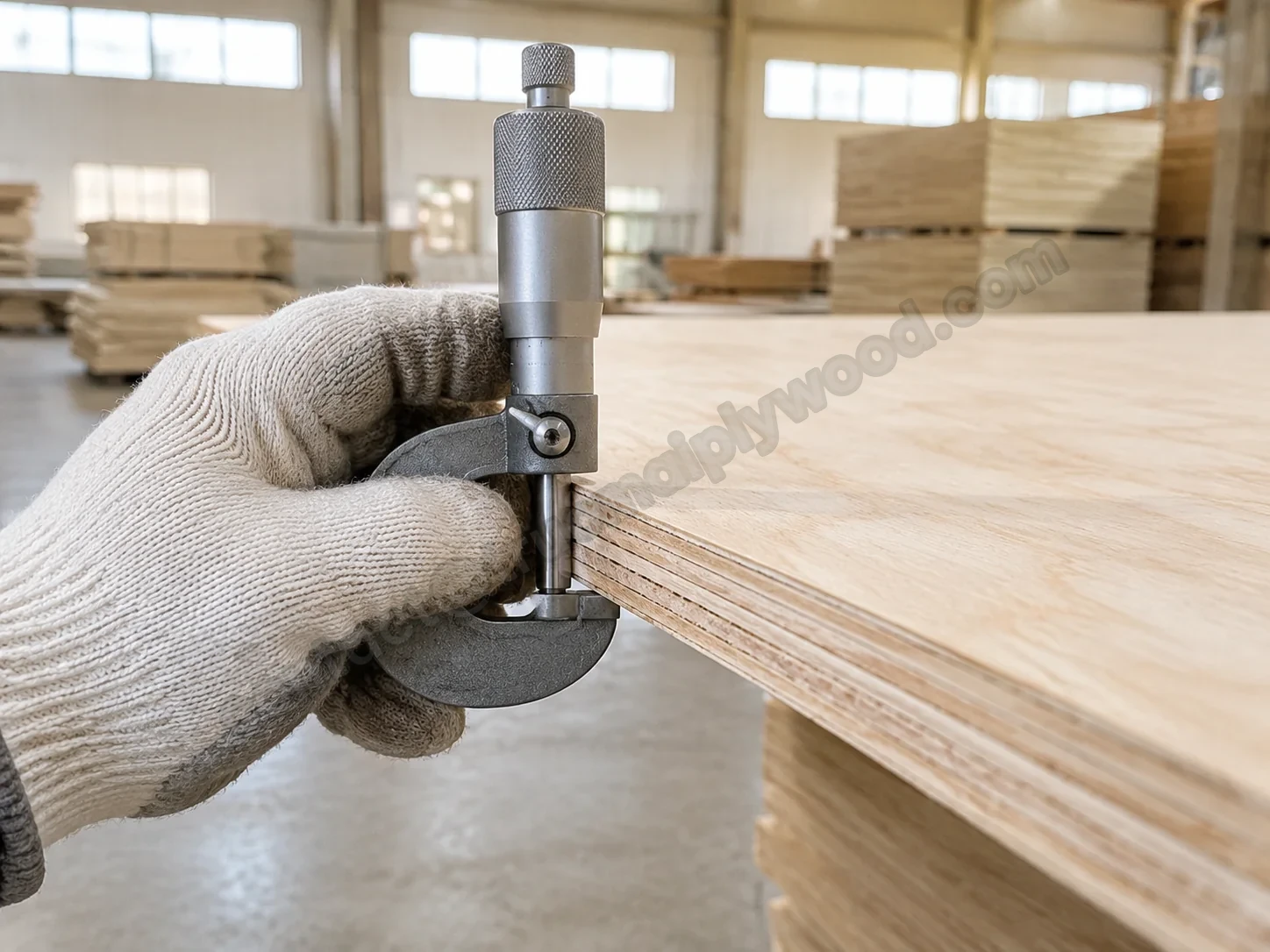
| Thickness | Caliper at four points per sheet | ±0.3–0.5 mm as written on the order |
What arrives with the load
What does a buyer receive with every Truc Mai container?
Every container comes with a packing list written pack by pack, loading photos, the seal number on the draft B/L and the FSC and emission papers of the order. Draft shipping documents go to the buyer for approval after loading, before the balance is paid.
- Packing list Per pack: product, thickness, size, grade, sheets, m³, gross weight
- Photos Pack labels, each row, the door end, the seal
- Draft B/L Seal and container number, gross weight, for approval
- Order papers FSC claim on sales documents, emission papers, test reports for the agreed configuration
- EU lots EUTR and EUDR file set with plot geolocation for core and face
Documents
Which shipping documents come with a plywood 40HC from Vietnam?
Seven documents travel with each container: commercial invoice, packing list, bill of lading, origin document, phytosanitary and fumigation papers, insurance under CIF, and the EUDR file set for EU lots.
- Commercial invoice
Values per product line and the Incoterm: FOB Hai Phong, CFR or CIF; the FSC claim is written here for eligible products.
- Packing list
Pack by pack, with sheet counts, m³ and gross weight that match the pack labels.
- Bill of lading
Sent as a draft for approval; the 70% balance is paid against the scanned B/L.
- Origin document
EUR.1 for EU-bound lots, other forms as the destination requires.
- Phytosanitary and fumigation papers
Plywood is processed wood and outside ISPM 15; solid-wood pallets, battens and dunnage shipped with it fall under that standard.
- EUDR file set
Product, species, quantity and plot geolocation for core and face veneer, under Regulation (EU) 2023/1115, so the EU importer files its own statement.
Capacity
How many containers a month can the Ha Hoa mill load?
The mill presses around 60,000 m³ a year, about 5,000 m³ in an average month. At the 18 mm planning loads that equals about 94 Styrax-core or about 116 Eucalyptus-core 40HC a month at full output. Both are planning figures, computed as 5,000 m³ ÷ 53 m³ and 5,000 m³ ÷ 43 m³.
For a buyer who reorders monthly, the useful number is the slot: production runs 15–45 days after the 30% deposit, depending on quantity, production conditions and agreement. The order from enquiry to loading sets that slot when the spec is fixed.
Order checklist
Which loading lines belong in a plywood purchase order?
Six lines on the order fix the load before production starts, so the packing list and the container match the quote.
Core species per product, for example Styrax-core poplar panels, since the core sets packs per 40HC.
Thickness and sheet size per product, with the sheet count per pack.
Number of products in the container: one or two as standard, up to six by agreement.
Payload limit for your carrier and route, if lower than 28,000 kg.
Pack label content and language, and any buyer marks.
Loading photos and documents wanted with the drafts, including the EU or US file set.
FAQ
Plywood container loading: buyer questions
Short answers with the planning numbers, by core and sheet size.
Does plywood core type affect container loading?
Yes. Styrax core loads 18 packs per 40HC, Acacia 16 and Eucalyptus 15, because denser cores reach the 28,000 kg planning payload before the container is full.
How many 18 mm sheets fit in a 40HC on Styrax, Acacia or Eucalyptus core?
At 1220 × 2440 mm the planning figure is 990 Styrax sheets (about 53 m³), 880 Acacia sheets (about 47 m³) or 795 Eucalyptus sheets (about 43 m³). Real sheets are weighed before final loading.
Why does a Eucalyptus-core container hit the weight cap first?
Eucalyptus is about 650 kg/m³ against 500 for Styrax, so an 18 mm sheet weighs about 34.8 kg instead of 26.8 kg. The payload runs out at about 43 m³, before the volume is used.
Does the 1250 × 2500 mm sheet change the m³ per container?
Yes, on Styrax it raises the load from about 53.0 to about 55.7 m³ at 18 mm with the same 990 sheets. On Acacia and Eucalyptus the larger sheet hits the weight cap, so the sheet count falls to 848 and 765.
Can core types or thicknesses be mixed in one 40HC?
Yes. A container usually carries one or two products, and three to six products can be mixed by agreement; the pack plan then follows the heaviest core.
How many packs go in a 40HC and how high is each pack?
The plan is 18 packs on Styrax core, 16 lying and 2 upright at the door end, 16 on Acacia and 15 on Eucalyptus. Each pack is about 1,000 mm high.
How many sheets are in one pack of plywood?
Sheets per pack are 1,000 mm divided by the thickness, rounded down, then capped by weight. That gives 55 sheets of 18 mm, 83 of 12 mm and 333 of 3 mm on Styrax.
Are these loading numbers measured or calculated?
They are planning figures computed from the Truc Mai packing model, panels only, with 28,000 kg of cargo and the container tare excluded. The carrier and the route set the real payload.
Do plywood packs need ISPM 15 treatment?
Plywood itself is processed wood and outside ISPM 15. Solid-wood pallets, battens and dunnage shipped with it fall under ISPM 15.
What do I receive after the container is loaded?
You receive loading photos and draft shipping documents for approval, including the packing list per pack and the draft B/L with the seal number. The 70% balance is paid against the scanned B/L.
Quotation
Ask for a loading plan with your quotation
Send the core, thickness, sheet size and number of products, and the quotation comes back with sheets, m³ and packs per 40HC as a planning figure.
State core, thickness, sheet size, face, products per container and destination port. The reply gives the pack plan and the planning load.