
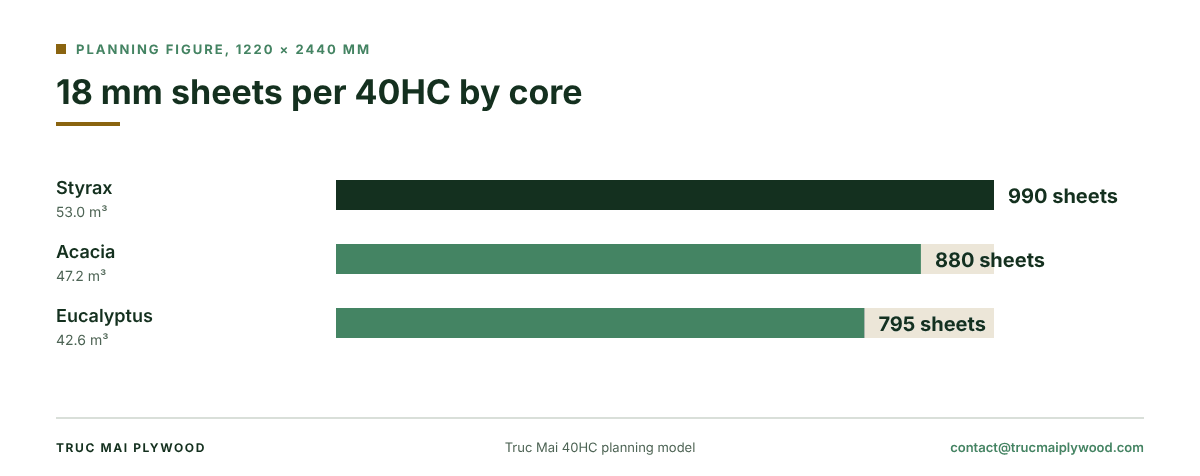
A 40HC takes 990 sheets of 18 mm plywood on Styrax core, 880 on Acacia or 795 on Eucalyptus (1220 × 2440 mm, planning figures). Choose the core before comparing prices: the heavier sheet reaches the 28,000 kg payload first, so the same box carries about 42.6 m³ instead of 53 m³. Truc Mai writes these lines into every repeat order.
How many 18 mm sheets fit in a 40HC?
At 1220 × 2440 mm, one 40HC takes 990 sheets of 18 mm board when the core is Styrax, against 880 for Acacia and 795 for Eucalyptus. Truc Mai’s packing model produces these counts as planning figures from three inputs: a 28,000 kg cargo payload, 55 sheets in a full pack and a pack height of about 1,000 mm.
The core species sets how many packs fit under that weight, which is why the three rows differ by almost 200 sheets.
18mm plywood 2440 x 1220 in a 40HC
The table uses the standard 4 × 8 ft sheet, written 1220 × 2440 mm here and often searched as 18mm plywood 2440 x 1220.
| 18 mm, 1220 × 2440 mm | Packs × sheets | Sheets per 40HC | Volume | Cargo weight |
|---|---|---|---|---|
| Styrax core | 18 × 55 | 990 sheets | 53.0 m³ | 26,523 kg |
| Acacia core | 16 × 55 | 880 sheets | 47.2 m³ | 27,348 kg |
| Eucalyptus core | 15 × 53 | 795 sheets | 42.6 m³ | 27,689 kg |
All three rows are planning figures, panels only, with the container tare excluded. The Eucalyptus row is weight-capped: its packs hold 53 sheets instead of 55, because a fifteenth full pack would push the load past the payload. The Styrax row is the only one that uses all 18 pack positions, 16 lying in a 4 × 4 block and 2 standing upright at the door end.
The same model gives the European format. Switch to 1250 × 2500 mm and Styrax still loads 990 sheets, now 55.7 m³, while Acacia falls to 848 sheets (16 × 53, 47.7 m³) and Eucalyptus to 765 sheets (15 × 51, 43.0 m³), both held back by weight. A buyer who moves from 1220 × 2440 to 1250 × 2500 on Styrax gains volume without losing a sheet.
Run your own mix of thickness and core in the 40HC load calculator, and read how a container is packed and lashed on loading a 40HC at the mill. The carrier and the route decide the real payload, so the figure on the booking always comes first.
How much does an 18 mm sheet weigh on Styrax, Acacia and Eucalyptus core?
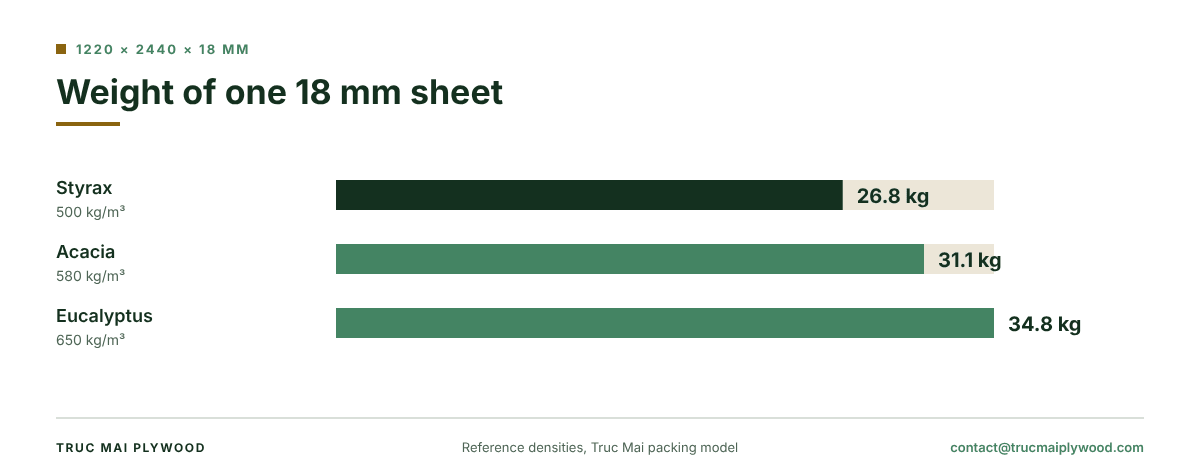
An 18 mm sheet of 1220 × 2440 mm weighs about 26.8 kg on Styrax core, 31.1 kg on Acacia and 34.8 kg on Eucalyptus. Each figure is the sheet volume of 0.0536 m³ multiplied by a reference density: 500 kg/m³ for Styrax, 580 kg/m³ for Acacia and 650 kg/m³ for Eucalyptus.
18 mm plywood weight, kg per sheet
| Sheet size, 18 mm | Styrax core | Acacia core | Eucalyptus core |
|---|---|---|---|
| 1220 × 2440 mm (4 × 8 ft) | 26.8 kg | 31.1 kg | 34.8 kg |
| 1250 × 2500 mm (European) | 28.1 kg | 32.6 kg | 36.6 kg |
| 1220 × 2280 mm (furniture parts) | 25.0 kg | 29.0 kg | 32.5 kg |
| Reference density | 500 kg/m³ | 580 kg/m³ | 650 kg/m³ |
Eucalyptus has the widest spread. The mill measures it at 650–750 kg/m³, and at the top of that range the same 1220 × 2440 × 18 mm sheet weighs about 40.2 kg. That difference is why Eucalyptus loads are planned as weight-capped, and why real sheets are weighed before the final loading plan is fixed.
Sheet weight matters twice for an importer. It sets how many sheets the container takes, and it sets what a warehouse team or a CNC loader handles every day. A cabinet plant cutting 18 mm carcass parts by hand lifts a Styrax sheet that is about 8 kg lighter than a Eucalyptus sheet of the same size.
Why does the core decide the 40HC load at 18 mm?
At 18 mm, every core fills the container by weight before it fills it by space. A pack 1,000 mm high holds 55 sheets of 18 mm, and 18 packs of Styrax weigh about 26,523 kg, under the 28,000 kg planning payload. Acacia and Eucalyptus reach that weight with fewer packs, so part of the box stays empty.
Pack positions are capped in the model at 18 for Styrax, 16 for Acacia and 15 for Eucalyptus. The sheet count per pack is simple at this thickness: 1,000 mm of pack height over 18 mm, rounded down, gives 55 sheets, and the weight limit then trims Eucalyptus to 53.
The volume gap is the practical cost. Styrax ships 53.0 m³ of 18 mm panel per container, Eucalyptus 42.6 m³. Over a programme of 12 containers a year, Styrax moves about 125 m³ more panel than Eucalyptus for the same freight, handling and port charges.
Switching an 18 mm furniture order from Acacia to Styrax core tends to bring three gains at once: a cleaner face, a lighter sheet and more m³ in each box. Acacia and Eucalyptus still have their place: they are denser cores, chosen where a buyer wants the heavier feel of the panel or prices the sheet rather than the m³.
Stacking extra 18 mm sheets onto a pack to squeeze more into the box does not pay. Pallet feet give way under an overweight pack, and one pallet that breaks at the discharge port costs more than the sheets riding on it.
How many plies does 18 mm plywood have?
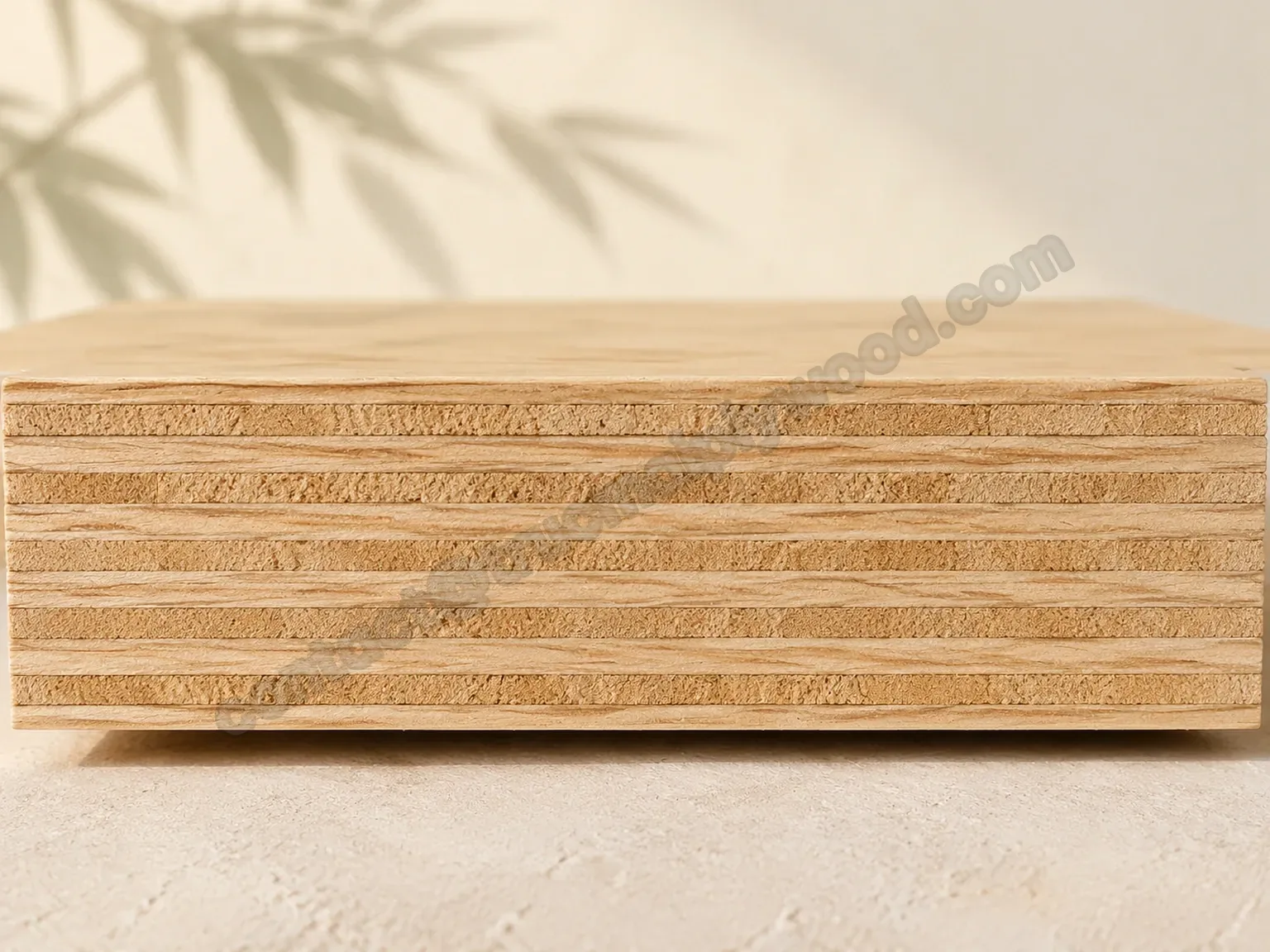
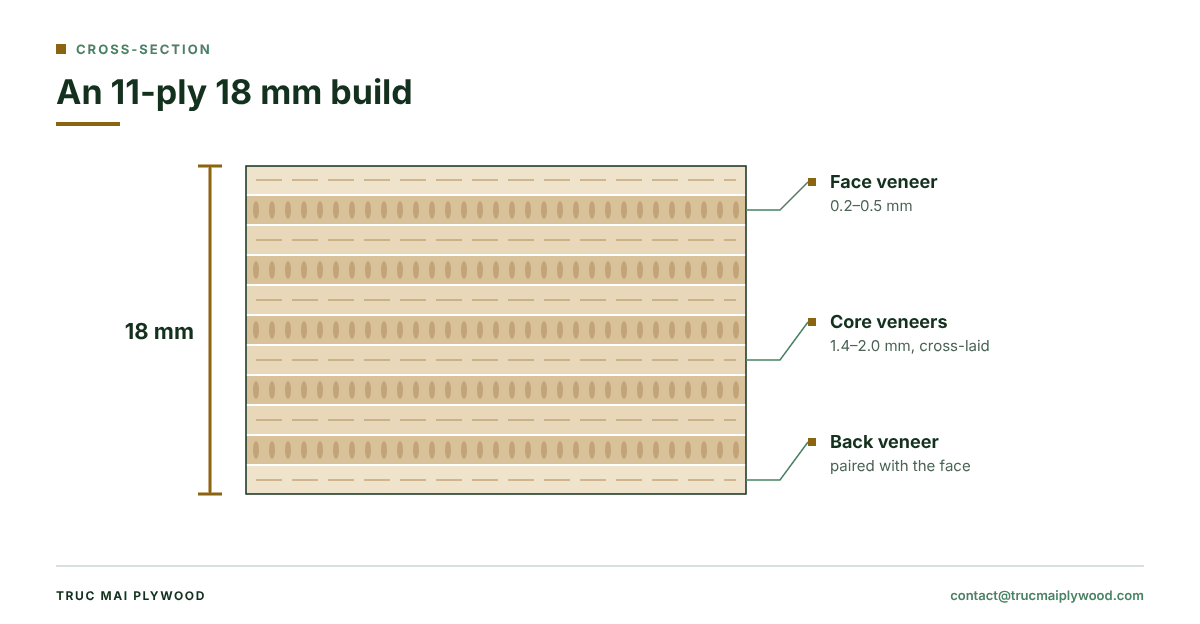
Truc Mai builds 18 mm plywood with 11–13 plies, most often 11. Two face veneers of 0.2–0.5 mm sit over cross-laid core veneers of 1.4–2.0 mm, each ply turned 90 degrees to the one below it. An odd ply count keeps the panel balanced, with the grain of both faces running the same way.
The ply count goes on the order beside the core species. Two offers for “18 mm, 11 plies” can still differ in core grade and joining, so the order also names the core build by line:
| 18 mm line | Core grade and joining | Faces | Usual emission |
|---|---|---|---|
| Furniture and interior | A-grade core, stitched | Sanded and calibrated | E0 (UF glue) |
| Commercial | AB core, loose-laid or jointed | Unsanded or lightly sanded | E0 (UF glue) |
| Packing | AB core, loose-laid | As pressed | Usually E2 |
Core stitching runs across and along the sheet. On most 18 mm orders the outer 2–4 plies are stitched, and all plies can be stitched on request. Stitching keeps the core veneers closed under the face, which shows up later as fewer dips under a high-gloss lacquer or a thin laminate.
Face veneer for Europe is usually 0.3 mm. EV faces arrive at 0.3 or 0.4 mm. A thicker face gives a cabinet maker more room for sanding before the core shows through, and it is one of the lines that separates a furniture-grade 18 mm panel from a commercial one.
Is 18 mm plywood the same as 3/4 inch?
No. Under the UK Weights and Measures Act 1985 a yard is exactly 0.9144 metre and an inch is 1/36 of a yard. The inch therefore measures 25.4 mm and three-quarters of it 19.05 mm, so an 18 mm panel comes out 1.05 mm thinner, about 0.709 in. The two are often sold for the same jobs, but they do not measure the same on a caliper.
The difference matters where parts meet hardware. Hinge plates, drawer runners and CNC dado depths are often drawn for one nominal thickness. A US cabinet shop that cuts grooves for 19.05 mm and receives 18 mm panels gets loose joints; a European shop drawing for 18 mm gets a panel that will not seat.
The fix is to write the actual thickness and its tolerance on the order, never only the nominal name. A line such as “18 mm ±0.3 mm, sanded, calibrated” leaves no room for doubt at the inspection table. For US orders, see the planned guide to three-quarter inch sheets, and convert other sizes with the mm to inch converter.
| Written on the order | Metric | Inch |
|---|---|---|
| 18 mm | 18.00 mm | about 0.709 in |
| 3/4 in (true) | 19.05 mm | 0.750 in |
| Difference | 1.05 mm | about 0.041 in |
What thickness tolerance is written for 18 mm furniture panels?
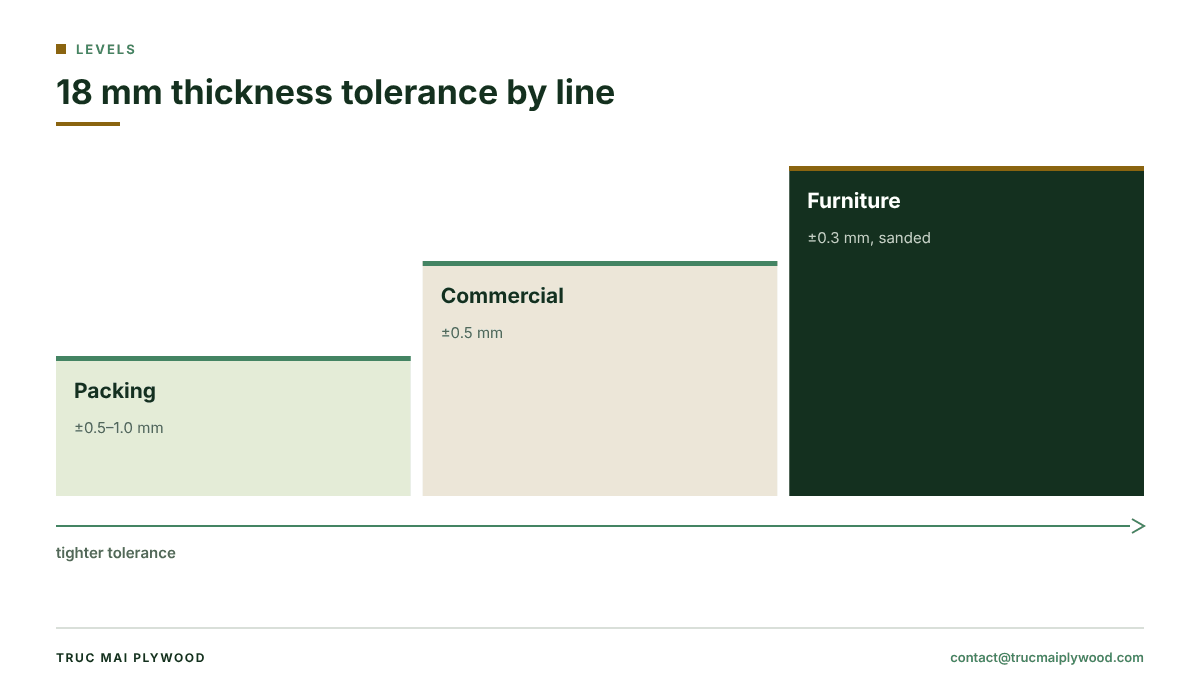
Truc Mai writes ±0.3 mm for sanded and calibrated 18 mm furniture panels. Commercial grade is written at ±0.5 mm and packing grade at ±0.5–1.0 mm, while length and width hold ±2 mm on every line. The figure is agreed per order and printed on the order sheet, so each container is measured against the same number.
| 18 mm line | Thickness tolerance | Length and width | Face preparation |
|---|---|---|---|
| Furniture and interior | ±0.3 mm | ±2 mm | Sanded and calibrated |
| Commercial | ±0.5 mm | ±2 mm | Unsanded or lightly sanded |
| Packing | ±0.5–1.0 mm | ±2 mm | As pressed |
A tolerance tighter than ±0.3 mm is not offered on Truc Mai panels. Buyers who need a closer fit for CNC nesting or edge banding get it from the calibrated, sanded furniture line, which takes both faces down to the written thickness after pressing.
Write the measuring method beside the tolerance: where on the sheet the caliper goes, how many points per sheet and how many sheets per pack. An agreed method turns a disputed pack into a measured one.
Can 18 mm be ordered in 1220 × 2280 mm?
Yes. Truc Mai makes 18 mm plywood in 1220 × 2280 mm as a regular size, beside 1220 × 2440 mm (4 × 8 ft) and 1250 × 2500 mm, the European format. The shorter sheet suits furniture plants whose parts nest into the shorter length with less offcut than a full 4 × 8 ft sheet.
Each 1220 × 2280 × 18 mm sheet holds 0.0501 m³, about 6.6% less than a 1220 × 2440 mm sheet. On Styrax core it weighs about 25.0 kg, on Acacia 29.0 kg and on Eucalyptus 32.5 kg. The 40HC count for this size is planned per order, because pack positions change with the sheet length.
Custom sizes go up to 1250 × 2500 mm and nothing larger. Panels of 1500 × 3000 mm or 1525 × 1525 mm are cut from standard sheets instead. Cut-to-size orders split one sheet into 2, 3, 4 or 6 panels before packing, so a buyer can receive carcass sides ready for edge banding.
See the planned 1220 × 2280 mm panels page for the faces offered in the short format.
Which core suits each 18 mm application?
Styrax suits most 18 mm furniture and interior work, because it is the lightest core and fills the most m³ per 40HC. Acacia and Eucalyptus suit buyers who want a denser, heavier panel or price by the sheet. Combined cores lay species together to balance price, weight and appearance.
| 18 mm use | Usual core | Line and tolerance | Why |
|---|---|---|---|
| Kitchen and wardrobe carcasses | Styrax | Furniture, ±0.3 mm | Light sheet, sanded face for laminate or lacquer |
| Shelving and table tops | Styrax or Acacia | Furniture, ±0.3 mm | Acacia adds weight where a buyer wants it |
| Shop fitting and interior joinery | Styrax | Furniture, ±0.3 mm | Most m³ per container on a repeat programme |
| Commercial resale sheets | Acacia or Eucalyptus | Commercial, ±0.5 mm | Sheet priced and sold by the piece |
| Crates and packing | Eucalyptus or combined | Packing, ±0.5–1.0 mm | AB loose-laid core, usually E2 emission |
Truc Mai does not use rubberwood core. Vietnamese plywood has no poplar or birch cores either: poplar, birch, gurjan, okoume and bintangor arrive on Vietnamese panels as face veneers over a Vietnamese core.
The core is one line of the specification, never the whole of it. A full 18 mm order names core species, core grade, glue and emission class, face and back, sheet size, tolerance, packing and quantity. The planned guide to choosing a plywood thickness sets 18 mm against the thinner and thicker options.
Which faces can an 18 mm Truc Mai panel carry?
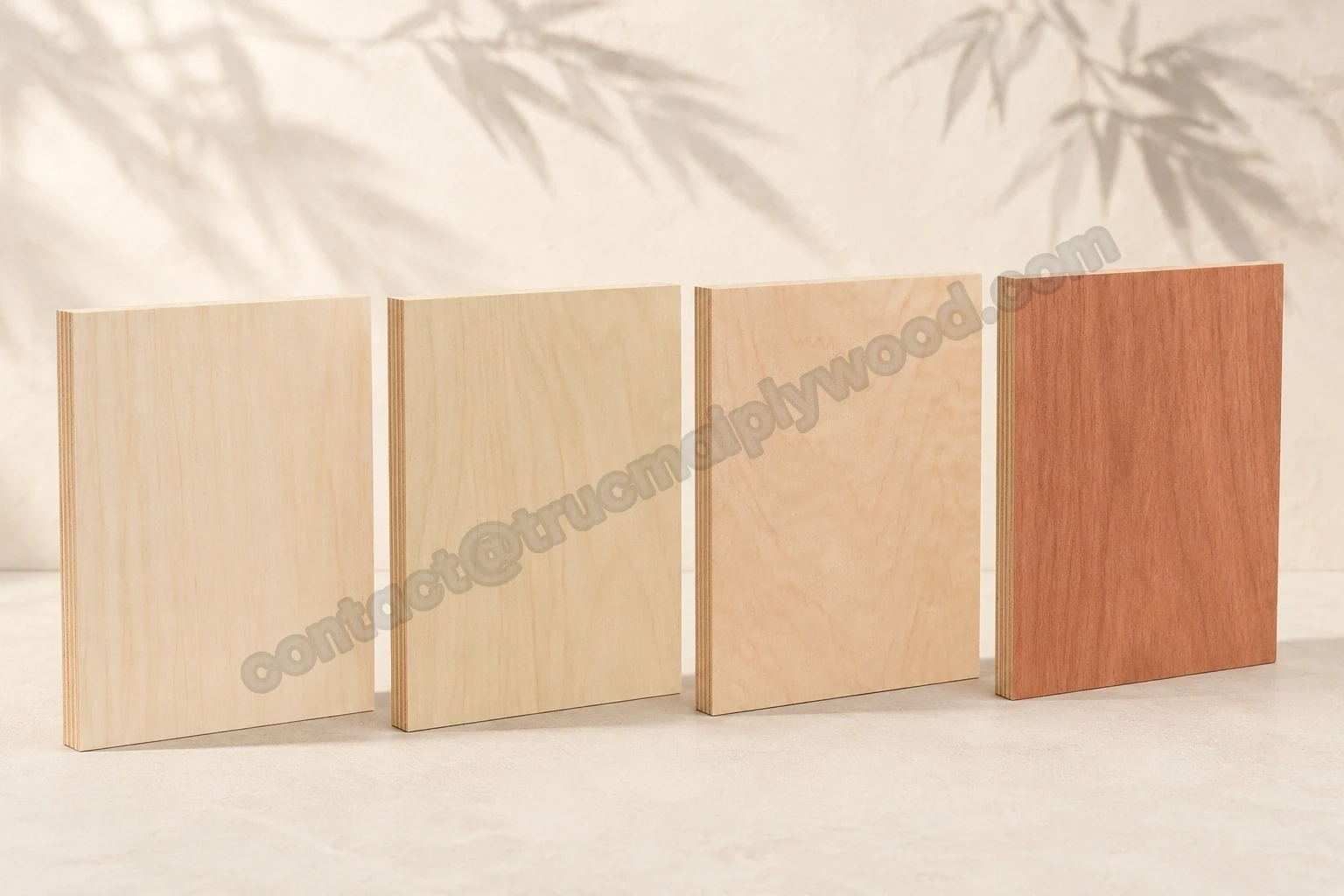
An 18 mm Truc Mai panel can carry EV (engineered veneer), poplar or bleached poplar, birch, okoume, bintangor, pine, eucalyptus, gurjan, sapele and other faces on request. Face and back are quoted as a pair, and the face grade is agreed against an approved sample.
EV on Styrax core is a regular Truc Mai build. Factory photos and a clip from the Truc Mai mill show white poplar EV faces on Styrax core panels at the trimming line. In Europe this face is called white poplar EV: a reconstituted veneer made from plantation poplar (Populus deltoides), imported in 2500 × 1300 mm sheets at 0.3 or 0.4 mm, and available as FSC 100%.
Birch on a Truc Mai panel is an imported face veneer on a Vietnamese core, sold as birch-faced plywood. It is never all-birch plywood, and the order should say so.
On 18 mm the faces leave the line sanded and calibrated, and polishing is available on request. A “UV-ready” panel has both faces prepared so the buyer can lay its own UV coat; Truc Mai does not apply UV itself. Panels overlaid with melamine, HPL or paper are also made at 18 mm, see the furniture and interior plywood group and the poplar plywood page.
Truc Mai does not make 18 mm marine, structural or film-faced formwork plywood.
What glue and emission class does an 18 mm order carry?
The default 18 mm Truc Mai panel is made with UF glue at E0 emission, which gives about 6 hours of boil resistance. Panels for outdoor exposure use melamine-fortified glue for a 12-hour boil, usually at E1 emission. Glue type and emission class are two separate lines on the order.
CARB Phase 2 and EPA TSCA Title VI apply to hardwood plywood sold in the United States. Truc Mai holds certificate CARB/EPA 26053 in its own name, issued by ICTT Corporation (approved third-party certifier TPC-43, mill ICTT-26053). It covers hardwood plywood with veneer core from 3–25 mm and 3–15 plies, so every 18 mm build is inside its scope. The federal limit for that product is 0.05 ppm formaldehyde under 40 CFR 770.10.
European buyers work to a different limit. Regulation (EU) 2023/1464 created entry 77 for formaldehyde in REACH Annex XVII, and from 6 August 2026 an 18 mm carcass panel, like any wood-based article or piece of furniture sold in the EU, may release at most 0.062 mg/m³ in the Appendix 14 chamber test. US ppm results are never converted into that unit; a European chamber test is ordered separately when the buyer needs one.
| Glue on the order | Boil resistance | Usual emission | Press temperature |
|---|---|---|---|
| UF glue (default) | About 6 hours | E0 | About 110–120 °C |
| Melamine-fortified glue | 12-hour boil | E1 | Set to the glue |
| WBP | Per order | Per order | About 130–145 °C |
The press temperature goes with the glue, so an order that changes glue also changes the press setting.
Which papers travel with an 18 mm container?
An 18 mm container leaves Hai Phong with the usual shipping set: invoice, packing list and B/L, an origin certificate (an EUR.1 on EU lots), phytosanitary and fumigation papers, and an insurance policy when the term is CIF. The certificates the order calls for go with it, plus the EUDR file set on EU lots, and certificate files reach the buyer before the order is confirmed. Each paper is explained on documents per container.
Truc Mai supplies with the EU file set and these certificates in its own name:
| Certificate or file | Number | What it covers on an 18 mm order |
|---|---|---|
| FSC chain of custody | FSC-C196493 / SA-COC-014545 | The FSC 100% line on invoice and packing list, if the 18 mm product is listed |
| CARB P2 and TSCA Title VI | CARB/EPA 26053 | Veneer-core hardwood plywood of 3–25 mm, so every 18 mm build |
| ISO 9001:2015 | W2012 (WCERT) | The quality system behind the 18 mm build and its checks |
| ISO 14001:2015 | W2012E (WCERT) | The environmental system of the mill that presses the panel |
| EUDR due-diligence data | Geolocation for core and face | Plot coordinates and GeoJSON for the EU importer’s statement |
| PPWR packaging test | Held | Packaging materials tested, not the panel |
The FSC certificate licenses FSC 100% products only, with no FSC Mix, and the claim is stated on sales and shipping documents for products on the current schedule. The full certificate story is on the FSC 100% page.
EUDR is a file set, not a certificate. Regulation (EU) 2023/1115 asks for the geolocation of every production plot, described with “at least six decimal digits”. Truc Mai supplies that data for both the Vietnamese core and the face veneer, so the EU importer can file its own due-diligence statement. An 18 mm panel with an EV face, for example, carries origin records for the Acacia or Styrax core logs and for the plantation poplar behind the face. See the planned EUDR geolocation data page.
Plywood is processed wood and sits outside ISPM 15. Solid-wood pallets, battens and dunnage shipped with it fall under ISPM 15, which is why the packing material carries its own treatment mark.
How do you keep 18 mm the same, container after container?
Keep the order sheet fixed and measure against it. A repeat 18 mm programme holds when core species, ply count, glue and emission class, face and back grades, tolerance, sheet size and pack count are written once and copied onto every new order. The approved face sample stays the reference for grading.
Truc Mai grades faces against the sample the buyer approved and quotes face and back grades as pairs. Each line keeps its build until the buyer asks for a change: an A-grade stitched core under sanded faces for the furniture line, an AB core for the commercial line. Before the loading plan is closed the mill weighs real sheets, and the packing list shows those measured weights next to the planned count.
- Approve a free sample of the exact 18 mm build, face and core.
- Write the order line: core, plies, glue and emission, face and back, size, tolerance, packing.
- Fix the pack count and the loading plan from the planning table and the booked payload.
- Check the first container against the order line and keep its packing list as the reference.
- Send the same order line each month and change nothing but the quantity or one named item.
The Ha Hoa mill ships around 5,000 m³ of panel in an average month and about 60,000 m³ over a year. A monthly 18 mm programme of one or two 40HC fits inside that output without the build changing. The planned repeat spec control page shows how the mill keeps that order line steady.
How long does an 18 mm container take from deposit to loading?
An 18 mm container is produced in 15–45 days from the 30% deposit; quantity, production conditions and the agreed schedule decide where in that window it lands. The remaining 70% falls due once the buyer holds the scanned B/L, and the payment and delivery terms in full are on deposit and balance terms.
One 40HC is the minimum. Most 18 mm containers hold one or two products, and a mix of three to six is possible by agreement: 18 mm carcass panels with 9 mm backs, or an 18 mm EV-faced lot beside a commercial 18 mm lot. Draft shipping documents go to the buyer for approval after loading.
Two lanes cover most 18 mm buyers. A European kitchen-carcass lot spends about 30–40 days at sea to Northern Europe, and a US West Coast cabinet lot about 20–30 days; the other lanes, and what the box rate means per m³ of 18 mm board, are on sea freight per m³.
Carrier and route move those days. Add the sea time to the production window to find the arrival month of a first 18 mm order, then keep that rhythm for the repeats so each container lands when the last one runs out.
What should an 18 mm order line say?
An 18 mm order line names eight things: application, core, plies, glue and emission, face and back, sheet size with tolerance, packing and quantity. Written once, the same line is sent with every repeat order and checked on every container.
A filled example for a European kitchen-carcass buyer:
Use: kitchen carcasses, 18 mm plywood. Core: Styrax, A-grade, stitched, 11 plies. Glue and emission: UF, E0. Face / back: white poplar EV / poplar, with the FSC 100% claim and the EUDR file set (core and face geolocation). Size and tolerance: 1220 × 2440 mm, sanded and calibrated to ±0.3 mm, ±2 mm on length and width. Packing: export packs about 1,000 mm high. Quantity and terms: 990 sheets, 1×40HC, FOB Hai Phong.
A US cabinet buyer changes three items: the thickness line (18 mm or 19.05 mm), the emission line (CARB P2 / TSCA Title VI, certificate CARB/EPA 26053) and the port terms. A packing buyer changes the line to Eucalyptus or combined core, packing grade, ±0.5–1.0 mm.
Paste that line into the quotation desk form or email it to contact@trucmaiplywood.com. Ask for the free sample in exactly that 18 mm build, so the face you approve is the face that is loaded.
Questions buyers ask
How many sheets of 18 mm plywood fit in a 40ft high cube container?
The Truc Mai planning model puts 990 sheets of 1220 × 2440 × 18 mm in a 40HC when the core is Styrax; an Acacia core gives 880 and Eucalyptus 795. The counts come from pack height and payload, so treat them as planning figures rather than a loading record.
How much does an 18 mm plywood sheet weigh in kg?
A 1220 × 2440 × 18 mm sheet weighs about 26.8 kg on Styrax core, 31.1 kg on Acacia and 34.8 kg on Eucalyptus, using reference densities of 500, 580 and 650 kg/m³. Real sheets are weighed before final loading.
How many layers does 18 mm plywood have?
Truc Mai builds 18 mm plywood with 11–13 plies, most often 11. The count is written on the order, so the build stays the same from container to container.
Is 18 mm plywood 3/4 inch?
No. 3/4 inch is 19.05 mm, so an 18 mm panel is 1.05 mm thinner, about 0.709 in. US buyers who need a true 3/4 inch panel write 19.05 mm or the nominal size they accept on the order.
What tolerance should I write for 18 mm furniture plywood?
Write ±0.3 mm for sanded and calibrated furniture panels, ±0.5 mm for commercial grade and ±0.5–1.0 mm for packing grade. Length and width hold ±2 mm.
Can I order 18 mm plywood in 1220 × 2280 mm?
Yes. Truc Mai makes 1220 × 2280 mm as a regular size for furniture parts, beside 1220 × 2440 and 1250 × 2500 mm.
Which core is lightest for 18 mm plywood?
Styrax is the lightest of the three Vietnamese cores at a reference 500 kg/m³. It gives the most sheets and the most m³ per 40HC at 18 mm.
Is 18 mm plywood from Truc Mai CARB P2 certified?
Yes. Certificate CARB/EPA 26053 for CARB P2 and TSCA Title VI runs from 3 to 25 mm of veneer-core hardwood plywood, so an 18 mm panel falls inside its scope.
Does Truc Mai make 18 mm marine or film-faced plywood?
No. Truc Mai makes 18 mm furniture, interior, commercial and packing plywood; marine, structural and film-faced formwork panels are outside its range.
Can 18 mm be mixed with other thicknesses in one container?
Yes. Most containers carry one or two products, and by agreement three to six can share one box, for example 18 mm carcass panels loaded with thinner backs.
How long does an 18 mm container take to produce?
Production takes 15–45 days after the 30% deposit, depending on quantity and the agreed schedule. The balance of 70% is paid against the scanned B/L.
What documents come with an 18 mm plywood container?
Commercial invoice, packing list, B/L, certificate of origin, phytosanitary and fumigation papers, plus the FSC claim, emission certificate and EUDR file set when the order needs them.