
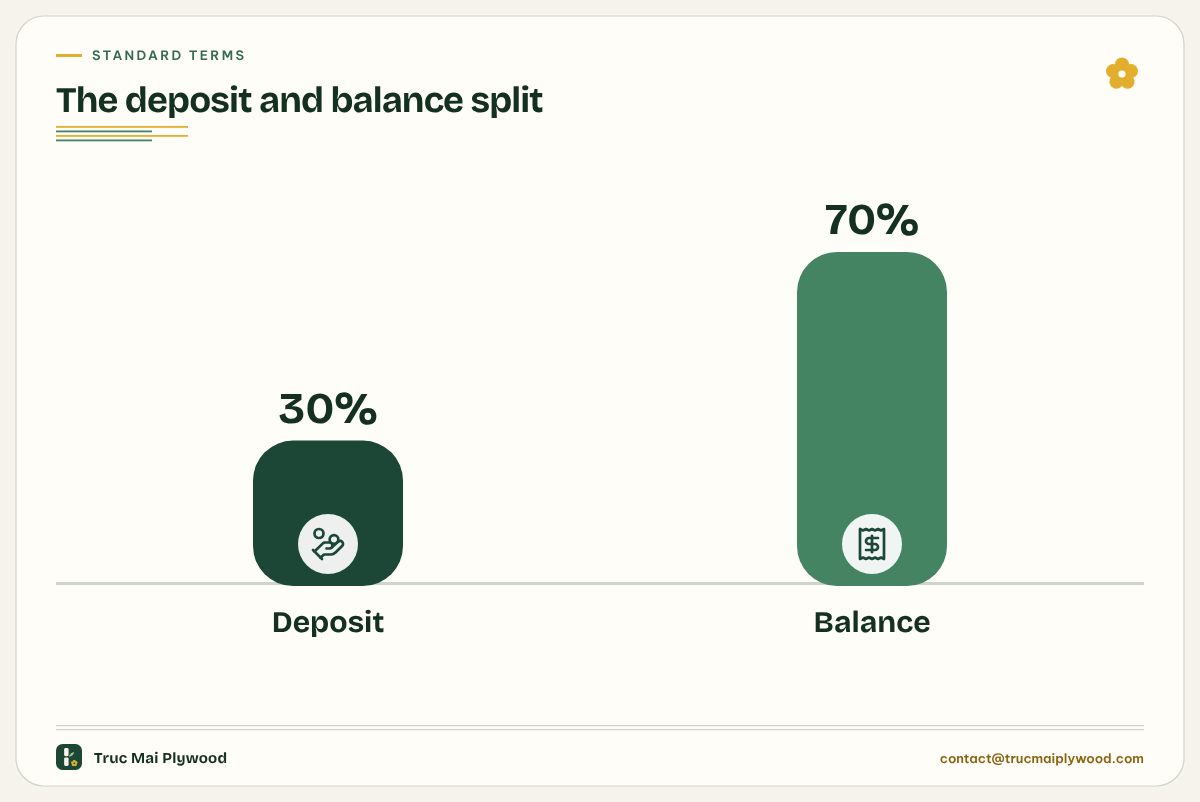
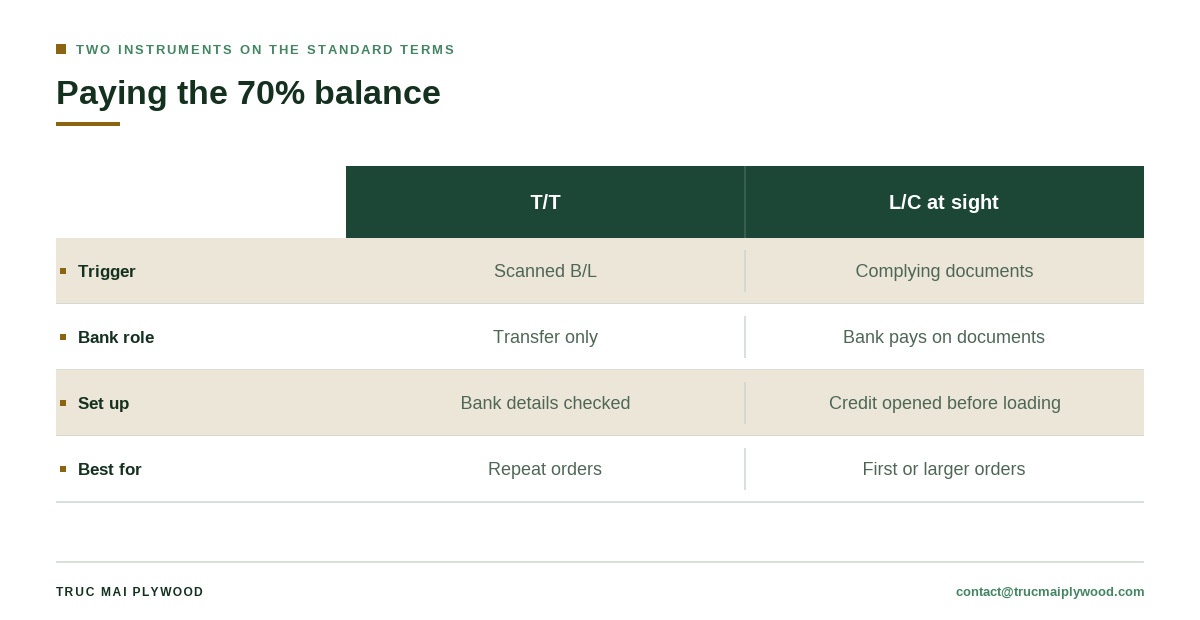
Most Vietnamese plywood mills work on a 30% deposit by T/T to start production and a 70% balance once the goods are loaded. At Truc Mai the balance is paid against the scanned bill of lading, by T/T or irrevocable L/C at sight, after the buyer approves the draft documents. Get the trigger wrong and the money moves before the proof does.
What payment terms do Vietnamese plywood suppliers usually accept?
Vietnamese plywood suppliers usually accept a 30% deposit by T/T and a 70% balance after loading, by T/T or letter of credit. At Truc Mai the balance is paid against the scanned bill of lading, by T/T or irrevocable L/C at sight, once the buyer has approved the draft documents. The minimum order is one 40HC.
Those are the standard terms, and they are the same on the first container and the fiftieth. They divide the risk in a way both sides can check. The deposit pays for the mill’s commitment: veneer bought, a press booked. The balance pays for goods that are on board a vessel, against a document the carrier issues, not against the mill’s word.
| Term | Truc Mai’s standard |
|---|---|
| Deposit | 30% by T/T when the order is confirmed |
| Production | 15–45 days after the deposit, depending on quantity, production conditions and agreement |
| Draft documents | Sent to the buyer for approval after loading |
| Balance | 70% against the scanned B/L |
| Balance instrument | T/T or irrevocable L/C at sight |
| Minimum order | One 40HC |
| Delivery terms | FOB Hai Phong, CFR (CNF) or CIF |
The rest of this page takes each line in turn: when it applies, what it protects, and what the buyer should check before money moves. The fixed terms in one place are on MOQ, payment and FOB terms.
What deposit is paid before production starts?
A 30% deposit is paid by T/T when the order is confirmed, and production starts when it arrives. It is paid after the order line, the sample and the certificate files are agreed, so the buyer knows exactly which panel the 30% buys and the mill knows exactly which panel to make.
The deposit is not a booking fee. It turns a quotation into a production order: the mill buys face veneer for the agreed face, takes core veneer of the agreed species and grade, and schedules the press. Without it, a quote is only a price that holds for a time.
Before the deposit, three things should already be in the buyer’s hands:
- The order line in writing. Core, glue and emission class, face and back grades, thickness and tolerance, sheet size, packing and quantity. The format is in the RFQ guide.
- The approved sample. The face grade is agreed against it and written on the order. Samples cost nothing; a new buyer pays for the courier and later sees that cost credited on a real order.
- The certificate files. At Truc Mai they are sent before the order is confirmed: the FSC certificate, the emission certificate and the test reports for the agreed configuration, plus the EUDR data for EU lots.
If one of the three is missing, the deposit is early. The checks a first-time buyer can run before paying are listed on verify a mill before the deposit.
How long after the deposit does production take?
Production takes 15–45 days after the deposit arrives, depending on quantity, production conditions and agreement. A single container of a standard build sits at the short end; a full container of a face that needs scarce veneer, or several containers at once, sits nearer the long end.
Plywood production lead time in Vietnam: what moves it
- The face. Good thin veneer is scarce, which is why 4 mm panels can take longer; an unusual face can do the same.
- The build. A stitched furniture core with sanded and calibrated faces takes more steps than a loose-laid commercial core.
- The quantity. Several containers in one order are scheduled across presses and weeks.
The 15–45 days run from the deposit, not from the first email. A buyer who needs a container on a date counts back from that date: sea days from Hai Phong, plus loading, plus up to 45 days of production, plus the time to agree the line and the sample. For Northern Europe the sea leg is typically 30–40 days and for the US East Coast 35–45 days, depending on carrier and route.
When is the 70% balance due?
The 70% balance is due against the scanned bill of lading, after the buyer has approved the draft documents. In practice that means a few days after loading: the container is sealed, the carrier issues the B/L, the mill sends the drafts and the scan, and the buyer pays once the papers match the order.
The trigger is a document, not a date. “70% before shipment” asks the buyer to pay for goods still in the yard; “70% on arrival” asks the mill to ship goods worth more than the deposit on credit. “70% against the scanned B/L” sits between them: the goods are on board, the carrier has said so in writing, and the buyer has seen the papers before paying.
T/T deposit, balance against B/L copy: the sequence
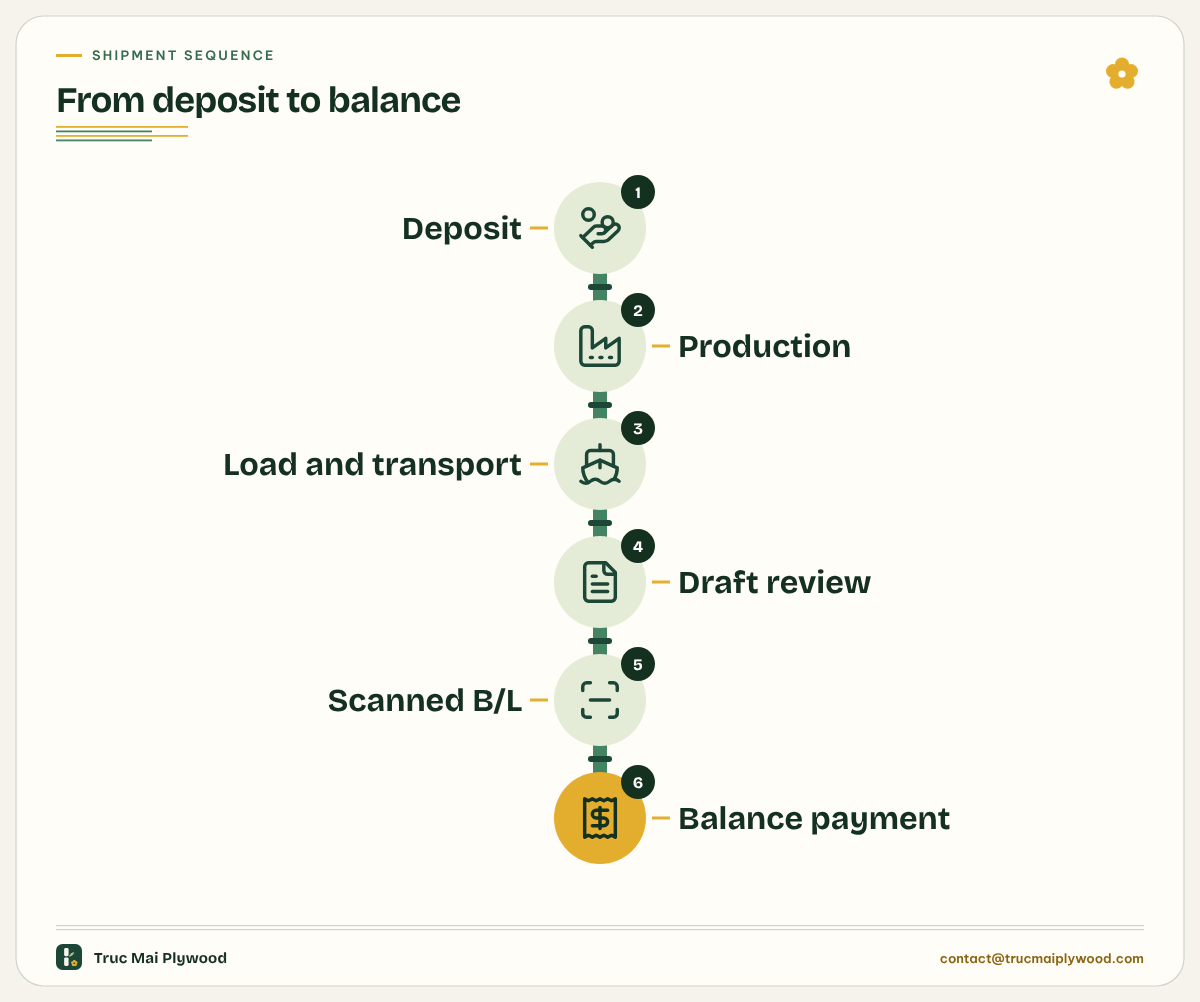
- Deposit 30% by T/T. Production starts.
- Production, 15–45 days.
- Loading at the mill and transport to Hai Phong.
- Draft commercial invoice, packing list and other drafts sent to the buyer.
- The buyer approves or corrects the drafts.
- The scanned B/L is sent.
- Balance 70% by T/T, or the documents are presented under the L/C.
- Final documents released to the buyer.
The balance is usually paid while the vessel is at sea, which is why the drafts are checked before it, not after the container arrives.
Which documents does the buyer approve before paying the balance?
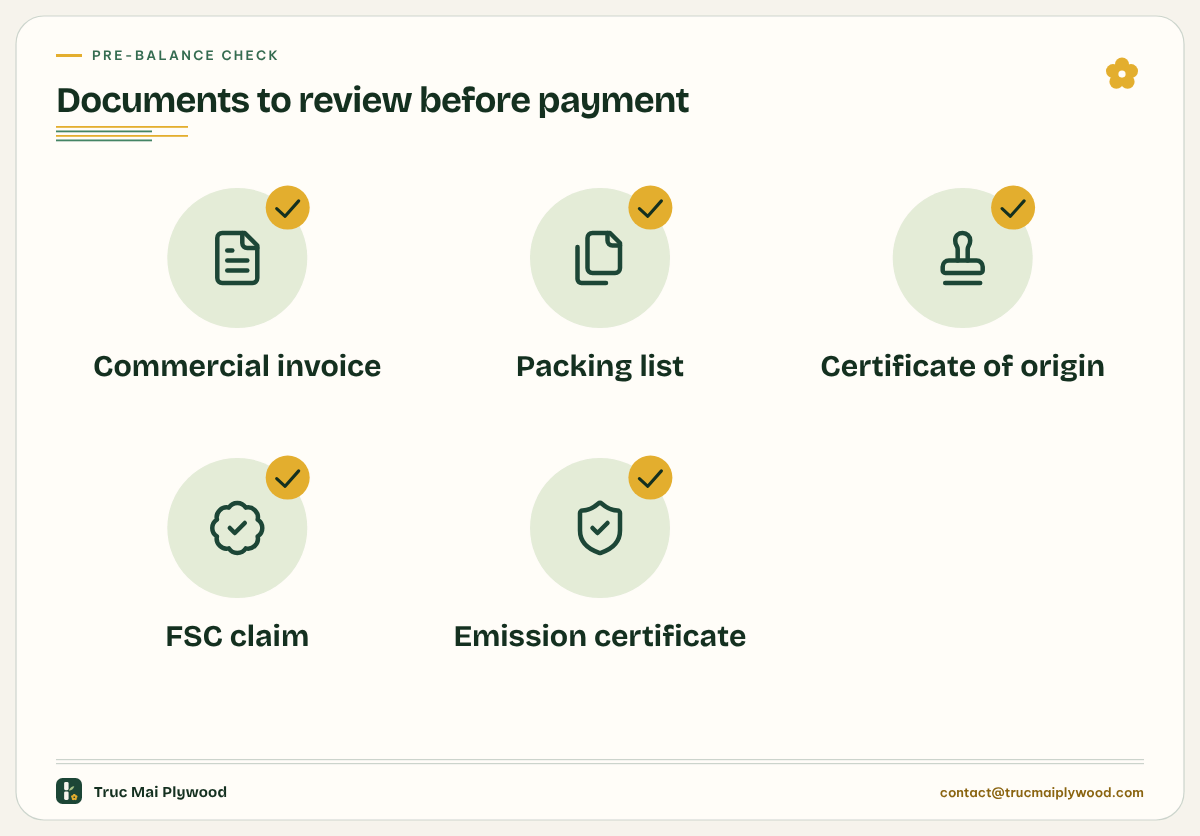
Before paying the balance, the buyer approves the draft commercial invoice, the draft packing list and the draft certificate of origin, checks the scanned bill of lading, and confirms that the order’s certificate documents are in the set: the FSC claim on the sales documents, the emission certificate and, for EU lots, the EUDR file set.
| Document | What to check before the balance |
|---|---|
| Commercial invoice | Product description, quantity in sheets and m³, price, delivery term, deposit deducted |
| Packing list | Sheets per pack, packs, gross and net weight, container and seal number |
| Bill of lading (scan) | Shipper, consignee, notify party, ports, container and seal number, on-board date |
| Certificate of origin | EUR.1 for EU-bound lots; names and quantities matching the invoice |
| Phytosanitary and fumigation papers | Container numbers matching the B/L |
| Insurance certificate | Only under CIF: insured value and the cover agreed |
| FSC claim | The claim under licence FSC-C196493 stated on the invoice for eligible products on the current schedule |
| Emission certificate | CARB/EPA 26053 for US lots, within its 3–25 mm scope |
| EUDR file set | Species, quantity, country and plot geolocation for core and face |
Two of these are written for the buyer’s customs, not for the mill. A US entry needs a commercial invoice and, “where appropriate”, a packing list under 19 CFR 142.3. In the EU, plywood cannot be sold without one: Regulation (EU) 2023/1115 requires an operator to file a due-diligence statement before it places relevant products on the market or exports them (dates in EUDR dates for panel buyers).
For US lots, 40 CFR 770.30 has the importer hold the B/L, the invoice or similar papers and the supplier’s written TSCA Title VI compliance statement on file for three years; US import steps lists the rest of that entry. A wrong line on the invoice costs more after arrival than before the balance.
The full list of papers for each container, and who issues each one, is on papers per container.
Can the balance be paid by irrevocable L/C at sight?
Yes. The 70% balance can be paid by irrevocable L/C at sight instead of T/T. The buyer’s bank opens the credit before loading; after loading the mill presents the documents the credit lists, and the bank pays at sight if they comply. The 30% deposit is still paid by T/T to start production.
An L/C moves the document check from the buyer’s desk to the banks. Under a T/T, the buyer reads the drafts and decides to pay. Under an L/C at sight, the bank pays when the presented documents match the terms of the credit, which is why the credit must describe the documents carefully. “Irrevocable” means the issuing bank cannot cancel or change it without the beneficiary’s agreement; “at sight” means payment on compliant presentation, without a deferred term.
L/C at sight for a plywood import: what the credit should say
- Amount. 70% of the contract value, because the deposit is already paid.
- Latest shipment date. Counted from the deposit: up to 45 days of production, plus transport to Hai Phong and a margin.
- Expiry and presentation period. Long enough for the drafts to be approved and the documents presented.
- Documents required. Commercial invoice, packing list, full set of B/L, certificate of origin, phytosanitary and fumigation papers, insurance certificate under CIF, and any certificate the market needs.
- Description of goods. The order line, written the same way as on the proforma: species, thickness, size, grade, quantity.
- Partial shipments and transhipment. Allowed or not, as the booking will run.
Documentary credits are usually issued under the ICC’s UCP 600 rules, and a common reason for a refused presentation is a small mismatch, such as a description on the invoice that differs from the credit by one word. Send the draft credit to the mill before it is issued, so both sides check the same text once.
What are the typical payment terms for first-time buyers?
The typical payment terms for first-time buyers are the same as for repeat buyers: 30% deposit by T/T, 70% balance after loading. At Truc Mai a first order runs on exactly that schedule. What differs for a first-time buyer is the work before the deposit, not the split.
A first container carries more uncertainty on both sides. The buyer has not yet seen a full load against the sample; the mill has not yet seen the buyer pay. The schedule handles that: the deposit is limited to 30%, and the balance follows a carrier’s document. If a first-time buyer wants more protection, the usual tool is an L/C at sight for the balance, not a lower deposit.
Are 30 70 payment terms standard for plywood?
Yes, the 30/70 split is common across plywood exporters, though the trigger for the 70% varies: some ask for it before shipment, some against a copy of the B/L, some on arrival. Read the trigger, not only the split. Truc Mai’s trigger is the scanned B/L after the drafts are approved, on every container.
What a first-time buyer can do to make the first order smoother:
- Agree the line, the sample and the files before the deposit, so nothing changes during production.
- Confirm the bank details of the mill by phone before the first transfer.
- Ask for a photo and measurement record before loading, or book an inspection at loading.
- Keep the first order to one or two products, so the first arrival is easy to check.
What is the minimum order on these terms?
The minimum order on these terms is one 40HC. Within that box a buyer normally loads one or two products, or three to six where agreed, so a first order can try more than one panel and still meet the minimum. Deposit and balance are both worked out on the whole container, not per product.
Plywood MOQ 40HC: how much is one container
One 40HC is a volume, not a sheet count. In the planning table for 18 mm, 1220 × 2440 mm sheets, a Styrax core loads 990 sheets, about 53 m³; an Acacia core 880 sheets, about 47 m³; a Eucalyptus core 795 sheets, about 43 m³, weight-capped. Thinner sheets load more sheets for about the same m³.
So the 30% deposit on one container of 18 mm Styrax core is 30% of about 53 m³ of panels, and the balance the remaining 70%. The figures are planning figures; real sheet weights are checked before final loading, and the invoice follows the packing list. The load by thickness is on m³ per 40HC by thickness.
How do FOB, CFR and CIF change what the balance pays for?
FOB, CFR and CIF change what the price includes, not when it is paid. Under FOB Hai Phong the price covers the goods loaded on the vessel; CFR adds sea freight to the destination port; CIF adds freight and insurance. The 30% deposit and the 70% balance against the scanned B/L apply to all three.
| Term | Price includes | Buyer arranges | Who insures the sea leg |
|---|---|---|---|
| FOB Hai Phong | Goods, export clearance, loading on board | Sea freight, insurance, import | Buyer |
| CFR (CNF) | FOB plus sea freight to the named port | Insurance, import | Buyer |
| CIF | CFR plus marine insurance | Import | Mill, for the buyer |
Under CIF the level of cover matters. By default, the International Chamber of Commerce explains, a CIF seller under Incoterms 2020 insures to Institute Cargo Clauses (C), and the two parties may settle on a higher level. Write the cover you want on the RFQ.
Who arranges cargo insurance under FOB plywood terms?
The buyer. Under FOB the risk passes when the goods are on board at Hai Phong, so the buyer’s insurance should start from that point. Book it when the vessel is confirmed, not when the B/L arrives. What an FOB price includes at Truc Mai is set out on FOB Hai Phong prices.
What does the scanned bill of lading prove?
A scanned bill of lading proves that the carrier has received the container on board, with the container and seal numbers, the ports, the shipper and the consignee written on it. It does not prove what is inside the container: the packing list, the inspection record and the photos at loading do that.
That distinction is why the balance is paid against the B/L and the approved drafts together. The B/L ties the money to a sealed container on a named vessel. The packing list ties the container to sheets and packs. The photos and any inspection record tie the packs to the order line. Each document covers a different gap.
Check four fields on the scan before paying:
- Container and seal number. They must match the packing list.
- Consignee and notify party. As agreed; a wrong consignee is hard to fix later.
- Ports. Hai Phong and the destination named on the order.
- On-board notation. The date the goods were loaded on the vessel.
The container weight is the shipper’s declaration: since 1 July 2016, SOLAS regulation VI/2 has made the shipper obtain and record a packed container’s verified gross mass, counting the cargo together with pallets, dunnage, securing material and the container’s own tare. The weights on the packing list feed that declaration.
Which payment instruments are not on the standard terms?
Truc Mai’s standard terms name two instruments for the balance, T/T and irrevocable L/C at sight, and T/T for the deposit. Documents against payment (D/P), documents against acceptance (D/A), usance or deferred credits and open account are not on the standard terms.
The reason is the same for all four: each one either delays payment beyond the moment the goods leave the mill’s control, or puts the documents in the buyer’s hands before payment. A mill producing to a written order line for one buyer cannot resell a container of that line quickly, so it does not ship on credit as a standard.
A buyer who needs another instrument should raise it in the RFQ, with the reason. It is a commercial question, and it is easier to answer before production than after.
How does one 40HC run from deposit to balance?
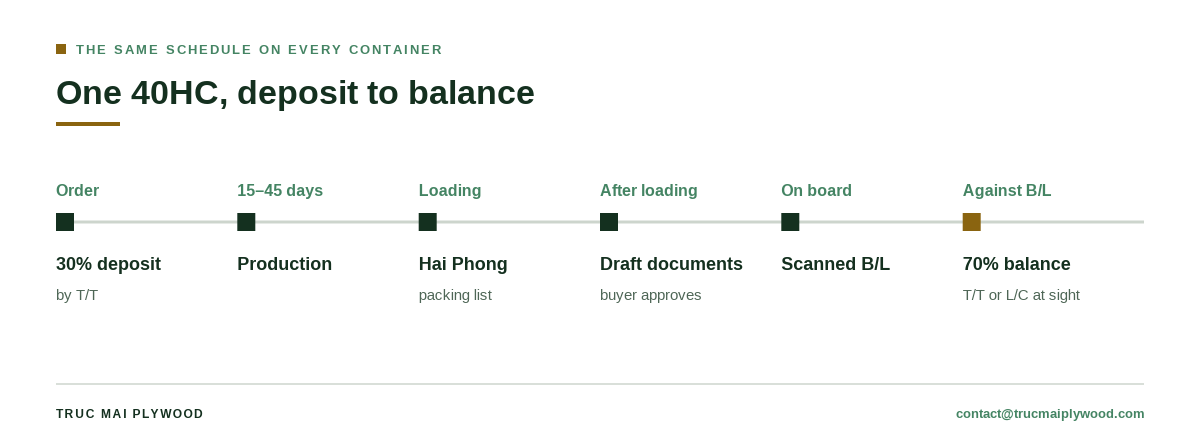
One 40HC runs in six steps: the 30% deposit, 15–45 days of production, loading and transport to Hai Phong, draft documents for the buyer’s approval, the scanned B/L, and the 70% balance. The same six steps repeat on every container, so a monthly buyer can plan cash as well as freight.
| Step | When | Who acts | Money |
|---|---|---|---|
| Order confirmed | Day 0 | Buyer and mill | 30% deposit by T/T |
| Production | 15–45 days | Mill | None |
| Loading | After production | Mill, carrier | None |
| Drafts | After loading | Mill sends, buyer approves | None |
| Scanned B/L | On board | Carrier issues, mill sends | None |
| Balance | After the drafts are approved | Buyer, or banks under an L/C | 70% |
For a monthly programme, the steps overlap: the next container’s deposit is often paid while the previous one is at sea. Plan the cash on the deposit dates and the balance dates, not on the arrival dates. The full order path from enquiry to loading is on from enquiry to loading.
What does each payment protect, for the buyer and the mill?
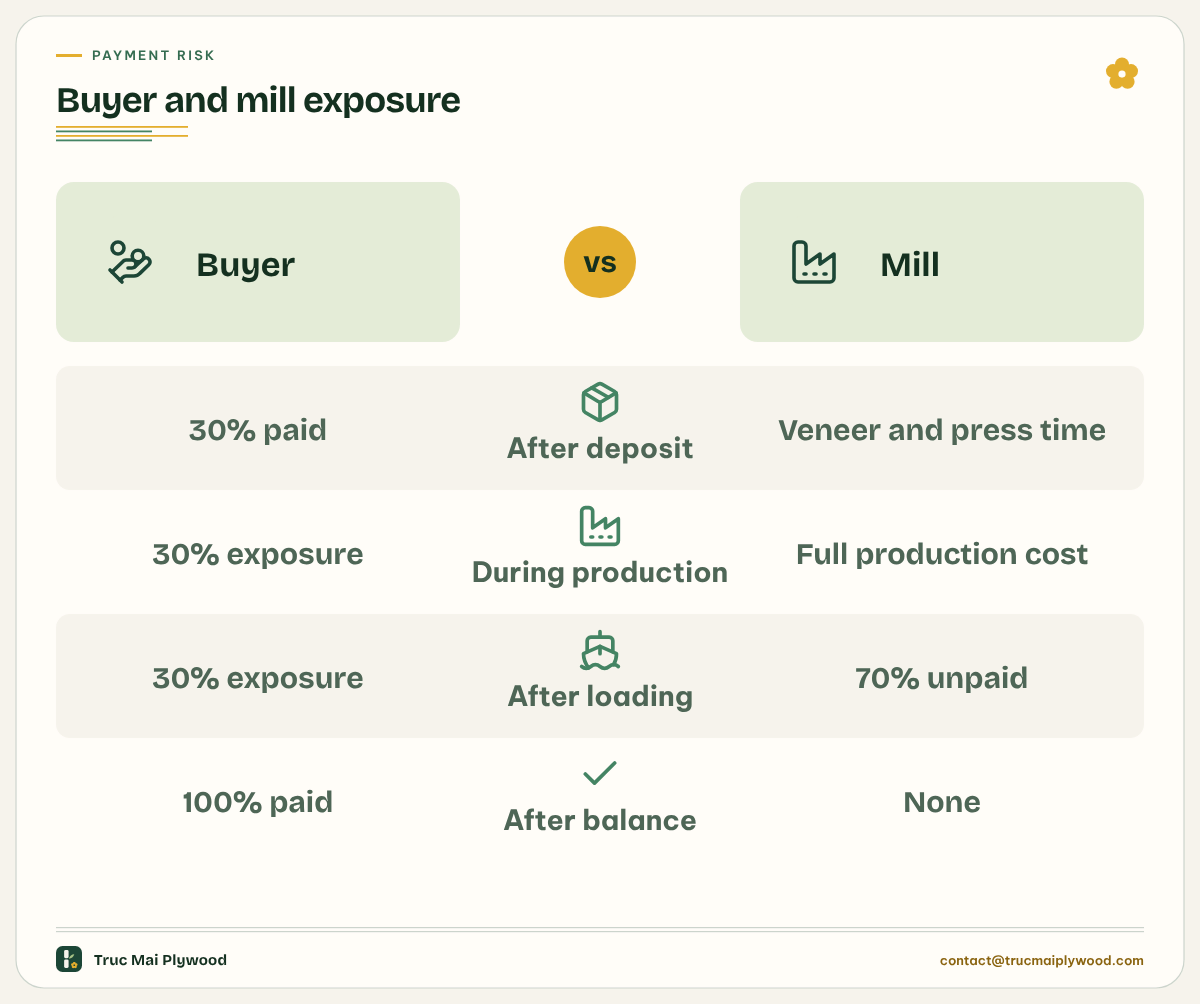
The 30% deposit protects the mill’s purchase of veneer and press time for one buyer’s line; the 70% balance protects the buyer by waiting until the goods are on board and the papers are approved. Each side carries a limited exposure for a limited time, and each can see the other’s step before taking its own.
| Moment | Buyer’s exposure | Mill’s exposure | What limits it |
|---|---|---|---|
| After the deposit | 30% paid, nothing shipped | Veneer and press time committed | Certificate files, sample, order line |
| During production | 30% | Full production cost | Agreed line, photo record |
| After loading | 30% | Goods on board, 70% unpaid | Final documents held until the balance |
| After the balance | 100% paid | None | Approved drafts, packing list, inspection |
The table shows where to put effort. A buyer’s checks are worth most before the deposit and before the balance. A mill’s are worth most before production starts: a line that changes after the veneer is bought costs both sides.
What should the proforma invoice say?
The proforma invoice should state the order line, the quantity in sheets and m³, the price per m³ or per sheet, the delivery term with its port, the deposit amount and the trigger for the balance, and the mill’s bank details. If the proforma and the order line differ, the proforma is the one the banks will read.
A proforma that works for both sides carries:
- The product, written as the order line. For example: 18 mm, 1220 × 2440 mm, white poplar EV face, Styrax core, UF glue at E0 emission, ±0.3 mm.
- Quantity. Sheets, packs and m³, per product if the container is mixed.
- Price and term. Per m³ or per sheet, FOB Hai Phong, CFR or CIF with the destination port.
- Payment. 30% deposit by T/T; 70% against the scanned B/L by T/T, or by irrevocable L/C at sight.
- Production time. 15–45 days after the deposit.
- Documents. The certificate files and the shipping documents the buyer needs.
- Bank details. Beneficiary name, bank, account, SWIFT.
No price list is published for Truc Mai; a quote is made against the line. How the price per m³ is built is on how plywood is priced.
How do you check bank details before a T/T?
Check bank details before a T/T by confirming them by phone with a person you already know at the mill, on a number you already hold, before the first transfer and after any change. The beneficiary name should match the company on the proforma and the certificates.
Payment fraud in international trade usually works by email: an invoice arrives that looks right, with a new account number. Three rules stop it:
- Confirm the account by phone before the first payment.
- Treat any change of account as suspect until it is confirmed by phone, never by replying to the email that announced it.
- Send a small test amount only if both sides agree; a test does not prove the account is the right one.
The same care applies to the balance. The scanned B/L and the drafts arrive by email, and so may a changed account. The order of the steps gives time to check it.
What should you send to get a proforma on these terms?
Send the order line, the quantity in containers, the delivery term with the destination port, the balance instrument you want, T/T or L/C at sight, and the certificate files you need. The mill answers with a quote, a sample offer and, once the line is agreed, the proforma on the standard terms.
A message that gets a proforma in one round:
| Line | What to write |
|---|---|
| Product | 18 mm, 1220 × 2440 mm, birch face to the approved sample, Styrax core, UF glue at E0 emission, ±0.3 mm |
| Quantity | 1 × 40HC, then one a month |
| Term | CIF [destination port], Institute Cargo Clauses (A) |
| Payment | 30% deposit by T/T, 70% by irrevocable L/C at sight |
| Files | FSC claim, EUDR data for core and face |
Send it to the quotation desk or to contact@trucmaiplywood.com, and ask for a free sample of the same build with the quote.
Questions buyers ask
What deposit do Vietnamese plywood mills ask for?
A 30% deposit is the usual figure, paid by T/T when the order is confirmed. At Truc Mai it starts production, which then takes 15–45 days.
Is the 70% balance paid before or after shipment?
After loading. At Truc Mai the 70% balance is paid against the scanned bill of lading, once the buyer has approved the draft documents, so the goods are already on board when the balance moves.
Can I pay the whole order by letter of credit?
The standard terms take the 30% deposit by T/T and allow the 70% balance by irrevocable L/C at sight. Any other split is a question to raise before the proforma, not after.
Do the terms change for a repeat buyer?
No. The same schedule applies to every container: 30% deposit, production, draft documents, then the 70% balance against the scanned B/L. What a repeat buyer saves is time, because the line and the files are already agreed.
What is the minimum order on these payment terms?
One 40HC. Most containers carry one or two products; by agreement, three to six can share the box under the same deposit and balance.
Which delivery terms can the price be quoted on?
FOB Hai Phong, CFR (CNF) or CIF. The payment schedule is the same under all three; what changes is what the price includes.
Does the mill accept D/P, D/A or open account?
Those instruments are not on Truc Mai's standard terms, which name T/T and irrevocable L/C at sight. A buyer who needs something else should say so in the RFQ.
When do I receive the original documents?
Draft shipping documents come for approval after loading, and the final set follows the balance. For an L/C, the documents travel through the banks as the credit specifies.
Are samples paid for before the deposit?
No. A sample costs nothing and needs no deposit; a new buyer only pays the courier, and that amount comes back as a credit on its first real order.
Who pays bank charges on a T/T?
Each side normally pays its own bank's charges. Write the charge option on the transfer, so the mill receives the invoiced amount and the balance closes without a small difference.
What happens if the draft documents have an error?
The buyer sends the correction before paying the balance, and the mill reissues the drafts. That is the reason the approval step sits before the balance.