
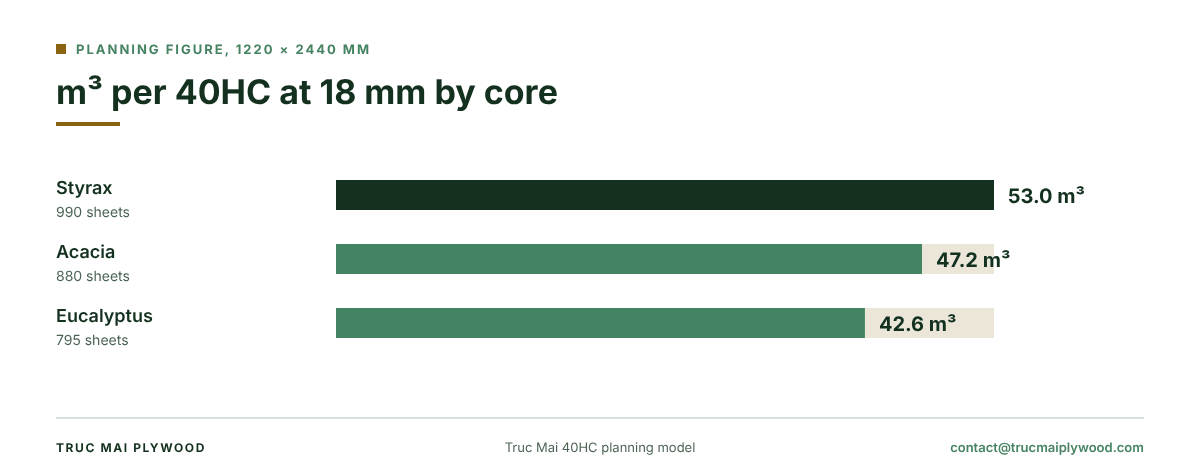
A 40ft high cube holds about 53 m³ of plywood on Styrax core, 47 m³ on Acacia and 43 m³ on Eucalyptus (1220 × 2440 mm, 3–40 mm, planning figures). The volume barely moves with thickness; the core moves it, because the denser sheets reach the 28,000 kg payload before the box is full. Truc Mai writes the core and the pack count on every order for that reason.
How many cubic meters of plywood fit in a 40ft container?
A 40ft high cube (40HC) holds about 53 m³ of plywood on Styrax core, 47 m³ on Acacia and 43 m³ on Eucalyptus, at 1220 × 2440 mm and any thickness from 3 to 40 mm. They are planning figures from the Truc Mai packing model, panels only, with a 28,000 kg payload.
Two limits decide the number. The first is space: the model has room for 18 packs about 1,000 mm high, and 18 packs of 1220 × 2440 mm panel cannot exceed about 53.6 m³. The second is weight: Acacia and Eucalyptus sheets are heavier, so those loads stop earlier. A buyer asking for “plywood cbm per 40hc container” therefore gets three answers, one per core, and none of them depends much on thickness.
| Core | Reference density | Packs | m³ per 40HC (1220 × 2440 mm) | Limit reached |
|---|---|---|---|---|
| Styrax | 500 kg/m³ | up to 18 | about 53 m³ | Space |
| Acacia | 580 kg/m³ | up to 16 | about 47 m³ | Weight |
| Eucalyptus | 650 kg/m³ | up to 15 | about 43 m³ | Weight |
The sections below show how the model works, the full table by thickness, and what the buyer writes on the order so that the container matches the plan.
How is the m³ per 40HC worked out?
The model multiplies four things: sheets per pack, packs per container, the volume of one sheet and a density for weight. A pack is stacked to about 1,000 mm, so sheets per pack are 1,000 mm divided by the thickness, rounded down and then capped by weight. The container takes at most 18 packs on Styrax, 16 on Acacia and 15 on Eucalyptus.
Take 18 mm at 1220 × 2440 mm. One sheet is 1.22 m × 2.44 m × 0.018 m, or 0.0536 m³. A pack holds 55 sheets (1,000 ÷ 18, rounded down). Eighteen Styrax packs make 990 sheets, which is 53.05 m³, and at 500 kg/m³ that is 26,523 kg of panel. The same maths with 16 Acacia packs gives 880 sheets, 47.15 m³ and 27,348 kg.
The result is a planning figure, not a measurement. The packing model is a calculation from pack height, density and payload. Truc Mai packing lists have not yet been compared against it line by line, so the order sheet and the booking stay the reference. Real sheets are weighed before the final loading plan, and the packing list then carries measured weights next to the planned count.
The width of the sheet matters little. At 1220 × 2440 mm the area of one sheet is 2.9768 m², so one full pack at 1,000 mm is close to 2.98 m³ whatever the thickness. Eighteen of them are 53.58 m³, the upper bound for a Styrax load in this model.
Table: m³ of plywood per 40HC by thickness and core
Per container, 1220 × 2440 mm, planning figures: the m³ column barely changes with thickness, and the core column does. Styrax stays between 52.9 and 53.6 m³, Acacia between 47.0 and 47.6 m³ and Eucalyptus between 42.2 and 43.0 m³ across the whole 3–40 mm range.
Plywood cbm per 40HC container by thickness
| Thickness | Sheets per pack (Styrax, Acacia) | Styrax, 18 packs | Acacia, 16 packs | Eucalyptus, 15 packs |
|---|---|---|---|---|
| 3 mm | 333 | 53.5 m³ | 47.6 m³ | 43.0 m³ |
| 4 mm | 250 | 53.6 m³ | 47.6 m³ | 43.0 m³ |
| 5 mm | 200 | 53.6 m³ | 47.6 m³ | 42.9 m³ |
| 6 mm | 166 | 53.4 m³ | 47.4 m³ | 42.9 m³ |
| 9 mm | 111 | 53.5 m³ | 47.6 m³ | 43.0 m³ |
| 12 mm | 83 | 53.4 m³ | 47.4 m³ | 42.9 m³ |
| 15 mm | 66 | 53.0 m³ | 47.2 m³ | 42.9 m³ |
| 18 mm | 55 | 53.0 m³ | 47.2 m³ | 42.6 m³ |
| 21 mm | 47 | 52.9 m³ | 47.0 m³ | 42.2 m³ |
| 25 mm | 40 | 53.6 m³ | 47.6 m³ | 42.4 m³ |
| 30 mm | 33 | 53.0 m³ | 47.2 m³ | 42.9 m³ |
| 40 mm | 25 | 53.6 m³ | 47.6 m³ | 42.9 m³ |
The small ups and downs come from rounding down. At 21 mm, 1,000 ÷ 21 gives 47.6, so a pack holds 47 sheets and about 987 mm is used; at 25 mm and 40 mm the division is exact and the pack uses all 1,000 mm. The Eucalyptus column also carries a lower pack count of sheets (for example 53 at 18 mm instead of 55), because its packs are trimmed to stay under the payload.
Panels of 3–25 mm are covered by the CARB P2 and TSCA Title VI certificate CARB/EPA 26053; 30 mm and 40 mm panels sit outside that scope. Container planning is the same for all of them.
How many sheets of 18 mm plywood fit in a 40HC?
At 1220 × 2440 mm, a 40HC holds 990 sheets of 18 mm on Styrax core, 880 on Acacia and 795 on Eucalyptus. That is 53.0, 47.2 and 42.6 m³. This is the thickness most buyers ask about, and the thickness where the weight limit shows most clearly.
The 18 mm line is worked through in its own article, with sheet weights, ply counts and the tolerance written on the order: 18 mm plywood by core. Here the point is how the same sheet count looks at other thicknesses.
18mm plywood sheets per container and other thicknesses
| Thickness | Styrax sheets | Acacia sheets | Eucalyptus sheets |
|---|---|---|---|
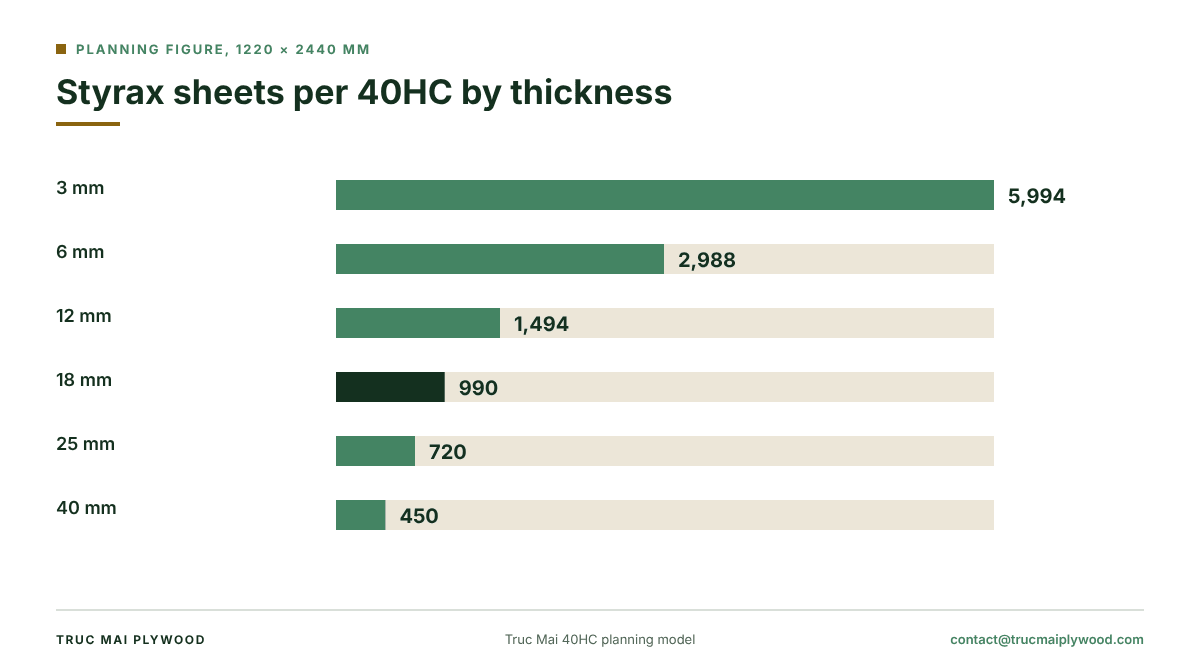
| 3 mm | 5,994 | 5,328 | 4,815 |
| 4 mm | 4,500 | 4,000 | 3,615 |
| 5 mm | 3,600 | 3,200 | 2,880 |
| 6 mm | 2,988 | 2,656 | 2,400 |
| 9 mm | 1,998 | 1,776 | 1,605 |
| 12 mm | 1,494 | 1,328 | 1,200 |
| 15 mm | 1,188 | 1,056 | 960 |
| 18 mm | 990 | 880 | 795 |
| 21 mm | 846 | 752 | 675 |
| 25 mm | 720 | 640 | 570 |
| 30 mm | 594 | 528 | 480 |
| 40 mm | 450 | 400 | 360 |
A buyer who counts sheets rather than m³ sees a very different picture across thickness: 5,994 sheets of 3 mm or 450 sheets of 40 mm on Styrax core fill the same container. For stock keeping, the count matters; for freight cost per m³, the volume does.
Why does a Styrax core load more m³ than Eucalyptus?
Styrax is the lightest of the three cores, so a full Styrax container is still under 28,000 kg. Eucalyptus is the heaviest, so the container reaches the payload with fewer packs. The empty space is the cost: about 10 m³ less panel per container at 18 mm, which is 53.05 m³ against 42.60 m³.
The planning densities are 500 kg/m³ for Styrax, 580 for Acacia and 650 for Eucalyptus. Eucalyptus has been measured at 650–750 kg/m³, so a real load can run heavier than the plan, which is why its row is marked weight-capped. At 18 mm the cargo weights come out close to each other, 26,523 kg for Styrax, 27,348 kg for Acacia and 27,689 kg for Eucalyptus, and that is the point: every core ends up near the same weight, and only the Styrax load fills the box.
Moving a repeat programme from Eucalyptus to Styrax core usually gives a lighter sheet, a better face and more m³ for the same freight, handling and port charges. Acacia and Eucalyptus are still used where a buyer wants the denser panel or prices by the sheet.
A seventeenth pack is not an option. On Acacia it would push the load past 28,000 kg, and overfilled packs break pallet feet, which costs more at the discharge port than the sheets are worth.
How much weight can a 40HC carry for plywood?
Truc Mai plans 28,000 kg of cargo per 40HC (28 t), with the container’s own tare excluded. It is a planning payload, not a promise: the carrier, the route and the booking set the real limit, and the shipper must verify the packed container’s mass before it is loaded on the ship.
The International Maritime Organization explains the rule. Under SOLAS regulation VI/2, in force since the amendments of 1 July 2016, the shipper declares a verified gross mass for each packed box: the plywood, plus pallets, dunnage and lashing, plus the container’s own tare. The mill’s weights per sheet therefore feed the shipping instructions, not only the loading plan.
For a plywood buyer, three practical points follow:
- Plan on cargo weight, not on volume, for any core except Styrax.
- Keep the booked payload on file; a lower limit on a route reduces the pack count.
- Compare offers on the same basis: m³ per container is only comparable at the same core and sheet size.
Does the 1250 × 2500 mm sheet change the container fill?
Yes, but only on Styrax. At 1250 × 2500 mm the Styrax load keeps its sheet count (990 at 18 mm) and rises to 55.7 m³. Acacia drops to 848 sheets and 47.7 m³, Eucalyptus to 765 sheets and 43.0 m³, both weight-capped. The bigger sheet fills more of the box only where weight allows.
Plywood sheet size in mm and in meters
Sheet sizes are named in millimetres, and the same sizes are often searched in meters. Truc Mai makes three regular formats and custom sizes up to 1250 × 2500 mm.
| Sheet size in mm | Size in meters | Also called | Styrax 3 mm | Styrax 18 mm | Styrax 40 mm |
|---|---|---|---|---|---|
| 1220 × 2440 mm | 1.22 × 2.44 m | 4 × 8 ft | 53.5 m³ | 53.0 m³ | 53.6 m³ |
| 1250 × 2500 mm | 1.25 × 2.50 m | European format | 55.9 m³ | 55.7 m³ | 54.0 m³ |
| 1220 × 2280 mm | 1.22 × 2.28 m | Furniture parts | per order | per order | per order |
A 4 × 8 ft sheet is slightly smaller than its metric name. Under the Weights and Measures Act 1985 the foot is 1/3 yard and the yard 0.9144 metre. That puts 4 ft at 1219.2 mm and 8 ft at 2438.4 mm, and the trade rounds them to 1220 × 2440 mm.
At 40 mm the 1250 × 2500 mm Styrax load is weight-capped too, at 432 sheets and 54.0 m³ against 450 sheets and 53.6 m³ for the shorter sheet. The 1220 × 2280 mm count is planned per order, because pack positions change with the sheet length. Open the 1220 × 2280 mm panels page for the faces offered in that format.
Can I mix core types in one 40HC container?
Yes, by agreement. One or two products per box is normal, and a mix of three to six is possible when asked for, for example Styrax-core 18 mm carcass panels with Eucalyptus-core 9 mm backs. The loading plan is then made for the mix, and the denser core sets the weight.
The rule of thumb for a mixed container is to plan on weight first. Add the cargo weight of each product (m³ × density), compare the total with the booked payload, and only then check the pack positions. A container with half Styrax and half Eucalyptus packs lands between 43 and 53 m³, not at either end.
Mixing thicknesses of the same core is simpler: packs of 6, 12 and 18 mm are each about 1,000 mm high, so the stack positions stay the same and only the sheet count per pack changes. The cost of mixing is on the admin side, not the loading side: each product needs its own line on the packing list and its own certificate scope. The 40HC load calculator runs a mix of core and thickness against the payload.
How are the packs laid out inside the container?
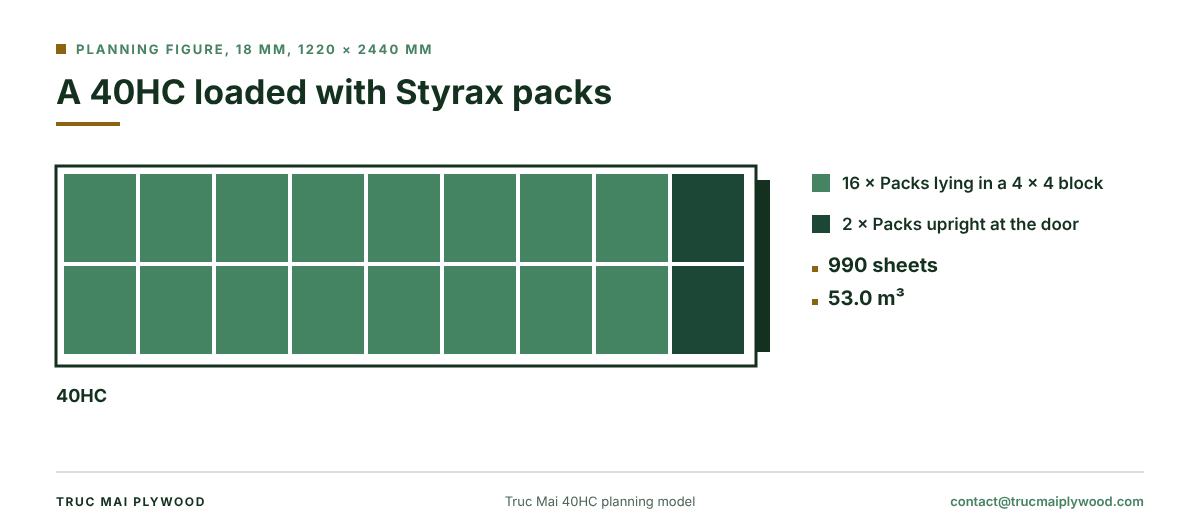
The Styrax plan uses all 18 pack positions: 16 packs lie in a 4 × 4 block and 2 stand upright at the door end. Acacia is planned with up to 16 packs and Eucalyptus with up to 15, so those loads leave the door-end positions free or partly filled.
Packs sit on pallets so that a forklift can place them, and the pallet feet are the weak point. A pack that is too tall or too heavy breaks them, which is why the model caps the sheets per pack by weight. On a US-bound load, the pallets, battens and dunnage made of solid wood need a treatment mark under 7 CFR 319.40-3 and are covered by ISPM 15, which exempts wood packaging made wholly of processed wood material such as plywood, so the panels themselves carry no treatment mark while the pallets do.
How a container is strapped and closed is shown on loading a 40HC at the mill. Export crates for fragile or thin panels are covered on the export crates page.
What do thin panels do to the count?
Thin panels raise the sheet count steeply and leave the volume where it is. A Styrax 40HC takes 5,994 sheets of 3 mm and 2,988 sheets of 6 mm, both about 53.5 m³. Eucalyptus holds 4,815 and 2,400 sheets, about 43 m³.
For thin panels the practical limits move from the container to the pack. A pack of 333 sheets of 3 mm is a lot of loose veneer faces to handle, so thin panels are packed with care and often crated. Thin 3–5 mm panels are always built with five plies (3 mm uses one core ply and two cross-bands), and 4 mm panels use 1.3 mm core veneer, which is scarce and can lengthen production. The thin panels page lists the range.
How do you plan a first container from this table?
Start from the m³ you need, divide by the core’s figure, and round up to whole containers. Then check the weight and write the pack count on the order. Five steps cover it:
- Choose the core. Styrax for the most m³ per container, Acacia or Eucalyptus for a denser sheet.
- Choose the sheet size: 1220 × 2440 mm, 1250 × 2500 mm or 1220 × 2280 mm.
- Read the m³ per 40HC for that thickness in the table, and divide your volume by it.
- Check the weight against the booked payload, especially for mixed loads.
- Write the core, thickness, size and pack count on the order, and keep the first packing list as the reference.
Whatever the m³ count, the minimum is one 40HC, built in 15–45 days from the deposit and paid off on the scanned B/L; deposit, balance and FOB, CFR or CIF terms are set out on MOQ, payment and FOB.
Planning figure or loading record: what is the difference?
A planning figure is calculated from pack height, density and payload. A loading record is what was actually put in the container and weighed. Truc Mai gives planning figures here, and the packing list gives the record. The two should be close; the packing list is the one that counts.
If a first container shows fewer sheets than planned, check three things before suspecting the plan: the core density of the real sheets, the pack height on the day, and the payload on the booking. Sheets at the top of the Eucalyptus range (750 kg/m³) weigh about 15% more than the planning density, which removes packs from the load.
What should the order line say about loading?
Write the core, thickness, sheet size, pack height and sheet count per pack, and the number of packs per container. One line carries all of it, and the same line is copied onto every repeat order.
An example for a furniture buyer: “18 mm plywood, Styrax core, A-grade stitched, 1220 × 2440 mm, ±0.3 mm sanded and calibrated. Packs about 1,000 mm high, 55 sheets per pack, 18 packs, 990 sheets, 1×40HC, FOB Hai Phong.” A packing buyer swaps the core to Eucalyptus or combined, the pack count to 15 and the tolerance to ±0.5–1.0 mm.
Paste the loading line into the quotation desk form or an email to contact@trucmaiplywood.com; the reply returns the pack plan for that exact core and thickness, and a sample sheet of the build can travel with it.
Questions buyers ask
How many cubic meters of plywood fit in a 40ft container?
On the Truc Mai planning model a 40HC holds about 53 m³ of plywood on Styrax core, 47 m³ on Acacia and 43 m³ on Eucalyptus at 1220 × 2440 mm. These are planning figures for panels only, not a loading record.
How many cubic meters of 18 mm plywood fit in a 40HC?
At 18 mm and 1220 × 2440 mm the planning figure is 53.0 m³ on Styrax core (990 sheets), 47.2 m³ on Acacia (880 sheets) and 42.6 m³ on Eucalyptus (795 sheets).
Does the thickness change the cubic meters per container?
Hardly. Packs are stacked to about 1,000 mm, so the Styrax load stays between 52.9 and 53.6 m³ from 3 to 40 mm. What changes with thickness is the number of sheets.
Does plywood core type affect container loading?
Yes. Styrax is planned at 500 kg/m³, Acacia at 580 and Eucalyptus at 650, so the denser cores reach the 28,000 kg planning payload with fewer packs and leave part of the box empty.
How much weight can a 40HC carry for plywood?
Truc Mai plans 28,000 kg of cargo per 40HC, with the container tare excluded. The carrier, the route and the verified gross mass on the booking decide the real limit.
Does the 1250 × 2500 mm sheet change the container fill?
It raises the volume on Styrax, to about 55.7 m³ at 18 mm, and leaves the count at 990 sheets. Acacia and Eucalyptus stay weight-capped near 48 m³ and 43 m³.
Can I mix core types in one 40HC container?
Yes, by agreement: one or two products is the norm, and up to six can share a box. The plan is then built for the mix, since the heaviest core decides the weight.
Can thicknesses be mixed in one container?
Yes. Packs of different thickness sit side by side, each pack about 1,000 mm high. Total weight is checked against the payload, not the volume.
How many 3 mm sheets fit in a 40HC?
On Styrax core, 5,994 sheets of 3 mm at 1220 × 2440 mm (18 packs of 333), about 53.5 m³. On Eucalyptus the figure is 4,815 sheets.
What is the standard plywood sheet size in mm?
1220 × 2440 mm is the 4 × 8 ft sheet. Truc Mai also makes 1250 × 2500 mm, the European format, and 1220 × 2280 mm for furniture parts.
Is the planning figure the same as the packing list?
No. The packing list records the sheets actually loaded. Real sheets are weighed before the final loading plan and the booking figure always comes first.
What is the minimum order for a 40HC?
One 40HC. Production runs 15–45 days from the 30% deposit, and the remaining 70% falls due on the scanned B/L.