
Resources · buyer FAQ
Vietnam plywood sourcing FAQ: MOQ, payment, loading and files by the container
This Vietnam plywood sourcing FAQ starts with the answer buyers ask for first: the minimum order is one 40HC, which can hold one or two products and up to six by agreement. Production takes 15–45 days after a 30% deposit, the 70% balance is paid against the scanned B/L, and delivery is FOB Hai Phong, CFR or CIF. Core type moves a load from about 43 to 53 m³, and EU lots carry EUDR records for core and face veneer.
This page is for buyers who fill a container every month and want a number for each question before they write an RFQ. Every answer is short and tied to a figure; the guides behind each one are listed below.
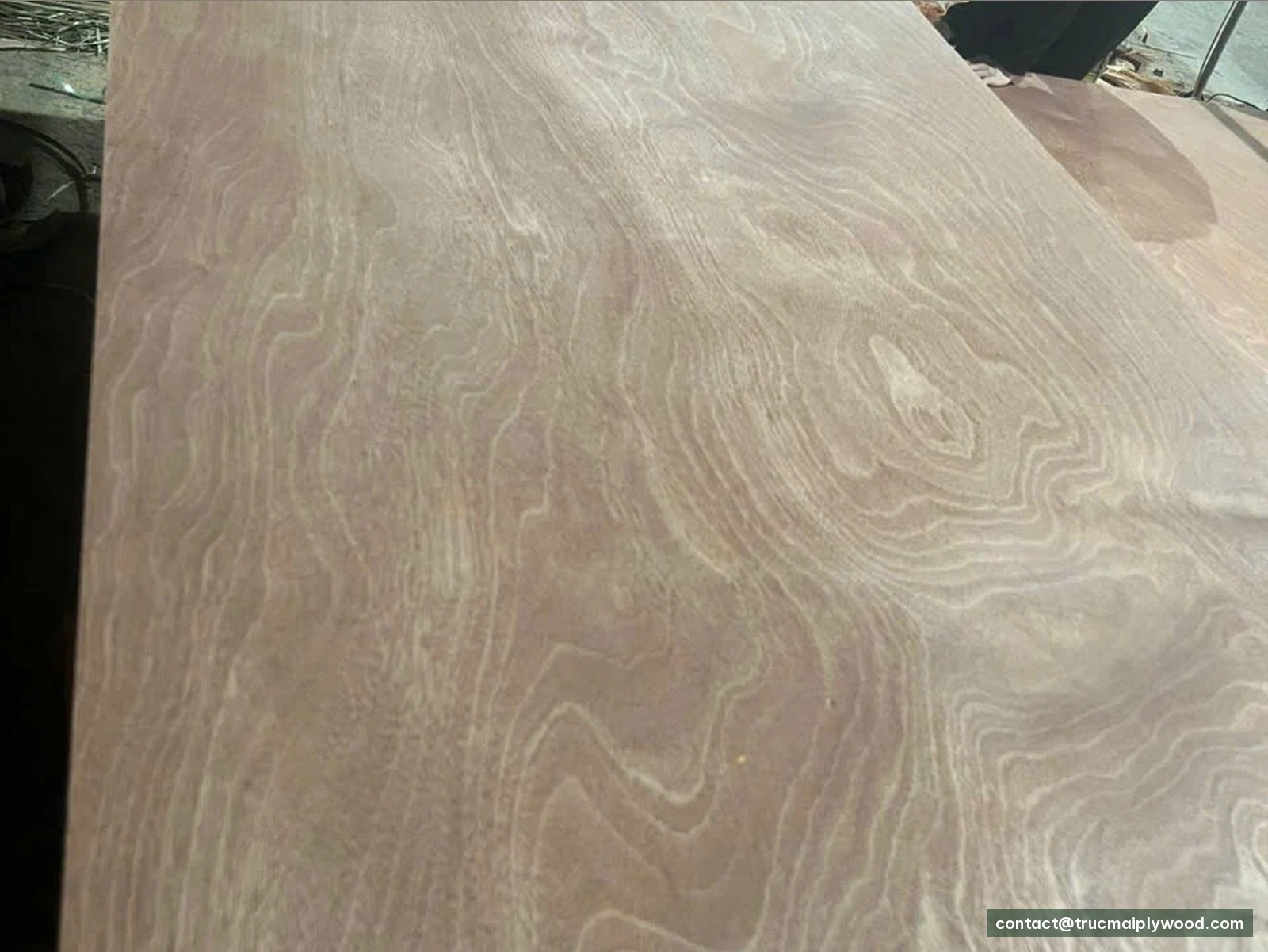
- 1 × 40HCminimum order
- 30% / 70%deposit and balance against the scanned B/L
- 53 m³18 mm Styrax per 40HC; Eucalyptus about 43 m³
- 7 questionsanswered first on this page
Load figures are planning figures from the Truc Mai packing model.
Answer and key facts
The seven Vietnam plywood sourcing FAQ questions container buyers ask first
Seven questions come before every first order, and each has a one-line answer: MOQ, mixing, core and m³, EUDR records, balance timing, delivery terms and samples. Longer explanations are one click away.
Each answer below rests on a public source: EUR-Lex for Regulation (EU) 2023/1115, FSC International for the claim, and the California Air Resources Board and the US EPA for formaldehyde.
| Question | Answer |
|---|---|
| Minimum order? | One 40HC. It usually carries one or two products; three to six can be mixed by agreement. |
| Does core type change m³ per container? | Yes: about 53 m³ on Styrax, 47 on Acacia and 43 on Eucalyptus at 18 mm and 1220 × 2440 mm. |
| Which EUDR records come with an EU lot? | Origin records and GeoJSON plot geolocation for both the Vietnamese core and the face veneer, so the importer can file its own due-diligence statement. |
| When is the balance due? | 70% against the scanned B/L, after the 30% deposit and 15–45 days of production. |
| Which delivery terms? | FOB Hai Phong, CFR (CNF) or CIF. |
| How is the face grade agreed? | Against the approved sample, written on the order as a pair of face and back grades. |
| Are samples free? | Free for repeat buyers and buyers with an order; new buyers get free samples and book their own courier, credited against a real order. |
Loading
MOQ for plywood from Vietnam: one container, several products and the load
A mixed container is normal for a monthly buyer, and the load is planned pack by pack rather than by product. Two or three products usually fit without trouble, and each extra product adds a pack plan.
The planning model uses at most 18 packs of Styrax core, 16 of Acacia or 15 of Eucalyptus, each pack about 1,000 mm high. Mixing a heavy 25 mm Eucalyptus panel with a light 6 mm Styrax panel therefore moves the m³ per container up or down, and the quotation reply states the mixed figure as a planning figure. The packing calculator runs the same model for a mixed order.
A buyer who reorders every month benefits most from keeping one or two products fixed and varying a third, because the reference sample, the face pair and the pack plan then repeat without a new agreement.
Specification
Vietnam plywood sourcing guide: how face grades are agreed before production
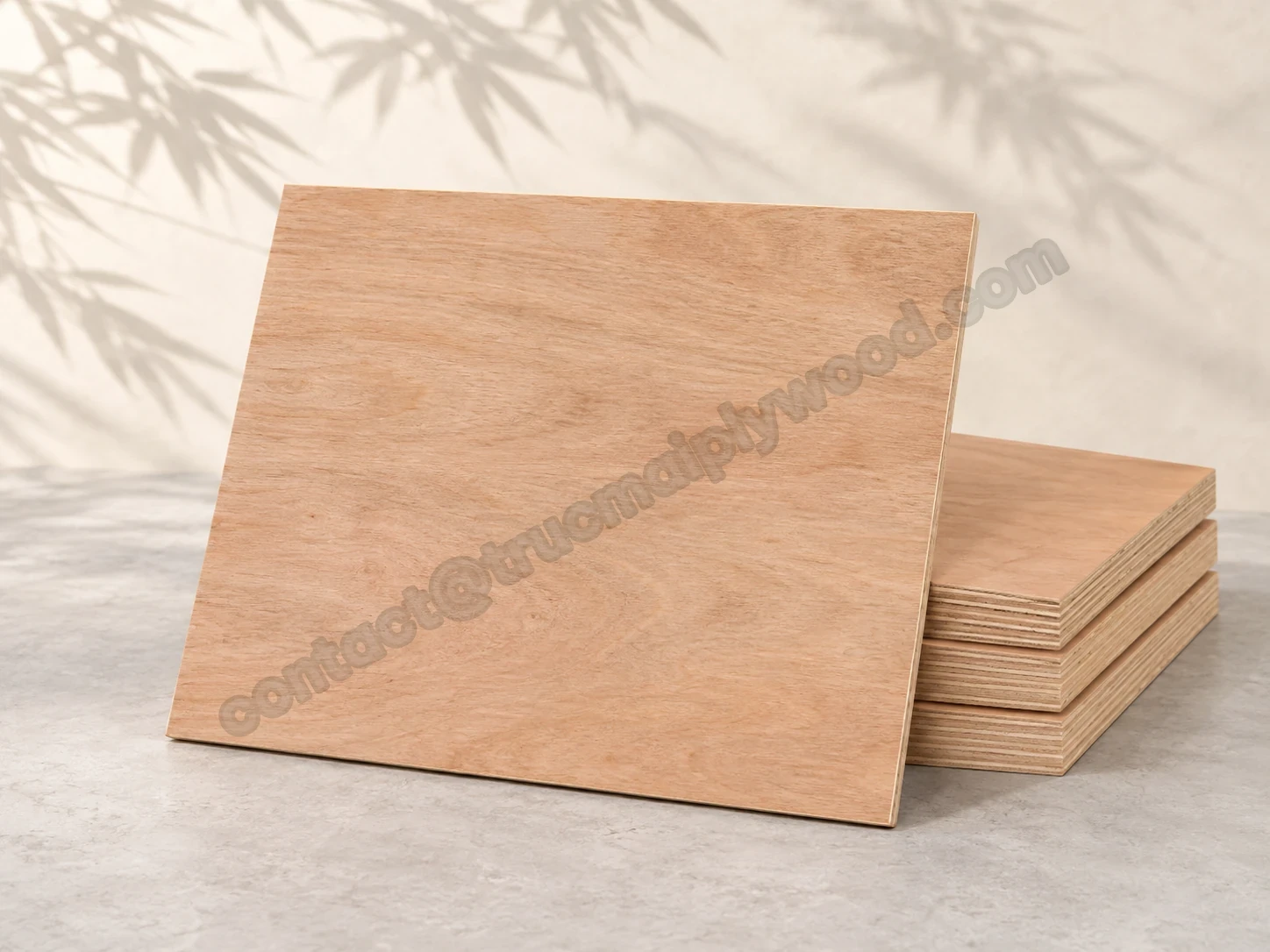
The face grade is agreed against an approved sample, and the order carries it as a pair: face and back. The sample stays with the buyer and at the mill as the reference for every reorder.
Face veneer is usually 0.3 mm for Europe, within a range of 0.2–0.5 mm, and faces are sanded and calibrated. Thickness tolerance is written per order, at ±0.3 mm on calibrated furniture panels and ±0.5 mm on commercial panels. A buyer who writes the pair and the tolerance on the order gets a result that can be checked with a caliper on arrival.
Two offers with the same product name are often different constructions, so compare the lines in this order: application, core, glue and emission class, face, sheet, packing and quantity.
Repeat orders
What stays the same when you reorder
A reorder repeats the written specification, not a new negotiation. The approved sample, the face and back pair, the thickness tolerance, the core, the pack plan and the file set stay as agreed unless the buyer changes a line.
What can go wrong on a reorder is drift: a face a shade darker, a core swapped for a heavier species, a tolerance read differently. The defence is to write each line on the order and to check arrivals against the reference sample. Thickness is measured with a caliper, sheets are counted per pack, and any difference is raised against the sample, not against memory.
Because the mill makes about 5,000 m³ in an average month, a monthly container of one or two products fits a regular production slot, and the 15–45 day range narrows as the quantity and the specification repeat.
Files
Which records travel with an EU-bound container
The EU importer is the EUDR operator and files the due-diligence statement. Truc Mai supplies the data behind it: product description, species, quantity, country of production and plot geolocation for core and face veneer.
Alongside the EUDR file set go the FSC claim on sales documents for products on the current schedule, the PPWR packaging test, the EUR.1 certificate of origin and the usual shipping set. The records are sent before the order is confirmed. Paperwork per market is explained on the rules and paperwork hub.
Payment
How the 30% deposit and the 70% balance protect both sides
The deposit starts production and the balance is released against the scanned B/L, so the mill is paid for work started and the buyer pays the larger part only once the goods are on a vessel. Payment is by T/T, or by irrevocable L/C at sight.
A buyer who prefers a letter of credit asks for it in the RFQ, and the L/C then follows the same 30% and 70% logic. The full commercial terms, including the documents, are on the MOQ, payment and FOB page, and the order sequence is on the enquiry-to-loading page.
Fraud on bank details is the most common payment problem in timber trading. Confirm bank details by phone with a number you already know before every transfer, and never act on a changed account number received by email alone.
Quotes and samples
How to compare two quotations for the same plywood
Two offers with the same product name are often not the same construction. The difference comes from core grade, joining method, face preparation, adhesive system and tolerance, so start every comparison from the application and then check core, glue and emission, face, sheet, packing and quantity.
Ask each supplier for the same lines in the same order. A price per m³ means little until the core, the thickness tolerance and the face pair are the same. A buyer who writes these lines into the RFQ gets quotations that can be put side by side.
Samples help most at this stage. Free samples for new buyers are sent against the buyer's own courier account, and the courier cost can be credited against a real order. The approved sample then becomes the reference sheet for every later container.
Timing
How long a container takes and why the range is 15 to 45 days
Production takes 15–45 days after the 30% deposit, depending on quantity, production conditions and what has been agreed. The low end suits a repeat specification in a regular slot; the high end suits a new specification or a thin-panel run.
Thin panels are the usual reason for a longer run: good veneer for 4 mm panels is scarce. A buyer who orders every month can plan the next deposit while the previous container is in production, so that one container is always being specified, one built and one at sea.
The sea leg is separate and runs from 5 to 50 days depending on the region, with Northern Europe at 30–40 days and the US East Coast at 35–45 days. The orders, freight and cost hub has the full table.
Core and load
How core type moves a container from 43 to 53 m³
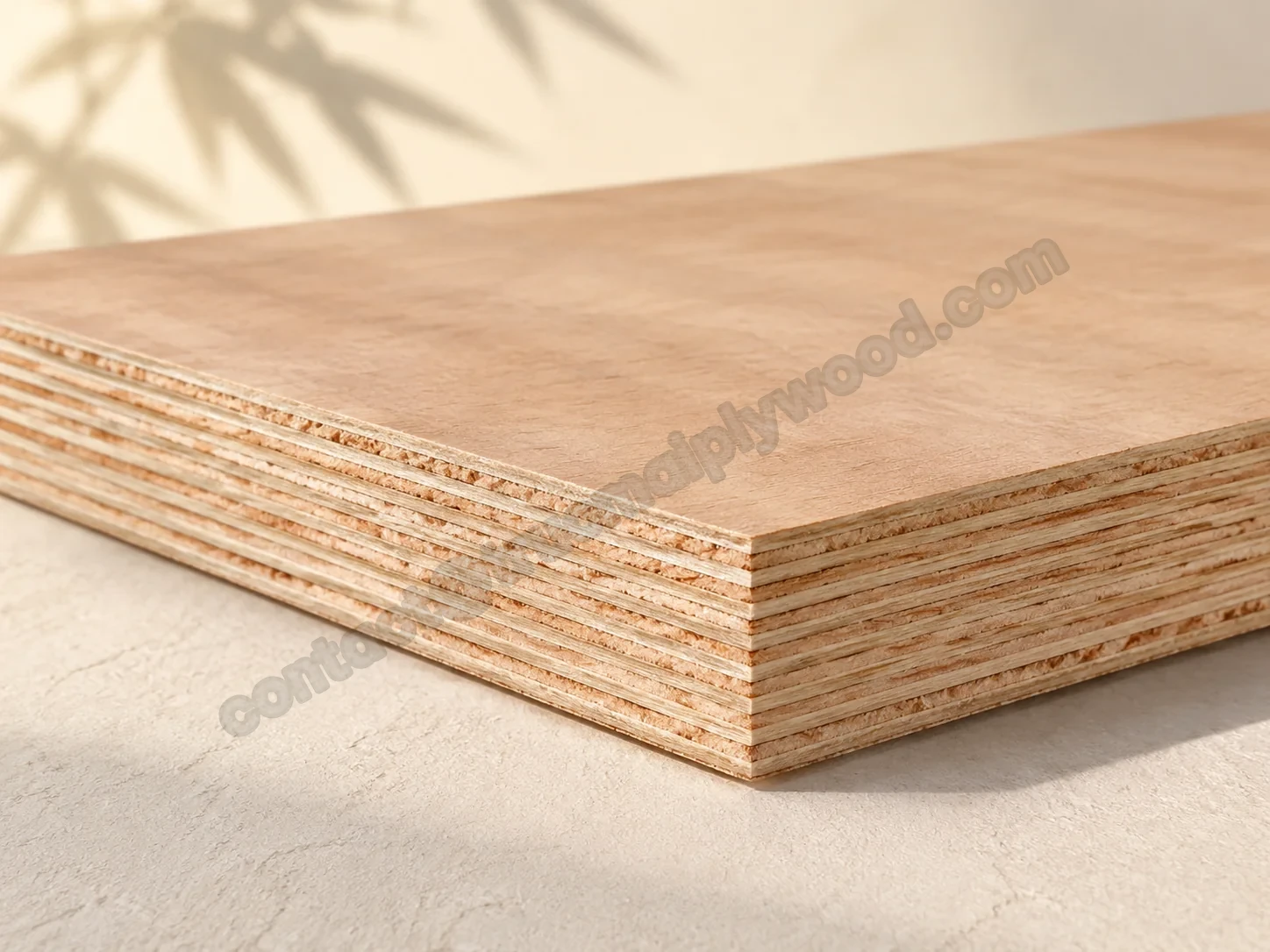
Core is the biggest lever on what a container holds. At 18 mm and 1220 × 2440 mm the planning model gives about 53 m³ on Styrax, about 47 m³ on Acacia and about 43 m³ on Eucalyptus, because denser cores reach the 28,000 kg planning payload before the box is full.
A buyer who is free to choose should price all three. A furniture buyer who moves from Acacia to Styrax usually gets a better face, a lighter sheet and more m³ per container. A buyer who needs a heavier, harder core for flooring-like parts or edge strength may accept the lower m³ and say so on the order.
Sheet counts and weights are planning figures from our packing model, panels only, not a loading record; the carrier and route decide the final payload. Every thickness and both sheet sizes are on the load calculator and the loading page.
| Core | Packs | Sheets | m³ |
|---|---|---|---|
| Styrax | 18 | 990 | about 53 |
| Acacia | 16 | 880 | about 47 |
| Eucalyptus | 15 | 795 | about 43, weight-capped |
Before you write
What to have ready before the first RFQ
A first enquiry gets a one-reply quotation when it states the product, the core, the thickness and sheet size, the face and back pair, the glue and emission class, the destination port and the quantity in containers per month.
If any of these is open, say so and give the range: the reply then offers two builds. A buyer who does not yet know the core can describe the product and the tolerance needed, and the quotation will name the core that fits.
State the destination early. An EU-bound lot carries the EUDR file set and the PPWR test; a US lot carries the CARB P2 and TSCA certificate for 3–25 mm panels. The certificate files are sent before the order is confirmed, so the buyer can check them with the customs broker first.
Related pages
Where each answer goes deeper
Hubs and guides behind the short answers above.
Terms, days at sea and freight per m³ by core.
EUDR, FSC, CARB P2 and PPWR files per market.
Sizes, thickness, tolerance and grade pairs.
How core and glue set weight, flatness and m³.
The full commercial terms.
The order sequence step by step.
Sheets and m³ for a mixed order.
A guide built around repeat orders of the same spec.
The lines every request for quotation should carry.
What samples are free and how the courier is credited.
FAQ
Container buyer FAQ
Is the minimum order one 40HC, and can it hold more than one product?
The minimum order is one 40HC. A container usually carries one or two products, and three to six can be mixed by agreement. Each added product needs its own pack plan, so the quotation reply states the mixed load as a planning figure.
Does core type change how many m³ a container holds?
Yes. At 18 mm and 1220 × 2440 mm the planning model gives about 53 m³ on Styrax core (990 sheets), about 47 m³ on Acacia (880 sheets) and about 43 m³ on Eucalyptus (795 sheets). Denser cores reach the 28,000 kg planning payload before the container is full.
Which EUDR records come with an EU-bound container?
Origin records and GeoJSON files with plot geolocation for both the Vietnamese core and the face veneer, with species, quantity and country of production. The EU importer is the operator and files its own due-diligence statement; there is no official EUDR certificate.
When is the balance due after the 30% deposit?
The 70% balance is due against the scanned B/L, by T/T or irrevocable L/C at sight. Production runs after the deposit, so the balance falls after loading, not before it.
Which delivery terms can be quoted from Hai Phong?
FOB Hai Phong, CFR (CNF) or CIF only. CIF adds cargo insurance to the documents. Under FOB the buyer books the sea freight; under CFR and CIF the mill does.
How are face grades agreed before production?
Against an approved sample, and written on the order as a pair of face and back grades. The sample is the reference for every reorder, and the buyer checks arrivals against it.
Are samples free for a new buyer?
New buyers receive free samples and book their own courier; the courier cost can be credited against a real order. Samples are free for repeat buyers and for buyers with an order.
Which documents travel with every container?
Commercial invoice, packing list, B/L, certificate of origin (EUR.1 for EU-bound lots), phytosanitary and fumigation papers and, under CIF, insurance. The order's certificate documents and the EUDR file set for EU lots join them; certificate files are sent before the order is confirmed.
How long does a first container take from order to arrival?
Production takes 15–45 days after the deposit. The sea leg then adds roughly 20–30 days to the US West Coast, 25–35 to the Mediterranean, 30–40 to Northern Europe and 35–45 to the US East Coast; carrier and route can move each of these.
What stays the same when I reorder the same specification?
The approved sample, the face and back pair, the thickness tolerance, the core, the glue and emission class, the pack plan and the file set stay as written on the order unless the buyer changes a line. Arrivals are checked against the reference sample, so any drift is raised against a physical sheet, not against memory.
Can the 70% balance be paid by letter of credit?
Yes. The balance is paid against the scanned B/L by T/T or by irrevocable L/C at sight. Ask for the L/C route in the RFQ so that the document list and the presentation period are agreed before the deposit.
How do I compare two plywood quotations?
Put the same lines side by side: application, core, glue and emission class, face and back pair, sheet size, thickness tolerance, packing and quantity. Two offers with the same product name are often different constructions, so a price per m³ means little until those lines match.
Quotation
Send the specification for a container quotation
Core, thickness, sheet size, face and destination port are enough for a first reply.
State core, thickness, sheet size, face and back grade, products per container and destination port. The reply gives the planning load and the production slot.