
Plywood samples are free at Truc Mai; a new buyer books the courier, and that cost is credited against a real order. Ask for each face on the core you will actually load, because Styrax and Acacia change the face, the weight and the m³ per 40HC. The approved sample becomes the written grade for every container that follows.
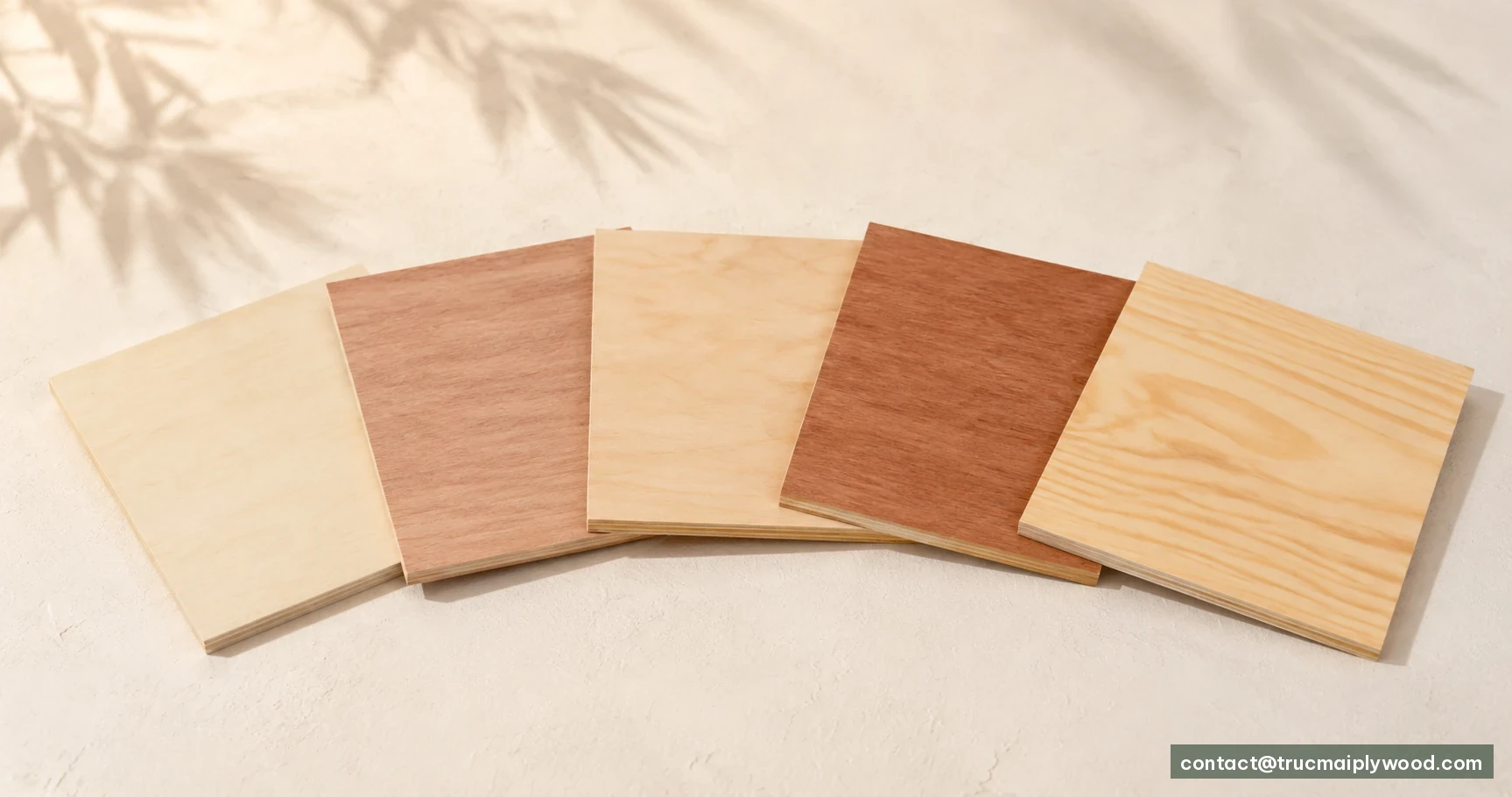
Who pays the courier when a new buyer asks for samples?
The new buyer pays the courier, and gets it back. Truc Mai’s samples are free; a new buyer books its own courier, and the courier cost can be credited against a real order. Repeat buyers and buyers with an order in hand receive free samples, with the courier arranged together with their order. Nothing on the sample itself is billed.
The rule exists because samples are heavy and many requests never turn into an order. A set of plywood pieces in several thicknesses weighs more than a box of brochures, and international courier rates are set by weight. Booking the courier on the buyer’s account keeps the cost visible, and the credit returns it to every buyer who places a container.
In practice the buyer sends a courier account number with the request, or asks the mill to quote the courier and pays it with the request. The credit then appears as a line on the proforma invoice of the first order. Keep the courier invoice: it is the amount credited.
Plywood samples free for importers: who receives them
Three groups receive free plywood samples, with one difference in who books the courier. The table is the whole policy; there is no sample fee and no separate charge for extra builds within one request.
| Buyer | Samples | Courier | Credit |
|---|---|---|---|
| New buyer, no order yet | Free | Booked and paid by the buyer | Credited against a real order |
| Buyer with an order in hand | Free | Arranged with the order | Not needed |
| Repeat buyer | Free | Arranged with the order | Not needed |
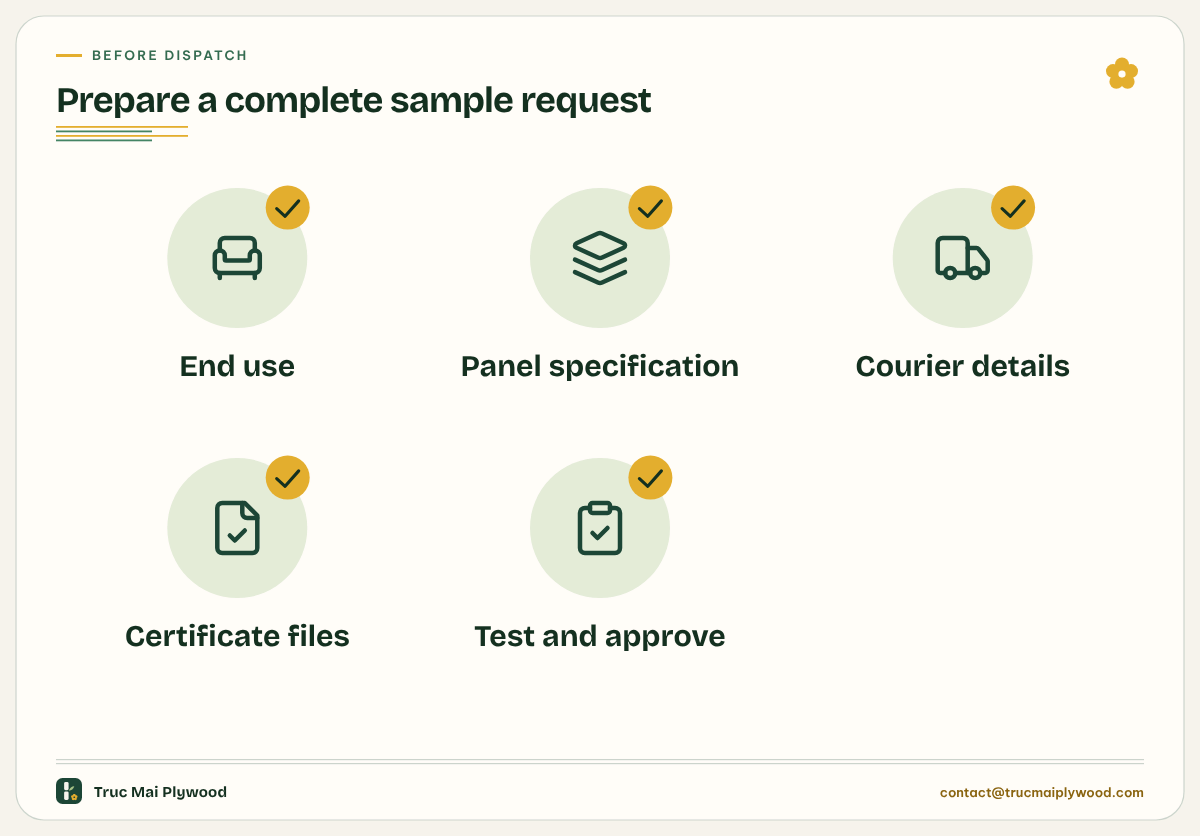
Free does not mean unlimited. A useful request asks for the builds the buyer intends to load, not the whole catalogue, and names the end product so that the sample is cut from the right line. A furniture buyer who receives a packing sample learns nothing about its own order.
Can the courier cost be credited against a real order?
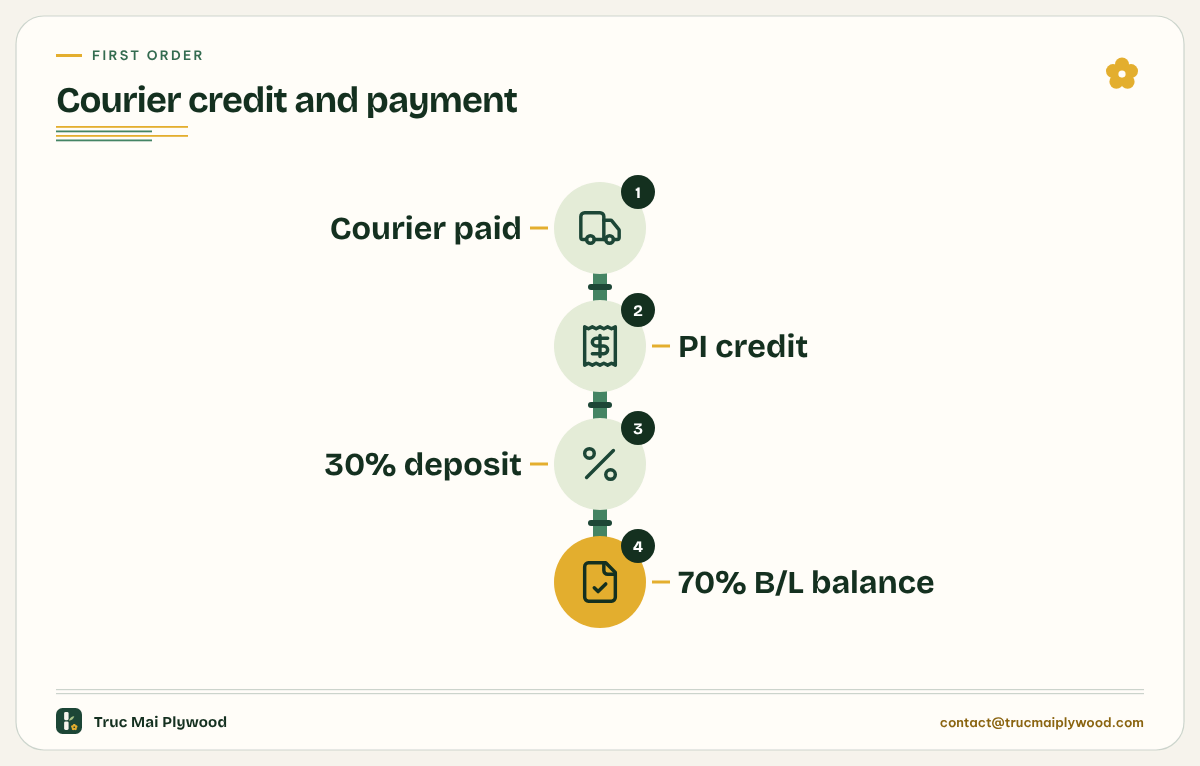
Yes. The courier cost a new buyer paid for its samples can be credited against a real order, which in practice means the first 40HC. The credit appears on the proforma invoice, and the buyer pays the 30% deposit on the net amount.
The credit follows a real order that grows out of the samples. A buyer who requests samples of a furniture build and orders that build gets the credit on the first container. Mention the courier invoice number and the date of the sample request when you send the order line, so the credit is matched without a second email.
| Item | Who pays | When it is settled |
|---|---|---|
| Sample pieces | Mill | Free |
| Courier (new buyer) | Buyer, at request | Credited on the first real order |
| Independent lab test on a sample | Buyer | Paid to the lab |
| Production | Buyer | 30% deposit, 70% against the scanned B/L |
| Sea freight | Depends on term | FOB: buyer; CFR or CIF: in the price |
Plywood samples by mail: how a sample set travels
Plywood samples by mail travel by international courier, packed flat in a carton. The buyer gives the courier account and the address, the mill packs the pieces with a label for each build, and the parcel leaves with the courier’s own paperwork. Plywood is processed wood, so the carton needs no ISPM 15 mark.
The phytosanitary standard says so directly. ISPM 15 exempts “wood packaging made wholly of processed wood material, such as plywood”. The same applies to a full container: solid-wood pallets, battens and dunnage shipped with plywood are inside ISPM 15 and carry their own treatment mark, the panels are not.
Each piece is labelled with its build: thickness, core, face and back, glue and emission. Without the label a sample is a nice piece of wood; with it, it is the reference for an order line. If the sample set goes to several people in your company, keep the labels on the pieces, not only in the email.
Which face and core combinations should go into one sample set?
One sample per build you plan to load: each face you are considering, on the core you would order it with, at the thickness you will buy. For a furniture buyer this is often two or three faces on a Styrax core, plus the same face on an Acacia core to see what the core changes.
A typical first set for a cabinet or furniture buyer:
- White poplar EV face on Styrax core, 18 mm, both faces sanded and calibrated.
- The same face on Acacia core, 18 mm, to compare weight and edge.
- A second face you are considering, for example bleached poplar, okoume or bintangor, on the same core.
- The thin panel you would mix in, for example 3, 4 or 5 mm with 5 plies, for drawer bottoms or backs.
Faces cover EV, poplar and bleached poplar, birch, okoume, bintangor, pine, eucalyptus, gurjan and sapele, and others on request. Cores are Eucalyptus, Acacia, Styrax or Pine, or combined species laid together. Birch is an imported face on a Vietnamese core, so ask for “birch-faced” and compare it as such.
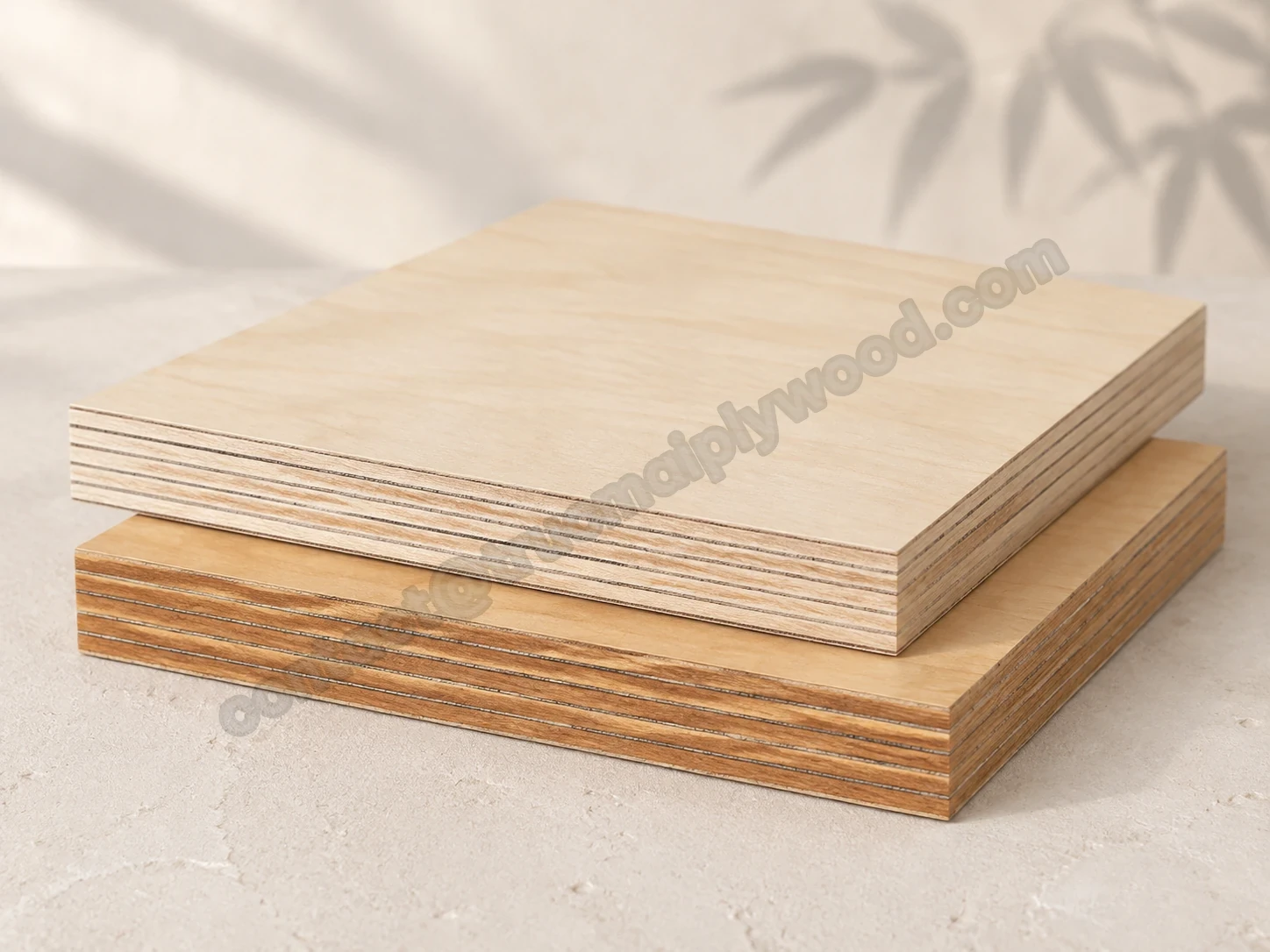

Why ask for each face on the core you will load?
Because the core changes the face, the weight and how much fits in a container. The same white poplar face looks calmer on a Styrax core than on an Acacia core, the Styrax sheet is lighter, and a Styrax load fills more m³ in a 40HC. A sample on the wrong core approves a panel you will not receive.
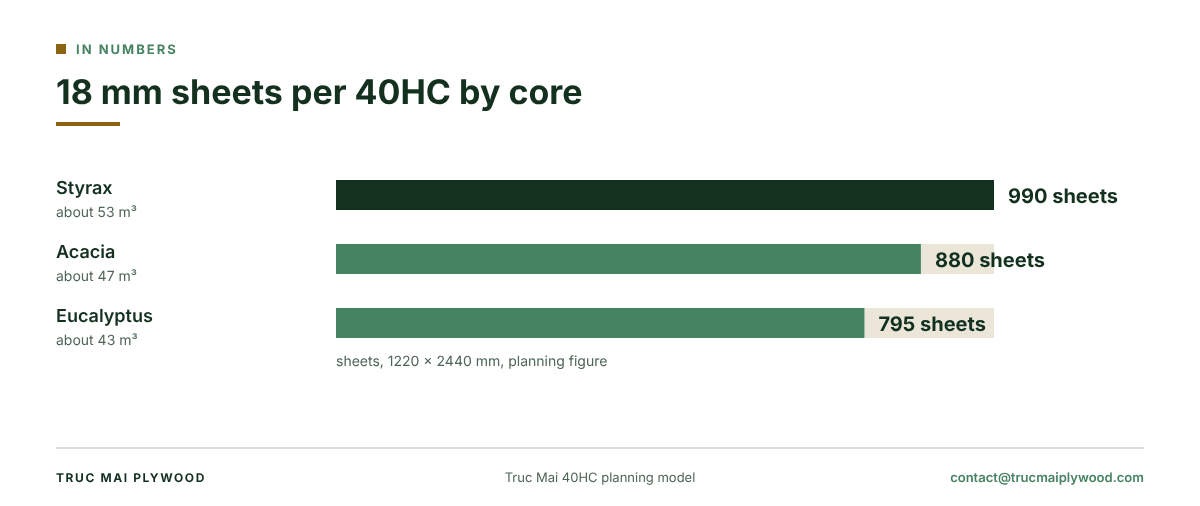
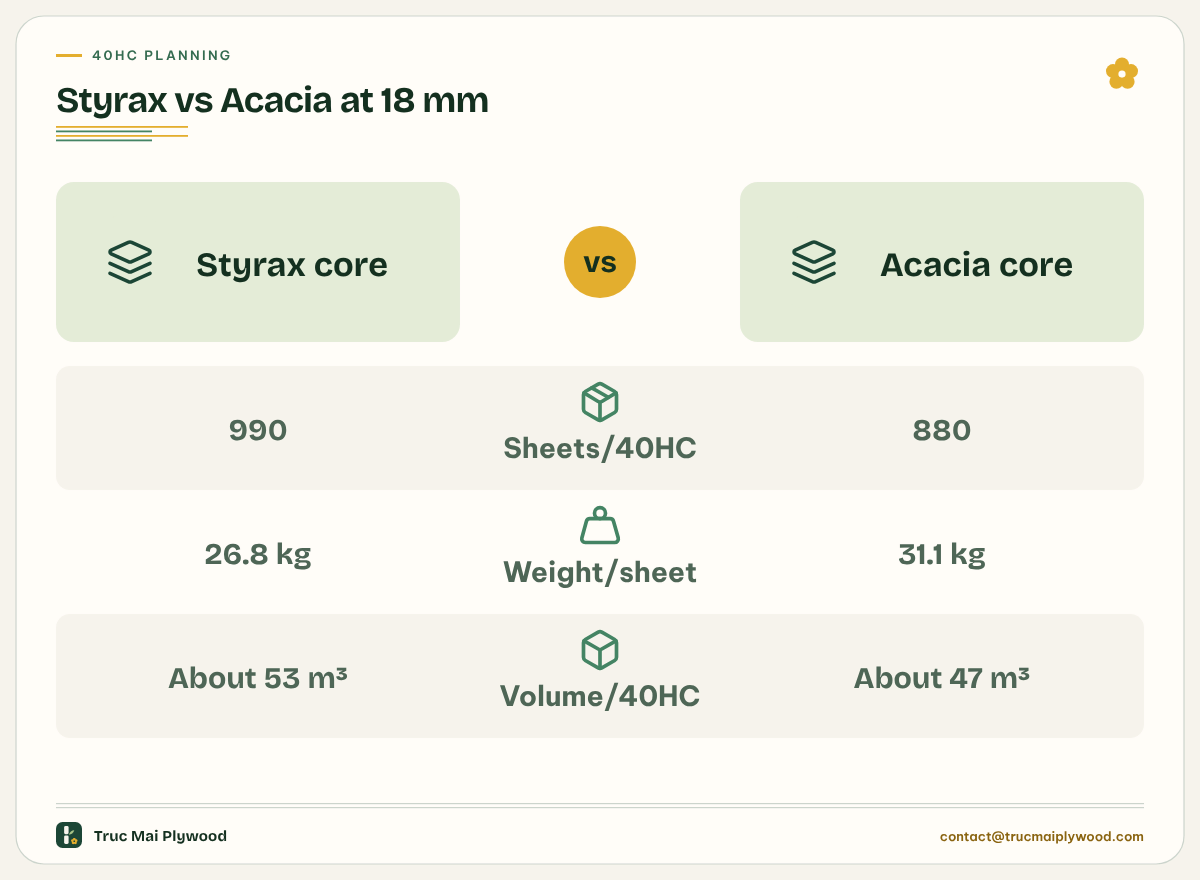
The container numbers show the size of the difference. In the mill’s 40HC planning figure for 18 mm, 1220 × 2440 mm panels:
| Core | Sheets per 40HC | m³ per 40HC | Weight per sheet |
|---|---|---|---|
| Styrax | 990 | About 53 m³ | 26.8 kg |
| Acacia | 880 | About 47 m³ | 31.1 kg |
| Eucalyptus | 795 | About 43 m³ | 34.8 kg |
These are planning figures from the packing model (packs, densities and a 28,000 kg planning payload), not weighed loads. They explain why a furniture buyer moving from Acacia to Styrax usually gets a better face, a lighter sheet and more m³ per container. The full table per thickness is on m³ per 40HC by thickness.
What should you test on a plywood sample?
Test what your own production will do to the panel. Measure thickness at several points, check both faces in daylight against your finish, look at all four edges, cut and edge-band a piece, and put a screw into the edge. Send the emission and bond tests to a laboratory only when your market or customer asks for them.
| Test | How | What it tells you |
|---|---|---|
| Thickness | Calibrated gauge, several points | Whether the line’s tolerance (±0.3 mm or ±0.5 mm) holds |
| Face and back | Daylight, against your finish | Grade pair, colour range, patches |
| Edges | Look along all four edges | Core gaps, overlaps, joining method |
| Cutting and edge-banding | Your saw and bander | Chipping, glue line, sanding-through |
| Screw holding | Screw into the edge | Core density and voids |
| Bond | Lab test to a named method | Glue line strength for the use |
| Formaldehyde | Lab test to your market’s method | Emission class |
For bond quality, European buyers often use EN 314-2, which “specifies requirements for bonding classes of veneer plywood according to their end uses”. For formaldehyde, the US limit for hardwood plywood with a veneer core is 0.05 ppm under 40 CFR 770.10, and the EU limit under Regulation (EU) 2023/1464 is 0.062 mg/m³ for wood-based articles after 6 August 2026. A ppm result is not converted to mg/m³; test to the method of the market.
How does the approved sample fix the face grade for repeat containers?
The approved sample becomes the written grade. Once the buyer approves it, the face and back grades are written on the order as a pair, the sample is kept as the reference, and every repeat container is produced and checked against it. Grade letters on their own leave room for argument; a sample leaves very little.
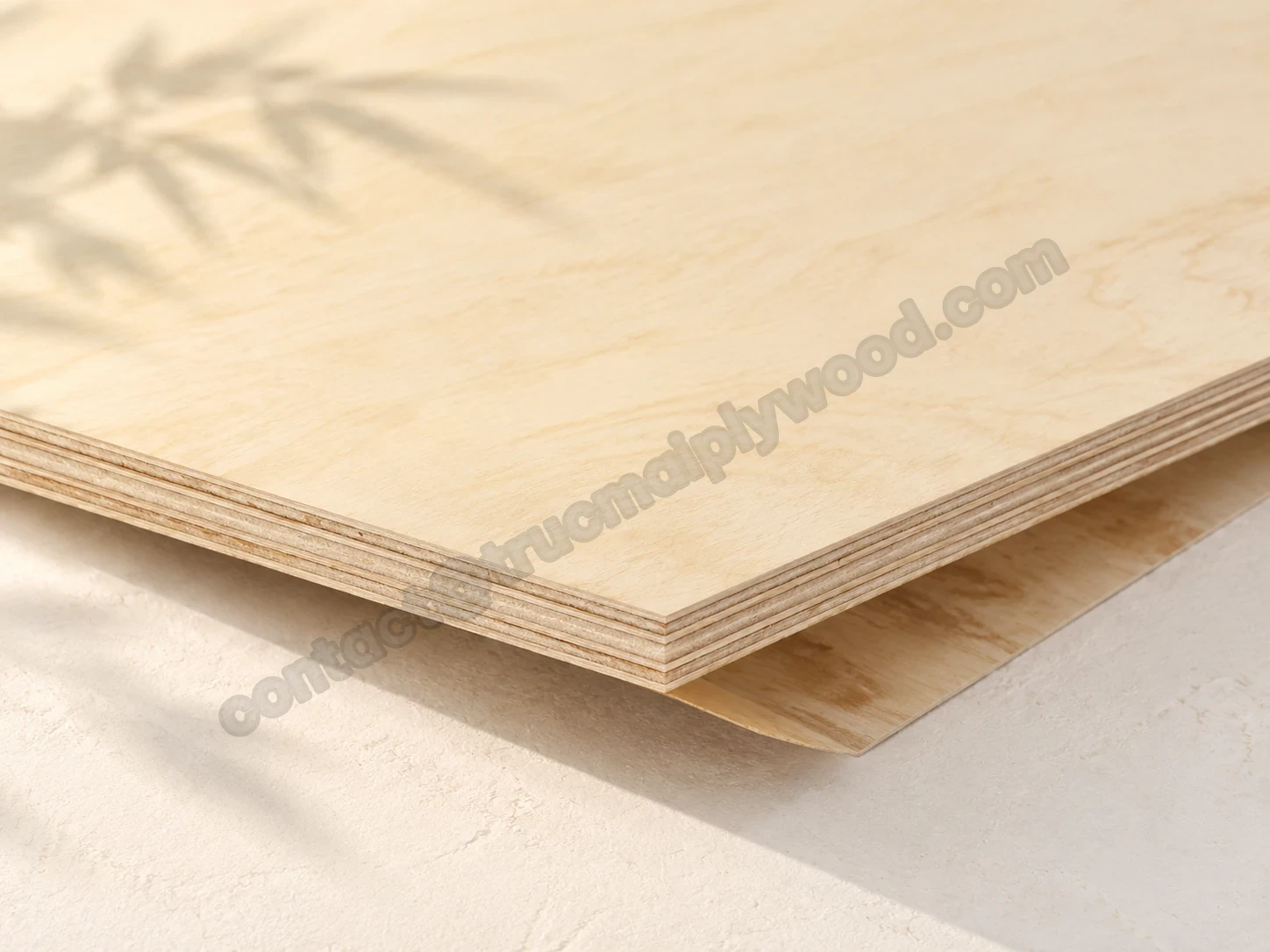
Keep three things together after approval: one labelled piece of each build at the buyer’s office, the same at the mill, and the order line that describes it. On a repeat order the line is copied, the reference is the same, and the arrival check compares the new packs with the piece on your desk.
A sample shows a range, not one sheet. Face veneer is 0.2–0.5 mm thick, usually 0.3 mm for Europe, and natural veneer varies from log to log. Approve the range you can sell: if one piece in the set shows the edge of what you accept, say so in writing. How the mill holds the build on each repeat is on the repeat spec control page.
Which certificate files arrive before the order is confirmed?
The certificate files for the order arrive before it is confirmed: the FSC claim for products on the current schedule, the emission certificate, test reports for the agreed configuration and, for EU orders, the EUDR file set with core and face geolocation. Draft shipping documents follow after loading, for approval before the balance is paid.
| File | When | Covers |
|---|---|---|
| FSC 100% claim (licence FSC-C196493) | Before confirmation | Listed products, on sales and shipping documents |
| CARB P2 / TSCA Title VI (CARB/EPA 26053) | Before confirmation | Hardwood plywood with veneer core, 3–25 mm |
| ISO 9001:2015 (W2012), ISO 14001:2015 (W2012E) | Before confirmation | The plant’s management systems |
| Sample EUDR dossier, core and face | Before confirmation, EU orders | Plot geolocation and origin records |
| PPWR packaging test | Before confirmation, EU orders | Packaging materials tested |
| Draft invoice, packing list, B/L | After loading | The container, for approval |
Read the files alongside the sample, not after. A sample of a 30 mm panel, for example, is outside the CARB scope of 3–25 mm; if your US order needs CARB P2, the sample and the order line should stay inside it. The FSC licence check guide shows how to look up the FSC code before you approve.
How do I get plywood samples from a Vietnamese factory?
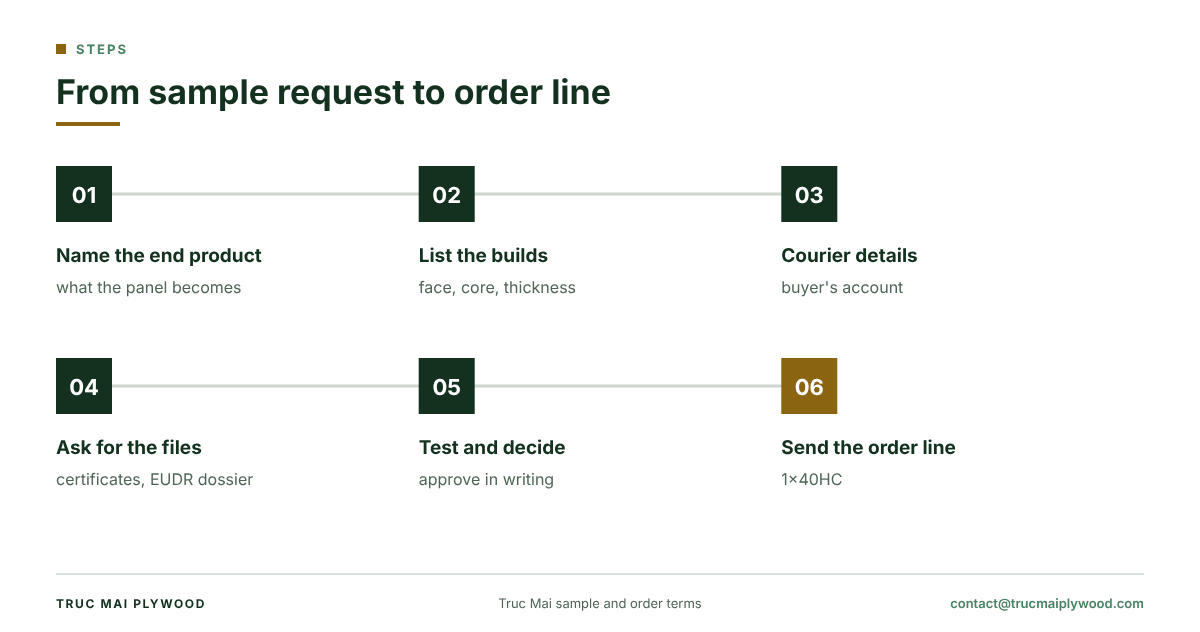
Send the mill one email with the end product, the builds you want to see, the thickness and size, the delivery address and your courier account, then approve or reject each piece in writing. A request that names the use gets the right line; a request for “your best plywood” gets a catalogue.
- Name the end product. Kitchen carcasses, UV-coated fronts, laminate substrate or crates.
- List the builds. Face and back, core, thickness, glue and emission for each sample.
- Give the courier details. Account number and delivery address, or ask for a courier quote.
- Ask for the files. Certificate files and, for the EU, the sample EUDR dossier.
- Test and decide. Run your own tests, then approve or reject each build in writing.
- Send the order line. Copy the approved build into the order with quantity and terms.
The full path from first email to a loaded container is on from enquiry to loading.
What is the minimum order after samples are approved?
One 40HC. Once the sample is signed off, the buyer turns it into a confirmed order line and sends the 30% deposit; production then runs 15–45 days depending on quantity, production conditions and agreement. The 70% balance is settled when the scanned bill of lading arrives, on FOB Hai Phong, CFR or CIF terms; how the deposit and balance work, by T/T or L/C, is set out on deposit and balance terms.
That is where the sample set pays off, because one container may hold more than one approved build (one or two is usual, three to six by agreement): a buyer who approved a furniture build and a thin back panel can load both in one 40HC. The terms are set out on MOQ, payment and FOB.
How long from sample approval to the first container?
Count three stages: the sample on its way, production after the deposit, and the sea leg. Production takes 15–45 days after the 30% deposit. The sea leg depends on the lane: a Northern Europe buyer should plan on roughly 30–40 days from Hai Phong, a US West Coast buyer on about 20–30, and carrier and route move both. Every lane is listed on sea freight per m³.
| Stage | Typical time | What decides it |
|---|---|---|
| Courier to the buyer | Courier’s own service | Service level the buyer books |
| Testing and approval | The buyer’s own process | Lab tests take longest |
| Production after deposit | 15–45 days | Quantity, production conditions, agreement |
| Sea, Northern Europe | 30–40 days | Carrier and route |
| Sea, US West Coast | 20–30 days | Carrier and route |
| Sea, US East Coast | 35–45 days | Carrier and route |
The thin panels can take longer. Good thin veneer is scarce, and 4 mm panels use 1.3 mm core veneer, so a sample set that includes 4 mm backs is worth sending early.
What makes a plywood sample misleading?
A sample misleads when it is not the build you will receive: a hand-picked sheet from a better line, a different core under the same face, a sanded sample for an unsanded order, or a sample with no label. Each one approves a panel the container will not carry.
Four checks prevent it:
- Label. Every piece names thickness, core, face and back, glue and emission.
- Core. The edge shows the core you will load; compare it with the order line.
- Preparation. Sanded and calibrated only if the order says so.
- Range. Ask for two pieces of a face when its colour range matters, one from each end of what the line produces.
The quality by grade guide explains what each line looks like at the edge, so a buyer can tell a furniture build from a commercial build in the sample box.
What should the sample request say?
A sample request says what the panel will become and lists each build as it would appear on the order. Written that way, the approved sample turns straight into the first order line.
Samples for kitchen carcasses. (1) 18 mm, Styrax core A-grade stitched, white poplar EV face / poplar back, sanded and calibrated, UF glue at E0 emission, 1220 × 2440 mm. (2) Same on Acacia core. (3) 5 mm, 5 plies, poplar face / back, for drawer bottoms. Courier on our account. Please include certificate files and the sample EUDR dossier.
Send the request to the quotation desk or by email to contact@trucmaiplywood.com. The furniture and interior plywood range lists the faces and cores a sample set can include.
Questions buyers ask
Are plywood samples free?
Yes. Samples are free for repeat buyers and buyers with an order; new buyers also receive free samples and book their own courier.
Who pays the courier for plywood samples?
A new buyer books and pays the courier. The courier cost can be credited against a real order, so it comes back when the first container is placed.
Can I get plywood samples by mail?
Yes, by international courier on the buyer's own account. Give the courier account number and the delivery address with the request, and the mill hands the parcel to the courier.
How many samples should I ask for?
One per build you plan to order: each face on the core you will load, at the thickness you will buy. Extra builds slow the decision without telling you more.
Do plywood samples need an ISPM 15 mark?
No. Plywood is processed wood and outside ISPM 15; only solid-wood pallets, battens or dunnage shipped with it fall under that standard.
Can a sample show the exact face of my order?
It shows the grade and the range of the face, not the individual sheets. Natural veneer varies from log to log, which is why the approved sample is the reference for the range.
Which certificates come with the samples?
Certificate files are sent before the order is confirmed: the FSC claim for listed products, the emission certificate, test reports for the agreed configuration and, for EU orders, the sample EUDR dossier.
What is the minimum order after samples?
One 40HC, which can hold the approved builds together: usually one or two, and up to six when agreed.
How long does production take after approval?
15–45 days after the 30% deposit, depending on quantity, production conditions and agreement.
Can I test formaldehyde on a sample?
Yes, through an independent laboratory with the test method your market uses. Agree the method and the emission class before the test, because US ppm results and EU mg/m³ results are not converted into each other.
Should I keep part of the sample?
Yes. Keep one approved piece of each build, labelled with the order line, so the arrival check of every repeat container is done against the same reference.
Can I ask for samples of a cut-to-size panel?
Yes. Cut-to-size orders split one sheet into 2, 3, 4 or 6 panels before packing, and a sample can show the cut edge and size for that order.