
Mill · How we work
How we work as a plywood supplier, from enquiry to loading
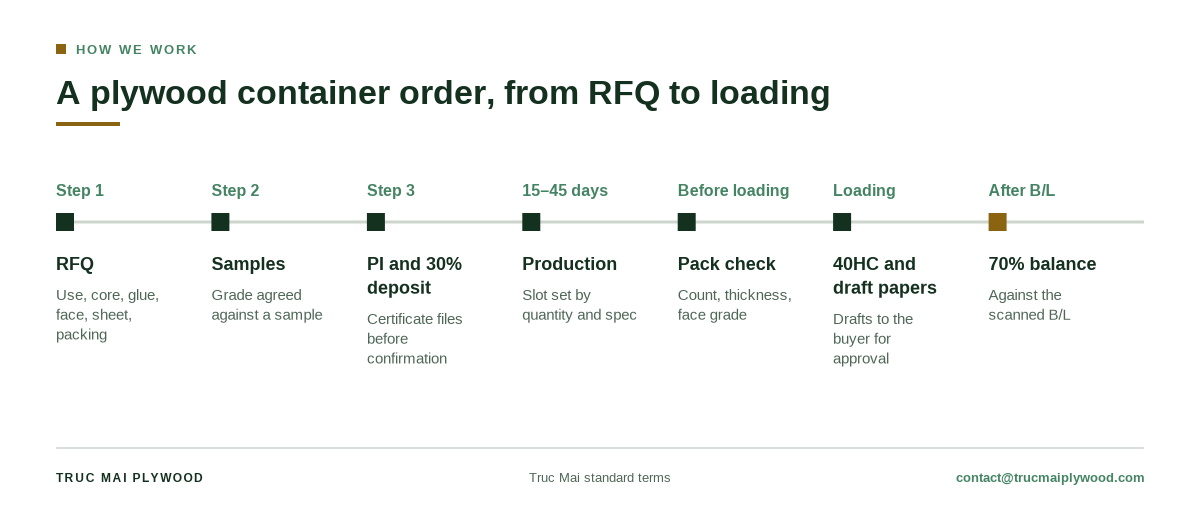
Truc Mai runs every container order as one fixed sequence: a written RFQ, samples, a proforma invoice with a 30% deposit, a production slot, a pack check, loading, and the 70% balance against the scanned B/L. Certificate files reach the buyer before the order is confirmed; draft shipping documents follow loading.
The sequence is built for a buyer who fills a container of furniture and interior plywood every month. The first order fixes the written spec and the grading sample; every repeat order runs on that spec, so the second container is planned in days, not weeks. Loading itself has its own page with the full loading plan.
- 1 × 40HCminimum order, one or two products per container
- 30% / 70%deposit with the PI, balance against the scanned B/L
- 15–45 daysproduction after the deposit, by quantity and spec
- FOB · CFR · CIFFOB Hai Phong, CFR (CNF) or CIF
Updated 12 November 2026
Before you confirm
Which certificate files arrive before the order is confirmed?
FSC, CARB P2, ISO 9001 and ISO 14001, plus EU file sets.
- FSC 100% chain of custody FSC-C196493 · SA-COC-014545
- CARB P2 and TSCA Title VI CARB/EPA 26053
- ISO 9001:2015 W2012 · WCERT
- ISO 14001:2015 W2012E · WCERT
For EU orders a sample geolocation file shows the format of the core and face data before confirmation, as the EU deforestation regulation asks of the importer. Dates on the scans are blurred; numbers are not.
At a glance
What is the plywood order process from Vietnam, step by step?
The plywood order process from Vietnam at Truc Mai has seven stages, from the written RFQ to the paid balance. A first order takes the full sequence; a repeat order on the same written spec starts at the proforma invoice.
An order process is the agreed order of commitments between buyer and mill: what the buyer sends, what the mill sends back, and which money moves at which point. Fixing it on the first order is what lets a monthly buyer plan containers without renegotiating each one.
| Stage | Buyer sends | Mill sends | On file |
|---|---|---|---|
| 1. RFQ | Application, core, glue, face, sheet, packing, quantity | Quotation with planning load per 40HC | Written spec, revision 1 |
| 2. Samples | Courier account, or order reference | Sample panels for the build quoted | Approved grading sample |
| 3. PI and deposit | 30% deposit by T/T | Proforma invoice, certificate scans | Signed PI |
| 4. Production | Pack label and marking wishes | Production slot and progress | Press and grading records |
| 5. Pack check | Optional third-party inspector | Count, thickness and face results | Check sheet per batch |
| 6. Loading | Approval of drafts | Photos, draft packing list and B/L | Seal and container number |
| 7. Balance | 70% by T/T or irrevocable L/C at sight | Originals or telex release | Paid invoice |
By product line
How does the order change by product line?
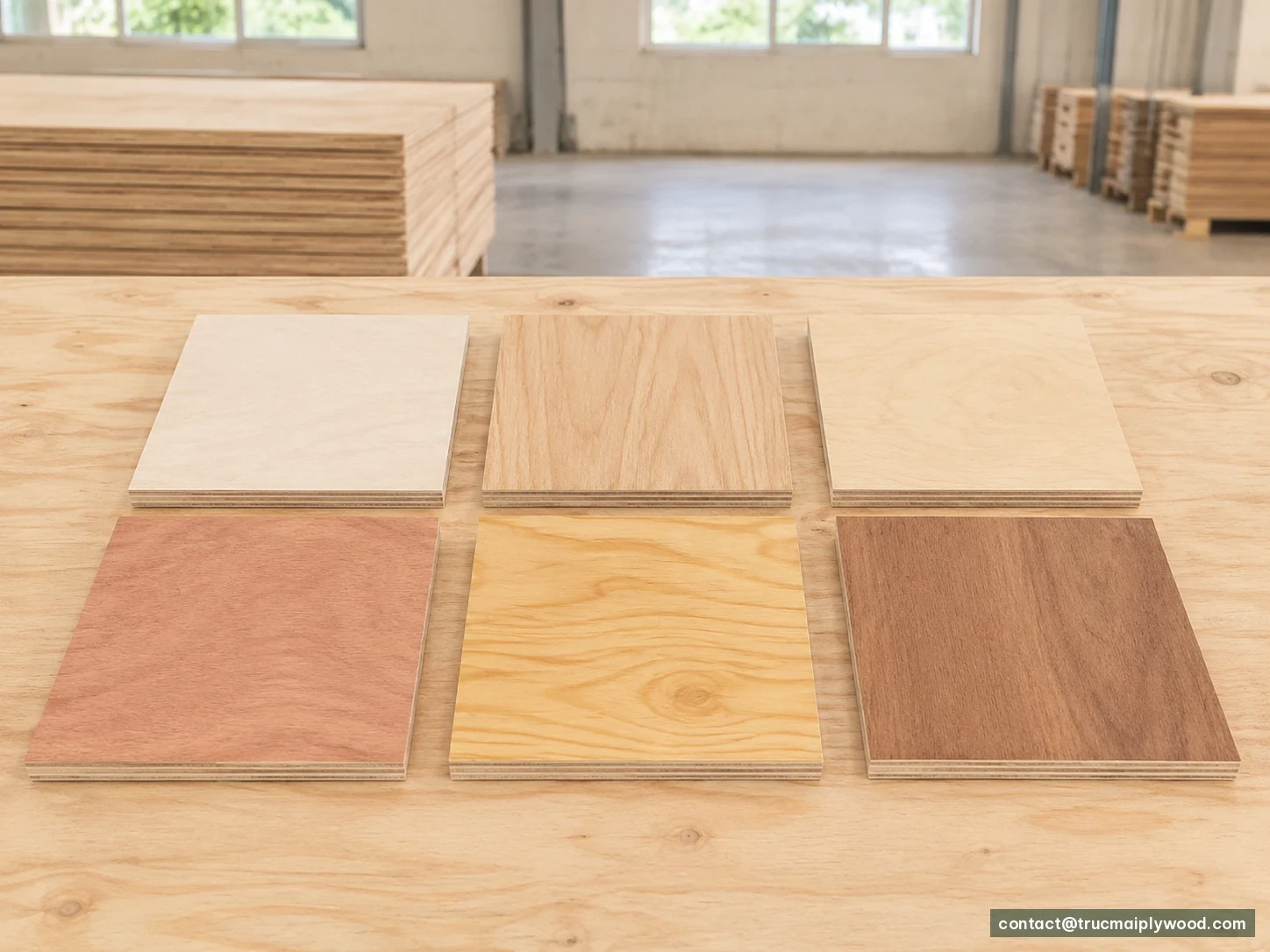
The sequence stays the same, but the sample, the tolerance and the slot change with the line: furniture panels are graded on sanded faces to ±0.3 mm, commercial panels to ±0.5 mm and packing panels to ±0.5–1.0 mm.
Thin panels of 4 mm can need a longer slot, because they use 1.3 mm core veneer and good thin veneer is scarce. For cut-to-size orders the cut plan, splitting one sheet into 2, 3, 4 or 6 parts, is approved with the sample, and the pack plan follows the cut size.
| Line | Sample shows | Tolerance on the order | Slot note |
|---|---|---|---|
| Furniture and interior | Sanded face and back grade pair, stitched A-grade core | ±0.3 mm, sanded and calibrated | Standard |
| Commercial | Face grade, AB core, light or no sanding | ±0.5 mm | Standard |
| Packing | AB loose-laid core, usually E2 emission | ±0.5–1.0 mm | Standard |
| Thin 3–6 mm | Ply count: 3–5 mm always 5 plies | As agreed per thickness | 4 mm can take longer |
| Cut to size | Cut plan 2, 3, 4 or 6 parts per sheet | Length and width ±2 mm | Cut before packing |
Steps
How we work as a plywood supplier: what happens at each step?
Nine steps take an enquiry to a paid container; each ends with something in writing, so a repeat order can copy the first one line by line.
- Written RFQ
Start from the application, then core, glue and emission, face, sheet size, packing and quantity. Check: one line per item, so two quotes compare on the same construction.
- Quotation
The reply gives the build, the planning load per 40HC and the delivery term: FOB Hai Phong, CFR or CIF. Check: core species and glue are named, not only the face.
- Samples
New buyers receive free samples and book their own courier; the courier cost can be credited against a real order. Repeat buyers and buyers with an order receive samples free. Check: the sample carries a label with the build it represents.
- Grade agreed against the sample
Face and back grades are quoted as a pair and fixed against the approved sample, then written on the order. Check: buyer and mill keep one sample each.
- Proforma invoice and 30% deposit
The PI lists every spec line, the tolerance, the emission class, packing and documents. Check: the FSC claim, where wanted, is written on the PI.
- Production slot
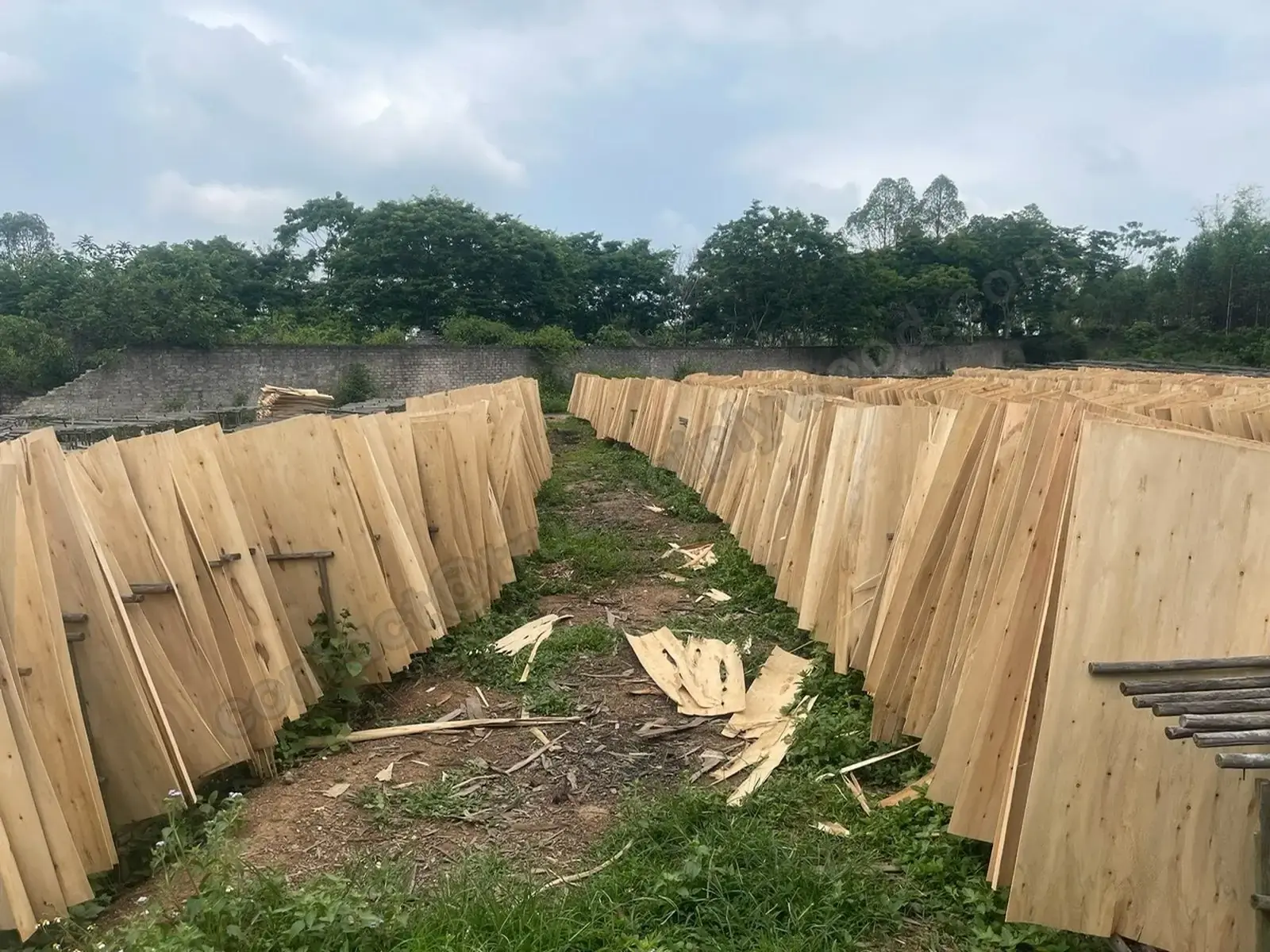
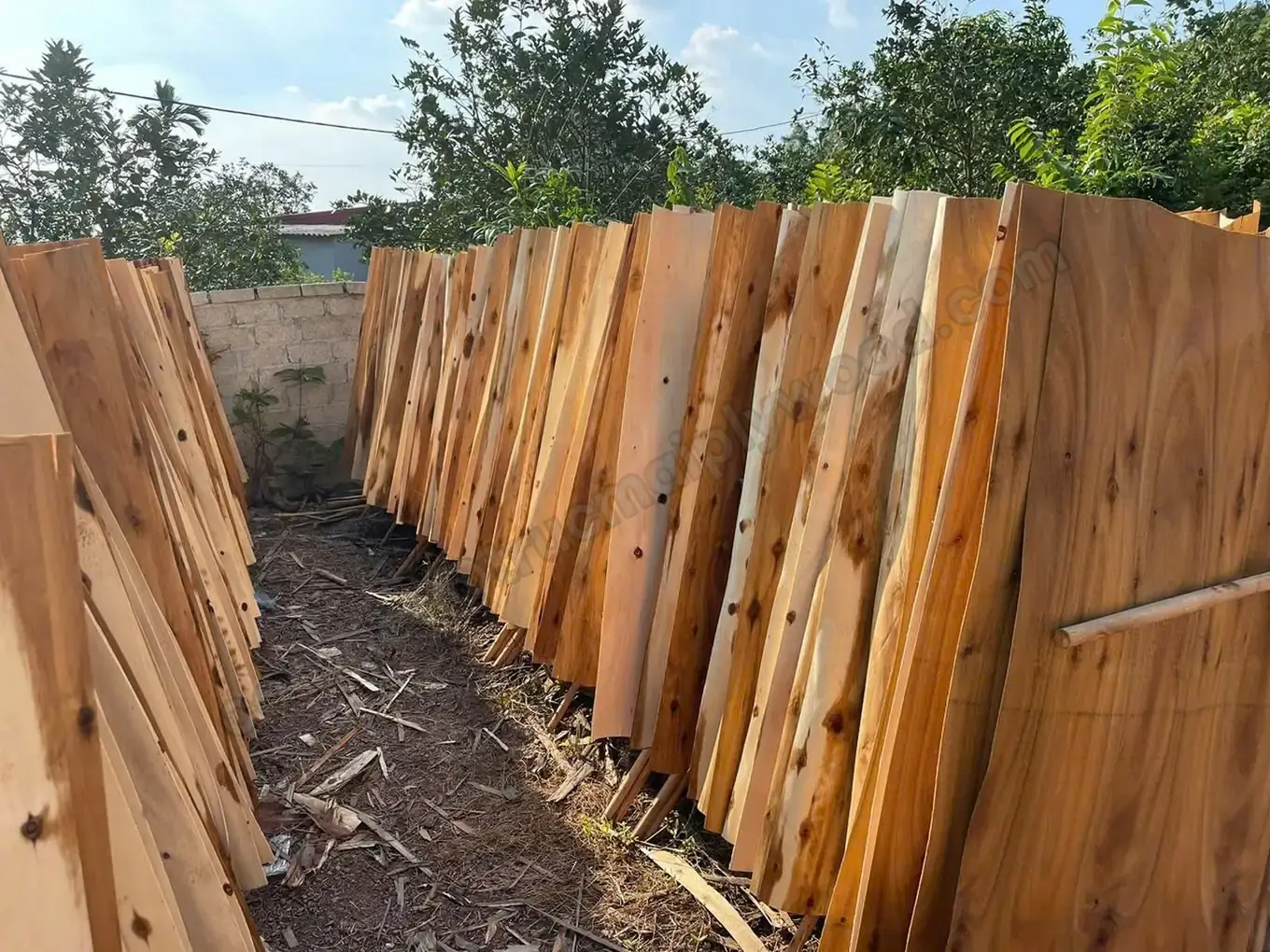
Production runs in the slot confirmed after the deposit, set by quantity, production conditions and agreement; the build follows how our plywood is made. Check: the slot date is confirmed in writing when the deposit arrives.
- Pack check
Before loading, QC counts sheets, measures thickness and compares faces with the approved sample. Check: a buyer's own inspector can attend this check.
- Loading and drafts
Packs are loaded to the plan and draft shipping documents go to the buyer for approval after loading. Check: seal number and gross weight on the draft B/L.
- Balance and release
The 70% balance is paid against the scanned B/L, by T/T or irrevocable L/C at sight. Check: originals or telex release follow payment.
Photos during the order
Which photos does a buyer see while the order runs?
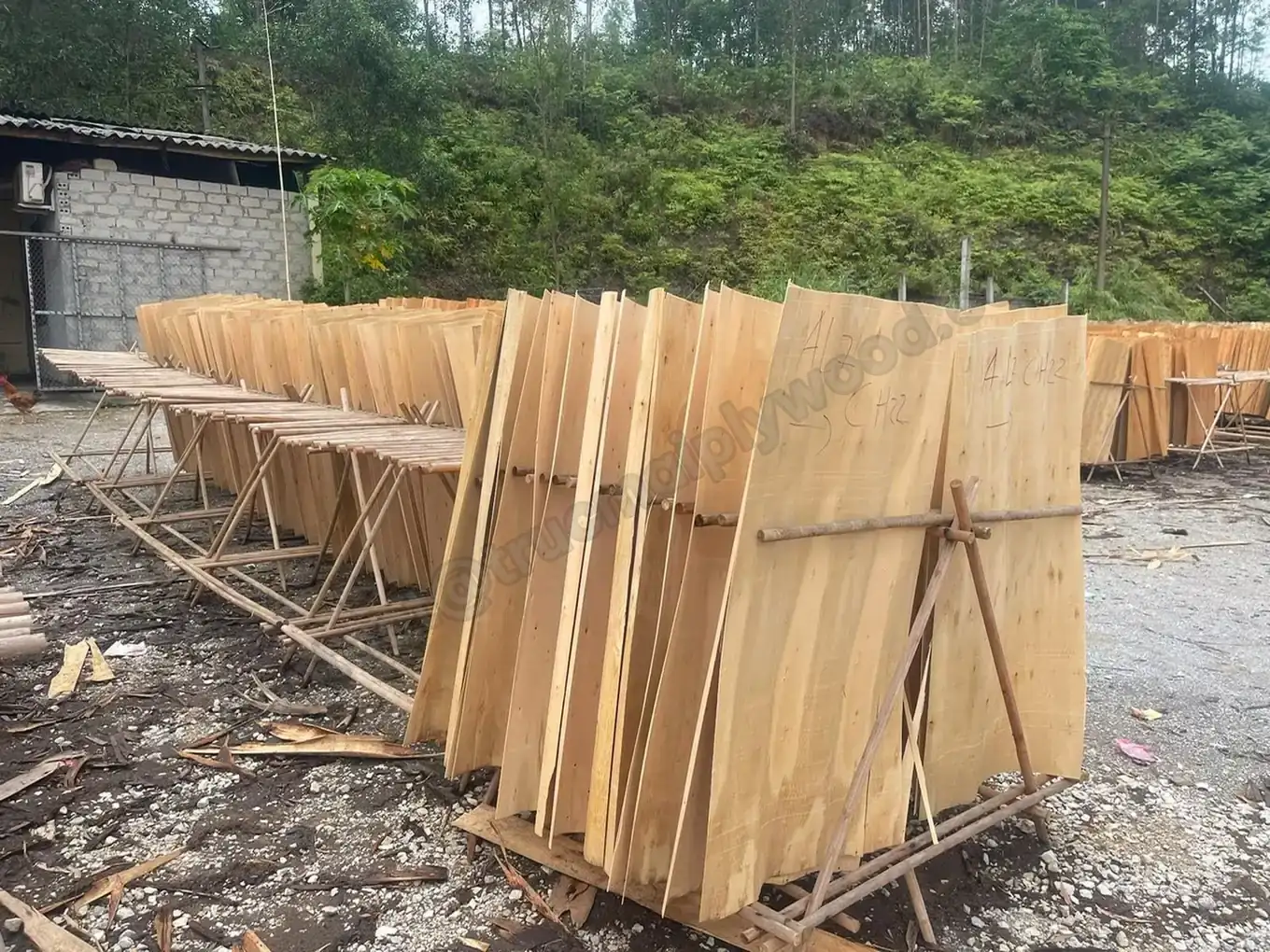
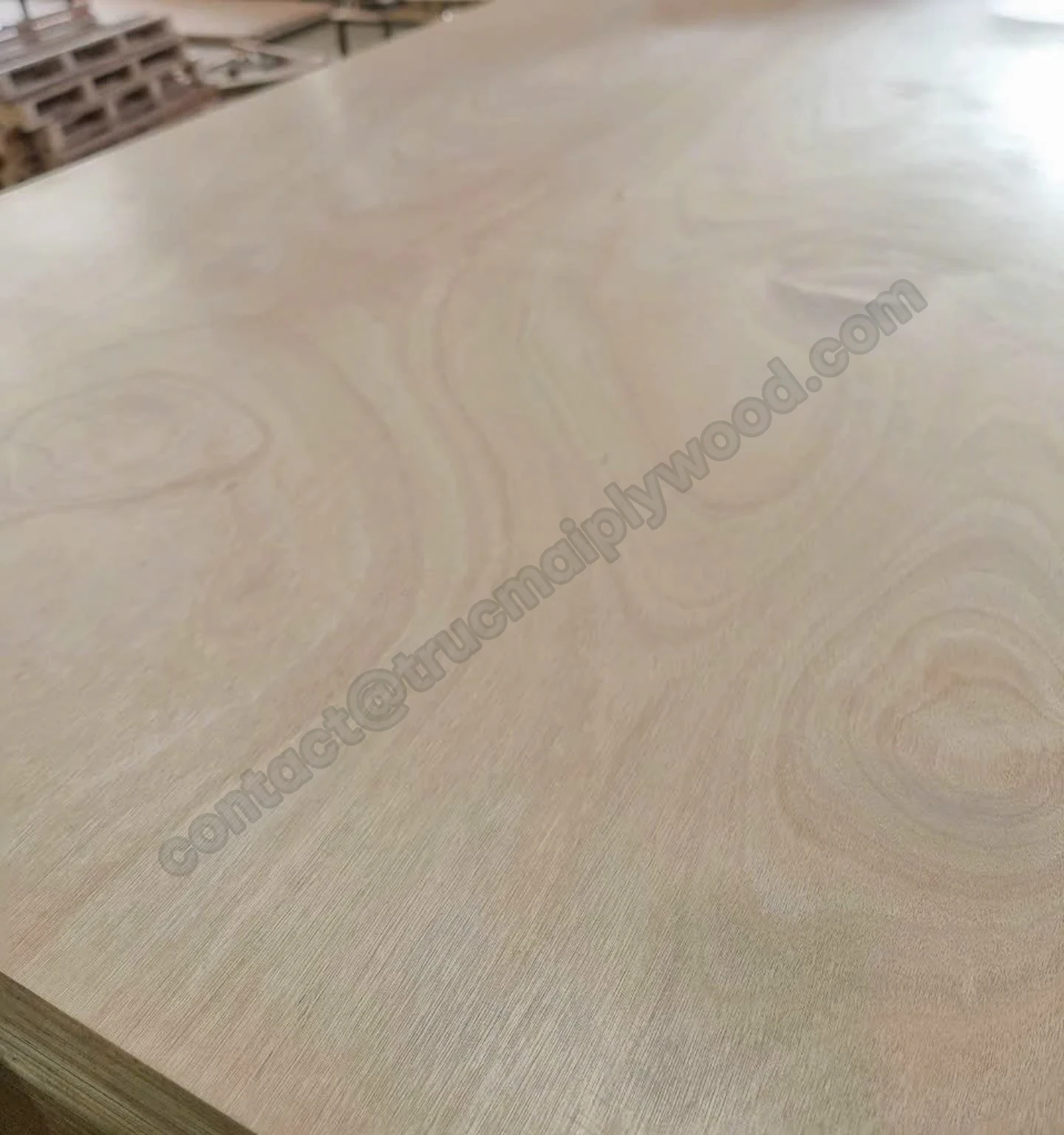
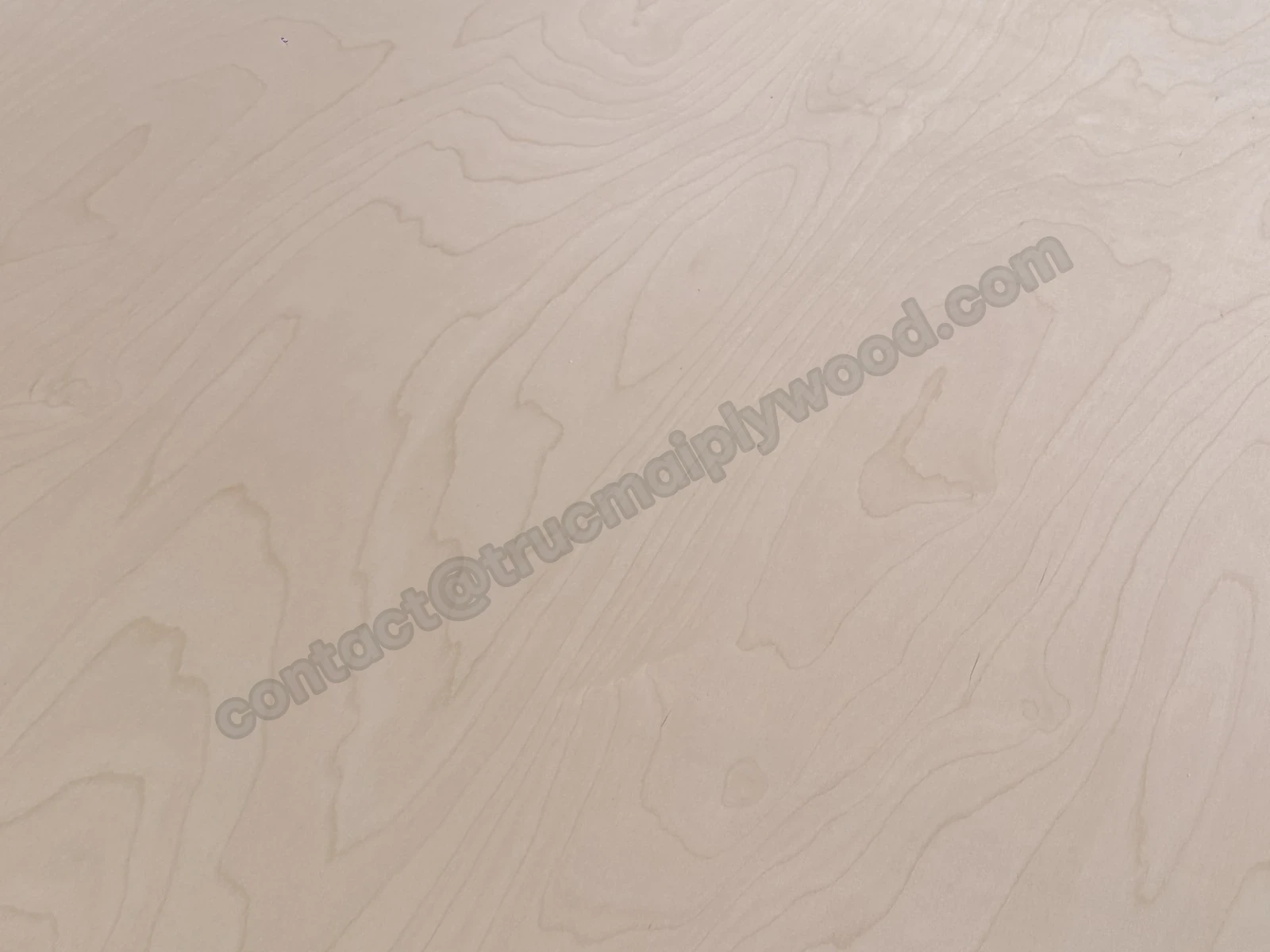
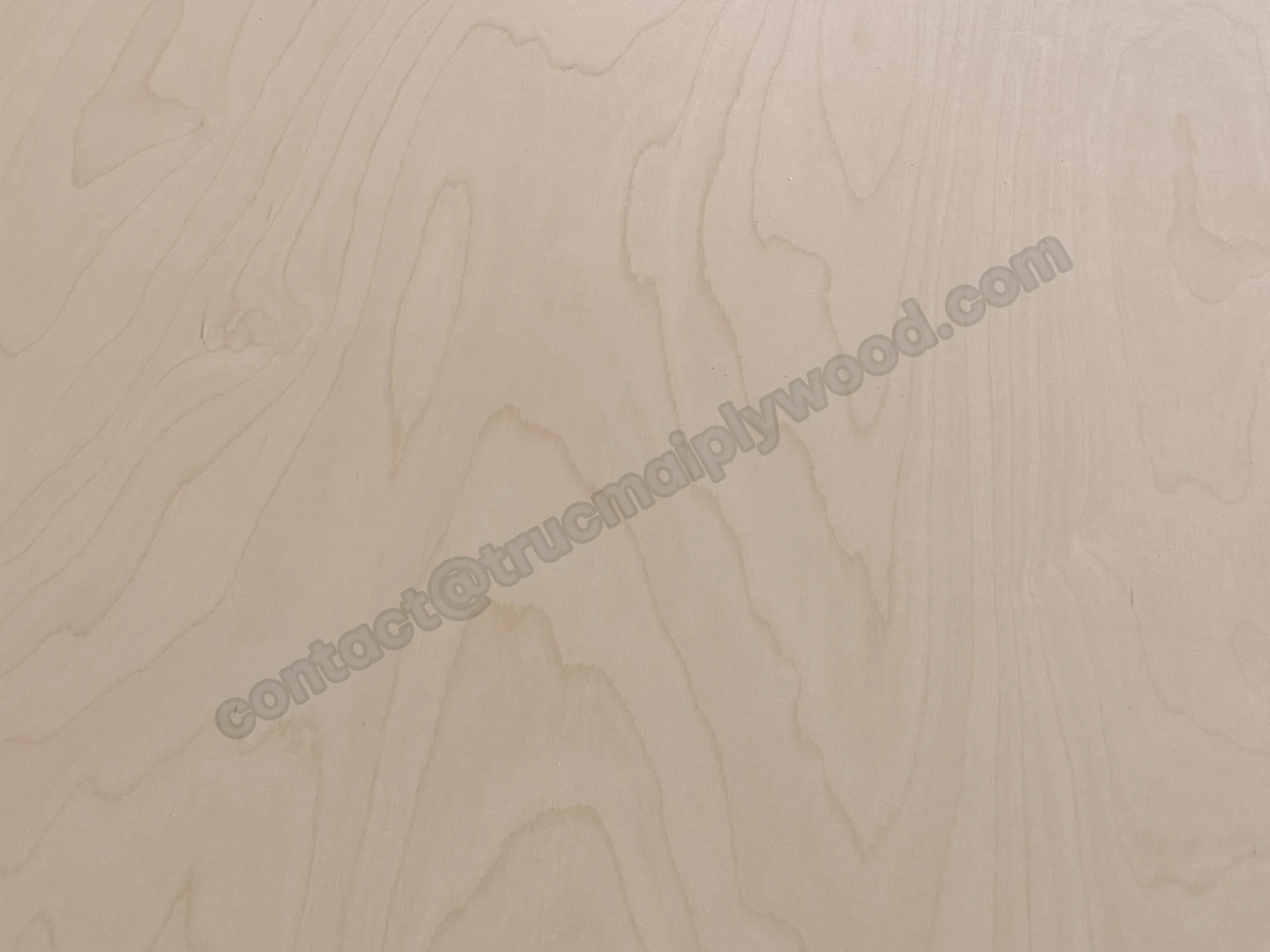
A buyer sees three sets of photos: the labelled sample against which the grade is fixed, the batch at the pack check, and the container at loading. Each set is taken from the same angles for every order, so a monthly buyer can compare one container with the last.
Sample photos show the face, the back and the edge with its ply count. Pack-check photos show the caliper reading and the face of the top sheets. Loading photos show the pack labels, the rows and the seal.
Where first orders go wrong
What goes wrong in a first plywood order, and how is it prevented?
First orders fail on the same six points: quotes that are not like for like, a grade nobody wrote down, thickness without a tolerance, documents that arrive late, a mixed load nobody planned and a balance paid on the wrong paper. Each one has a fix in the sequence.
| Problem | Cause | Prevention in the sequence |
|---|---|---|
| Two quotes, two different panels | Same product name, different core grade, joining, face prep, glue or tolerance | RFQ written line by line from the application |
| Grade dispute on arrival | Grade agreed by name only | Grade pair fixed against a labelled sample kept by both sides |
| Thickness complaint | No tolerance on the order | ±0.3–0.5 mm written on the PI per line |
| Customs delay | Certificate or EUDR data arrives after shipping | Certificate files before confirmation, file set with the drafts |
| Mixed container short or overweight | Products added after planning | Products per container fixed on the PI: one or two, up to six by agreement |
| Payment friction | Balance terms unclear | 70% against the scanned B/L, T/T or irrevocable L/C at sight |
Terms and numbers
What are the standard terms of a Truc Mai plywood order?
The standard terms fit in one table: one 40HC minimum, 30% deposit, 15–45 days of production, 70% balance against the scanned B/L, and FOB Hai Phong, CFR or CIF. The delivery terms follow the ICC Incoterms 2020 rules.
| Term | Value | Condition |
|---|---|---|
| Minimum order | 1 × 40HC | One or two products; three to six by agreement |
| Deposit | 30% | With the proforma invoice |
| Production | 15–45 days | After the deposit, by quantity, production conditions and agreement |
| Balance | 70% | Against the scanned B/L, by T/T or irrevocable L/C at sight |
| Delivery terms | FOB Hai Phong, CFR (CNF), CIF | Insurance included under CIF |
| Thickness tolerance | ±0.3–0.5 mm | ±0.3 mm sanded furniture panels, ±0.5 mm commercial, ±0.5–1.0 mm packing |
| Length and width | ±2 mm | All lines |
| Samples | Free | New buyers book the courier; cost credited against a real order |
| Destination | Days at sea | Note |
|---|---|---|
| Middle East | 15–25 days | Varies by carrier and route |
| US West Coast | 20–30 days | Varies by carrier and route |
| Mediterranean | 25–35 days | Varies by carrier and route |
| Northern Europe | 30–40 days | Varies by carrier and route |
| US East Coast | 35–45 days | Varies by carrier and route |
Buyer guide
What does the first RFQ need to state so two quotes compare like for like?
The first RFQ needs eight lines: application, core species, glue and emission class, face and back grade, thickness with tolerance, sheet size, packing, and quantity with destination. Two offers with the same product name are often different panels, and these lines make the difference visible.
Price differences between mills usually come from core grade, joining method, face preparation, adhesive system and tolerance, not from the face species alone. A buyer comparing birch-faced plywood or engineered veneer from two mills gets a fair comparison only when both quotes answer the same eight lines.
| RFQ line | Example | Why it matters |
|---|---|---|
| Application | Kitchen carcasses, painted | Sets face prep and core grade |
| Core species | Styrax, Acacia, Eucalyptus, Pine or combined | Sets weight, flatness and m³ per 40HC |
| Glue and emission | UF glue at E0 emission | Two separate lines, never one |
| Face and back | Grade pair against a sample | Fixes the appearance |
| Thickness and tolerance | 18 mm ±0.3 mm | Sets sanding and calibration |
| Sheet size | 1220 × 2440, 1220 × 2280 or 1250 × 2500 mm | Sets cut yield and load |
| Packing | Pack label, marking, pallet type | Sets the packing materials |
| Quantity and port | 1 × 40HC to the buyer's port | Sets the Incoterm and the file set |
What you hold
What does a buyer hold in writing after the first order?
After the first order a buyer holds five things that make the next one faster: the written spec, the labelled sample, the signed PI, the pack-check sheet and the approved document set. A repeat order is made to exactly that written spec.
- Written spec Every line of the RFQ as confirmed, with its revision
- Labelled sample The grade pair both sides compare against
- Signed PI Price basis, terms, tolerance and documents
- Pack-check sheet Counts, thickness readings and face notes per batch
- Document set The approved drafts, reused as the template for the next container
Documents and timing
Which shipping documents come with each container, and when are drafts sent?
Drafts go to the buyer right after loading, and originals or a telex release follow the balance. The set covers the invoice, packing list, B/L, origin papers, plant-health papers, insurance under CIF and the order's own certificate documents.
- Before confirmation
FSC, CARB and ISO scans; test reports for the agreed build; a sample EUDR file for EU buyers.
- After loading
Commercial invoice, packing list per pack, draft B/L with seal and gross weight.
- With the drafts
Certificate of origin, EUR.1 for EU lots; phytosanitary and fumigation papers for any solid-wood pallets and dunnage.
- EU lots
EUTR and EUDR file set with plot geolocation for core and face, for the importer's own statement.
- Packaging
The PPWR packaging test for the pallets, wraps and straps that travel with the panels.
- After the balance
Original documents by courier, or a telex release when the B/L is surrendered.
Lead time and capacity
What is the plywood production lead time for a 40HC?
Plywood production lead time for a 40HC at Truc Mai is 15–45 days after the 30% deposit. The short end fits one or two standard products on a known spec; the long end fits a first order, several products or 4 mm panels.
The mill in Ha Hoa presses around 60,000 m³ a year, about 5,000 m³ in an average month, so a monthly container is a small share of output. A buyer who books the next container when approving the drafts of the current one keeps a steady monthly rhythm.
Order checklist
Which six lines should every plywood purchase order carry?
Six lines on the purchase order cover most of what goes wrong between two containers.
The written spec reference and revision, so the repeat order is the same panel.
The approved sample reference for face and back grade.
Thickness tolerance per line, ±0.3–0.5 mm, and ±2 mm on length and width.
Glue type and emission class as two separate lines.
Products per container, the planning load and the delivery term.
Documents wanted before confirmation and with the drafts, kept under the ISO 9001 system.
FAQ
Order process questions from container buyers
Direct answers on samples, money, timing and documents.
How long does production take after the 30% deposit?
Production takes 15–45 days after the 30% deposit, depending on quantity, production conditions and agreement. A repeat order on a known spec sits at the short end.
When is the 70% balance paid, and by which payment methods?
The 70% balance is paid against the scanned B/L, by T/T or irrevocable L/C at sight. Originals or a telex release follow payment.
Are samples free, and who pays the courier?
Samples are free. Repeat buyers and buyers with an order pay nothing; new buyers book their own courier, and that cost can be credited against a real order.
Which certificate files arrive before the order is confirmed?
The FSC 100% chain of custody, the CARB P2 and TSCA Title VI listing, ISO 9001:2015 and ISO 14001:2015 scans arrive with the quotation. Test reports for the agreed build and a sample EUDR file follow for EU buyers.
Which shipping documents come with each container, and when are drafts sent?
Commercial invoice, packing list, B/L, origin papers, phytosanitary and fumigation papers and insurance under CIF come with each container. Drafts go to the buyer for approval right after loading.
Can a repeat order be made to exactly the same written spec?
Yes. The confirmed spec, the labelled sample and the signed PI from the first order are reused line by line, and the repeat order starts at the proforma invoice.
What is the minimum order?
The minimum order is one 40HC, usually with one or two products. Three to six products can share a container by agreement.
Which Incoterms do you quote?
We quote FOB Hai Phong, CFR (CNF) or CIF. Under CIF the insurance is part of the price and its paper comes with the documents.
Can my own inspector check the goods before loading?
Yes. A third-party inspector can attend the pack check, where sheets are counted, thickness is measured and faces are compared with the approved sample.
Why can a 4 mm order take longer?
Thin 4 mm panels use 1.3 mm core veneer, and good thin veneer is scarce. The slot for a 4 mm order can sit at the long end of the production range.
Start the order
Send the first RFQ
Send the eight RFQ lines and the destination port; the quotation comes back with the build, the planning load and the delivery term.
Application, core, glue and emission, face and back, thickness and tolerance, sheet size, packing, quantity and port.