
Mill · Process
How plywood is made at Truc Mai, step by step
Plywood is made by peeling logs into thin veneer, drying and grading it, laying the sheets crosswise with glue, then pressing them hot into one flat panel. At Truc Mai in Ha Hoa, Phu Tho that takes eight steps, from core veneer of 1.4–2.0 mm to a sanded sheet loaded into a 40HC, at around 60,000 m³ a year.
This page follows one 18 mm sheet of furniture and interior plywood through the mill: Styrax or Eucalyptus core veneer, a stitched core, UF glue at E0 emission pressed at 110–120 °C, then sanding, grading and packing until the packs are loaded into a 40HC. For each step it names the number that step controls and the spec line it fixes for a buyer who reorders every month.
- 8 stepsfrom peeled core veneer to a loaded container
- 110–120 °Chot press for UF glue, 130–145 °C for WBP
- 11 pliesthe usual 18 mm build, 11–13 by order
- ~60,000 m³pressed a year, about 5,000 m³ a month
Updated 12 November 2026
Systems behind the process
Which certificates govern how Truc Mai plywood is made?
FSC, CARB P2, ISO 9001 and ISO 14001, plus EU file sets.
- FSC 100% chain of custody FSC-C196493 · SA-COC-014545
- CARB P2 and TSCA Title VI CARB/EPA 26053 · ICTT-26053
- ISO 9001:2015 W2012 · WCERT
- ISO 14001:2015 W2012E · WCERT
The FSC 100% chain can be checked in the FSC register, the formaldehyde listing at the California Air Resources Board, and the management standard itself in the ISO 9001:2015 standard text.
At a glance
How is plywood made step by step at a Vietnamese mill?
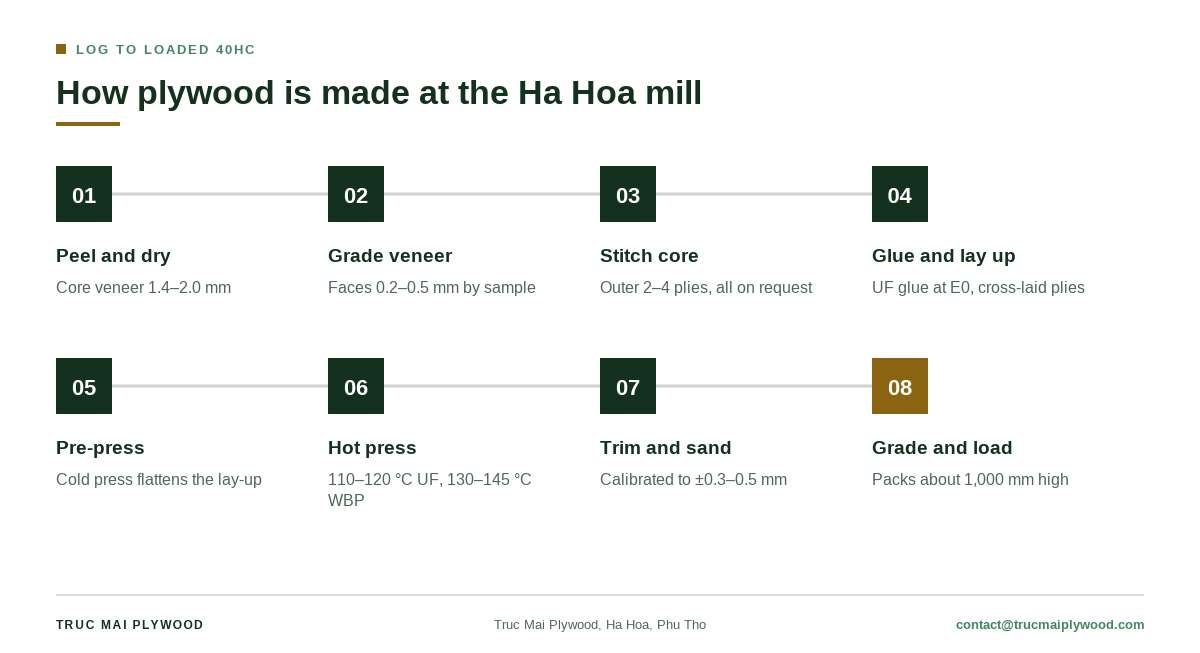
Plywood is a panel of thin wood veneers glued with their grain at right angles and pressed under heat. A Vietnamese mill makes it in eight steps: peel and dry, grade, stitch the core, glue and lay up, pre-press, hot press, trim and sand, then grade, pack and load.
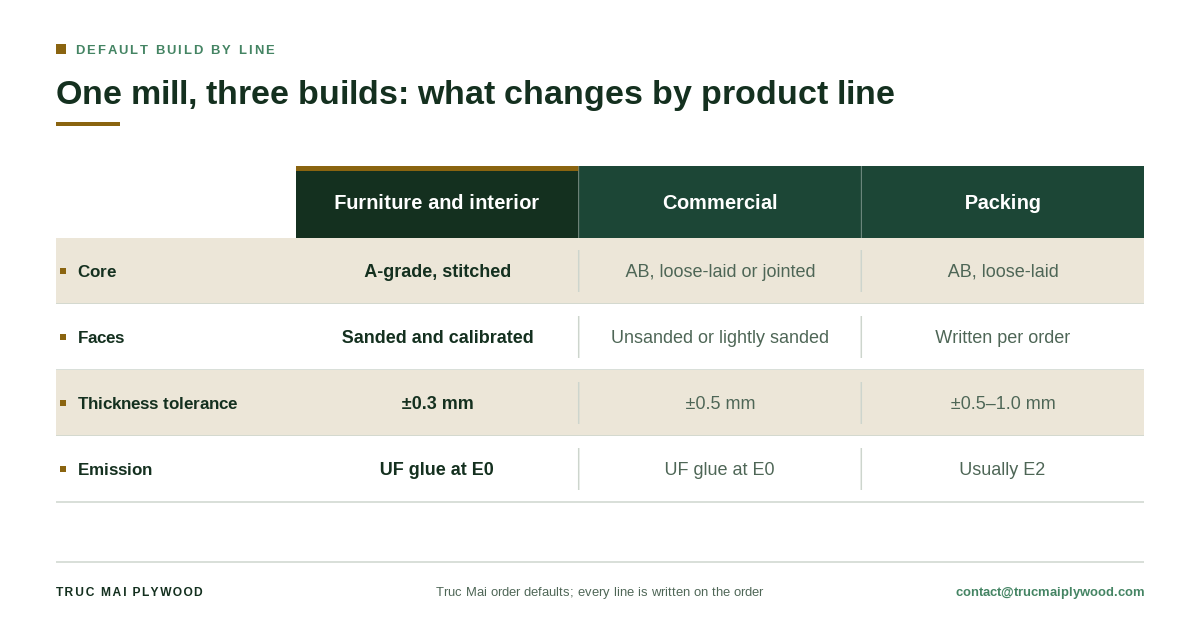
Cross-laying is what makes plywood stable: each veneer resists the movement of the one beside it, so the sheet stays flat and holds screws near the edge. The core species sets weight and price, the face sets the look, the glue sets the emission class, and the press and the sanding line set flatness and thickness.
| Step | Machine | Number | Check |
|---|---|---|---|
| 1. Peel and dry | Rotary lathe, drying racks | Core veneer 1.4–2.0 mm; 1.3 mm for 4 mm panels | Veneer thickness, splits |
| 2. Grade veneer | Grading table | Face veneer 0.2–0.5 mm, usually 0.3 mm for Europe | Face against the approved sample |
| 3. Stitch core | Stitching line | Outer 2–4 plies stitched, all on request | Gaps and overlaps |
| 4. Glue and lay up | Glue spreader, lay-up table | UF glue at E0, about 6 hours boil resistance | Even spread, cross direction |
| 5. Pre-press | Cold press | Lay-up flattened before heat | Sheet holds together |
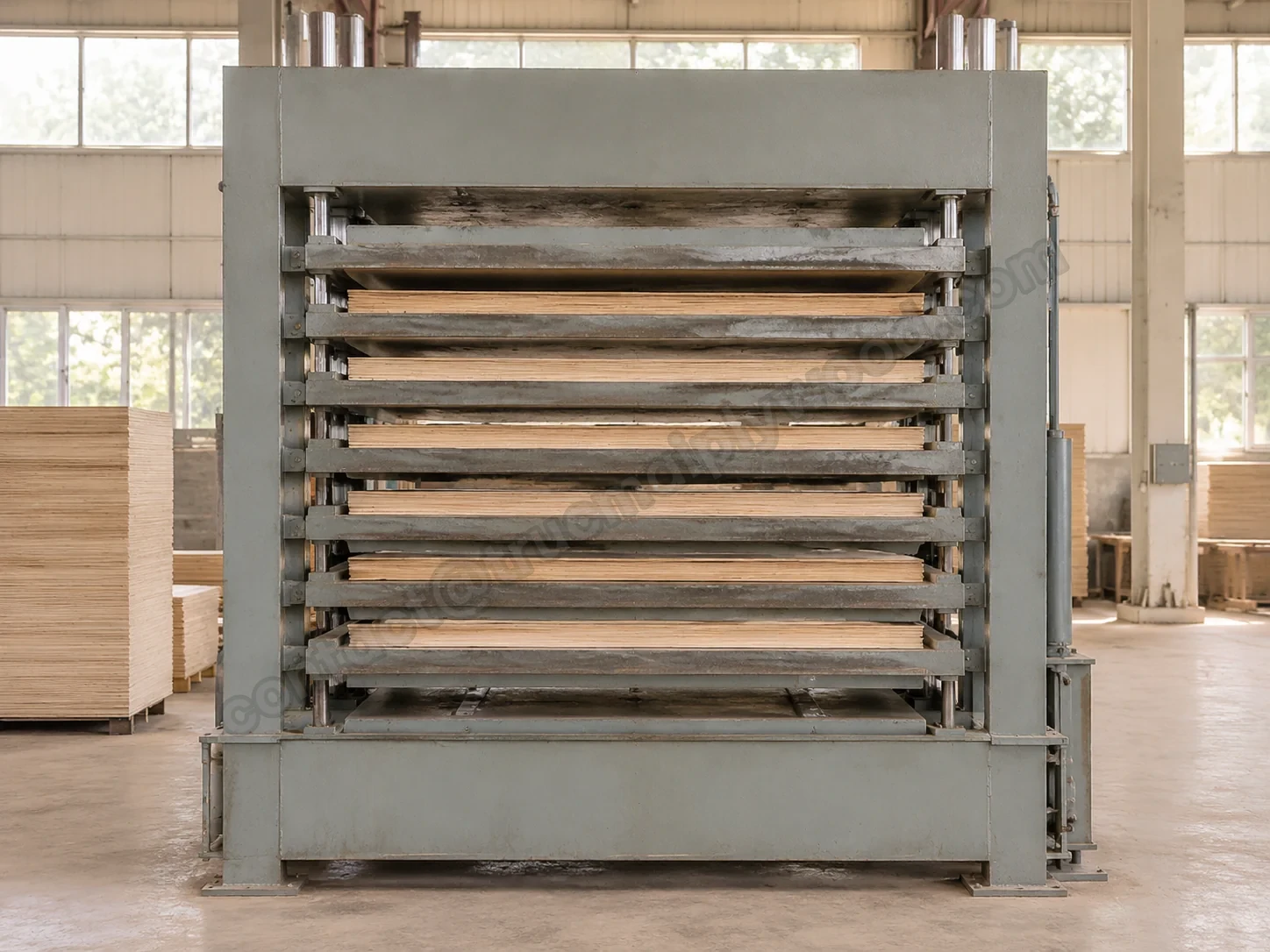
| 6. Hot press | Multi-opening hot press | 110–120 °C UF, 130–145 °C WBP | Press record per batch |
| 7. Trim and sand | Edge saws, wide-belt sander | ±0.3 mm furniture, ±0.5 mm commercial; ±2 mm length and width | Caliper at four points |
| 8. Grade, pack, load | Grading bench, packing area | Packs about 1,000 mm high | Count, label, photos |
Raw materials
What is plywood made of at the Ha Hoa mill?
Truc Mai plywood is made of a Vietnamese plantation core, an imported or local face veneer and a glue system chosen for the emission class. The core is Eucalyptus, Acacia, Styrax or Pine, or a combination; there is no rubberwood core.
Faces cover the full range: engineered veneer (EV), Poplar and bleached Poplar, Birch, Okoume, Bintangor, Pine, Eucalyptus, Gurjan, Sapele and others on request. The EV face is reconstituted veneer from plantation poplar, imported in 2500 × 1300 mm sheets of 0.3 or 0.4 mm. Birch arrives as face veneer on a Vietnamese core, so the panel is birch-faced, never all-birch.
| Material | Options | Number | Goes into |
|---|---|---|---|
| Core veneer | Eucalyptus, Acacia, Styrax, Pine or combined | 1.4–2.0 mm; Styrax about 500 kg/m³, Acacia 580, Eucalyptus 650 | Every panel |
| Face veneer | EV, Poplar, bleached Poplar, Birch, Okoume, Bintangor, Pine, Eucalyptus, Gurjan, Sapele | 0.2–0.5 mm; EV 0.3 or 0.4 mm | Furniture, interior, commercial panels |
| Glue, standard | UF glue at E0 emission | About 6 hours boil resistance | Interior furniture and commercial panels |
| Glue, outdoor | Melamine-fortified glue, usually E1 | 12-hour boil | Panels for damp or covered outdoor use |
| Glue, WBP | WBP glue | Pressed at 130–145 °C | Exterior-glue panels |
Every step
What happens at each step of the plywood manufacturing process?
Each step below says what happens, its number and the check that closes it, with a link to the step's own page where one exists.
- Peel and dry the core veneer
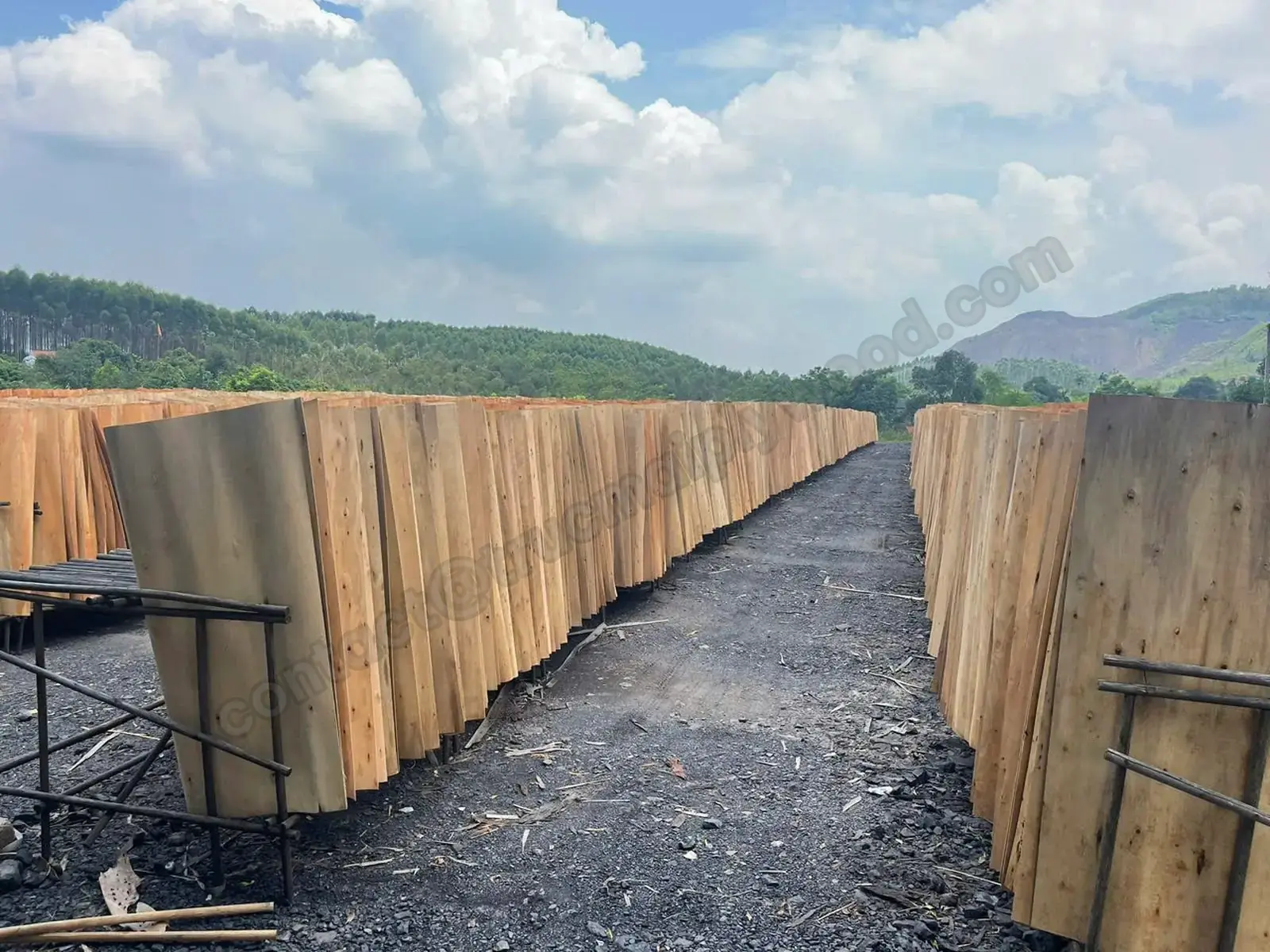
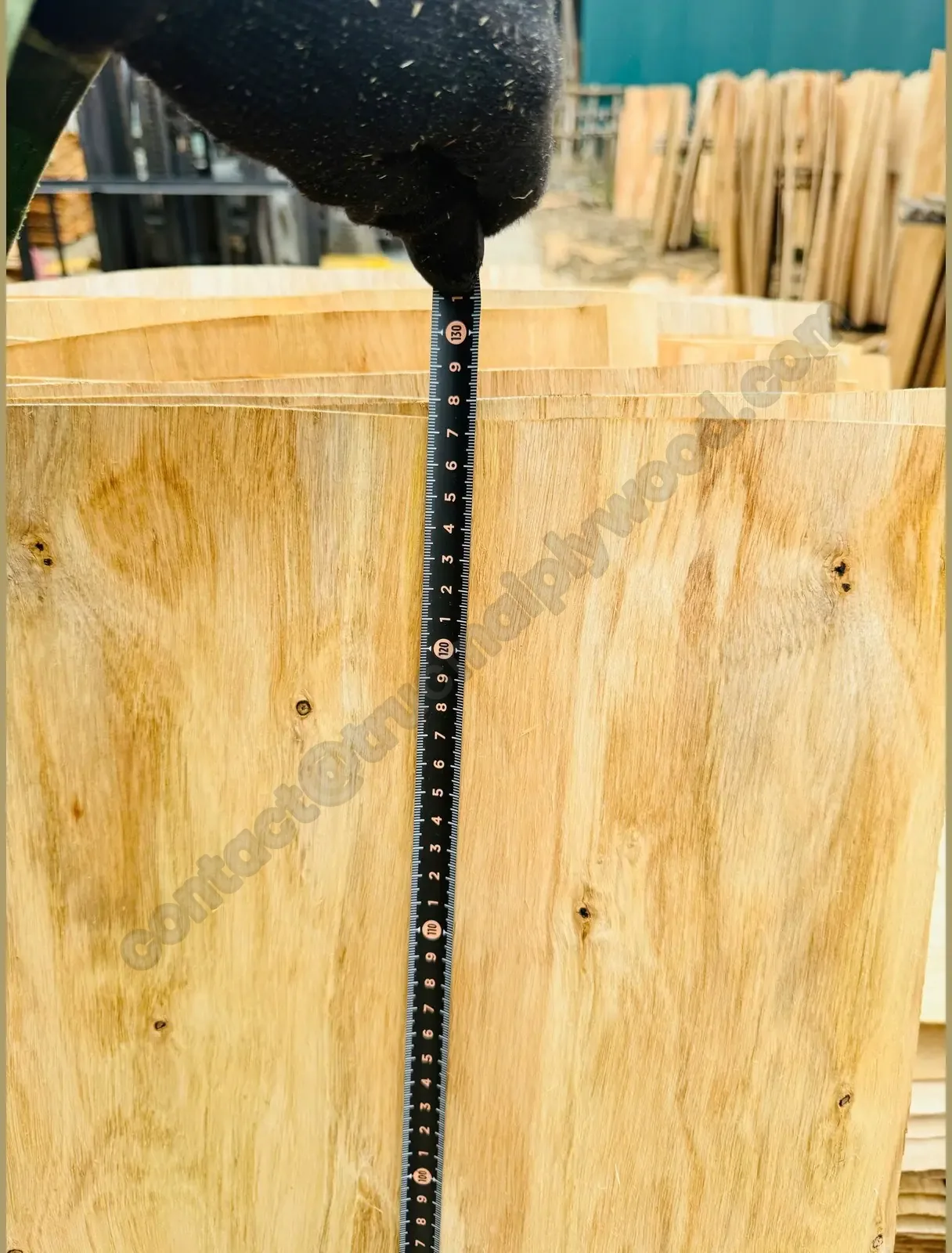
Debarked plantation logs turn on a rotary lathe and come off as one continuous sheet, cut to length and dried. Number: core veneer 1.4–2.0 mm; 4 mm panels use 1.3 mm veneer. Check: thickness and splits before the veneer goes to grading.
- Grade faces and core
Face veneer of 0.2–0.5 mm, usually 0.3 mm for European orders, is sorted against the approved sample; core veneer is sorted A or AB by defects. The face grading line has its own page. Check: face and back grade pair written on the batch.
- Stitch the core
Core plies are stitched across and along the sheet so joints do not open or overlap in the press. Number: usually the outer 2–4 plies, all plies on request. Check: no gap or overlap visible against the light.
- Spread glue and lay up
Rollers spread UF glue at E0 emission on the core veneers, which are laid with grain crossing at right angles. The glue type and the emission class per order are two separate spec lines. Check: even spread, no dry patches.
- Pre-press cold
The lay-up goes into a cold press so the veneers bond enough to load the hot press without shifting. Check: the lay-up moves as one sheet.
- Hot press
Heated platens cure the glue under pressure. Number: 110–120 °C for MR and UF glue, 130–145 °C for WBP. Check: temperature and time on the press record for each batch.
- Trim, sand and calibrate
Edge saws square the sheet; the wide-belt sander brings both faces to thickness. Number: ±0.3 mm on sanded furniture panels, ±0.5 mm commercial, ±2 mm on length and width. Check: caliper at four points; the batch checks page lists the rest.
- Grade, pack and load
Finished sheets are graded against the sample, counted into packs about 1,000 mm high, strapped and labelled; export crates and loading a 40HC have their own pages. Check: pack count and label against the packing list.
Photos of the process
What does each stage of plywood production look like?
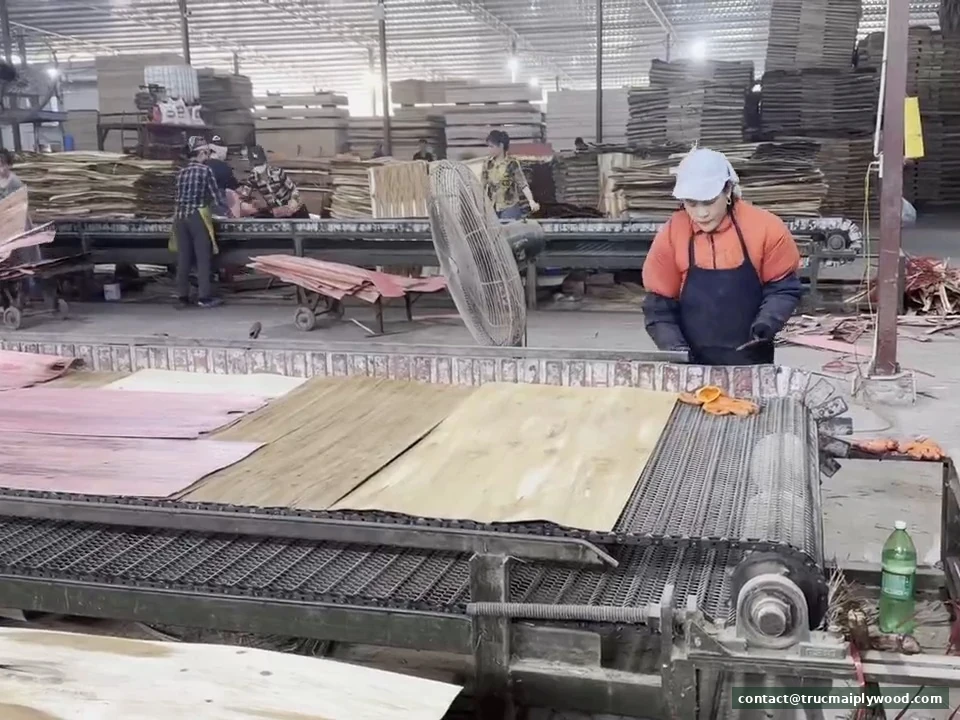
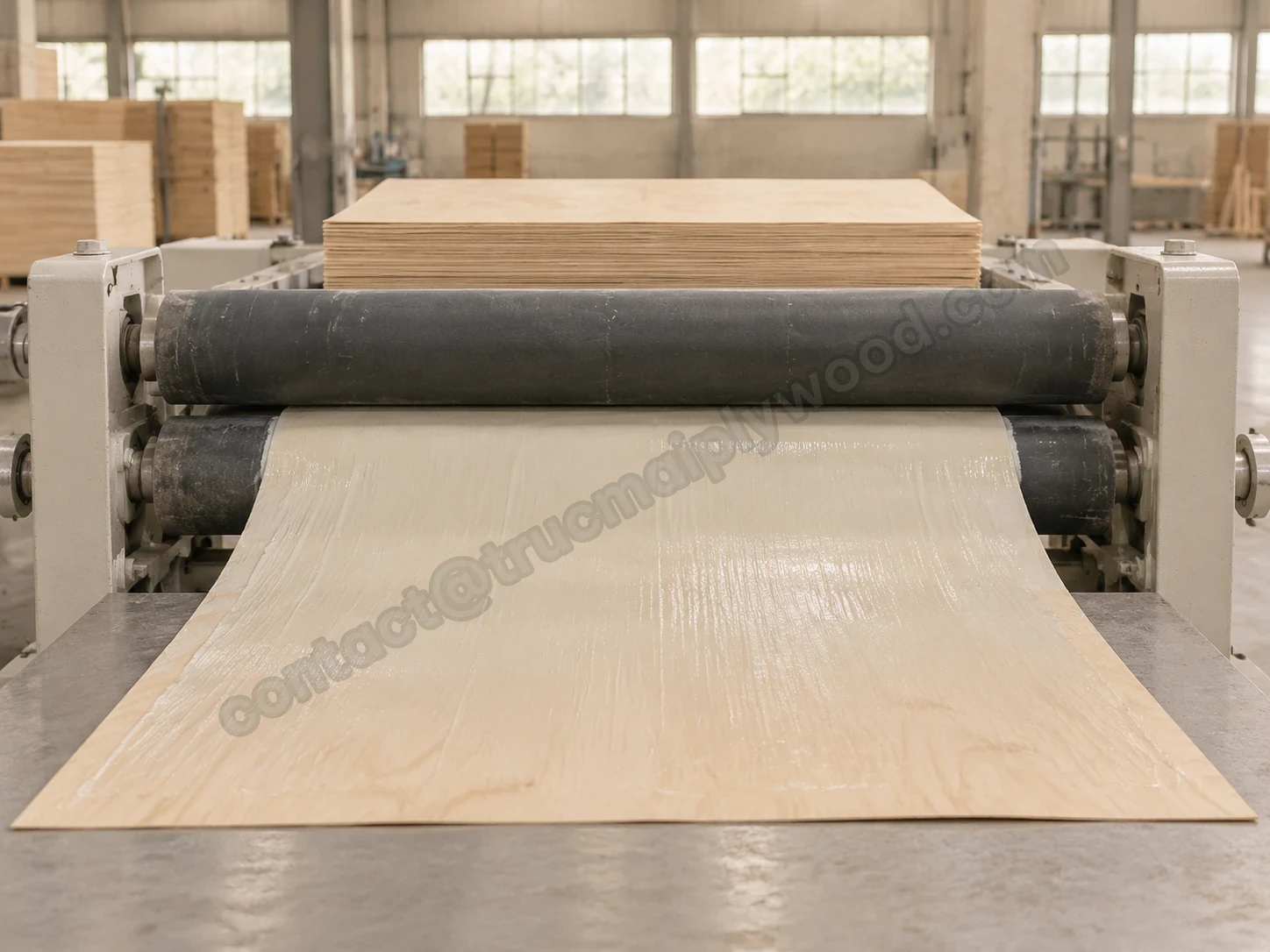
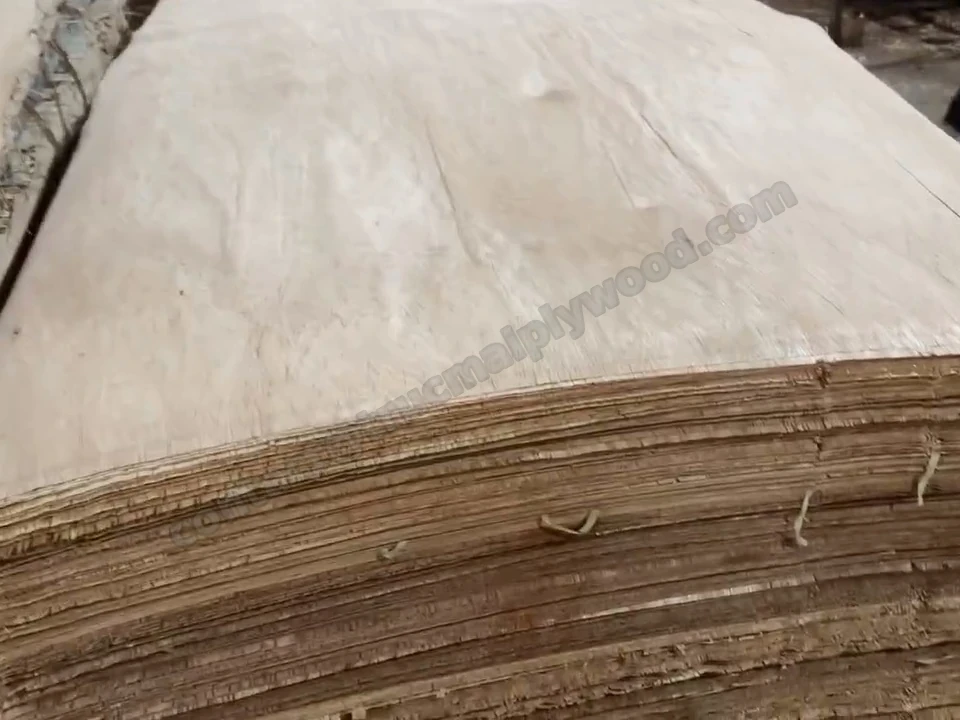
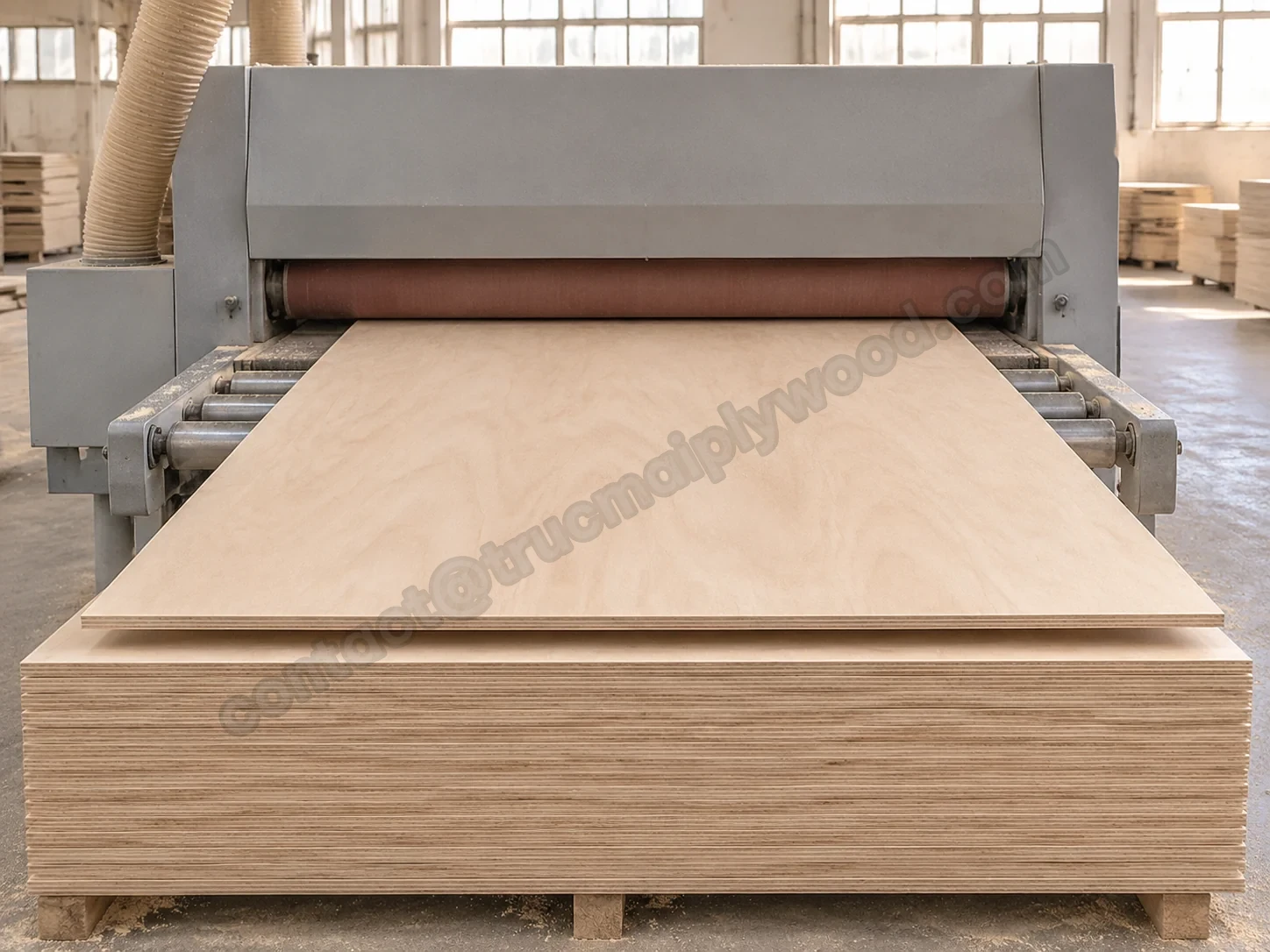
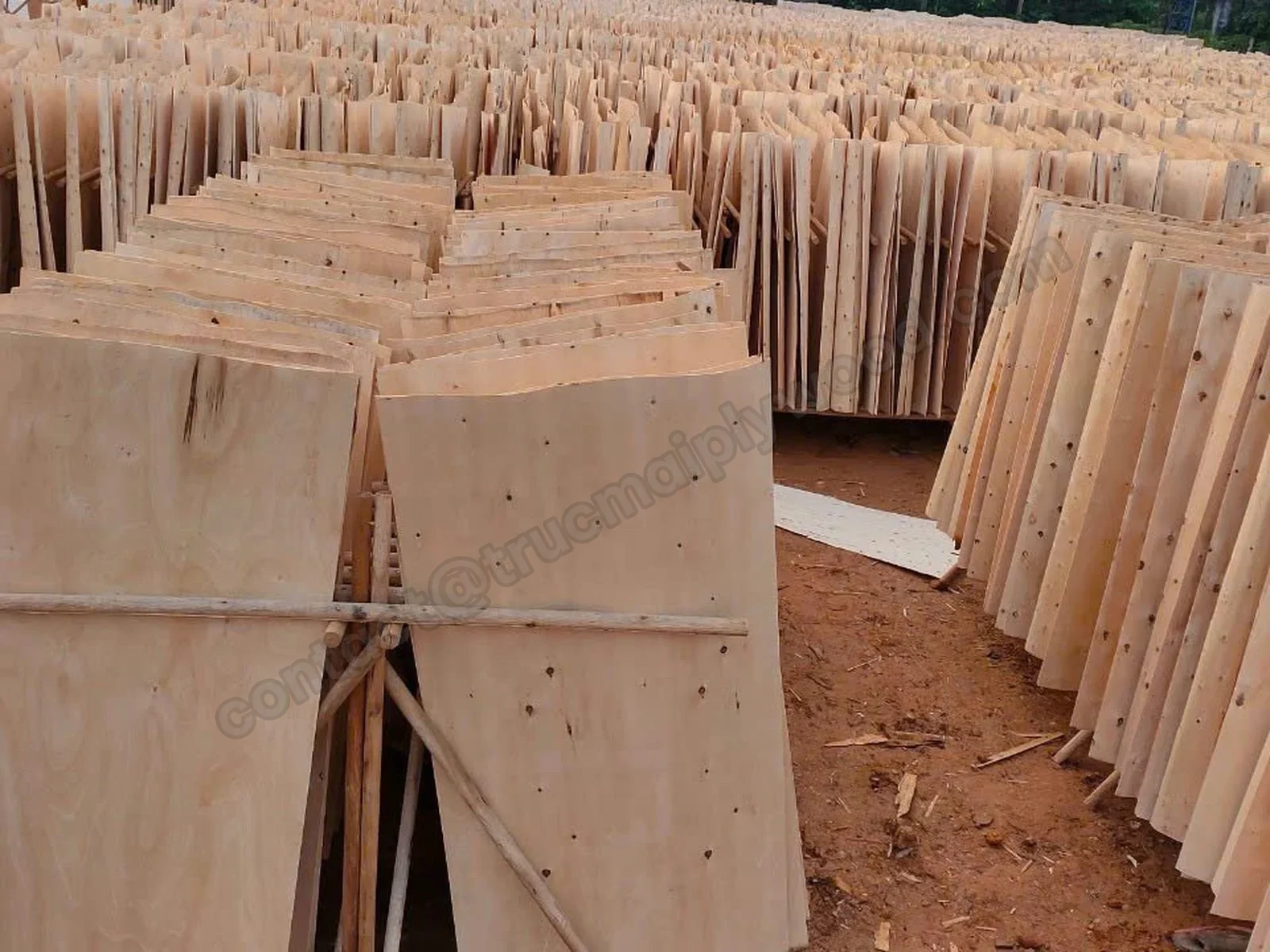
The photos show grading and sanding as they are run in plywood mills: veneers sorted by eye under even light, then finished sheets leaving a wide-belt sander onto a stack of the same size.
Grading is the stage a buyer sees least and feels most: a split or a knot on the face is caught here, before the glue. Sanding is where thickness is set, so the stack at the sander outfeed is where the caliper check starts. Photos of the Ha Hoa lines themselves are added as they are shot.
Defects
Which plywood defects start in production, and how are they caught?
Six defects account for most complaints about plywood, and each starts at a known step: core gaps and overlaps at lay-up, blisters in the press, face splits at grading, thickness drift at sanding, warping from an unbalanced build, and glue bleed-through on thin faces.
| Defect | Step where it starts | Cause | Prevention or check |
|---|---|---|---|
| Core gaps and overlaps | Lay-up | Core veneers laid loose or shifting | Stitched outer 2–4 plies; check against the light |
| Blisters or delamination | Hot press | Too little glue, moisture in veneer, short press time | Even glue spread, dried veneer, press record per batch |
| Face splits and knots | Grading | Defects in the face veneer | Face graded against the approved sample |
| Thickness out of tolerance | Sanding | Uneven sanding or core thickness | Calibrated sanding; caliper at four points to ±0.3–0.5 mm |
| Warping | Lay-up | Unbalanced build, plies not symmetrical | Odd ply count, symmetrical build around the centre ply |
| Glue bleed-through | Hot press | Thin face over a heavy glue line | Face of 0.3 mm or more for Europe, controlled spread |
Numbers and tolerances
How many plies does 18 mm plywood have, and what are the other build numbers?
An 18 mm Truc Mai panel usually has 11 plies, 11–13 by order. Thin panels of 3–5 mm always have 5 plies; 6 mm is built to the order. The table below is the canonical list of the process numbers with their conditions.
A 3 mm panel has one core ply, two cross-bands and two faces; 4 and 5 mm panels have three core plies and two faces. A 4 mm panel uses 1.3 mm core veneer, and good thin veneer is scarce, so a 4 mm order can take longer to make than 18 mm; the thin panels of 3–6 mm page covers that range. Formaldehyde limits for US-bound panels come from CARB Phase 2 and 40 CFR part 770: 0.05 ppm for hardwood plywood with veneer core.
| Number | Value | Condition |
|---|---|---|
| Core veneer | 1.4–2.0 mm | 1.3 mm for 4 mm panels |
| Face veneer | 0.2–0.5 mm | Usually 0.3 mm for Europe; EV 0.3 or 0.4 mm |
| Plies, 18 mm | 11–13 plies | Most often 11 |
| Plies, 3–5 mm | 5 plies | Always |
| Stitching | Outer 2–4 plies | All plies on request |
| Hot press, UF and MR glue | 110–120 °C | Per batch record |
| Hot press, WBP glue | 130–145 °C | Per batch record |
| Boil resistance | About 6 hours UF at E0; 12-hour boil | 12-hour boil needs melamine-fortified glue, usually E1 |
| Thickness tolerance | ±0.3 mm / ±0.5 mm / ±0.5–1.0 mm | Sanded furniture / commercial / packing grade |
| Length and width | ±2 mm | All lines |
| Thickness range | 3–40 mm | No panel thinner than 3 mm |
| Sheet sizes | 1220 × 2440, 1220 × 2280, 1250 × 2500 mm | Custom up to 1250 × 2500 mm |
Buyer guide
What do the process numbers mean for a buyer, and how are they checked on arrival?
Each process number becomes a line a buyer can check on arrival with a caliper, a light and a count of plies. Four checks on a few sheets per pack tell whether the build matches the order.
Ply count tells the build: an 18 mm sheet with 11 plies and thin faces is the standard furniture build. Thickness at four points tells whether calibration held. A sheet held against the light shows core gaps. A face compared with the kept sample shows whether grading held. The 18 mm loading and spec guide adds sheet weight per core as a fifth check.
| What to check | How | Expected |
|---|---|---|
| Ply count | Count plies on a cut edge | 18 mm: 11–13; 3–5 mm: 5 |
| Thickness | Caliper, four points per sheet | Within ±0.3–0.5 mm as ordered |
| Core gaps | Hold a sheet edge to the light | No open joints in stitched outer plies |
| Face grade | Compare with the kept sample | Same grade pair as the order |
What comes with the panels
What records does a buyer receive from the production run?
Each order comes with the records that show how it was made: the grade pair against the approved sample, press and grading records kept under ISO 9001:2015, thickness readings from the pack check, and loading photos.
- Grading Face and back grade pair against the approved sample
- Press Glue type, emission class and press temperature for the batch
- Thickness Caliper readings from the pack check
- Packs Pack labels with sheet counts, matched to the packing list
- Loading Photos of rows, door end and seal
Documents
Which documents does the production run produce for the buyer?
Three kinds of documents come out of the process: the order's own records, the certificate papers for the agreed build, and the shipping set.
- Order records
Written spec, approved sample reference, grading and thickness results.
- Emission papers
The emission certificate and test reports for the agreed glue and build.
- FSC claim
FSC 100% on sales and shipping documents for eligible products.
- EU file set
EUDR geolocation data for core and face veneer, with origin records.
- Shipping set
Invoice, packing list, B/L, origin and plant-health papers.
Capacity and lead time
How long after the deposit is a container of plywood produced?
A container is produced 15–45 days after the 30% deposit, depending on quantity, production conditions and agreement. The mill presses around 60,000 m³ a year, about 5,000 m³ in an average month.
The short end of that range fits a repeat order of one or two products on a known spec; the long end fits a first order or thin 4 mm panels. The full order sequence from enquiry to loading sets the slot, and a monthly buyer can book the next one with the current drafts.
Order checklist
Which six build lines go into a plywood specification?
Six lines on the specification fix the build from the first step to the last.
Core species, or combined core, with core grade A or AB.
Face and back species and the grade pair, against an approved sample.
Glue type and emission class as two separate lines, for example UF glue at E0 emission.
Thickness, ply count and thickness tolerance.
Sheet size, or the cut plan for panels cut at the mill.
Sanding: sanded and calibrated, light sanding, or unsanded, and polished on request.
FAQ
How plywood is made: buyer questions
Short answers with the process numbers of the Ha Hoa mill.
How is plywood made step by step at a Vietnamese mill?
Logs are peeled into veneer, dried and graded, the core is stitched, glue is spread and the sheets are laid crosswise, then cold pre-pressed and hot pressed. The panel is trimmed, sanded, graded, packed and loaded.
How many plies does 18 mm plywood have?
An 18 mm panel usually has 11 plies, and 11–13 plies by order. Two thin faces sit over cross-laid core veneers of 1.4–2.0 mm.
Why do thin 3–5 mm panels use 5 plies?
Five plies keep a thin panel balanced and flat. A 3 mm panel has one core ply, two cross-bands and two faces; 4 and 5 mm panels have three core plies and two faces.
What temperature is plywood hot-pressed at for UF and WBP glue?
UF and MR glue are pressed at about 110–120 °C. WBP glue is pressed at 130–145 °C.
Why does 4 mm plywood sometimes take longer to make?
A 4 mm panel uses 1.3 mm core veneer, and good thin veneer is scarce. Finding enough of it can push a 4 mm order toward the long end of the lead time.
What does core stitching do, and which plies are stitched?
Stitching holds core veneers edge to edge so joints do not open or overlap in the press. Usually the outer 2–4 plies are stitched, and all plies on request.
How long after the deposit is a container of plywood produced?
Production takes 15–45 days after the 30% deposit, depending on quantity, production conditions and agreement.
What is plywood made of?
Plywood is made of thin wood veneers glued with the grain of each layer at right angles to the next. At Truc Mai the core is Eucalyptus, Acacia, Styrax or Pine, the face is one of a full range of veneers, and the glue is usually UF at E0 emission.
Is E0 a type of glue?
No. E0 is an emission class; the glue is a separate line, for example UF glue at E0 emission. A 12-hour boil needs melamine-fortified glue, which is usually E1.
Does the mill apply UV coating?
No. UV-ready means both faces are sanded and prepared for the buyer's own UV coating; the mill does not apply UV.
Quotation
Ask for a quotation on your build
Send the six build lines and the quantity; the quotation names the core, plies, glue, press and tolerance for your order.
Core, face and back grade, glue and emission, thickness and plies, sheet size, sanding, quantity and port.