
Mill · Export packing
Plywood packaging for export: the pack behind every container
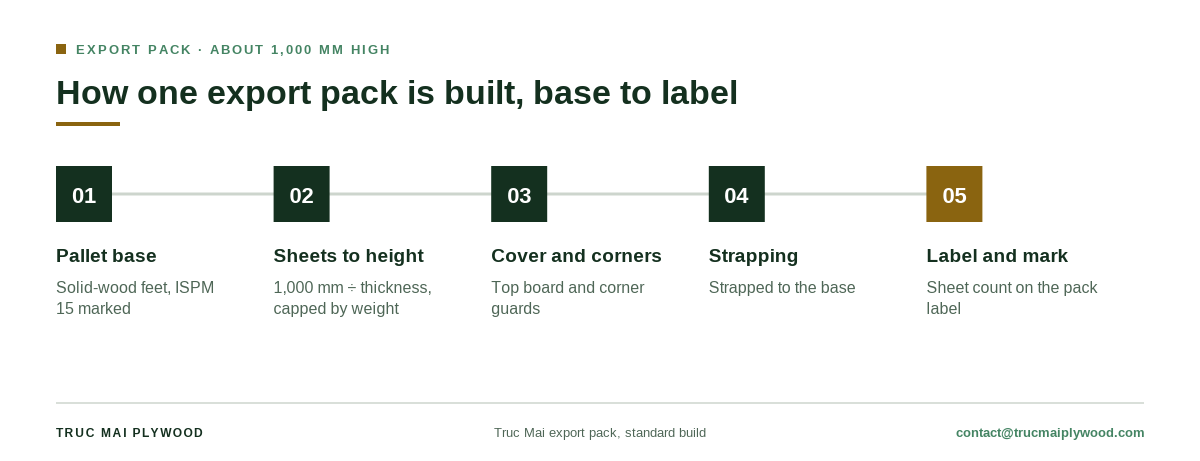
Plywood packaging for export at Truc Mai means one pack design on every order: a pallet base, sheets stacked to about 1,000 mm, a cover board with corner guards, strapping and a label with the sheet count. The plywood is outside ISPM 15, but the solid-wood pallet under it is not, so the pallet carries the mark.
This page follows one pack from the empty pallet to the door end of a loaded 40HC, for the buyer who orders a container every month and wants the pack on the twelfth order to match the first. Pack counts per core and the full planning table sit on the loading page. Here the subject is the pack itself: how it is built, why it weighs about 1.5 t on Styrax core at any thickness, how cut-to-size panels are packed and what a receiving crew should check.
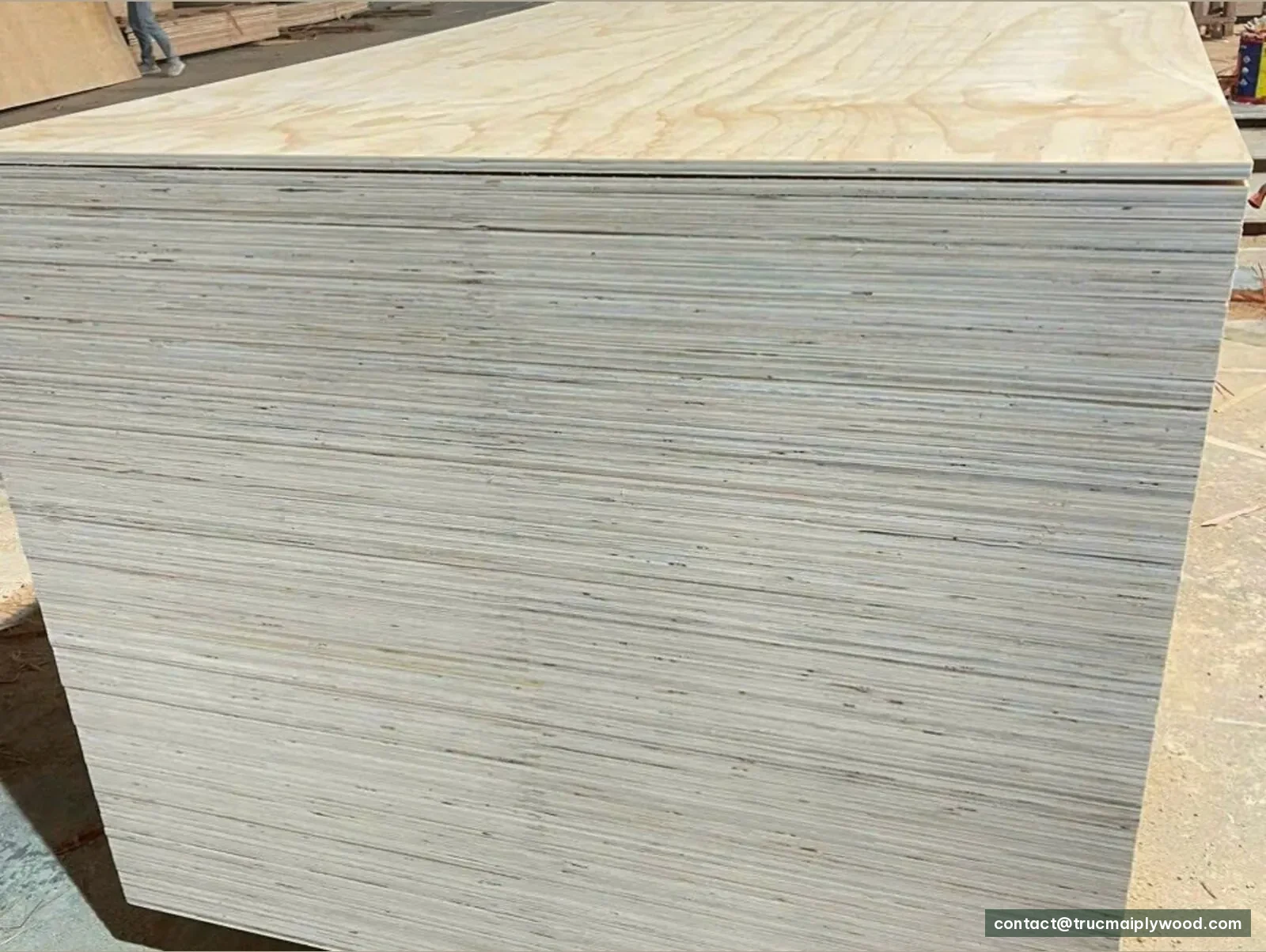
- ~1,000 mmheight of every export pack; sheets per pack = 1,000 ÷ thickness
- ~1.5 tone Styrax-core pack at any thickness (planning figure)
- 18 packsat most per 40HC on Styrax core, 16 on Acacia, 15 on Eucalyptus
- 2, 3, 4 or 6panels cut from one sheet before the pack is built
Planning figure: pack weights are computed from reference densities, panels only, not a weighed record.
Certificates
Which certificates and test files go with a packed container?
FSC, CARB P2, ISO 9001 and ISO 14001, plus EU file sets.
- FSC 100% FSC-C196493 · SA-COC-014545
- CARB P2 and TSCA Title VI CARB/EPA 26053 · TPC-43
- ISO 9001:2015 W2012 · WCERT
- ISO 14001:2015 W2012E · WCERT
Check the FSC code in the FSC database, the formaldehyde listing with the California Air Resources Board, the federal rule in the US formaldehyde standards and, for EU lots, the file set against Regulation (EU) 2023/1115.
At a glance
What is an export pack of plywood, and what is in it?
An export pack is one pallet base carrying about 1,000 mm of sheets, closed with a cover board and corner guards, strapped and labelled with the sheet count. At most 18 of them fill a 40HC on Styrax core.
The pack is the unit that is counted, lifted and loaded. The packing list is written per pack, a forklift lifts one pack at a time, and the label on the pack is what a receiving crew reads first. Fixing the pack once, on the first order, is what lets a monthly buyer plan the unloading crew and the forklift without asking again.
Every sheet in a pack has the same size and thickness, so one label describes the whole pack. A container that carries two products carries separate packs of each, never a mixed pack.
| Job | What is done | What a buyer can check | Record |
|---|---|---|---|
| Base | Pallet base set out for the sheet size | Feet whole; ISPM 15 mark on the solid wood | Pack plan |
| Stack | Sheets laid to about 1,000 mm, edges flush | Pack height; flush edges on all four sides | Count per pack |
| Protect | Cover board on top, guards on the corners | Corners and top sheet undented | Pack-check sheet |
| Strap | Straps pull cover and stack onto the base | Straps tight; no strap cutting an edge | Pack-check sheet |
| Label | Label with sheet count, size and thickness | Label count equals the packing list | Packing list per pack |
| Load | Packs set into the 40HC to the loading plan | Rows, door end and seal in the loading photos | Draft packing list and B/L |
By product line
How does the pack change by product line and by cut size?
The pack design stays the same; what changes is the sheet count and the unit inside the pack. Thin 3 mm sheets give the most sheets per pack, packing grade the loosest thickness tolerance, and cut-to-size panels are counted as parts.
On Styrax core a 3 mm pack holds about 333 sheets and a 40 mm pack about 25, yet both weigh about 1.5 t. Height and density set the weight of a pack, not the thickness, so a forklift treats every Styrax pack alike and only the label count differs.
A cut-to-size order is split before packing: one sheet becomes 2, 3, 4 or 6 panels, and the pack plan follows the cut size, not the mother sheet. The label then shows the cut size and the number of panels, which keeps a pack of small parts from being read as a pack of full sheets.
| Line | What a pack holds | Tolerance on the order | Packing note |
|---|---|---|---|
| Furniture and interior | Sheets, 1,000 ÷ thickness | ±0.3 mm, sanded and calibrated | One face and back grade pair per pack, written on the batch |
| Commercial | Sheets, 1,000 ÷ thickness | ±0.5 mm | Thickness reading and count per pack on the check sheet |
| Packing grade | Sheets, 1,000 ÷ thickness | ±0.5–1.0 mm | Loosest tolerance, so the sheet count is the number that matters |
| Thin 3–6 mm | Most sheets per pack: 333 at 3 mm, 166 at 6 mm | As agreed per thickness | 3–5 mm panels are always five plies |
| Cut to size | Panels cut from a sheet in 2, 3, 4 or 6 | Length and width ±2 mm | Pack plan follows the cut size |
Steps
How is plywood packaging for export built, pack by pack?
Seven steps take an empty pallet to a loaded 40HC, and each one ends with a check a buyer can repeat on arrival.
- Plan the pack
The pack plan comes from the order: core, thickness, sheet size and how many products share the container. It fixes sheets per pack (1,000 mm ÷ thickness, rounded down) and the weight cap per pack. Check: sheets per pack and packs per container are on the quotation.
- Set the pallet base
A pallet base is laid out for the sheet size. Solid-wood pallets, battens and dunnage fall under ISPM 15 and carry its mark; the plywood on top does not. Check: the mark is on the wood of the pallet, not on the sheets.
- Stack to height
Sheets are laid to about 1,000 mm with the edges flush, so the pack is a clean block. Check: pack height, and a flush edge on all four sides.
- Add the cover board and corner guards
A cover board goes on top and guards on the corners, so that the strap pulls on the guard and not on the plywood edge. Check: no dented corner and no strap line pressed into the top face.
- Strap the pack
Straps pull the cover board and the sheets down onto the base until the pack lifts as one piece. Check: straps tight, and the pack does not shift when a forklift raises it.
- Label and count
The pack label states the sheet count, size and thickness, and the same count goes on the packing list under the pack. Check: the label count equals the packing list; a cut-to-size pack shows the cut size.
- Load to the plan
Packs go in as the loading plan says: on Styrax core, 16 lying in rows and 2 upright at the door end. Loading photos show the rows, the door end and the seal. Check: the number of packs in the container equals the packing list.
Photos
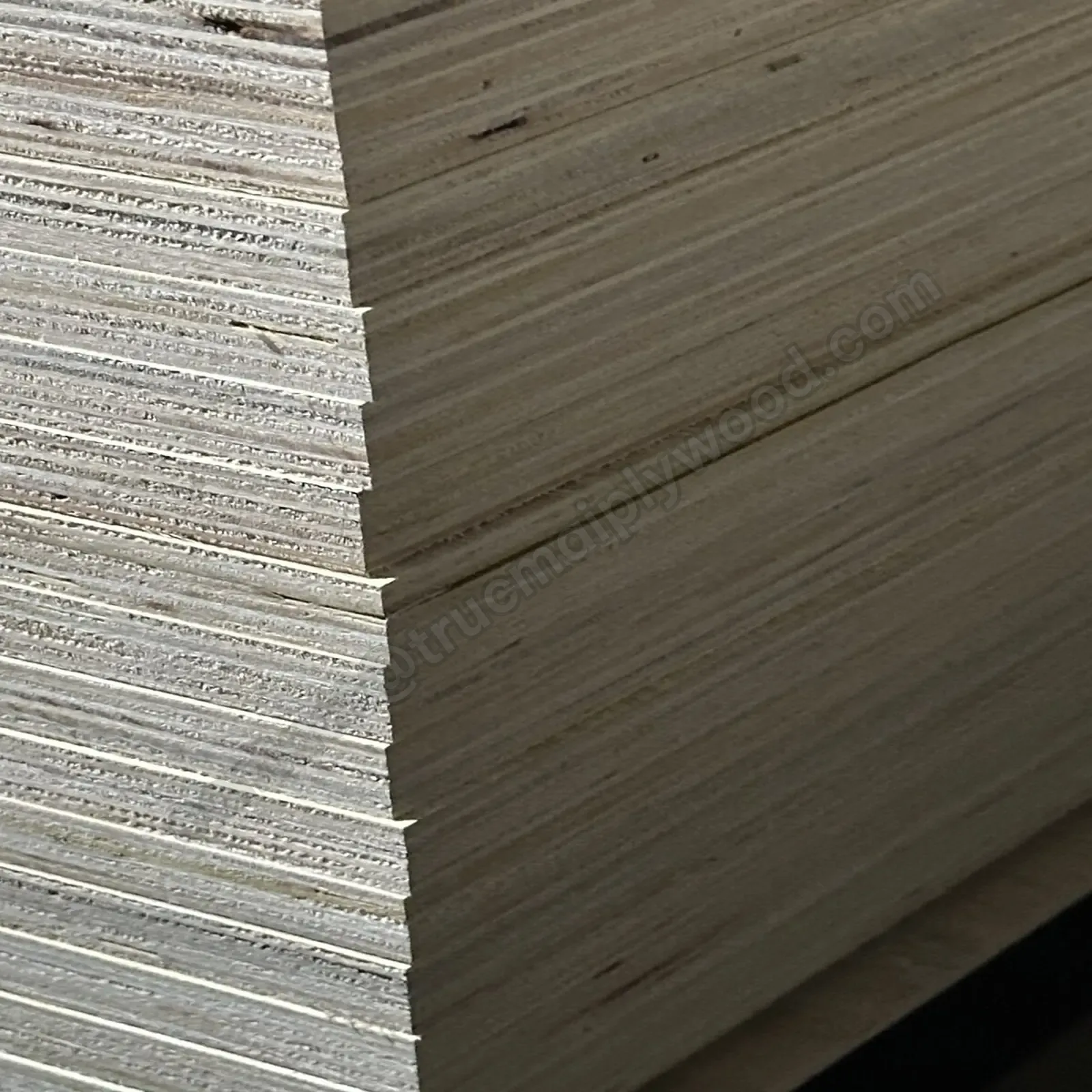
What does a plywood pack look like before it is wrapped and strapped?
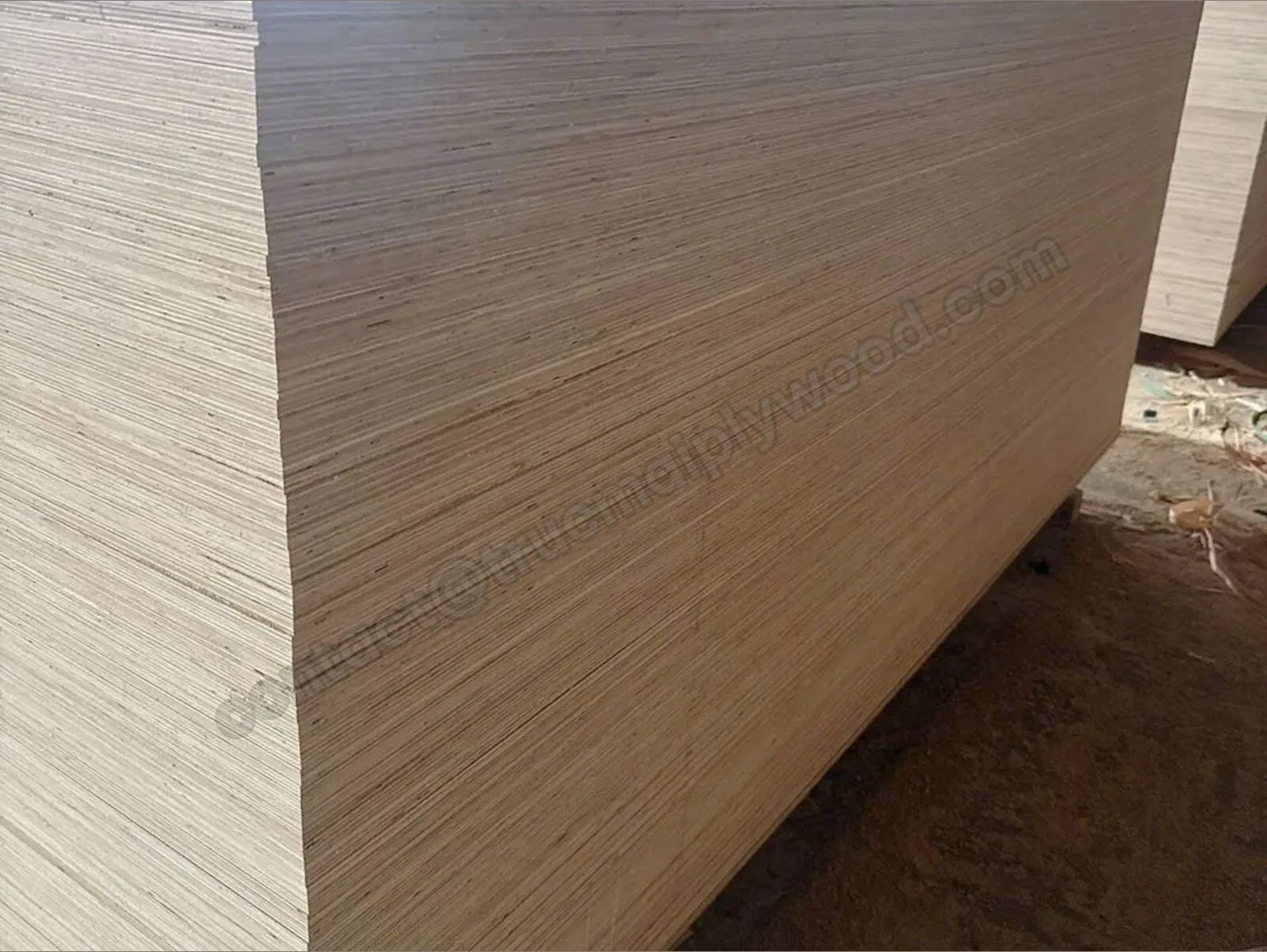
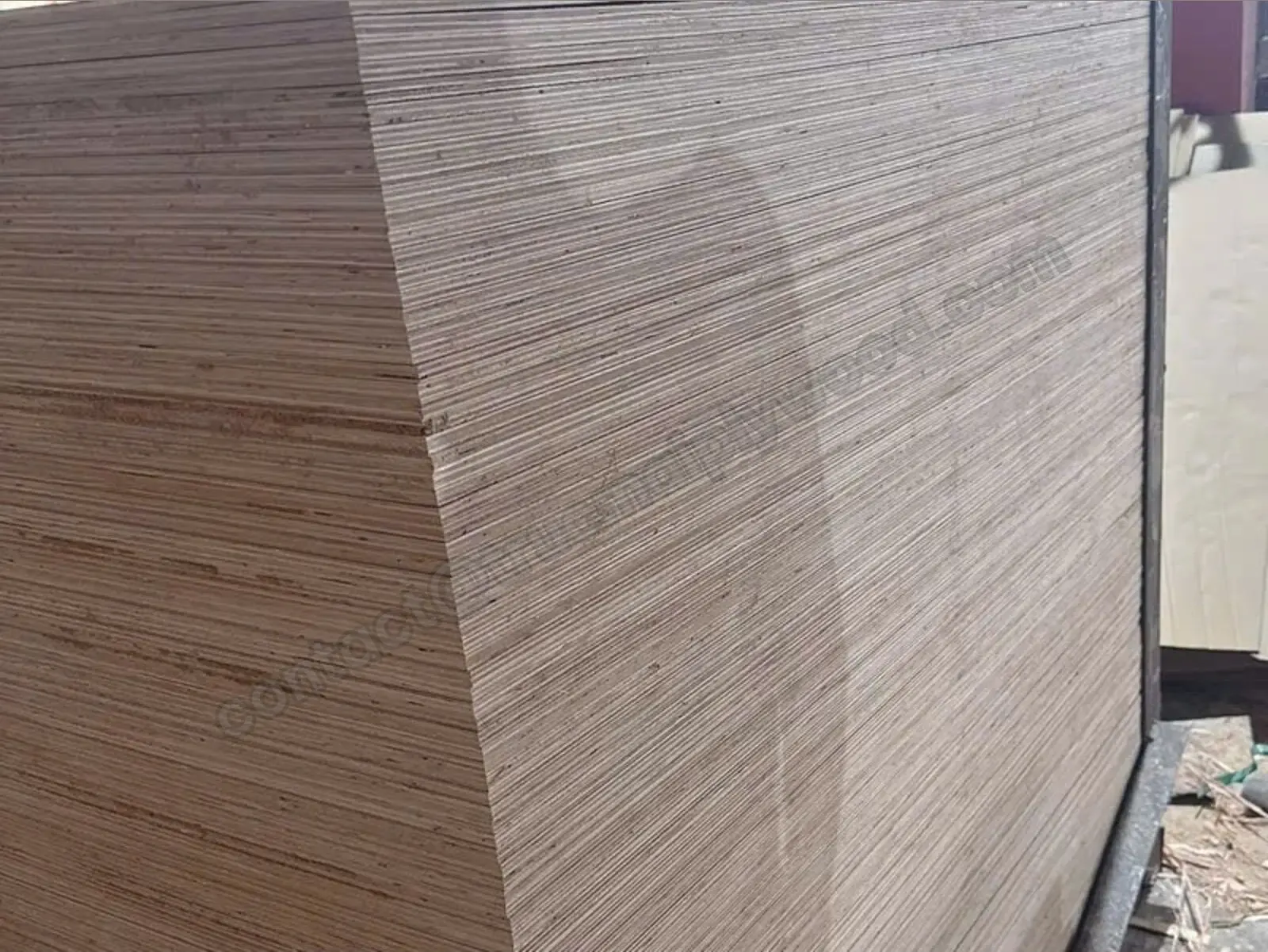
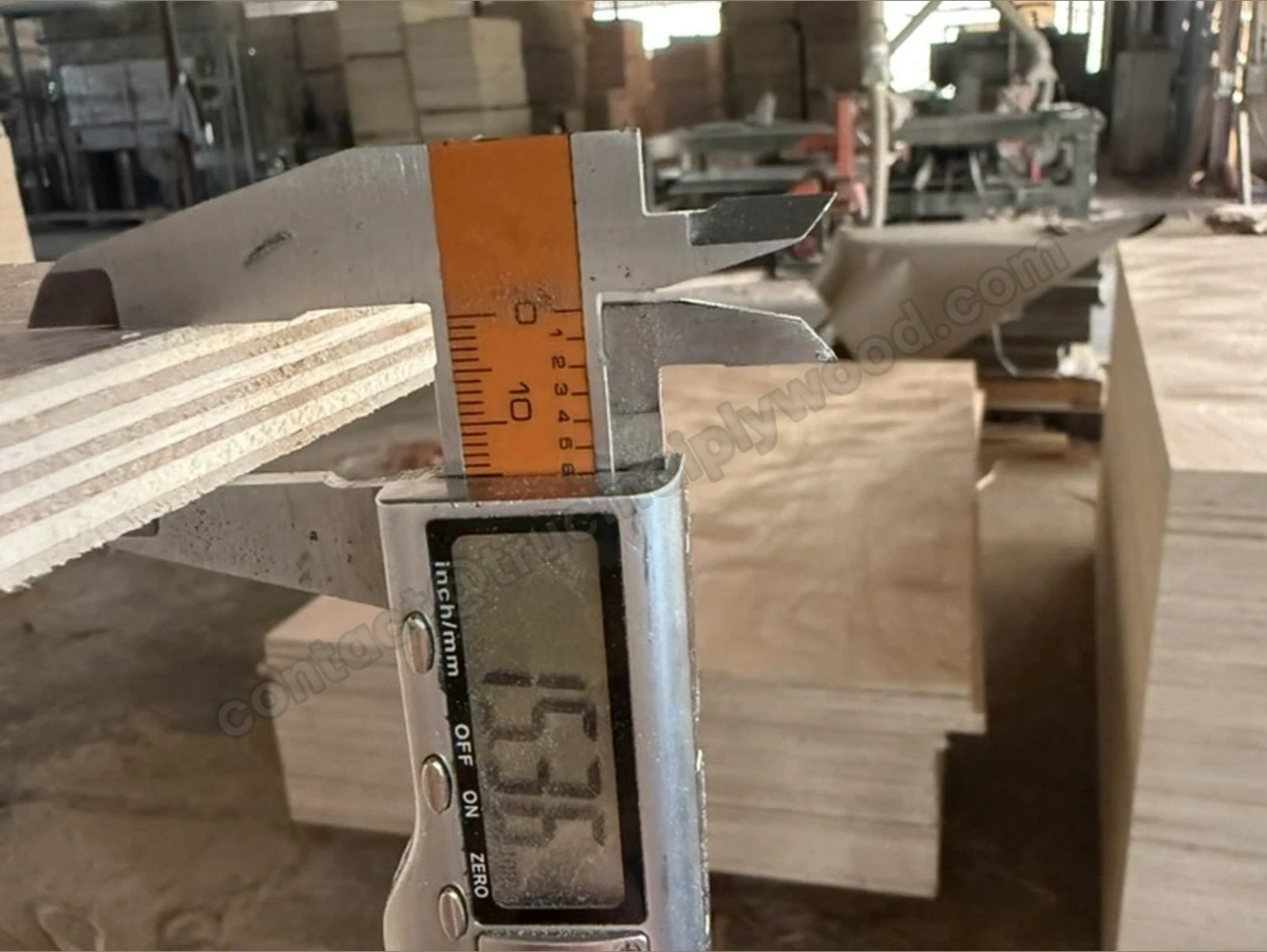
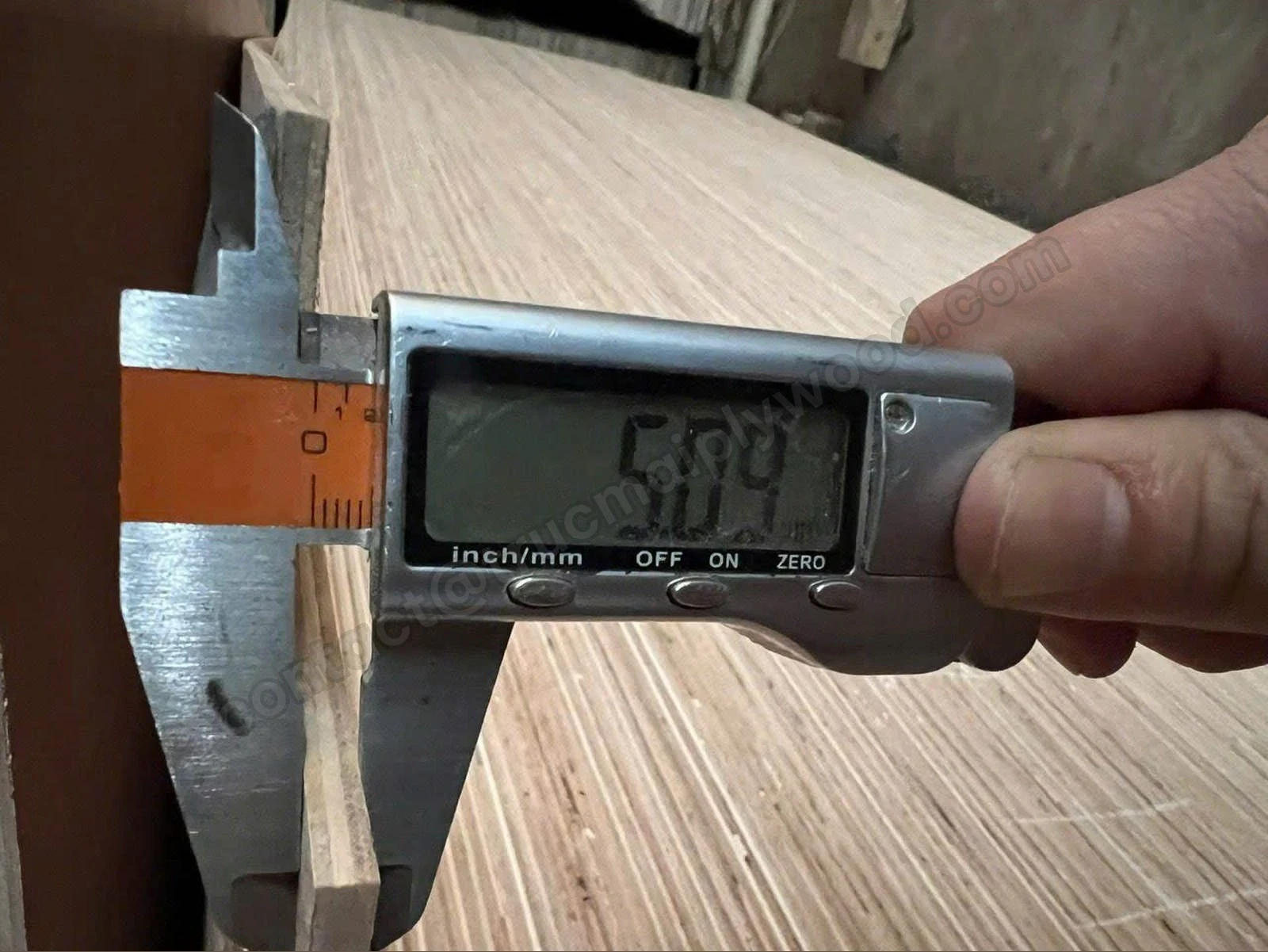
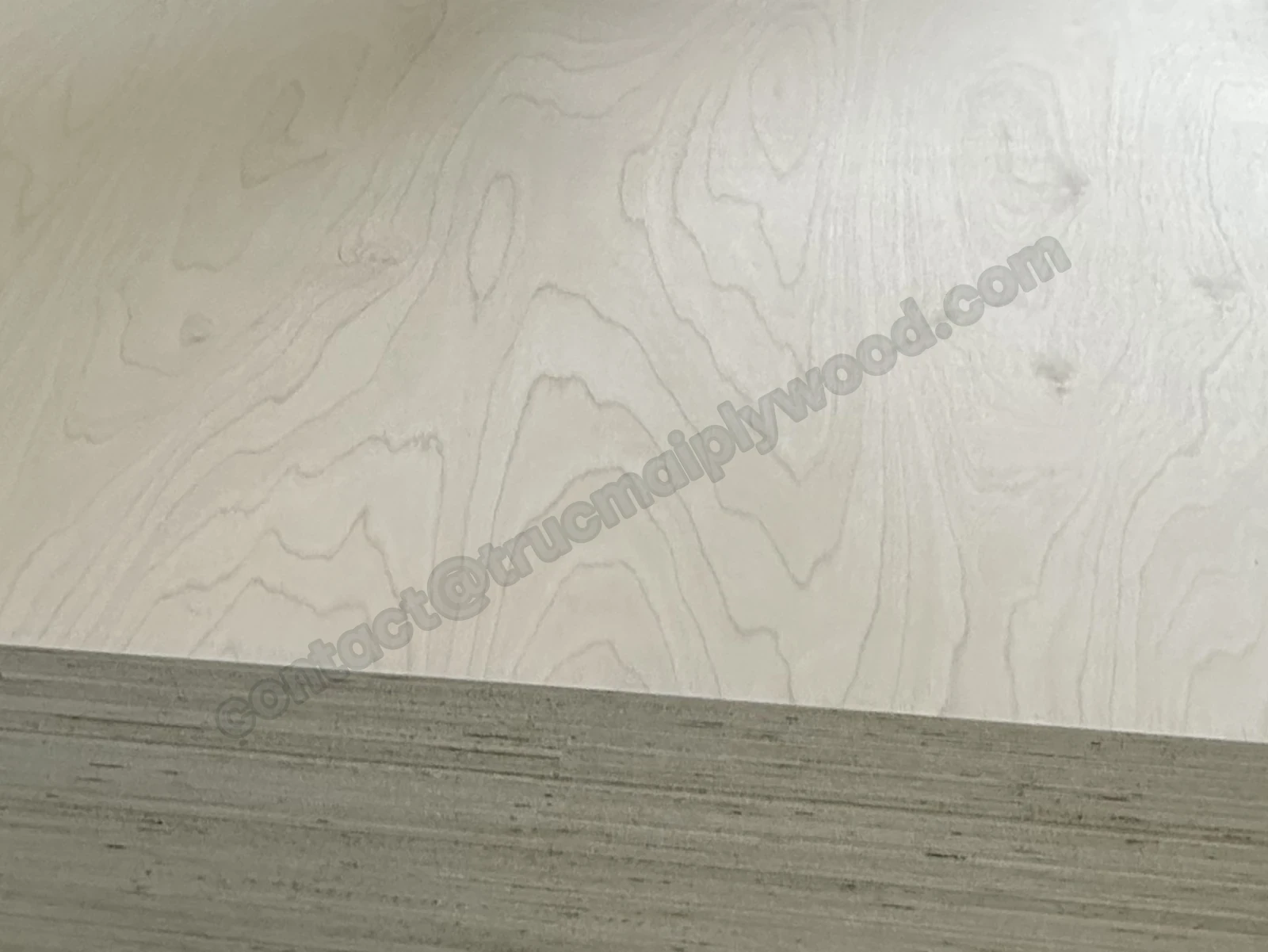
Before packing, a buyer sees three things: a flush stack, a clean edge and a caliper reading. The photos show each of them on plywood stacks, so the same three can be looked for on arrival.
Flush edges matter because a strap and a cover board bear on the edge of the top sheet; a stack with stepped edges lets the strap bite. The ply lines in the edge photos show how many veneers sit in one sheet, which is also why a thickness reading is taken on the edge and not on the face.
Where packing goes wrong
What goes wrong with an export pack, and how is it prevented?
Six faults account for most packing complaints: an overfilled pack that breaks its pallet feet, a corner dented by the strap, damp on the top sheet, a label that does not match the list, a pallet without a mark and a pack of mixed sizes. Each has a fix in the pack build.
An overfilled pack is the fault with the largest cost. A pack stacked above the planning height weighs more than the pallet feet were chosen for, the feet crack under the forklift and the pack has to be unstacked by hand. The planning height of about 1,000 mm exists to prevent exactly that, and it is a rule for the pack, not a target to beat.
| Fault | Cause | Prevention in the pack build |
|---|---|---|
| Broken pallet feet | Pack stacked above the planning height, or weight not capped | Sheets per pack = 1,000 mm ÷ thickness, then capped by weight |
| Dented corner or strap line | Strap pulling directly on the plywood edge | Corner guards and a cover board under the strap |
| Damp on the top sheet | Open top or torn wrap, stack left on a wet floor | Cover board on every pack; packs kept off the ground |
| Count does not match | Sheets added or removed after labelling | One count: label, pack-check sheet and packing list agree |
| Pallet held at the port | Solid-wood pallet or batten without the ISPM 15 mark | Marked pallets only; plant-health papers with the documents |
| Pack of mixed sizes | Cut-to-size parts and full sheets in one pack | One size and one thickness per pack; label shows the cut size |
Numbers
What is the ISPM 15 plywood exemption, and how many sheets and kilograms are in one pack?
A Styrax-core pack of 1220 × 2440 mm sheets holds 1,000 ÷ thickness sheets, from 333 at 3 mm to 25 at 40 mm, and weighs about 1.5 t at every thickness. Acacia and Eucalyptus packs weigh more, about 1.7 and 1.8 t at 18 mm.
The weight follows from the geometry: the footprint of one sheet, 1220 × 2440 mm, times 1,000 mm of height, times 500 kg/m³ for Styrax, comes to about 1.5 t. Sheets are counted in whole numbers, so the real figure sits a little under that. Acacia at 580 kg/m³ and Eucalyptus at 650 kg/m³ put more weight on the same pallet, which is why fewer packs fit a container on those cores.
| Thickness | Sheets per pack | Kilograms per sheet | Pack weight, about |
|---|---|---|---|
| 3 mm | 333 | 4.5 | about 1.5 t |
| 6 mm | 166 | 8.9 | about 1.5 t |
| 12 mm | 83 | 17.9 | about 1.5 t |
| 18 mm | 55 | 26.8 | about 1.5 t |
| 25 mm | 40 | 37.2 | about 1.5 t |
| 40 mm | 25 | 59.5 | about 1.5 t |
| Rule | What it says | Source |
|---|---|---|
| ISPM 15 | Solid-wood packaging (pallets, battens, dunnage) must be treated and marked; plywood is processed wood and outside the standard | IPPC, ISPM 15 |
| PPWR | Lead, cadmium, mercury and hexavalent chromium in packaging at or under 100 mg/kg in total | Regulation (EU) 2025/40, Art. 5(4) |
| Import checks | Some destinations check wood packaging on arrival and hold unmarked pallets | UK government wood packaging guidance |
Sheet counts and weights are planning figures from our packing model, panels only, not a loading record; the carrier and route decide the final payload. Full table by core and size: 40HC load calculator and loading a 40HC.
Buyer guide
How does a buyer check an export pack on arrival, and what should plywood packaging for export suppliers show?
Check seven things on the first pack off the container: label count, pallet mark, pack height, corners, straps, damp and one thickness reading. Together they take a few minutes and settle most disputes before a forklift moves the second pack.
Open the packing list first and read the count for the pack in front of you. If the label, the list and a count of the top few sheets agree, the rest of the pack can be taken on trust until it is unwrapped. A buyer who receives every month can keep the check sheet from the first container and compare each later one with it.
| Look at | It tells you | If it is off |
|---|---|---|
| Label against packing list | The count and size are the ones ordered | Photograph the label and the list, count the pack |
| ISPM 15 mark on the pallet | The wood packaging was treated | Hold the pallet and ask for the plant-health papers |
| Pack height | The pack was built to the plan | Compare with the planning height, about 1,000 mm |
| Corners and top sheet | No strap or forklift damage | Photograph before unstrapping |
| Straps | The pack travelled as one piece | Note loose straps on the delivery note |
| Edges and top face for damp | The cover board kept water out | Photograph, then open the pack and test the inner sheets |
| One thickness reading from the middle of the pack | The tolerance on the order holds | Read three sheets before reporting a pattern |
What you hold
What does a buyer hold in writing for each packed container?
For every packed container a buyer holds four records that describe the packs: the pack plan, the pack-check sheet, the packing list per pack and the loading photos. Together they let a second container be packed exactly like the first.
- Pack plan Sheets per pack, packs per container, pallet type, weight cap
- Pack-check sheet Count, thickness readings and edge notes for the batch
- Packing list per pack Count, size and thickness for every pack, matched to its label
- Loading photos Rows, door end and seal of the container
Documents
Which documents travel with a packed 40HC?
Four sets of paper describe the packing: the packing list, the plant-health papers for the wood, the packaging test for EU lots and the origin papers. Drafts go to the buyer for approval right after loading.
- Packing list
Count, size and thickness for every pack, in the order the packs stand in the container.
- Plant-health papers
Phytosanitary and fumigation papers for any solid-wood pallets, battens and dunnage.
The test for the pallets, wraps and straps that travel with the panels.
- Origin papers
Certificate of origin, EUR.1 for EU-bound lots, issued against the same packing list.
Volume
Does the pack stay the same when the order is a container a month?
Yes. The pack is a fixed design, so a container a month uses the same pallet base, the same height, the same guards and the same label layout from the first order to the twelfth.
The mill presses around 60,000 m³ a year, about 5,000 m³ in an average month, and a monthly container is one small share of that; the pack design does not change with the volume. When the order changes (another thickness, another core, a cut size) the pack plan is rewritten and sent for approval, and the new plan then becomes the one the next containers repeat.
Order checklist
Which six packing lines belong on a plywood purchase order?
Six lines on the order fix the pack, so that a repeat order is packed like the last one.
Pack height and sheets per pack, or the rule: 1,000 mm ÷ thickness, capped by weight.
Pallet type and the ISPM 15 mark on every solid-wood part.
Label content: sheet count, size, thickness, and any marking the buyer wants.
Cut-to-size split: 2, 3, 4 or 6 panels per sheet, and the cut size on the label.
Wrap, cover board and strap wishes, if the buyer has a standard.
Documents wanted for the packs: packing list per pack, plant-health papers, packaging test.
FAQ
Export packing questions from container buyers
Direct answers on pack height, weight, ISPM 15, cut sizes and paperwork.
Does plywood need to be heat-treated for export?
No. Plywood is processed wood and outside ISPM 15, so the sheets need no heat treatment or mark. The solid-wood pallet, batten or dunnage under or between the packs is wood packaging and does fall under the standard.
Do the pallets and battens under plywood need ISPM 15 marks?
Yes, any solid-wood pallet, batten or dunnage shipped with the packs needs the ISPM 15 mark, and the papers for it go with the documents. Plywood sheets themselves carry no mark.
How high is one export pack of plywood?
One export pack is about 1,000 mm high. The number of sheets in it is 1,000 mm divided by the thickness, rounded down, then capped by weight: 55 sheets at 18 mm and 333 at 3 mm on Styrax core.
Why is a Styrax-core pack about 1.5 t at every thickness?
Because the pack height is fixed and Styrax core is about 500 kg/m³. A block with the footprint of one 1220 × 2440 mm sheet and a height of 1,000 mm, at that density, is about 1.5 t, whether it holds 333 thin sheets or 25 thick ones. Acacia and Eucalyptus packs weigh about 1.7 and 1.8 t.
Why does overfilling a pack damage the pallet?
An overfilled pack puts more than the planning weight on the pallet feet, and the feet crack when a forklift lifts the pack. The pack then has to be unstacked by hand, which is why the planning height of about 1,000 mm is kept.
Can sheets be cut to size and packed as smaller panels?
Yes. A sheet is cut into 2, 3, 4 or 6 panels before packing, and the pack plan follows the cut size. Length and width hold ±2 mm, and the label shows the cut size and the number of panels.
Which documents travel with a packed 40HC?
The packing list per pack, plant-health papers for any solid-wood pallets, the origin papers and, for EU lots, the packaging test. Drafts go to the buyer for approval right after loading.
How is the sheet count on a label checked against the packing list?
The count is written once at the pack-check and copied to the label and the packing list, so the three must agree. A buyer can confirm it by counting the sheets of a pack on arrival.
Can the pack build stay identical from one monthly order to the next?
Yes. The pack plan is part of the written order, so the pallet, height, guards and label layout repeat until the order changes. A change in core, thickness or cut size produces a new plan for approval first.
Can a 3 mm pack be as tall as an 18 mm pack?
Yes, both are built to about 1,000 mm. The 3 mm pack simply holds more sheets, about 333 against 55, and weighs the same, so the label count is what tells them apart.
Pack plan
Ask for a pack plan
Send the core, thickness, sheet size and quantity; the quotation comes back with sheets per pack, packs per container and the label layout.
Core, thickness, sheet size, cut size if any, quantity, destination port and any labelling wish.