
Importing plywood takes a fixed set of papers: commercial invoice, packing list, bill of lading, certificate of origin, phytosanitary and fumigation papers and insurance, plus the order's FSC claim, emission certificate and, for EU lots, the EUDR geolocation files. Certificate files go to the buyer before the order is confirmed, draft shipping papers after loading, and the panels themselves fall outside ISPM 15.
What documents are needed to import plywood?
A plywood import needs seven core papers: commercial invoice, packing list, bill of lading, certificate of origin, phytosanitary paper, fumigation paper for the pallets, and insurance under CIF. The order then adds its own certificate files: the FSC claim, the emission certificate and, for EU lots, the EUDR geolocation files.
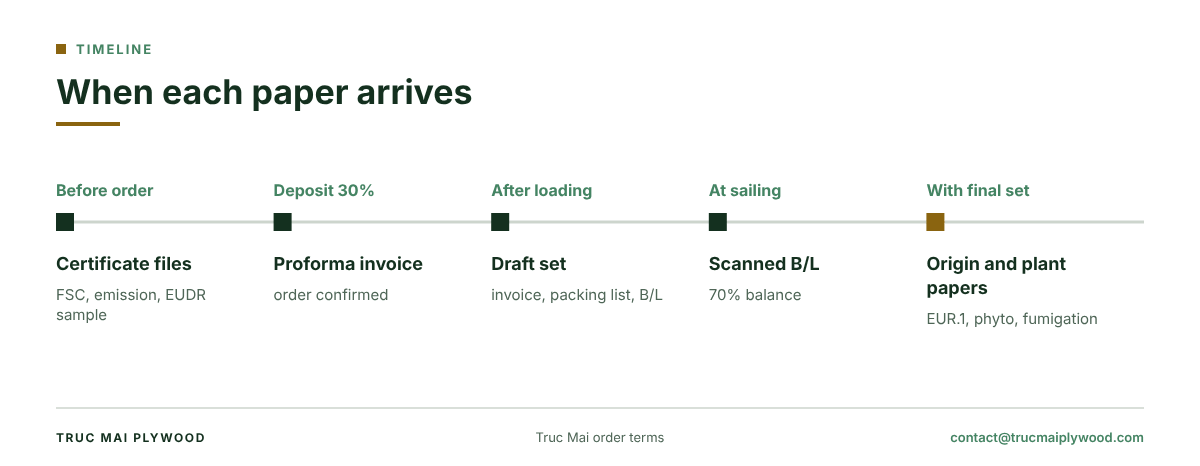
The mill prepares the set; the importer or broker files it with customs. The table shows each paper, who needs it and when it arrives.
| Paper | Who needs it | Arrives |
|---|---|---|
| Certificate files (FSC, emission, test reports) | Importer, buyer’s customer | Before the order is confirmed |
| Proforma invoice | Importer, bank | With the quotation |
| Draft invoice, packing list, B/L | Importer, broker | After loading, for approval |
| Scanned B/L | Importer, bank | At sailing; triggers the 70% balance |
| Certificate of origin (EUR.1 for the EU) | Customs | With the final set |
| Phytosanitary and fumigation papers | Plant-health inspection | With the final set |
| EUDR file set (EU lots only) | EU importer | Before loading |
Which documents does the mill send with each container?
Every 40HC leaves the mill with its shipping papers: the commercial invoice, the packing list, the B/L, the origin certificate (for any EU-bound lot this is an EUR.1), the phytosanitary paper with the fumigation paper for the pallets, and, on CIF terms only, the insurance policy.
Alongside them come the documents the order itself asks for: the FSC claim on sales documents, the emission certificate, test reports for the agreed build and, for EU lots, the EUDR file set.
What documents are required to import plywood from Vietnam to the EU or USA?
What documents are required to import plywood from Vietnam? The same core set for both destinations, with extra files by destination as shown below. Plywood shipping documents Vietnam exporters issue follow one order sheet, so each line is copied once and repeated on every paper.
Plywood shipping documents Vietnam exporters issue: what each paper shows
What each paper shows matters as much as having it:
- Commercial invoice. Product description, species, thickness, size, quantity in sheets and m³, price, terms (FOB Hai Phong, CFR or CIF) and, where it applies, the FSC claim.
- Packing list. Sheets per pack, packs, pack height, core, measured weights next to the planned count.
- Bill of lading. The carrier’s receipt for the container and the document the 70% balance is paid against.
- Certificate of origin. EUR.1 for EU-bound lots; a standard certificate of origin for other markets.
- Phytosanitary and fumigation papers. Plant-health papers for the shipment and its wood packaging.
- Insurance. Under CIF terms the mill insures the cargo; under FOB and CFR the buyer does.
Truc Mai keeps the same description across all of them. A species, thickness or quantity that reads differently on the invoice and the packing list is the quickest way to a customs query, so the mill copies each line from the order sheet once.
When do certificate files arrive compared with shipping papers?
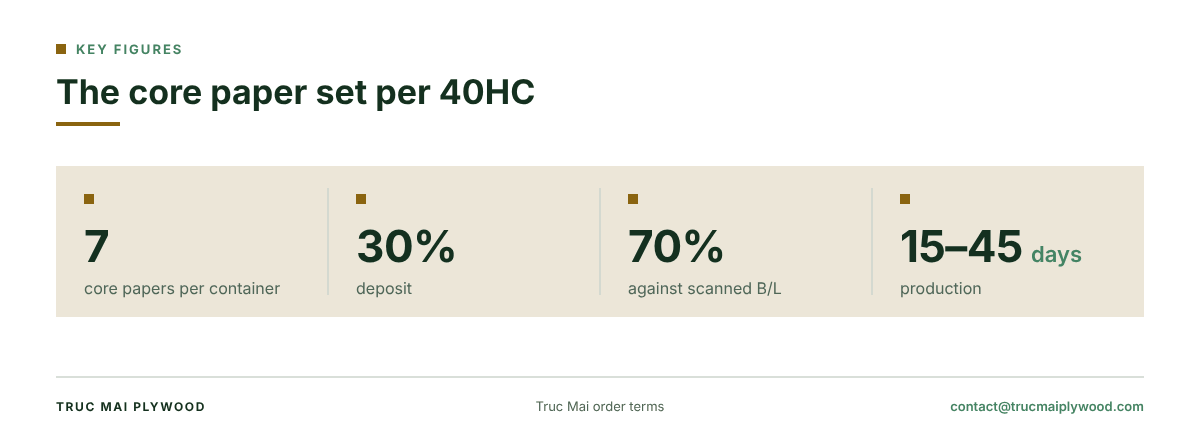
Certificate files arrive first, before the order is confirmed. Draft shipping documents follow after loading, for the buyer’s approval, and the scanned B/L comes when the vessel sails. The balance of 70% is paid against that scan, and the final set follows.
That order gives the importer time for its own checks. The buyer reads the FSC and emission files and the sample EUDR dossier before paying a deposit of 30%. The mill then produces for 15–45 days, loads, and sends the draft set. The buyer corrects any line, and the corrected set is the one issued.
For an EU-bound lot the EUDR geolocation files are ready before loading, because the importer’s statement must exist before the goods are placed on the market. For a US-bound lot the manufacturer, country of origin and tariff-line data for the ISF must reach the broker before loading. The sequence is on from enquiry to loading.
Does plywood need ISPM 15 treatment?
No. ISPM 15, the international standard for wood packaging, exempts “wood packaging made wholly of processed wood material, such as plywood, particle board, oriented strand board or veneer” made with glue, heat or pressure. Plywood panels carry no treatment mark. The pallets, battens and dunnage that ship with them are solid wood and do.
The exemption is in section 2.1 of ISPM 15, and the standard also exempts wood packaging made entirely from thin wood of 6 mm or less. For the United States, 7 CFR 319.40-3 requires regulated wood packaging to carry a mark with the ISO two-letter country code, a producer number and the treatment type, HT for heat treatment or MB for methyl bromide fumigation.
That is why a plywood container still has fumigation or heat-treatment papers: they cover the pallets and dunnage, not the panels. Ask for the mark on the pallets in photos of the packing if the destination inspects packaging.
Which extra files does an EU-bound lot carry?
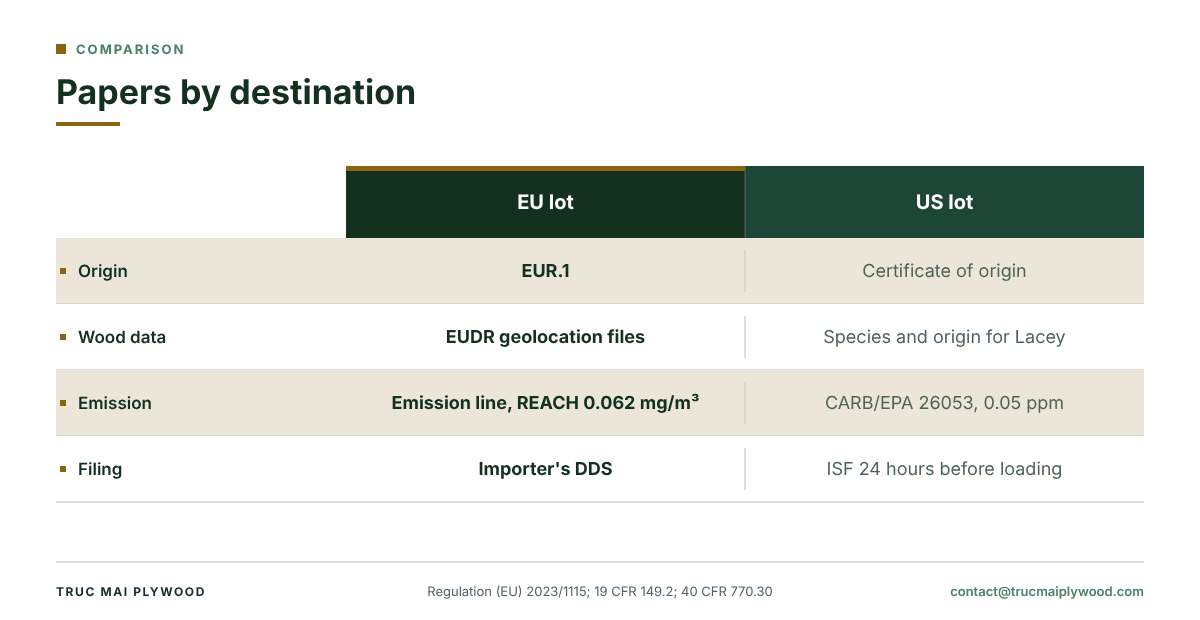
An EU-bound lot adds the EUDR file set, the EUR.1 certificate of origin, the emission line for the REACH formaldehyde limit and the PPWR packaging test. Truc Mai supplies with the EU file set, and the importer uses it to file its own due-diligence statement.
| Extra file | Basis | What it contains |
|---|---|---|
| EUDR file set | Regulation (EU) 2023/1115 | Plot geolocation for core and face, species, quantity, country of production |
| EUR.1 | Origin rules | Country of origin Vietnam |
| Emission line | REACH Annex XVII entry 77 | Glue and emission class; chamber test on request |
| PPWR packaging test | Regulation (EU) 2025/40 | Test of the packaging materials |
The importer is the operator. Under Regulation (EU) 2023/1115 an operator may not put relevant products on the EU market, or export them, until it has submitted its due-diligence statement, and it keeps the records for five years. The date of application is 30 December 2026, set by Regulation (EU) 2025/2650. The step-by-step route is on import plywood from Vietnam to Europe.
There is no official “EUDR certificate”. The file set is data, and the geolocation must use “at least six decimal digits”, with polygons for plots above four hectares. The files contain plot owners and supplier names that stay in the importer’s file.
What are the requirements for importing wood products into the USA?
A US importer needs entry documents, an ISF, a Lacey Act declaration, TSCA Title VI compliance for hardwood plywood and a check of the AD/CVD orders. The mill’s papers feed each one: the commercial invoice and packing list for entry, the producer data for the ISF, species and origin data for the declaration, and the CARB/EPA certificate for the formaldehyde rule.
- Entry documents. 19 CFR 142.3 lists the entry documentation: evidence of the right to make entry, a commercial invoice and a packing list “where appropriate”, plus other documents required by CBP or other agencies.
- ISF. 19 CFR 149.2 requires manufacturer, country of origin and commodity HTSUS number “no later than 24 hours before the cargo is laden aboard the vessel at the foreign port”.
- Lacey Act. 16 U.S.C. 3372(f) requires a declaration with the scientific name of the plant, value, quantity and the country where it was taken.
- Formaldehyde. 40 CFR 770.30 tells importers to keep bills of lading or invoices with a written statement from the supplier that the products are TSCA Title VI compliant, for three years.
- AD/CVD. The final determinations on hardwood and decorative plywood from Vietnam are in the Federal Register; the US route explains scope and rates on import plywood from Vietnam to the USA.
Where does the FSC claim appear on the documents?
The FSC claim appears on the sales and shipping documents, mainly the commercial invoice and the packing list, for products on the current FSC product schedule. Truc Mai’s chain-of-custody certificate licenses FSC 100% products only, with no FSC Mix, and it does not cover every panel automatically.
Truc Mai’s licence code is FSC-C196493 and the certificate SA-COC-014545, issued by Soil Association Certification for plywood as a primary processor. A buyer who needs the claim writes it on the order line (“FSC 100%”) and checks that the invoice and packing list carry it for the lot. If a lot includes a product that is not on the schedule, the claim is left off that line.
The claim is a statement about the wood’s chain of custody. It is not an EUDR statement and not a legality certificate for customs, but the FSC chain of custody gives the importer an evidence trail for the origin of both core and face veneer. The FSC 100% page explains the scope.
Which certificates does the mill hold in its own name?
Truc Mai holds FSC 100% chain of custody, CARB Phase 2 with TSCA Title VI, ISO 9001:2015 and ISO 14001:2015, and supplies EUDR data and a PPWR packaging test.
| Certificate | Number | What it covers |
|---|---|---|
| FSC 100% chain of custody | FSC-C196493 / SA-COC-014545 | The FSC 100% line on invoice and packing list, listed products only |
| CARB P2 and TSCA Title VI | CARB/EPA 26053 | Veneer-core hardwood plywood of 3–25 mm and 3–15 plies |
| ISO 9001:2015 | W2012 (WCERT) | The mill’s quality management system |
| ISO 14001:2015 | W2012E (WCERT) | The mill’s environmental management system |
| EUDR due-diligence data | Per order | Plot geolocation for core and face |
| PPWR packaging test | Held | Packaging materials tested |
Neither ISO certificate is a claim about the panel itself, so neither appears as a product line on the invoice. The CARB/EPA certificate stops at 25 mm, so panels of 30 mm and 40 mm are not described as CARB P2 certified. Certificate files go to the buyer before the order is confirmed.
What do insurance and payment papers add?
Under CIF terms the mill insures the cargo, and the policy is part of the set. On the payment side, the proforma invoice carries the 30% deposit and the scanned B/L releases the 70% balance; how T/T and L/C at sight work on FOB Hai Phong, CFR and CIF is set out on deposit and balance terms.
Under an L/C, the bank checks the documents against the credit line by line, so descriptions, quantities and dates must match exactly. Send the draft L/C wording before it is issued, so that the product description and the document list can be matched to what the mill produces. The standard terms are on MOQ, payment and FOB.
What is the verified gross mass, and who provides it?
The verified gross mass is the weight of the packed container, and the shipper has to obtain and document it before the container is loaded on the ship. The packing list gives the planned count and the measured weights that feed it.
Truc Mai plans 28,000 kg of cargo per 40HC and weighs real sheets before the final loading plan, so the planned count and the weight line on the packing list can differ, and the packing list is the record. SOLAS regulation VI/2 makes the shipper responsible for the verified gross mass, which adds the mass of pallets, dunnage and securing material and the tare of the container, and its amendments entered into force on 1 July 2016. See the m³ per 40HC table for the planning figures.
Which mismatches hold a container at the port?
Four mismatches cause most delays: a species or thickness written differently on two papers, a quantity that differs between the invoice and the packing list, a missing treatment mark on pallets, and a certificate scope that does not cover the thickness shipped. Each is avoided by checking the draft set against the order line.
- Compare the product description on the invoice, packing list and certificate line by line.
- Check that the quantity in sheets and m³ matches, and that weights are measured.
- Look at the pallets for the treatment mark in the photos of the packing.
- Check the certificate scope against the thickness range in the container.
What does the packing list show for a plywood container?
The packing list shows the container as it was loaded: the product lines, the core and thickness of each, sheets per pack, packs per container, pack height, the measured weights and the total. It is the record against which the buyer checks the container, and the line the broker uses to compare quantity with the invoice.
A good packing list for a 40HC of Styrax-core 18 mm reads like the plan: 18 packs of 55 sheets, 990 sheets, about 53 m³. The plan is a planning figure from the packing model, and the packing list records what was actually put in the box. If the two differ, for example because real sheets weighed more than the reference density, the packing list is the document that counts and the difference is explained on the draft. Buyers who run a repeat programme keep the first packing list as the reference and compare every later one with it.
The packing list is also where a mixed container shows its structure. A container with two or three products carries one block per product, each with its own core, thickness and pack count, and the weights are added to the verified gross mass. The m³ per 40HC table shows the planning counts for each thickness and core.
How is a draft document set approved?
After loading, the mill sends the draft invoice, packing list and B/L to the buyer for approval. The buyer checks each line against the order, marks corrections, and returns the draft; the mill then issues the corrected set. Nothing is final until the buyer has approved the drafts.
Check these lines on the draft set:
- Names and addresses of buyer, consignee and notify party, spelled as the bank or customs will read them.
- Product description, species, thickness, size and tolerance, copied from the order.
- Quantity in sheets and in m³, and the weights, equal on the invoice and the packing list.
- Terms (FOB Hai Phong, CFR or CIF), port of loading and port of discharge.
- The FSC claim, where the order has one, on the products that carry it.
- The container number and seal number on the packing list and B/L.
A correction at the draft stage costs nothing. After the vessel has sailed, a changed B/L or invoice costs time, and under a letter of credit a mismatch can stop the payment.
What do customs ask for at the port of arrival?
Customs ask for the commercial invoice, the packing list, the bill of lading and the origin papers, and then for whatever the product needs: the EUDR reference number in the EU, the Lacey declaration and the ISF record in the United States. The mill’s set is built so that the first four are consistent and the rest can be filled from its data.
An importer who has the set in hand before the vessel arrives can pre-lodge it with the broker, and a lot whose papers agree with each other clears faster than one whose papers need correction. The importer’s broker is the person who knows the local entry rules, and the mill’s role is to send papers that do not contradict each other.
What should the first order include?
A first order should include the full certificate file, the sample set of documents, the sample panels and the payment terms in writing. The importer reads the certificates and the sample documents, approves the sample, and only then pays the 30% deposit.
A sample costs a new buyer only the courier, and that cost is credited back on a real order (see ordering samples). One 40HC is the minimum, normally holding one or two products, or three to six if agreed. Production takes 15–45 days after the deposit, depending on quantity and the agreed schedule.
What should the order line say about documents?
Name the papers on the order line: the destination, the origin certificate, the FSC claim, the emission line and, for EU lots, the EUDR file set. Written once, the line is copied onto every repeat order, and the mill issues the same set each time.
18 mm plywood, Styrax core, UF glue at E0 emission, FSC 100% claim, 1220 × 2440 mm, 1×40HC FOB Hai Phong. Documents: commercial invoice, packing list, B/L, EUR.1, phytosanitary and fumigation papers, EUDR file set with core and face geolocation, emission certificate. Drafts for approval after loading, balance against the scanned B/L.
Put that line in the quotation desk form or in an email to contact@trucmaiplywood.com, and ask for the certificate files and a sample document set before you pay the deposit.
Questions buyers ask
Which documents does the mill send with each container?
The shipping set is the commercial invoice, packing list and bill of lading, a certificate of origin (EUR.1 for lots bound for the EU), phytosanitary and fumigation papers and, under CIF, the insurance policy. The certificate documents the order names travel with it.
When do certificate files arrive compared with shipping papers?
Certificate files go to the buyer before the order is confirmed. Draft shipping documents go for approval after loading, and the scanned B/L triggers the 70% balance.
Does plywood need ISPM 15 treatment?
No. ISPM 15 exempts wood packaging made wholly of processed wood material such as plywood. Solid-wood pallets, battens and dunnage shipped with it do need the treatment mark.
Which extra files does an EU-bound lot carry?
The EUDR file set with plot geolocation for core and face veneer, an EUR.1 certificate of origin, the emission line for REACH and the PPWR packaging test.
What are the requirements for importing wood products into the USA?
A Lacey Act declaration, an ISF filed 24 hours before loading, TSCA Title VI formaldehyde compliance for hardwood plywood, entry documents with the commercial invoice and packing list, and a check of the AD/CVD orders.
Where does the FSC claim appear on the documents?
On the sales and shipping documents, mainly the invoice and the packing list, for products on the current FSC product schedule. It does not cover every panel automatically.
What is the EUR.1 certificate for?
It states the origin of the goods for EU customs. Truc Mai issues it for EU-bound lots, with Vietnam as the country of origin.
Is there an EUDR certificate?
No. The EU importer files a due-diligence statement; the mill supplies the data behind it. FSC 100% is a separate chain-of-custody claim.
Who is responsible for the verified gross mass?
The shipper has to obtain and document the verified gross mass of a packed container under SOLAS. The packing list carries measured weights next to the planned count.
Do I get the original B/L before paying the balance?
No. The 70% balance falls due when the buyer receives the scanned B/L, settled by T/T or by an irrevocable L/C at sight.
Does Truc Mai issue structural-grade papers?
No. Truc Mai makes non-structural interior and commercial plywood, so no structural grade stamp or certificate is part of the set.
What does the packing list show?
Sheet count per pack, packs per container, size, thickness, core and measured weights, so the buyer can check each container against the order line.