
To import plywood from Vietnam to Europe, classify the panels under HS heading 4412, collect the origin and certificate files from the mill, and file the EUDR due-diligence statement yourself as the operator: it applies from 30 December 2026. Truc Mai supplies with the EU file set, so each 40HC arrives with plot geolocation for core and face, the FSC 100% claim, a packaging test and EUR.1.
How do you import plywood from Vietnam to Europe?
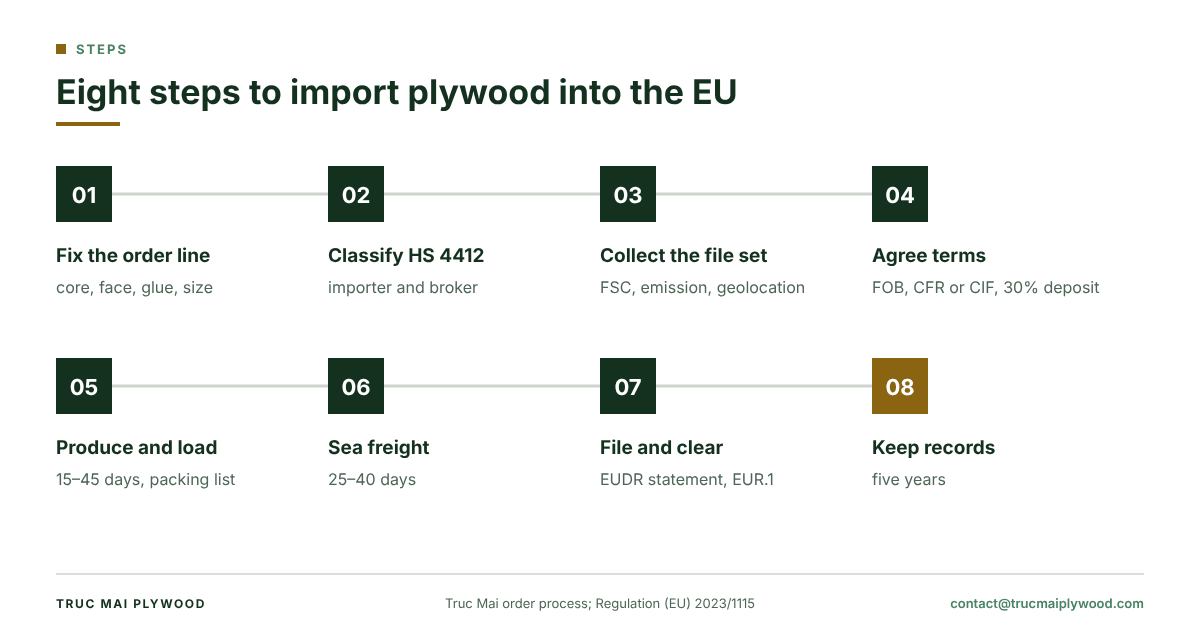
You import plywood from Vietnam into the EU in eight steps: fix the specification, classify under HS 4412, collect the file set from the mill, agree terms, ship, file the EUDR due-diligence statement before placing the goods on the market, clear customs and keep the records. The importer is the operator and carries the legal duty.
Truc Mai supplies with the EU file set, so the documents that the importer needs for each step arrive with the container or before it. The mill makes non-structural interior and commercial plywood; it does not make structural panels.
| Step | What happens | Who acts | What the mill supplies |
|---|---|---|---|
| 1 | Fix the order line: core, face, glue and emission, size, tolerance | Importer and mill | Samples and the specification sheet |
| 2 | Classify the goods under HS 4412 | Importer and broker | Product description and species |
| 3 | Collect certificates and origin files | Mill | FSC 100% claim, emission certificate, EUDR geolocation files |
| 4 | Agree terms: FOB Hai Phong, CFR or CIF, 30% deposit | Importer and mill | Proforma invoice |
| 5 | Production and loading | Mill | Packing list, draft shipping documents |
| 6 | Sea freight, 25–40 days | Carrier | B/L |
| 7 | File the EUDR statement, clear customs | Importer | EUR.1, invoice, packing list |
| 8 | Keep records for five years | Importer | Copies of the file set |
What is the HS code for plywood?
Plywood is classified under HS heading 4412 (“plywood, veneered panels and similar laminated wood”). Panels with at least one outer ply of tropical or non-coniferous wood fall under subheadings 4412 31, 4412 33 and 4412 34, and the full eight-digit EU code depends on the face species, whether the panel is coated, and the thickness of each ply.
The heading is the one the EU deforestation regulation lists. Annex I of Regulation (EU) 2023/1115 lists heading 4412 by the same wording, “Plywood, veneered panels and similar laminated wood”, which makes any plywood consignment entering the EU a relevant product for EUDR purposes. The Chinese anti-dumping duty described below uses the same heading.
Describe the panel the same way on every paper. The invoice, the packing list and the EUDR statement should carry the same product description, the same species names and the same HS code, because a mismatch between documents is the most common reason for a customs query.
The duty rate is read per CN code in the EU’s integrated tariff (TARIC), so the broker fixes it once the face and the code are known; it is not quoted here because it changes with the code and with any preference claimed under the origin papers.
What certificates are needed to import plywood into the EU?
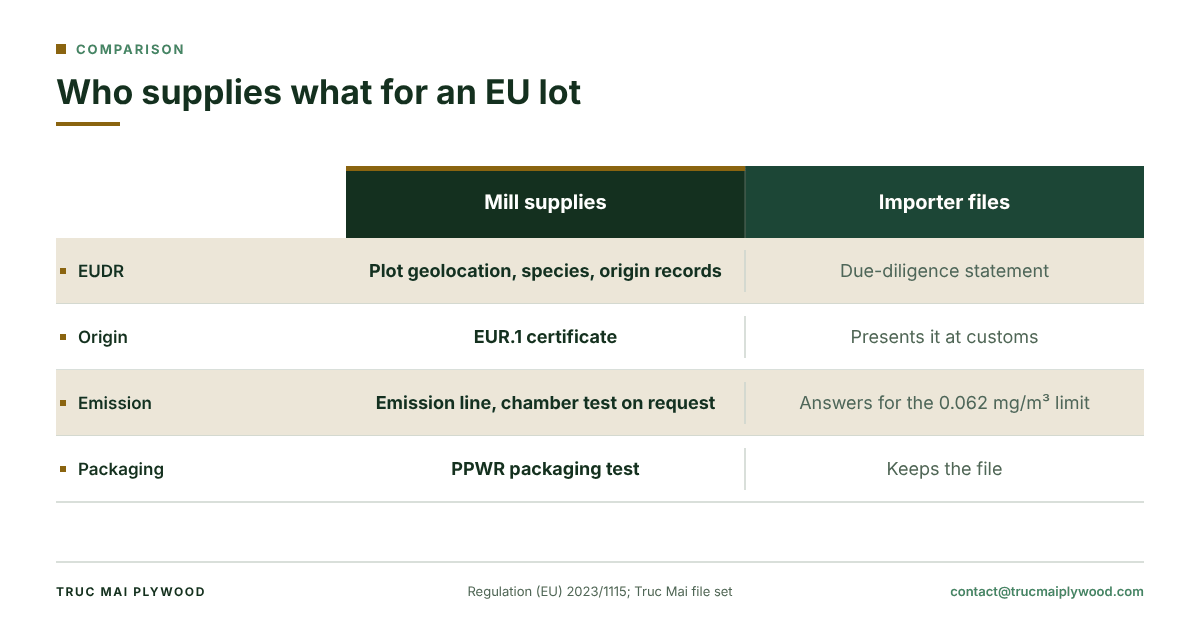
No single certificate is needed to import plywood into the EU. The importer needs a due-diligence statement under EUDR, a panel that meets the formaldehyde limit, packaging that meets PPWR, and the commercial papers customs asks for. The mill’s certificates support those duties; they do not replace them.
| Duty or paper | Legal basis | Who files or holds it | What the mill supplies |
|---|---|---|---|
| EUDR due-diligence statement | Regulation (EU) 2023/1115 | EU importer | Plot geolocation, species, quantity, origin records |
| Formaldehyde limit 0.062 mg/m³ | REACH Annex XVII entry 77 | Importer answers for the product | Emission class per order, chamber test on request |
| Packaging limits | Regulation (EU) 2025/40 (PPWR) | Importer and mill | PPWR packaging test of the materials used |
| Origin | EUR.1 certificate of origin | Mill issues, importer presents | EUR.1 for EU-bound lots |
| FSC 100% claim | FSC chain of custody | Mill states, importer keeps | Claim on sales and shipping documents |
| Wood packaging | ISPM 15 | Pallet supplier | Treatment mark on pallets and dunnage |
Truc Mai holds the following in its own name: FSC 100% (licence FSC-C196493, certificate SA-COC-014545), ISO 9001:2015 (W2012), ISO 14001:2015 (W2012E) and CARB P2 with TSCA Title VI (CARB/EPA 26053, for the United States). The FSC claim is stated on sales and shipping documents for products listed on the current schedule, not on every panel automatically; the FSC 100% page explains the scope.
Who files the EUDR due-diligence statement for plywood from Vietnam?
The EU importer files it. EUDR calls the importer the operator: “any natural or legal person who, in the course of a commercial activity, places relevant products on the market or exports them”. The statement must be submitted before the plywood is placed on the market, and the operator takes responsibility for compliance by submitting it.
Article 4 of Regulation (EU) 2023/1115 sets the order of events: the due-diligence statement is submitted first, and only then may the operator place relevant products on the market or export them. Operators keep a record of the statements for five years from the date of submission. One statement can cover several shipments, and the reference number is passed down to later buyers.
The mill’s part is data. Truc Mai supplies due-diligence data for the Vietnamese core and the face veneer so that the importer’s statement is complete. The mill cannot file for you, and the data does not replace the importer’s own risk assessment. A downstream operator, such as a furniture maker in the EU who buys plywood that already has a statement, does not file a new one but keeps the reference number.
When does EUDR apply to plywood importers?
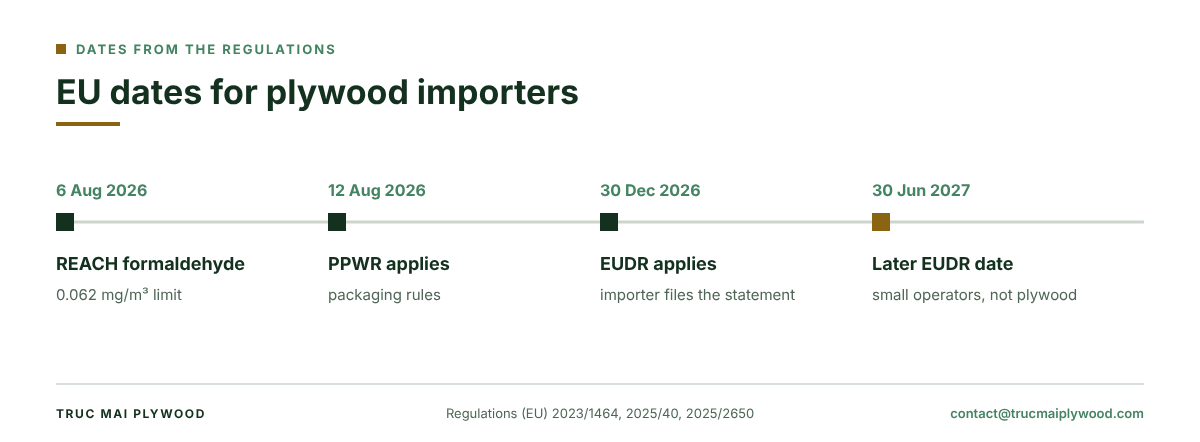
EUDR applies to plywood importers from 30 December 2026. A later date, 30 June 2027, exists only for micro and small operators, and it excludes the products that were covered by the EU Timber Regulation. Plywood was one of them, so a small plywood importer is on the same date as a large one.
Regulation (EU) 2025/2650 rewrote the application article: Articles 3 to 13, 16 to 24, 26, 31 and 32 apply from 30 December 2026, and the 30 June 2027 date is “except as regards the products covered by the Annex to Regulation (EU) No 995/2010”. The same act repeals the Timber Regulation from 30 December 2026, but keeps it alive until 31 December 2029 for timber produced before 29 June 2023 and placed on the market from 30 December 2026.
The cut-off date for deforestation stays at 31 December 2020. Land cleared after that date disqualifies the commodity, which is why the geolocation data names the plot and its production dates.
What geolocation data does the mill send for core and face veneer?
For each container the mill sends origin records with plot coordinates and polygon files (GeoJSON) for the core logs and for the face veneer. EUDR asks for the geolocation of every plot where the wood was produced, with the date or time range of production, so both layers of the panel need a record.
The legal wording is in Regulation (EU) 2023/1115: geolocation means coordinates “using at least six decimal digits”, and plots of more than four hectares are described with polygons. Two layers are involved in a Truc Mai panel:
- Core. The core logs come from plantations in Vietnam. For an FSC 100% Acacia core, the sample dossier runs from the harvest permit papers and the forest-product lists to the weighbridge tickets, with the plot coordinates and a map of the polygon.
- Face. The EV face on a Truc Mai panel is made of reconstituted plantation poplar and is traced through forest-management and chain-of-custody certificates to a polygon, with the supplier’s deforestation-free declaration and the export and import declarations.
The files contain plot owners, plot numbers and supplier names, which stay in the importer’s file and are not published. Read the file contents in outline on the EUDR geolocation data page.
The Annex of Implementing Regulation (EU) 2025/1093 headed “Low risk countries” lists both Vietnam and China. That matters for the importer’s assessment, because simplified due diligence applies only when all commodities in the product come from low-risk countries. The importer still decides the assessment.
What formaldehyde limit applies to plywood under REACH from August 2026?
For an importer the formaldehyde line changes on 6 August 2026: a furniture or wood-based article put on the EU market must then emit no more than 0.062 mg/m³, with the chamber set up as Appendix 14 of REACH Annex XVII, entry 77, prescribes. Plywood panels are wood-based articles, so the limit is a condition of sale, not an option.
The test chamber is held at 23 °C and 45% relative humidity with a loading of 1 m² per m³. Regulation (EU) 2023/1464 sets the 0.062 mg/m³ limit from 6 August 2026. Other articles have a limit of 0.080 mg/m³, and articles used only outdoors are excluded.
Truc Mai writes glue and emission as two separate lines on the order. The default is UF glue at E0 emission. Because the EU limit is in mg/m³, a US result in ppm cannot be converted: a European chamber test is ordered separately for the order when the buyer needs one. The emission class per order page shows how the line is written.
What does a PPWR packaging test cover?
For the importer, a PPWR packaging test answers for the materials that went to the lab, such as the pallet, the strapping and the wrap; it says nothing about the panel and does not settle every PPWR obligation. The heavy-metal cap starts on 12 August 2026: lead, cadmium, mercury and hexavalent chromium in packaging may not add up to more than 100 mg/kg.
Both figures are in Regulation (EU) 2025/40: Article 71 says the regulation “shall apply from 12 August 2026”, and Article 5(4) says the sum of the four heavy metals “shall not exceed 100 mg/kg”. Truc Mai holds a PPWR packaging test and may name it; the test is run independently, and the report goes into the file set for the order. The details are on the PPWR packing page.
Wood packaging is a separate topic. Solid-wood pallets, battens and dunnage shipped with the panels fall under ISPM 15 and carry a treatment mark, while the plywood itself is outside it.
Does the EU anti-dumping duty on Chinese plywood apply to Vietnamese plywood?
No. The anti-dumping duty is imposed on hardwood plywood “originating in the People’s Republic of China”, and it applies to plywood with each ply not exceeding 6 mm. The rates are 43.3% for one named exporter and 86.8% for all other companies, on the net free-at-Union-frontier price.
Article 1 of Regulation (EU) 2025/2333 imposes the definitive anti-dumping duty on hardwood plywood “originating in the People’s Republic of China”. A Vietnamese-origin panel is outside the scope, and the mill’s origin papers say so: the EUR.1 certificate of origin for an EU lot states Vietnam as the country of origin. The duty is stated here as context only; it is not a reason to choose a supplier.
Customs origin rules, not the address of the mill, decide origin. If you know that some of the material in the panel, a face veneer for instance, was produced in another country, have your broker confirm what origin the papers will state before the container sails.
Which documents travel with each container to the EU?
For an EU-bound 40HC the paper set is the commercial invoice and packing list, the bill of lading (B/L), the EUR.1 certificate of origin, phytosanitary and fumigation papers, and, under CIF, the insurance. The order’s certificate files and the EUDR file set go with them. Certificate files go to the buyer before the order is confirmed.
Draft shipping documents are sent to the buyer for approval after loading, and the balance of 70% is paid against the scanned B/L. The full set, in the order the papers arrive, is on the documents needed to import plywood page.
How long does a container take from Hai Phong to Europe?
Production takes 15–45 days after the 30% deposit, depending on quantity and the agreed schedule. Sea freight then takes typically 30–40 days from Hai Phong to Northern Europe and 25–35 days to the Mediterranean. Add them and book the EUDR statement before the container is placed on the market.
| From Hai Phong to | Typical days at sea |
|---|---|
| Mediterranean | 25–35 days |
| Northern Europe | 30–40 days |
Days at sea vary by carrier and route. The delivery terms are FOB Hai Phong, CFR or CIF, and the minimum order is one 40HC. A container usually carries one or two products; three to six can be mixed by agreement. For the m³ and sheet count of each product see the m³ per 40HC table.
What does the EU importer keep on file after the container arrives?
The importer keeps the due-diligence statement record for five years from the date of submission, together with the documents behind it: the mill’s geolocation files, the species and quantity data, the invoice and the packing list. Article 4 of the regulation sets the five years, and the same period is a sensible rule for the whole file.
A tidy file makes a customs or competent-authority query a matter of minutes. Keep one folder per container with the statement reference number, the origin records for core and face, the FSC claim as printed on the invoice, the emission line and any chamber test, the packaging test and the EUR.1. When a repeat order carries the same specification, the folder for the first container is the template for the next.
Downstream buyers need part of it. An EU furniture maker that buys the plywood from the importer does not file a new statement, but it keeps the reference number, so the importer passes the number on with each sale. That is one more reason to write the reference on the invoice to the customer.
How does a first EU order start?
A first EU order starts with the specification and a sample of the same build, which costs nothing; a new buyer only arranges the courier, and that cost is credited if the order follows. Certificate files, including the sample EUDR dossier, are sent before the order is confirmed.
Once the sample and the file set are approved, the importer pays a 30% deposit and production runs 15–45 days; the 70% balance follows loading and the approval of the draft papers, against the scanned B/L, as set out in deposit and balance terms. A container usually carries one or two products; three to six can be mixed by agreement, and the m³ per 40HC table shows how many sheets each product puts in the box.
What should an EU order line say?
An EU order line adds three items to the usual specification: the HS code, the emission line (E0 with the chamber test if required) and the file set. Written once, the line is copied onto every repeat order.
HS 4412 plywood for furniture interiors, 18 mm, 1220 × 2440 mm. EU papers: EUDR file set with geolocation for core and face, EUR.1, PPWR test of the packaging. Build: white poplar EV face over a poplar back on an A-grade stitched Styrax core, UF glue at E0 emission, FSC 100% claim. Sanded and calibrated to ±0.3 mm. FOB Hai Phong, 1×40HC.
For an EU quote, paste the line into the quotation desk form or mail it to contact@trucmaiplywood.com; the sample panel is free, and it is worth asking for the sample EUDR dossier with it so your broker can read the file before the first order.
What should an importer check before the first order?
Check five things before paying a deposit: the HS code agreed with the broker, the EUDR operator role and the system access to submit the statement, the emission line against the formaldehyde limit, the packaging file, and the origin papers. Then compare two offers on the same specification, not on price alone.
- Confirm the face species and the HS code.
- Register as an operator and open the statement workflow before the first arrival.
- Ask for the sample file set and read the geolocation files.
- Fix the emission line and, if needed, order a chamber test.
- Agree the terms: FOB, CFR or CIF, 30% deposit, 70% against the B/L.
Questions buyers ask
Who files the EUDR due-diligence statement for plywood from Vietnam?
The EU importer, who is the operator under the regulation. The mill supplies the data behind the statement, including plot geolocation for core and face veneer, but it does not file for the importer.
When does EUDR apply to plywood importers?
From 30 December 2026. The later date of 30 June 2027 for micro and small operators does not cover products that were already under the EU Timber Regulation, and plywood is one of them.
What is the HS code for plywood?
Plywood is HS heading 4412. Plywood with at least one outer ply of tropical or non-coniferous wood falls under subheadings 4412 31, 4412 33 and 4412 34, and your broker fixes the full eight-digit code from the face species.
What geolocation data does the mill send for core and face veneer?
Origin records and GeoJSON files for the Vietnamese core logs and for the face veneer, with plot coordinates and polygons. The EU importer uses them for its own statement.
Is there an EUDR certificate?
No. EUDR is a due-diligence duty with a statement filed by the operator, not a certificate issued by a body. FSC 100% is a separate chain-of-custody claim that can support the file.
What formaldehyde limit applies to plywood in the EU from August 2026?
0.062 mg/m³ for furniture and wood-based articles from 6 August 2026, measured under the chamber conditions of Appendix 14 of REACH Annex XVII entry 77. A US ppm result is not converted to that unit.
Does the EU anti-dumping duty on Chinese plywood apply to Vietnamese plywood?
No. The duty of 43.3% for one named exporter and 86.8% for all other companies applies to hardwood plywood originating in China, with each ply not exceeding 6 mm.
What does a PPWR packaging test cover?
Only the packaging materials it tested: not the panel, and not every PPWR duty. From 12 August 2026 the regulation caps lead, cadmium, mercury and hexavalent chromium in packaging at a combined 100 mg/kg.
Does Truc Mai make structural plywood for EU buildings?
No. Truc Mai makes non-structural interior and commercial plywood, so its panels are not specified as structural elements.
Is the packing material treated for ISPM 15?
Plywood is outside ISPM 15, but solid-wood pallets, battens and dunnage shipped with it are inside and carry their own treatment mark.
How long does a container take from Hai Phong to Europe?
Typically 30–40 days at sea to Northern Europe and 25–35 days to the Mediterranean, on top of 15–45 days of production after the 30% deposit.
What is the minimum order?
One 40HC, on FOB Hai Phong, CFR or CIF terms, with 30% deposit and 70% balance against the scanned B/L.