
Resources · faces and panels
Plywood types and face veneer guides: EV, poplar, birch, okoume and overlays
Plywood types and face veneers guides start with the face: Truc Mai lays EV, poplar, bleached poplar, birch, okoume, bintangor, pine, eucalyptus, gurjan and sapele faces, and others on request, on its own Eucalyptus, Acacia, Styrax or Pine cores. Birch is a face veneer on a Vietnamese core, so the product is birch-faced plywood, not all-birch plywood. Melamine, HPL and paper overlay panels cover the printed and painted end of the range.
A face is chosen for look and price per container, not only for species. This hub shows how each face looks, what it sits on, and how the face and back grade is agreed, then links the sheets page for each.
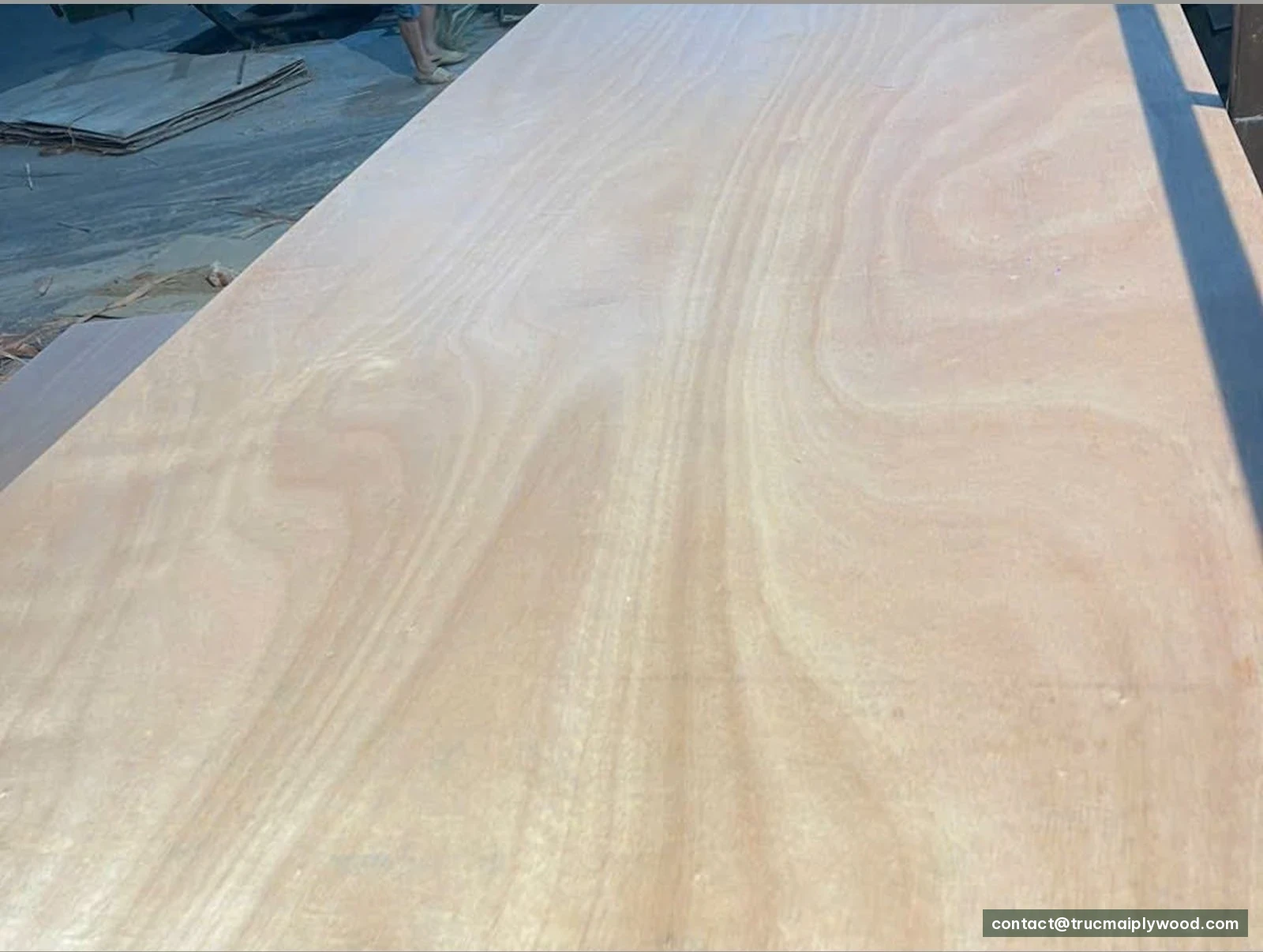
- 10 facesEV, poplar, bleached poplar, birch, okoume, bintangor, pine, eucalyptus, gurjan, sapele
- 0.2–0.5 mmface veneer, usually 0.3 mm for Europe
- 2500 × 1300 mmEV sheet size as imported
- ±0.3 mmon sanded, calibrated furniture panels
Face colours vary from sheet to sheet; the face grade is agreed against an approved sample.
Answer and key facts
Plywood types and face veneers guides: which face for which job?
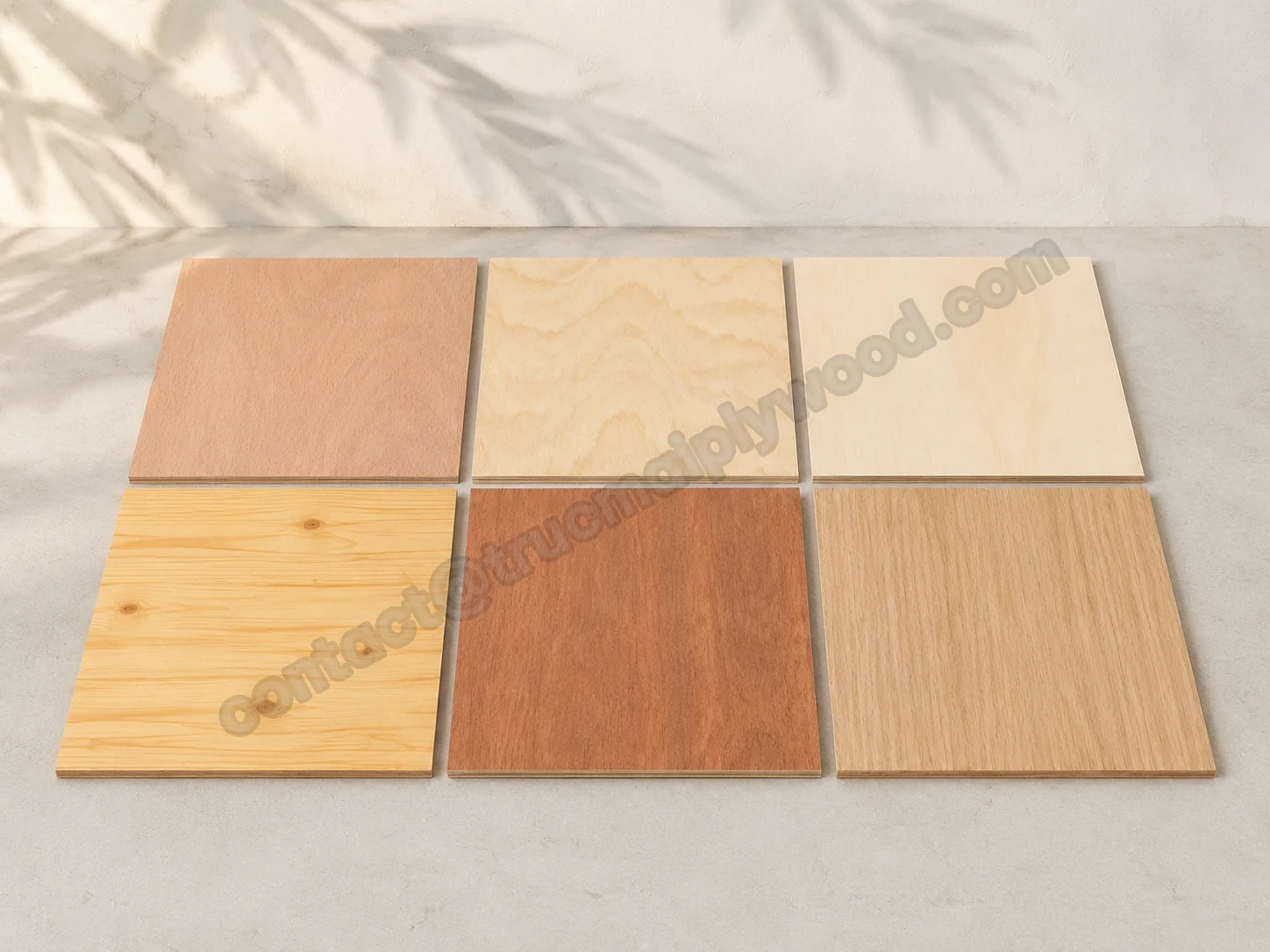
Light, plain faces (poplar, bleached poplar, EV) suit painted and printed parts; warm figured faces (okoume, bintangor, gurjan, sapele) suit clear-finished cabinets; pine gives a honey, knotty look; birch-faced sheets give a pale, wavy grain at a Vietnamese-core price.
The face is a thin layer of 0.2–0.5 mm veneer, usually 0.3 mm for Europe, glued to a sanded core. Because the veneer is thin, the core decides flatness and weight, and the face decides look. Faces are sanded and calibrated, and polished on request. UV-ready means both faces are prepared for the buyer's own UV coating; the mill does not apply UV.
When a face is sold with a claim, the rule behind it sits with FSC International, with Regulation (EU) 2023/1115 (EUR-Lex), or with the California Air Resources Board and the US EPA for emission.
| Face | Look | Note for a buyer |
|---|---|---|
| EV (engineered veneer) | Straight, uniform grain; colour by order, for example oak-look | Reconstituted from plantation poplar; sold in Europe as white poplar EV; FSC 100% available; sheets arrive at 2500 × 1300 mm, 0.3 or 0.4 mm |
| Poplar and bleached poplar | Cream-white, almost plain | A plain base for painted and printed parts |
| Birch (faced) | Pale cream, soft wavy grain | Imported face veneer on a Vietnamese core: write birch-faced |
| Okoume | Light pinkish-beige, less red than mahogany | Clear-finished interiors and cabinet faces |
| Bintangor | Reddish-brown, even | Warm tone, even colour |
| Pine | Honey-yellow with tight small knots | Visible grain, often finished clear |
| Eucalyptus | Light pink-brown, interlocked grain | Face or core; the densest core is the same species |
| Gurjan and sapele | Warm brown, stronger figure | On request and by sample |
Face and core
Okoume face veneer and the other faces: which can be laid on a Vietnamese core?
Any listed face can go on Eucalyptus, Acacia, Styrax or Pine cores, or on combined cores. The face does not change the container load much; the core does. A Styrax-core panel loads about 53 m³ per 40HC at 18 mm whatever the face.
Gurjan, okoume and bintangor are faces only: they are never used as core plies. Poplar and birch cores do not exist in Vietnamese plywood either. A furniture buyer who moves from Acacia to Styrax core usually gets a better face base, a lighter sheet and more m³ per container.
Face veneer thickness for Europe is usually 0.3 mm.
Overlays
Which overlays are offered besides the types of wood veneers?
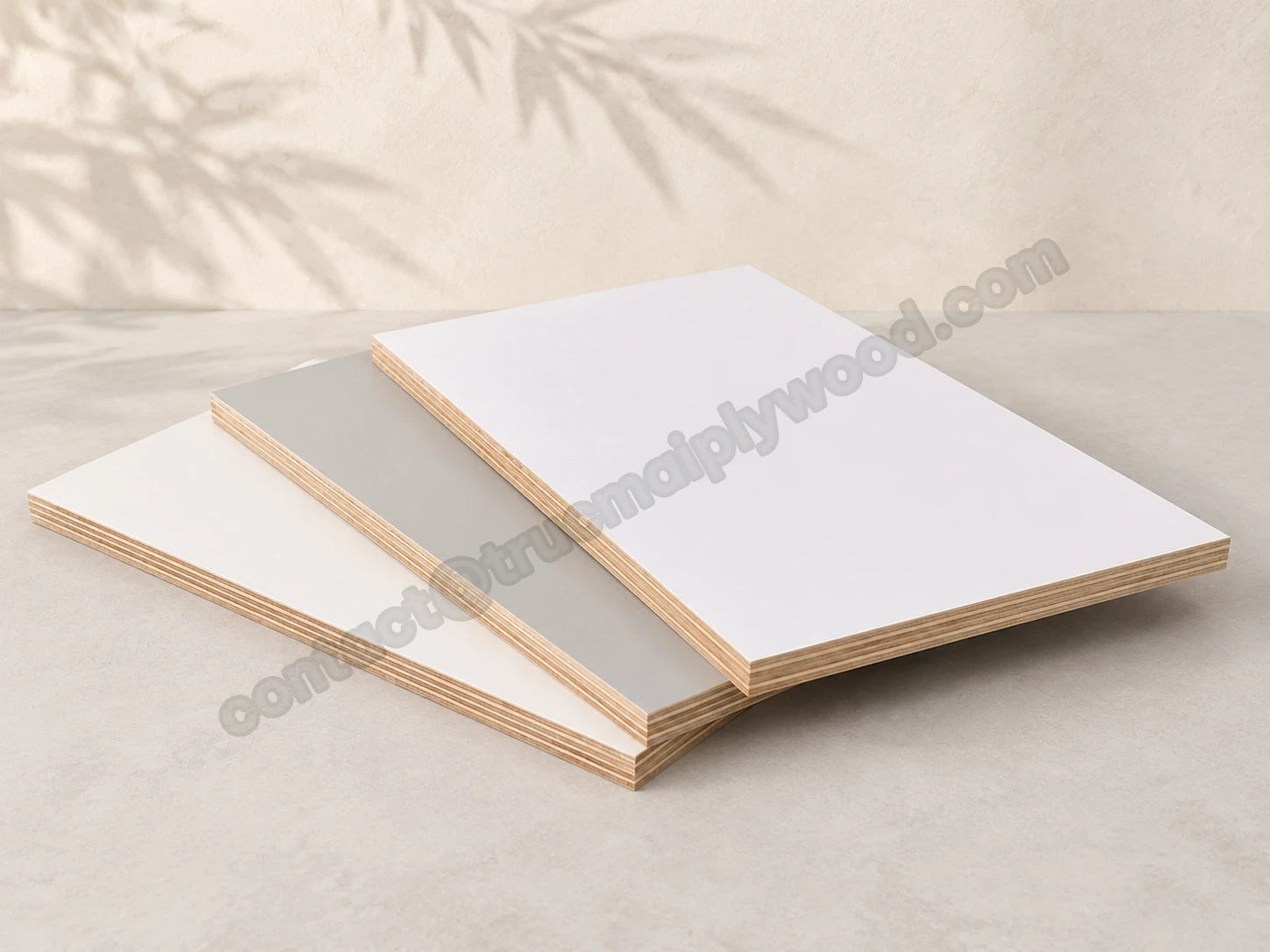
Melamine-faced, HPL-faced and paper-overlay panels are made for painted, printed and wipe-clean parts. UV-ready panels are prepared for the buyer's own UV line. Each sits on a plywood core, so the core guidance above applies.
Melamine paper is a resin-impregnated sheet pressed onto the face; HPL is a thicker laminate; paper overlay gives a smooth, paint-ready surface. The decor, sides and stamp are fixed for every repeat order against an approved sample. Truc Mai does not make film-faced, formwork, structural or marine plywood.
Grades
How face and back grades are agreed
Face and back grades are written as a pair against an approved sample, and the pair goes on the order. The sample is the reference for every reorder, so a buyer who changes face on the second container changes it in writing.
Grades are quoted per order and are not a fixed ladder for every face. Defects that matter are checked on arrival: colour band, knots, patches and flatness. The FSC claim covers eligible products on the current schedule, and whether a given face is on that schedule is confirmed at enquiry. For EU lots the face veneer origin sits in the EUDR file together with the core.
Related pages
Face and panel guides
Guides on face veneers, overlays and panel types, and the sheets page for each face.
- Hardwood plywood for importers: Vietnamese faces, cores and file sets
On a Truc Mai proforma invoice, hardwood plywood means a named face (okoume, bintangor, gurjan, sapele or birch-faced) on a eucalyptus, acacia or styrax core, with UF.
- Lacquer and UV coat at the press line: factory-finished okoume and pine faces
Which coated faces a mill can supply, coat weight and gloss, and when a buyer saves by skipping the spray booth.
- UV plywood: cured gloss and matt coatings on cabinet faces
UV-coated faces for cabinet and shelving lines: gloss levels, coat weight and what a mill can supply in volume.
- Ply or MDF on a furniture line: what each part should be
The panel decision a furniture factory makes per part, with cost per m3 and per container.
The two faces most often swapped on commercial orders, compared on look, paint and price.
- Veneer or laminate faces: what a furniture line pays and gets with okoume, bintangor and melamine
Natural veneer faces (okoume, bintangor, pine, poplar, EV) against melamine and HPL faces for furniture makers: appearance, finishing steps the factory must add, wear.
- Sande plywood: what it is and how poplar or bintangor faces compare
Informational sande plywood explainer with the colour, weight and price per m3 of the faces a Vietnamese mill runs in volume.
- Types of wood: softwood, hardwood and plantation timber behind panels
A buyer's map of wood types, and which ones end up as faces and cores in Vietnamese plywood.
- Wood boards: solid, ply, MDF, chipboard and OSB in one table
Every common wood board in one table with density, cost per m3 and typical use, plywood against the rest.
- Panel types by face, core and glue: a buyer's classification
Every plywood type sorted by the three choices written on an order, with the ones a commercial mill makes.
- LVL or ply: same veneer, different lay-up, different job
When a buyer should order parallel-grain LVL and when cross-grain plywood, for packing and furniture.
- Real wood veneer sheets: thickness, sizes and backing
Loose real-wood veneer sheets explained, and how they differ from a pressed plywood face.
- Compact HPL and phenolic sheets against HPL-faced plywood
Solid compact laminate against HPL-faced plywood for worktops, lockers and partitions: weight and cost per m2.
- Decorative plywood: textured, grooved and fancy faces for furniture
Decorative face options for furniture and fit-out (textured, brushed, grooved, fancy veneer) and what a mill supplies in volume.
- Coloured plywood: dyed faces, coloured cores and laminate colours
How coloured plywood is made (dyed veneer, laminate, paint) and what a mill can supply in repeatable colours.
A Baltic birch replacement here is a birch face on a Vietnamese Styrax or Eucalyptus core, never all-birch.
A white panel is either a bleached poplar face or a white melamine or paper overlay, laid on a light Styrax or other Vietnamese core.
- Lightweight ply on Styrax core: lighter sheets, more m³ per 40HC
Styrax core at about 500 kg/m³ fits 18 packs in a 40HC, against 16 on Acacia and 15 on Eucalyptus.
- Birch vs Baltic birch plywood: a birch face or birch all the way through
A birch-faced panel puts a birch face of about 0.3 mm on a Vietnamese core, usually 11 plies at 18 mm.
A buyer's face decision between bintangor, okoume and eucalyptus on look, paint and price for repeat commercial orders.
- Bintangor wood as a face veneer: grades, colour and the cores beneath
At Truc Mai, bintangor is only a face: a 0.2–0.5 mm veneer, usually 0.3 mm for Europe, laid on a eucalyptus, acacia, styrax or pine core.
Compares the melamine, HPL and paper-overlay faces Truc Mai presses on its own eucalyptus, acacia and Styrax cores.
- The main disadvantage LVL panels carry: moisture, edges and outdoor use
Truc Mai LVL is made for furniture parts, door and frame stock, bed slats and packing.
- Is LVL stronger than sawn wood for furniture and packing parts?
Weighs LVL against sawn parts for rails, frame stock, bed slats and runners.
The panel range most containers carry.
Poplar-faced panels on Styrax core.
Birch face veneer on a Vietnamese core.
Okoume-faced panels for clear-finished cabinets.
Bintangor faces in a warm tone.
Honey-coloured pine faces.
Uniform-grain EV faces.
Gurjan faces on a Vietnamese core.
Melamine and HPL faced panels.
Plywood door skin in okoume and bintangor from a Vietnamese mill: 5-ply 3 and 4 mm builds, face grades, sheet sizes, 4 mm lead time and sheets per 40HC.
FAQ
Face and panel questions
Which face veneers can be laid on a Vietnamese core?
EV, poplar, bleached poplar, birch, okoume, bintangor, pine, eucalyptus, gurjan, sapele and others on request, on Eucalyptus, Acacia, Styrax or Pine cores or on combined cores. There is no rubberwood core.
Is birch plywood from Vietnam all birch or birch-faced?
Birch-faced. Birch is an imported face veneer glued to a Vietnamese core, and the product is written as birch-faced plywood. Vietnamese plywood does not use birch core plies.
Can gurjan, okoume or bintangor be used as core plies?
No. Gurjan, okoume and bintangor are faces only on Truc Mai panels. Cores are Eucalyptus, Acacia, Styrax or Pine, or combinations of them.
What face veneer thickness is used for Europe?
Usually 0.3 mm, within a range of 0.2–0.5 mm. EV faces arrive as 0.3 or 0.4 mm sheets of 2500 × 1300 mm before they are laid on the core.
Which overlays are offered besides veneer faces?
Melamine-faced, HPL-faced and paper-overlay panels, and UV-ready panels prepared for the buyer's own coating. The mill does not apply UV itself.
How are face and back grades agreed?
Against an approved sample, written on the order as a pair of face and back grades, and used as the reference for every reorder. Whether a face is on the current FSC product schedule is confirmed at enquiry.
Quotation
Ask for faced samples with your quotation
Name the face, core, thickness and sheet size; samples are free for repeat buyers and buyers with an order.
State face and back grade, core, thickness, sheet size and quantity. New buyers receive free samples and book their own courier, credited against a real order.