
A plywood door skin is a thin hardwood panel, usually 3 or 4 mm, glued to each side of a door frame or core to make a flush door. At Truc Mai both thicknesses are 5-ply, faced in okoume or bintangor. Order skins by face name alone and two batches can differ in colour on one door.
What is door skin plywood?
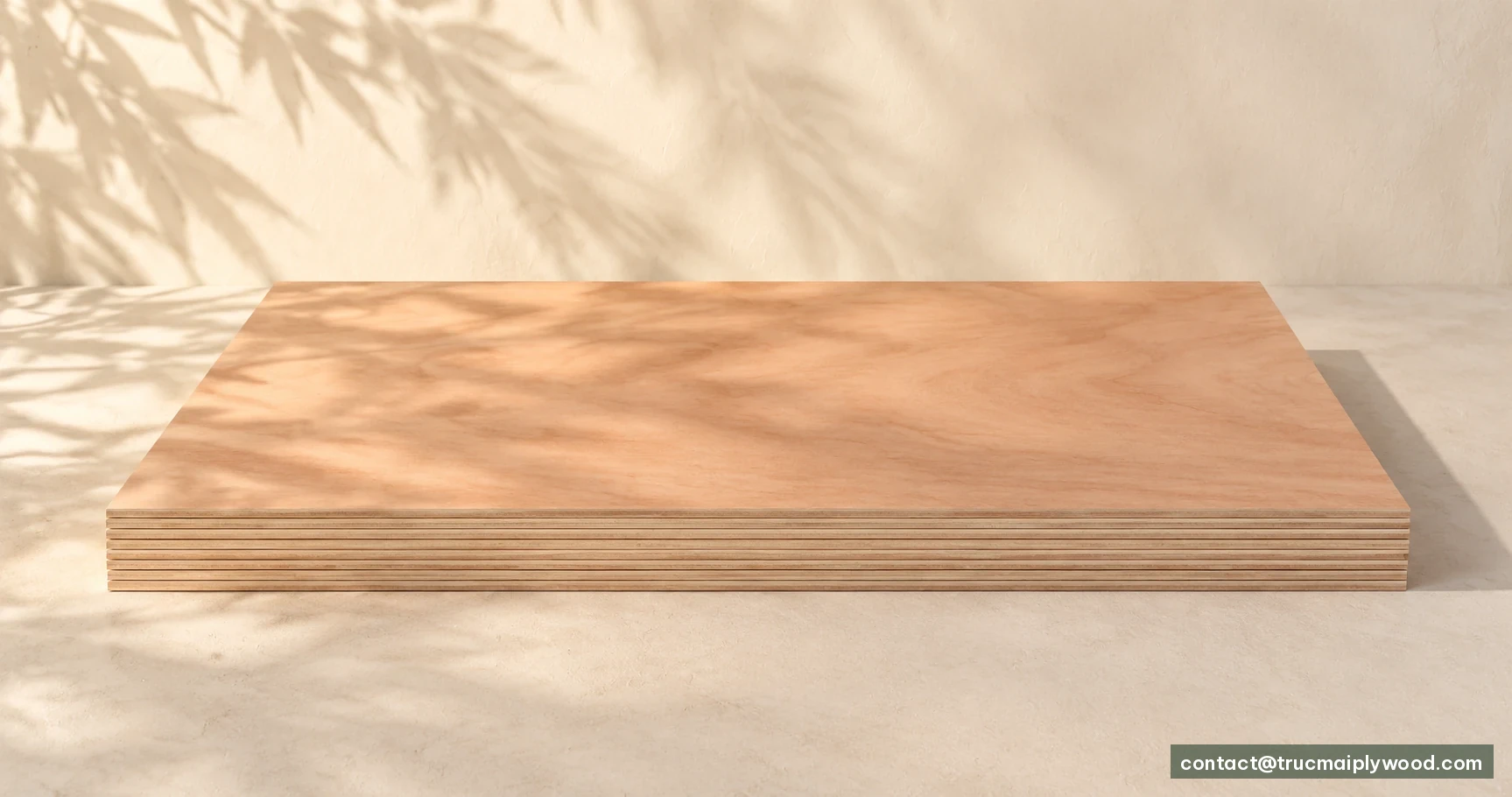
Door skin plywood is a thin hardwood plywood panel, usually 3 or 4 mm thick, glued to both sides of a door frame or core to make a flush door. The skin carries the visible face; the frame inside carries hinges, lock and stiffness. Truc Mai door skins are 5-ply, faced in okoume or bintangor.
A flush door is a sandwich. In the middle sits a frame of stiles and rails, often with a light core between them. On each side sits one skin. The skin has to be flat, so the door does not show waves under paint; thin, so the door is not heavy; and even in colour from sheet to sheet, so a corridor of doors looks like one order.
That makes the door skin one of the most exacting thin panels a mill makes. It is mostly face, and a fault that a thick panel would hide inside its plies shows straight through a 3 mm sheet. This guide covers the two thicknesses, the builds behind them, the two faces, the grades, sheet sizes and how many skins fit in a 40HC.
Truc Mai presses door skins on its thin-panel line in Ha Hoa, Phu Tho. The thin panels from 3 to 6 mm page covers the wider thin range.
Door skin plywood at 3 mm and 4 mm
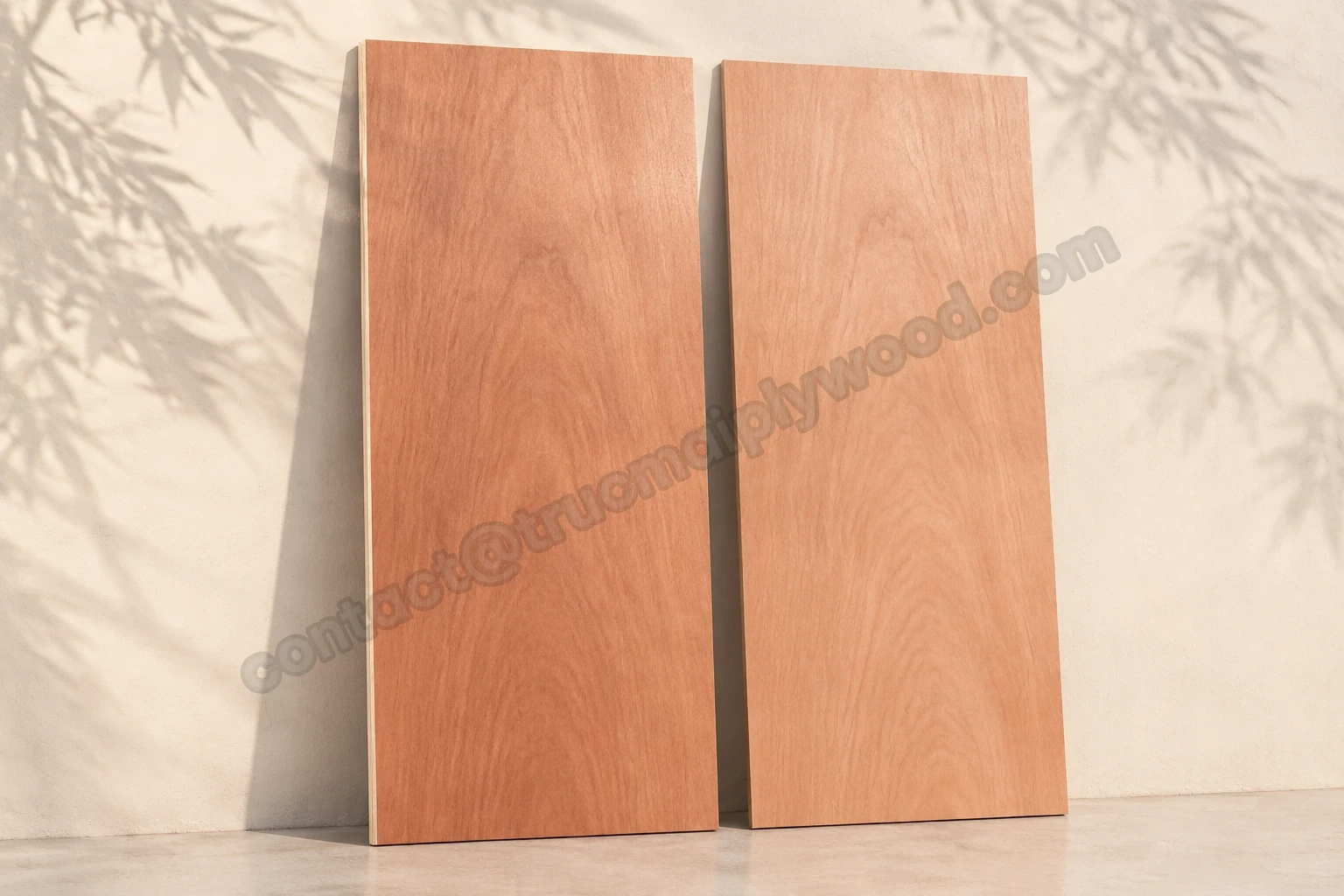
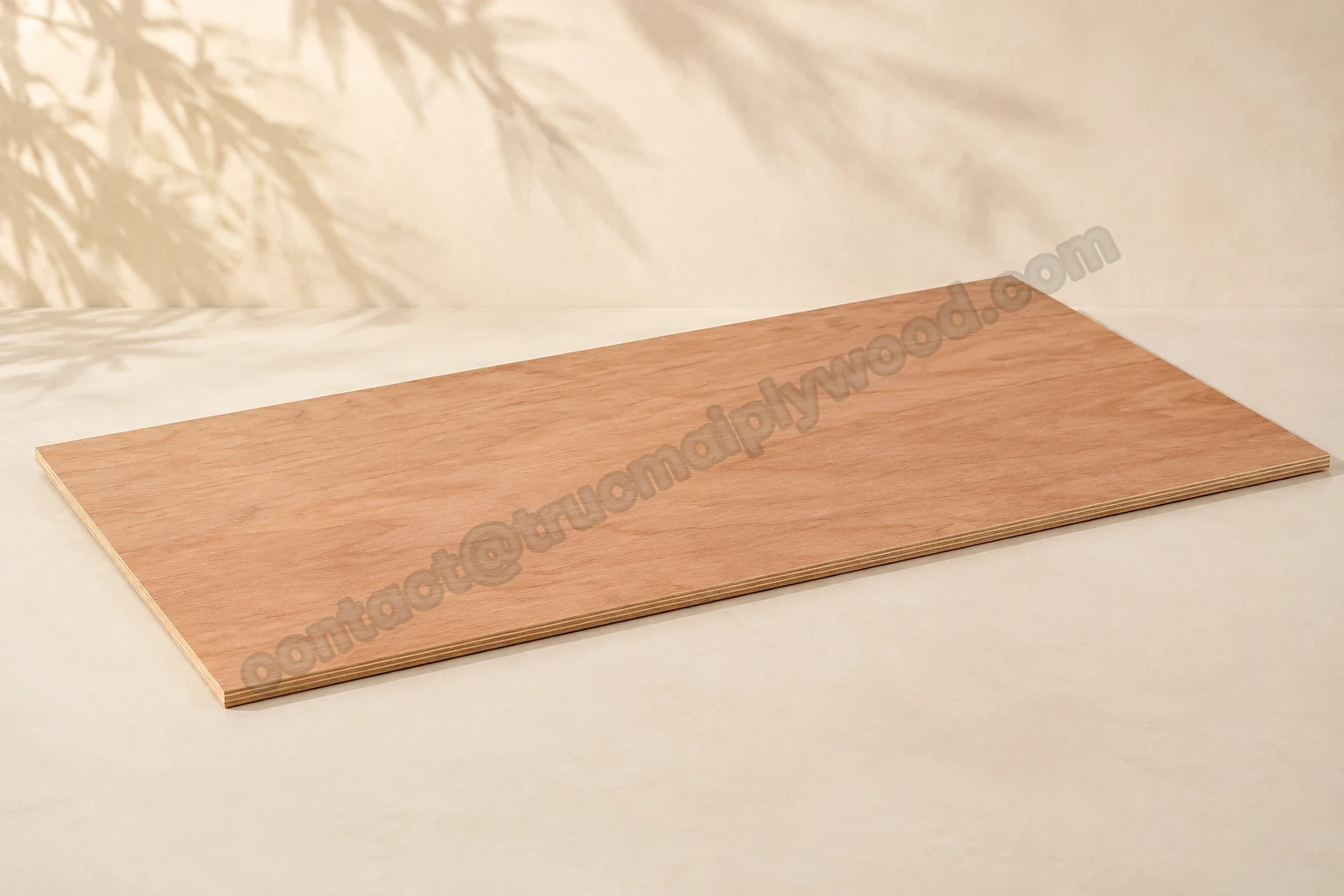
Door skin plywood is ordered at 3 mm or 4 mm. The 3 mm skin is the lighter, cheaper sheet for standard interior doors; the 4 mm skin is stiffer between frame members and takes more sanding at the door factory. Both are 5-ply builds with a hardwood face on each side.
| Line | 3 mm skin | 4 mm skin |
|---|---|---|
| Plies | 5 plies | 5 plies |
| Build | One core ply, two cross-bands, two faces | Three core plies, two faces |
| Core veneer | Core ply of the mill’s core species | 1.3 mm core veneer |
| Lead time | Standard | Can take longer: thin veneer is scarce |
| Weight per 1220 × 2440 mm sheet, Styrax core | 4.5 kg | 6.0 kg |
Weights are planning figures from the packing model, not weighed sheets.
The choice between them is a door-factory decision. A frame with closely spaced rails and a full core supports a 3 mm skin well. A frame with wide gaps, or a door that will be sanded hard before paint, is safer with 4 mm. Truc Mai presses nothing thinner than 3 mm.
How many plies does a 3 mm or 4 mm door skin have?
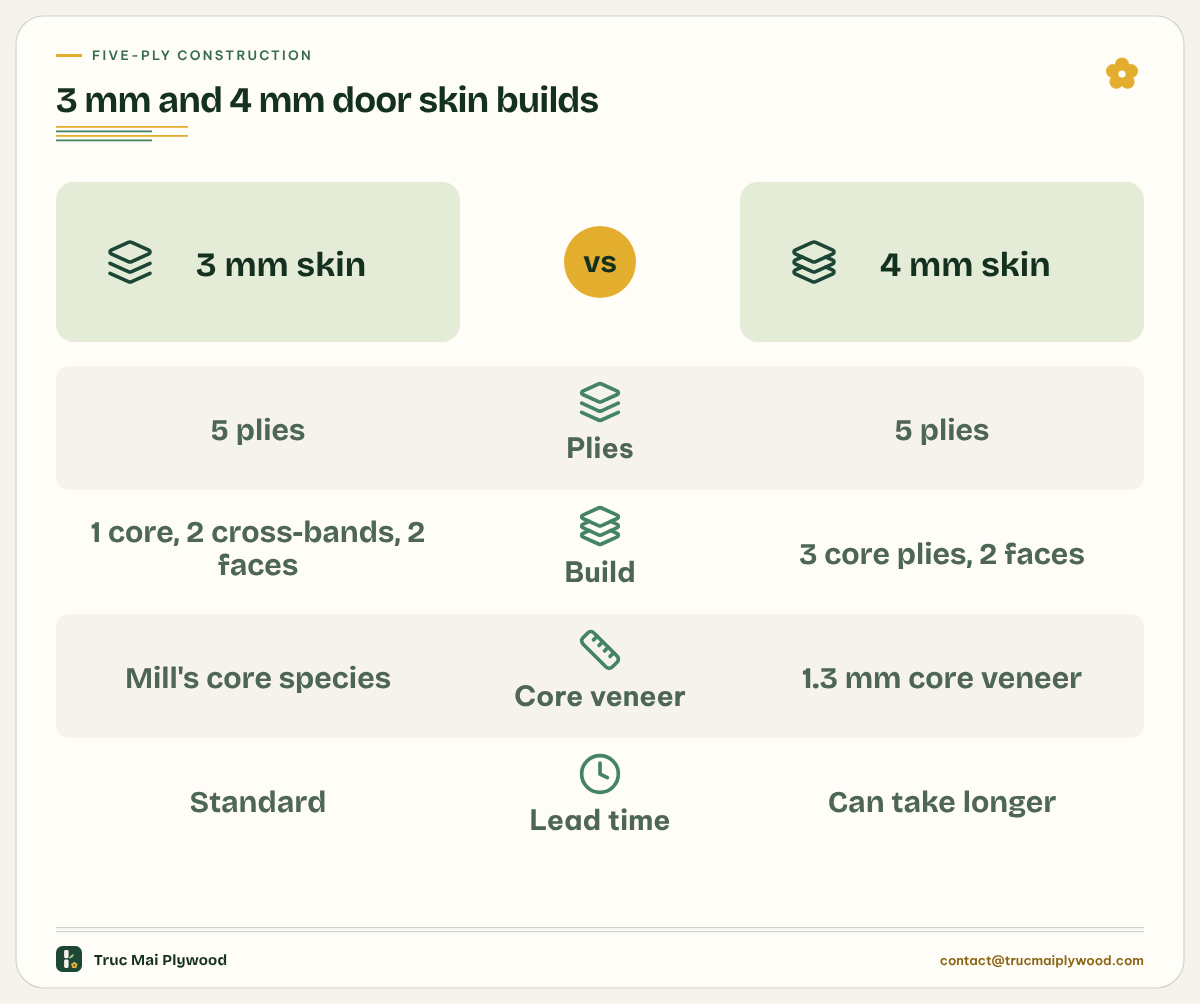
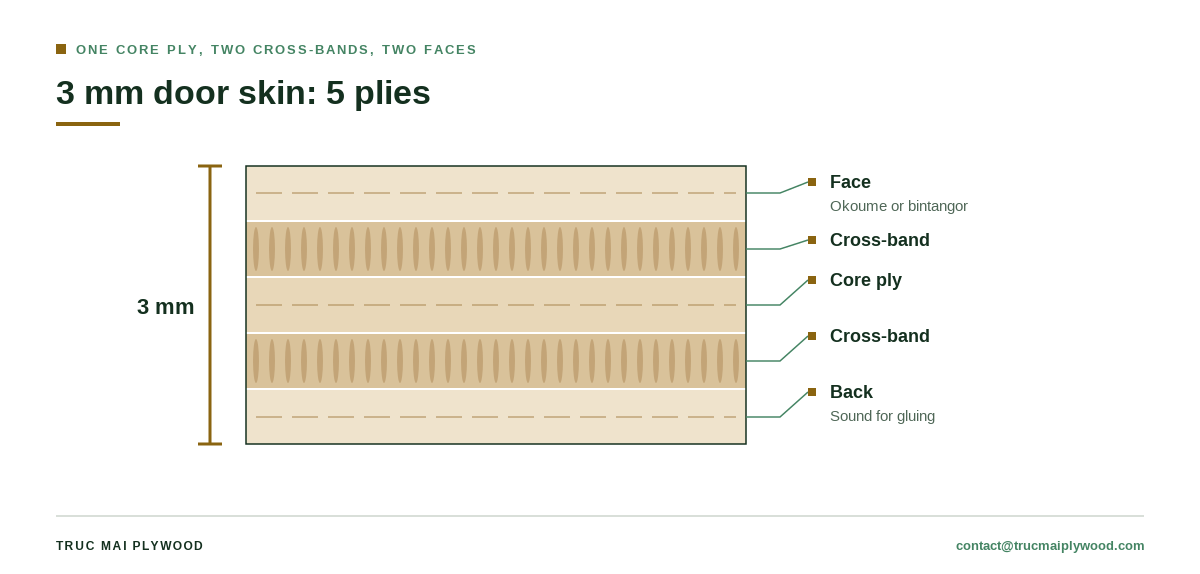
Both have 5 plies. A 3 mm door skin is one core ply, two cross-bands and two faces. A 4 mm door skin is three core plies and two faces. At Truc Mai thin panels from 3 to 5 mm are always 5 plies, so a door factory gets the same layer count whichever of the two it orders.
The difference is inside. In the 3 mm build the cross-bands, laid at right angles to the core ply, give the sheet its stability in both directions. In the 4 mm build three core plies sit between the faces, laid crosswise in turn. Either way the sheet is balanced: the same number of layers each side of the centre, which is what keeps a thin panel flat.
Face veneer at the mill runs 0.2–0.5 mm, usually 0.3 mm for Europe. On a 3 mm skin the face is a large share of the sheet, which is why face quality decides door skin quality more than on any other panel.
Why can 4 mm door skins take longer to produce?
4 mm door skins can take longer because they use 1.3 mm core veneer, and good thin veneer is scarce. Thicker panels use core veneer that is usually 1.4–2.0 mm, which is easier to peel and dry in volume. Collecting enough sound 1.3 mm veneer for a full container can add days to a 4 mm order.
The production window on the standard terms is 15–45 days after the 30% deposit, depending on quantity, production conditions and agreement. A 4 mm door skin container tends to sit later in that window than an 18 mm load of the same m³.
Two things help. A door factory that orders 4 mm skins every month gives the mill a steady call on thin veneer, which shortens the wait. And a buyer who can accept 3 mm for part of the range can split the container: the 3 mm skins load first while the 4 mm core is gathered.
Which face suits a door factory better, okoume or bintangor?
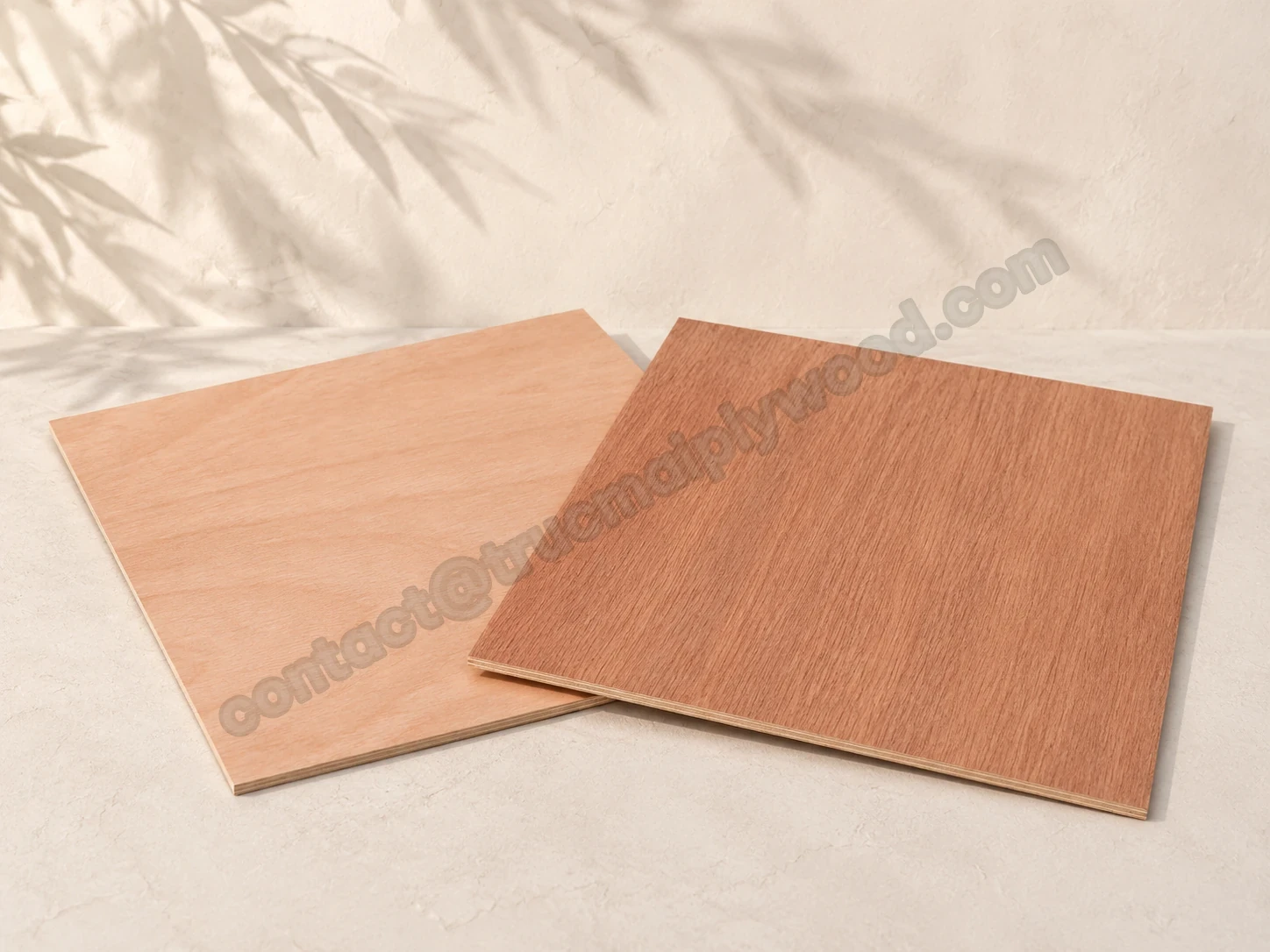
Okoume suits a door factory that wants a pale, pinkish-beige face with a soft figure, for light stains and clear finishes. Bintangor suits a factory that wants a light reddish-brown face with a straighter, interlocked grain, for warmer stains. For painted doors either face works; choose on surface and supply, not colour.
Okoume door skin
Okoume is a light hardwood face with a soft ribbon figure and an even pinkish-beige colour. It sands smoothly and takes paint and stain well. On a corridor of doors it reads as one calm colour, which is why many door factories standardise on it. The okoume-faced plywood page covers the face in more detail.
Bintangor door skin plywood
Bintangor is a light reddish-brown face with a finer, straighter interlocked grain. It looks warmer under a clear finish and shows a more pronounced figure. It suits doors that will be stained to a mid tone. The bintangor-faced plywood page sets out the face.
| Feature | Okoume | Bintangor |
|---|---|---|
| Colour | Pale pinkish-beige | Light reddish-brown |
| Figure | Soft ribbon figure | Straighter interlocked grain |
| Best finish | Paint, light stain, clear | Mid-tone stain, clear |
| Batch match | Order one face batch per run | Order one face batch per run |
Both are faces only. Okoume and bintangor do not form the core of a Vietnamese panel; the core is Eucalyptus, Acacia, Styrax or combined species.
Face and back grades for door skins
Door skin grades are quoted as a face and back pair and agreed against an approved sample. On a skin, the back is glued to the door frame and never seen, so it can take a lower grade than the face; the face is graded for what the door factory’s finish will show, with paint grades accepting more than clear-finish grades.
The sample is the reference. A door factory sends or approves a sample skin, and the order names it: face grade, back grade, colour range. That is how a skin batch in month six matches month one. The face grading line sorts face veneer before pressing.
| Finish at the door factory | Face grade asks for | Back |
|---|---|---|
| Paint | Sound, smooth face; small repairs acceptable | Sound, for gluing |
| Stain | Even colour, few repairs | Sound, for gluing |
| Clear lacquer | Best colour match, clean figure | Sound, for gluing |
Ask for the back to be “sound for gluing”: no open splits or loose patches that would let the adhesive through or leave a void under the face.
Thickness tolerance and flatness for a door press
A door press needs skins of one thickness and a flat, sanded face. Truc Mai writes the thickness tolerance per order at ±0.3–0.5 mm, with ±0.3 mm on sanded and calibrated panels. Length and width are held to ±2 mm. Never assume a tighter figure: the order states the tolerance that applies.
Thickness consistency matters on a door line more than the absolute figure. A press that glues two skins to a frame sees the total thickness of the door; skins that vary make doors that vary, and the doors then catch on hinges or frames. A calibrated skin gives a door that fits its frame without planing.
Flatness comes from balance and storage. A balanced 5-ply build stays flat as long as it is stored flat and dry. Skins should arrive in tight packs, be kept flat on battens at the door factory, and be acclimatised before pressing.
What sheet sizes can door skins be ordered in?
Door skins can be ordered in 1220 × 2440 mm (4 × 8 ft), 1220 × 2280 mm and 1250 × 2500 mm, with custom sizes up to 1250 × 2500 mm and nothing larger. Cut-to-size orders split one sheet into 2, 3, 4 or 6 panels before packing, so a door factory can receive skins sized to its door leaf.
| Sheet | Typical use for skins |
|---|---|
| 1220 × 2440 mm | Standard sheet; skins cut at the door factory |
| 1220 × 2280 mm | Shorter sheet; less offcut on shorter doors |
| 1250 × 2500 mm | European format |
| Cut to size | Sheets split into 2, 3, 4 or 6 panels at the mill |
Cutting at the mill moves the offcut to the mill, which suits factories that buy by the container and run doors of a few standard sizes. The panels cut at the mill page covers the cut-to-size line.
How many 3 mm door skins fit in one 40HC?
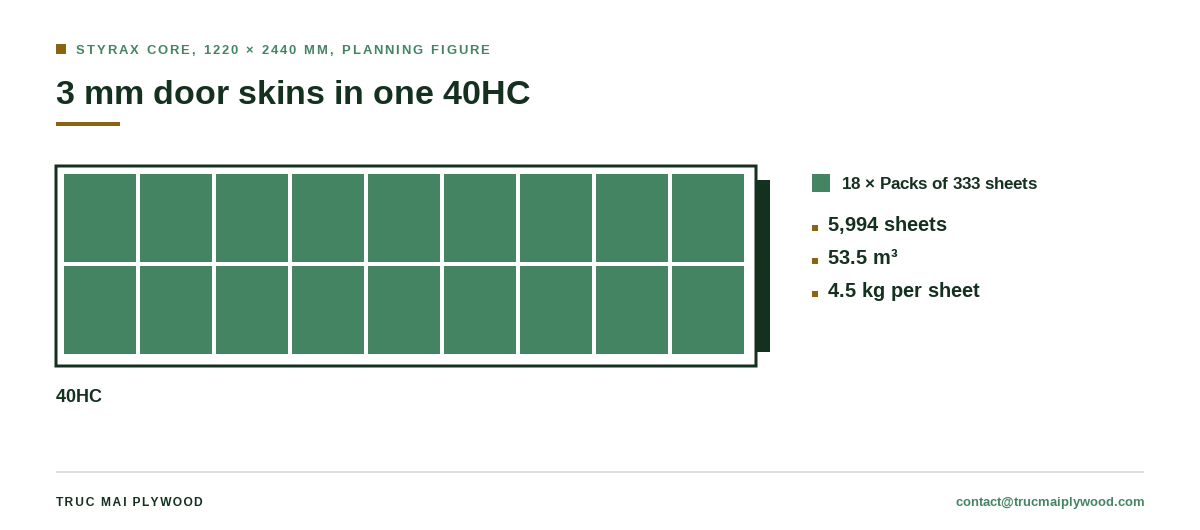
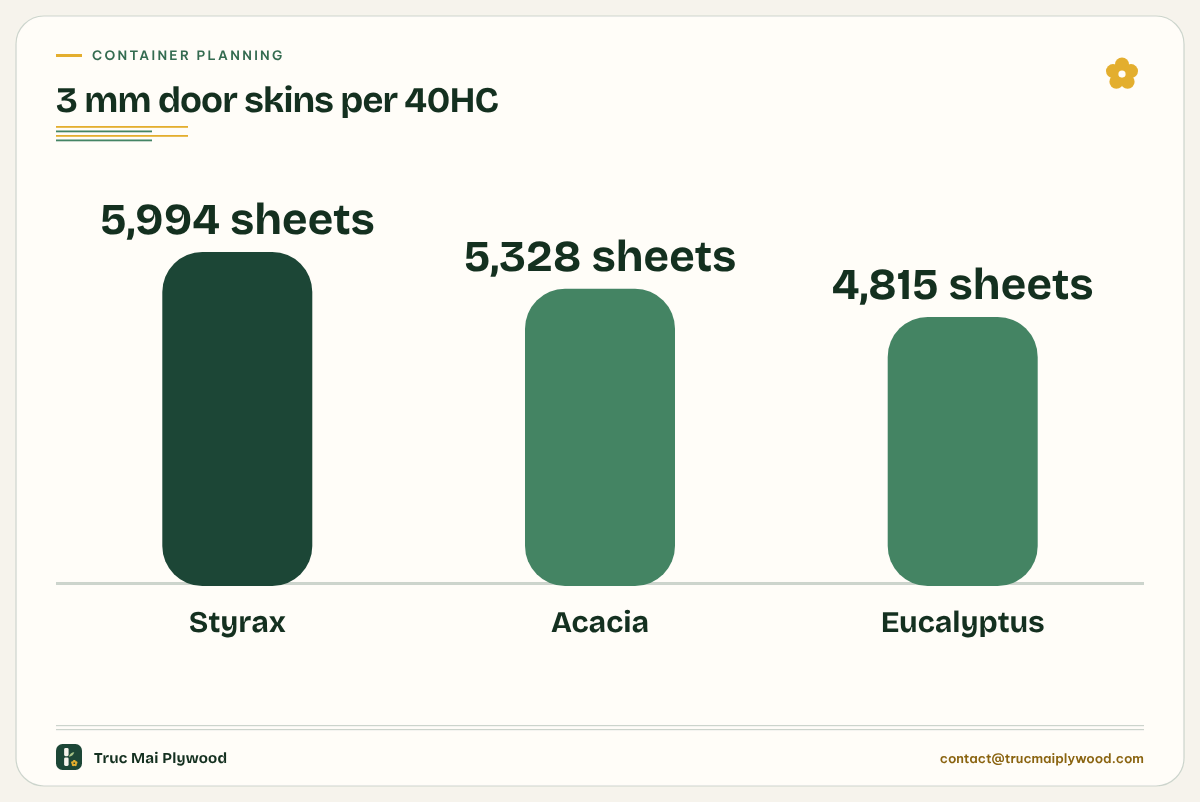
On a Styrax core, a 40HC holds 5,994 door skins of 1220 × 2440 × 3 mm as a planning figure: 18 packs of 333 sheets, about 53.5 m³. On Acacia the figure is 5,328 sheets in 16 packs, about 47.6 m³; on Eucalyptus 4,815 sheets in 15 packs, where the weight caps the load. These are computed loads, not packing lists.
| Core, 1220 × 2440 mm | 3 mm skins per 40HC | 4 mm skins per 40HC |
|---|---|---|
| Styrax | 5,994 sheets (18 × 333 sheets), 53.5 m³ | 4,500 sheets (18 × 250 sheets), 53.6 m³ |
| Acacia | 5,328 sheets (16 × 333 sheets), 47.6 m³ | 4,000 sheets (16 × 250 sheets), 47.6 m³ |
| Eucalyptus | 4,815 sheets (15 × 321 sheets), 43.0 m³ | 3,615 sheets (15 × 241 sheets), 43.0 m³ |
Planning figures from the 40HC planning model: packs about 1,000 mm high, a 28,000 kg planning payload, Eucalyptus rows capped by weight. Weigh real sheets before final loading. Any other build can be run on the container load calculator.
For a door factory the sheet count is the useful number: two skins per door means a 3 mm Styrax load is about 2,997 door leaves’ worth of skins, before offcuts.
How many door skins go in one pack?
In the planning model, a pack is about 1,000 mm high, so it holds 333 sheets at 3 mm and 250 sheets at 4 mm: 1,000 divided by the thickness, rounded down, then capped by weight. On a Eucalyptus core the weight cap brings the pack down to 321 sheets at 3 mm and 241 at 4 mm.
| Thickness | Styrax or Acacia, sheets per pack | Eucalyptus, sheets per pack |
|---|---|---|
| 3 mm | 333 sheets | 321 sheets |
| 4 mm | 250 sheets | 241 sheets |
A tall pack of thin sheets is heavy on its base. Overfilling packs can break pallet feet, which is why the model caps by weight as well as height. Thin skins also need edge protection: a dented corner on a 3 mm sheet is a skin lost. The loading guide shows how packs are placed.
Glue, emission and certificates for door skins
Door skins are bonded with UF glue at E0 emission by default, the interior glue line. For the US, both the 3 mm and the 4 mm skin sit inside certificate CARB/EPA 26053, Truc Mai’s CARB P2 and TSCA Title VI scope. EU lots carry the EUDR file set.
United States. A door skin is a thin veneer-core hardwood plywood, and 40 CFR 770.10 holds that product to 0.05 ppm formaldehyde. The federal definitions in 40 CFR 770.3 describe hardwood plywood as a hardwood or decorative panel that is intended for interior use, which is where door skins sit. The certificate was issued by ICTT Corporation, mill ICTT-26053, for 3–15 plies.
European Union. A door is a wood-based article, so Regulation (EU) 2023/1464 applies to it: 0.062 mg/m³ of formaldehyde in the chamber, from 6 August 2026. The skins travel with EUDR plot data for the okoume or bintangor face and for the core.
FSC. Skins can carry FSC 100% when the build is on the current schedule (licence code FSC-C196493, certificate SA-COC-014545); ask at enquiry whether your face species is.
A door maker that prints the label on its own product is passing on the promise on the FSC label page: “All materials used come from responsibly managed, FSC-certified forests”.
Door skins in inches: 1/8 inch against 3 mm
A US door skin called “1/8 inch” is about 3.2 mm, and a 3 mm skin is a little thinner. The inch is fixed at 25.4 mm, so 1/8 inch is 3.175 mm. A door line set for 1/8-inch skins should check the press settings and the total door thickness before switching to 3 mm skins.
The conversion is set in law: the UK Weights and Measures Act 1985, Schedule 1 fixes the yard at 0.9144 metre and the inch at 1/36 yard. Two 3 mm skins make a door about 0.35 mm thinner than two 1/8-inch skins on the same frame.
Write thicknesses in millimetres on the order, with the tolerance. The mm to inch converter gives the other equivalents.
Door skins and LVL door stock in one container
A door factory can take door skins and LVL door and frame stock in one container: a container usually carries one or two products, and three to six can be mixed by agreement. Skins face the door; LVL stiles, jambs and moulding blanks build the frame. One booking, one document set.
Non-structural LVL is pressed on the same veneer lines as the plywood, from Eucalyptus, Acacia, Styrax or Pine veneer laid with the grain parallel, and cut to the length and section on the drawing. For door stock that is profiled, an even, hard species such as Eucalyptus is the usual choice. The LVL door and frame stock page covers the parts, and LVL sizes explains how sections are specified.
In the container, the dense LVL bundles sit low, and the skin packs go above or beside them. Truc Mai LVL is non-structural; the mill does not make structural, film-faced, formwork or marine products.
How to write a door skin order
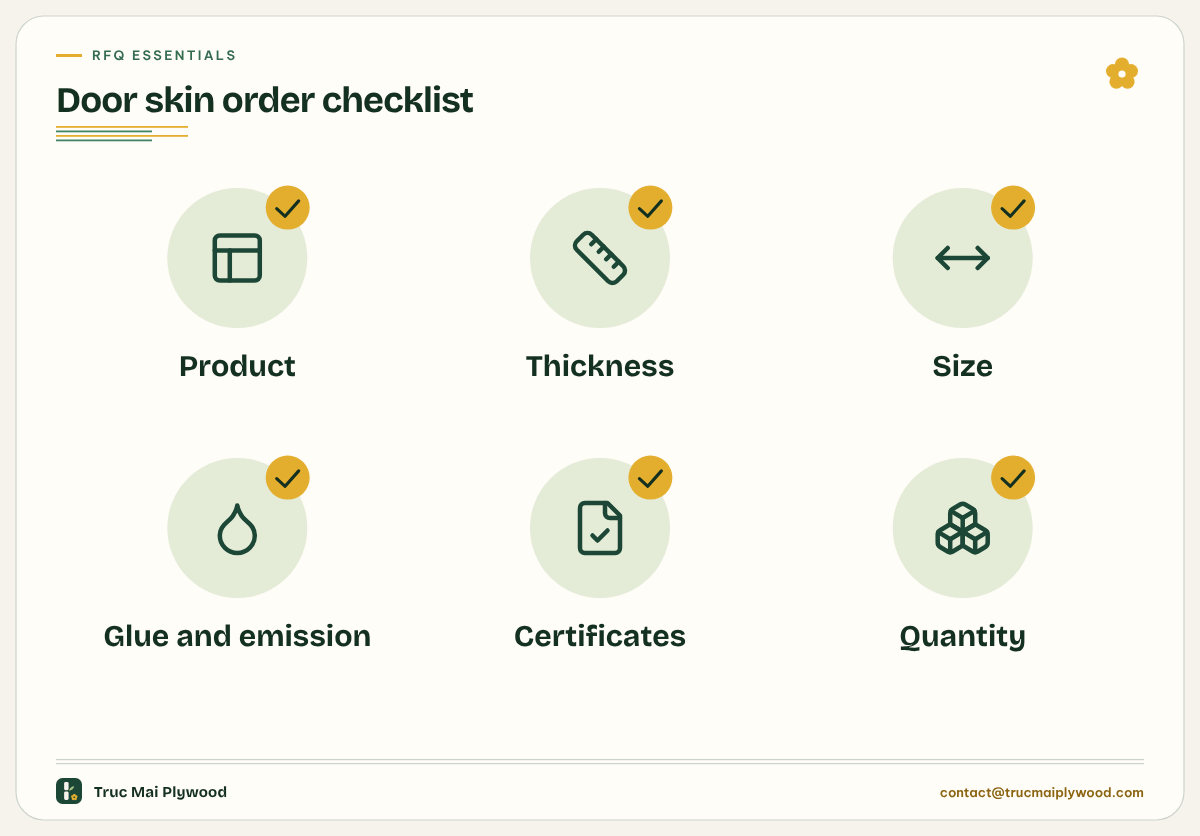
Write a door skin order on one line per product: face species and grade pair, back grade, thickness and tolerance, sheet size or cut size, core species, glue and emission, packs and quantity. Add the approved sample reference. The mill quotes from those lines and repeats them on every container.
| Line | Example |
|---|---|
| Product | Door skin, 5 plies |
| Face / back | Okoume, face graded to approved sample; back sound for gluing |
| Thickness | 3 mm, tolerance written on the order |
| Size | 1220 × 2440 mm, or cut to door leaf size |
| Core | Styrax |
| Glue and emission | UF glue at E0 emission |
| Certificates | CARB P2 / TSCA for US lots; EUDR file set for EU lots |
| Quantity | 1 × 40HC, FOB Hai Phong |
Payment is a 30% deposit and the 70% balance against the scanned bill of lading, by T/T or irrevocable L/C at sight. Start with samples: new buyers receive free samples of both faces and book their own courier, credited against a real order; see ordering samples. Then send the line to the quotation desk or to contact@trucmaiplywood.com.
Questions buyers ask
What thickness are plywood door skins?
Usually 3 or 4 mm for flush doors. Truc Mai presses thin panels from 3 mm, and nothing thinner than 3 mm.
How many plies does a 3 mm door skin have?
Five: one core ply, two cross-bands and two faces. A 4 mm skin is also five plies, with three core plies and two faces.
Why do 4 mm door skins sometimes take longer?
A 4 mm panel uses 1.3 mm core veneer, and good thin veneer is scarce, so the core can take longer to collect than for thicker panels.
Okoume or bintangor: which face suits painted doors?
Both take paint; okoume is paler and pinkish-beige with a soft figure, bintangor is light reddish-brown with a straighter, interlocked grain. Choose the face for the stain or clear finish if the grain will show.
How many 3 mm door skins fit in one 40HC?
On a Styrax core the planning figure is 5,994 sheets of 1220 × 2440 mm, in 18 packs of 333, about 53.5 m³. On Acacia it is 5,328 sheets.
How many 4 mm door skins fit in one 40HC?
On a Styrax core the planning figure is 4,500 sheets of 1220 × 2440 mm, in 18 packs of 250, about 53.6 m³.
What sizes can door skins be ordered in?
1220 × 2440 mm, 1220 × 2280 mm and 1250 × 2500 mm, with custom sizes up to 1250 × 2500 mm. Cut-to-size orders split one sheet into 2, 3, 4 or 6 panels.
Are Truc Mai door skins CARB P2 certified?
Yes, within scope: certificate CARB/EPA 26053 covers hardwood plywood with a veneer core from 3 to 25 mm, which includes 3 and 4 mm skins.
How is the face grade of a door skin agreed?
Against an approved sample. Face and back grades are quoted as a pair and written on the order.
What is the minimum order for door skins?
One 40HC. Door skins can share the container with other products, three to six by agreement.
Can door skins and LVL door stock ride in one container?
Yes. A container usually carries one or two products, so a door factory can take thin skins and LVL stiles and frame stock together.