
LVL sizes from a plywood mill are not a fixed chart: non-structural LVL is pressed as a billet and ripped to the length and section on your drawing. Order from a builder's beam chart instead and the parts arrive in the wrong section, or as a structural product the mill does not make.
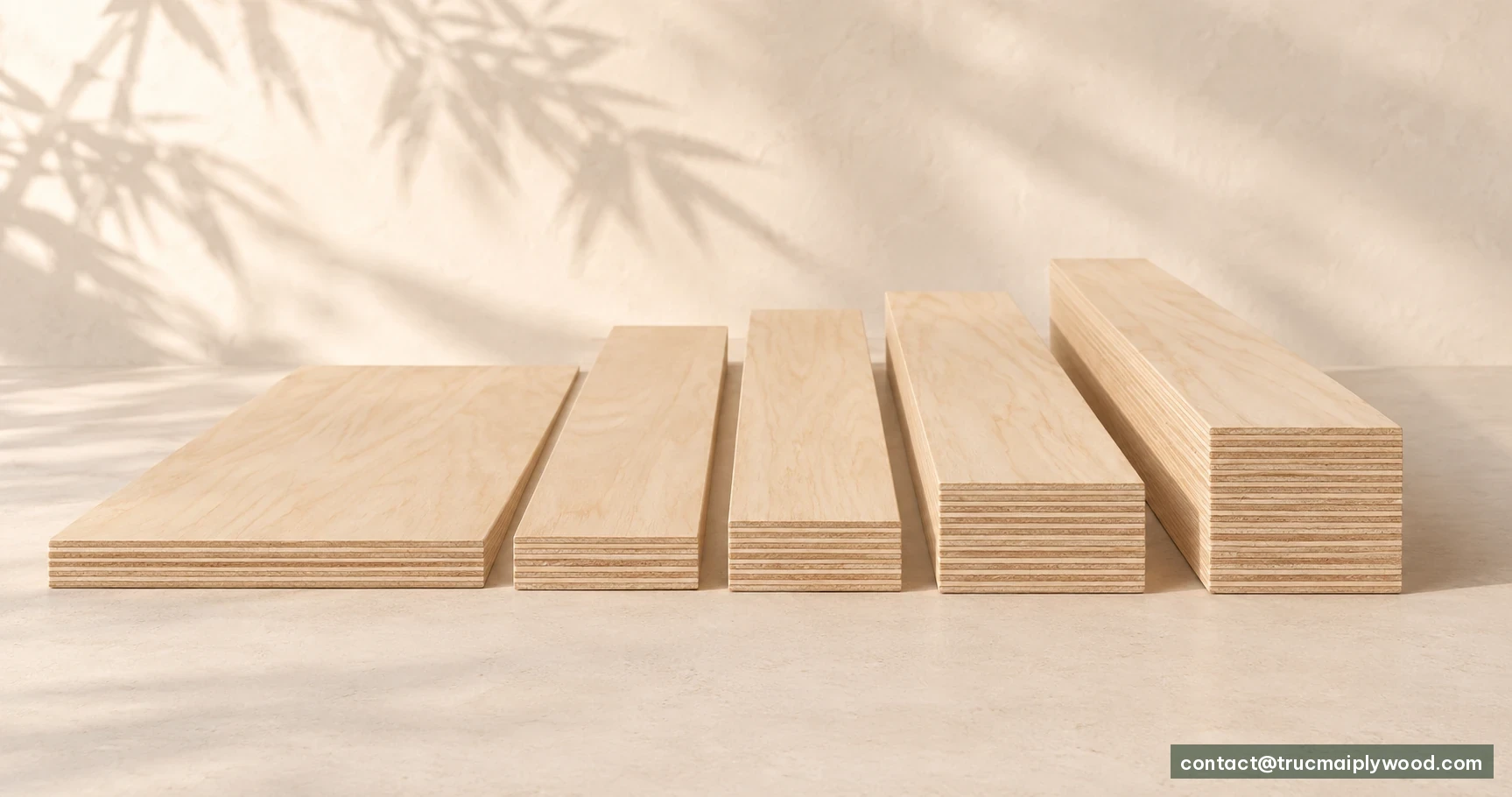
What are standard LVL sizes?
Standard LVL sizes are a building-trade idea: structural producers publish fixed beam depths and lengths for framing. Non-structural LVL from a plywood mill has no fixed chart. Truc Mai presses LVL as a billet from parallel veneer and rips and cuts it to the length, width and thickness on the buyer’s drawing for each part.
That difference decides how a buyer should order. A builder chooses a section from a span table and buys it off a list. A furniture, door or packing factory starts from a part: a sofa rail, a door stile, a bed slat, a pallet runner. The part has a finished size, and the LVL is cut to that size before it is packed, so nothing is ripped again at the factory.
So the useful “size chart” for non-structural LVL is not a list of sections. It is the list of dimensions and lines a drawing must fix, by part, so the mill can quote and the next container matches the first. The sections below set that out, with what the mill controls and what the buyer writes.
Truc Mai presses LVL on the same veneer and press lines as its plywood, which run around 60,000 m³ of plywood a year. LVL is made on request; no LVL export history is claimed. The product itself is described on the LVL page.
LVL sizes chart: the dimensions a drawing fixes, by part
An LVL sizes chart for non-structural parts is a list of the dimensions each kind of part needs on its drawing: finished length, width and thickness, the face that will be seen, any curve, profile or holes, and the tolerance. The mill quotes from those lines and repeats them on every reorder.
| Part | Dimensions to state | Extra lines | Usual species |
|---|---|---|---|
| Furniture rail | Length, width, thickness | Show face, holes, rounded edges | Acacia or Styrax |
| Bed slat | Length, width, thickness | Flat or curved, bundle count | Styrax |
| Door stile or jamb blank | Length, width, thickness | Profile drawing, show faces | Eucalyptus |
| Moulding blank | Length, section | Profile drawing | Eucalyptus |
| Pallet runner or skid | Length, width, thickness | Nail pattern if any | Pine or combined |
| Crate batten | Length, section | Bundle by size | Pine or combined |
Every row is a part cut to drawing, not a stock section. That is the point: an LVL rail cut to its finished length arrives ready for the assembly line, and the offcut stays at the mill instead of in the buyer’s waste bin.
Write sizes in millimetres, one drawing per part. A drawing that mixes inches and millimetres, or gives a nominal size for one part and a finished size for another, is the most common reason a first LVL order needs a second round of questions.
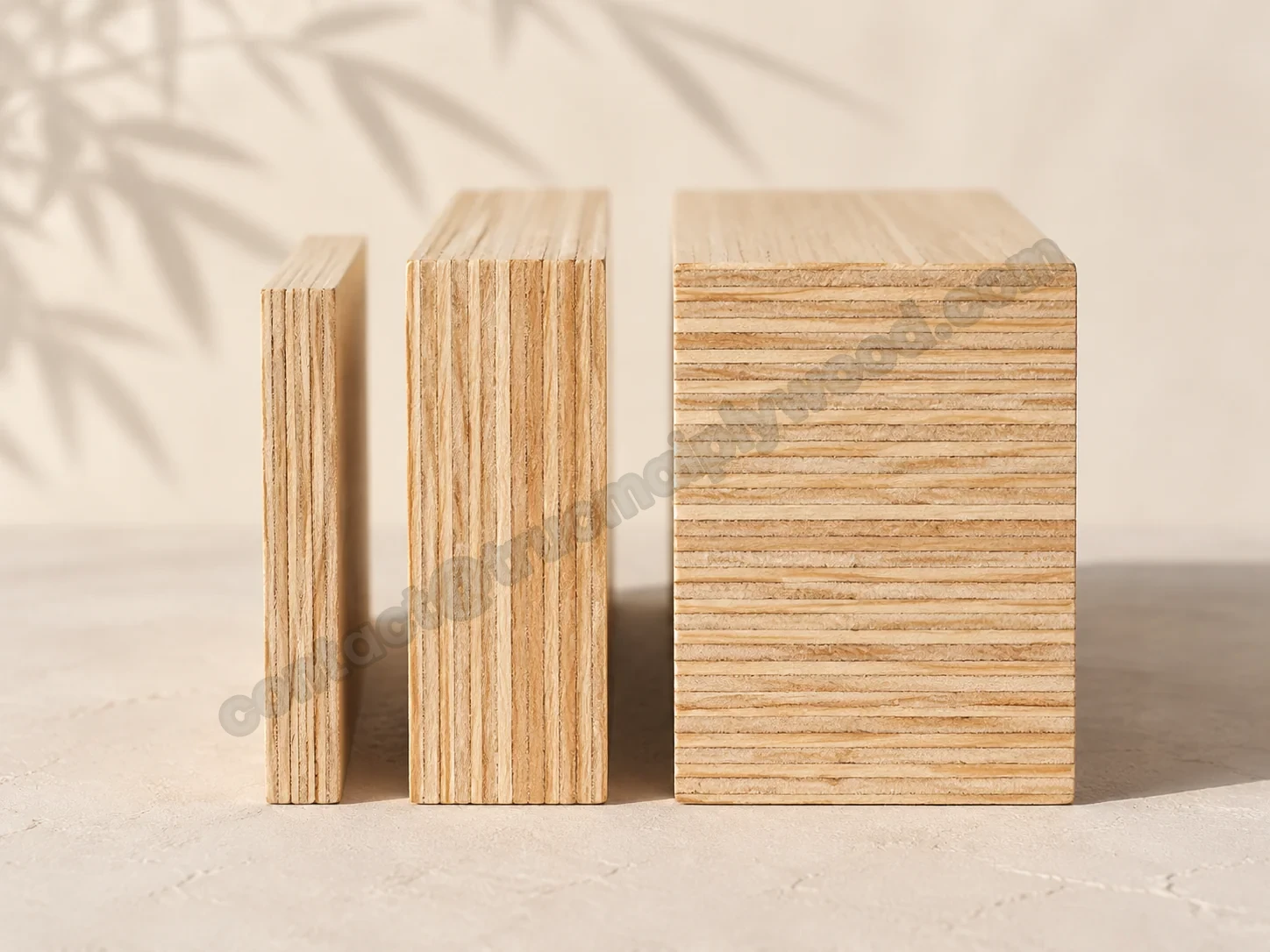
LVL thickness: how the section is built from veneer
LVL thickness is built from layers of core veneer, each usually 1.4–2.0 mm thick, glued with the grain of every layer running the same way along the length. The number of layers follows the thickness the drawing asks for; the outer layers on a show face are selected and sanded.
That build explains why LVL behaves like a long straight piece of timber rather than a flat sheet. In plywood every second layer is turned across the sheet, which makes a sheet stable in both directions. In LVL nothing is turned, so all the wood fibre runs along the part. A strip ripped from LVL is stiffer along its length than a strip of the same size ripped from plywood.
The thickness also sets which tolerance the order can carry. Furniture and door stock is sanded on its wide faces so it can be profiled, glued and finished, and its thickness tolerance is written per order at ±0.3–0.5 mm. Packing LVL is usually left unsanded, so its tolerance is written to suit the pallet line rather than the furniture line.
LVL lengths and the press
LVL lengths are set by the press. The billet comes off the same presses as the plywood, so the press decides the longest piece the mill can make in one length. State the finished length on the drawing; the quotation confirms it. Parts longer than the press are redesigned in two pieces or finger-jointed by the buyer.
Most furniture rails, slats and door parts are shorter than a full sheet, so for these orders length is a cutting question, not a pressing one. The mill rips the billet to width, cuts it to length and, where the drawing asks, rounds edges or drills holes before bundling.
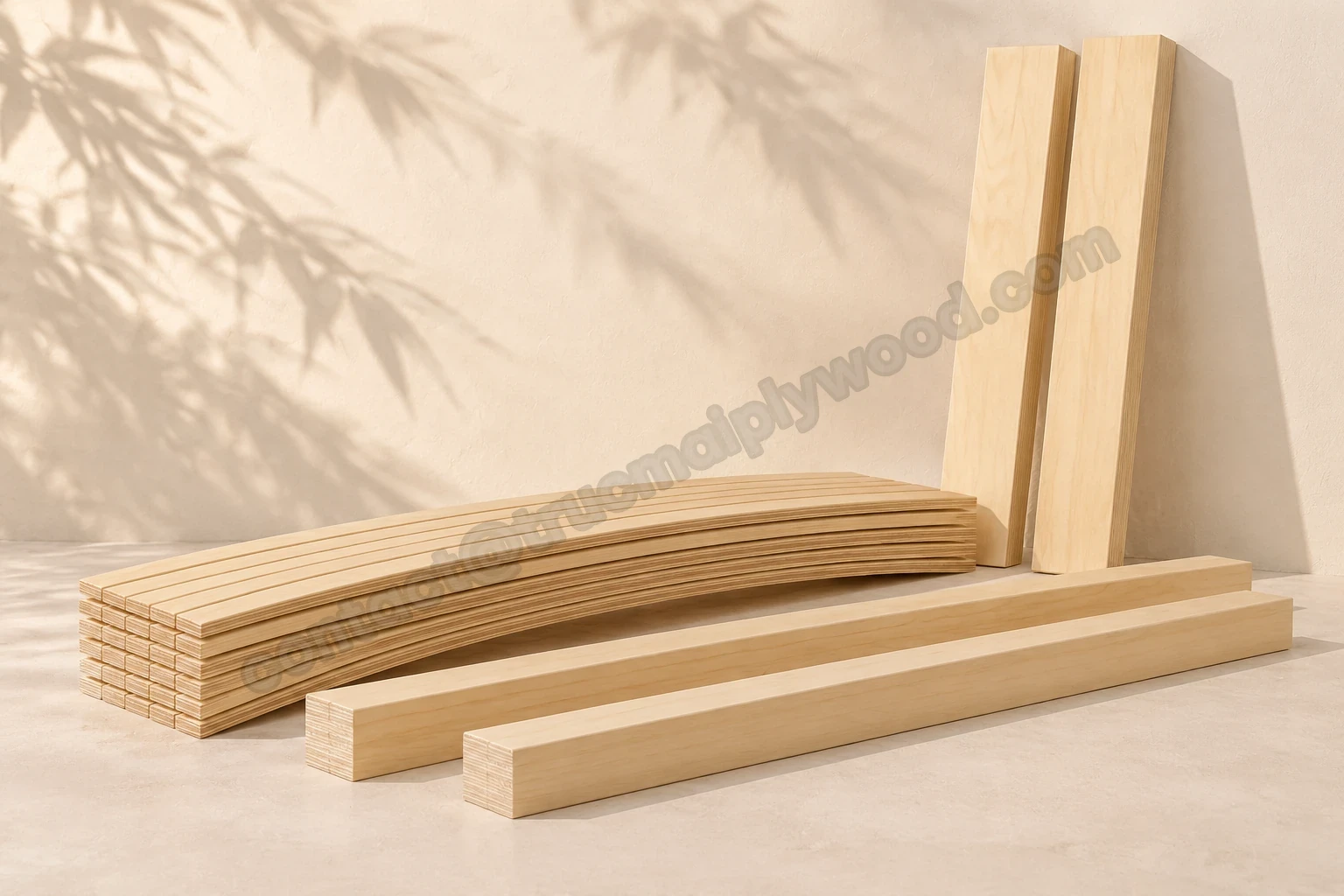
Which LVL sizes can be ordered for furniture rails and bed slats?
Furniture rails and bed slats can be ordered in the finished length, width and thickness on the drawing, cut from billets pressed for the order. Rails can be drilled or rounded; slats can be flat or gently curved. The mill confirms each size on the quotation, then repeats it on every reorder from the same drawing.
LVL for furniture: rails and frame members
Sofa and chair frames, table rails, bed frame members and drawer runners need parts that stay straight and hold screws. LVL does that well because its knots and grain faults are spread through many thin layers instead of sitting in one board. For a rail that takes screws, Acacia or a combined lay-up with harder veneers on the outside is the usual choice; for long light rails, Styrax.
LVL bed slats sizes: flat or curved
Bed slats are long, thin and many. They are pressed flat or with a gentle curve, then cut to length and bundled by count. Styrax is the light choice, with the lowest reference density of the mill’s species, 500 kg/m³ in the planning model. Write the slat length, width, thickness, curve and pieces per bundle; the LVL slats for beds page covers slats in more detail.
| Line on the drawing | Rail | Slat |
|---|---|---|
| Length, width, thickness | Finished size | Finished size |
| Shape | Straight; rounded edges on request | Flat or gently curved |
| Machining | Holes, rounded ends on request | Cut to length |
| Show face | Name it; outer veneers sanded | Usually both faces sanded |
| Bundle | Pieces per bundle | Pieces per bundle |
LVL door frame stock: sections for profiling
LVL door frame stock is sized as a blank that the door factory profiles: the drawing gives the finished profile, and the mill sizes the blank so the profile clears the outer veneers cleanly. Stiles, jambs, stops and moulding blanks are cut to length and section, sanded on the show faces, and bundled by size.
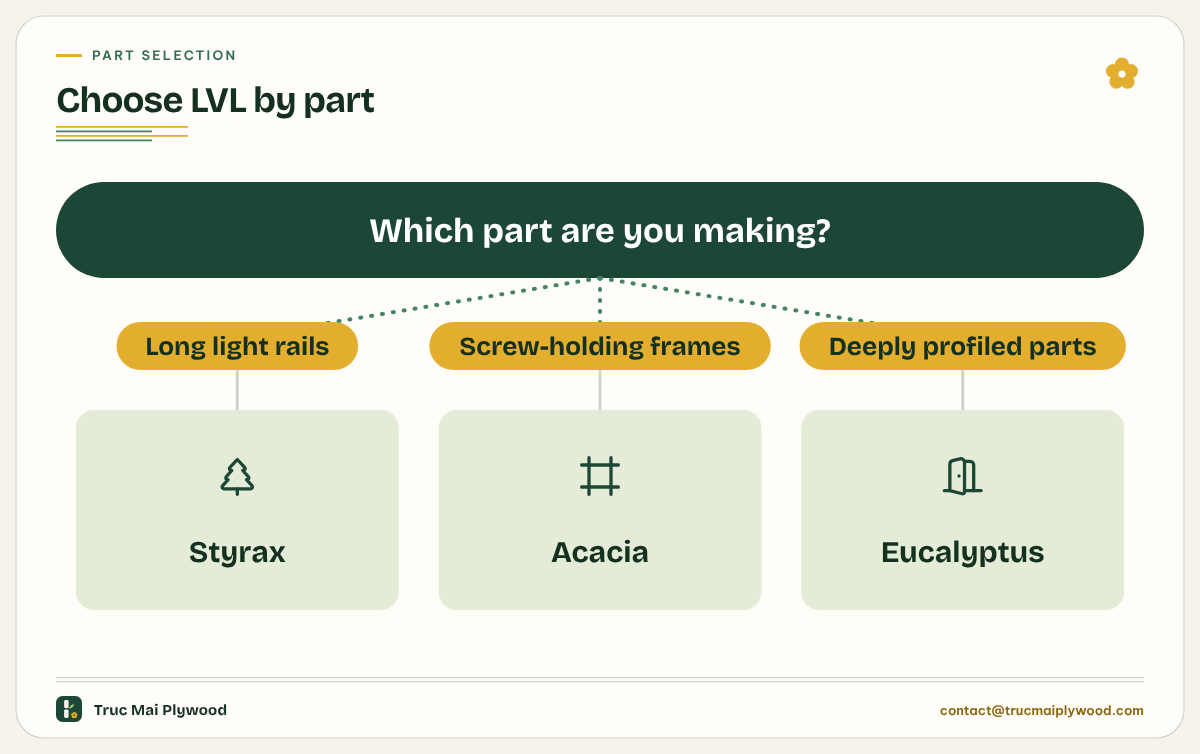
Door stock is where species matters most. Parts that are routed into deep profiles need an even, hard veneer, so Eucalyptus is the usual choice: the planning model gives it a reference density of 650 kg/m³, and it is measured at 650–750 kg/m³. Acacia suits frames that take screws but are not deeply machined.
Send the profile drawing with the part list. A jamb blank sized without the profile in view can leave a glue line exactly where the router cuts, which shows as a dark line on a finished frame. The LVL door and frame stock page covers door parts and how they pair with thin plywood skins.
LVL packing runner sizes: cut to the pallet drawing
LVL packing runner sizes follow the pallet or crate drawing: runners, battens and skids are ripped and cut to length and section, bundled by size, and left unsanded unless the drawing says otherwise. The part arrives ready for the pallet line, with no further cutting.
Packing LVL is often ordered with packing-grade panels in one container, so a crate maker receives the battens and the sheathing together. Pine is light and soft and suits packing; combined lay-ups balance weight and nail holding.
There is a regulatory reason packers like LVL. The international standard for wood packaging, ISPM 15, exempts “wood packaging made wholly of processed wood material, such as plywood, particle board, oriented strand board or veneer that has been created using glue, heat or pressure”. Solid-wood dunnage loaded with the LVL is not exempt, so it still needs its own treatment and mark.
Which core species is the LVL pressed from?
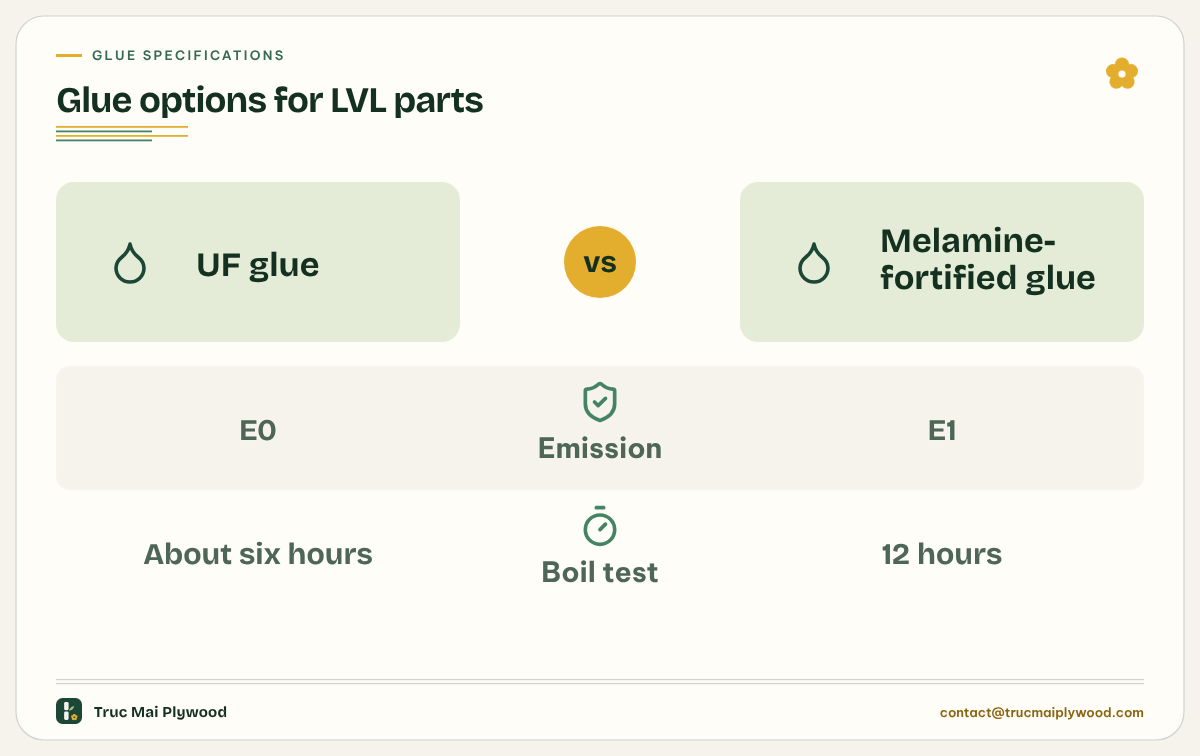
Truc Mai LVL is pressed from Eucalyptus, Acacia, Styrax or Pine veneer, or combined species laid together, the same veneers that go into the mill’s plywood cores. The default glue is UF at E0 emission; a melamine-fortified glue line can be written for parts that see damp, and emission is then usually E1.
| Species | Reference density | Suits |
|---|---|---|
| Styrax | 500 kg/m³ | Long light rails, slats |
| Acacia | 580 kg/m³ | Frame parts that take screws |
| Eucalyptus | 650 kg/m³ | Door stock, deeply machined parts |
| Pine | Light, soft | Packing parts |
The densities are the reference figures the mill uses to plan container loads. Eucalyptus is measured at 650–750 kg/m³, so a Eucalyptus part is the heaviest choice for its size. Species can be combined: harder veneers on the outside where screws go, lighter ones inside.
Glue type and emission class are two separate lines on the order. UF glue holds about six hours in a boil test; melamine-fortified glue holds 12 hours. Neither turns LVL into an outdoor product: it is made for dry interior parts, damp rooms at most, and packing.
What tolerance can be written on an LVL size?
The thickness tolerance on LVL is written per order at ±0.3–0.5 mm by line, as on the plywood: the tighter figure for sanded furniture and door stock, the looser for packing. Section and length are measured against the drawing on sample pieces from each bundle, and ripped strips are sighted along their length for bow and twist.
The checks follow what a long part shows: straightness, open layers at the cut ends and the section size. Veneers are graded so no open defect lines up through several layers, and cut ends are checked for open glue lines. The LVL checks page sets out the inspection in full.
| Check | How it is done |
|---|---|
| Thickness | Measured against the drawing, ±0.3–0.5 mm by line |
| Section and length | Sample pieces from each bundle, against the drawing |
| Straightness | Ripped strips sighted along their length |
| Cut ends | Checked for open glue lines |
The quality system behind those checks is ISO 9001:2015 certified (certificate W2012), with the scope “manufacture of plywood”. A tolerance is only useful if it is the same on the tenth container as on the first, which is why it is written on the order and not left to habit.
How is LVL packed and loaded into a 40HC?
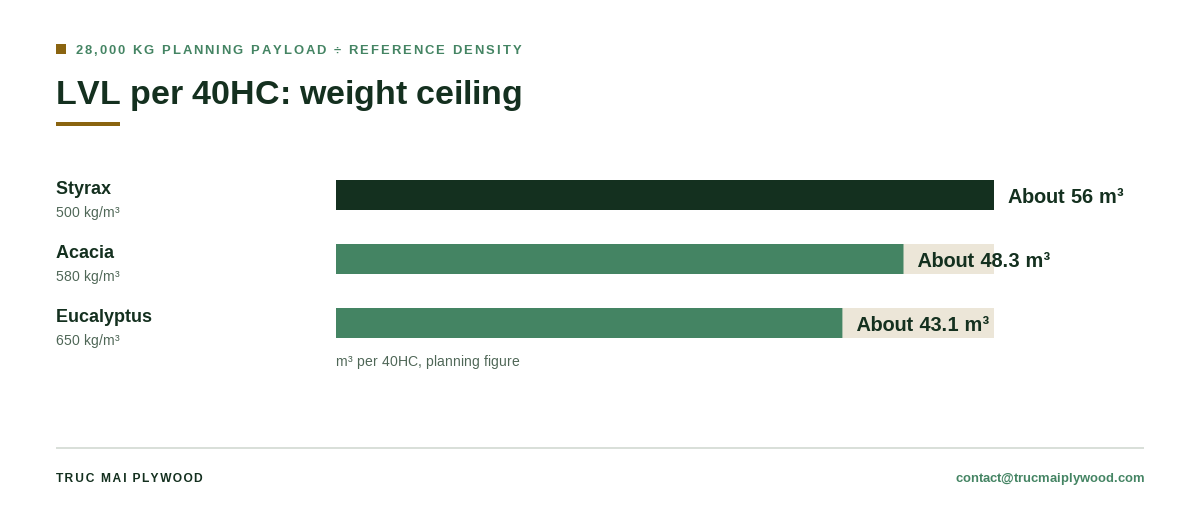
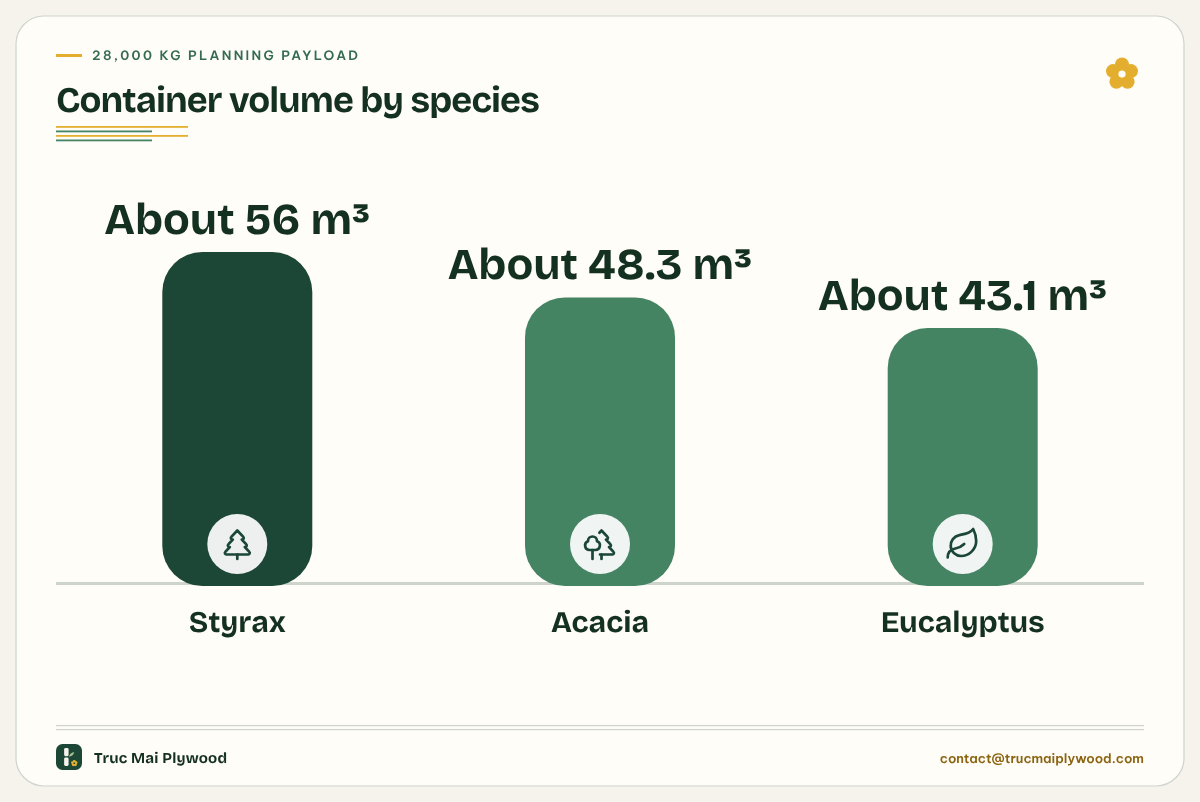
LVL is bundled by size and loaded into a 40HC on the same planning model as the plywood: a 28,000 kg planning payload, with weight checked against the species density. At reference density that payload is about 56 m³ of Styrax, 48.3 m³ of Acacia or 43.1 m³ of Eucalyptus; the real fill depends on bundle sizes and is a planning figure.
LVL bundles stack as a dense block, so they usually sit low in the container, with plywood packs above or beside them. The bundle size follows the part: long rails in a few large bundles, slats by count, door stock by section. Each bundle carries its part reference, so the factory can take it straight to the right station.
| Species | Reference density | Payload ceiling at 28,000 kg (planning figure) |
|---|---|---|
| Styrax | 500 kg/m³ | About 56 m³ |
| Acacia | 580 kg/m³ | About 48.3 m³ |
| Eucalyptus | 650 kg/m³ | About 43.1 m³ |
The ceiling is a weight limit, computed as 28,000 kg divided by the density; the space inside the container and the bundle shapes can stop the load earlier. The planning payload itself is unconfirmed, because the carrier and route decide, so the final plan is made with weighed bundles. The loading guide shows how mixed loads are placed.
Can LVL and plywood be mixed in one container?
Yes. A container usually carries one or two products, and three to six can be mixed by agreement, so LVL parts can ride with plywood panels on one booking and one set of documents. Furniture factories take carcass panels and LVL frame members together; door factories take thin skins and LVL stiles.
Mixing changes the loading plan more than the paperwork. LVL bundles are dense and are placed low; plywood packs, about 1,000 mm high, go above or beside them. The order lists each product as its own line with its own pack count, so the packing list matches what the factory unloads.
The file set is shared. The EUDR data for an EU lot carries plot geolocation for both the Vietnamese core and the face veneer, and LVL veneer from the same plots travels under the same records. The importer files its own due-diligence statement from them; the EUDR geolocation data page shows what is in the file.
What is the minimum order for LVL?
The minimum order is one 40HC, the same as for plywood, and it can be LVL alone or LVL mixed with plywood by agreement. Production runs 15–45 days after a 30% deposit, and the 70% balance is paid against the scanned bill of lading by T/T or irrevocable L/C at sight.
| Term | Standard |
|---|---|
| Minimum order | One 40HC |
| Production | 15–45 days after the 30% deposit |
| Balance | 70% against the scanned B/L, T/T or irrevocable L/C at sight |
| Delivery terms | FOB Hai Phong, CFR (CNF) or CIF |
| First order | Built from the drawing and an approved sample piece |
A first LVL order starts with a sample piece cut to the drawing. Once approved, the sample becomes the reference: species, show face, sanding and tolerance are written on the order and kept on every reorder. Samples are free; a new buyer books its own courier, and that cost can be credited against a real order.
Structural LVL sizes: why they are a different product
Structural LVL sizes, the beam depths and lengths in a builder’s span table, belong to a structurally rated product made and stamped for load-bearing building parts. Truc Mai LVL is non-structural: it is not sold for beams, joists or frames and carries no structural rating. Truc Mai also does not make film-faced, formwork or marine plywood.
The difference is not only the label. A structural LVL is designed, tested and graded so that an engineer can rely on its strength in a building. A non-structural LVL is made so a furniture rail stays straight, a door blank profiles cleanly and a pallet runner nails well. Both are veneer glued with the grain parallel; what they promise is different.
For buyers this has a practical side. A size copied from a structural chart, for a part that will sit inside a sofa, leads to a section that is far larger than the part needs. Start from the part drawing instead.
LVL dimensions in inches and millimetres
LVL dimensions should go on the drawing in millimetres, because the mill cuts and measures in millimetres. Where a design is in inches, convert the finished sizes before sending it, and round only once.
The conversion is fixed in law: the UK Weights and Measures Act 1985, Schedule 1 sets the yard at 0.9144 metre and the inch at 1/36 yard. A drawing that rounds each conversion separately can lose a millimetre over a long rail; one that converts the finished sizes keeps the parts true.
The same goes for plywood ordered with the LVL. Sheet sizes are 1220 × 2440 mm (4 × 8 ft), 1220 × 2280 mm and 1250 × 2500 mm; the mm to inch converter gives the equivalents.
US and EU formaldehyde lines for LVL parts
LVL parts carry the same glue and emission lines as the plywood, UF glue at E0 emission by default, but LVL is not hardwood plywood. The federal definitions in 40 CFR 770.3 list a composite wood product as hardwood plywood made with a veneer or composite core, medium-density fiberboard and particleboard.
Truc Mai’s CARB P2 and TSCA Title VI certificate, CARB/EPA 26053 (mill ICTT-26053), covers hardwood plywood with a veneer core, 3–25 mm. It does not cover LVL, so a US buyer of LVL parts confirms at enquiry which formaldehyde rule applies to the part or the finished good it goes into.
An FSC claim follows the same rule: LVL carries an FSC 100% claim under licence code FSC-C196493 only if it is on the current product schedule, which is confirmed at enquiry.
What that claim promises is set out on the FSC label page: for FSC 100%, “All materials used come from responsibly managed, FSC-certified forests”. For packing runners and slats the label is rarely asked for, so say so if your customer needs it.
What to send for an LVL quotation
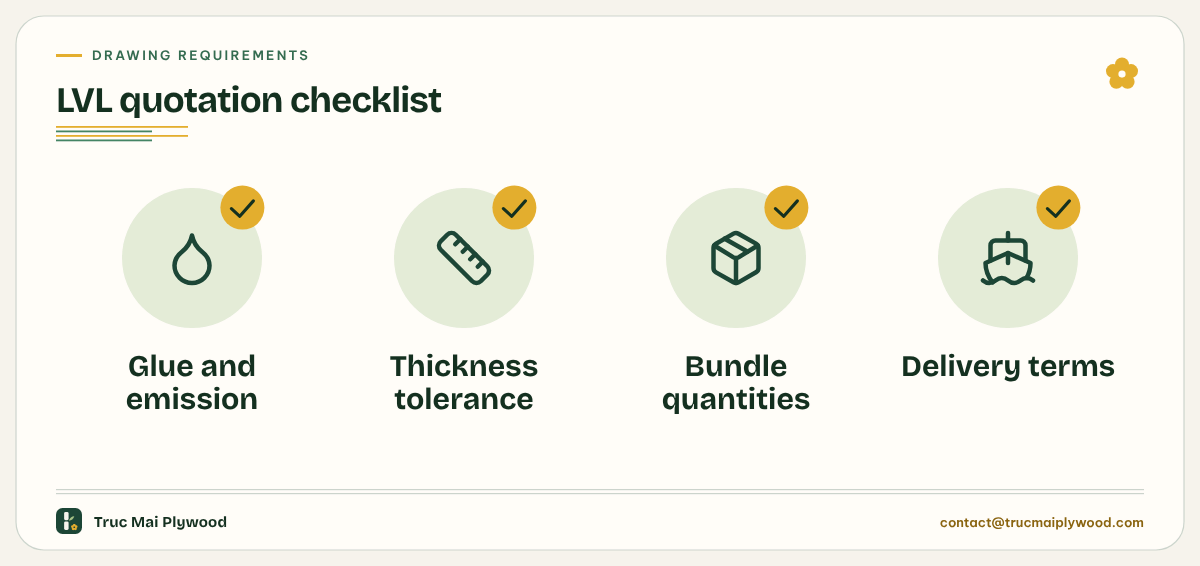
Send one drawing per part with the finished length, width and thickness, the show face, any profile, curve or holes, the tolerance, the species if you have a preference, and the pieces per bundle and per container. Add the plywood lines if the LVL rides with panels. The mill quotes per part and sends a sample piece.
| Line | Example: bed slat |
|---|---|
| Part | Bed slat, gently curved |
| Size | Finished length, width and thickness on the drawing, in mm |
| Species | Styrax |
| Glue and emission | UF glue at E0 emission |
| Faces | Both faces sanded |
| Tolerance | Thickness ±0.3–0.5 mm by line, written on the order |
| Bundle | Pieces per bundle, bundles per 40HC |
| Delivery | 1 × 40HC, FOB Hai Phong |
Send it with the drawing to the quotation desk or to contact@trucmaiplywood.com. The LVL checks page shows what each bundle is measured against once the order is running.
Questions buyers ask
What are standard LVL sizes at Truc Mai?
There is no fixed size list. Non-structural LVL is pressed as a billet and ripped and cut to the length, width and thickness on the buyer's drawing, then confirmed on the quotation.
Is Truc Mai LVL rated for beams or joists?
No. It is non-structural LVL for furniture parts, door and frame stock, bed slats and packing, and it carries no structural rating or stamp.
Which veneer is the LVL made from?
Eucalyptus, Acacia, Styrax or Pine veneer, or combined species, laid with the grain running the same way and pressed with UF glue at E0 emission by default.
What thickness tolerance can be written on LVL parts?
Thickness tolerance is written per order at ±0.3–0.5 mm by line. Section and length are measured against the drawing on sample pieces from each bundle.
How long can an LVL part be?
The billet comes off the plywood presses, so the press sets the longest piece. State the length on the drawing and the quotation confirms it; longer parts are redesigned in two pieces or finger-jointed by the buyer.
Can LVL be cut to curved bed slats?
Yes. Slats can be pressed flat or with a gentle curve and then cut to length and bundled.
How many m³ of LVL fit in one 40HC?
The 28,000 kg planning payload caps the load at about 56 m³ of Styrax, 48.3 m³ of Acacia or 43.1 m³ of Eucalyptus at reference density. The real fill depends on bundle sizes and is set in the loading plan.
Can LVL ride in the same container as plywood?
Yes. A container usually carries one or two products and three to six can be mixed by agreement; LVL bundles usually sit low with plywood packs above or beside them.
What is the minimum order for LVL?
One 40HC, which can be LVL alone or LVL mixed with plywood by agreement. Production runs 15–45 days after the 30% deposit.
Does the CARB P2 certificate cover LVL?
No. Certificate CARB/EPA 26053 covers hardwood plywood with a veneer core, 3–25 mm. US buyers of LVL parts confirm at enquiry which formaldehyde rule applies to their part.
Does ISPM 15 apply to LVL packing runners?
ISPM 15 exempts packaging made wholly of processed wood created with glue, heat or pressure, such as plywood. Solid-wood dunnage loaded with the LVL still falls under it.