
LVL bed slats · Ha Hoa, Phu Tho, Vietnam
LVL bed slats: flat and curved LVL slats cut to each bed width, by the 40HC
Truc Mai presses LVL bed slats, flat or gently curved, cut to the length of each bed width on your drawing and bundled by size. They are laid up from Styrax, Acacia or Eucalyptus veneer with UF glue at E0 emission, for bed-base and sofa makers that load slats by the 40HC, often with the plywood for the rest of the bed.
This page is written for the bed factory that buys slats every month. It covers which veneer and curve to write, how slats are counted and bundled per bed size, how they share a container with panels, and what keeps the next slat the same as the one you approved.
The slats come off the veneer lines that make around 60,000 m³ of plywood a year, about 5,000 m³ in an average month, so a bed maker buys slats and panels from one mill with one set of papers. LVL slats are non-structural furniture parts: they carry a mattress and a sleeper, not a building.
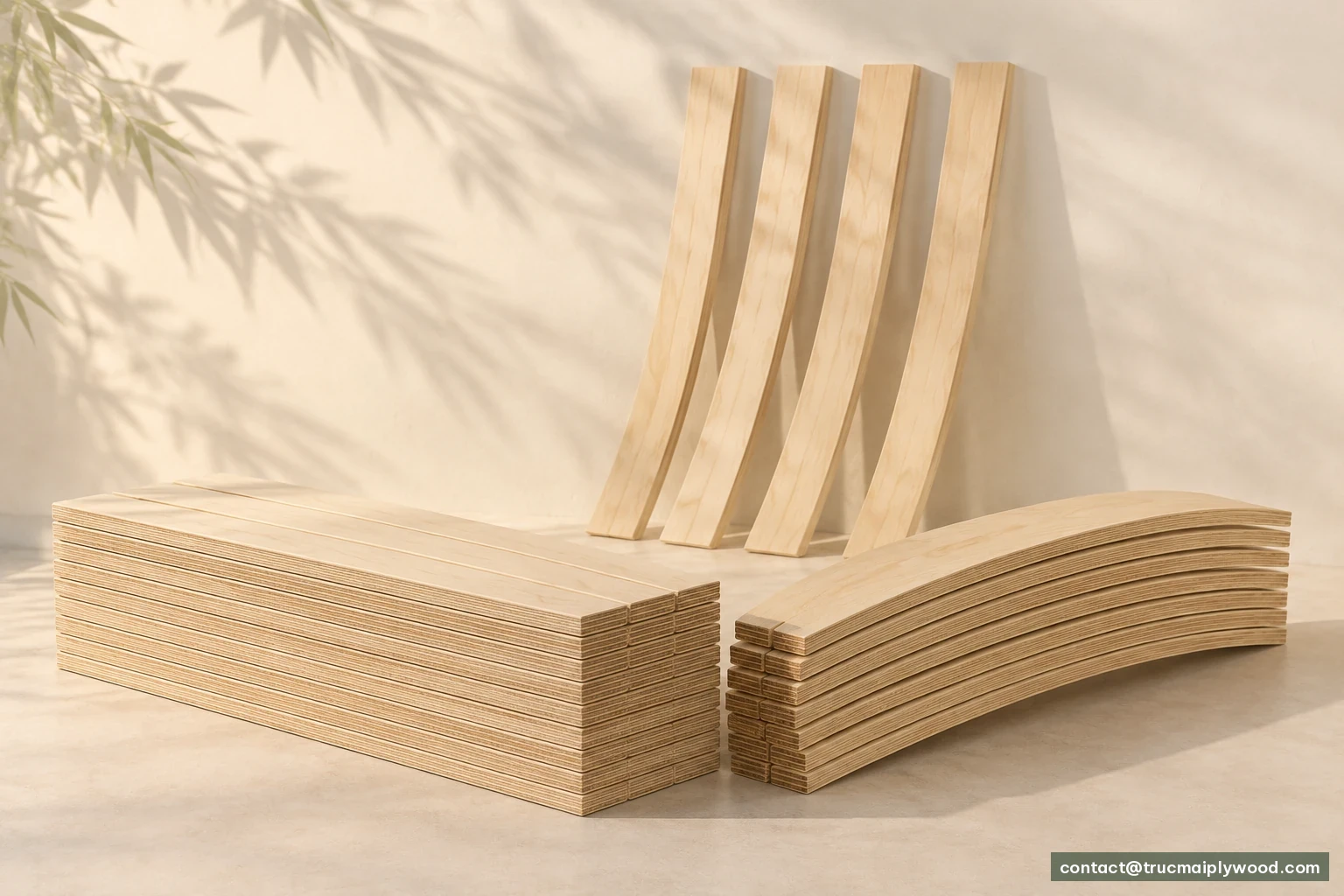
- Flat or pressed curveShape
- Styrax, Acacia or EucalyptusVeneer
- UF glue at E0 emissionGlue
- ±0.3–0.5 mm by lineTolerance
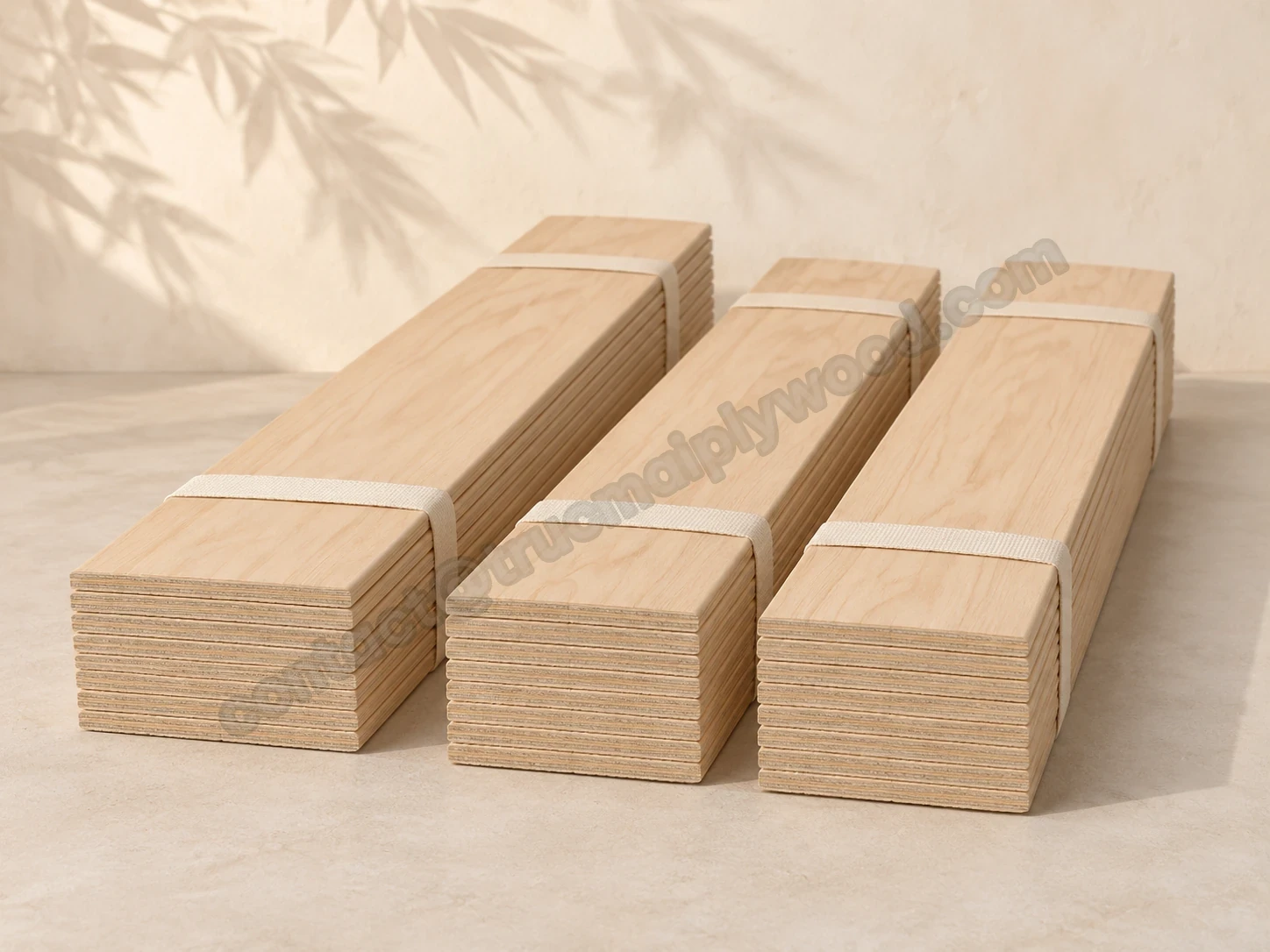
- By part number, one length per bundleBundled
On the line
How does a slat go from veneer to bundle?
Veneer is laid up lengthwise, pressed flat or over a curve, ripped into strips of the slat width, sanded, cut to length per bed size and counted into bundles. The press and the veneer are the ones the plywood uses.
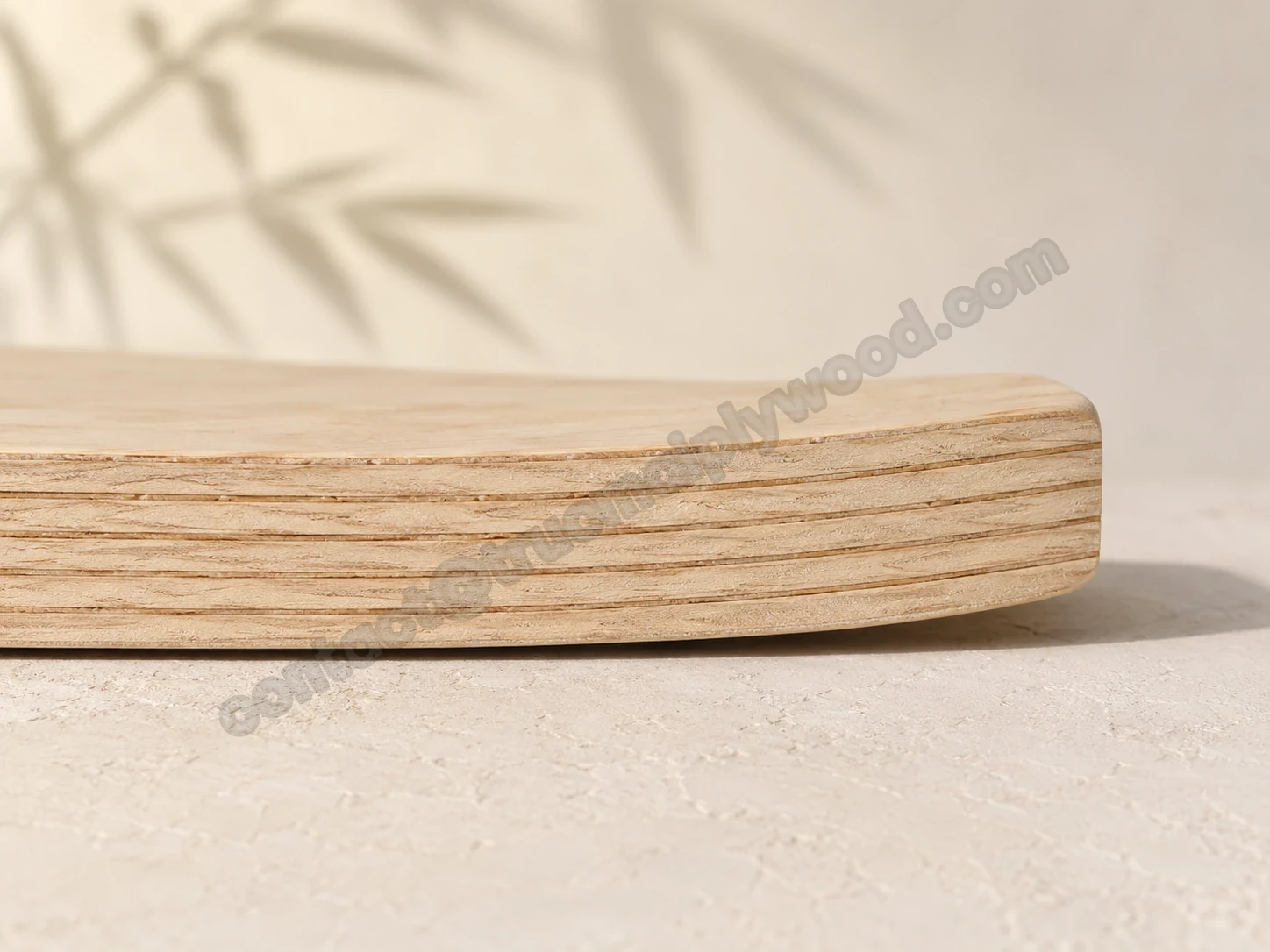
A slat is thin, so it is built from only a handful of core veneers of 1.4–2.0 mm. With so few layers, each veneer matters more than in a thick part, and the grader keeps split or brittle veneer out of slat lay-ups.
Curved slats are pressed between curved platens; flat slats on the flat press. After pressing, the billet is ripped into slats, both faces are sanded, the edges are rounded if the drawing says so, and each slat is cut to the length of its bed size.
Counting is the last step and the one bed lines care about most: every bundle carries one part number and one count, so the line opens one bundle for one bed. How our plywood is made shows the veneer, drying and pressing the slats share with the panels.
Specification
What goes on an LVL slat specification?
Shape, species, section, length per bed size, edge and end finish, glue and emission, tolerance and count per bundle. One line per slat part number.
Thickness and width are on your drawing, because they follow your slat holders and your comfort design; the mill does not impose a standard section. What it does fix is that each part number keeps its section, curve and species on every reorder.
Write the slat holder you use. A slat that clips into a rubber or plastic cap needs its thickness at the tight end of the tolerance; a slat screwed or stapled to a rail can take the wider end.
- Shape Flat, or pressed to a gentle curve
- Veneer species Styrax, Acacia or Eucalyptus; combined on request
- Lay-up All veneers grain-parallel along the slat
- Core veneer Usually 1.4–2.0 mm before pressing
- Glue UF glue at E0 emission by default
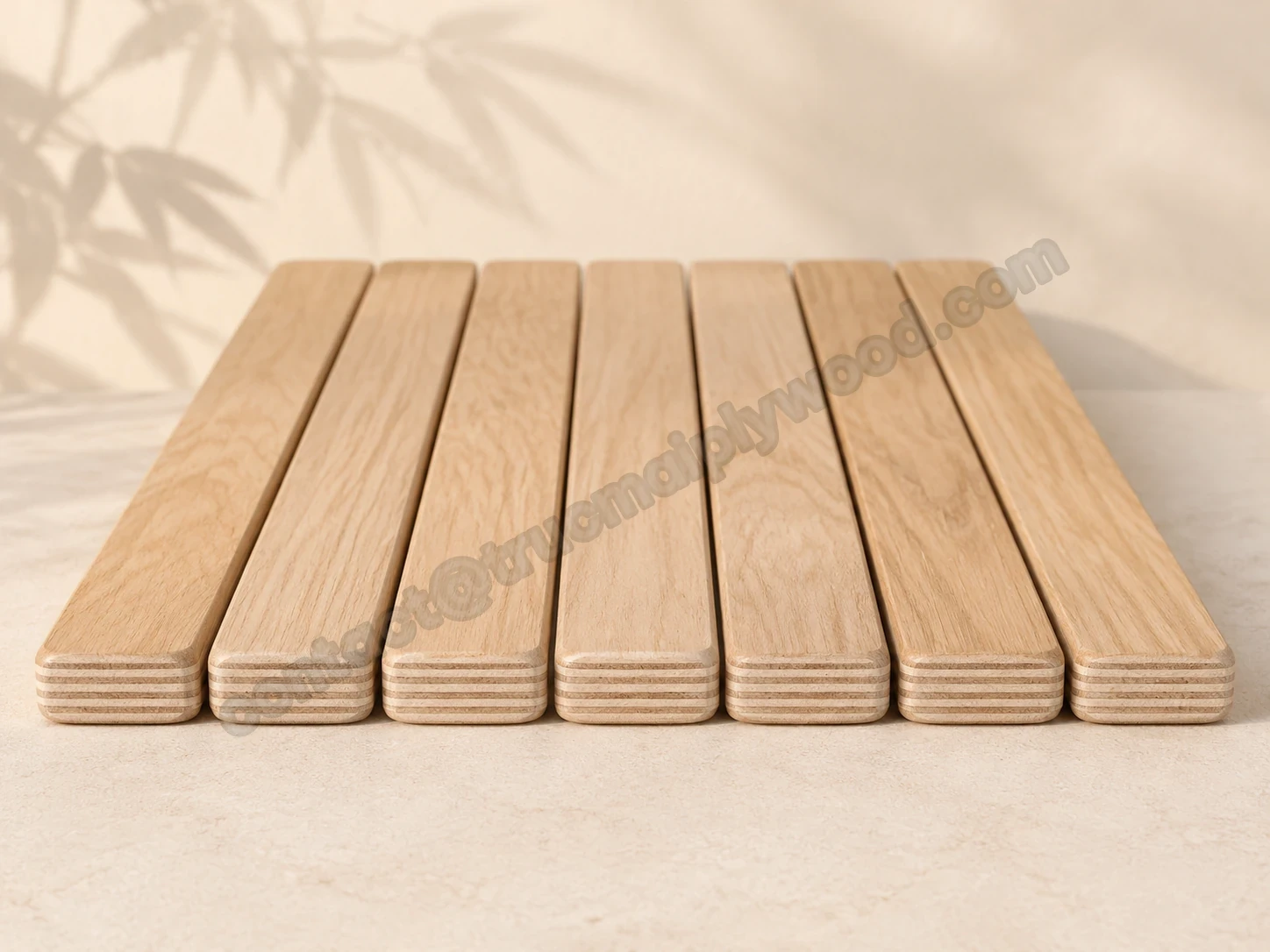
- Faces Sanded both sides
- Edges and ends Square, chamfered or rounded, per drawing
- Thickness tolerance ±0.3–0.5 mm by line
- Section and length From the buyer's drawing, one length per bed size
- Bundle One part number, counted pieces
Shapes and grades
Flat or curved LVL slats, and which face grade?
Two shapes and two face grades. Curved slats for sprung bed bases, flat slats for firm bases and bunks; a standard face for slats under a mattress, a select face for slats left visible in an open bed frame.
Most slat volume is the standard face, because a mattress covers it. A curve is set by the press, so a curved slat order is quoted with the curve on your drawing and an approved sample slat that the next order is checked against.
- Curved slat, standard face
Gentle even curve, sanded both faces, small closed knots and colour streaks allowed. Sprung bed bases and sofa seats where the slat is covered by a mattress or cushion.
- Flat slat, standard face
Straight and flat, sanded both faces, edges rounded or chamfered on request. Firm bases, divans, bunk beds and children's beds.
- Select-face slat
Outer veneer chosen for even pale colour on the top face. Open bed frames and daybeds where slats stay in view.
Species
Which veneer species makes the best bed slat?
Styrax for light slats and the most slats per container, Acacia for stiffer slats on wide beds, Eucalyptus where stiffness matters more than weight. The species changes both the feel of the bed and how the container fills.
The densities are the reference figures used in the mill's planning model; Eucalyptus is measured at 650–750 kg/m³. For slats the species also shows: Styrax is near-white, Acacia golden, Eucalyptus pink-brown, which matters only on select-face slats left in view.
A bed factory moving from Acacia to Styrax slats gets a lighter slat and more slats in the same container, at the cost of some stiffness, which the drawing can return by adding a millimetre of thickness.
| Species | Reference density, kg/m³ | Slat character | Container effect | Choose it for |
|---|---|---|---|---|
| Styrax | 500 | Light, pale, springy | Most slats per tonne; fills by volume | Standard sprung bases, sofa seats |
| Acacia | 580 | Stiffer, golden brown | Fewer slats per tonne | Wide double and king beds |
| Eucalyptus | 650 | Stiffest, pink-brown | Weight limit reached first | Heavy-duty and contract beds |
| Combined | Per order | Harder outer veneers, light centre | Between the two | Stiff slats kept light |
Glue and emission
Which glue and emission class do LVL slats carry?
UF glue at E0 emission by default, the right line for slats inside a bed in a dry bedroom. The CARB P2 and TSCA plywood certificate does not cover LVL slats.
Glue type and emission class are two separate lines on the order: the default is UF glue at E0 emission, and a melamine-fortified glue for damp rooms usually gives E1. UF glue holds about six hours in a boil test; melamine-fortified glue holds twelve.
Slats sit close to the sleeper, so EU bed makers check the finished bed against REACH Annex XVII entry 77, which limits formaldehyde from furniture to 0.062 mg/m³ under chamber conditions; plywood formaldehyde indoors explains the rule. Emission class per order shows how the line is written for LVL as for plywood.
| Glue line | Emission | Boil resistance | Slat use |
|---|---|---|---|
| UF | E0 | About six hours | Bed bases and sofa seats in dry rooms |
| Melamine-fortified UF | Usually E1 | Twelve hours | Slats in damp storage or humid climates, on request |
Lengths per bed size
How are slat lengths set for each bed width?
From your drawing: each bed width has its own slat length, and each length is a part number with its own count. The mill cuts slats to those lengths after sanding.
Writing the slats per bed on the drawing lets the quotation turn your monthly bed count into bundles, and the bundles into a container.
Slat stock is ripped from pressed billets, so the press sets the longest slat; ordinary bed widths fit inside it. The cut yield calculator helps compare slat widths against billet width.
- Length One length per bed size, from the drawing
- Width and thickness From the drawing, to suit the slat holder
- Ends Square, or rounded for slat caps
- Curve Set by the press, the same for every slat of one part number
| What the drawing gives | Why the line matters |
|---|---|
| Slat length per bed width | Each length is cut and counted separately |
| Slat width and thickness | Must fit the holder or rail without play |
| Curve, if any | Set once in the press and repeated |
| Edge and end finish | Protects mattress covers and holders |
| Slats per bed | Lets the quotation count bundles per bed |
Uses
Which beds and seats use LVL slats?
Sprung slatted bed bases, firm platform beds, bunk and children's beds, sofa and daybed seats. In each the slat bends under a sleeper or sitter and must spring back the same way every night.
LVL slats are non-structural furniture parts. Truc Mai does not make film-faced, formwork, structural or marine plywood.
Bed factories that also buy panels for headboards, bases and side rails can read panels by end product for the plywood side; slatted bases are often paired with thin plywood for drawer bottoms and backs.
- Sprung bed bases
Curved slats in caps on a frame, the most common use; the curve gives the base its spring.
- Platform and divan beds
Flat slats screwed or stapled to side rails under a mattress.
- Bunk and children's beds
Flat slats on short spans where stiffness and clean rounded edges matter.
 Sofa and daybed seats
Curved or flat slats under cushions, often in the same Styrax as the frame stock.
Compare
LVL slats, sawn wood slats or plywood strips?
LVL for slats that must spring back evenly and keep a pressed curve; sawn beech or pine where a solid-wood slat is part of the sales story; plywood strips only for flat, short slats, because crossed layers make a narrow strip less stiff along its length.
LVL or plywood explains why the lay-up decides stiffness in a narrow part, and LVL or solid wood parts compares LVL with sawn timber for furniture frames. For a volume bed maker the deciding line is usually consistency: a bundle of LVL slats behaves like one slat repeated.
| Slat material | Spring and stiffness along the slat | Holds a pressed curve | Slat-to-slat consistency | Best use |
|---|---|---|---|---|
| LVL | Even; all layers run along the slat | Yes, set in the press | High; defects spread over layers | Sprung and flat bases in volume |
| Sawn hardwood slat | Good, varies by board | Only if steam-bent | Varies with knots and grain | Solid-wood beds sold as such |
| Sawn pine slat | Softer, varies by board | No | Varies; knots can break | Low-cost flat bases |
| Plywood strip | Lower; half the layers run across | No | High | Short flat slats, drawer bottoms |
Checks
What is checked on slats before they are bundled?
Curve against the approved sample, thickness for the holder, length per part number and the count in each bundle. Slats are checked the way the bed line will use them.
The LVL checks page sets out the inspection, and repeat spec control explains how the retained sample slat is used on the next order.
Curved slats are laid on a template of the approved curve.
Thickness is measured on slats from each bundle against the holder tolerance.
Length is checked per part number; ends and edges for rounding.
Each bundle is counted and its count written on the bundle card.
Certificates
Which certificates and files come with LVL slats?
FSC, CARB P2, ISO 9001 and ISO 14001, plus EU file sets.
- FSC 100% FSC-C196493 · SA-COC-014545
- CARB P2 and TSCA Title VI CARB/EPA 26053 · TPC-43
- ISO 9001:2015 W2012 · WCERT
- ISO 14001:2015 W2012E · WCERT
Container
How are slat bundles loaded with plywood in a 40HC?
Strapped bundles of one part number, counted, laid flat. Slat bundles fill the gaps around plywood packs or make a floor layer under them.
There is no planning table for slats: slats per bundle and bundles per 40HC come from your section and lengths and are stated on the quotation. Loading a 40HC shows how plywood packs sit, and the 40HC load calculator gives the plywood share of a mixed bed-kit load.
| Load | Where slat bundles go | What limits it |
|---|---|---|
| Slats only, Styrax | Floor to roof in rows | Volume |
| Slats only, Eucalyptus | Lower rows | Weight |
| Slats with plywood packs | Beside packs and at the door end | Agreed mix per product |
Terms
What are the minimum order and production time for LVL bed slats?
Full containers direct from the mill; these terms apply unless the contract says otherwise.
Full terms are on MOQ, payment and FOB. Slats and the plywood they ship with count together towards the one-40HC minimum.
- Minimum order One 40HC
- Production time 15–45 days after the 30% deposit, by quantity and agreement
- Payment 30% deposit; 70% against the scanned B/L by T/T, or irrevocable L/C at sight
- Delivery terms FOB Hai Phong, CFR or CIF
- Documents Invoice, packing list, B/L, certificate of origin, phytosanitary, fumigation, order certificates
- Price Quoted per order against the written specification
How to order
What to send for a slat quotation
Four items are particular to slats.
Deposit, documents and balance follow from enquiry to loading.
Slat drawing: section, curve, edges, length per bed size.
Species and face grade.
Monthly bed count, slats per bed, other products in the load.
Approve a sample slat; one stays at the mill.
FAQ
Questions from bed-base and sofa makers
Why do bed-base makers use LVL slats instead of sawn slats?
Because a slat built from many thin veneers laid in one direction springs back the same way from slat to slat, and a knot or short grain in one veneer is carried by the layers around it. A sawn slat cut from one board can hide a weak spot that breaks under a sleeper. LVL slats also take a pressed curve and keep it, which sawn wood does not.
Which veneer species go into Truc Mai LVL bed slats?
Mostly Styrax and Acacia, sometimes Eucalyptus. Styrax at a reference density of 500 kg/m³ gives the lightest slat and the most slats per tonne of payload; Acacia at 580 kg/m³ gives a stiffer slat for wide beds; Eucalyptus at 650 kg/m³ is the stiffest and heaviest. The species is written on the order and kept on every repeat.
Can LVL slat bundles and plywood panels be mixed in one 40HC?
Yes, by agreement. A container usually carries one or two products and three to six can be mixed. A bed factory often loads its slats with the plywood for headboards, side rails and bases, so the whole bed kit leaves Hai Phong in one box.
Can LVL bed slats carry the FSC 100% claim on the sales documents?
Only when LVL is on the current FSC product schedule of certificate FSC-C196493, which is confirmed at enquiry. If it is, the FSC 100% claim is written on the invoice and packing list for those slats; if not, the slats ship without a claim and the plywood in the same container keeps its own.
What emission class do the LVL slats have for EU and US bed makers?
UF glue at E0 emission by default. EU bed makers check their finished bed against the REACH formaldehyde limit for furniture; US bed makers confirm at enquiry which formaldehyde rule applies to slats, because the mill's CARB P2 and TSCA certificate covers hardwood plywood with veneer core, not LVL.
Flat or curved slats: which should a bed base use?
Curved slats give a sprung feel and are pressed into the curve, so they keep it under load and push back when a sleeper lies down. Flat slats suit firm bases, divans and bunk beds and nest tighter in a bundle. The bed maker chooses by the comfort it sells; the mill presses either.
How is a slat pressed into a curve?
The veneers are laid up and pressed between curved platens, so the curve sets as the glue cures and every layer keeps its share of the bend. A curved billet is then ripped into slats of the drawn width, so every slat from one press has the same curve.
Do LVL slats need edges rounded?
Most bed makers ask for rounded or chamfered long edges and rounded ends, so the slat does not cut into a mattress cover or a slat holder. Write it on the drawing; it is a cutting line like the length.
What thickness tolerance is written on LVL slats?
±0.3–0.5 mm by line, with the tighter end on sanded slats that clip into plastic or rubber holders, because a thick slat will not seat and a thin one rattles.
How many slats fit in a 40HC?
It depends on the slat section and length on your drawing, so the quotation states slats per bundle and bundles per container. A Styrax slat load fills by volume; a heavy Eucalyptus load can reach the weight limit first.
Can the slats be sorted by length for each bed width?
Yes. Each bed width is a separate part number with its own length, bundled and counted on its own, so the bed line takes one bundle per bed size without sorting.
Quotation
Request an LVL slat quotation
Send the slat drawing with section, curve, edges and length per bed size, the species and face grade, your monthly bed count and what ships with the slats. Lucy replies with a written specification and price. Write to contact@trucmaiplywood.com or use the quotation form.
Styrax, Acacia or Eucalyptus veneer, UF glue at E0, cut to each bed width and bundled by size.