
Resources · plywood cut calculator
Plywood cut calculator: parts per sheet, waste and sheets per order
A plywood cut calculator tells you how many parts one sheet gives. A 720 × 560 mm cabinet side with a 4 mm kerf gives 6 parts per 1220 × 2440 mm sheet, a 81.3% yield. The same part gives 6 on 1220 × 2280 mm (87.0%) and 6 on 1250 × 2500 mm (77.4%). 600 parts need 100 sheets, 10.1% of a Truc Mai 40HC of 18 mm Styrax.
The calculator is for a furniture or interior buyer who orders sheets by the container and cuts them at home, and wants to know which of the three mill sizes wastes least before fixing the order. It works on pure geometry: sheet size, part size, saw kerf and edge trim.
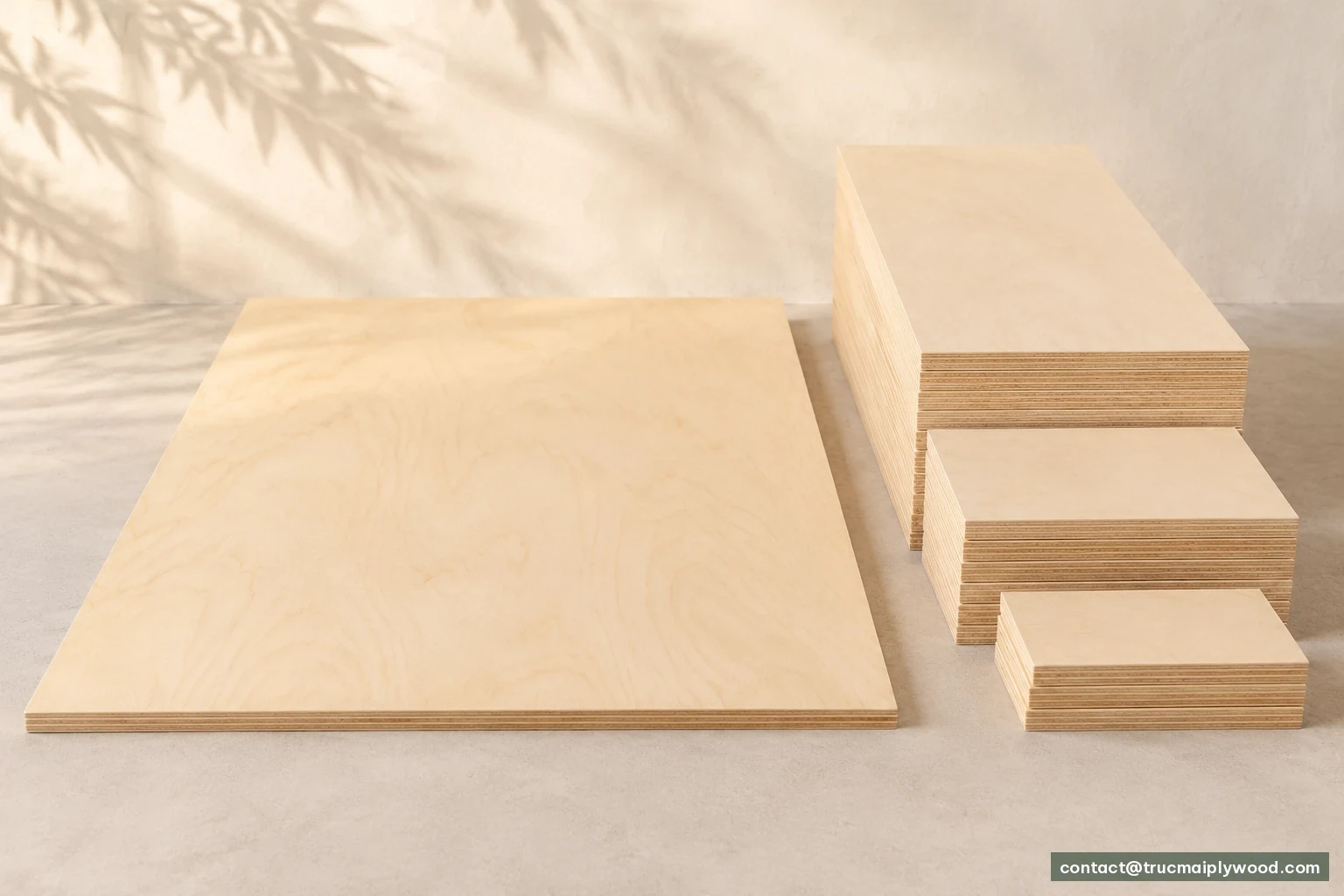
- 6 parts720 × 560 mm per 1220 × 2440 mm sheet
- 87.0%best yield, on the 1220 × 2280 mm sheet
- 3 sizes1220 × 2440, 1220 × 2280, 1250 × 2500 mm
- 2, 3, 4 or 6panels per sheet when the mill cuts to size
Geometry and planning figures; a nesting program on your saw may fit one or two more parts.
Calculator
Plywood cut calculator: parts per sheet on each mill size
Enter one part size, the number you need, your saw kerf and trim. Choose whether the part may turn 90°; on a decorative face the grain usually has to run along the part length.
The tool tries the part with its length along the sheet and turned 90°, adds one strip of turned parts in the offcut at the end of the sheet, and keeps the better layout. With the grain fixed, only the first grid counts. A part larger than the sheet returns 0 parts and no sheet count.
The last four lines turn the 1220 × 2440 mm result into an order: sheets, m³ and the share of a 40HC for the chosen thickness and core, from the mill’s planning table.
Reference table
Parts per sheet and yield for common furniture parts
Parts per sheet · yield, for seven parts a cabinet or wardrobe line cuts most. The shorter 1220 × 2280 mm sheet often gives the same count as 1220 × 2440 mm with less waste.
Kerf matters on halves and quarters. A quarter sheet of 610 × 1220 mm gives 4 parts with no kerf but 3 with a 4 mm kerf, because four quarters leave no room for the saw. When the mill cuts to size it splits one sheet into 2, 3, 4 or 6 panels before packing, with the cut sizes written on the order; see panels cut at the mill. A cut panel keeps the emission class of its sheet, and 3–25 mm panels stay inside the CARB P2 scope set by the California Air Resources Board.
Grain direction costs parts. A 1100 × 350 mm shelf gives 6 parts per sheet when parts may turn, and 6 when the grain must run along the shelf.
| Part (length × width) | 1220 × 2440 mm | 1220 × 2280 mm | 1250 × 2500 mm |
|---|---|---|---|
| Base cabinet side, 720 × 560 mm | 6 · 81.3% | 6 · 87.0% | 6 · 77.4% |
| Wall cabinet side, 720 × 300 mm | 12 · 87.1% | 12 · 93.2% | 13 · 89.9% |
| Drawer box side pair blank, 600 × 400 mm | 12 · 96.7% | 11 · 94.9% | 12 · 92.2% |
| Wardrobe shelf, 1100 × 350 mm | 6 · 77.6% | 6 · 83.0% | 7 · 86.2% |
| Wardrobe side, 2000 × 600 mm | 2 · 80.6% | 2 · 86.3% | 2 · 76.8% |
| Quarter sheet (cut-to-size), 610 × 1220 mm | 3 · 75.0% | 3 · 80.3% | 4 · 95.3% |
| Small drawer front, 400 × 300 mm | 24 · 96.7% | 21 · 90.6% | 24 · 92.2% |
How the numbers work
How does the plywood cutting calculator count parts?
Parts in a row = floor((sheet side − 2 × trim + kerf) ÷ (part side + kerf)): n parts need n − 1 saw cuts. Parts per sheet = parts across × parts along, plus one strip of turned parts in the offcut; the better of the two orientations wins.
This is a guillotine model: every cut runs straight across the piece being cut, as on a panel saw; see guillotine cutting. It is exact for one part size and conservative for mixed lists, where a nesting program fills offcuts with smaller parts.
Thickness does not change the parts per sheet; it changes m³ and the container share. Thickness tolerance is written per order at ±0.3–0.5 mm, and more about sizes is in sheet specifications.
- Sheet sizes 1220 × 2440, 1220 × 2280 and 1250 × 2500 mm; nothing larger is made
- Sheet tolerance length and width ±2 mm; set trim if your saw squares every sheet
- Kerf your blade width; 0 mm gives the geometric maximum
- Yield parts × part area ÷ sheet area
- Container sheets ÷ planning sheets per 40HC at 28,000 kg payload
- Not modelled mixed part sizes on one sheet, grain-matched sets, edge defects
Questions
Plywood cutting questions
How many cabinet parts will one sheet give?
A 720 × 560 mm base cabinet side gives 6 parts per 1220 × 2440 mm sheet with a 4 mm kerf, 81.3% of the sheet. A 720 × 300 mm wall cabinet side gives 12.
Does 1220 × 2280 or 1220 × 2440 cut better for my parts?
For 720 mm long parts the 2280 mm sheet gives the same 6 parts and lifts yield from 81.3% to 87.0%, because three 720 mm parts and their kerfs use 2,168 mm of length. For a 2,000 mm wardrobe side the longer sheet is needed.
How many sheets does my order need, and how many 40HC is that?
600 cabinet sides at 6 per sheet need 100 sheets, 5.36 m³ at 18 mm. A 40HC of 18 mm Styrax is planned at 990 sheets, so the order fills 10.1% of one container.
What happens if the part is larger than the sheet?
The calculator returns 0 parts and no sheet count. The largest sheet the mill makes is 1250 × 2500 mm; nothing larger, so larger parts are joined or ordered as LVL or panel stock.
Can the mill cut each sheet into 2, 3, 4 or 6 panels before packing?
Yes. Cut-to-size orders split one sheet into 2, 3, 4 or 6 panels at the mill before packing, which changes pack counts; the quotation gives the load for the cut size.
How much does the saw kerf cost?
On a quarter-sheet cut, everything: 610 × 1220 mm gives 4 parts at 0 mm kerf and 3 at 4 mm. On a 720 × 560 mm part the 4 mm kerf costs nothing, since 6 parts fit either way.
Quotation
Send your cut list with the quotation request
Send part sizes, quantities and the face. The reply names the sheet size that wastes least and the container it fills.