
The right plywood grades for cabinets are a pair, not one letter: a clear face, a sound back, and an A-grade stitched core sanded to ±0.3 mm. Buy on the label alone and doors warp, edges show voids and the CNC line rejects sheets. Truc Mai writes all three onto the order, with UF glue at E0 emission and CARB P2 certification.
What is the best grade of plywood for cabinets?
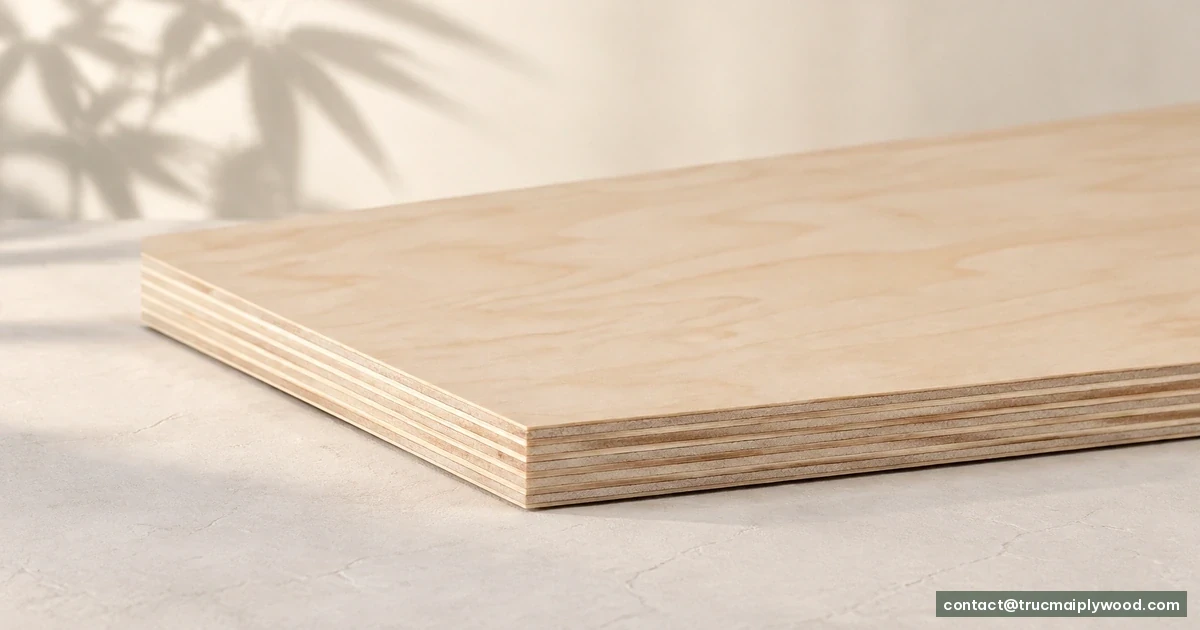
The best plywood grade for cabinets is a written pair: a clear, matched face over a sound back, on an A-grade stitched core, sanded and calibrated to ±0.3 mm, with UF glue at E0 emission. One letter on a quote is not enough. Visible parts take the top face grade on both sides; hidden parts can take a lower back.
A cabinet line buys plywood for three different jobs. Carcass sides, tops and bottoms carry hinges, drawer runners and shelf pins, so the core must hold screws and stay flat. Doors and visible end panels carry the finish, so the face is judged under light and paint. Backs and drawer bottoms carry almost nothing, so they can be thinner and plainer.
Grading that follows those jobs saves money. A buyer who orders top grade on both sides for every part pays for a back face nobody sees. A buyer who orders the cheapest pair for everything sends doors back from the paint line. The order sheet should name the grade per part, not per container.
At Truc Mai, face and back grades are agreed against an approved sample and quoted as pairs. The furniture and interior line uses an A-grade core, stitched, with sanded faces, which is the build a cabinet line needs. Commercial panels use an AB core, loose-laid or jointed, and suit drawer bottoms or hidden shelves where the price matters more than the core.
What is considered cabinet grade plywood?
Cabinet grade plywood is a hardwood plywood panel with faces clear enough to finish, a core free of open voids, and a thickness held tight enough for machining and hinge fixing. It is a trade term, not a grade in any standard, so two mills can sell different panels under the same words.
That is why “cabinet grade” belongs in the title of the order, not in its specification. The specification names the face species and grade, the back grade, the core species and grade, the core build (stitched or loose-laid), the glue and emission class, the thickness with its tolerance, and the sheet size.
Retail shelves in North America sell “cabinet grade” as a product line, often a birch or maple face on a mixed core. A volume buyer importing by the container is in a different position: the mill builds to the line written on the order, so the order can say exactly what the shop needs, part by part.
Under one product name, two quotes can hide two different panels: the core grade, the way the core is joined, the face preparation, the adhesive and the tolerance held all vary, and how plywood is priced shows what each of those does to the price. A cabinet RFQ therefore begins with the part the sheet will become, then writes core, glue and emission, face, sheet, packing and quantity.
Cabinet plywood grades explained: what do A, B, C and D mean?
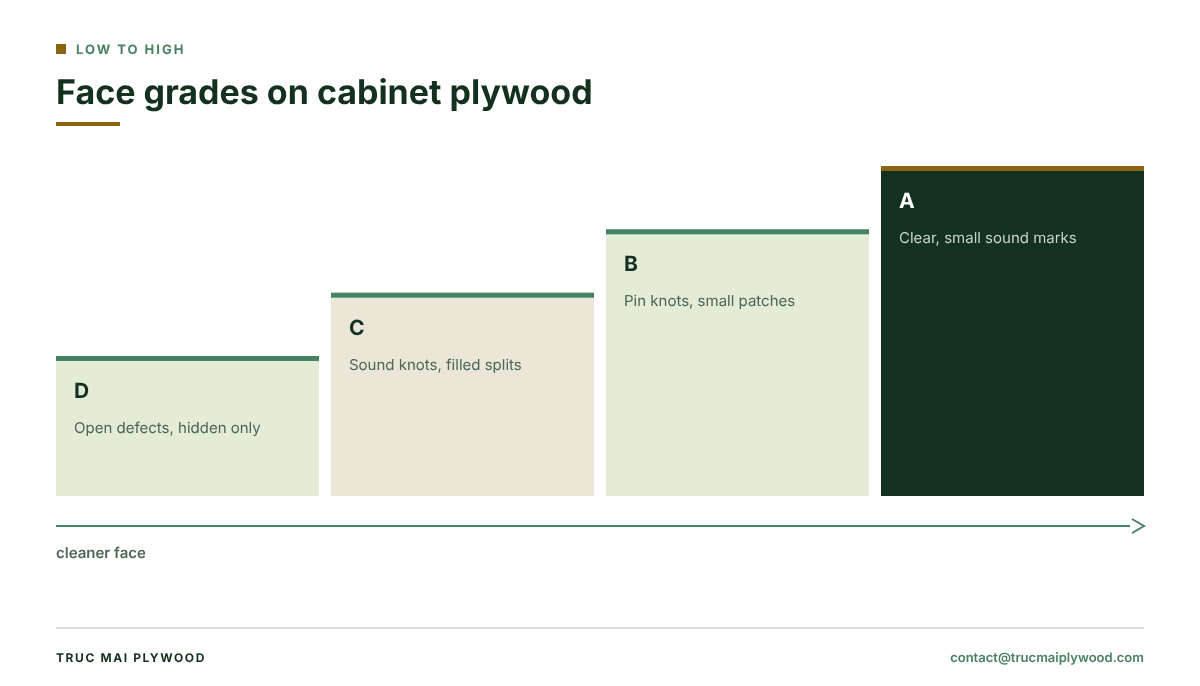
Cabinet plywood grades rate the face veneer by how many defects it allows. A is the cleanest face, with small sound marks at most; B allows more pin knots, small patches and colour change; C and D allow open defects, splits and larger patches, and belong on hidden or structural faces, not on cabinet parts.
Letter pairs: A/B, B/BB, BB/CC
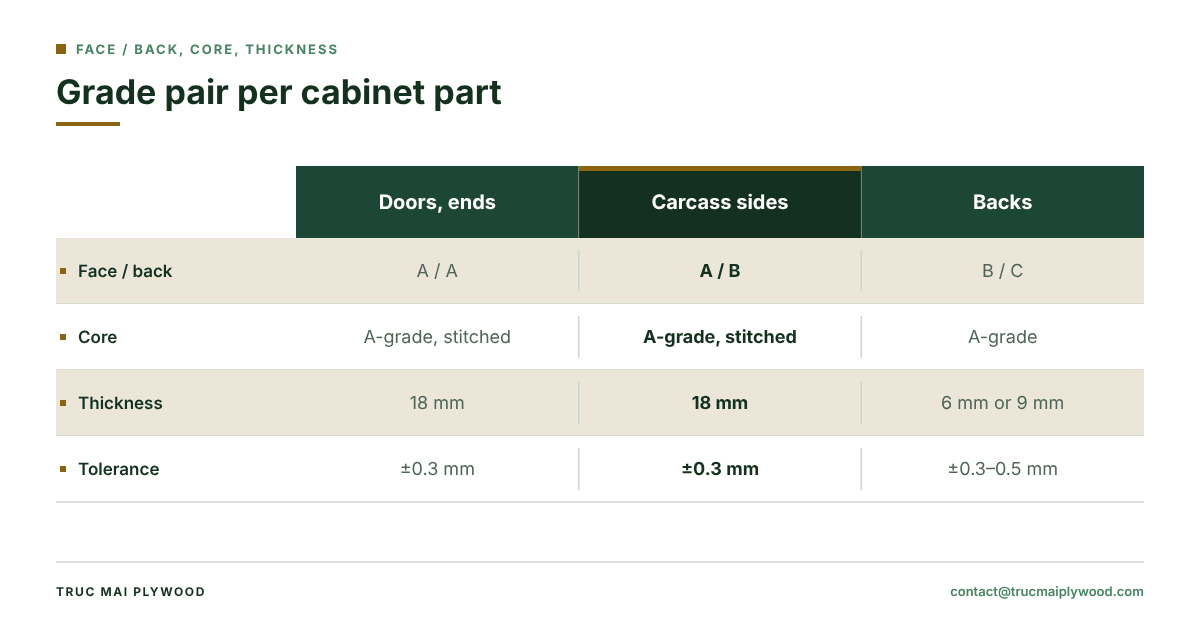
The pair is written face first, back second. A/B is a top face over a good back, the usual choice for carcass sides seen from one side. A/A puts the top grade on both faces, for doors, open shelving and visible ends. B/BB and BB/CC come from the birch trade: BB allows colour-matched patches, CC allows sound knots and open splits that are filled.
The US hardwood plywood standard, ANSI/HPVA HP-1, uses letters for faces (AA, A, B, C, D, E) and numbers for backs (one to four), so a shop may see “A-1” or “B-2”. Softwood construction panels use A to D on both faces under a different standard and are not cabinet stock.
How the grades map onto a cabinet
| Cabinet part | Face / back pair | Core | Usual thickness |
|---|---|---|---|
| Door, visible end panel | A / A | A-grade, stitched | 18 mm |
| Carcass side, top, bottom | A / B | A-grade, stitched | 18 mm |
| Fixed and adjustable shelf | A / B or B / B | A-grade, stitched | 18 mm |
| Drawer box sides | A / B | A-grade, stitched | 12 mm or 15 mm |
| Back panel | B / C | A-grade | 6 mm or 9 mm |
| Drawer bottom | B / C | AB core | 6 mm |
Letters mean different things at different mills and in different trades. A Vietnamese mill’s “A” face and a North American retail “A” face may not match. The safe practice is the one Truc Mai uses: grade against the sample the buyer approved and keep that sample as the reference for every repeat order.
How can you tell if plywood is cabinet grade?
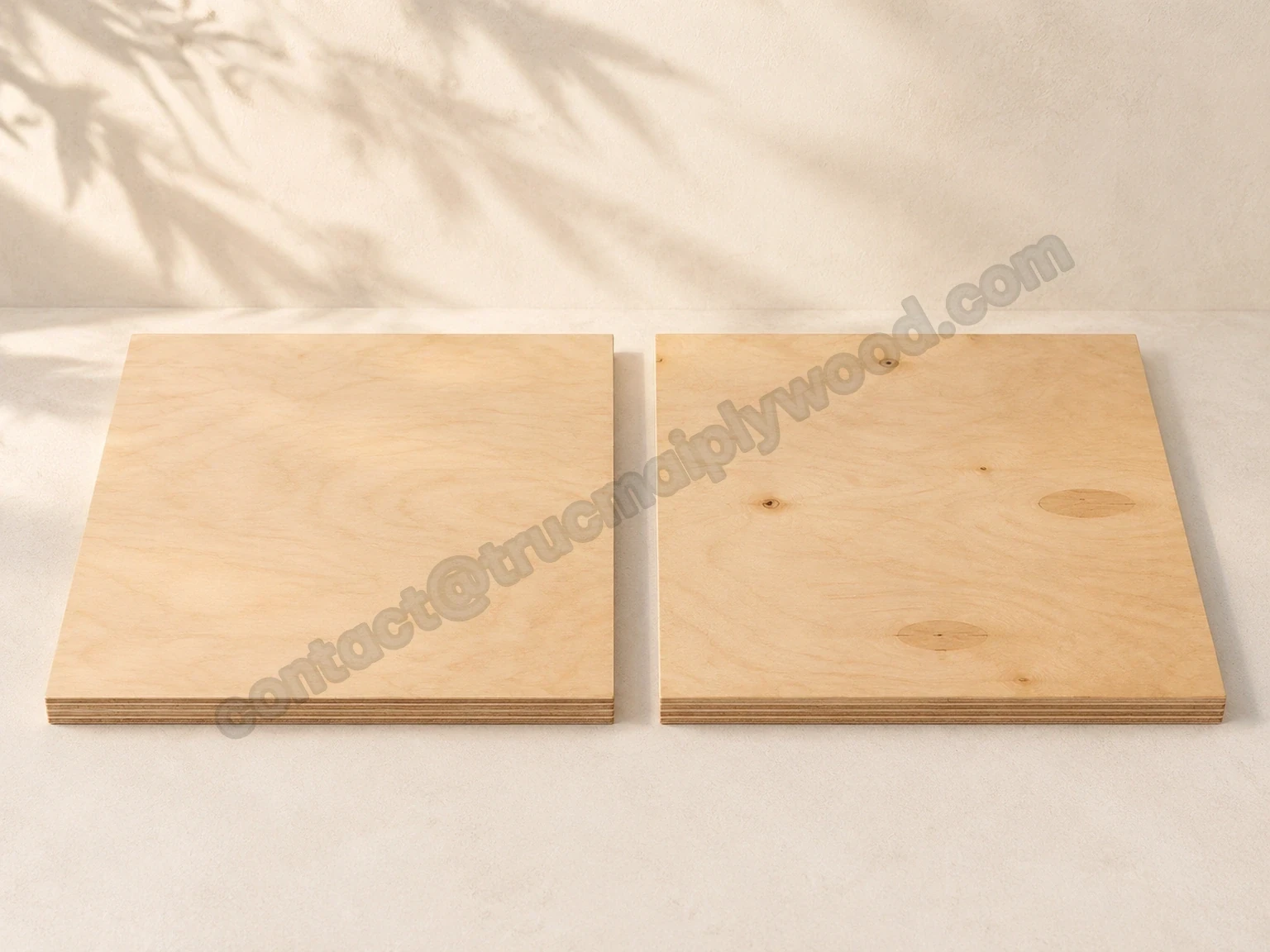
You can tell plywood is cabinet grade by checking five things on the sheet itself: an even, clean face under raking light, a back that matches the grade written, edges with no core gaps, a thickness inside the stated tolerance at several points, and a flat sheet when laid on a level surface. The label proves none of them.
- Face: hold a light low across the sheet. Patches, glue bleed and sanding marks show at once.
- Back: turn the sheet over and compare with the grade on the order, not with the face.
- Edge: look along all four edges. A cabinet core shows tight, even plies with no open gaps or overlaps.
- Thickness: measure with a caliper at the corners and centre of the long edge against the written tolerance.
- Flatness: lay the sheet on a flat bench; a warped sheet will not sit on a cabinet line’s vacuum table.
Cut one sheet as well. A drawer-box test across the core shows whether screws will bite: an A-grade core holds a screw on every ply, while a core with gaps lets it spin. The same cut shows the glue line; a good bond leaves wood fibre on both sides when a strip is broken by hand.
These checks belong on the first container and on every repeat. Truc Mai weighs real sheets before the final loading plan, so the packing list carries measured weights beside the planned count, and a buyer can compare one sheet with the list on arrival.
Which face and back grade pair does a cabinet carcass need?
A cabinet carcass needs an A-grade face where the side shows and a B-grade back where it meets the wall or the next cabinet: an A/B pair. Doors and open shelving need A/A. Backs and drawer bottoms can drop to a B/C pair because nothing is finished on them.
Plywood grades for cabinets, part by part
Pairing by part keeps the face where it earns its price. A kitchen run of ten base units has twenty side panels, but only two of them are end panels that show on the outside. If the end panels are written as A/A and the rest as A/B, the visible quality stays the same and the order costs less.
Paint grade and stain grade are a second question. A face for paint can take small sound patches and colour change, because the paint covers both; a face for stain or clear lacquer cannot, because the finish shows every patch. Write “paint grade” or “clear finish” on the order beside the letters.
Face and back grades are quoted as pairs at Truc Mai, against the approved sample. Door stock comes sanded and calibrated as standard, or polished if asked. A “UV-ready” door face is one the mill prepares on both sides for the buyer’s own UV coating line; no UV coat is put on at the mill. A buyer who coats doors in-house orders UV-ready faces on the door stock only.
Why does a stitched A-grade core matter for cabinet panels?
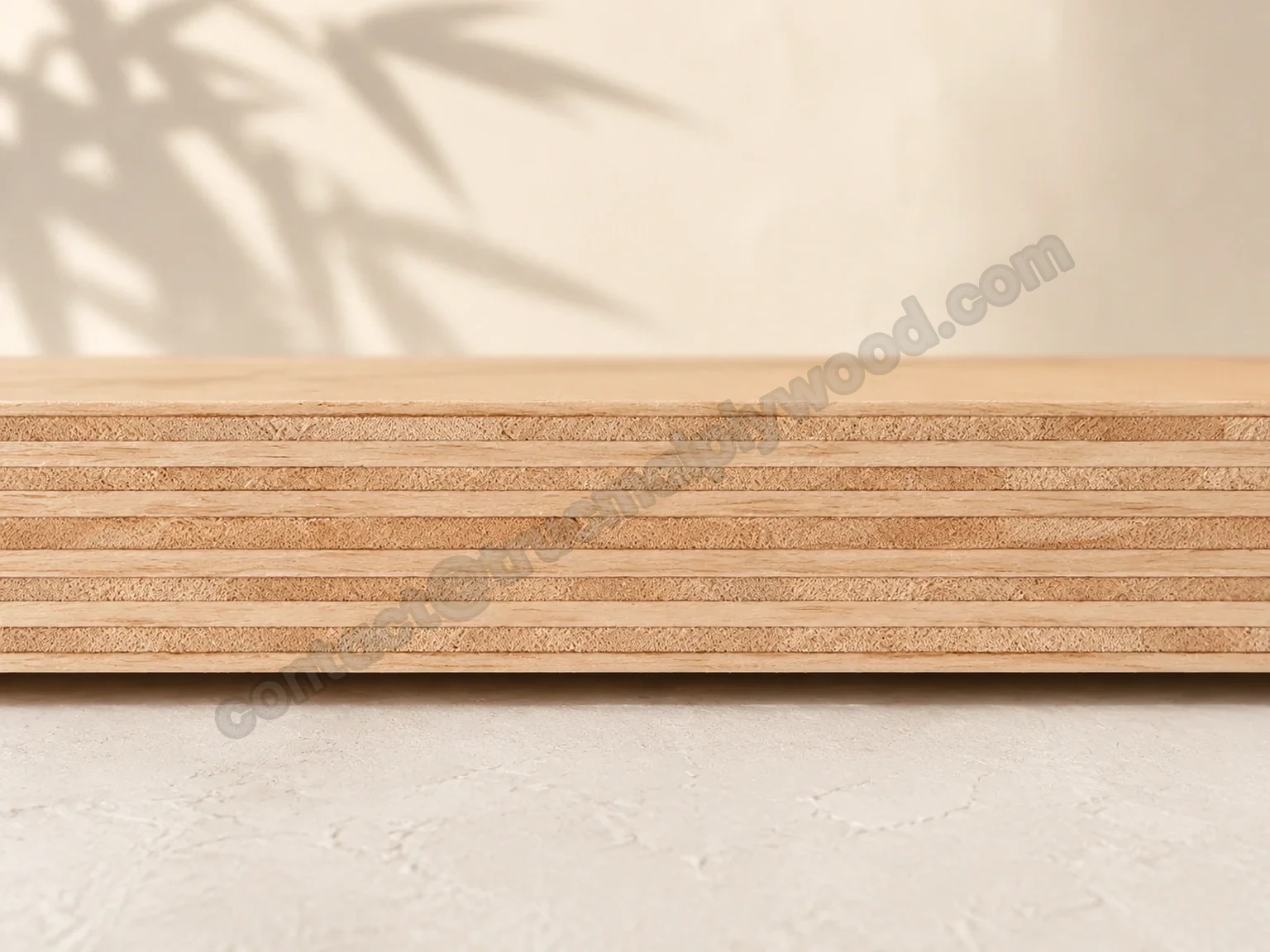
A stitched A-grade core matters because cabinet panels are cut into narrow parts, drilled for hinges and edged with tape, and every one of those steps finds the gaps in a poor core. Stitching joins core veneers edge to edge so no open joint sits under the face or along a cut edge.
On a cabinet core the stitches run both across and along the sheet, normally on the outer 2–4 plies, with every ply stitched if the order asks for it. On a cabinet panel the outer plies carry the hinge cup and the edge band, so stitching them keeps the edge solid where the tape is glued and the drill goes in.
A loose-laid core places core veneers side by side without joining them. It is cheaper and fine for packing panels and hidden parts, but it leaves gaps that open when the sheet is ripped into narrow strips for face frames or drawer sides. The gap then shows as a dip under the edge band, or as a screw that will not hold.
The Truc Mai furniture and interior line uses an A-grade core, stitched, with sanded faces. The commercial line uses an AB core, loose-laid or jointed. A cabinet buyer writes “A-grade core, stitched” on the order line, and the build stays the same from one container to the next.
Stitched core cabinet plywood and the CNC line
Nested CNC cutting puts a cabinet’s parts edge to edge on one sheet. With a stitched core, every part edge is solid. With a loose-laid core, the router finds joints in random places, and the waste rate rises with the number of small parts per sheet.
How thick should plywood be for a cabinet?
Plywood for a cabinet is usually 18 mm for sides, tops, bottoms and shelves, 12 or 15 mm for drawer boxes, and 6 or 9 mm for backs and drawer bottoms. Wall cabinets can use 15 mm sides where weight matters; long shelves stay at 18 mm or get a front rail.
Cabinet grade plywood 18mm against 3/4 inch
Many US cabinet designs are drawn around 3/4 inch. Under the UK Weights and Measures Act 1985, Schedule 1, the inch is 1/36 of a yard and the yard is 0.9144 metre.
That makes an inch 25.4 mm and 3/4 inch 19.05 mm, so an 18 mm cabinet side comes out 1.05 mm short of a true 3/4 inch panel.
That gap matters for dado and groove joints, for hinge plates set to a fixed panel thickness and for drawer runners. A shop that cuts 19.05 mm dados for 18 mm panels gets loose joints. Write the real thickness on the order with its tolerance, for example “18 mm ±0.3 mm, sanded, calibrated”, and set the machines to it.
| Part | Thickness | Tolerance on the order |
|---|---|---|
| Sides, tops, bottoms, shelves | 18 mm | ±0.3 mm, sanded, calibrated |
| Drawer box sides | 12 mm or 15 mm | ±0.3 mm |
| Backs | 9 mm or 6 mm | ±0.3–0.5 mm |
| Drawer bottoms | 6 mm | ±0.5 mm |
| Length and width, every part | — | ±2 mm |
A cabinet uses mainly 6 to 18 mm out of the listed range of 3 to 40 mm: 3, 4, 5, 6, 9, 12, 15, 18, 21, 25, 30 or 40 mm. Thickness tolerance is written per order: ±0.3 mm on sanded and calibrated furniture panels, ±0.5 mm on commercial grade. No tighter claim than ±0.3 mm is made.
Cabinet grade plywood 4x8: sizes and cut-to-size
Cabinet grade plywood 4x8 is the 1220 × 2440 mm sheet, the standard size of the range and the one most cabinet lines nest their parts on. The same panels are made in 1220 × 2280 mm, a shorter sheet for furniture parts, and in 1250 × 2500 mm for European lines.
The shorter 1220 × 2280 mm sheet earns its place when a carcass side or a wardrobe panel fits it with less offcut. Run the cutting list on both sizes before ordering: a shorter sheet only saves material when the parts fit it.
Custom sizes go up to 1250 × 2500 mm; nothing larger is made. Panels over that size are cut from standard sheets. A cut-to-size order can split one sheet into 2, 3, 4 or 6 panels before packing, which suits a buyer that assembles flat-pack carcasses without a panel saw. See the planned panels cut at the mill page.
Which core species suits cabinet boxes, shelves and doors?
Styrax suits most cabinet work: it is the lightest Vietnamese core, it sands to a pale even edge and it gives the most sheets per container. Acacia and Eucalyptus are denser cores, chosen where the buyer wants a heavier panel or a firmer screw hold in thin parts. Combined cores mix species to balance price, weight and look.
Reference densities on the Truc Mai packing model are 500 kg/m³ for Styrax, 580 kg/m³ for Acacia and 650 kg/m³ for Eucalyptus, which the mill measures at 650–750 kg/m³. On those figures one 1220 × 2440 × 18 mm cabinet sheet comes to about 26.8 kg with a Styrax core, 31.1 kg with Acacia and 34.8 kg with Eucalyptus.
Sheet weight matters on a cabinet floor. An installer carrying tall pantry sides, or a worker feeding a beam saw by hand, lifts the Styrax sheet about 8 kg lighter than the Eucalyptus one. Over a shift of two hundred sheets, that is the difference a factory manager hears about.
For a cabinet shop that switches its core from Acacia to Styrax, the usual gain comes three ways: more m³ in each container, a sheet the crew lifts with less effort, and a cleaner face. Vietnamese plywood has no poplar or birch cores; birch, poplar, okoume and other species sit on top as faces. There is no rubberwood core in the Truc Mai range.
Which faces does a cabinet line order?
Cabinet lines order the face by finish. White poplar EV and bleached poplar suit paint and light stains, birch suits clear lacquer and the “Baltic birch” look, and okoume, sapele and other species suit stained or veneered fronts. Melamine-, HPL- and paper-overlay faces suit carcasses that need no finishing at all.
EV (engineered veneer) on Truc Mai panels is reconstituted veneer made from plantation poplar, called white poplar EV in Europe. It gives a uniform, straight-grain face that takes paint and pale stain evenly, which is why it sits on many carcass sides. Birch-faced panels are a birch face on a Vietnamese core, never all-birch plywood; the Baltic birch plywood alternative guide covers that build in detail.
Faces are sanded and calibrated, or polished on request. The face veneer is 0.2–0.5 mm thick, usually 0.3 mm for Europe. A thicker face gives more room for a final sanding at the cabinet shop; a buyer who sands hard before lacquer writes the face thickness on the order.
| Finish at the cabinet shop | Face to order | Note |
|---|---|---|
| Paint | White poplar EV or bleached poplar | Small sound patches allowed under paint |
| Clear lacquer, natural look | Birch | Grade both faces against the sample |
| Stain | Okoume, sapele, others on request | Order colour-matched faces for doors |
| In-house UV line | Any veneer face, UV-ready | The mill prepares, the buyer coats |
| No finishing | Melamine, HPL or paper overlay | Carcasses and interior shelves |
Which glue and emission class should a cabinet spec name?
A cabinet spec should name the glue and the emission class as two separate lines: UF glue at E0 emission for dry kitchen, bedroom and office cabinets, and CARB P2 / TSCA Title VI where the panel goes to the United States. Writing “E0 glue” mixes the two and leaves the glue type open.
UF glue at E0 is the default build. It resists about 6 hours of boiling, which is enough for dry interiors. Vanity units and laundry cabinets in wet rooms can order melamine-fortified glue for a 12-hour boil; emission is then usually E1, so write both lines again.
CARB P2 cabinet plywood for US orders
Truc Mai is certified to CARB Phase 2 and TSCA Title VI in its own name, through the third-party certifier ICTT Corporation (TPC-43): certificate CARB/EPA 26053, mill ICTT-26053, for hardwood plywood with veneer core from 3–25 mm and 3–15 plies. Every common cabinet thickness sits inside that scope. Panels of 30 and 40 mm are outside it and are never called certified.
Under 40 CFR 770.10, veneer-core hardwood plywood may emit no more than 0.05 ppm formaldehyde. The certificate number goes on the order and on the shipping documents, so the US importer and the cabinet maker can trace each panel to it.
The EU limit for cabinets
From 6 August 2026, a cabinet sold in the European Union must stay at or below 0.062 mg/m³ of formaldehyde in the chamber test of Appendix 14. Regulation (EU) 2023/1464 set that limit by listing formaldehyde as entry 77 of REACH Annex XVII, and it reaches furniture and wood-based articles alike; the import guide covers the rule in full. A finished cabinet is such an article, so the cabinet maker answers for the whole unit, and the panel spec should leave a margin under that line.
How many sheets of 18 mm cabinet plywood fit in a 40HC?
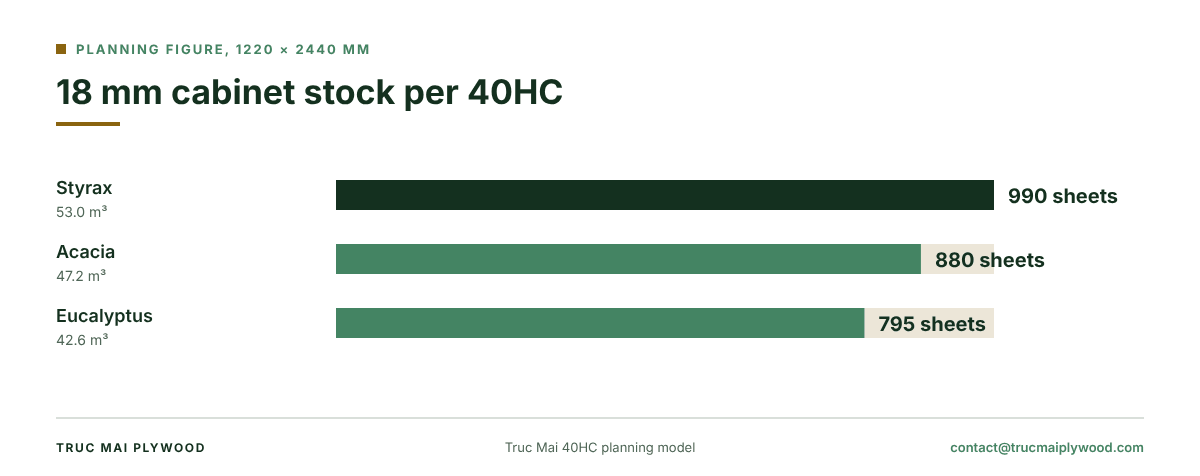
Planned at 1220 × 2440 mm, a 40HC of 18 mm cabinet plywood takes 990 sheets with a Styrax core, 880 with Acacia and 795 with Eucalyptus. The counts come from the mill’s packing model, not from loading records; it assumes a 28,000 kg cargo payload (container tare not included), stacks roughly 1,000 mm tall and 55 sheets in each full pack of 18 mm.
| Cabinet stock, 1220 × 2440 mm, sheets (m³) per 40HC | Styrax core | Acacia core | Eucalyptus core |
|---|---|---|---|
| 18 mm sides and shelves | 990 (53.0 m³) | 880 (47.2 m³) | 795 (42.6 m³) |
| 15 mm wall-cabinet sides | 1,188 (53.0 m³) | 1,056 (47.2 m³) | 960 (42.9 m³) |
| 12 mm drawer boxes | 1,494 (53.4 m³) | 1,328 (47.4 m³) | 1,200 (42.9 m³) |
| 9 mm backs | 1,998 (53.5 m³) | 1,776 (47.6 m³) | 1,605 (43.0 m³) |
Every row is a planned count of panels alone, and on the Eucalyptus rows weight, not space, sets the limit. What a box can really carry depends on the carrier and the route, so confirm the booked payload before trusting any row. The full table for every thickness sits in the 40HC load calculator, and the 18 mm loading and spec guide explains the packing model behind the 18 mm row.
A cabinet container is rarely one thickness. One or two products per box is the norm, and a mix of three to six is possible when agreed in advance; loading the carcass stock with 9 mm backs and 12 mm drawer sides is the typical cabinet case. Because the mix reshapes the pack plan, it is settled before production starts.
Which certificates come with cabinet plywood for the US and EU?
Cabinet plywood from Truc Mai can carry FSC 100% chain of custody (licence FSC-C196493, certificate SA-COC-014545), CARB P2 and TSCA Title VI (CARB/EPA 26053), ISO 9001:2015 quality management (W2012), ISO 14001:2015 environmental management (W2012E) and the EUDR file set with geolocation for both core and face veneer.
Only FSC 100% is licensed; there is no FSC Mix. For cabinet stock the claim appears on the sales and shipping papers only where the panel is an eligible product on the current schedule, so it is agreed per order rather than taken for granted on every sheet. The FSC 100% page shows how the claim travels.
For EU orders, Regulation (EU) 2023/1115 asks for the geolocation of each production plot, using at least six decimal digits. A cabinet panel has two origins: the Vietnamese core logs and the face veneer. Truc Mai supplies origin records and GeoJSON files for both, so the EU importer can file its own due-diligence statement. See the planned EUDR geolocation data page.
Certificate files are sent before the order is confirmed. Draft shipping documents go to the buyer for approval after loading. Truc Mai makes furniture, interior, commercial and packing plywood; marine, structural and film-faced formwork panels are outside its range.
How do you keep one cabinet spec the same every container?
Keep one cabinet spec the same by writing it once, approving a sample of the exact build and copying the same order line onto every repeat order. The approved face sample stays the reference for grading, and the first container’s packing list becomes the reference for counts and weights.
- Approve a free sample of the build: core, plies, face and back pair, thickness and finish.
- Write the order line per part: face and back grade, core grade and stitching, glue and emission, size and tolerance.
- Fix the product mix and pack plan for the container.
- Check the first container against the order line on arrival, part by part.
- On each monthly repeat, edit the quantity or a named item and leave every other field as approved.
The Ha Hoa mill ships around 5,000 m³ of panel in a typical month and around 60,000 m³ over a year, so one or two cabinet 40HC a month fit inside that output with no change to the build. Each container is built in 15–45 days once the 30% deposit arrives, and the rest falls due when the scanned B/L is sent; the deposit and balance terms guide sets out the T/T and L/C options for a monthly programme.
A sample of the cabinet build costs nothing; a new buyer pays its own courier and gets that cost back as a credit on the first real order (see ordering samples).
What should a cabinet plywood order line say?
A cabinet plywood order line names the part, the face and back pair, the core grade and build, glue and emission, thickness and tolerance, sheet size, packing and quantity. Written per part and sent with every repeat, it turns “cabinet grade” into a panel the mill can build the same way each month.
A filled example for a US kitchen-cabinet buyer:
Part: carcass sides. Face and back: birch A over birch B, for clear lacquer. Core: Styrax, A-grade, stitched, 11 plies. Thickness: 18 mm, sanded and calibrated to ±0.3 mm. Glue: UF, CARB P2 / TSCA Title VI under certificate CARB/EPA 26053. Sheet: 1220 × 2440 mm, length and width within ±2 mm. Load: shared 40HC with 9 mm B / C backs, FOB Hai Phong.
A European buyer changes the emission line to E0 and adds the FSC 100% claim and the EUDR file set. A painted-door buyer changes the face to white poplar EV, paint grade. Put the line in a message to the quotation desk or to contact@trucmaiplywood.com, asking for a cabinet sample built to it.
Questions buyers ask
What is the best grade of plywood for cabinets?
For cabinet boxes, order a clear face with a sound back on an A-grade stitched core, sanded to ±0.3 mm. Doors and visible ends take the top face grade on both sides; hidden backs and shelves can take a lower back grade.
What does A/B mean on cabinet plywood?
The first letter is the face grade and the second the back grade. A/B means a top-grade face over a back that allows small, sound defects, a common pair for carcass sides that show on one side only.
Is cabinet grade plywood the same as furniture grade?
In practice yes: both mean a panel with clear faces, a void-free core and a calibrated thickness. Neither term is a standard, so the face grade, back grade, core and tolerance still need writing on the order.
What thickness is cabinet grade plywood?
Most cabinet carcasses use 18 mm for sides, tops and bottoms, 12 or 15 mm for drawer boxes and 6 or 9 mm for backs. US shops that design around 3/4 inch should note that 18 mm is 1.05 mm thinner than 19.05 mm.
Can I get cabinet grade plywood in the 4x8 size?
Yes. 4 × 8 ft is the 1220 × 2440 mm sheet, the main size of the range, beside 1220 × 2280 mm for furniture parts and 1250 × 2500 mm for European lines.
Is Truc Mai cabinet plywood CARB P2 certified?
Yes. Under certificate CARB/EPA 26053, the mill's hardwood plywood with veneer core meets CARB Phase 2 and TSCA Title VI from 3 to 25 mm, a scope that takes in every common cabinet thickness.
Which core is best for cabinet plywood?
Styrax is the lightest of the Vietnamese cores and gives the most sheets per container; Acacia and Eucalyptus are denser and heavier. The core grade matters more than the species: cabinet panels use an A-grade, stitched core.
Does cabinet plywood need waterproof glue?
Dry kitchen and wardrobe boxes use UF glue at E0 emission, which resists about 6 hours of boiling. Vanity units in wet rooms can order melamine-fortified glue, which is usually E1.
How many sheets of 18 mm cabinet plywood fit in a 40HC?
The packing model plans 990 sheets of 1220 × 2440 mm with a Styrax core, against 880 with Acacia and 795 with Eucalyptus. Treat them as planning numbers for the cabinet order, not loading records.
Can I mix cabinet thicknesses in one container?
Yes. Most containers hold one or two products, but by agreement a cabinet buyer can combine three to six, for instance 18 mm carcass panels, 9 mm backs and 12 mm drawer stock.
Does Truc Mai make marine or film-faced plywood for cabinets?
No. Marine, structural and film-faced formwork panels are outside the Truc Mai range; the mill makes furniture, interior, commercial and packing plywood.
How do I check a first cabinet plywood container?
Measure thickness at several points against the written tolerance, check face and back against the approved sample, look at the edges for core gaps and compare the pack count with the packing list.