
The practical Baltic birch plywood alternative from Vietnam is a birch face and back on a hardwood core, not birch all the way through. It matches the face, the flatness and the CNC behaviour, not the all-birch edge. Order it as Baltic birch and the first container disappoints; order it as birch-faced, and Truc Mai repeats the same 11-ply build every month.
Is birch-faced plywood from Vietnam the same as Baltic birch?
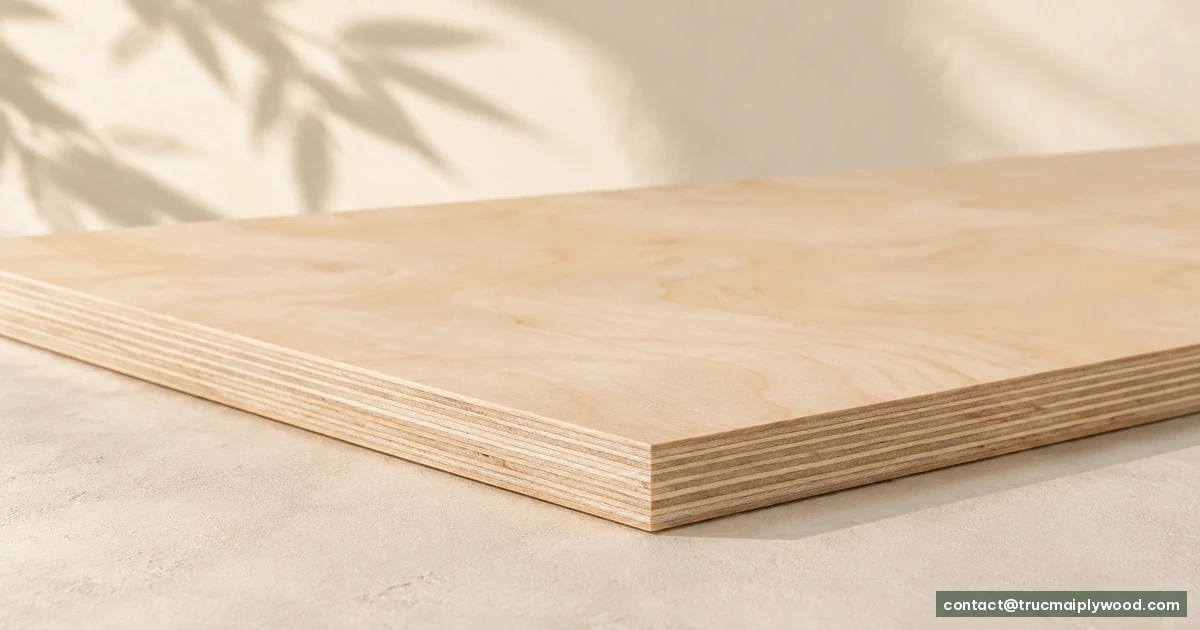
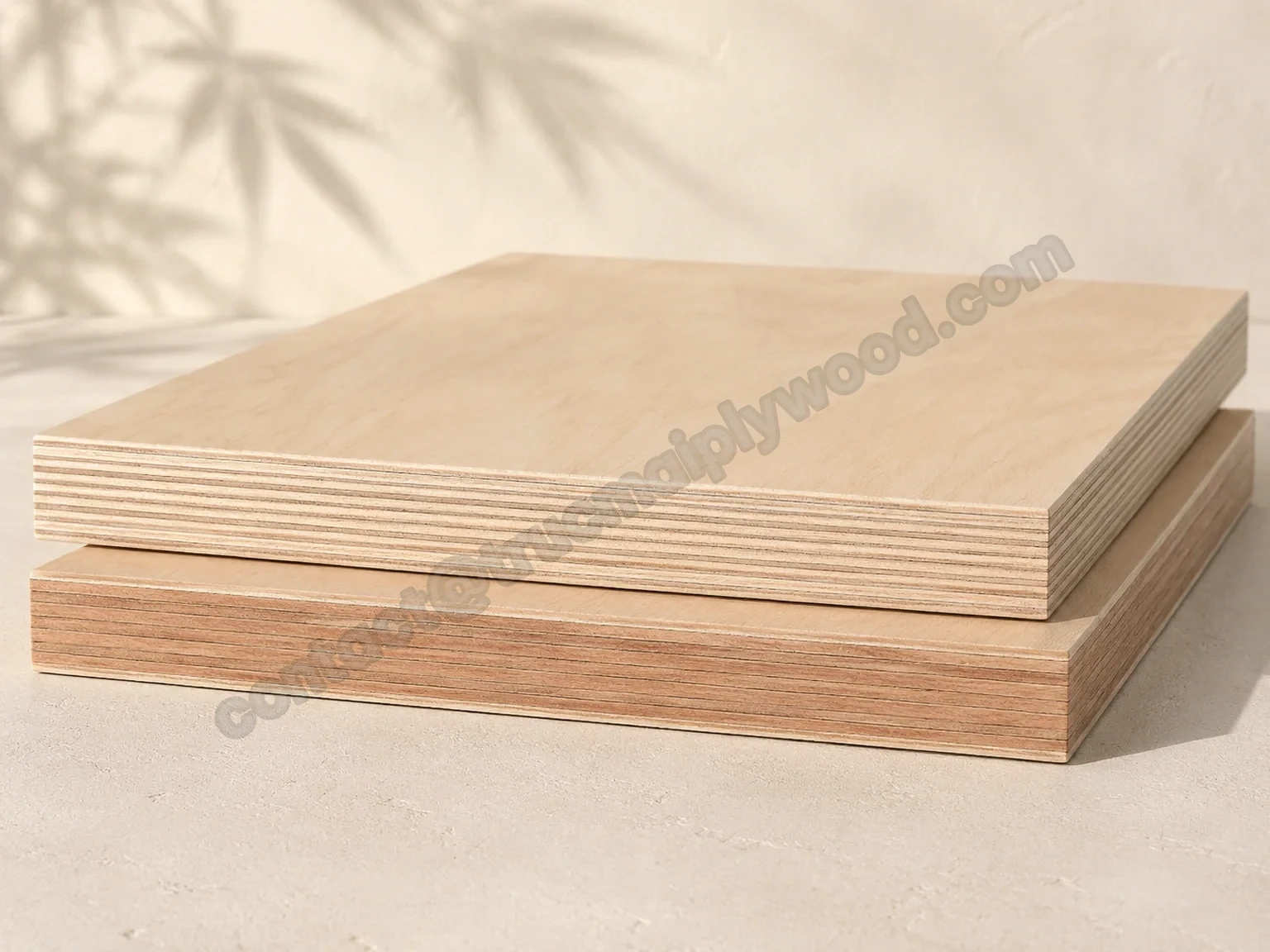
No. Baltic birch plywood is birch in every ply; birch-faced plywood from Vietnam carries a birch face and back over a hardwood core of Styrax, Eucalyptus or Acacia. The face, flatness and machining can match a cabinet or furniture spec, but the edge shows the hardwood core, and the sheet weight follows the core species.
That difference is not a defect; it is a different product, and it should be bought under its own name. A buyer who writes “Baltic birch” on an order to a Vietnamese mill invites a dispute at the first inspection. A buyer who writes “birch-faced, Styrax core, A-grade stitched, 11 plies” gets a panel that can be checked line by line.
Truc Mai sells birch as an imported face veneer on a Vietnamese core and names it birch-faced plywood. Vietnamese plywood has no birch or poplar cores. The core is chosen to balance weight, price and look, and the face is graded against the sample the buyer approves.
What is Baltic birch plywood composition?
Baltic birch plywood composition is simple: every ply is birch veneer, cross-laid, with thin and even plies, glued under pressure and with almost no core voids. The thin even plies give the striped edge, the screw hold and the flatness that furniture and jig makers buy it for.
The name “Baltic birch” is a trade name, not an origin mark. It grew around birch plywood from the Baltic region, Russia and Belarus, sold in the five-by-five-foot sheet as well as in 4 × 8 ft. Face grades in that trade run B, BB, CP, C, with B/BB and BB/BB the usual furniture pairs.
Baltic plywood and Baltic birch: one name, several products
“Baltic plywood” in many shops means the same all-birch panel; elsewhere it covers any birch plywood from the region. When a buyer quotes a “Baltic plywood” price against a birch-faced quote, the first question is whether the comparison sheet is birch in every ply or only on the faces.
Why do buyers look for a Baltic birch plywood alternative?
Buyers look for a Baltic birch plywood alternative because most of that plywood came from Russia and Belarus, and both supplies were cut off for EU buyers in 2022. Prices rose, lead times grew and furniture lines that had built products around birch had to find a panel they could buy every month.
For Russia, Council Regulation (EU) 2022/576 prohibits importing into the Union the goods listed in Annex XXI, which includes chapter 44, wood and articles of wood, with contracts concluded before 9 April 2022 allowed to run until 10 July 2022.
For Belarus, Council Regulation (EU) 2022/355 prohibits importing wood products listed in Annex X, chapter 44, with contracts concluded before 2 March 2022 allowed to run until 4 June 2022.
Plywood sits in chapter 44 of the Combined Nomenclature, under heading 4412, “plywood, veneered panels and similar laminated wood”. The bans therefore cover Russian and Belarusian birch plywood in all its forms. North American buyers faced their own tariff changes on Russian goods in the same period, and many turned to the same alternatives.
A buyer that switches origin also needs paperwork that proves the new origin. That is why the certificate and EUDR file set of the replacement panel matter as much as its face.
Baltic birch against birch-faced plywood: how do they compare?
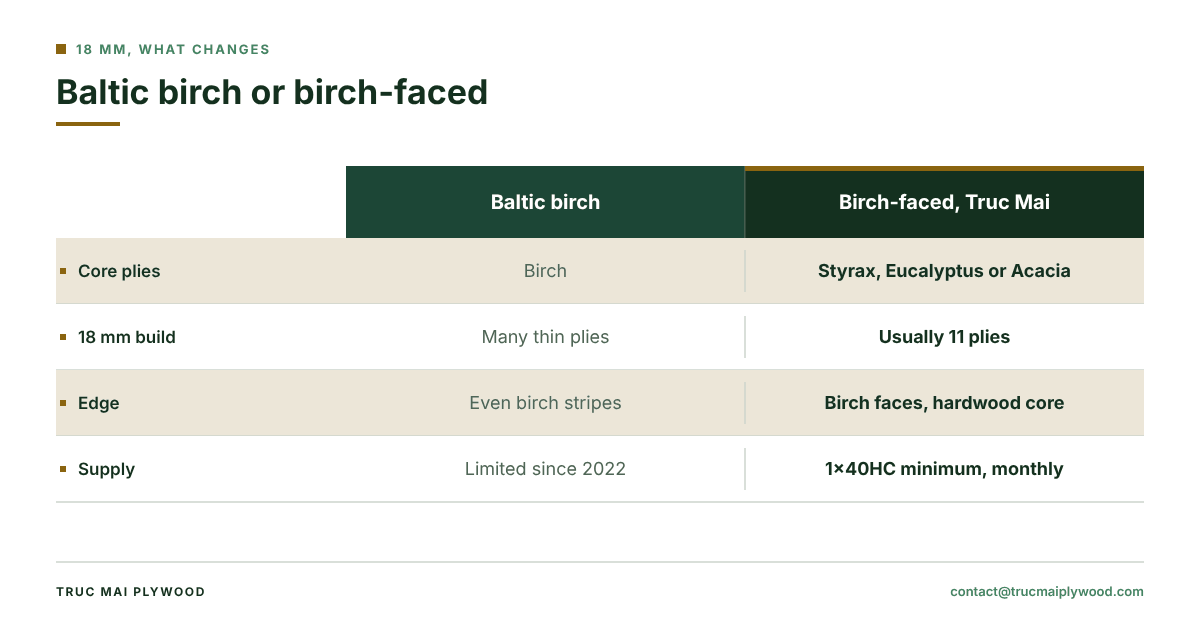
Baltic birch wins on the edge and on even, thin plies through the whole sheet. Birch-faced plywood on a Vietnamese core wins on monthly volume, price per m³, choice of core weight and an origin with full file sets. Both can be built flat and calibrated for CNC work.
| Measure | Baltic birch (all-birch) | Birch-faced, Truc Mai |
|---|---|---|
| Face and back | Birch | Birch, graded against the approved sample |
| Core plies | Birch | Styrax, Eucalyptus, Acacia or combined |
| 18 mm ply count | Usually thirteen thin plies | Usually 11 plies; 11–13 plies to order |
| Edge look | Even pale birch stripes | Birch faces over hardwood core plies |
| 18 mm sheet weight, 1220 × 2440 mm | Heavier than Styrax core | 26.8 kg on Styrax, 34.8 kg on Eucalyptus |
| Thickness tolerance | Per mill | ±0.3 mm sanded and calibrated |
| Sizes | Five-by-five-foot and 4 × 8 ft common | 1220 × 2440, 1220 × 2280, 1250 × 2500 mm |
| Emission, US | Per mill | CARB P2 / TSCA Title VI, CARB/EPA 26053, 3–25 mm |
| Chain of custody | Per mill | FSC 100%, FSC-C196493 |
| EU origin file | Per origin | EUDR file set with core and face geolocation |
| Supply by container | Limited since 2022 | One 40HC minimum, repeat monthly |
The fair verdict follows the use. Where the edge is the product, as in exposed-edge furniture, toys or laser-cut parts sold on their striped look, an all-birch panel is still the right choice. Where the face is the product and the edge is banded, painted or hidden, a birch-faced sheet does the same job.
Where is a birch-faced sheet the better choice, and where is it not?
A birch-faced sheet is the better choice for cabinet carcasses, wardrobe and shelving panels, painted or lacquered doors, edge-banded furniture and CNC-nested parts bought by the container. It is the weaker choice for exposed-edge designs, very thin jig and template stock cut to narrow strips, and any product sold as all-birch.
Birch plywood substitute for furniture
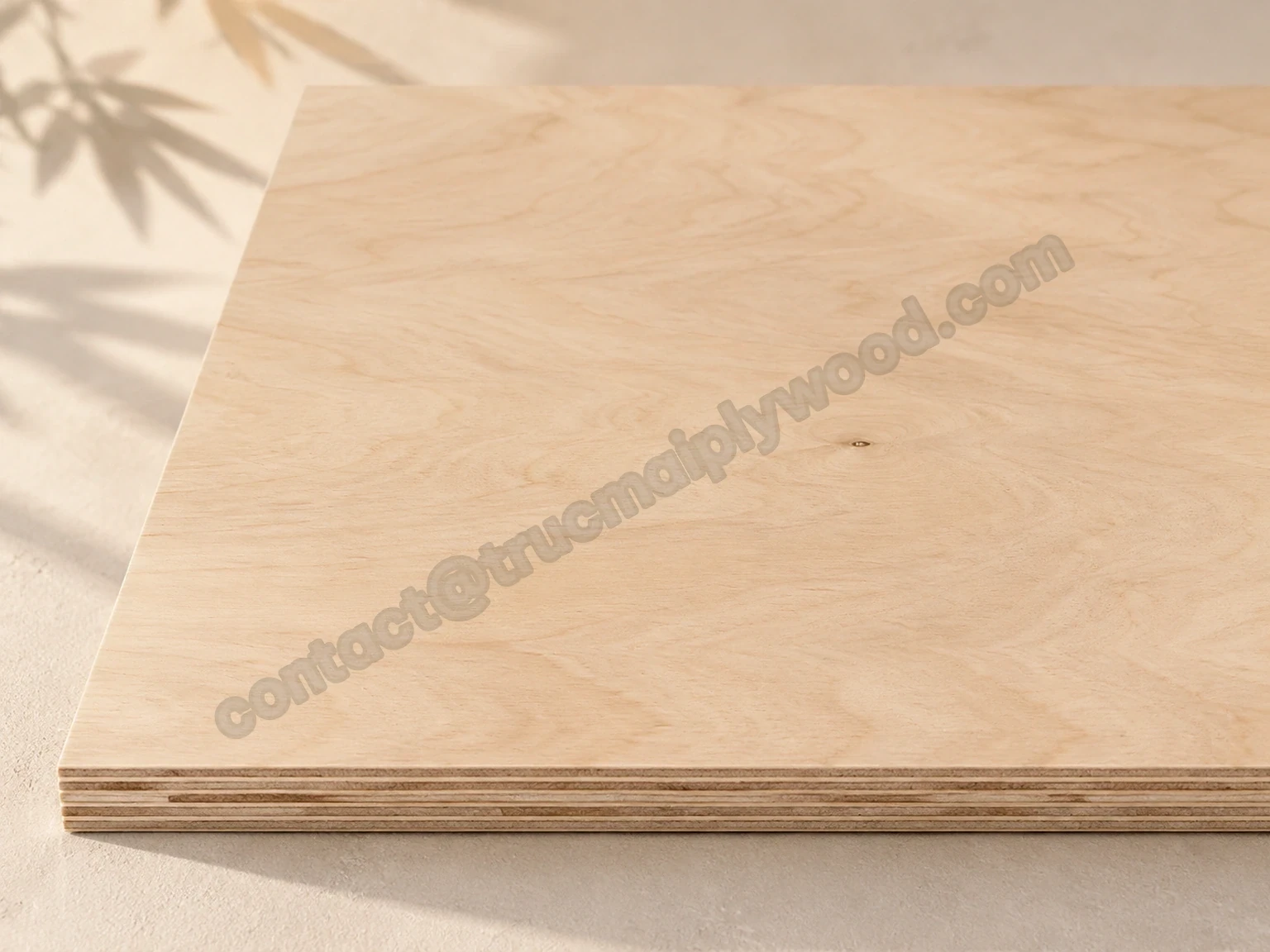
Furniture lines use birch-faced panels for the parts a customer sees as faces: sides, tops, doors and fronts. The edge gets a birch edge band or a solid lipping, and the customer sees birch. Over a monthly programme, the core choice then decides weight and m³ per container rather than looks.
Baltic birch alternative for cabinets
Cabinet makers use a birch face A over a back B on an A-grade stitched core, sanded to ±0.3 mm. The plywood grades for cabinets guide sets out the face and back pairs per part. Drawer boxes with exposed edges are the one place to approve a sample edge before the order.
Where a birch-faced sheet is not the answer, say so on the order sheet and keep that part on all-birch stock. Splitting the bill of materials this way keeps the all-birch spend for the few parts that need it.
Which core sits under the birch face and how does it change sheet weight?
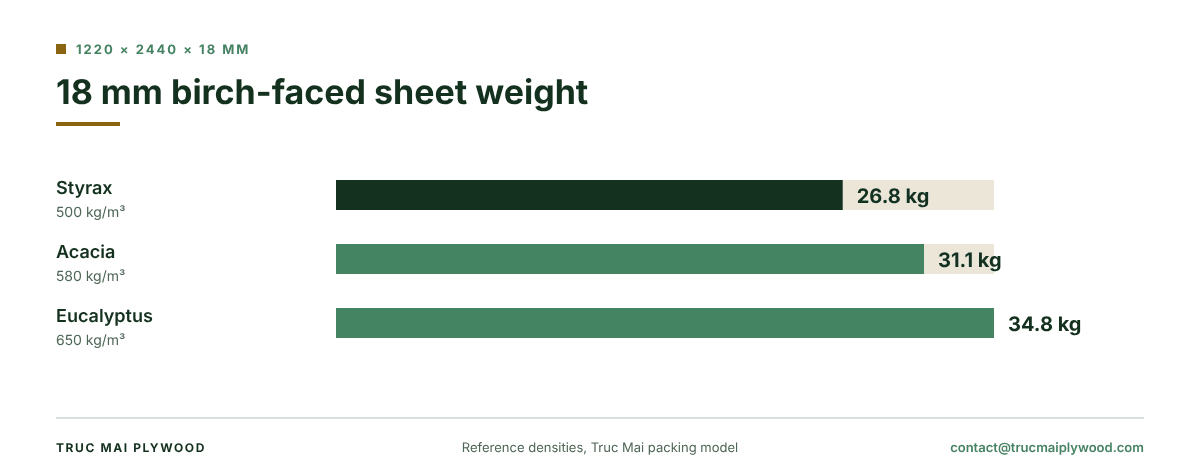
Styrax, Eucalyptus, Acacia or a combined core sits under the birch face. The core decides the sheet weight: at 1220 × 2440 × 18 mm a sheet weighs about 26.8 kg on Styrax, 31.1 kg on Acacia and 34.8 kg on Eucalyptus, from reference densities of 500, 580 and 650 kg/m³.
| Birch-faced sheet, 18 mm, 1220 × 2440 mm | On Styrax | On Acacia | On Eucalyptus |
|---|---|---|---|
| Weight of one sheet | 26.8 kg | 31.1 kg | 34.8 kg |
| Density used in the model | 500 kg/m³ | 580 kg/m³ | 650 kg/m³ |
| Planned sheets in one 40HC | 990 sheets | 880 sheets | 795 sheets |
| Volume per 40HC | 53.0 m³ | 47.2 m³ | 42.6 m³ |
The birch face is thin, 0.2–0.5 mm, so it adds little to the core weight. Eucalyptus is measured at 650–750 kg/m³ at the mill, and its sheets are weighed before the final loading plan. A buyer who wants the denser, heavier feel of Baltic birch chooses Eucalyptus; a buyer who wants the most panels per container and a lighter sheet on the shop floor chooses Styrax.
A combined core lays different species together to balance price, weight and appearance. There is no rubberwood core in the Truc Mai range.
How many plies does an 18 mm birch-faced sheet have?
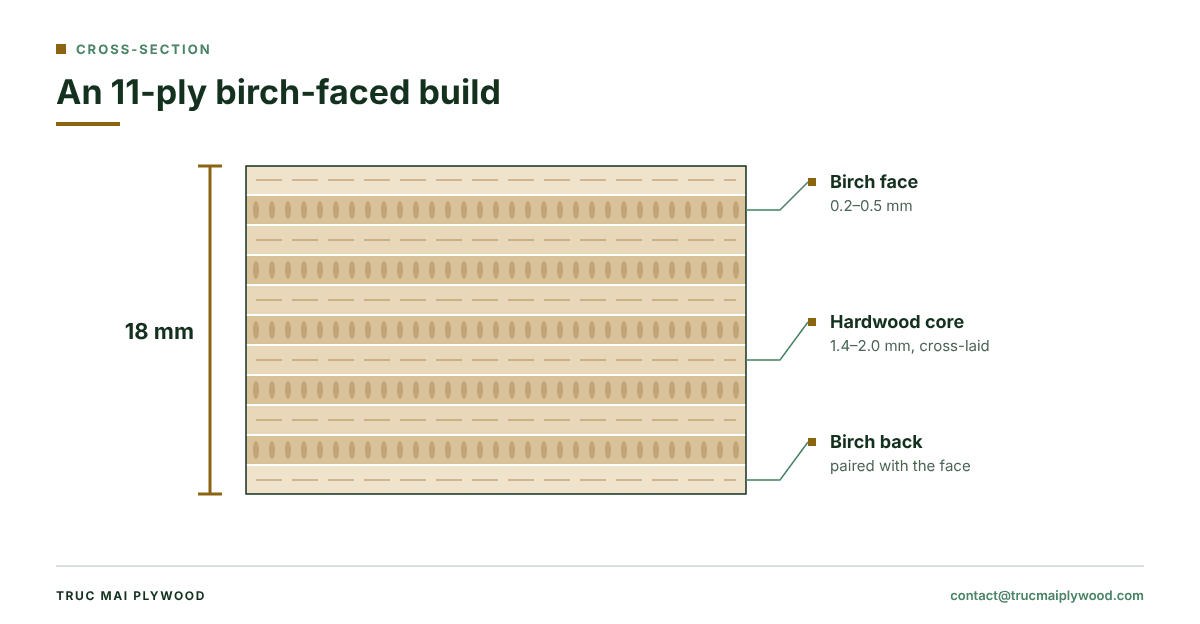
An 18 mm birch-faced sheet usually has 11 plies: a birch face, a birch back and nine cross-laid core plies between them. Builds of 11–13 plies are made to order, and the count is written on the order so every repeat container carries the same build.
Core veneer is usually 1.4–2.0 mm thick and the face veneer 0.2–0.5 mm, usually 0.3 mm for Europe. Baltic birch reaches more plies at the same thickness because its birch plies are thinner. More plies are not a strength rating on their own; the core grade and the stitching decide how well the sheet holds screws and how its edges machine.
The furniture line builds birch-faced panels on an A-grade core, stitched, with sanded faces. Core stitching runs across and along the sheet; usually the outer 2–4 plies are stitched, all plies on request. Thin panels follow their own rule: 3–5 mm sheets are always 5 plies, and 6 mm is built per order.
Birch faced plywood 18mm: the order line for the build
Write “18 mm, 11 plies, birch face / birch back, Styrax core A-grade stitched” and the build is fixed. Leave the ply count out and two containers can arrive with different builds under the same product name.
Which birch face grades and finishes can be ordered?
Birch faces are graded against the approved sample and quoted as face and back pairs, such as a clear face over a sound back for carcass sides, or the top grade on both faces for doors and open shelving. Faces are sanded and calibrated, polished on request, or prepared UV-ready for the buyer’s own coating line.
Birch takes clear lacquer well, which is why it suits natural-look furniture. Under stain it can blotch, so stained fronts often move to okoume, sapele or another face. Paint-grade work can drop to white poplar EV, which costs less than birch and paints evenly.
A birch face sold as “UV-ready” has been prepared on both sides so the buyer can coat it on its own UV line; the mill applies no UV itself. The same cores also take melamine, HPL and paper-overlay faces for interior parts that need no finishing.
Which thicknesses and sheet sizes are made?
Birch-faced panels come in every listed thickness from 40 mm down to 3 mm (40, 30, 25, 21, 18, 15, 12, 9, 6, 5, 4 and 3 mm) and in 1220 × 2440 mm, 1220 × 2280 mm and 1250 × 2500 mm. Custom sizes go up to 1250 × 2500 mm; nothing larger is made, and the five-by-five-foot Baltic format is cut from a standard sheet.
The 1220 × 2280 mm sheet is a shorter furniture-parts size; it earns its place when the cutting list fits it with less offcut. On a cut-to-size order, each birch-faced sheet can be divided into 2, 3, 4 or 6 panels before it is packed.
| Thickness | Typical birch-faced use | Tolerance written |
|---|---|---|
| 3–6 mm | Drawer bottoms, backs, laser and craft parts | ±0.3–0.5 mm per order |
| 9 mm and 12 mm | Drawer boxes, door panels | ±0.3 mm sanded |
| 15 mm and 18 mm | Carcasses, shelves, furniture panels | ±0.3 mm sanded and calibrated |
| 21 mm and 25 mm | Worktops, heavy shelving | ±0.3–0.5 mm per order |
How many 18 mm birch-faced sheets fit in a 40HC?
At 1220 × 2440 mm, a 40HC is planned at 990 sheets of 18 mm birch-faced plywood on Styrax core, about 53 m³, against 880 sheets on Acacia and 795 on Eucalyptus. The Truc Mai packing model behind those counts uses panels only, a 28,000 kg cargo payload and packs roughly 1,000 mm tall.
The core decides the count because every 18 mm load is capped by weight before it is capped by space. For birch-faced 18 mm the model plans up to 18 packs on a Styrax core, 15 on Eucalyptus and 16 on Acacia. A pack starts as 1,000 mm over the thickness, rounded down, and weight then trims it; on Eucalyptus that trim stops each pack at 53 sheets.
Birch faced plywood per 40HC container in the European size
On the larger 1250 × 2500 mm sheet, Styrax still plans at 990 sheets, now 55.7 m³, while the weight cap pulls Acacia down to 848 sheets and Eucalyptus to 765. Carrier and route fix what a box may really carry, so check the booked payload first. Run other thicknesses in the 40HC load calculator and see the packing model in the 18 mm loading and spec guide.
Can the same birch-faced spec be repeated container after container?
Yes. The same birch-faced spec repeats when the build is written once and copied: face and back grade pair, core species and grade, stitching, ply count, glue and emission, thickness and tolerance, sheet size and pack count. The approved face sample stays the grading reference for every later container.
- Approve a free sample of the exact build: birch face pair, core, plies and finish.
- Write the order line with every item above, including “birch-faced”, never “Baltic birch”.
- Fix the pack plan from the planning table and the booked payload.
- Check the first container on arrival and keep its packing list as the reference.
- Reorder monthly on that same line, editing just the quantity or a named item.
With around 5,000 m³ of panel shipped from Ha Hoa in a typical month and about 60,000 m³ a year, one or two birch-faced 40HC a month fit inside the mill’s output with the build unchanged. Each birch-faced container is built in 15–45 days after the 30% deposit, and the balance follows the scanned B/L; the deposit and balance terms guide covers T/T, L/C and the delivery terms.
Most boxes hold one or two products, and three to six can share one where agreed, which lets the birch-faced carcass stock share a 40HC with 9 mm backs or with white poplar EV panels for the painted parts.
Which certificates come with birch-faced panels for EU and US orders?
A birch-faced order can ship with the EUDR file set, geolocated for both the Vietnamese core and the birch face, and with four certificates: CARB P2 and TSCA Title VI (CARB/EPA 26053, 3–25 mm), FSC 100% chain of custody (licence FSC-C196493, certificate SA-COC-014545), ISO 9001:2015 (W2012) and ISO 14001:2015 (W2012E).
For US orders
The CARB P2 and TSCA Title VI certificate is held in Truc Mai’s own name through the third-party certifier ICTT Corporation (TPC-43), mill ICTT-26053, for hardwood plywood with veneer core, 3–25 mm and 3–15 plies. The federal limit for that product is 0.05 ppm formaldehyde under 40 CFR 770.10. Panels of 30 and 40 mm are outside the certificate scope.
For EU orders
Each production plot must be geolocated to at least six decimal digits under Regulation (EU) 2023/1115. A birch-faced panel has two origins, the core logs and the birch face veneer, and both need their file. Truc Mai supplies origin records and GeoJSON files for core and face so the EU importer can file its own due-diligence statement. See the planned EUDR geolocation data page.
The FSC claim is stated on sales and shipping documents for eligible products on the current product schedule; it is agreed per order and never assumed for every panel. Certificate files are sent before the order is confirmed.
What other Baltic birch alternatives do buyers consider?
Buyers also consider all-birch plywood from Finland and other European mills, birch plywood from China, maple- or poplar-faced hardwood plywood, and combi-core panels. Each solves part of the problem: European all-birch keeps the edge at a higher price, while faced hardwood panels keep the face and the volume.
Birch plywood from China meets an extra cost at the EU border: Regulation (EU) 2025/2333 sets anti-dumping duty on Chinese hardwood plywood at 86.8% for most companies and 43.3% for a single named exporter, charged on the net free-at-Union-frontier price. Vietnamese-made panels sit outside that measure, so for a birch-faced buyer the rate is simply one line in a landed-cost comparison.
Poplar- and EV-faced panels are the budget step for painted work. Truc Mai makes them on the same cores and in the same sizes, so a furniture line can move painted parts off birch without changing the cutting list. What Truc Mai does not make: marine, structural or film-faced formwork panels.
How do you check a birch-faced container on arrival?
Check a birch-faced container against the order line, not against a memory of Baltic birch. Open several packs from different positions, compare faces and backs with the approved sample under raking light, measure thickness at the corners and centre of the long edge, count plies on a cut edge and weigh one sheet against the packing list.
- Faces: compare the face and back of sheets from the top, middle and bottom of a pack with the approved sample.
- Thickness: measure with a caliper against the written tolerance, for example ±0.3 mm on sanded furniture stock.
- Build: cut one sheet and count the plies; an 11-ply order shows a birch face, nine core plies and a birch back.
- Core: look along the cut edge for gaps or overlaps; an A-grade stitched core shows tight, even plies.
- Weight and count: weigh one sheet and compare the pack count with the packing list.
Write down what was found, with photos, while the container is still at the warehouse door. A dispute settled on a written order line and photos of the same sheets is short; a dispute about whether a sheet “looks like Baltic birch” has no end. Truc Mai weighs real sheets before the final loading plan, so the packing list already carries measured weights to compare with.
The same check, repeated on every container, is what turns a first trial into a monthly programme. Keep the first container’s packing list and inspection photos as the reference, and send any difference to the mill with the pack number, so the next production run corrects it.
What should a birch-faced order line say?
A birch-faced order line names the application, face and back grade pair, core species and grade, stitching and plies, glue and emission, thickness with tolerance, sheet size, packing and quantity. It says “birch-faced”, so the mill and the inspector judge the sheet against what was actually bought.
A filled example for an EU furniture buyer replacing Baltic birch:
Birch-faced plywood for furniture carcasses and shelves, 18 mm, 11 plies. Faces: birch both sides, clear-lacquer grade to the approved sample. Core: Styrax, A-grade, stitched. Glue: UF, E0 emission. Paperwork: FSC 100% claim plus the EUDR file set with geolocation for core and birch face. Sheet: 1220 × 2440 mm; thickness ±0.3 mm, sanded and calibrated; length and width ±2 mm. Quantity: 990 sheets in 1×40HC, FOB Hai Phong.
For a US cabinet line, swap the emission field for CARB P2 / TSCA Title VI with certificate CARB/EPA 26053. Send the line to the quotation desk or to contact@trucmaiplywood.com, and ask for a birch-faced sample with an edge cut, so the core can be judged before the first container.
Questions buyers ask
What is a good alternative to Baltic birch plywood?
For furniture, cabinets and CNC parts, a birch-faced plywood with birch face and back on a stitched A-grade hardwood core is the closest volume alternative. Where an all-birch edge must show, Finnish or other European all-birch plywood is the like-for-like option.
Is Vietnamese birch plywood real birch?
The face and back veneers are real birch, imported as face veneer. The core plies are Vietnamese hardwood such as Styrax, Eucalyptus or Acacia, so the correct name is birch-faced plywood.
What is Baltic birch plywood made of?
Baltic birch plywood is made of birch veneer in every ply, cross-laid and glued, with thin even plies and very few core voids. That composition gives the clean striped edge it is known for.
Why is Baltic birch hard to buy now?
Most Baltic birch came from Russia and Belarus, and since 2022 the EU has banned imports of wood products from both countries. Supply shifted to other origins and to birch-faced panels.
How heavy is an 18 mm birch-faced sheet?
About 26.8 kg on Styrax core and about 34.8 kg on Eucalyptus core at 1220 × 2440 × 18 mm, on reference densities of 500 and 650 kg/m³. The thin birch face adds little to the core weight.
How many plies does 18 mm birch-faced plywood have?
Usually 11 plies, with 11–13 plies built to order. The count is written on the order so it stays the same on every repeat.
Can birch-faced plywood be used for drawer boxes with exposed edges?
Yes, on an A-grade stitched core with a clear lacquer, but the edge shows hardwood core plies rather than all-birch plies. Buyers who sell the striped edge as a feature should approve a sample edge first.
Is birch-faced plywood from Truc Mai CARB P2 certified?
Yes, between 3 and 25 mm. Certificate CARB/EPA 26053 puts the mill's veneer-core hardwood plywood, birch-faced panels included, under CARB Phase 2 and TSCA Title VI.
Can I get FSC birch-faced plywood?
Truc Mai holds FSC 100% chain of custody (FSC-C196493). The claim applies to eligible products on the current product schedule and is agreed per order, face veneer included.
What sizes does birch-faced plywood come in?
1220 × 2440 mm, 1220 × 2280 mm and 1250 × 2500 mm, plus custom sizes up to 1250 × 2500 mm, in 3–40 mm.
Does EU anti-dumping duty on Chinese plywood apply to Vietnamese birch-faced plywood?
No. The EU duty under Regulation (EU) 2025/2333 applies to hardwood plywood from China; it does not apply to plywood made in Vietnam.
What is the minimum order for birch-faced plywood?
One 40HC. Production takes 15–45 days after the 30% deposit, and the 70% balance is paid against the scanned B/L.