
Packing plywood · Ha Hoa, Phu Tho, Vietnam
Packing plywood by the 40HC for crate and pallet makers
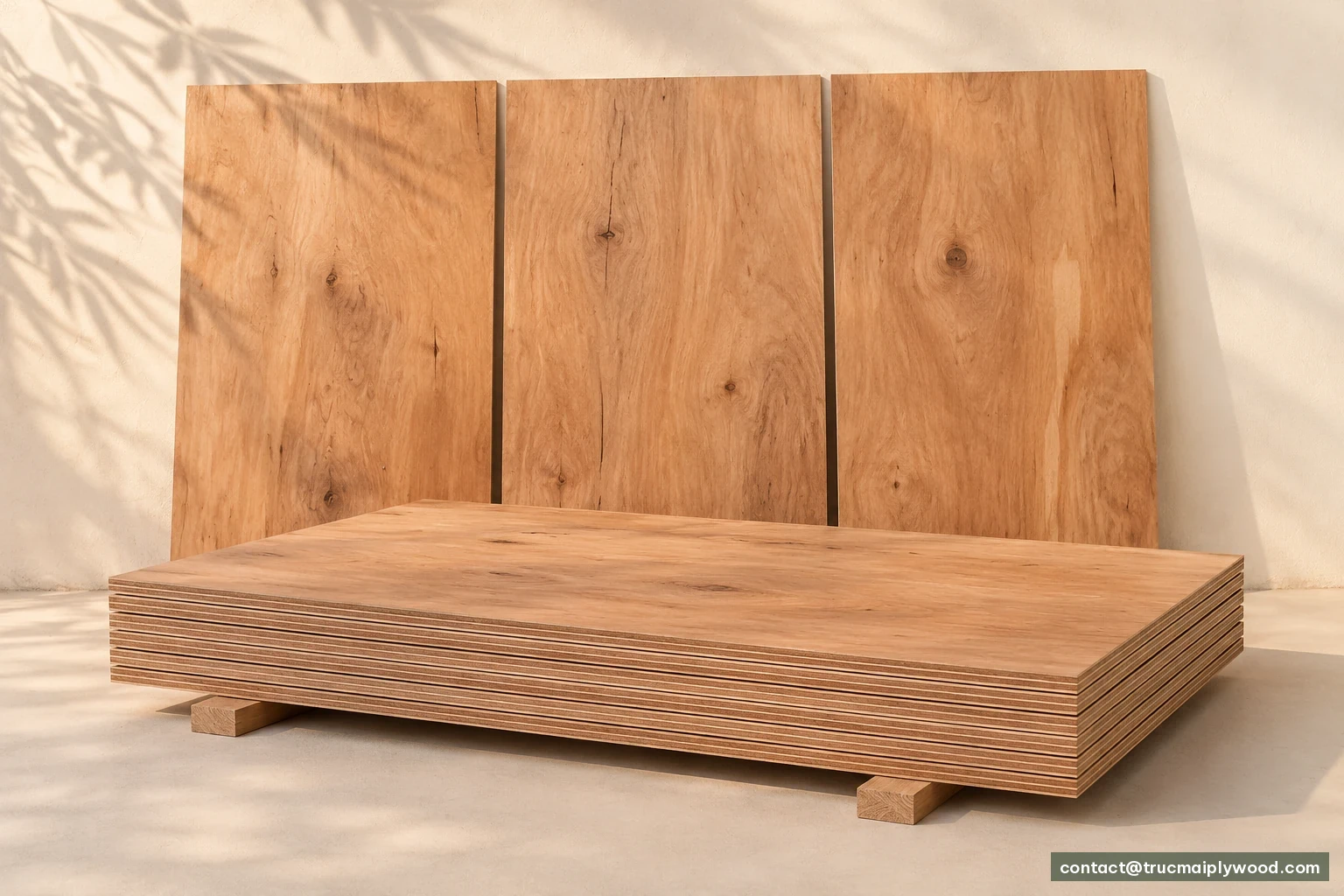
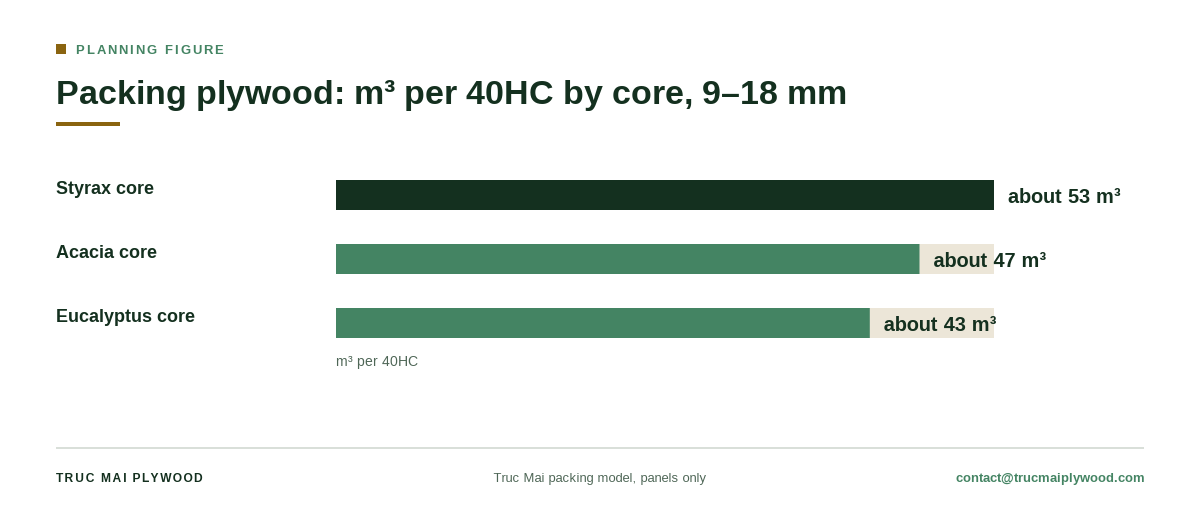
Packing plywood from Truc Mai is a utility panel for crate, case and pallet makers who buy on cost per crate and reorder every month. It has an AB loose-laid hardwood core, plain faces and a UF glue line, usually at E2 emission, and comes as full sheets or cut to your crate sizes. A Styrax-core 40HC carries about 53 m³ as a planning figure.
Truc Mai presses around 60,000 m³ of plywood a year at Ha Hoa, Phu Tho, about 5,000 m³ in an average month. Packing panels run on the same peeling, drying and pressing lines as the commercial range, with a cheaper core build and wider face limits, so a monthly packing programme fills gaps in a steady plan.
A crate shop needs the same three numbers on every container: thickness, m³ in the box and panel count per crate size. Everything below is written around those three.
- AB, loose-laidCore
- Usually E2Emission
- ±0.5–1.0 mm, written per orderTolerance
- About 53 m³ on Styrax (planning)Per 40HC
- 2, 3, 4 or 6 panels per sheetCut sizes
On arrival
What a packing plywood pack should look like at your door
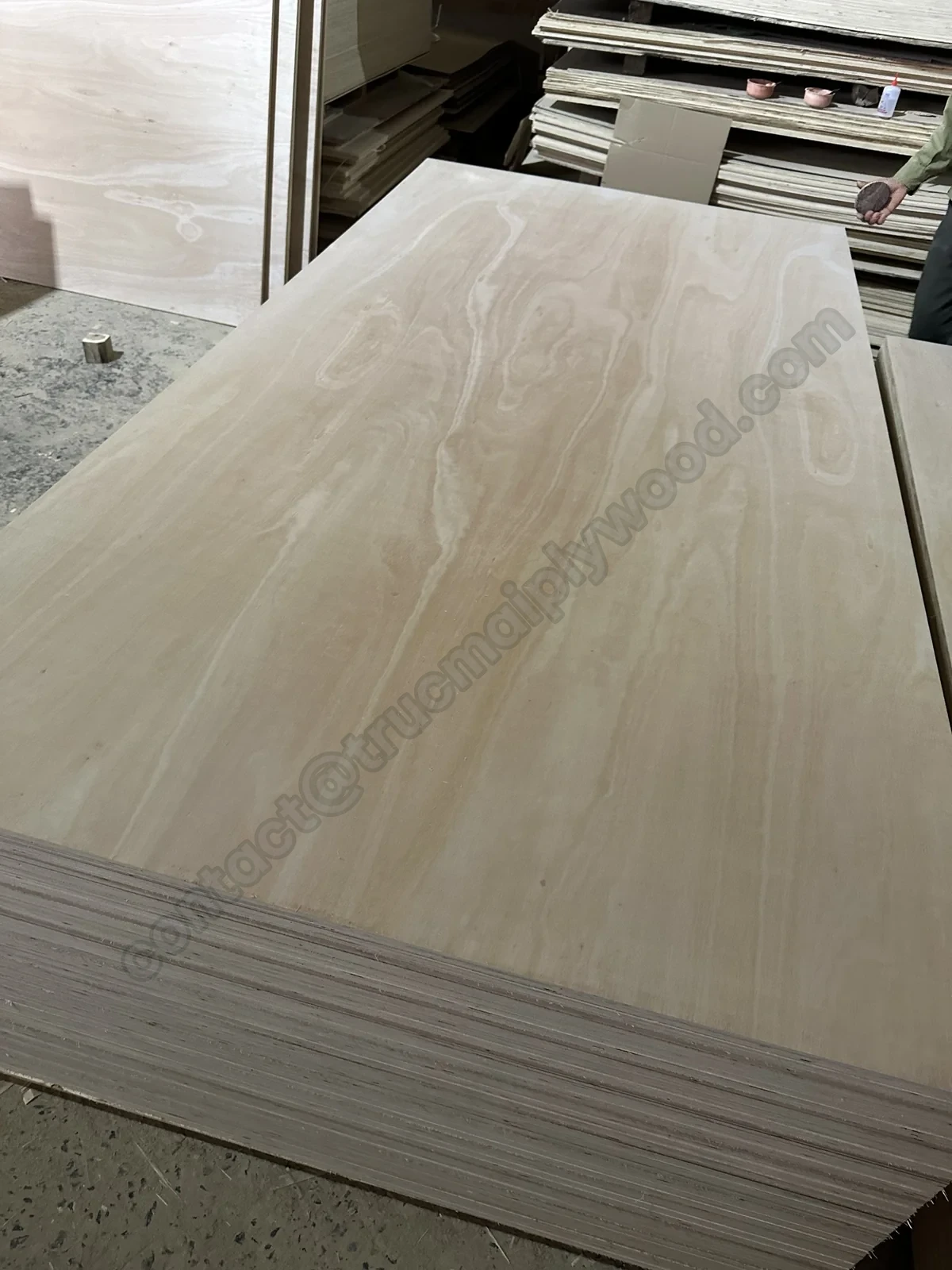
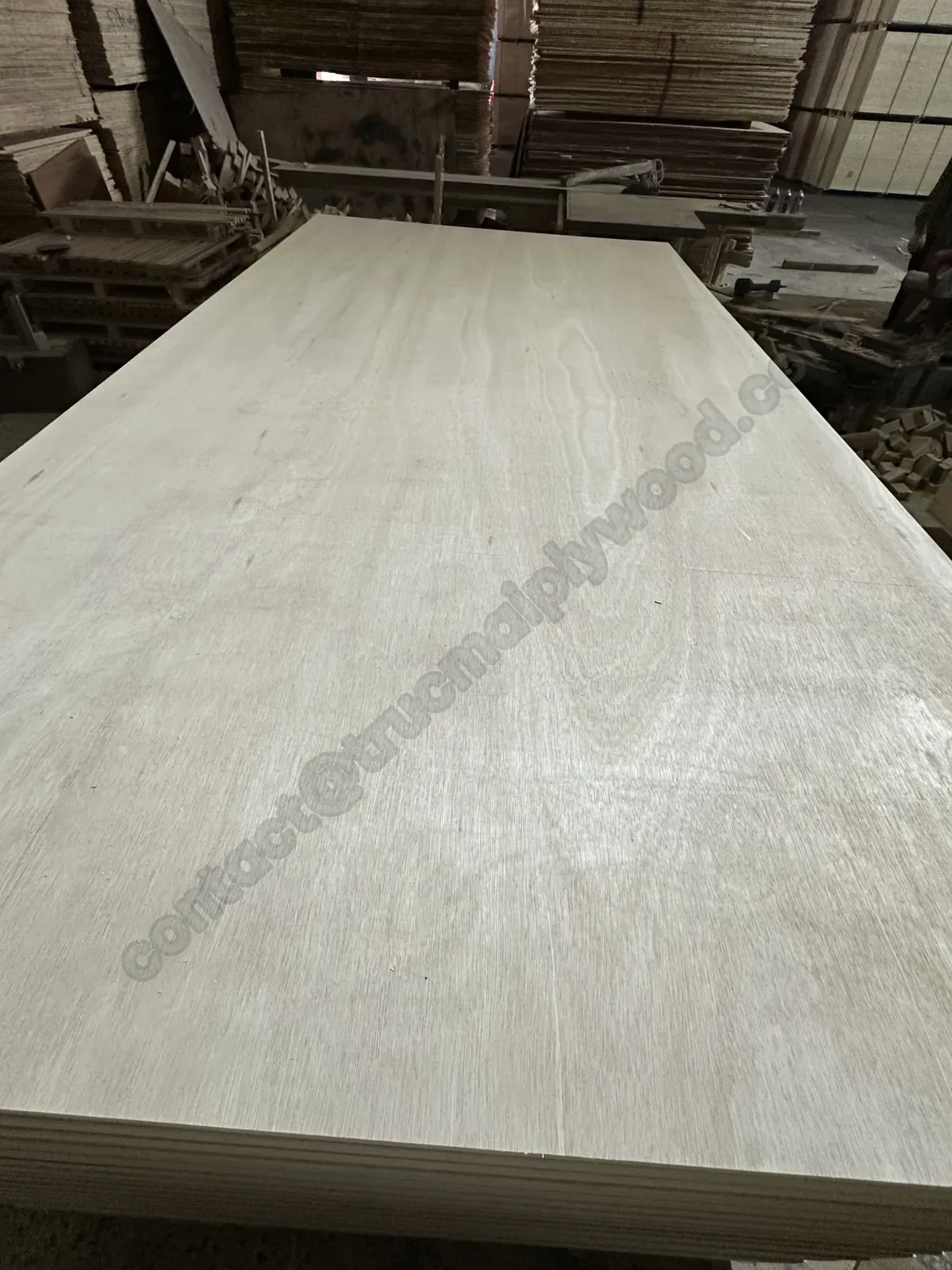
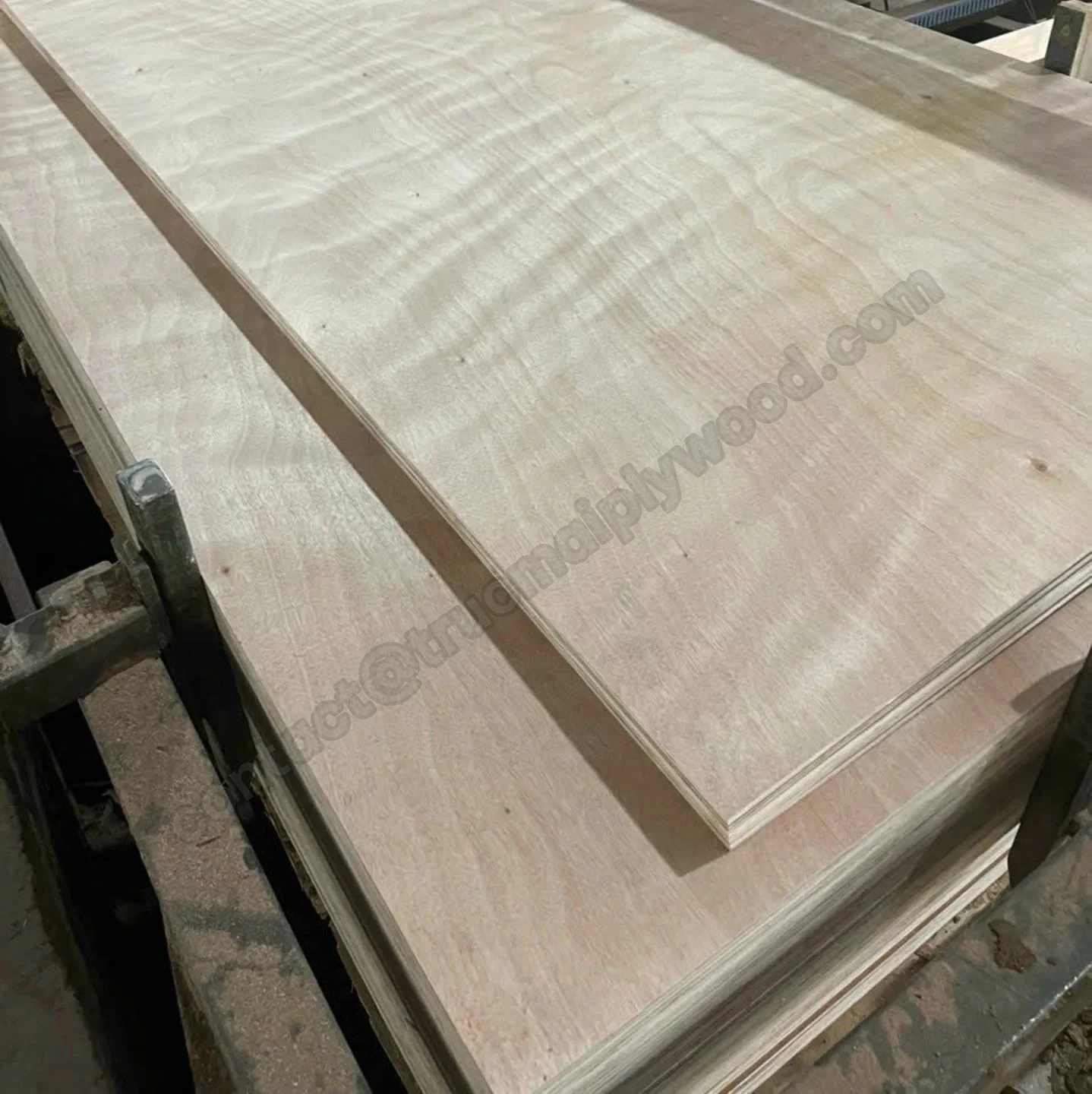
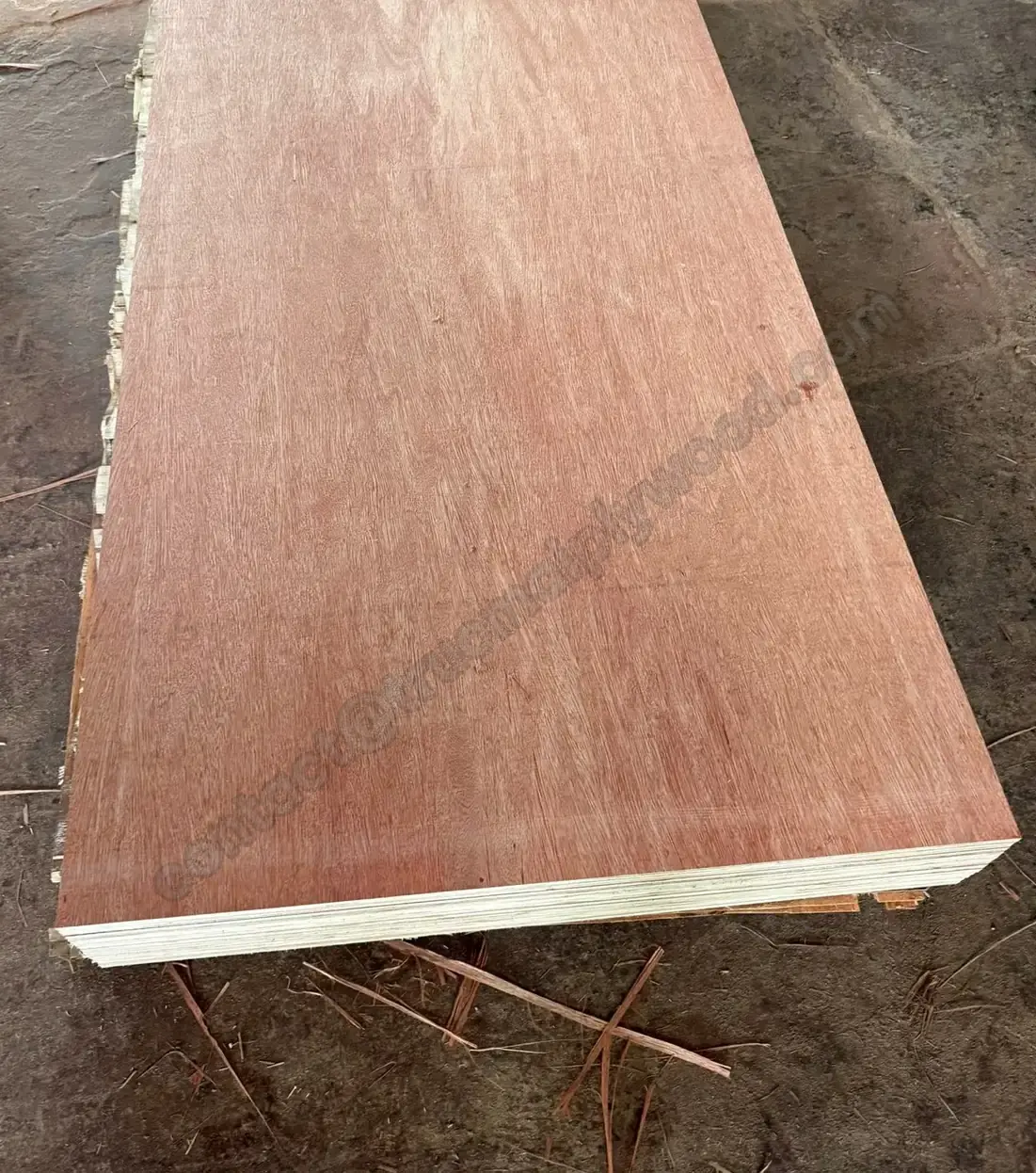
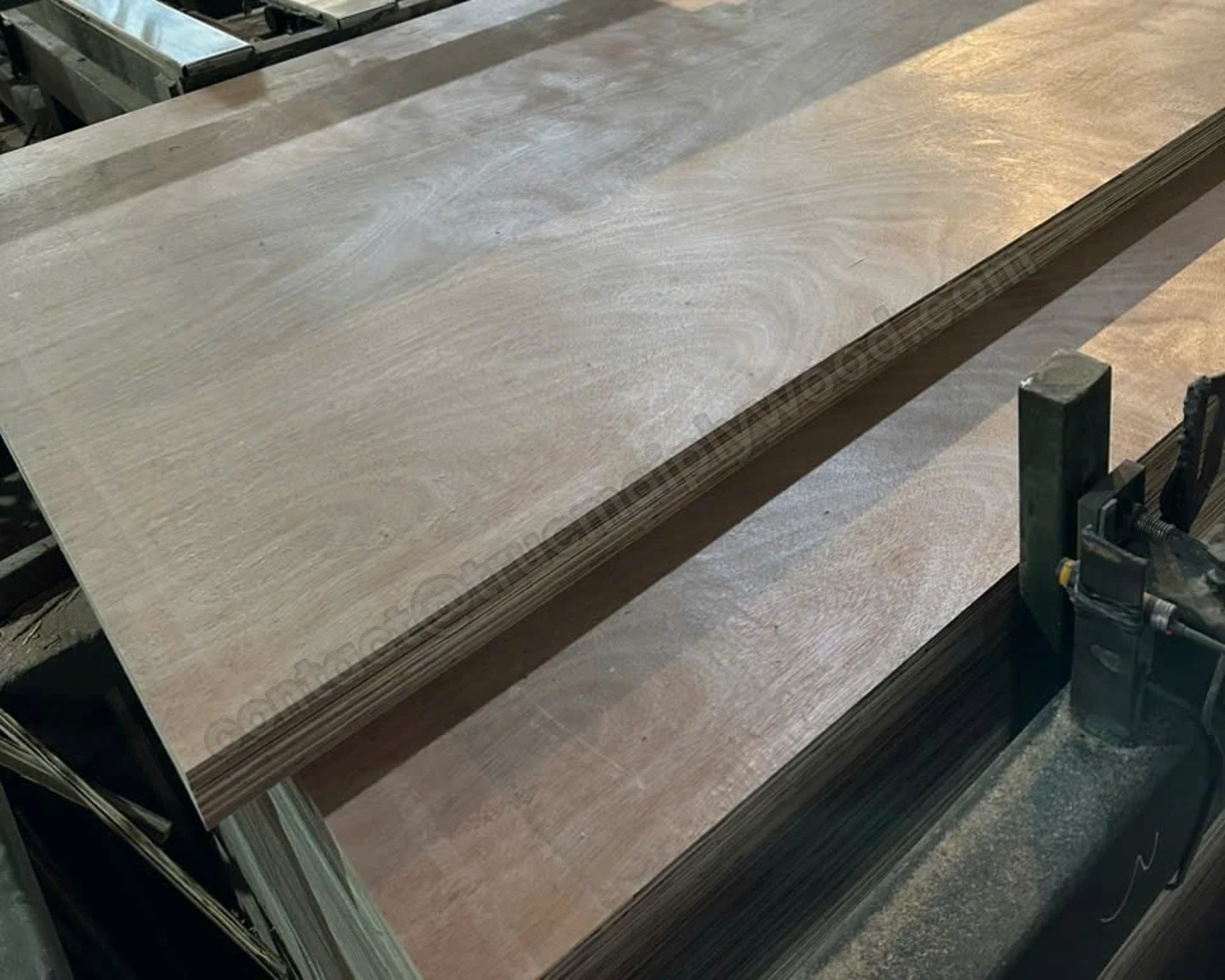
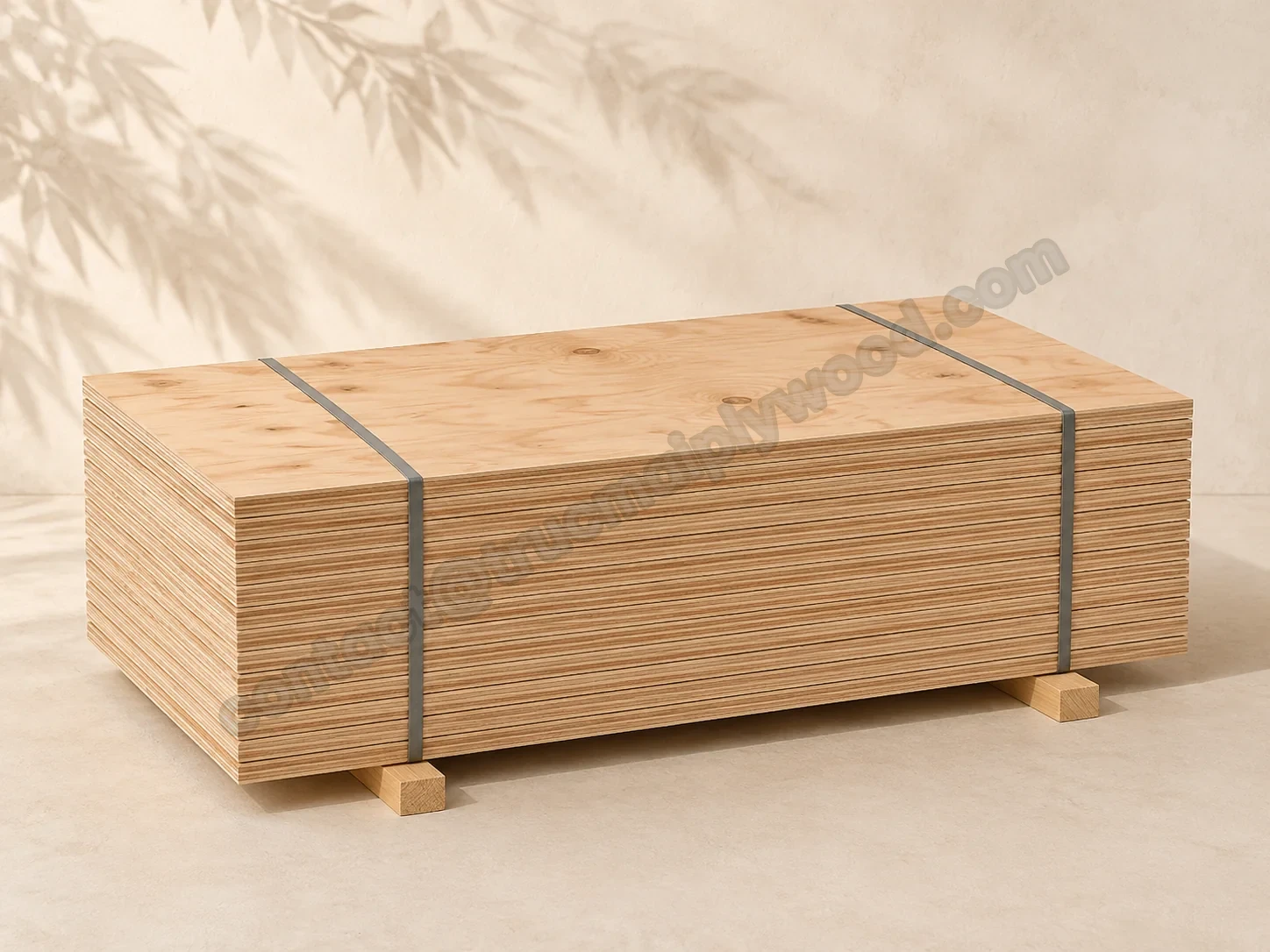
A packing pack looks rougher than a furniture pack, and it should. What matters on arrival is that sheets are flat enough to nail, thickness sits inside the written tolerance, and the count per pack matches the packing list.
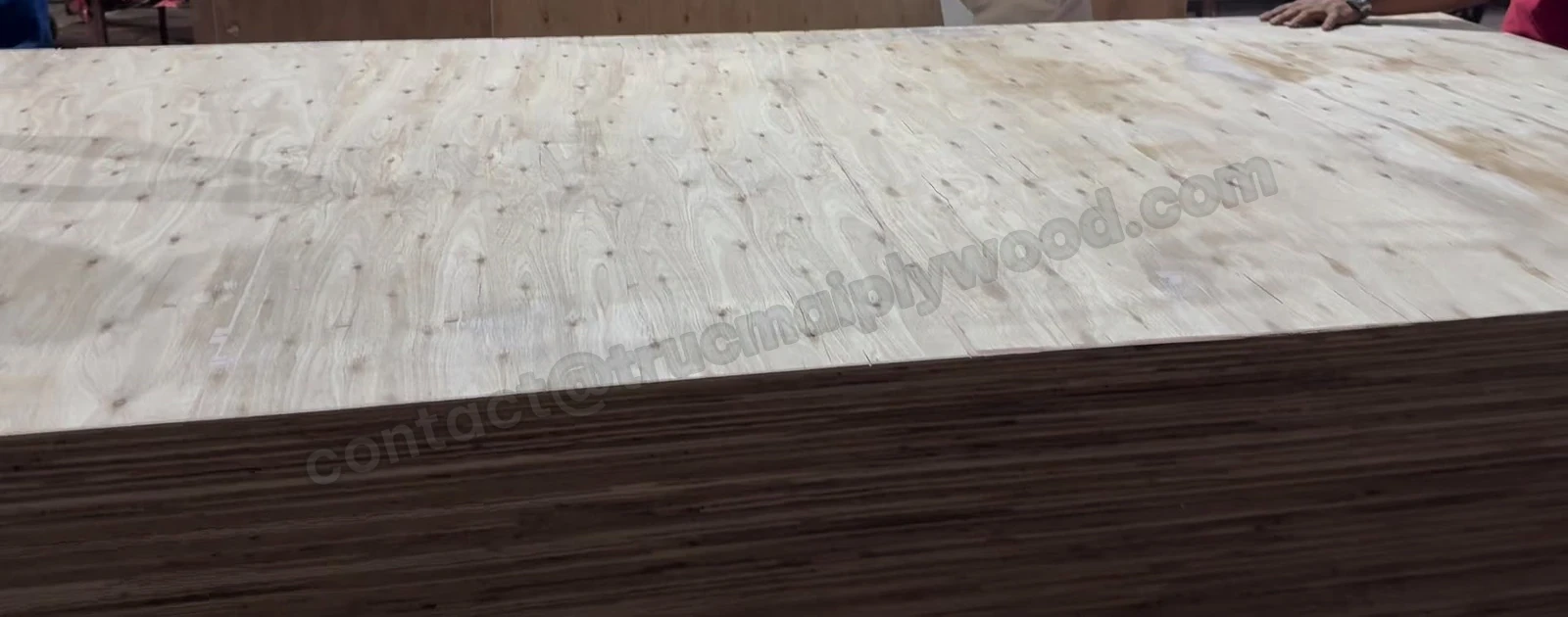
Faces carry splits, knots and patches; edges show small gaps where loose-laid core pieces meet. None of these are faults on a packing order. A blow, a soft spot that dents under the thumb, or a face lifting at the edge is a fault, because it opens at the nail line.
Lay one sheet across two battens at your usual spacing and stand on the middle. A sheet that sags far more than the last container's tells you the core or thickness has moved, and that is worth raising before the next load is pressed.
For cut panels, measure ten pieces of each size against the cut list. Cut panels are counted per size, so a short count in one size shows on the packing list before you open a single bundle.
Check the moisture feel too. Packing plywood leaves the press dry; sheets that feel cold and heavy at the pack edge have taken on water on the way and should be noted on the arrival report before they are nailed.
Specification
How packing-grade plywood is built
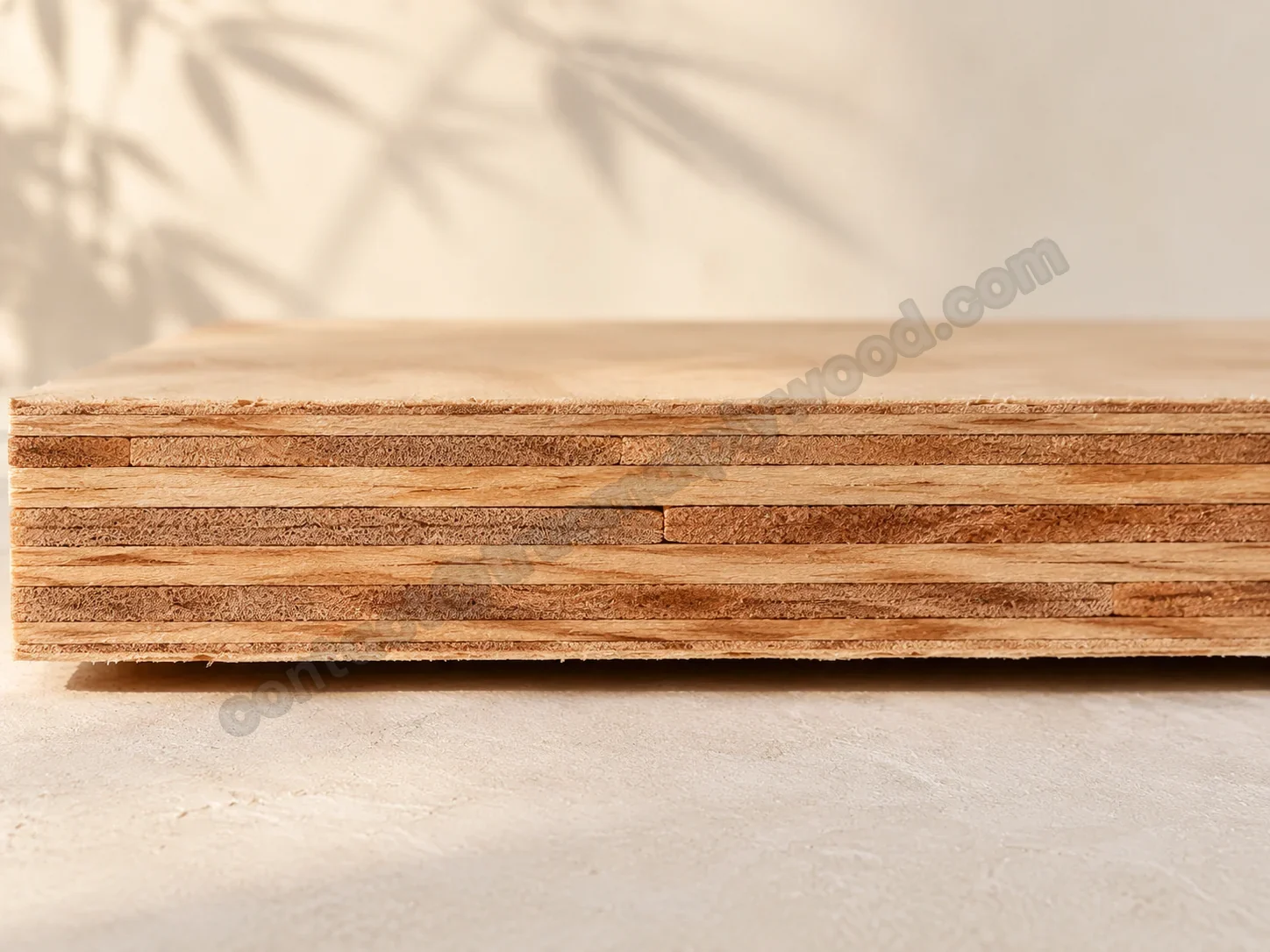
Packing-grade plywood is cross-laid hardwood veneer pressed into a sheet that nails and screws into a crate but is not graded for looks. At Truc Mai it has an AB core laid loose, utility faces and a UF glue line, usually at E2 emission.
Loose-laid means the core veneer pieces sit edge to edge without a joint. It saves labour and wood, and the small gaps it leaves do not matter in a crate side nailed to battens. A gap does matter where a nail lands on it, which is why the order states the batten spacing: the mill keeps gaps away from the usual nail lines on cut panels.
E2 emission is the usual choice because most crates carry machinery and goods that travel and stand in warehouses or outdoors. Where a crate goes into a closed room, or the goods are sold in a market with a formaldehyde limit on wood products, order E0 and the glue line changes with it.
Write the core gap limit on the order as a maximum gap width. The checks hold the core to it, with most attention at the sheet edges, because that is where a crate nail splits a loose-laid panel.
The cheapest packing sheet is not always the cheapest crate. A core that is too thin or too gappy splits at the nail line and adds rejects at your bench. Tell us how the crate is assembled, and the thickness and core are chosen for that, not for the lowest price per sheet.
- Core species Eucalyptus, Acacia, Styrax or a combined core, peeled from plantation wood near the mill
- Core build AB grade, loose-laid: core pieces butt together without jointing, small gaps allowed
- Core veneer Usually 1.4–2.0 mm
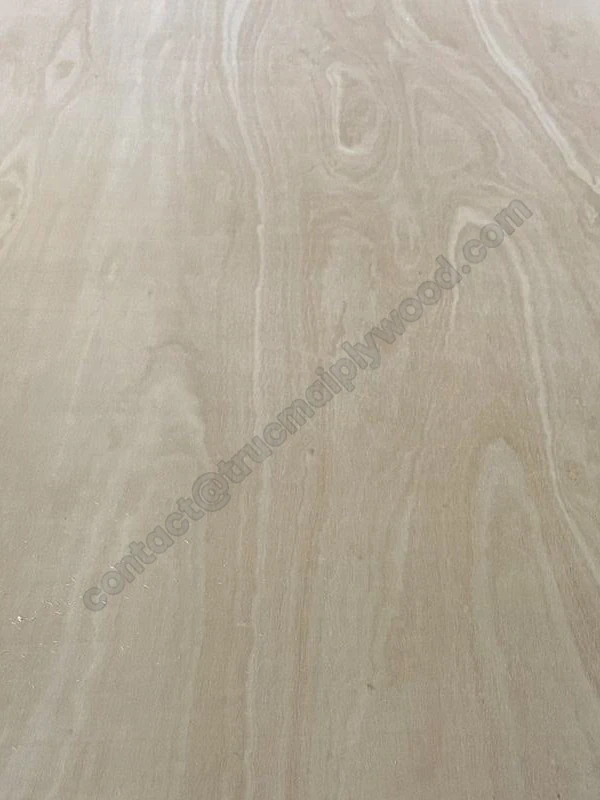
- Faces Utility hardwood face and back; splits, knots, patches and colour variation allowed
- Thickness list 3–40 mm; crate shops mostly order 9, 12, 15 and 18 mm
- Thickness tolerance Usually ±0.5–1.0 mm for packing grade, written on each order
- Sheet size 1220 × 2440 mm or 1250 × 2500 mm; length and width ±2 mm
- Glue and emission UF glue, usually E2; E0 or E1 on request
- Surface Unsanded or lightly sanded
- Stitching Not needed for crates; outer plies stitched on request
Face grades
Packing plywood grades: what each face allows
Packing faces are graded for use, not looks. Three grade pairs cover almost every crate and pallet order, and the pair is written on the order next to the thickness.
On packing orders, AB names the core grade, not an A face. If you need a clean A face for a printed or display crate, the sheet is priced as commercial plywood instead.
Grades are agreed against a sample sheet and a photo, then written as two letters, face first. The same letters go on every reorder, so a crate shop sees no difference on the nailing bench from one container to the next.
The commonest reorder problem on packing grade is a drift towards rougher faces when face veneer is short. The written pair stops it: faces below the pair are not packed to make up the count, they go to a lower order.
Thickness and grade work together on a crate. A CD face on a sound 15 mm core usually outlasts a BC face on a gappy 12 mm sheet at the nail line, so when a crate shop wants to save money, the face grade is the first line to cut, and the core is the last.
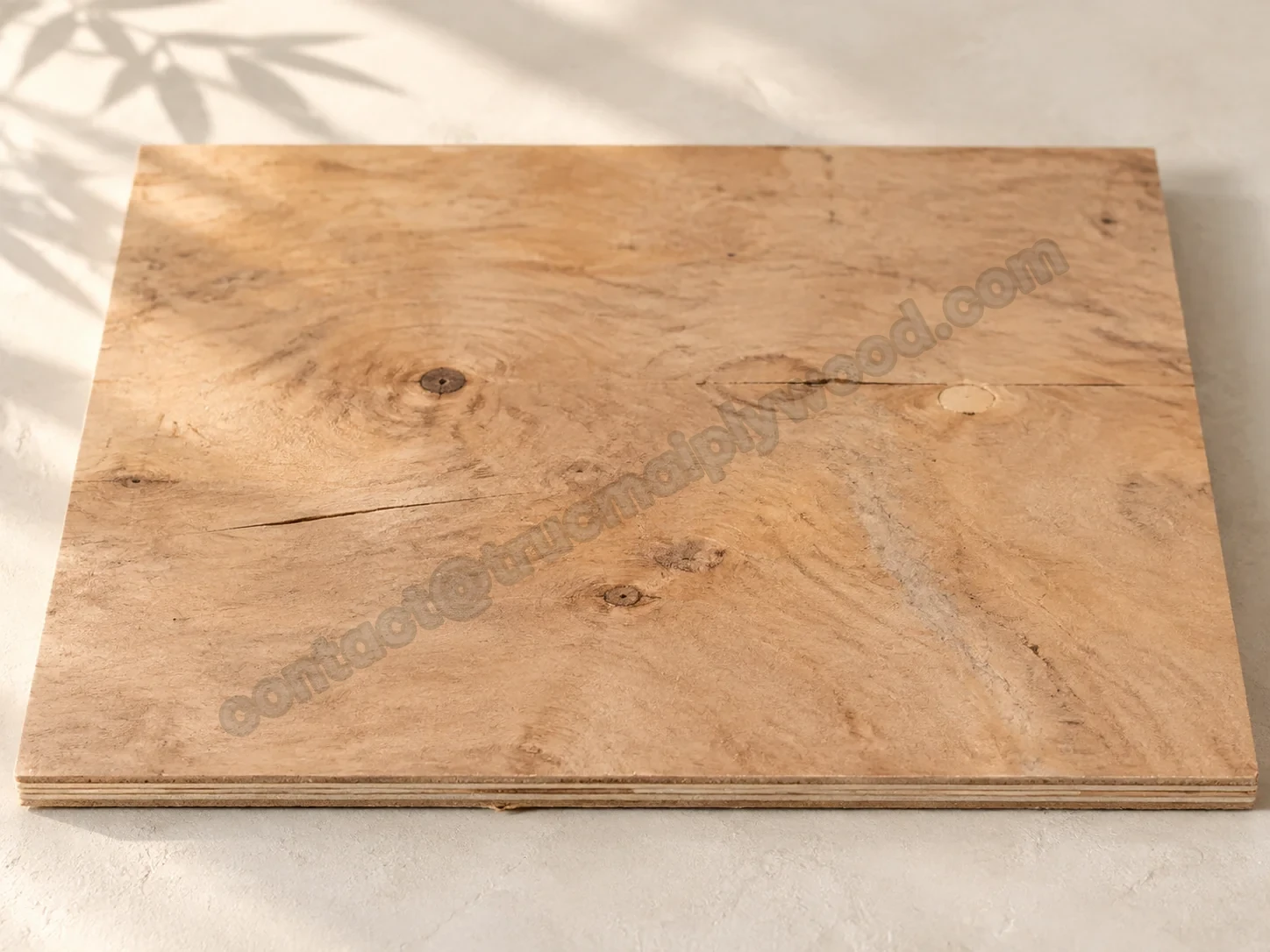 Packing grade BC
Small sound knots, filled splits and a few patches; colour varies. Crates and cases that are printed, stencilled or seen by the end customer.
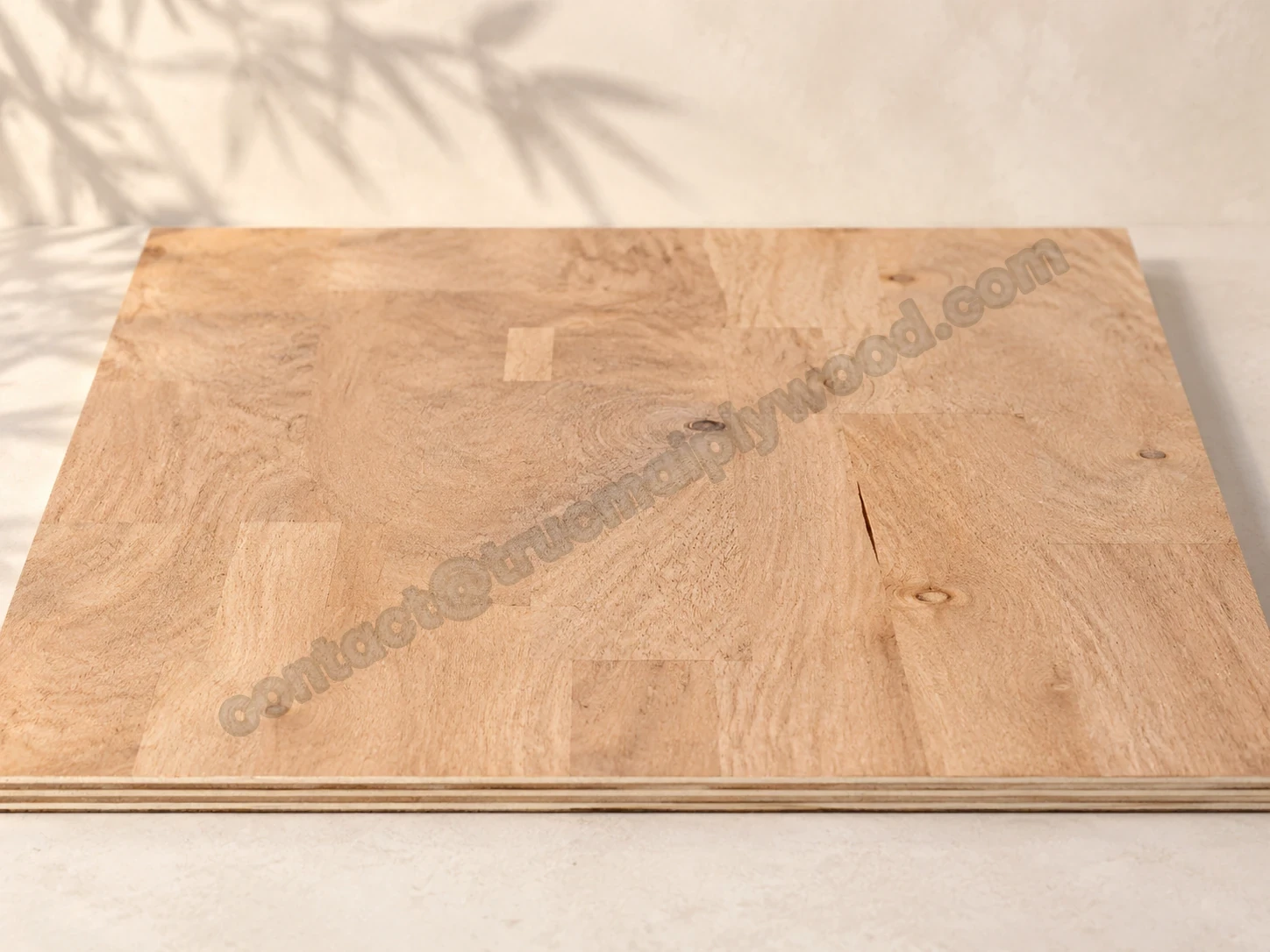 Packing grade CD
Open splits, dead knots, larger patches and rough areas; no holes through the face. Crate sides, pallet decks and drum ends that are nailed and never shown.
- Packing grade DD
Both faces at the lowest packing level; splits and patches on face and back. Dunnage, separators, one-way packing and inner crate parts.
Core
Which core and emission class packing plywood uses by default
By default packing plywood has an AB loose-laid core of Styrax, Acacia or Eucalyptus with a UF glue line at E2 emission. The core species is the main cost and weight lever: Styrax puts the most m³ in a container, Eucalyptus gives the heaviest, hardest sheet.
In a crate side, nail holding comes mostly from the outer plies. A combined core with a denser Eucalyptus ply under each face and Styrax inside holds nails close to a full Eucalyptus sheet and still loads more m³. Write the species order on the specification so the reorder is laid the same way.
Weights and volumes are planning figures from reference densities. Eucalyptus measures 650–750 kg/m³ in practice, which is why a Eucalyptus load reaches its payload before the box is full.
Ha Hoa sits beside plantation forest, so core wood reaches the mill at low cost. That, more than the face, is what keeps packing plywood from the mill cheap per m³.
| Core | Reference density | 18 mm sheet weight | About m³ per 40HC | Packing use |
|---|---|---|---|---|
| Styrax | 500 kg/m³ | 26.8 kg | 53 | Light crates and cases where freight per m³ counts |
| Acacia | 580 kg/m³ | 31.1 kg | 47 | General crates with better nail holding |
| Eucalyptus | 650 kg/m³ | 34.8 kg | 43 | Heavy machinery crates and pallet decks |
| Combined | Per order | Per order | Per order | A hard ply under each face, light inside |
Glue and emission
Glue line options for packing panels
Packing panels are pressed with UF glue, usually at E2; crates that stand outside for weeks take a melamine-fortified line.
Packing panels from 3–25 mm ordered on the E0 build sit inside Truc Mai's CARB P2 and TSCA Title VI scope, number 26053; the E2 packing build does not. See emission class per order.
| Glue line | Emission | Boil test | Use it for |
|---|---|---|---|
| UF, packing build | Usually E2 | Short, for dry storage | Indoor crates, inner packing, separators |
| UF, standard build | E0 | About 6 hours | Crates for markets with emission limits |
| Melamine-fortified UF | Usually E1 | 12 hours | Crates standing outdoors or in damp holds |
Sizes
Crate panels cut at the mill: sizes and tolerances
Packing plywood can be cut at the mill into crate panels up to 1250 × 2500 mm, usually by splitting one sheet into 2, 3, 4 or 6 parts, then packed and labelled by panel size, so your shop assembles crates without sawing.
A cut list that stays the same from month to month is the cheapest way to buy packing plywood: the saw set-up repeats, the kerf stays at the mill instead of in your scrap bin, and the bundles arrive sorted by crate part. When a crate design changes, send the new list with the next order and only that line changes.
Read panels cut at the mill for how cut lists are written and checked. Thin lids and dividers of 3–6 mm are covered on thin panels.
Label each bundle with the crate part and the panel size, not only the thickness. A crate shop working from several orders at once then pulls the right bundle from the stack without measuring, and a short count shows on the label before the bundle is opened.
- Full sheet 1220 × 2440 mm or 1250 × 2500 mm
- 4 parts One sheet cut into four, for example about 610 × 1220 mm from 1220 × 2440 mm
- 6 parts Six panels per sheet for mid-size case sides
- 2 or 3 parts Halves or thirds of the sheet for long crate sides and pallet tops
- Custom Your crate drawing, up to 1250 × 2500 mm per panel
| Measure | Tolerance | Where it applies |
|---|---|---|
| Thickness, packing grade | ±0.5–1.0 mm | Written per order |
| Thickness, commercial build | ±0.3–0.5 mm | When the crate needs a tighter fit |
| Length and width | ±2 mm | Full sheets and cut panels |
Applications
What packing plywood is used for
Packing plywood carries and protects goods for one trip or a few: export crates, cases, pallet decks and collars, cable drum ends and dunnage. It is not a furniture or building panel.
Plywood for packing from Vietnam is usually bought by crate shops, pallet makers and export packers who need a steady monthly volume of one or two thicknesses rather than a mix of faces. The core species and the glue line are chosen once for the crate, then repeated on every container.
Packing plywood is also sold as crating or case plywood. Whatever the name, the order should state the crate, the load and how long the crate stands outside, because those three decide thickness and glue line.
For a crate that is also a display, such as a wine case or a presentation box, the face matters, and commercial panels by container are the better buy.
- Export crates and cases
Crate sides, tops and bases for machinery, spare parts and equipment. 12–18 mm on an Acacia or Eucalyptus core holds nails at the batten line.
- Pallet decks and collars
Deck boards and collar panels at 9–15 mm. A Styrax core keeps pallets light.
- Cable drums and reels
Drum ends cut from 18–25 mm sheets, where a denser core takes the weight of the cable.
- Dunnage and separators
Thin 3–9 mm DD-grade panels between layers of goods in containers and trucks.
- Machinery skids and bases
15–18 mm panels on an Acacia or Eucalyptus core fixed over runners under heavy machines, where the denser core holds screws and bolts close to the edge.
- Crate lids and inner partitions
9–12 mm BC or CD panels cut to the lid and divider sizes on your cut list, packed with the crate sides of the same order so a whole crate kit leaves the bundle together.
Comparison
Packing plywood vs commercial plywood, OSB and sawn boards for crates
Choose packing plywood for the lowest cost per crate with good nail holding; commercial plywood when the crate face is seen; OSB or sawn boards trade off weight, splitting and treatment.
On a Styrax core, packing plywood weighs less than OSB of the same thickness, and it splits less at the nail line than sawn boards. Sawn boards need heat treatment and a mark for export; plywood does not.
When buyers compare packing plywood manufacturers, the useful questions are the same for every mill: what core species and core grade are used, how gaps are kept off the nail line, what thickness tolerance is written on the order, and whether cut panels are counted per size. Ask for those four lines in writing, and the quotations become comparable.
A Styrax core is the lightest of the three and fills the container by volume. Acacia and Eucalyptus cores are heavier, hold nails and screws better near the edge, and suit crates for heavy goods; on a mixed load the dense packs go at the door end and the light Styrax packs behind them.
Truc Mai does not make film-faced, formwork, structural or marine plywood.
| Panel | Core and faces | Thickness tolerance | Heat treatment for export | Best fit |
|---|---|---|---|---|
| Packing plywood | AB loose-laid core, utility faces | ±0.5–1.0 mm | Not needed | Crates, pallets, dunnage |
| Commercial plywood | AB jointed core, better faces | ±0.3–0.5 mm | Not needed | Display crates, printed cases |
| OSB | Oriented strands, no veneer | Per maker | Not needed | Heavy crates where weight matters less |
| Sawn boards | Solid timber | Per sawmill | Needed | Traditional crates and skids |
Checks
What is checked differently on a packing order
On packing grade the checks follow the nailing bench, not the showroom.
Check records and the reference sample are kept as described on repeat spec control.
Core gaps are kept inside the agreed limit and away from the batten lines on cut panels.
Edges are checked for blows and lifting, the defects that open at a nail.
Thickness is measured per press load against the packing tolerance.
Cut panels are measured and counted per size before strapping.
Certificates
Certificates and files for packing plywood
FSC, CARB P2, ISO 9001 and ISO 14001, plus EU file sets.
- FSC 100% FSC-C196493 · SA-COC-014545
- CARB P2 and TSCA Title VI CARB/EPA 26053 · TPC-43
- ISO 9001:2015 W2012 · WCERT
- ISO 14001:2015 W2012E · WCERT
Packing
How many m³ of packing plywood fit in a 40HC?
About 53 m³ on a Styrax core, 47 m³ on Acacia and 43 m³ on Eucalyptus, almost the same at every thickness.
Sheet counts and weights are planning figures, not a loading record.
Crate shops buy by m³, and the core, not the thickness, sets that number. Cut panels load at about the same m³ as full sheets when bundled to the same footprint. Battens and dunnage shipped with the panels fall under ISPM 15; the plywood does not. See the 40HC load calculator and loading a 40HC.
| Thickness, 1220 × 2440 mm | Styrax: sheets / m³ | Acacia: sheets / m³ | Eucalyptus: sheets / m³ |
|---|---|---|---|
| 9 mm | 1,998 / 53.5 | 1,776 / 47.6 | 1,605 / 43.0 |
| 12 mm | 1,494 / 53.4 | 1,328 / 47.4 | 1,200 / 42.9 |
| 15 mm | 1,188 / 53.0 | 1,056 / 47.2 | 960 / 42.9 |
| 18 mm | 990 / 53.0 | 880 / 47.2 | 795 / 42.6 |
Terms
Terms for packing plywood by the container
Full containers direct from the mill; these terms apply unless the contract says otherwise.
Full terms are on MOQ, payment and FOB. Packing plywood is quoted per m³, the unit crate shops use to compare it with OSB and sawn boards.
- Minimum order One 40HC
- Production time 15–45 days after the 30% deposit, by quantity and agreement
- Payment 30% deposit; 70% against the scanned B/L by T/T, or irrevocable L/C at sight
- Delivery terms FOB Hai Phong, CFR or CIF
- Documents Invoice, packing list, B/L, certificate of origin, phytosanitary, fumigation, order certificates
- Price Quoted per order against the written specification
How to order
Starting a monthly packing plywood supply
A packing order starts from your crate, not from a sheet.
Deposit, draft documents and B/L follow from enquiry to loading.
Send the crate drawing or cut list, the load, the batten spacing and how long it stands outside.
Receive core, thickness, grade pair, glue line and a price per m³.
Approve a sample sheet or a set of cut panels.
Each month, send the new cut list and m³; the rest stays fixed.
FAQ
Questions crate makers ask packing plywood manufacturers
What is packing-grade plywood and how is it built?
It is a utility plywood for crates, cases and pallets: an AB loose-laid core of Styrax, Acacia or Eucalyptus, utility faces with knots and patches allowed, and a UF glue line, usually at E2. At Truc Mai it runs on the same lines that press around 60,000 m³ of plywood a year.
Which core and emission class does packing plywood use by default?
An AB loose-laid core with a UF glue line at E2 emission. The core species is chosen per order. If the market limits emission, order the E0 build: from 3–25 mm it then sits inside Truc Mai's emission scope number 26053.
Can packing plywood be cut to crate sizes before loading?
Yes. Sheets are cut at the mill into panels up to 1250 × 2500 mm, usually 2, 3, 4 or 6 per sheet, and packed by size. Where the crate needs a tighter fit than the packing tolerance, order the commercial build, written per order at ±0.3–0.5 mm.
What thickness tolerance applies to packing panels?
Packing grade is usually ±0.5–1.0 mm, written on each order. Length and width are ±2 mm on full sheets and cut panels.
How many m³ of packing plywood fit in a 40HC?
About 53 m³ on a Styrax core, 47 m³ on Acacia and 43 m³ on Eucalyptus, as planning figures from the Truc Mai packing model. At 12 mm that is about 1,494, 1,328 and 1,200 sheets of 1220 × 2440 mm.
Why does a loose-laid core matter in a nailed crate?
Small gaps between core pieces do not weaken a crate side nailed to battens, but a nail that lands in a gap holds less. Tell us the batten spacing, and gaps are kept off the usual nail lines on cut panels.
Is packing grade AB the same as an A face?
No. On packing orders AB describes the core grade. A clean A face is a commercial-line option and is priced as commercial plywood.
When is E0 worth paying for on packing plywood?
When the crate goes into a closed room, or the goods are sold in a market that limits formaldehyde from wood products. For crates that travel and stand in yards and holds, the E2 packing build is the usual choice.
How is a cut list kept the same from one container to the next?
The cut list is written on the order by panel size and count, and the saw set-up is repeated from it. Only a changed crate design changes the list; send the new one with the next order.
Do cut panels change the m³ in a container?
Very little. Cut panels bundled to the same pack footprint load at about the same m³ as full sheets, and the offcut stays at the mill.
Which packing grade suits cable drum ends?
CD grade on an 18–25 mm Eucalyptus or combined core. The face is hidden, and the denser core takes the weight of the cable and the bolts through the drum.
Does the PPWR test cover the crates I build?
No. A PPWR test covers the packaging materials tested. A crate you build from the panels is your packaging, and your own packaging file covers it.
When is commercial plywood a better buy than packing grade?
When the crate is seen by the end customer, printed on, or reused many times. A jointed core and a cleaner face cost more per m³ but cut rejects and look better on display.
Quotation
Request a packing plywood quotation
Send the crate or cut list, thickness, monthly m³ and port, and Lucy will reply with a written specification and a price per m³. Write to contact@trucmaiplywood.com or use the quotation form.
AB loose-laid core, utility faces, full sheets or crate panels, about 53 m³ per Styrax-core 40HC.