
Mill · Repeat spec control
Consistent plywood on repeat orders: how one spec is held from container to container
Consistent plywood quality on repeat orders comes from a written spec: container 20 matches container 1 because every line is held under the ISO 9001:2015 quality system. The face and back grade pair is fixed against an approved sample, thickness is written with a tolerance of ±0.3–0.5 mm per order, and the core line and UF glue at E0 emission stay as written until the buyer changes them.
This page is for the buyer who has already received one container and wants the second, the tenth and the twentieth to be the same panel. It explains which lines of the spec are fixed, how each is checked before the container is loaded, what a buyer can check on arrival with a caliper and a sample, and why two quotes for the same product name are so often different panels. The standing agreement that uses this control every month is on monthly container programmes.
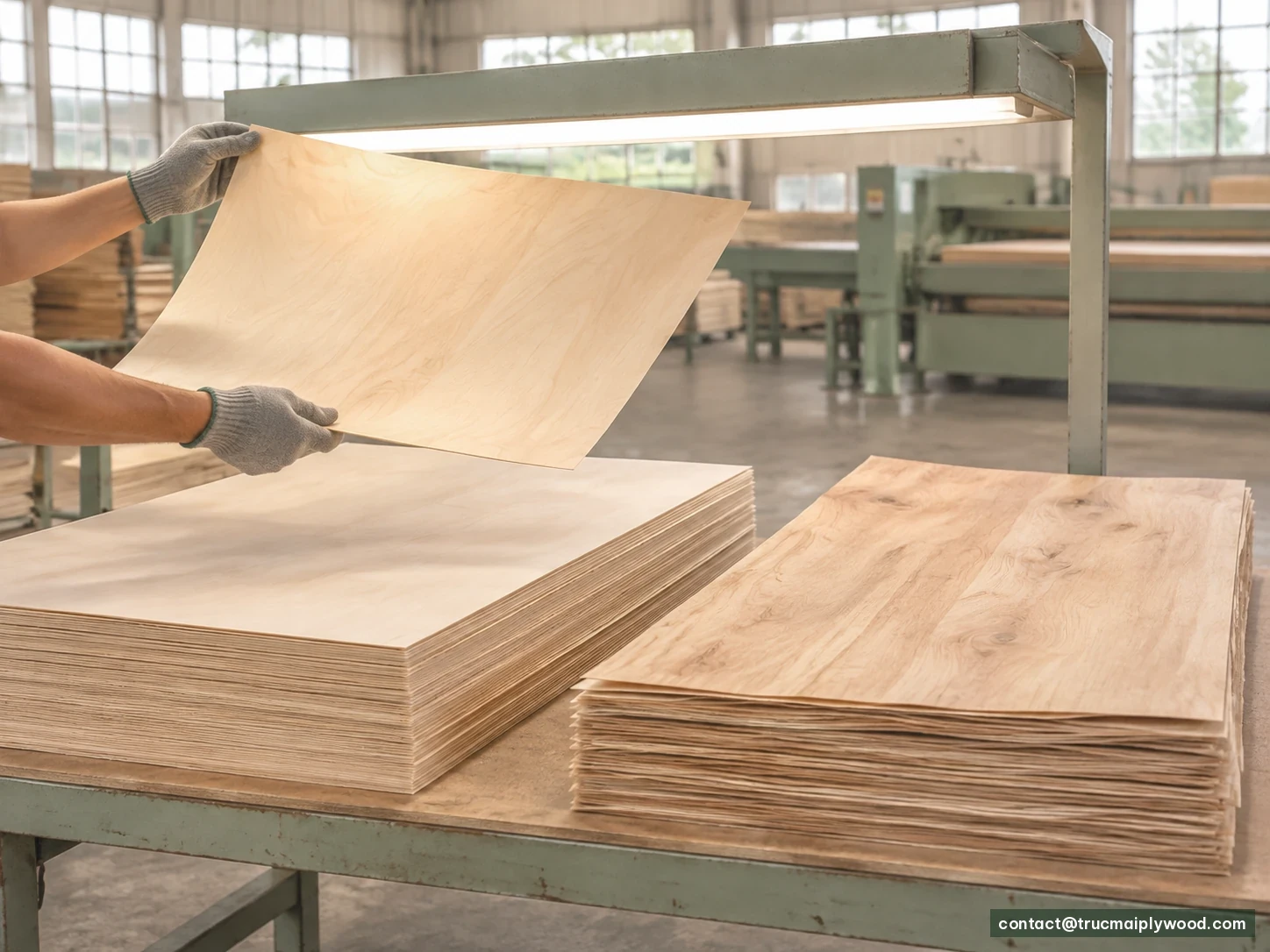
- ±0.3 mmthickness tolerance on sanded and calibrated furniture panels
- ±0.5 mmon commercial panels; ±0.5–1.0 mm on packing panels
- ±2 mmlength and width, per order
- 11 pliesmost common build of an 18 mm panel, 11–13 in range
Tolerance is written per order; Truc Mai does not offer a tolerance tighter than ±0.3 mm.
Certificates
Which certificate covers the way a repeat spec is held?
FSC, CARB P2, ISO 9001 and ISO 14001, plus EU file sets.
- FSC 100% FSC-C196493 · SA-COC-014545
- CARB P2 and TSCA Title VI CARB/EPA 26053 · TPC-43
- ISO 9001:2015 W2012 · WCERT
- ISO 14001:2015 W2012E · WCERT
The system standard is ISO 9001; the claims it supports can be checked at the FSC database, at the California Air Resources Board and the US formaldehyde standards, and, for EU lots, in Regulation (EU) 2023/1115 and Regulation (EU) 2025/40 for packaging.
At a glance
How is consistent plywood quality held on repeat orders, container after container?
A plywood spec is held by writing every line that makes the panel what it is, fixing the face against a sample, and checking each line before the container is loaded. At Truc Mai the lines are the face and back grade pair, thickness with tolerance, length and width, the core line, glue and emission class, sheet size and packing.
The quality system keeps the checks the same from one container to the next; the spec says what is checked. Both are needed. A system with no written spec checks nothing in particular, and a spec with no system is only a promise.
| Spec line | How it is fixed | How it is checked | Record |
|---|---|---|---|
| Face and back grade pair | Against the approved, labelled sample | Faces of the batch compared with the sample | Pack-check sheet |
| Thickness | Written with a tolerance per order | Caliper readings on the sheets of the batch | Pack-check sheet |
| Length and width | ±2 mm, per order | Measured on cut and trimmed sheets | Pack-check sheet |
| Core line | Core grade and stitching written by line | Edge and core inspected | Spec sheet |
| Glue and emission class | Two separate lines on the order | Checked against the order, files supplied | Spec sheet and emission files |
| Sheet size and packing | Standard size or custom up to 1250 × 2500 mm | Counted and labelled before loading | Loading plan |
By product line
Plywood thickness tolerance per order: what is written on a furniture order, and how do the controls differ by line?
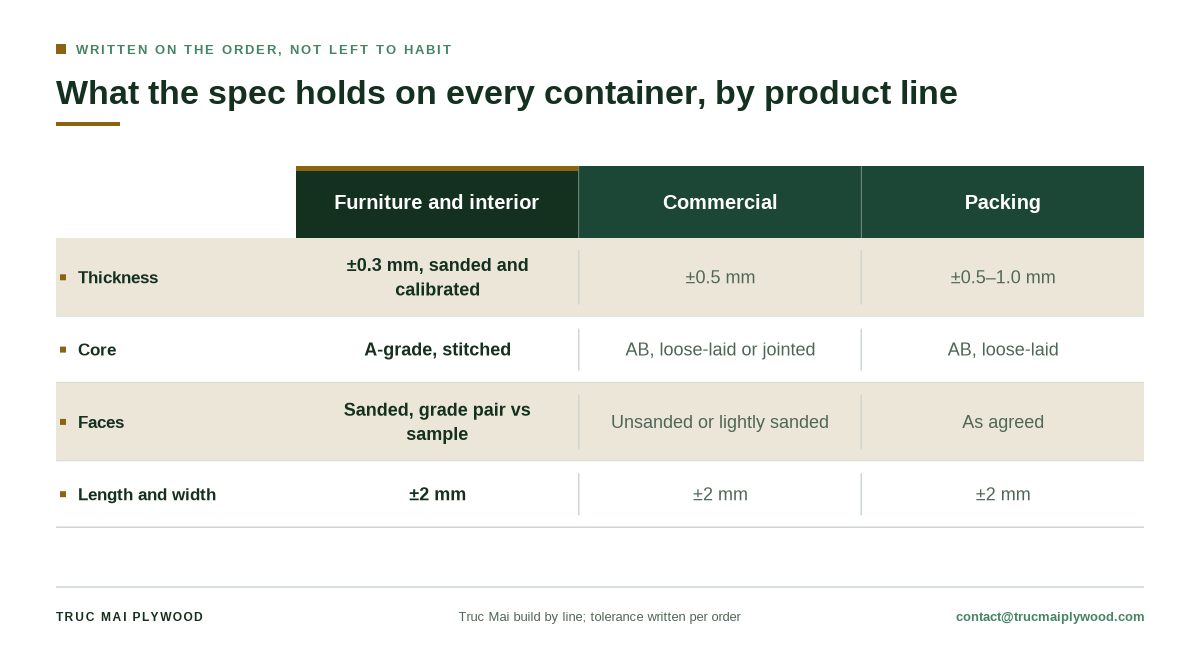
A furniture order carries a thickness tolerance of ±0.3 mm on sanded and calibrated panels; commercial panels are ±0.5 mm and packing panels ±0.5–1.0 mm, and the core grade and the sanding differ with them.
The tolerance follows the build. Furniture panels use an A-grade, stitched core and sanded faces because a drawer front or a cabinet side has to meet its neighbour. Commercial panels use an AB core, loose-laid or jointed, unsanded or lightly sanded, where the thickness band can be wider. Packing panels use an AB loose-laid core, usually at E2 emission, where strength and cost matter more than a flush surface.
| Line | Thickness reading | Face check | Core and edge |
|---|---|---|---|
| Furniture and interior | Against ±0.3 mm | Grade pair against the sample, sanded face | Stitched A-grade core, plies as specified |
| Commercial | Against ±0.5 mm | Grade against the sample, face unsanded or lightly sanded | AB core, gaps within the grade |
| Packing | Against ±0.5–1.0 mm | As agreed | AB loose-laid core |
| Thin 3–6 mm | Per thickness as agreed | Face and flatness | Five plies at 3–5 mm |
| Cut-to-size | As the parent sheet; ±2 mm on length and width | Face as sample | Cut plan checked before packing |
Building the reference
Plywood approved sample grading: how does the first container become the reference for the next one?
Seven steps turn a first container into the reference for the second; each leaves a record the buyer can hold.
- Approve a labelled sample
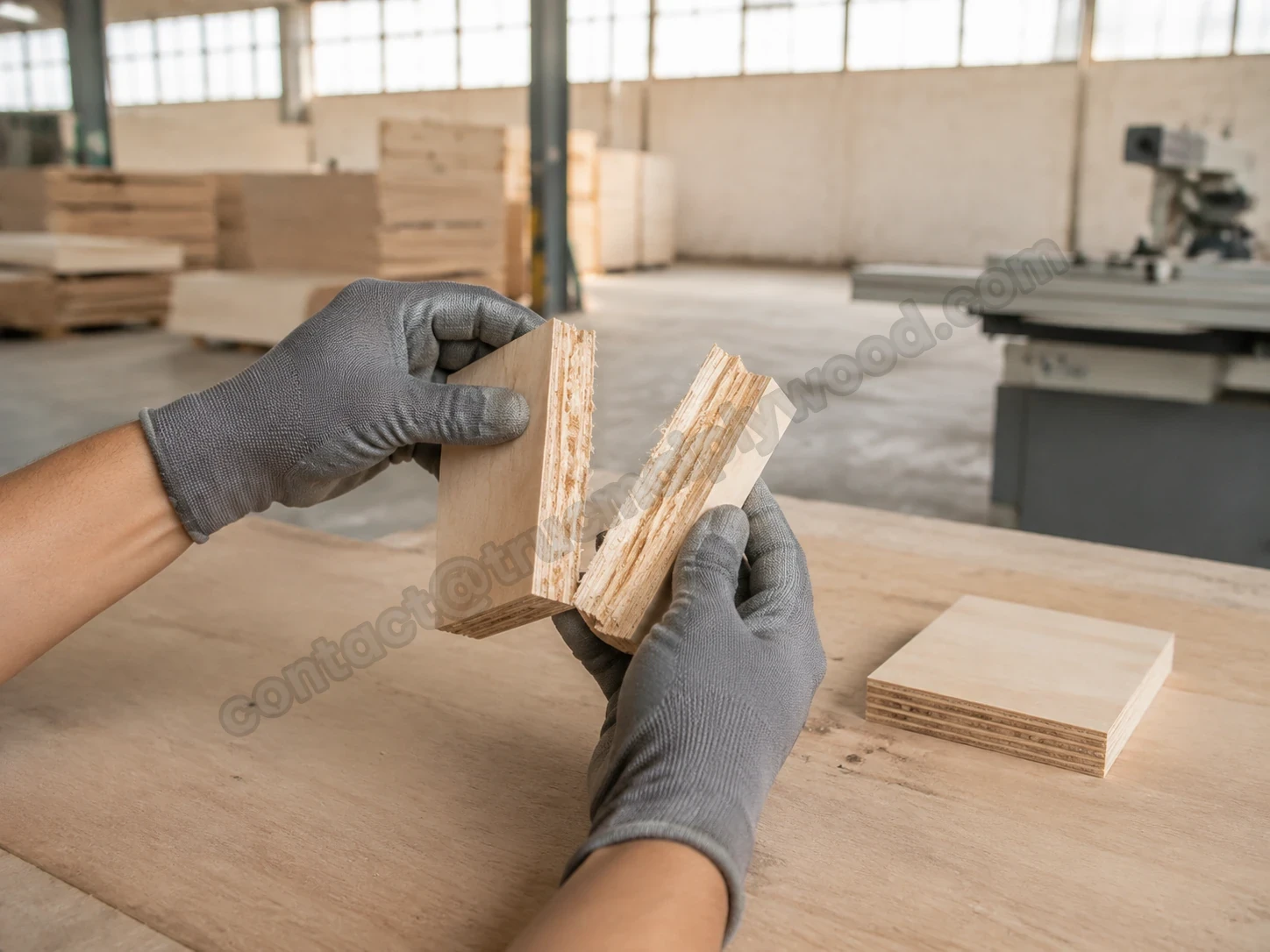
The grade pair is approved against a sample that carries a label with the build it represents. Check: the label names core, thickness and face.
- Write the spec as lines
Every line of the panel is written, with the thickness tolerance and the sheet size. Check: nothing is left as 'as before'.
- Keep a reference sample on each side
Buyer and mill each retain a sample of the same revision. Check: both labels carry the same revision number.
- Build to the lines
The core line, the glue and emission class and the face pair follow the sheet. Check: glue and emission are two separate lines.
- Record the pack check
Sheets are counted, thickness is measured and faces are compared with the sample. Check: readings are written, not only passed.
- Compare on arrival
The buyer checks edge plies, thickness and faces against the sample. Check: readings are taken from sheets chosen by the buyer.
- Change only by revision
A new line value gets a new revision and a note on which container carries it. Check: the next sample is relabelled with the new revision.
Checking in practice
What do the checks look like in practice?
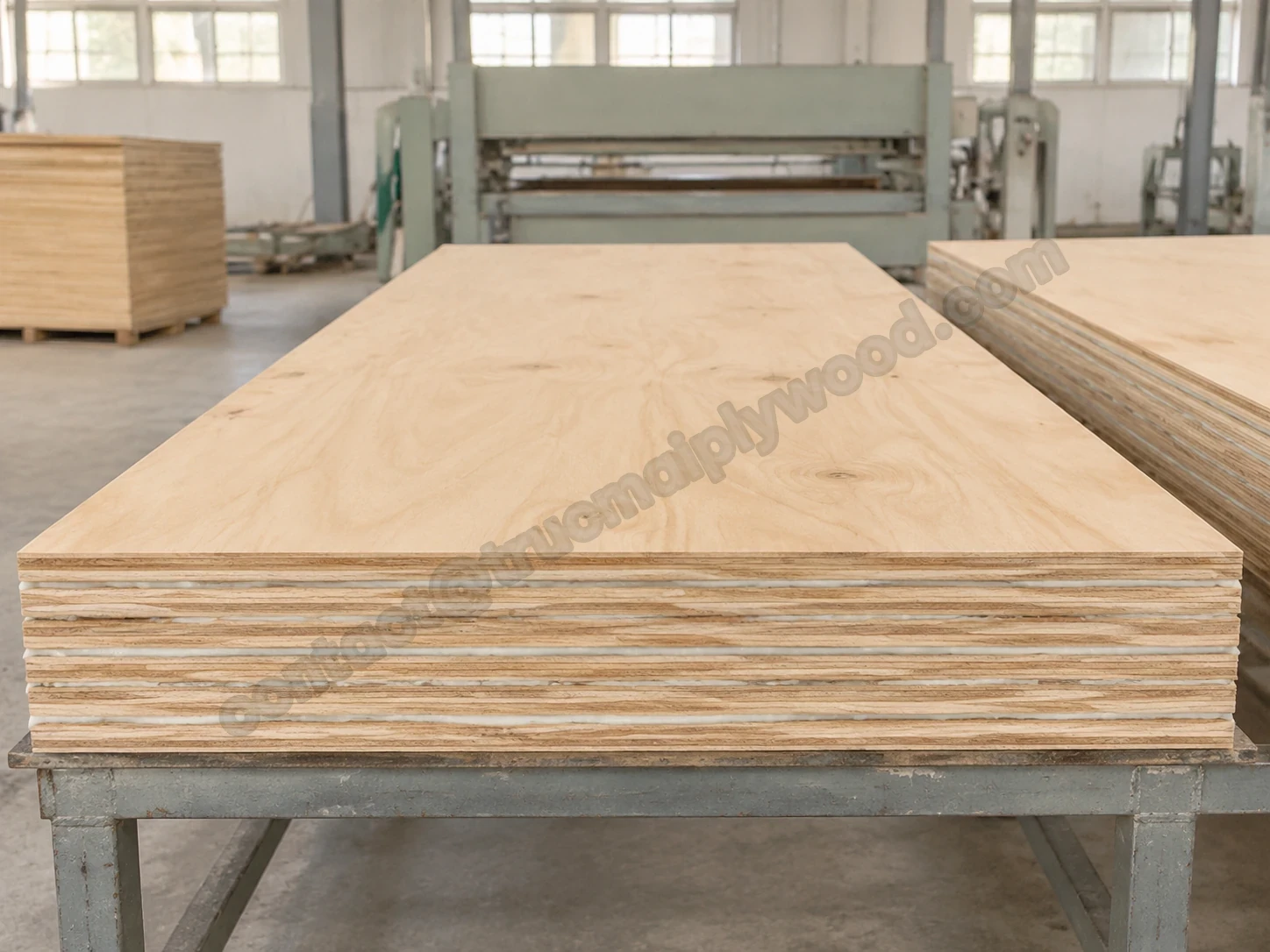
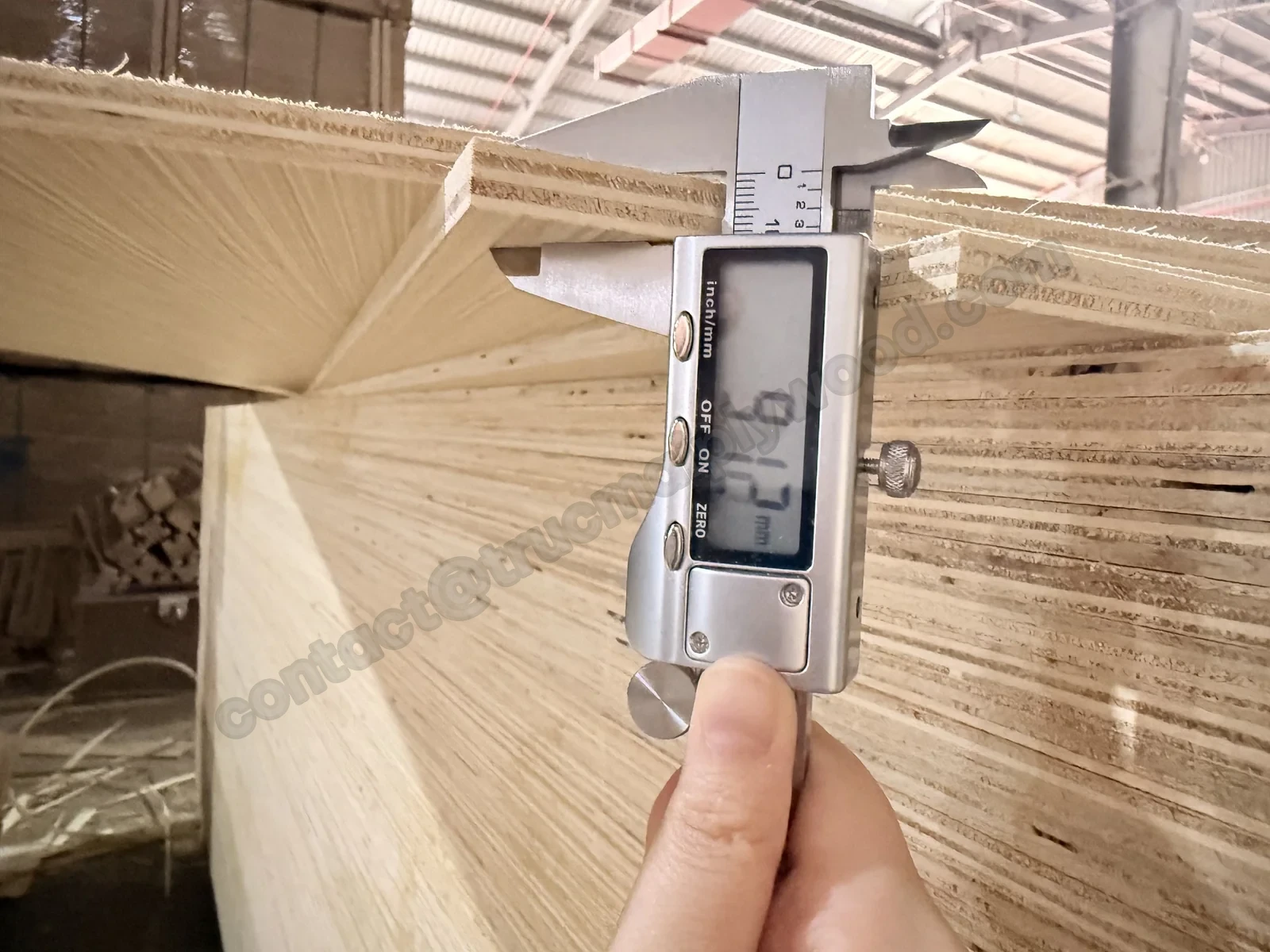
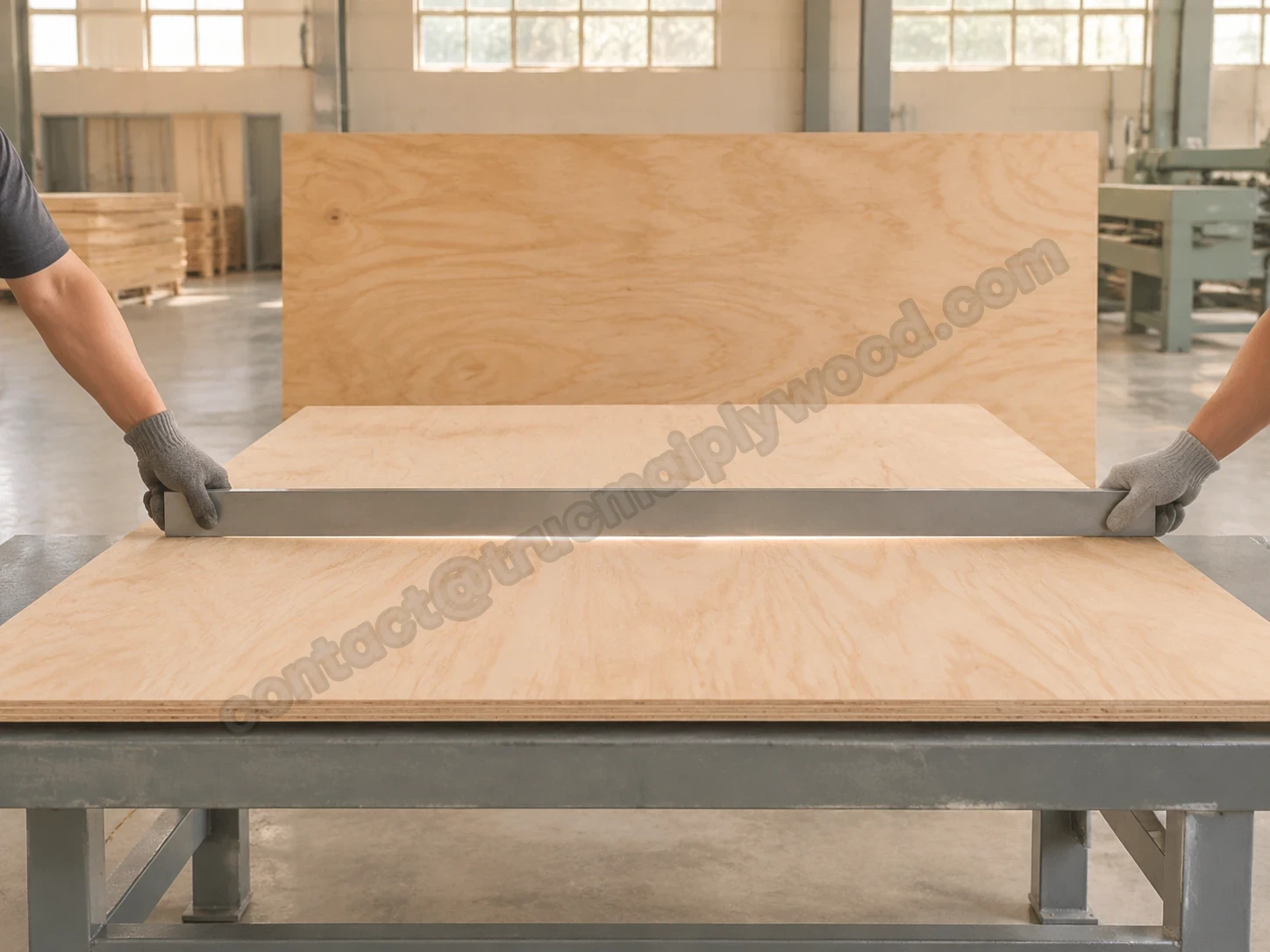
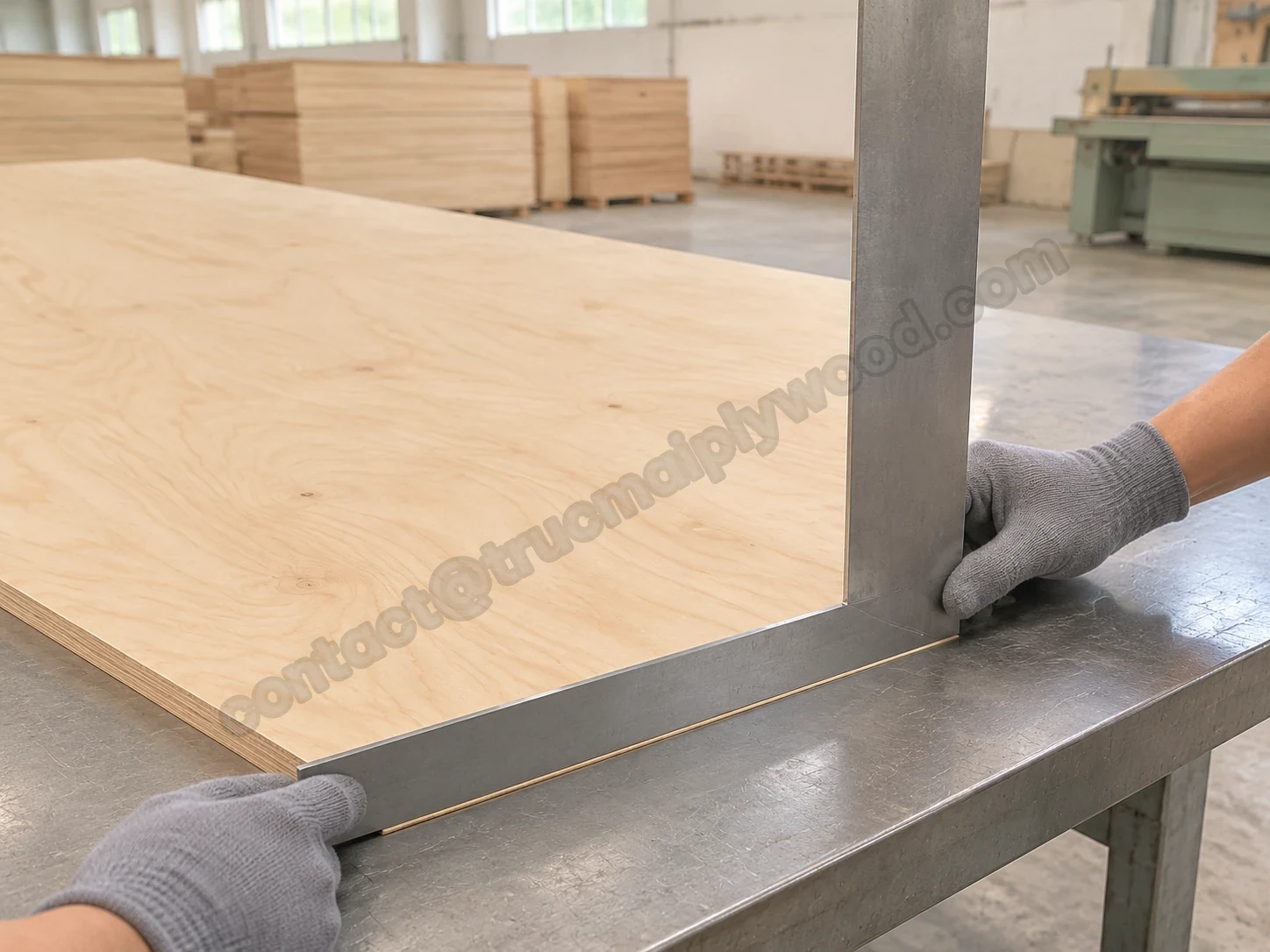
The checks are physical and simple: a caliper across the edge, a straightedge across the face and a sample beside it; the first two take minutes and the third needs only the retained sample.
A caliper reading on a stack edge gives the thickness of the sheets together and the ply count along the edge shows the build. A straightedge laid across a sanded sheet shows warp as a gap of light under it, and a face compared in daylight with the retained sample shows colour drift that a written grade cannot.
Where repeat orders drift
Why are two quotes for the same plywood name often different panels, and what drifts between containers?
Two quotes with the same product name differ in core grade, joining method, face preparation, glue system and tolerance; between containers of the same quote, the face colour, the thickness and the core tightness are what drift.
| What drifts | Cause | Held by |
|---|---|---|
| Face colour or figure | Grade agreed by name, face veneer from a different lot | Face pair fixed against a retained sample |
| Thickness | No tolerance on the order, or a different sanding set-up | Tolerance written per order, caliper readings in the pack check |
| Core tightness and voids | Core grade differs: A-grade versus AB | Core grade written by line |
| Warp | Core and glue differ, or sheets stored badly | Same core line; flatness checked with a straightedge |
| Glue or emission | Glue changed without the emission line | Glue type and emission class as two lines |
| Plies | Different build for the same thickness | Ply count on the spec, for example 11 plies at 18 mm |
Numbers and tolerances
Which numbers does a repeat spec hold, and under which conditions?
The repeat spec holds a short list of numbers; each is written on the order with its condition, and the standard named is ISO 9001:2015.
Glue type and emission class are two separate lines on the order: the default is UF glue at E0 emission, and a melamine-fortified glue for damp rooms usually gives E1.
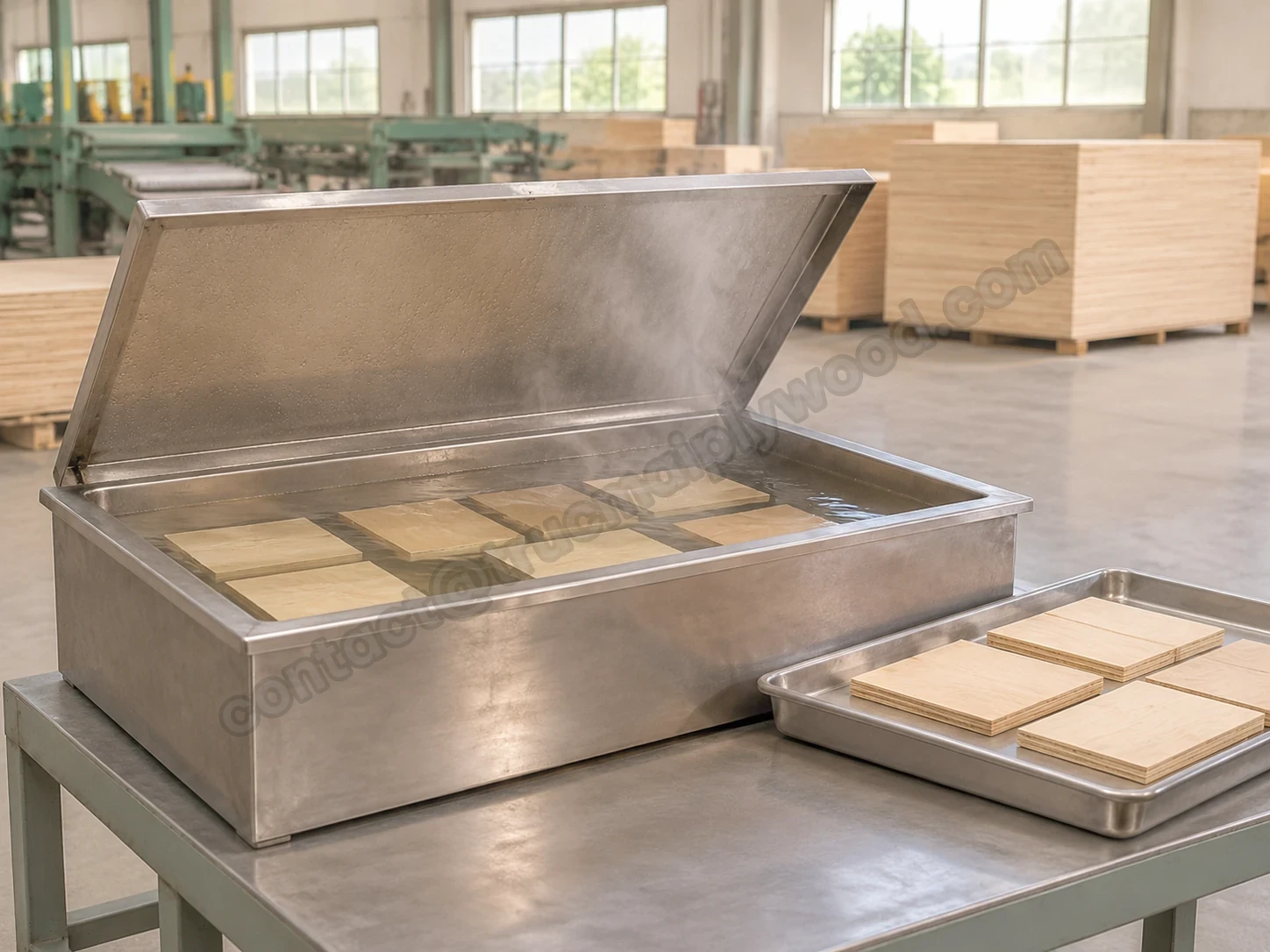
UF glue holds about six hours in a boil test; melamine-fortified glue holds twelve.
| Number | Value | Condition |
|---|---|---|
| Thickness tolerance, furniture | ±0.3 mm | Sanded and calibrated panels |
| Thickness tolerance, commercial | ±0.5 mm | Per order |
| Thickness tolerance, packing | ±0.5–1.0 mm | Per order |
| Length and width | ±2 mm | Per order |
| Plies, 3–5 mm | 5 plies | 3 mm: one core ply, two cross-bands, two faces; 4 and 5 mm: three core plies and two faces |
| Plies, 18 mm | 11–13, most often 11 | Per order |
| Face veneer | 0.2–0.5 mm, usually 0.3 mm | Usually 0.3 mm for Europe |
| Core veneer | 1.4–2.0 mm | 4 mm panels use 1.3 mm core veneer |
| Core stitching | Across and along the sheet | Usually the outer 2–4 plies; all plies on request |
The quality system is ISO 9001:2015; the emission files for an order are in the emission class per order and CARB P2 test reports pages.
Buyer guide
How can you tell if plywood is good quality, and what should be checked on arrival?
Good plywood is the plywood that matches its spec and its sample: the right number of plies on the edge, the thickness inside the written tolerance, a flat sheet and a face that looks like the approved one.
A buyer needs only a caliper, a straightedge and the retained sample. Check on sheets chosen by the buyer rather than the top sheet of a pack, because the top sheet is the one most likely to have been looked at before loading.
| Check | How | Compare with |
|---|---|---|
| Plies on the edge | Count the layers along a clean edge | The ply count on the spec |
| Thickness | Caliper across the edge at several places | The tolerance on the order |
| Flatness | Straightedge across the face | No visible gap of light |
| Face | Daylight, beside the retained sample | The labelled sample |
| Glue and emission | Read the files for the order | The two lines on the order |
What you hold
What does a buyer hold that proves the spec was held?
Five things prove it: the spec sheet with its revision, the labelled sample, the pack-check sheet, the emission and test files, and the revision log.
- Spec sheet Every line, with its revision
- Labelled sample The grade pair, with the build on its label
- Pack-check sheet Counts, thickness readings and face notes for the container
- Emission and test files The files for the agreed configuration
- Revision log Each change and the first container that carried it
Records
Which records make a repeat order checkable?
Four records belong to repeat control; the shipping documents are on papers per container.
- Spec sheet
The panel as lines, from application to packing.
- Pack-check sheet
Readings and notes taken before loading.
The glue and emission lines and the files that support them.
The formaldehyde listing for hardwood plywood with veneer core.
Capacity
Does holding a repeat spec limit how many containers a month the mill can take?
No. The checks are part of the 15–45 production days of each container, and a programme of one to ten containers is about 1% to about a tenth of an average 5,000 m³ month.
Each container is checked by itself, so ten containers a month are ten pack checks, not one long one. The output behind that is on monthly output and the standing agreement is on monthly container programmes.
Spec checklist
Which six lines make a repeat order the same panel?
Six lines on the purchase order, repeated unchanged, make the next container the same panel as the last.
The spec reference and revision number.
The approved sample reference for the face and back grade pair.
Thickness with its tolerance, and length and width with ±2 mm.
Core line: species and grade, and the plies per thickness.
Glue type and emission class as two separate lines.
Sheet size, packing and the container mix.
FAQ
Repeat spec questions from container buyers
Direct answers on samples, tolerance and checks.
How can you tell if plywood is good quality?
Compare it with its spec and its sample. Count the plies on the edge, measure the thickness with a caliper against the written tolerance, lay a straightedge across the face to check flatness, and look at the face in daylight beside the labelled sample.
How is face grade agreed and held between orders?
Against an approved, labelled sample. Face and back grades are quoted as a pair and written on the order, and buyer and mill each keep a sample of the same revision.
What thickness tolerance is written on a furniture order?
±0.3 mm on sanded and calibrated furniture panels. Commercial panels are ±0.5 mm and packing panels ±0.5–1.0 mm; length and width are ±2 mm.
Why are two quotes for the same product name often different panels?
The product name hides the core grade, the joining method, the face preparation, the glue system and the tolerance. Start every RFQ from the application and write each line so the quotes can be compared.
What does the ISO 9001:2015 scope cover?
The certificate scope is the manufacture of plywood, so it covers the quality management system. It certifies how checks are made and recorded, not a particular panel.
How are core stitching and glue fixed for a repeat spec?
The core grade and stitching are written by line: furniture panels use a stitched A-grade core, usually stitching the outer 2–4 plies. Glue type and emission class are two lines on the order, the default being UF glue at E0 emission.
Can I choose the sheets I check on arrival?
Yes, and you should. Check sheets you choose from the pack, not only the top sheet, and write the caliper readings down.
What if the arrival differs from the sample?
Report it with photos and caliper readings and compare it with the pack-check sheet for that container and with the sample both sides hold. The comparison shows whether the face, the thickness or the build differs.
Does ISO 9001 guarantee that every panel is the same?
No. It certifies the management system. The sameness comes from the written spec, the sample and the checks the system keeps the same.
Can the spec be changed between containers?
Yes, by a new revision with a note on the first container that carries it. A change made informally is how a repeat order drifts.
Start a repeat spec
Send the sample and the spec lines
Send the eight RFQ lines and a photo of the face you want held; the quotation comes back with the build, the tolerance and the planning load.
Application, core, glue and emission, face and back, thickness and tolerance, sheet size, packing, quantity and a sample photo.