
Mill · Monthly programmes
Plywood supply contract for monthly container orders: one written spec, one 40HC slot a month
What buyers call a plywood supply contract for monthly container orders is, at Truc Mai, a programme: production is reserved for one written spec, so every 40HC call-off is built from the same approved sample, core and tolerance. The buyer calls off one or more containers a month on FOB Hai Phong, CFR or CIF terms, and each takes 15–45 days after its 30% deposit.
Monthly plywood container orders and a long term plywood supply agreement come to the same thing in practice: a written spec, a monthly number of containers and a call-off date. This page is for the buyer who already knows the panel and now wants it every month: a furniture or joinery maker, a distributor or an importer who reorders the same face, thickness and core. It explains what is agreed once, what is repeated for each container and what the buyer can plan around. How the spec is held between containers is on repeat spec control, and the days from deposit to loading are on lead times by volume.
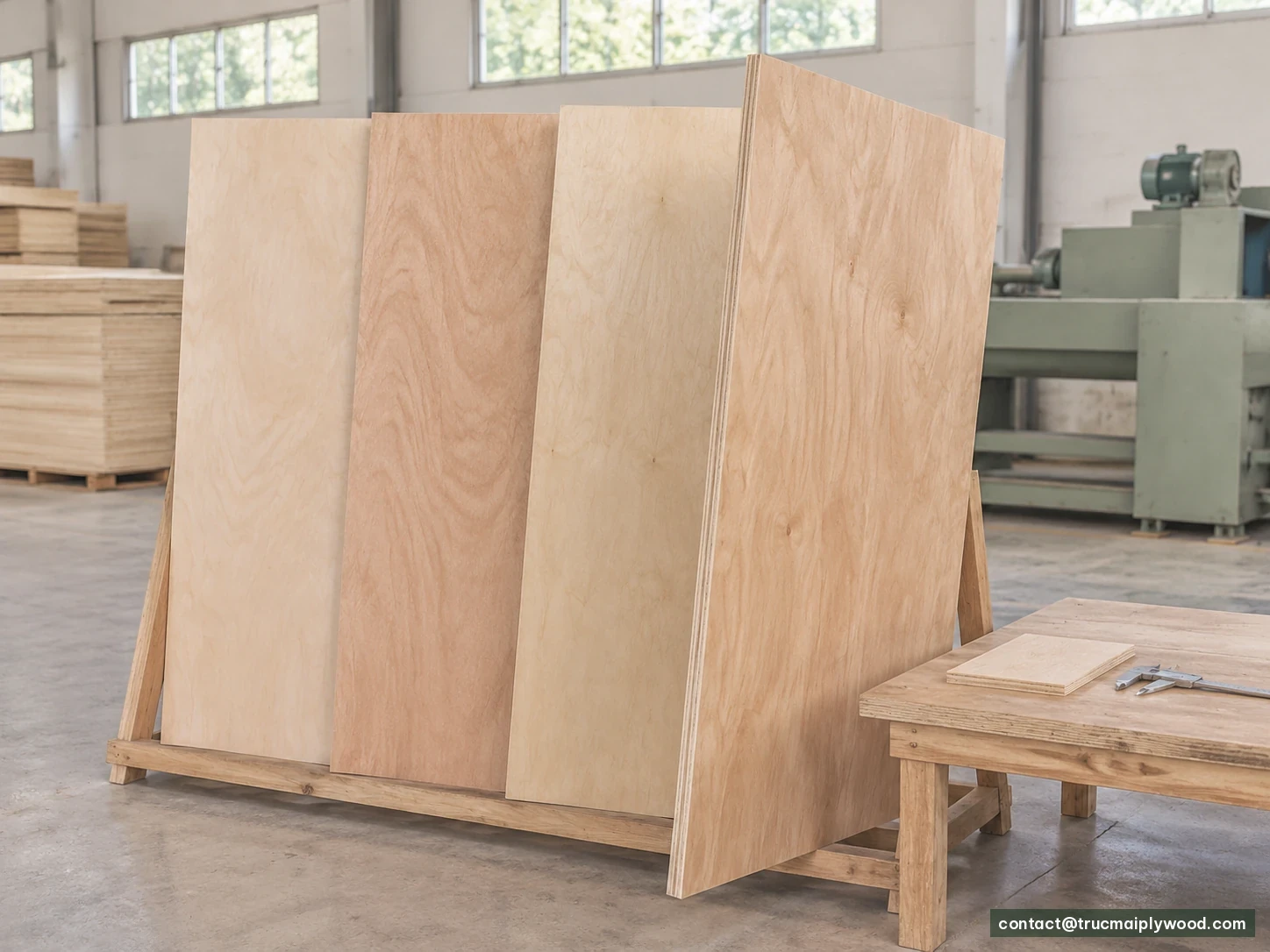
- 1 × 40HCsmallest call-off, the same minimum as a first order
- 15–45 daysproduction after the 30% deposit, by quantity and agreement
- 1–2 productsusually per container; up to six by agreement
- ~1%of an average 5,000 m³ month is one 40HC of 18 mm panels
Planning figure: one 40HC of 18 mm, 1220 × 2440 mm panels is about 53 m³ on Styrax core, 47 m³ on Acacia and 43 m³ on Eucalyptus.
Certificates
Which certificate files travel with every call-off in a programme?
FSC, CARB P2, ISO 9001 and ISO 14001, plus EU file sets.
- FSC 100% FSC-C196493 · SA-COC-014545
- CARB P2 and TSCA Title VI CARB/EPA 26053 · TPC-43
- ISO 9001:2015 W2012 · WCERT
- ISO 14001:2015 W2012E · WCERT
Programme buyers verify once, then reuse: the FSC database for code FSC-C196493; the California Air Resources Board and the US formaldehyde standards for the listing; Regulation (EU) 2023/1115 for the EU file set; Regulation (EU) 2025/40 for the packaging test; ISO 9001 for the system.
At a glance
What are monthly plywood container orders on a programme, and how do they run?
A monthly plywood programme is a standing agreement on one spec and a monthly number of 40HC containers. The spec, the approved sample and the tolerance are fixed once; each month the buyer confirms a call-off, pays the 30% deposit for that container, and the mill builds it to the same written lines.
Nothing about the terms of sale changes from a first order: the minimum is one 40HC, the balance of 70% is paid against the scanned B/L, and delivery is FOB Hai Phong, CFR or CIF. What a programme adds is a reserved place in the production plan and a fixed reference, so the buyer does not start from a blank RFQ every month. Terms in full are on MOQ, payment and FOB.
| Stage | Buyer does | Mill does | On paper |
|---|---|---|---|
| Spec fixed | Approves the sample and the written spec | Keeps a matching reference sample | Spec sheet with revision |
| Slot reserved | Gives the monthly 40HC number | Holds the place in the production plan | Programme sheet |
| Call-off | Confirms the container and pays the 30% deposit | Confirms the production slot in writing | Proforma invoice per call-off |
| Production | Waits, or sends an inspector | Builds to the spec in 15–45 days | Batch notes |
| Pack check | Receives photos and counts | Counts sheets, measures thickness, compares faces with the sample | Pack-check sheet |
| Load and drafts | Approves draft documents | Loads to the plan, sends drafts after loading | Draft set, then B/L |
| Next call-off | Confirms the following month | Updates the spec only if the buyer changed it | Revision note |
Container mix
Can a plywood supply contract mix different specifications and core types in one 40HC?
Yes, within limits. A programme container usually carries one or two products, and three to six can be mixed by agreement; the mix is written on the proforma invoice before production, because each core fills a container differently.
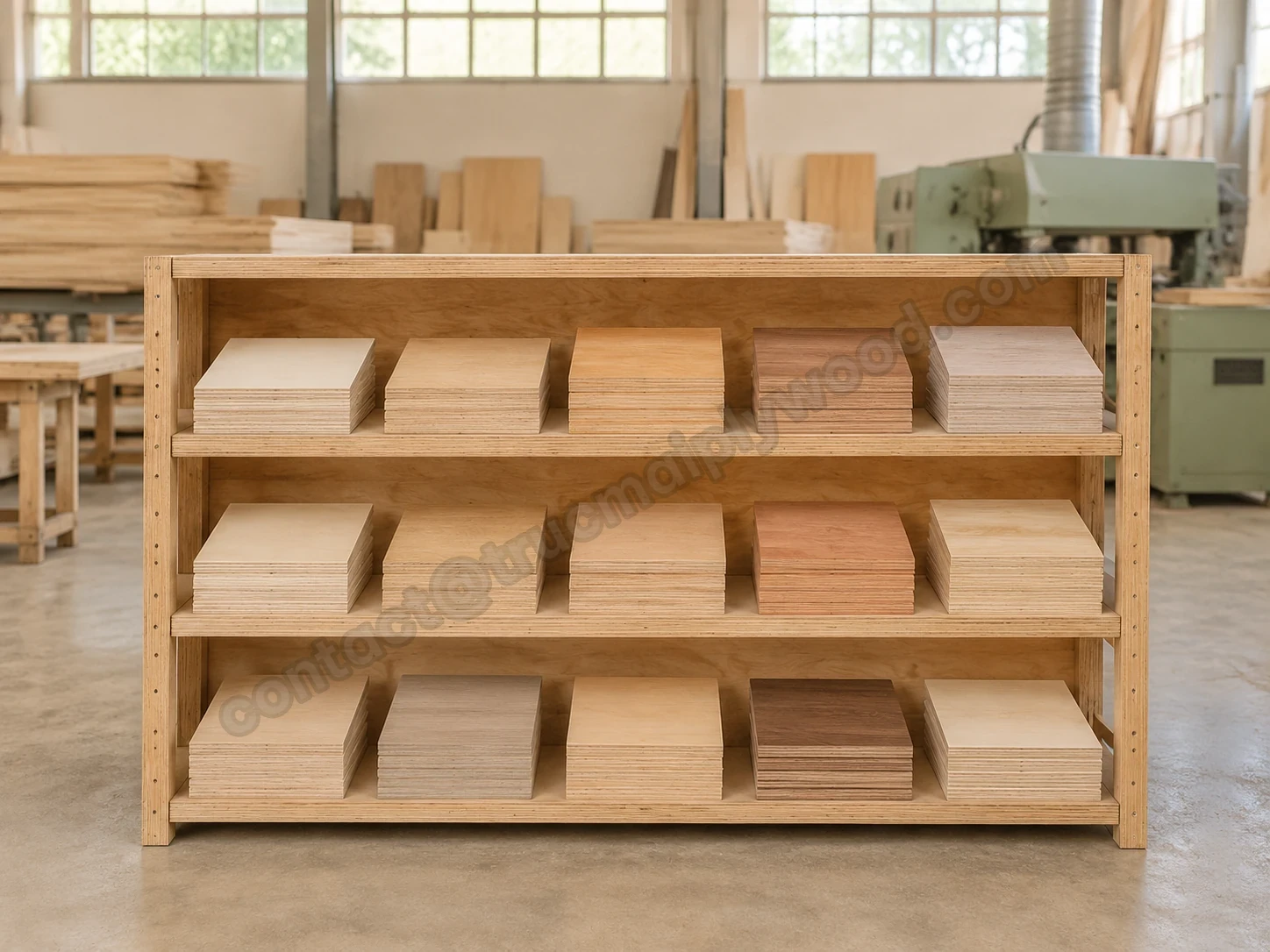
A container of Styrax-core panels on the planning model holds up to 18 packs and about 53 m³ at 18 mm, Acacia 16 packs and about 47 m³, Eucalyptus 15 packs and about 43 m³. Heavier cores reach the payload limit before the container is full, so a mixed load of two cores is planned by weight and by volume together. Buyers who want a steady monthly rhythm usually keep the mix the same every month, because a changing mix is the most common reason a container has to be re-planned.
A mixed container is not a different programme. Each product keeps its own line on the spec sheet, with its own face grade pair, tolerance and sample, and the pack check treats each line separately. The load plan for any mix is in loading a 40HC, and the sheet-count tool is on the 40HC load calculator.
| Mix | What stays fixed each month | What can change by call-off |
|---|---|---|
| One product | Core, face pair, thickness, tolerance, sample | Quantity only if the container is not full |
| Two products | Both lines, and the split between them in packs | The split, if agreed before the slot is confirmed |
| Three to six products | Every line on the spec sheet | The split, by agreement; the load plan is redone |
| Two cores in one load | Which product sits on which core | Weight and pack count per core |
Set-up
How do you set up a monthly plywood programme with Truc Mai?
Seven steps take a repeat buyer from the first container to a standing rhythm; each step ends with something written that the next month can copy.
- Run one container first
The first 40HC is an ordinary order with a written spec and an approved sample. Check: the first pack-check sheet becomes the baseline for every later container.
- Write the spec as lines
Core, glue and emission class, face and back grade pair, thickness with tolerance, sheet size, packing and quantity, each on its own line. Check: two people reading the sheet would build the same panel.
- Fix the monthly number
State how many 40HC a month the buyer expects and in which months it changes. Check: the number is in 40HC, not m³, because the container is the unit that is loaded and invoiced.
- Agree the call-off date
Say how many days before the wanted loading date the buyer confirms, using the 15–45 day production range. Check: the date is written on the programme sheet.
- Keep one sample on each side
The buyer and the mill each hold a labelled sample of the approved face. Check: both samples carry the same spec revision.
- Call off, deposit, produce
Each call-off gets its own proforma invoice and 30% deposit; production runs in the slot confirmed in writing. Check: the slot date arrives with the deposit receipt.
- Review after each container
Compare the pack-check sheet and the arrival result with the sample, and change the spec only through a new revision. Check: the revision note says what changed and from which container.
Programme picture
What does one repeating month look like on a programme?
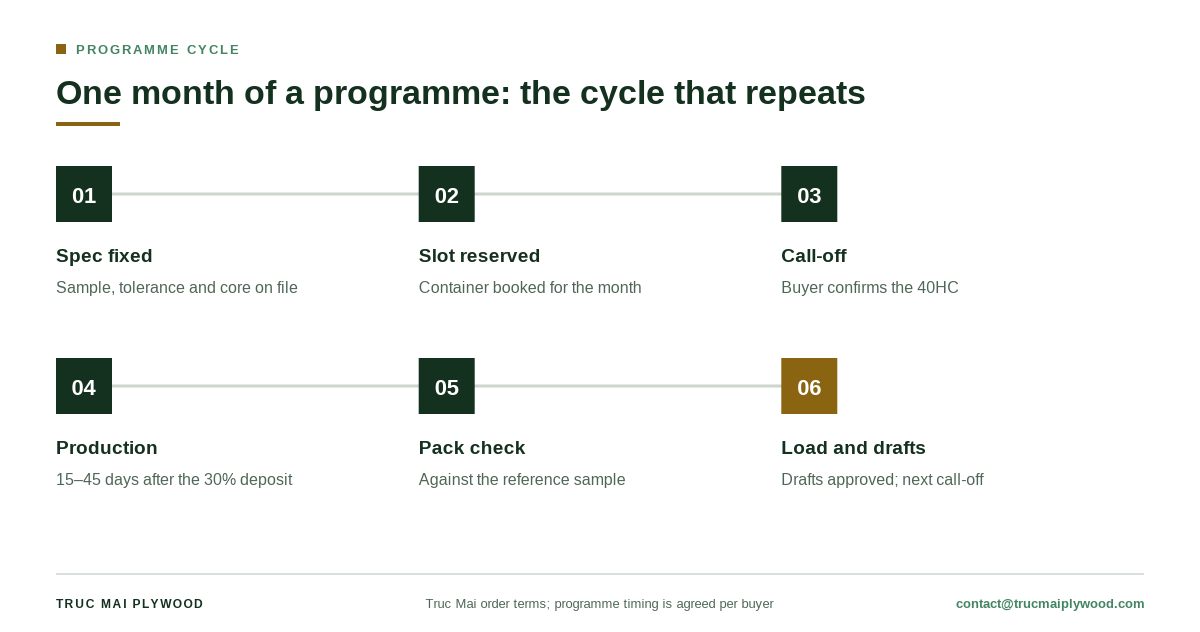
One month is a loop of six stages, from the fixed spec to the next call-off; the loop is the same in month two as in month twenty, and only the revision note changes when the buyer changes a line.
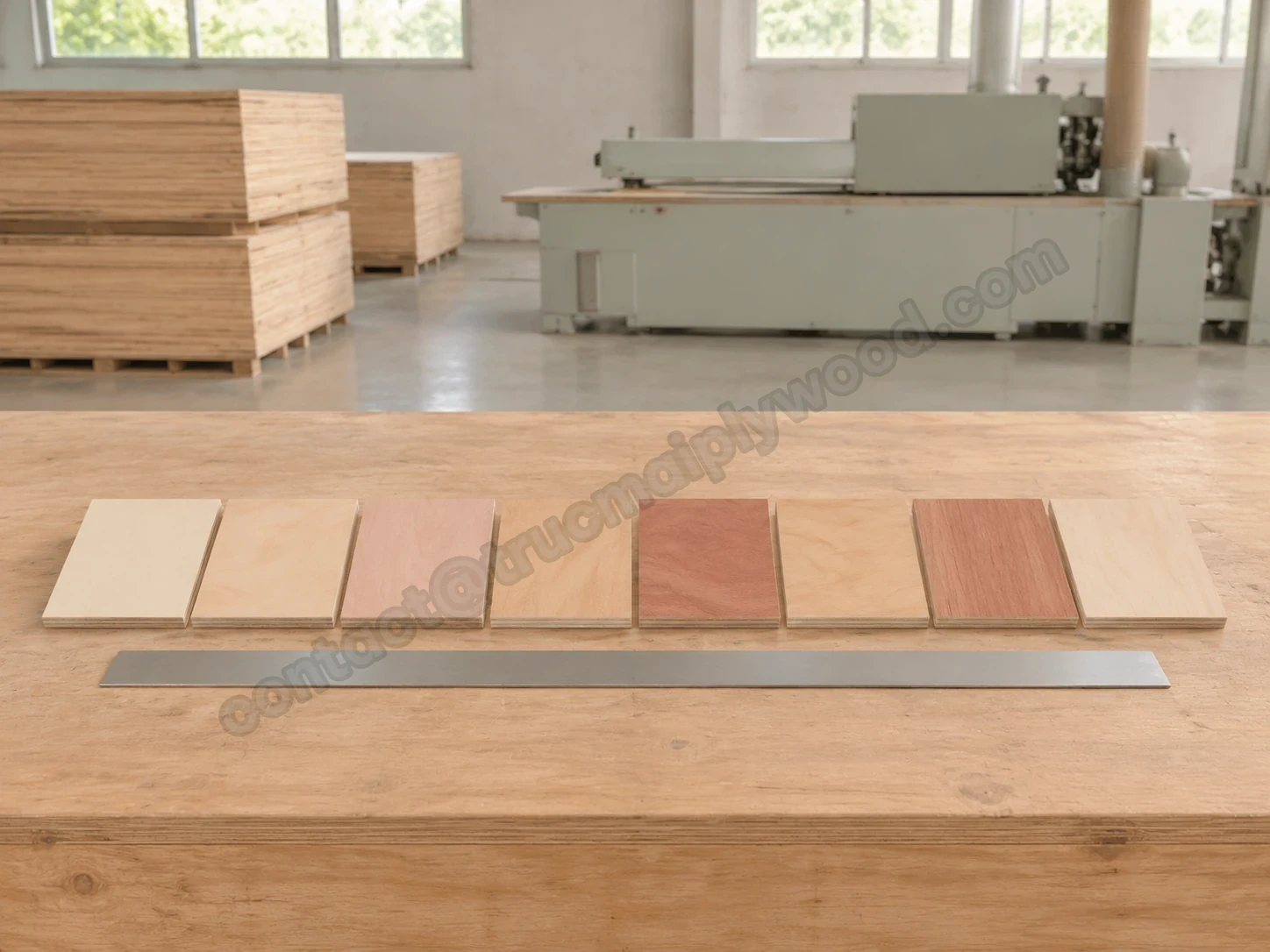
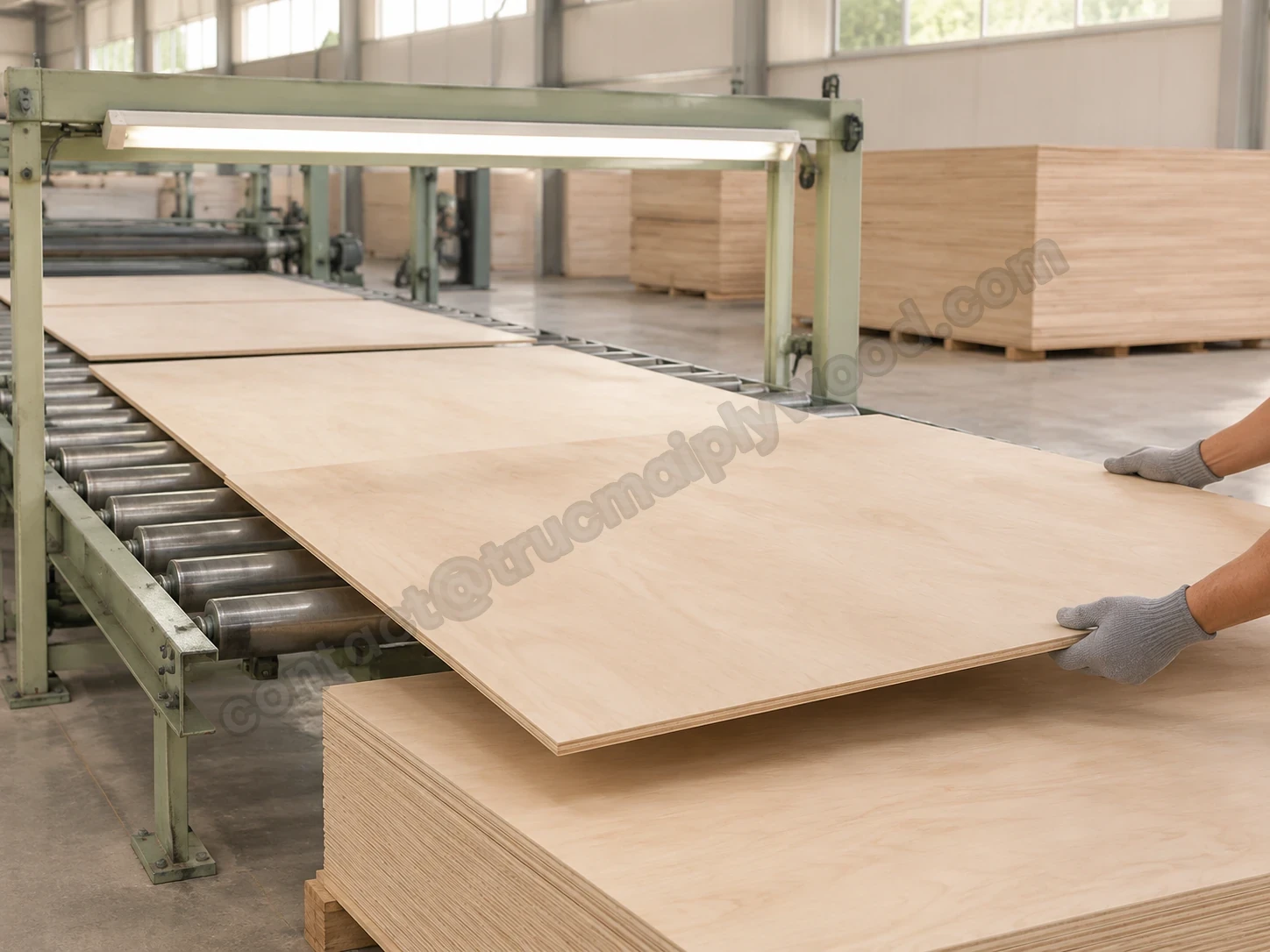
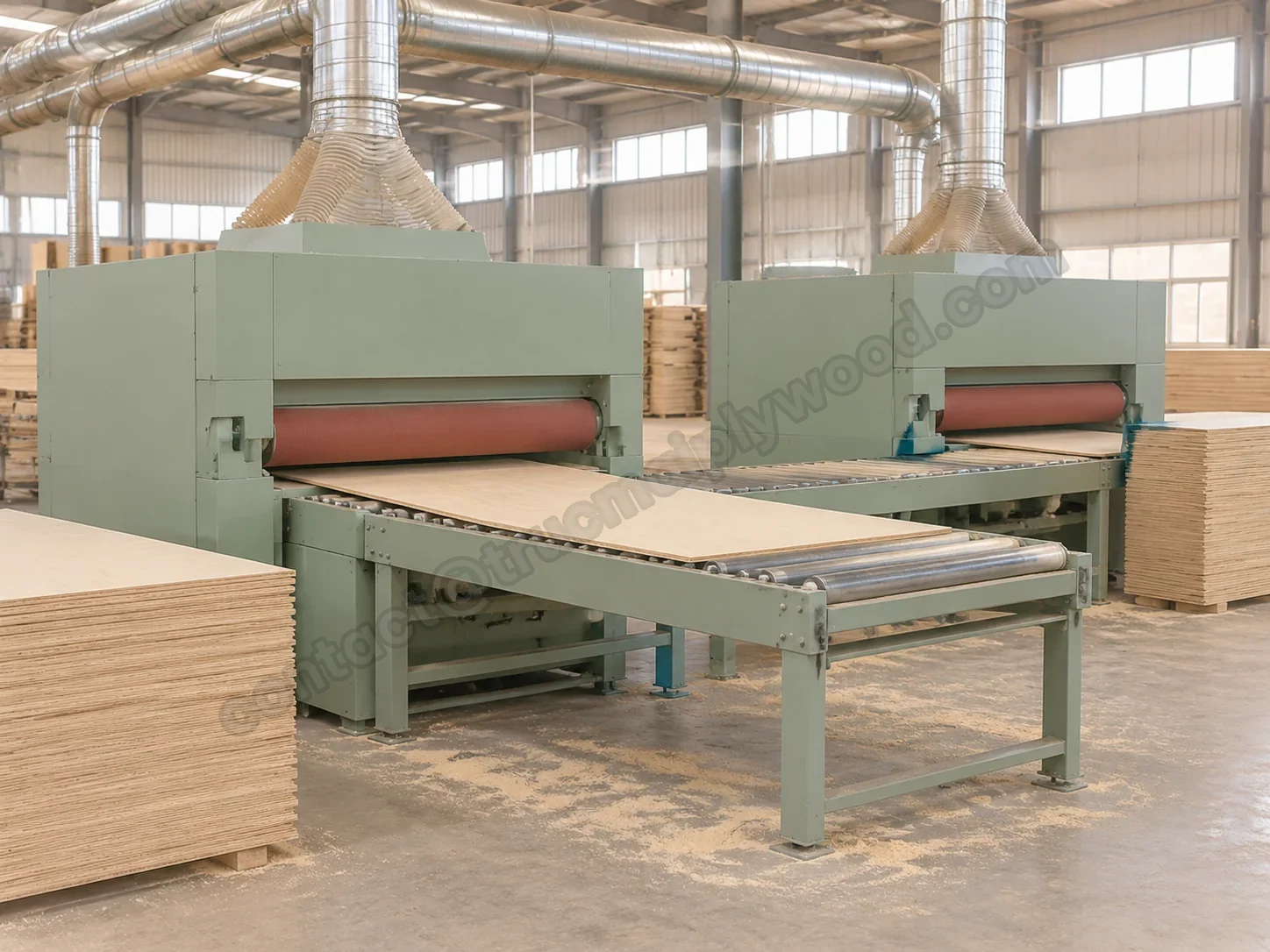
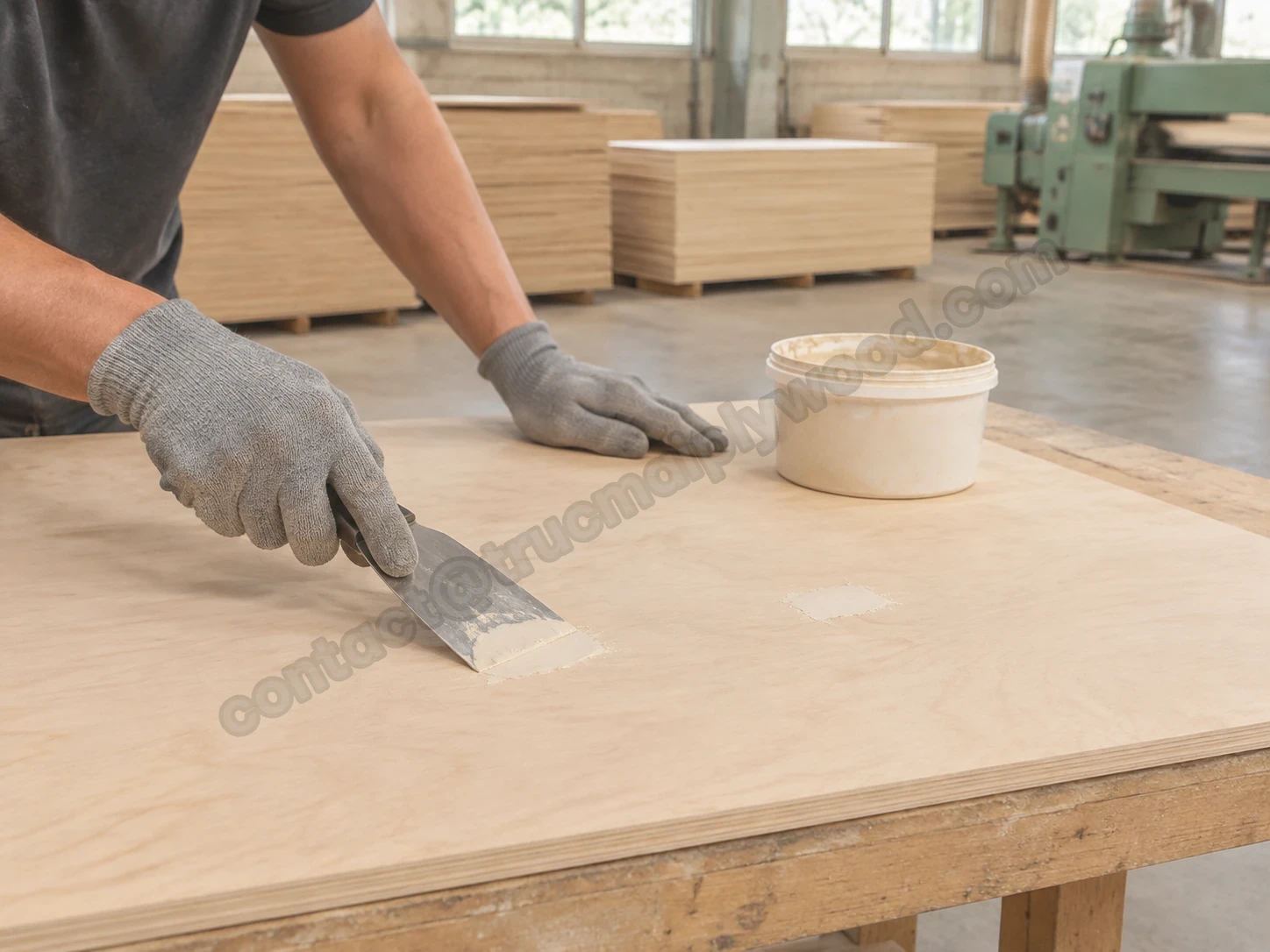
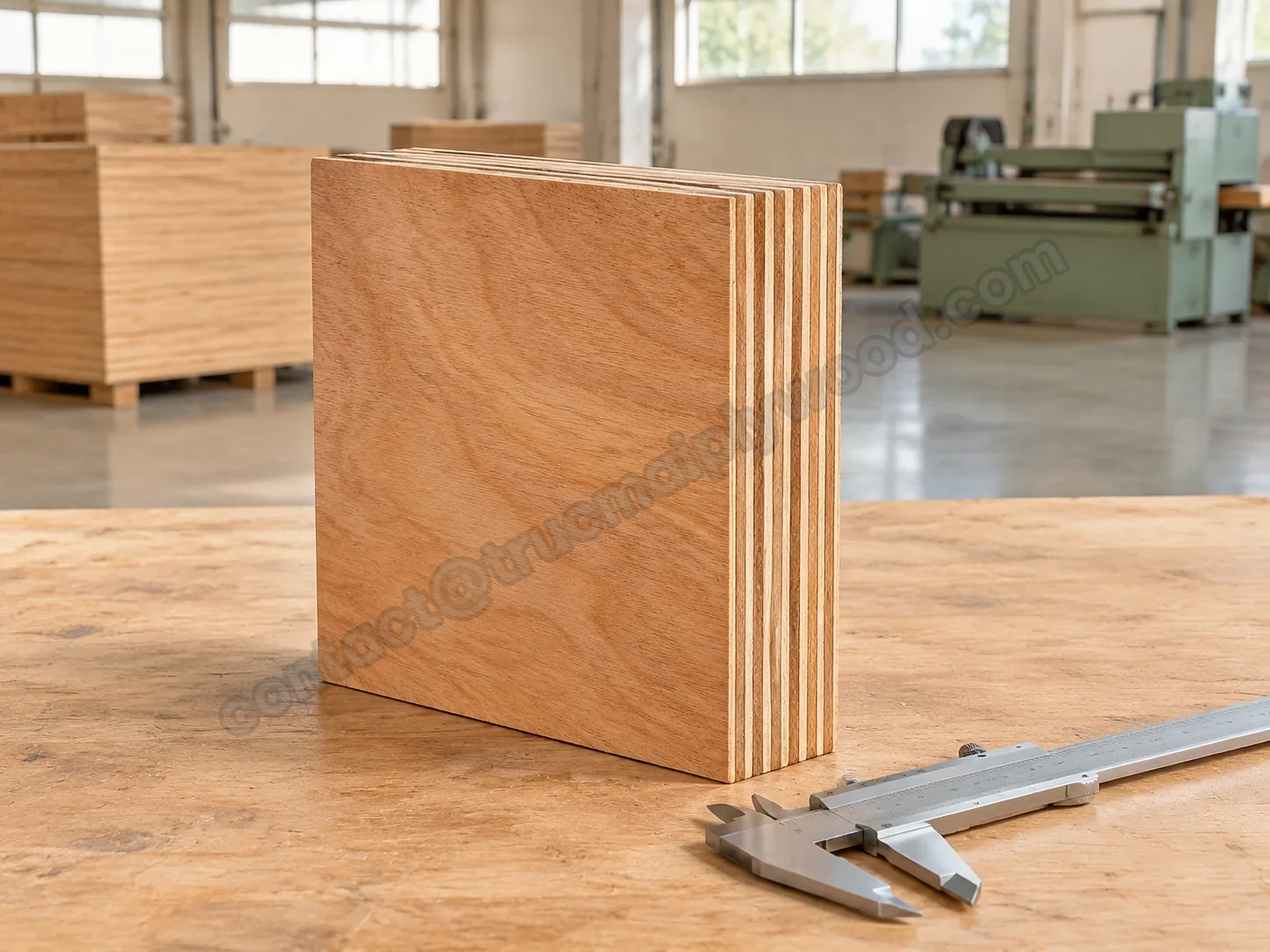
Each call-off carries the same photo set from the same angles: the labelled sample, the pack-check readings with a caliper, and the packs at loading. Because the angles do not change, a buyer can lay this month's photos next to last month's and see a drift before the container leaves Hai Phong, not after it arrives.
Where programmes slip
What goes wrong on a monthly plywood programme, and how is it caught?
Programmes slip in six places: the face drifts in colour, a call-off comes too late for the slot, the mix changes after planning, a thin panel is asked for at short notice, the spec changes without a revision, and the paperwork differs from the last container. Each has a written check.
| Problem | Cause | Fix on the programme |
|---|---|---|
| Face looks different from last month | Grade agreed by name, not against a sample | Face pair fixed against the labelled sample; pack check compares with it |
| Slot missed | Call-off confirmed inside the production time | Call-off date written on the programme sheet, 15–45 days before loading |
| Container overweight or short | Mix changed after the plan | Mix fixed on the proforma invoice; load plan redone if it changes |
| 4 mm panels late | Good thin veneer is scarce and 1.3 mm core veneer is needed | Order 4 mm earlier in the cycle and say so on the programme sheet |
| Panel differs between containers | A line was changed informally | Changes only through a new spec revision with its own note |
| Documents arrive in a new shape | Each container treated as a new order | Same document set as the first container, drafts approved after loading |
Numbers
What numbers does a monthly programme fix in writing?
A programme fixes the same numbers as any Truc Mai order, once, for every container: the minimum, the production range, the deposit, the tolerance and the container mix.
| Item | Value | Condition |
|---|---|---|
| Smallest call-off | One 40HC | Same as a first order |
| Production time | 15–45 days | After the 30% deposit; by quantity, production conditions and agreement |
| Deposit and balance | 30% and 70% | Balance against the scanned B/L, by T/T or irrevocable L/C at sight |
| Delivery terms | FOB Hai Phong, CFR or CIF | Written on each proforma invoice |
| Products per container | 1–2 usually; up to six | Three or more by agreement |
| Thickness tolerance | ±0.3–0.5 mm | Written per order; ±0.3 mm on sanded and calibrated furniture panels |
| Length and width | ±2 mm | Per order |
| Thickness range | 3–40 mm | Thin 4 mm panels can take longer |
| Load of one 40HC at 18 mm | About 53, 47 or 43 m³ | Styrax, Acacia, Eucalyptus; planning figure, see the 40HC load calculator |
Sheet counts and weights are planning figures, not a loading record.
Is it for you?
When is a long term plywood supply agreement worth setting up, and how big should it be?
A programme pays when the same spec is used every month and the monthly need is at least one full container. Below one container a month the buyer is better served by separate orders; above it, the programme removes the repeated work of re-specifying and re-approving.
Start from the monthly need in m³ and divide by the planning figure for the core: a buyer who needs a little under three times that figure a month writes the programme for three 40HC. A buyer whose need is just over one container has a surplus; the extra volume is better placed in a second product in the same container than in a half-empty second container.
Set the number a little below the real need rather than above it. A programme is easier to raise than to cut, and a container that is not filled is paid for in freight. If the demand is seasonal, say which months change; the mill plans against the programme sheet, not against a guess.
| Buyer's situation | Better route |
|---|---|
| Under one full container a month | Single orders, planned around the production range |
| One container a month on one spec | Programme of one 40HC, one product |
| One container a month on two specs | Programme with two product lines in one 40HC |
| Several containers a month on one spec | Programme with the number of 40HC written, call-offs spaced across the month |
| Spec still being decided | Run a first container and samples before writing the programme |
What you hold
What does a buyer hold while a programme is running?
A buyer on a programme holds six documents that stay constant, and one that changes with each container: the spec sheet, the sample, the programme sheet, the revision log, the pack-check sheet and the document set, plus the proforma invoice of the month.
- Spec sheet Every line of the panel, with its revision number
- Labelled sample The face pair both sides compare with
- Programme sheet Monthly 40HC number, call-off date, mix, delivery term
- Revision log What changed, from which container, agreed by whom
- Pack-check sheet Counts, thickness readings and face notes per container
- Document set Approved draft shape, reused for the next container
- Proforma invoice The one document that is new each month
Records
Which records belong to a programme rather than to a single order?
Four records exist only because the order repeats; the invoices, the bill of lading and the certificate files follow the normal order set on MOQ, payment and FOB and papers per container.
Monthly number of 40HC, the call-off date in days before loading, the container mix and the delivery term.
- Spec sheet and revision log
The panel as lines, and the list of changes with the first container that carries each one.
Packs per product and core, sequenced to the 40HC; it is redone whenever the mix changes.
The sheet counts, the thickness readings and the face notes taken before loading, kept so the next one can be compared.
Capacity
How much of the mill's month does one programme container take?
One programme container is about 1% of an average month at Truc Mai: the mill produces around 60,000 m³ a year, about 5,000 m³ in an average month, and one 40HC of 18 mm panels is about 53, 47 or 43 m³ by core.
The arithmetic is small on purpose. A programme of three containers a month takes about 3% of an average month, so a reserved slot is a planning commitment on both sides rather than a claim on a large part of the mill. The mill-wide output and how it is shared across product lines are on monthly output; the days from deposit to loading, and why a larger quantity moves toward the long end of the range, are on lead times by volume.
Programme checklist
Which six lines should a monthly programme sheet carry?
Six lines on the programme sheet cover what is hardest to recover once a month has gone wrong.
The spec reference and revision, so every call-off names the same panel.
The monthly number of 40HC and the months in which it changes.
The call-off date, in days before the wanted loading date.
The container mix: products, cores and the split in packs.
The sample reference for each face pair, and who holds the samples.
The delivery term, FOB Hai Phong, CFR or CIF, and the destination port.
FAQ
Monthly programme questions from container buyers
Direct answers on mixing, timing, payment and what stays fixed.
How does a monthly plywood supply programme work?
The buyer and the mill write one spec and a monthly number of 40HC. Each month the buyer confirms a call-off, pays the 30% deposit for that container and the mill builds it to the same spec in 15–45 days. The 70% balance is paid against the scanned B/L.
Can I mix different plywood specifications in one container?
Yes. A container usually carries one or two products, and three to six can be mixed by agreement. Each product keeps its own line on the spec sheet and its own sample, and the mix is written on the proforma invoice before production.
Can I mix core types in one 40HC?
Yes, if the load is planned for it. Styrax, Acacia and Eucalyptus cores have different weights, so a mixed load is planned by weight and by volume together, and the pack plan is redone when the mix changes.
What is the minimum order on a programme?
One 40HC per call-off, the same as a first order. A programme does not lower the minimum; it removes the need to re-specify and re-approve each month.
How long after the deposit is a programme container loaded?
Production takes 15–45 days after the 30% deposit, by quantity, production conditions and agreement. The programme sheet writes the call-off date in days before the wanted loading date, so the deposit is paid early enough.
What payment terms apply to each call-off?
The same as any order: a 30% deposit, then 70% against the scanned B/L by T/T or irrevocable L/C at sight. Each call-off has its own proforma invoice.
Does a programme fix the price?
No price is written on this page. Price is quoted per order against the written specification; whether a programme price basis is agreed is a point for the quotation.
Can the monthly number change?
Yes, by a revision of the programme sheet. State the months in which the number changes; the mill plans the production slots against the sheet.
Who holds the reference sample?
Both sides. The buyer and the mill each keep a labelled sample of the approved face, and both carry the same spec revision.
How do I start a programme?
Run one container as an ordinary order with a written spec and an approved sample, then write the spec as lines and the monthly number on a programme sheet. A quotation request with the eight RFQ lines is the starting point.
Start a programme
Send the spec and the monthly number
Send the eight RFQ lines and the number of 40HC you expect each month; the quotation comes back with the build, the planning load and the delivery term.
Spec lines, monthly 40HC number, container mix, call-off timing and destination port.