
A first order with a plywood supplier becomes monthly supply when the first 40HC is used to fix one written line: core, glue and emission, face and back against an approved sample, tolerance and pack plan. Check that container on arrival, freeze the line, and repeat it. Change one line quietly and the second load no longer matches the first.
How does a first order with a plywood supplier become monthly supply?
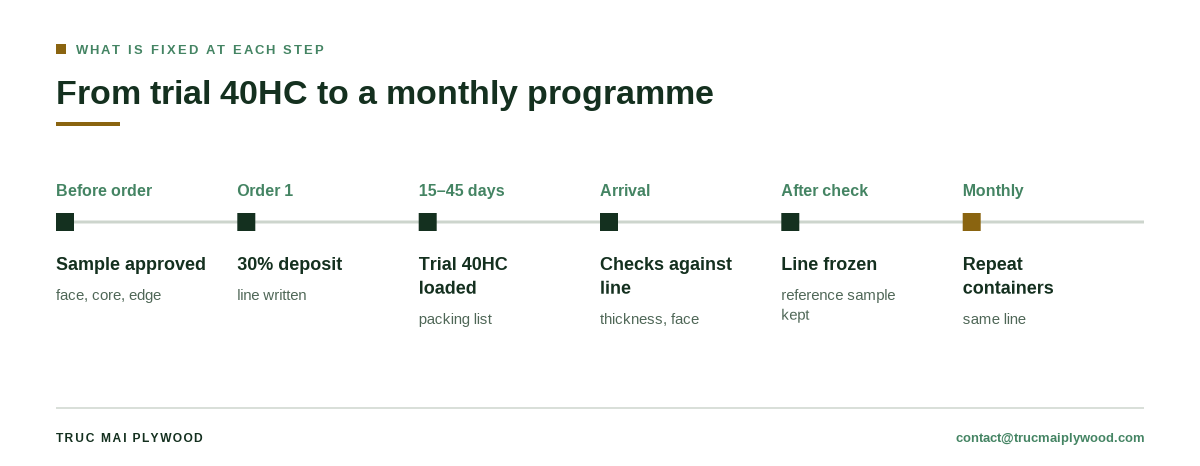
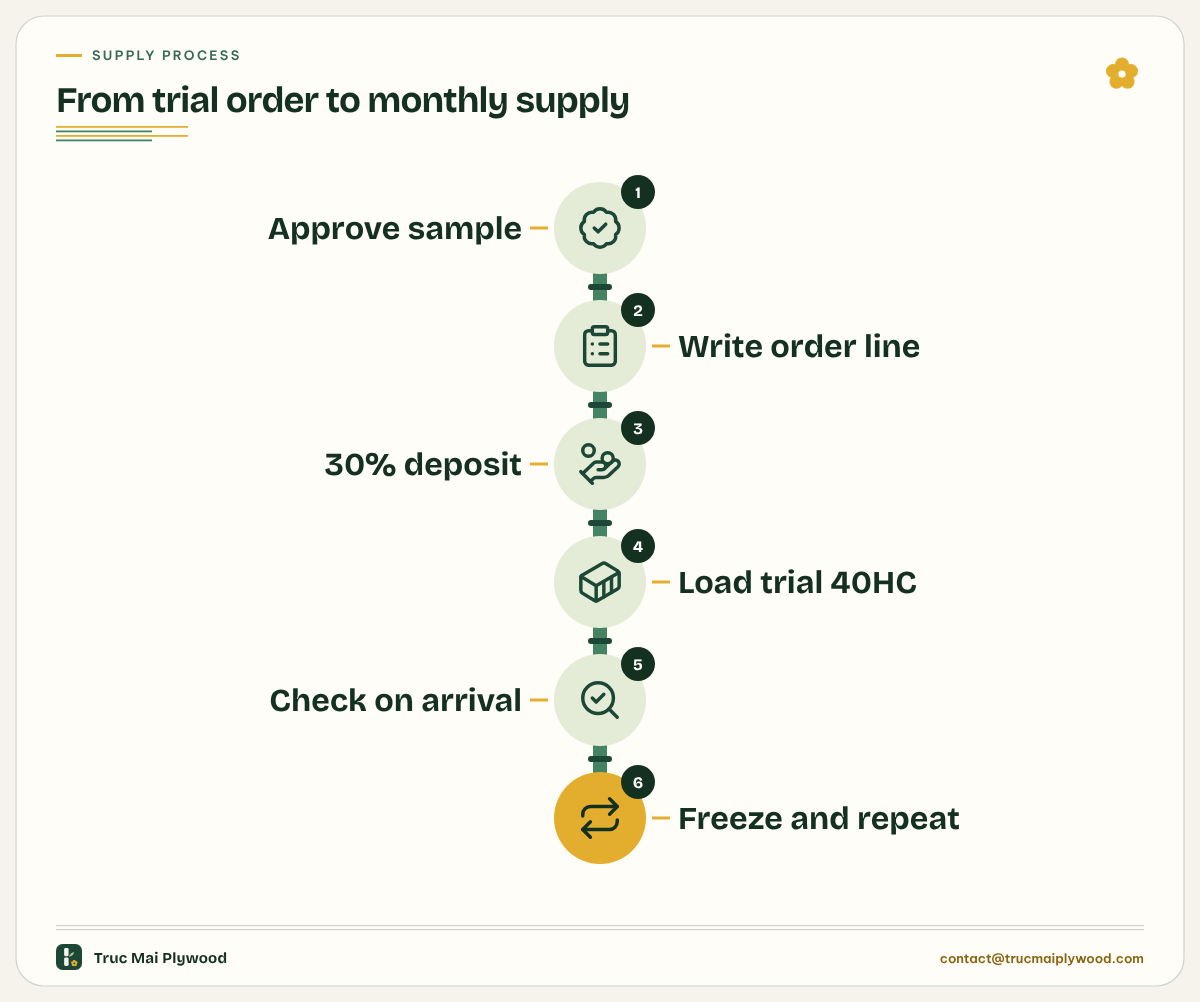
A first order becomes monthly supply in six steps: approve a sample, write the order line, pay the 30% deposit, load the trial 40HC, check it on arrival against the line, then freeze the line and repeat it monthly. The trial exists to prove the line; the programme exists to keep it unchanged.
Most failed programmes do not fail on the first container. They fail on the third or the fifth, when something small moves: a different core species because the usual one is short, a looser tolerance, a face graded a little more generously. Each change can be reasonable on its own. Together they produce a container that no longer matches the panels the buyer’s customers expect.
So the work of a first order is mainly writing. The buyer and the mill agree, in words and against a physical sample, what the panel is. The trial container tests that description against a full load. After the arrival check, the description is frozen and becomes the programme.
At Truc Mai the programme runs on a mill that presses around 5,000 m³ in an average month, in Ha Hoa, Phu Tho. The details of a running programme are on monthly container programmes.
What is the MOQ for a first order?
The MOQ for a first order is one 40HC, on the same terms as every later container: a 30% deposit, production in 15–45 days, and a 70% balance against the scanned B/L. Samples sit before that first order at no charge, and the courier fee a newcomer pays is refunded as credit on the trial container (ordering samples).
Plywood supplier first order USA and EU: what is the same
The MOQ and the terms do not change with the market. What changes is the file set: a US container needs the CARB P2 and TSCA Title VI certificate for the product, and an EU container needs the FSC claim where it applies and the EUDR data for core and face. Name the market in the first message, so the sample and the quote are made for the right files.
One 40HC is a large first order for a buyer who has never seen the mill’s panels. That is why the sample comes first, and why the first container can carry more than one product.
How many products can a first container carry?
The trial box normally holds one or two products, and a mix of three to six is possible if agreed. Each product is its own order line with its own sheet count, so a buyer can test two thicknesses, or one face on two cores, inside the one-40HC minimum.
Fewer products make the first arrival easier to check. With one or two lines, every pack can be compared with one or two samples. With six lines, the check takes longer, the loading plan has more small parcels, and any difference is harder to trace. For a trial, two products is often enough.
Mixed plywood container first order: an 18 mm and 12 mm example
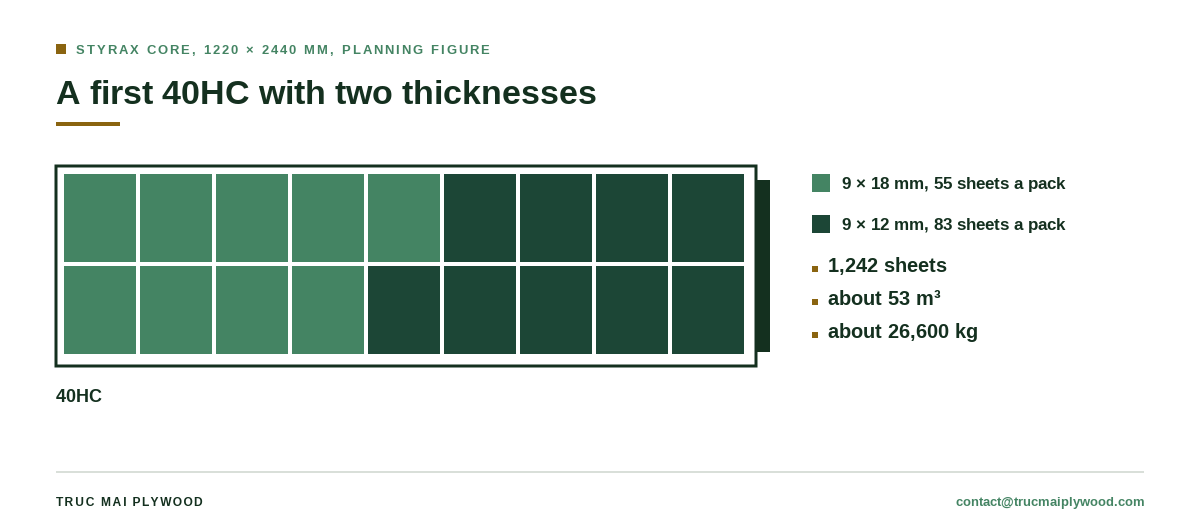
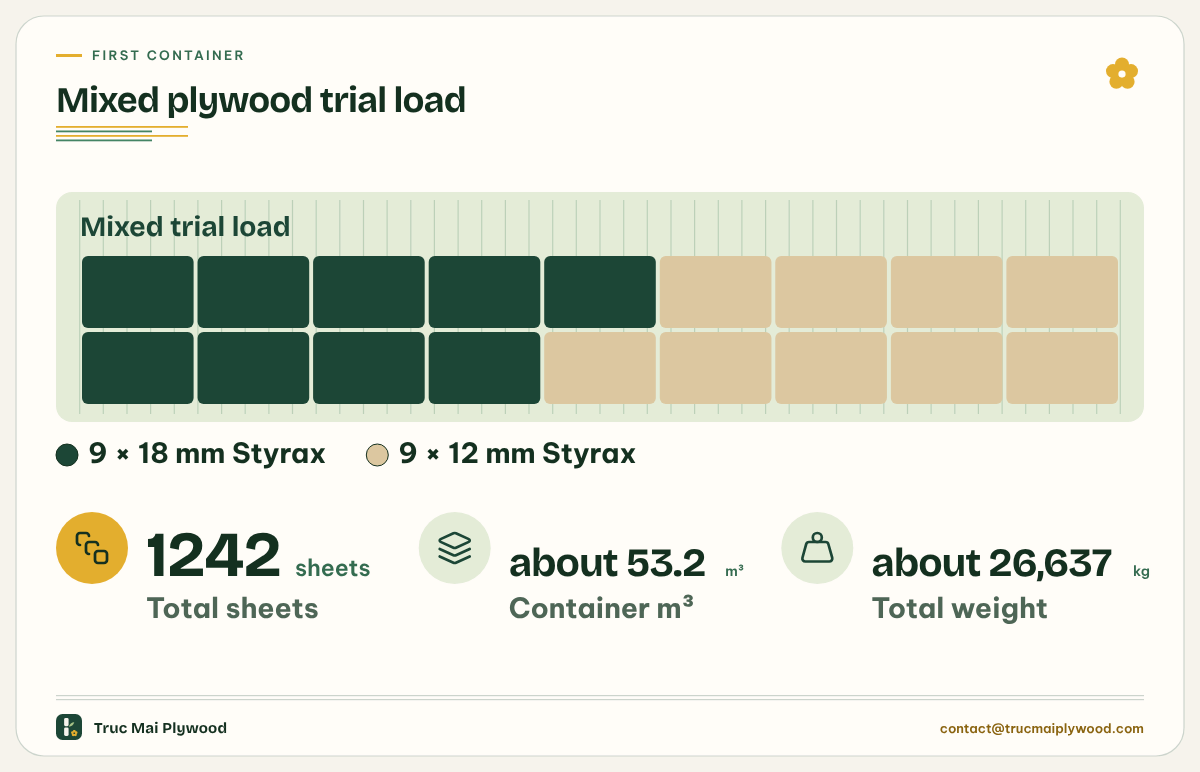
On a Styrax core, 1220 × 2440 mm, the planning model fits up to 18 packs about 1,000 mm high. Split them evenly between two thicknesses:
| Line | Packs | Sheets per pack | Sheets | m³ | Weight |
|---|---|---|---|---|---|
| 18 mm, Styrax core | 9 | 55 | 495 | about 26.5 | about 13,266 kg |
| 12 mm, Styrax core | 9 | 83 | 747 | about 26.7 | about 13,371 kg |
| Container | 18 | 1,242 | about 53.2 | about 26,637 kg |
These are planning figures from the packing model, under the 28,000 kg planning payload, not a loading record. Real sheet weights are checked before final loading. The full table for every thickness and core is on m³ per 40HC by thickness.
What should the trial container prove?
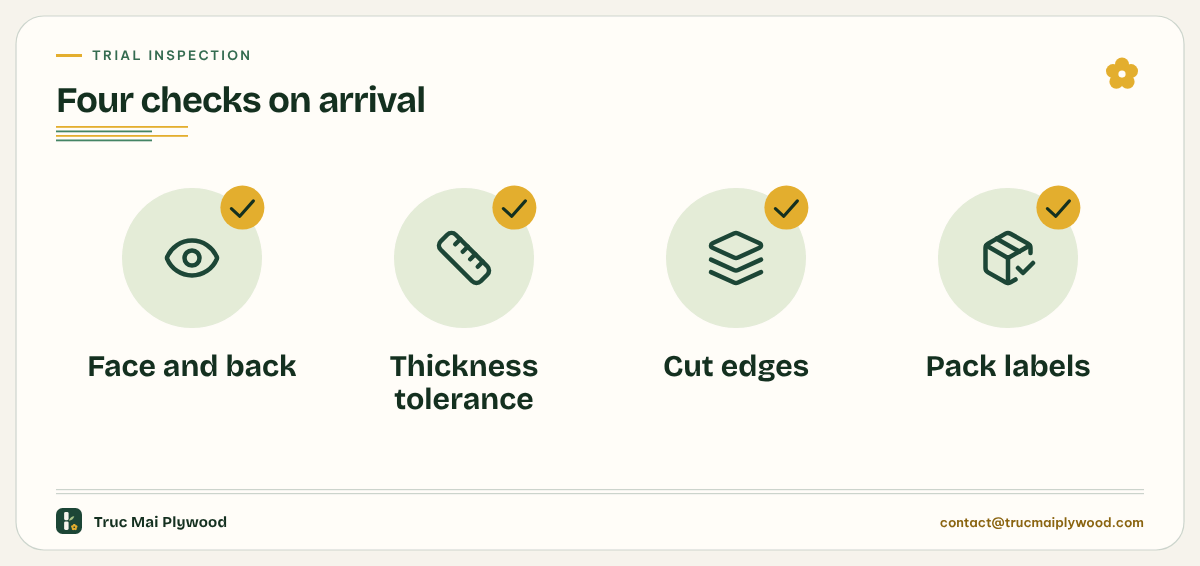
The trial container should prove five things against the written line: the faces match the approved sample, the thickness stays inside the written tolerance, the core is the agreed species and build, the packs and sheet counts match the packing list, and the files arrive complete and on time.
Write the arrival check before the container leaves, so the buyer’s team knows what to measure:
- Faces. Pull sheets from several packs and compare face and back with the approved sample, in daylight.
- Thickness. Measure near the corners and the middle of each sampled sheet. Check against the tolerance on the order: ±0.3 mm for a sanded, calibrated furniture build, ±0.5 mm for commercial grade.
- Core. Look along the cut edges for the agreed species, open joints and overlaps.
- Count. Packs against the packing list, sheets against the pack label.
- Files. Every document the order named, with matching container and seal numbers.
Record the results with photos and measurements. If the trial passes, the record becomes the reference for the programme. If it does not, the record shows which line to correct, and the correction is written before the next deposit. More on what to measure is on verify a mill before the deposit.
How is the spec kept the same from one monthly container to the next?
The spec is kept the same by four fixed things: the order line copied unchanged, the face grade judged against one approved reference sample, the tolerance written on every order, and the same core species, so the pack plan and the sheet count repeat. Any change is written as a change, never made silently.
Repeat plywood orders, same specification: the order line that does not change
| Line | Fixed at the trial | On each repeat order |
|---|---|---|
| Core | Species and grade, stitched or loose-laid | Unchanged |
| Glue and emission | For example UF glue at E0 emission | Unchanged |
| Face and back | Grades against the approved sample | Judged against the same sample |
| Thickness and tolerance | For example 18 mm, ±0.3 mm | Unchanged, written on the order |
| Sheet size | 1220 × 2440, 1220 × 2280 or 1250 × 2500 mm | Unchanged |
| Packing | Pack height, sheets per pack, labels | Unchanged |
| Quantity | One 40HC | Per month, as agreed |
The reference sample is the hinge. Face and back are graded as a pair against that approved piece, and the pair goes onto the order in writing. Keep one half of the sample at the buyer’s site and one at the mill, labelled with the order reference. When a face looks different on arrival, both sides compare it with the same piece.
At Truc Mai, a furniture panel uses an A-grade core, stitched, with sanded faces; core stitching runs across and along the sheet, usually on the outer 2–4 plies. How those checks are kept from one load to the next is on repeat specification control.
Why does the same core load the same count in every 40HC?
The same core loads the same count because the sheet weight and the pack plan depend on the core species. At 18 mm, 1220 × 2440 mm, the planning table loads 990 sheets on a Styrax core, 880 on Acacia and 795 on Eucalyptus. Change the core, and the count, the m³ and the invoice change with it.
| Core, 18 mm | Packs per 40HC | Sheets | m³ | Weight per sheet |
|---|---|---|---|---|
| Styrax | 18 × 55 | 990 | about 53 | 26.8 kg |
| Acacia | 16 × 55 | 880 | about 47 | 31.1 kg |
| Eucalyptus | 15 × 53 | 795 | about 43 | 34.8 kg |
A programme that switches from Styrax to Acacia without saying so loses about 110 sheets and about 6 m³ per container at 18 mm, and every sheet is about 4.3 kg heavier on the buyer’s line. That is why the core is a fixed line, not a mill’s choice per container.
The reverse is also true. A trial can also show the opposite: furniture buyers who step from Acacia to Styrax often find a cleaner face, a lighter sheet and more m³ per box. If the trial shows that a different core suits the product better, change it once, with a new sample, and freeze the new line.
What monthly volume can the mill supply?
Truc Mai presses around 5,000 m³ in an average month and around 60,000 m³ a year. One 40HC of 18 mm Styrax core is about 53 m³ in the planning table, so one container a month is roughly 1% of an average month’s output, and a buyer can add containers without the mill changing its line.
Plywood supplier for monthly containers: how volume is planned
Volume is planned in containers per month, by product. A buyer who takes two containers of 18 mm furniture panels and one of 9 mm commercial panels each month gives the mill three lines to plan, not a single total in m³. Tell the mill:
- the number of containers per month, by product;
- whether the quantity is fixed or a forecast;
- which months are heavier;
- how early a change of quantity will be announced.
For buyers who resell, such as wholesale plywood distributors, the monthly container often carries one fast-moving thickness and a second, slower line that is reordered every second or third month. Write that rhythm down; it is easier to plan than to improvise.
More on what the mill presses is on monthly output.
How long does production take after each deposit?
Each container takes 15–45 days of production after its own deposit, depending on quantity, production conditions and agreement. A programme does not shorten that window; it makes it predictable, because the line, the veneer and the press time are known in advance and nothing is decided during production.
The window is set per container, which is why a monthly programme needs overlapping orders. If the deposit for the next container waits until the previous one arrives, the gap between arrivals becomes production time plus sea time. Thin panels can take longer: good thin veneer is scarce, so 4 mm can sit at the long end. Production planning by volume is on lead times by volume.
How do you set the monthly rhythm of deposits, loadings and arrivals?
Set the rhythm by counting back from the arrival month: sea days from Hai Phong, loading, and up to 45 days of production give the latest date for each deposit. For a steady monthly arrival, the next deposit is paid while the previous container is still in production or at sea.
Sea days to count back from (from Hai Phong, by carrier and route; all lanes on sea freight per m³):
| Arrival region | Sea days to plan |
|---|---|
| Northern Europe | 30–40 |
| Mediterranean | 25–35 |
| US East Coast | 35–45 |
| Middle East | 15–25 |
| US West Coast | 20–30 |
A simple rule for Northern Europe: a container that should arrive in a given month needs its deposit about two to three months earlier. The payments follow the same schedule on every container, 30% deposit and 70% against the scanned B/L, so cash can be planned on two dates per container. The terms are explained on deposit and balance terms.
Which files come with every EU or US container?
Every container carries the commercial set: commercial invoice, packing list, B/L, certificate of origin, phytosanitary and fumigation papers, and insurance under CIF. An EU container adds the FSC claim for eligible products, the EUR.1 certificate of origin and the EUDR file set; a US container adds the CARB P2 and TSCA Title VI certificate.
| File | EU container | US container |
|---|---|---|
| Commercial invoice and packing list | Yes | Yes |
| Bill of lading | Yes | Yes |
| Certificate of origin | EUR.1 | As required |
| Phytosanitary and fumigation papers | Yes | Yes |
| FSC claim on sales documents | Eligible products on the current schedule | Eligible products on the current schedule |
| Emission | Emission certificate and test reports for the build | CARB/EPA 26053, 3–25 mm |
| EUDR file set | Plot geolocation for core and face | Not applicable |
For an EU programme, every container needs the importer’s own due-diligence statement filed first: Regulation (EU) 2023/1115 bars operators from placing or exporting relevant products until that statement is submitted, so the geolocation file must arrive with each shipment, not once. For a US programme, veneer-core hardwood plywood must meet 0.05 ppm of formaldehyde under 40 CFR 770.10, and 40 CFR 770.30 makes the importer keep each container’s records for three years; US import steps lists what goes in that file.
The files repeat with every container, so a programme should name them once in the order line and receive them each time without asking. The plywood itself is processed wood and outside ISPM 15; only solid-wood pallets, battens and dunnage fall under it. The full list is on papers per container.
What changes between the first order and the repeats?
Between the first order and the repeats, the quantity, the shipping month and the paperwork routine change; the panel does not. The first order fixes the line and the sample; each repeat copies the line, adds the month and quantity, and is checked against the same reference.
| Item | First order | Repeat orders |
|---|---|---|
| Sample | Requested, approved | The same reference sample |
| Order line | Written and agreed | Copied unchanged |
| Certificate files | Read before confirmation | Sent with each container |
| Arrival check | Full check, written up | Shorter check against the trial record |
| Deposit and balance | 30% and 70% | 30% and 70% |
| Planning | One container | Monthly rhythm, deposits overlapping |
The buyer’s effort moves from writing to checking. The mill’s effort moves from quoting to holding the line. If either side starts writing the line again on each order, the programme has not been frozen yet.
Is an annual plywood supply agreement worth signing?
An annual plywood supply agreement is worth signing once a trial container has passed and the buyer can forecast monthly volume. It should fix the order line, the reference sample, the monthly quantity or forecast, the delivery term, the payment terms and how a change is announced. It is a planning tool, not a price list.
What it usually includes:
- The frozen order line and the reference sample by name.
- Monthly quantity in containers per product, fixed or forecast.
- Notice for changes in quantity, product or month.
- Terms. Deposit 30%, balance 70% on the scanned B/L (T/T or irrevocable L/C at sight); delivery FOB Hai Phong, CFR or CIF.
- Files. The certificate documents and EU or US file sets with each container.
- Price review. How and when prices are reviewed; no price list is published, so the agreement says how a price is set, not what it is.
An agreement that only sets a volume, without the line and the sample, protects neither side. The line is what makes the volume worth committing to.
Can a monthly programme carry a private label?
Yes. A monthly programme can carry the buyer’s brand on the packs, filled on the same written line and the same pack plan as an unbranded order. The certificates stay in the mill’s name: the FSC claim is stated on the invoice for eligible products, and the buyer’s brand does not extend it.
Private label plywood supplier: what to fix at the start
- The label. Artwork, position on the pack and the wording, approved once.
- The pack. Pack height, sheets per pack and the wrapping, the same on every container.
- The claims. Only claims the mill’s certificates support; a 30 mm or 40 mm panel carries no CARB or TSCA claim.
- The line. Exactly as for an unbranded programme.
The label makes a programme harder to change later, because the buyer’s customers see the brand, not the mill. That is a reason to freeze the line before the first branded container, not after. Own-brand programmes are covered on private-label programmes.
What goes wrong on the second and third container?
On the second and third container the usual problems are drift: a core species swapped, a face graded more generously, a tolerance that slips toward the commercial figure, a pack plan that changes the sheet count, or files that arrive late because nobody listed them. Each is prevented by writing it on the order.
| Drift | How it shows on arrival | What prevents it |
|---|---|---|
| Core swapped | Different edge colour, weight and sheet count | Core species and grade on the order line |
| Face graded looser | More defects than the reference sample | Grade judged against the named sample |
| Tolerance slips | Thickness varies across the load | Tolerance written on every order |
| Pack plan changed | Sheets per pack differ from the trial | Pack plan in the order line |
| Files late | Customs or certificate question at arrival | File list in the order line |
When a difference is found, report it with photos and measurements against the reference, before the next deposit. A difference reported after three more containers have been ordered is harder to correct for everyone.
What should the first order line say?
The first order line should say the use, core, glue and emission, face and back against a named sample, thickness with tolerance, sheet size, packing, quantity, delivery term and files, and that the line will be repeated monthly. Written that way, the trial container and the programme share one text from the start.
| Line | What to write |
|---|---|
| Use | wardrobe carcasses, monthly programme |
| Core | Styrax, A grade, stitched |
| Glue | UF glue at E0 emission |
| Face/back | white poplar EV, graded to approved sample ref [ ] |
| Thickness | 18 mm, ±0.3 mm; sheet 1220 × 2440 mm, ±2 mm |
| Packing | export packs, 55 sheets |
| Quantity | 1 × 40HC trial, then 1 × 40HC monthly |
| Term | FOB Hai Phong; 30% deposit, 70% against scanned B/L |
| Files | FSC claim, EUDR data for core and face |
The full RFQ format is in writing a plywood RFQ. Mail the frozen line to contact@trucmaiplywood.com or enter it at the quotation desk, and request the matching sample that will serve as the reference for every repeat.
Questions buyers ask
What is the minimum first order from Truc Mai?
One 40HC. Because one box may hold one or two products, or up to six if agreed, a first order can test more than one panel.
Can a first container mix thicknesses?
Yes. Each thickness is its own line with its own sheet count. In the planning table, 9 packs of 18 mm and 9 packs of 12 mm on a Styrax core make 1,242 sheets and about 53 m³.
How is the spec kept the same on every monthly container?
The order line is written once and copied unchanged, the face grade is judged against the approved sample, the tolerance is written on the order, and the core species stays the same so the pack plan does not change.
How much plywood can Truc Mai supply each month?
The mill presses around 5,000 m³ in an average month and around 60,000 m³ a year. One 40HC of 18 mm Styrax core is about 53 m³ in the planning table.
Is a 20ft container possible for a first order?
The minimum on the standard terms is one 40HC. A buyer who needs less should say so in the RFQ, but the terms are written for full 40HC loads.
Do the payment terms change once a programme is running?
No. The first container and every repeat are paid the same way: 30% up front, 70% once the scanned B/L is out, by T/T or L/C at sight.
How long does each monthly container take to produce?
15–45 days after its deposit, depending on quantity, production conditions and agreement. For a steady monthly rhythm, the next deposit is paid before the previous container arrives.
Which certificate files come with a US container?
The CARB P2 and TSCA Title VI certificate CARB/EPA 26053 for hardwood plywood with veneer core at 3–25 mm, with the order's shipping documents. Panels of 30 and 40 mm are outside that scope.
Which files come with an EU container?
The FSC claim on the sales documents for eligible products, the emission certificate and test reports for the agreed build, the EUR.1 certificate of origin and the EUDR file set with plot geolocation for core and face.
Can I change the face after a few containers?
Yes, but treat it as a new line: new sample, new approval, and a note on the order that the face has changed. The other lines stay as they were.
Can the mill put our brand on the packs?
Yes, own-brand packs are part of a private-label programme with the same written line and the same certificate files, which stay in the mill's name.