
To verify a plywood factory in Vietnam, check four things before any money moves: the output it claims, the certificate codes in public databases, the press line on a live video audit, and the files it sends before the order is confirmed. A deposit paid on a quote alone buys a promise; paid after these checks, it buys a production slot.
How to verify a plywood factory in Vietnam before paying
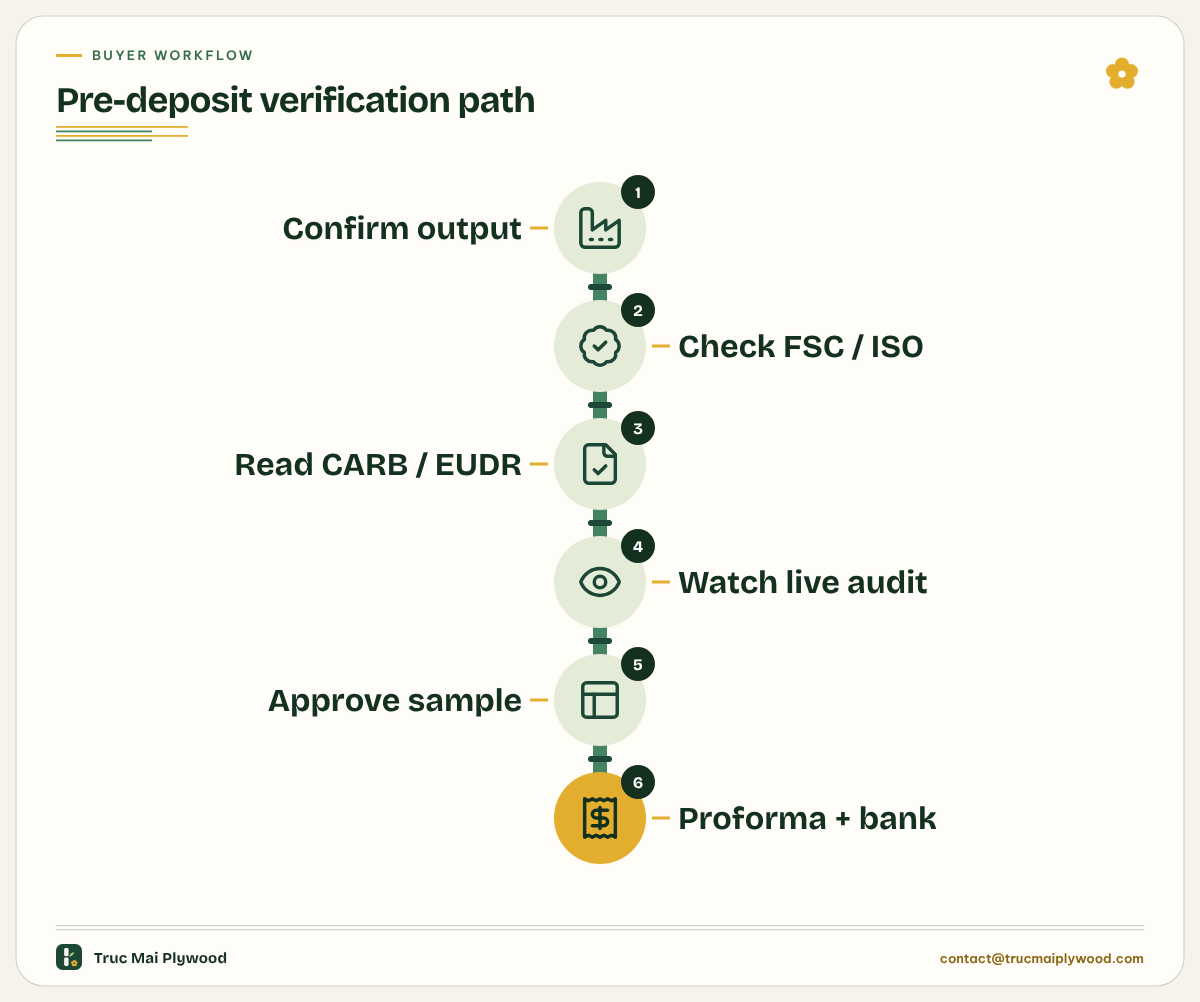
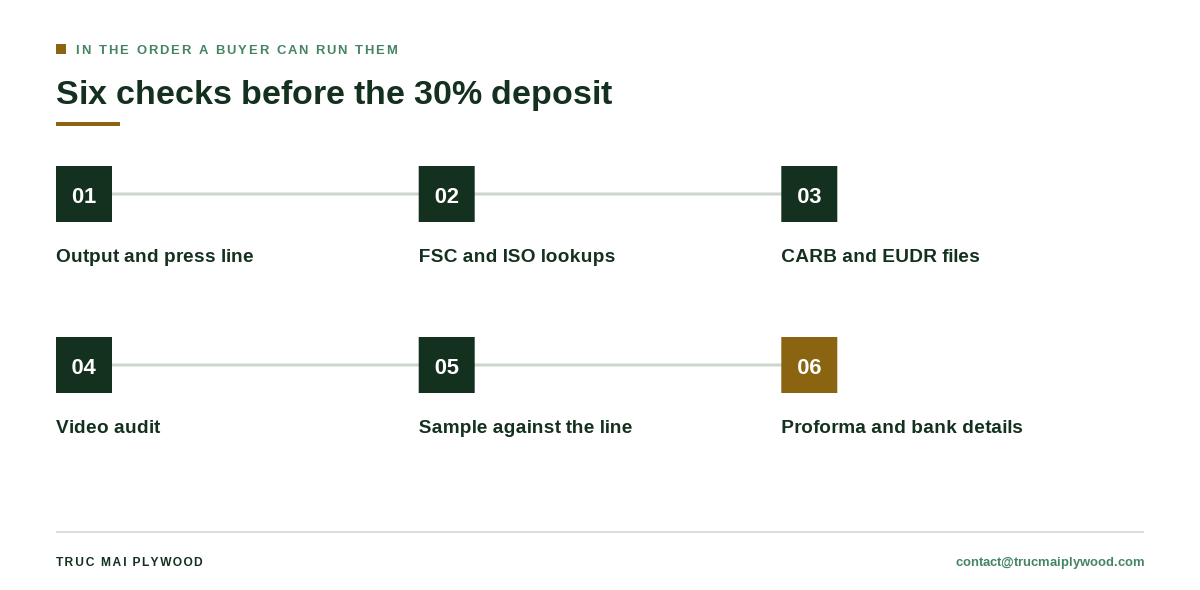
Verify a plywood factory in Vietnam in six steps before the 30% deposit: confirm its output, look up its FSC and ISO codes, read its CARB and EUDR files, watch the press line on a live video audit, approve a sample against a written order line, and confirm the proforma and bank details. Each step costs little.
The order matters because each check narrows the next one. A code that is not in a public database ends the process in minutes, before anyone books a video call. A video call that shows presses running at the address on the quote makes the files worth reading. And a sample approved against a written line turns the deposit into payment for something both sides have described in the same words.
None of these checks needs a trip to Vietnam, though a visit is welcome. They need a buyer who asks for proof rather than for assurances, and a mill that answers with documents, numbers and a camera. The sections below take each claim a mill makes, show where it can be checked, and say what a good answer looks like, using Truc Mai’s own figures and certificate codes as the worked example.
A word on scope. Truc Mai makes furniture and interior plywood and commercial plywood in Ha Hoa, Phu Tho: veneer-faced panels, UV-ready panels, melamine-, HPL- and paper-overlay-faced panels, packing plywood and non-structural LVL. The same checks apply to any mill; the numbers are ours.
Which mill claims can a buyer check, and where?
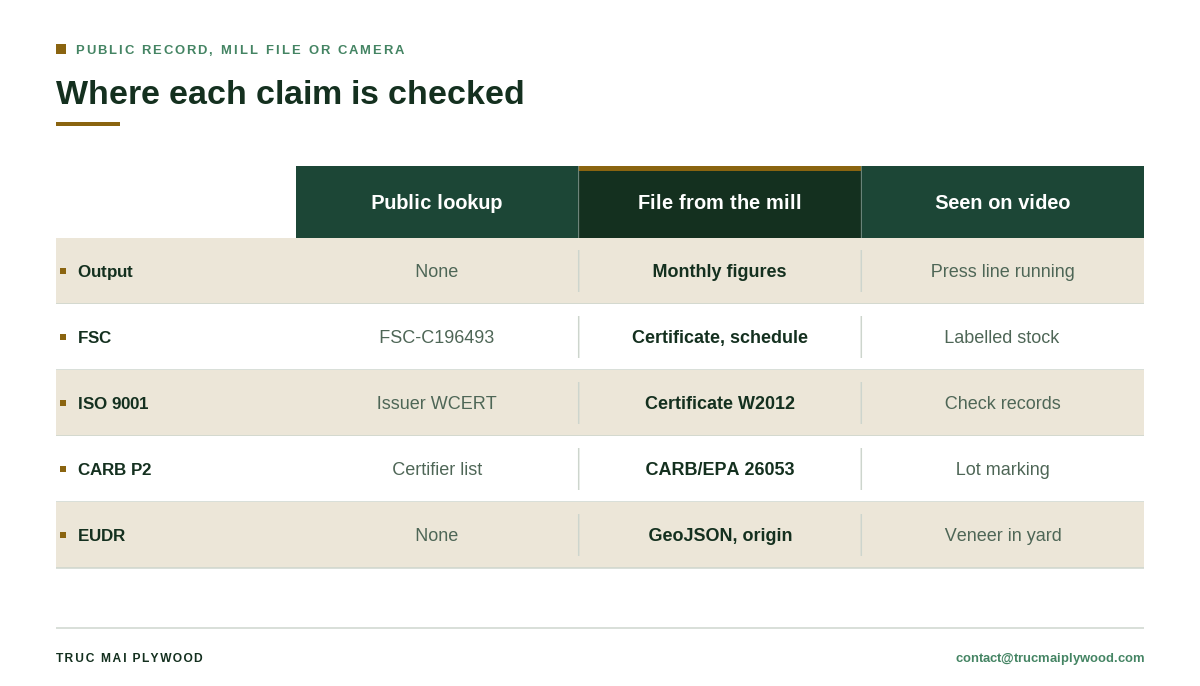
Five claims carry most of the risk on a first container: output, chain of custody, quality management, formaldehyde certification and origin data. Three of them can be checked in a public record before any contact; two can only be shown by the mill, in files and on camera. Knowing which is which tells you what to ask for.
| Claim | Public check | What the mill should send | What a video audit shows |
|---|---|---|---|
| Output | None | Monthly figures and the press count | Presses running, packs waiting |
| FSC chain of custody | FSC certificate search, by licence code | Certificate and product schedule | FSC-labelled stock in the yard |
| ISO 9001:2015 | The issuer confirms number and scope | Certificate with number and scope | Check records at the line |
| CARB P2 and TSCA Title VI | Certifier and certificate number | Certificate with product type and thickness range | Lot marking on packs |
| EUDR origin data | None | Origin records and GeoJSON files for core and face | Core veneer in the yard |
Read the table from left to right. A claim that passes the public check is real somewhere; the file shows it belongs to this mill and this product; the camera shows it on the line that will make your order. A claim that only exists in a brochure fails at the first column.
The same logic covers price. A quote far below the others is not a claim you can check in a database, but it is one you can test: ask the mill to confirm, in writing, the core species, grade, glue, emission class, face and back grades and tolerance behind it. If the lines are missing, the price is for a different panel. The page on how plywood is priced shows which lines move the price per m³.
What monthly output should a mill show for repeat 40HC orders?
A mill that will carry repeat 40HC orders should show its monthly output in m³ and let you compare it with your own volume. Truc Mai presses around 60,000 m³ a year, around 5,000 m³ in an average month, so one 18 mm Styrax-core container of about 53 m³ is roughly 1% of a month.
That ratio is the useful number. A buyer whose monthly container is a small share of the mill’s output is unlikely to wait behind a larger order, and a change of core or face for one container does not stop the line. A buyer whose order is a large share of a small mill’s output is buying that mill’s whole month, and a single delay elsewhere becomes his delay.
Plywood factory capacity check
Ask three questions and compare the answers with what the camera shows:
- How many m³ did the mill press last month, and in an average month?
- How many hot presses run, and on how many shifts?
- How many containers of the buyer’s product could be loaded in one month without moving other orders?
The answers should be consistent with each other. Around 5,000 m³ a month is the volume of about 94 containers at the 53 m³ planning figure, so a mill claiming that output should show a yard with packs waiting to load, not a single press. Truc Mai’s monthly output page gives the figures in one place.
Do not overvalue size on its own. A larger mill is not automatically the right supplier for a buyer who needs one special build a quarter. What matters is that the output and the order fit each other, and that the mill can say how a monthly container would be planned.
How can a buyer check the FSC licence and ISO 9001 certificate before paying?
Check an FSC licence by typing the licence code into the FSC certificate search and reading the holder, status and scope; check ISO 9001 by reading the number, issuer and scope and confirming them with the issuer. For Truc Mai that means FSC-C196493 and certificate W2012 from WCERT Certification.
FSC licence check plywood supplier
Before any money moves, run the code through the database FSC itself publishes, which its UK office presents as the place to confirm that a certificate is valid and what it covers, see FSC UK. Type the licence code, open the record and read four fields: the certificate holder, the status, the product type and the claim.
For Truc Mai the record should match these lines: licence code FSC-C196493, certificate SA-COC-014545, issued by Soil Association Certification, plywood, Primary Processor, FSC 100% only. The certificate licenses sales of FSC 100% products listed on its product schedule; there is no FSC Mix claim.
FSC Search also lets you download “a time-stamped PDF document” of a certificate record. Save it with your order file: it shows what the database said on the day you checked.
Two points catch buyers out before a deposit. First, holding a certificate does not put every panel the mill makes under it: the claim appears on sales and shipping papers only for eligible products listed on the current schedule, so confirm that your line is listed. Second, chain of custody is a tracking system: FSC describes it as one in which certified material “is identified and tracked during the manufacturing and distribution processes”, see FSC chain of custody. The claim belongs on the invoice, not only on the website. Our FSC licence code guide walks through a lookup screen by screen.
ISO 9001 and ISO 14001
ISO certificates are not held in one public database, so the check runs through the issuer. Read three fields on the certificate: the number, the certification body and the scope. Truc Mai’s are ISO 9001:2015 certificate W2012 and ISO 14001:2015 certificate W2012E, both issued by WCERT Certification (Vietnam), both with the scope “manufacture of plywood”.
The scope line is the one to read twice. A quality certificate whose scope is “trading of wood products” says nothing about a press line. ISO 14001 certifies an environmental management system; it is not a claim about the panel. More on what the quality system records at ISO 9001 at Truc Mai.
How do you check a CARB P2 and TSCA Title VI certificate?
Check a CARB P2 and TSCA Title VI certificate by reading four lines on it: the certifier, the certificate number, the product type and the thickness range, then confirming the certifier is recognised. Truc Mai’s certificate CARB/EPA 26053 was issued through ICTT Corporation (TPC-43) for hardwood plywood with veneer core, 3–25 mm.
The limit behind the certificate is federal. Under 40 CFR 770.10, hardwood plywood with a veneer core may emit no more than 0.05 ppm of formaldehyde. The certificate is the mill’s evidence that its product type is tested and certified against that limit by an approved third-party certifier.
Read the product type and thickness range against your order. Truc Mai’s certificate covers HWPW-VC, hardwood plywood with a veneer core, at 3–25 mm and 3–15 plies, with mill number ICTT-26053. A 30 mm or 40 mm panel is outside that scope and is never sold as CARB or TSCA certified. A melamine-faced or HPL-faced panel is a separate question to ask about the core panel underneath.
No ppm test results are published for Truc Mai yet, so ask for the certificate, not for a number on a web page. The CARB P2 file page lists what a US importer receives with an order.
Is EUDR a certificate a mill can hold?
No. There is no EUDR certificate for a mill to hold. Under the EU Deforestation Regulation the EU importer is the operator and files its own due-diligence statement; the mill’s job is to supply the data that statement needs, including plot geolocation for both the core veneer and the face veneer.
Article 4 of Regulation (EU) 2023/1115 is the source: without a due-diligence statement filed first, an operator may neither place relevant products on the market nor export them. That is your obligation, so the deposit should wait until the mill’s data can support it.
So the check is not “do you have EUDR” but “show me a sample file”. Ask for it before the deposit. A file you can use names the product, gives each wood species by both its common and its scientific name, states the quantity and the producing country, and locates every plot the wood came from: coordinates carry six decimal digits or more, and any plot above 4 ha is drawn as a polygon.
Truc Mai supplies that data for both the Vietnamese core and the face veneer, as origin records and GeoJSON files. A sample core dossier, for example, holds plot coordinates, a polygon map, harvest permit papers, forest-product lists and weighbridge tickets for FSC 100% Acacia mangium from a smallholder plantation. An EV face dossier traces engineered veneer made from plantation poplar through FSC certificates to a GeoJSON polygon. Plot owners and coordinates are never published; they go to the importer.
The deadline to plan a deposit around is 30 December 2026, when EUDR starts to apply to large and medium operators and to micro and small operators that EUTR already covered; plywood importers are among them. The dates and roles are set out at EUDR geolocation data.
What should a video audit of the Ha Hoa mill show?
A video audit of the Ha Hoa mill should show, live and in one call, the core veneer yard, the glue spreaders and hot presses running, the sanding and thickness checks, finished packs with their labels, and the certificate originals held up to the camera. It answers what no database records.
Ask for it live, not as a recorded film. A recording shows that a factory exists; a live call shows that the person quoting you can walk into it today. Ask the camera to turn around at least once, toward the gate or a building, so the site matches the address on the quote.
Shot list for a video audit of a plywood mill
- Veneer yard. Core veneer stacked and drying. Ask which core species is in each stack: Eucalyptus, Acacia, Styrax or Pine.
- Face veneer store. The faces for your order type, such as white poplar EV or birch. Ask where the face comes from and whether its origin file is ready.
- Glue spreading and lay-up. Veneers laid with cross-grain, cores butted, not overlapped.
- Hot press. Panels going in and out. UF and MR glue presses run at about 110–120 °C, WBP at 130–145 °C.
- Sanding and calibration. A thickness check with a gauge on a finished panel, against the tolerance you would write.
- Grading. Faces sorted against a reference sample.
- Packs. Finished packs with their labels, strapping and corner protection.
- Files. The FSC, ISO 9001, ISO 14001 and CARB/EPA certificate originals in front of the camera.
Keep a screenshot of each step with the date. Together with the FSC record and the certificate files, it is the evidence behind the deposit.
How can you verify a plywood supplier is a real factory, not a trading company?
Verify that a plywood supplier is a real factory by asking for things only a factory can produce on demand: a live video of presses running, certificates in the same company name as the proforma, and a sample cut from a current production run. A trading company can send a brochure; it rarely controls a press line.
A trading company is not a bad supplier in itself. Some buyers need one, to combine products from several mills or to handle a small order. The problem is a trader who presents himself as the factory, because then nobody on the buyer’s side knows who controls the spec, the timing and the files.
Questions that separate the two:
- “Whose name is on the FSC certificate, and is it the name on the proforma?” A mismatch is not always wrong, but it should be explained in writing.
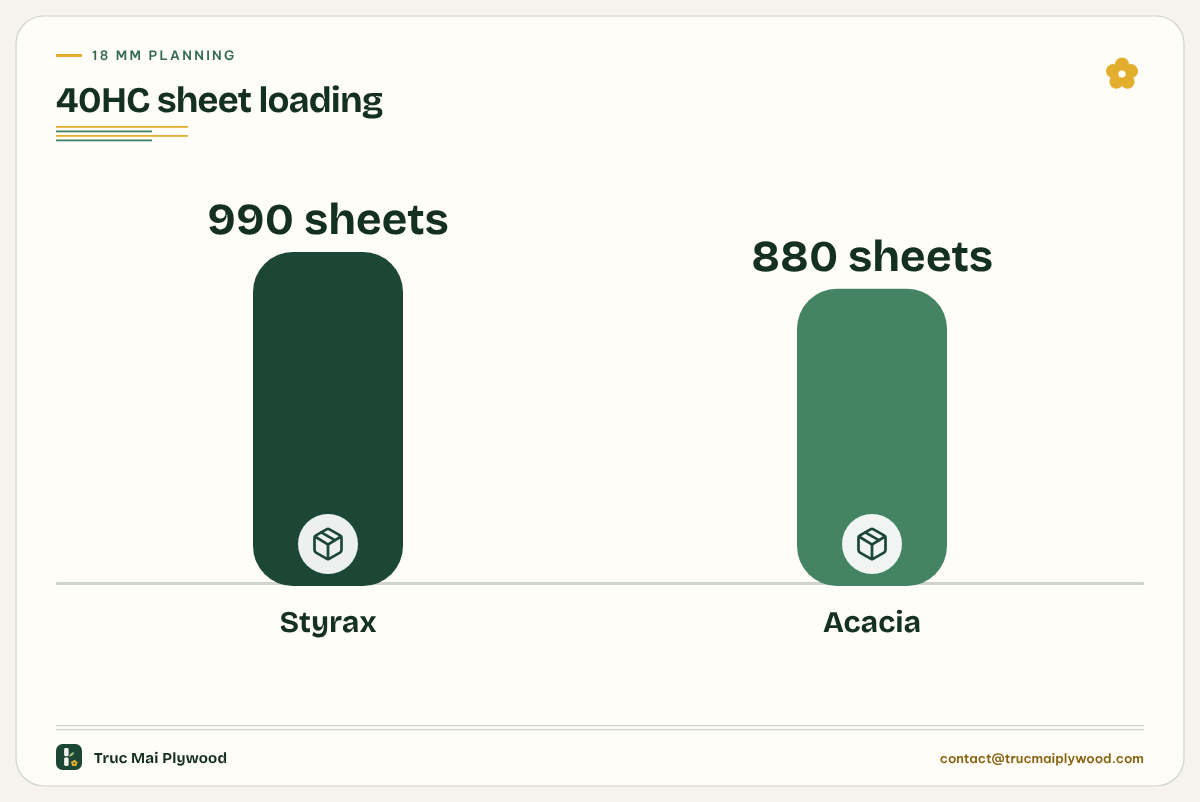
- “Can you change the core from Acacia to Styrax for this order, and what happens to the sheet count?” A mill answers with a number. At 18 mm in the planning table, Styrax loads 990 sheets per 40HC and Acacia 880.
- “Can we see the press that will make this order, live, now?” A trader needs to arrange it.
- “Which tolerance do you write for sanded furniture panels?” A mill answers with a figure on the contract. Truc Mai sets it per order within ±0.3–0.5 mm, and a calibrated, sanded furniture panel gets ±0.3 mm.
The aim is not to catch anyone out. It is to know who you are paying, and who will answer when a pack arrives with the wrong face.
What does a plywood factory audit in Vietnam cover on site?
A plywood factory audit in Vietnam covers the same points as a video audit, with time to look closer: the veneer and its origin files, the glue and press records, thickness checks at sanding, the grading against a reference sample, the pack plan and the certificate originals. A visit adds one useful test: trace one batch end to end.
Truc Mai’s mill is in Ha Hoa, Phu Tho, where plantation forest nearby supplies the core wood. A visit is planned around the buyer’s product; the plan is on visiting Ha Hoa.
What a visit adds over a call:
- The feel of the faces. Run a hand over a sanded face and a calibrated one; the difference is easier to feel than to see on a screen.
- The trace. Pick one finished pack of a product like yours, ask for its packing list, and follow it back to the veneer lots and their origin files.
- The records. Ask to see the check sheets that sit behind the ISO 9001 certificate: thickness readings, moisture, grading notes.
- Loading. If a container is being loaded, watch how packs are placed and how the door end is filled.
An audit report that only lists machines tells you little. One that records what was measured, against which written line, is the start of the order file.
Which files are sent before the order is confirmed?
Before the order is confirmed, Truc Mai sends the certificate files that apply to the order: the FSC certificate, the emission certificate, test reports for the agreed configuration, and for EU lots a sample of the EUDR file set. The deposit is then paid after the buyer has read them, not as a step toward receiving them.
The full document set per shipment is longer, and most of it comes later:
| Document | When it is sent | What to check |
|---|---|---|
| FSC certificate and claim wording | Before confirmation | Licence code, scope, whether your product is on the schedule |
| Emission certificate (CARB/EPA 26053 for US lots) | Before confirmation | Product type, 3–25 mm range |
| Test reports for the agreed configuration | Before confirmation | That the report matches your build |
| EUDR data sample (EU lots) | Before confirmation | Species, plot geolocation for core and face |
| Draft commercial invoice and packing list | After loading, for approval | Sheet counts, packs, weights |
| B/L | After loading | Consignee, port, container and seal |
| Certificate of origin (EUR.1 for EU lots) | With shipping documents | Origin and consignee |
| Phytosanitary and fumigation papers | With shipping documents | Matching container numbers |
| Insurance certificate | Under CIF only | Insured value and cover |
The list of papers that travel with each container is on papers per container. Ask for the pre-confirmation files by name in the RFQ, so they arrive with the quote.
How can I check plywood quality before shipping?
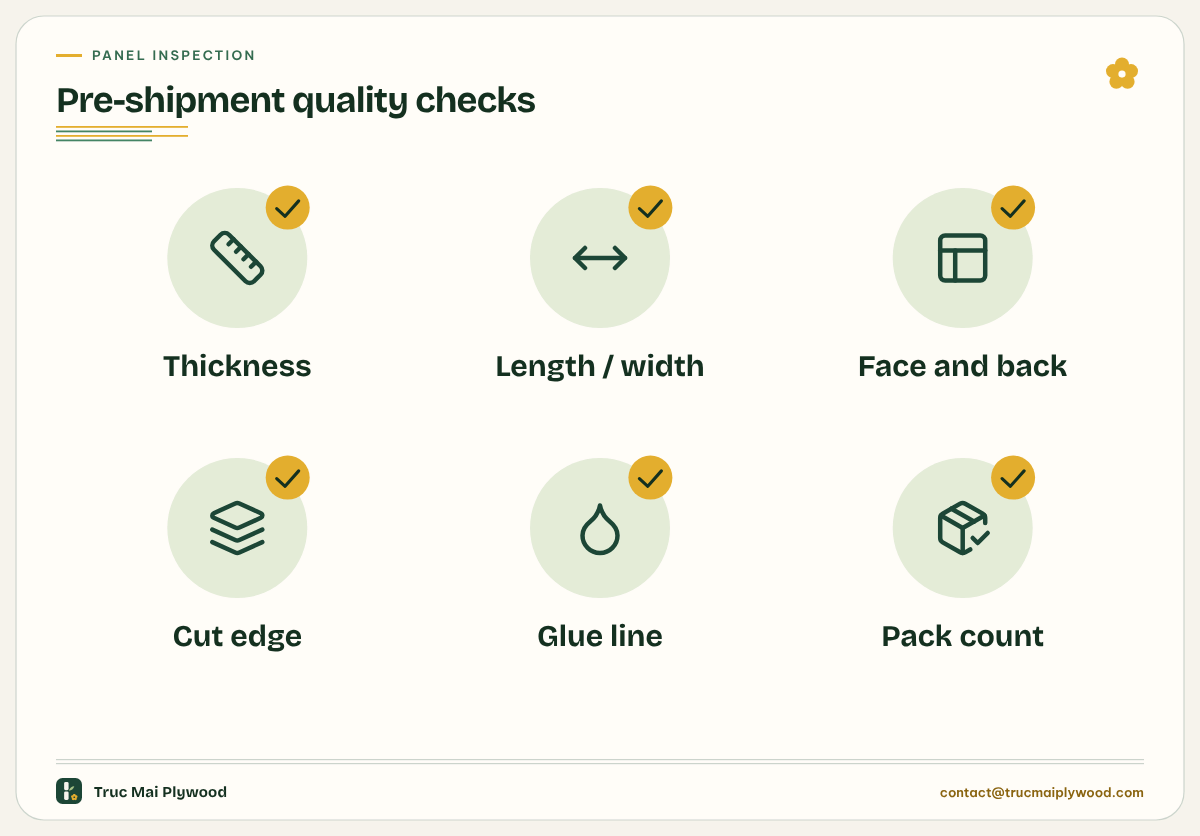
Check plywood quality before shipping by measuring a sample of finished sheets against the written order line: thickness at several points against the tolerance, the face and back against the approved sample, the core edge for gaps and overlaps, the sheet size, and the pack count and weight against the planning figures.
Check Vietnam plywood quality before shipping: what to measure
- Thickness. Measure each sampled sheet near the corners and the middle. Compare the readings with the figure on your order, not with a general one: a calibrated, sanded furniture panel is held to ±0.3 mm, commercial grade to ±0.5 mm and packing grade to ±0.5–1.0 mm.
- Length and width. ±2 mm on a 1220 × 2440 mm sheet, or whichever size was ordered.
- Face and back. Against the approved sample, side by side, in daylight. The grades are quoted as a pair.
- Core edge. Look along a cut edge for open joints and overlaps; a furniture core is stitched, usually on the outer 2–4 plies.
- Glue and emission. Confirm the glue line on the packing list matches the order: UF glue at E0 emission is the default.
- Packs. Sheets per pack and packs per container against the loading plan.
The buyer can do this himself on a visit, ask the mill for a photo and measurement record before loading, or send an inspection company. Whichever is used, it checks against the same written line, or the result cannot be compared with anything. The grades by line are explained in Vietnamese plywood grades.
When is the deposit paid and when is the balance due?
Pay the 30% only once every check above has passed and the order is confirmed; that payment is what puts your panels into production, which runs 15–45 days according to quantity, production conditions and what was agreed. The other 70% follows the approval of the draft documents and is paid against the scanned B/L, by T/T or irrevocable L/C at sight. The full schedule is on deposit and balance terms.
That sequence is what makes the checks worth doing. Everything before the deposit is cheap to stop. After the deposit, the mill has bought veneer and booked a press; after loading, the goods are on the water. The buyer’s position is strongest before the deposit and is held again at the balance, when the documents must match what was ordered.
The minimum order on these terms is one 40HC, and delivery terms are FOB Hai Phong, CFR or CIF. The full schedule is on MOQ, payment and FOB terms.
Which warning signs should stop a deposit?
Stop before the deposit if a certificate code is not in the public database, if the certificate holder differs from the seller without a written explanation, if the mill will not show the press line live, or if the bank account named on the proforma belongs to a different company or a person.
Other signs that call for a pause, not necessarily a stop:
- A certificate scope that does not mention plywood manufacture.
- A CARB claim on a thickness outside the certificate’s range.
- A price with no core species, glue, emission class or tolerance behind it.
- A promise of “any face, any core, any thickness” with no question back about the use.
- Pressure to pay before files are sent.
- A request to change the bank account after the proforma was issued.
The last one deserves its own rule. Confirm any bank detail change by a phone call to a number you already hold, never by replying to the email that announced it.
What does the pre-deposit checklist look like?
The pre-deposit checklist is short: six checks in order, each with a pass condition you can write down. Keep it with the order file, and do not pay the deposit until every line has a date and a result.
| Check | Pass condition | Truc Mai’s answer |
|---|---|---|
| 1. Output | Monthly m³ stated and consistent with the video | Around 5,000 m³ in an average month |
| 2. FSC | Code found, holder and scope match | FSC-C196493, SA-COC-014545, FSC 100% |
| 3. ISO | Number, issuer and scope confirmed | W2012 and W2012E, WCERT, manufacture of plywood |
| 4. CARB and EUDR | Certificate covers the order; sample file read | CARB/EPA 26053, 3–25 mm; GeoJSON for core and face |
| 5. Video audit | Live, shot list complete | Veneer, presses, sanding, packs, originals |
| 6. Sample and line | Sample approved, line written, bank details confirmed | Free sample; line includes tolerance |
The six checks run in this order. Public lookups come first because they are free; the sample comes last because it costs a courier.
What should you send the mill to start the checks?
Send one email with the product and use, the quantity in containers, the destination market and the files you need, and ask for a video audit slot. That is enough for the mill to send certificates, propose a sample and quote the same panel you will check.
A starting message that works:
| Line | What to write |
|---|---|
| Product | 18 mm white poplar EV face, Styrax core, sanded, UF glue at E0 emission |
| Use | kitchen carcasses |
| Quantity | 1 × 40HC trial, then monthly |
| Market | EU (FSC claim, EUDR data for core and face) |
| Request | certificate files, sample of the same build, live video audit slot |
The RFQ guide gives the full ten-line version. Send it through the quotation desk or to contact@trucmaiplywood.com, and book the video audit in the same reply.
Questions buyers ask
Can I visit the Truc Mai mill in Ha Hoa before the first order?
Yes. A visit to the mill in Ha Hoa, Phu Tho, is booked in advance and planned around your product. The certificate originals can be read on site, and the same codes can be looked up before you travel.
Does a video audit replace a visit to the factory?
For most first containers it is enough, if it is live and follows a shot list: veneer yard, presses running, sanding, packs and the certificate originals. A visit adds what a camera cannot, such as the feel of the faces and the noise of a full shift.
Is the FSC claim printed on every panel the mill sells?
No. The FSC claim is stated on the sales and shipping documents for eligible products listed on the current product schedule. Ask which of your lines are on that schedule before the order is confirmed.
Which thicknesses does the CARB P2 and TSCA Title VI certificate cover?
Truc Mai's certificate CARB/EPA 26053 covers hardwood plywood with a veneer core from 3 to 25 mm and 3–15 plies. Panels of 30 and 40 mm are outside that scope and are never sold as CARB or TSCA certified.
How do I check an ISO 9001 certificate from a Vietnamese mill?
Read the certificate number, the issuing body and the scope, then confirm them with the issuer. Truc Mai's ISO 9001:2015 certificate is W2012, issued by WCERT Certification, with the scope manufacture of plywood.
Is there an EUDR certificate I should ask for?
No. There is no EUDR certificate; the EU importer files its own due-diligence statement. The mill supplies the data for it: species, quantity, country and the geolocation of the plots for both core and face veneer.
Will the mill send certificate files before I pay?
Yes. At Truc Mai the certificate files are sent before the order is confirmed, so the deposit is paid after the buyer has read them, not before.
How much does a sample cost a new buyer?
Nothing for the panels themselves. A new buyer arranges the courier, and what it paid is credited once a real order follows; buyers with an order, and repeat buyers, get samples with no courier cost at all.
What if the first container does not match the sample?
The face grade is agreed against the approved sample and written on the order, so the comparison is against a named physical piece. Check the load on arrival against that sample and the written tolerance, and report any gap with photos and measurements.
How much of the mill's output does one 40HC take?
About 1%. One 18 mm Styrax-core container is about 53 m³ in the planning table, and the mill presses around 5,000 m³ in an average month.
Who should run the checks, the buyer or an inspection company?
The lookups and the video audit are quick enough for the buyer's own team. An inspection company is useful at loading, when it measures thickness, face grade and pack counts against the same written order line.