
A mill sets its plywood price per m³ from the order line: core, face, glue and emission, thickness, tolerance, size and packing. The per-sheet price follows from the sheet volume, and the landed cost from how many m³ the container carries. Compare quotes on the line, not the product name, or the cheaper offer turns out to be a different panel. Truc Mai quotes every order this way.
How do you calculate a plywood rate per m³ and per sheet?
A mill sets the rate per m³ for one written construction, and the price per sheet is that rate multiplied by the volume of one sheet. A 1220 × 2440 × 18 mm sheet is 0.0536 m³, so one m³ holds about 18.7 of them. Compare offers per m³ for the same build, then per sheet for the budget.
Plywood is made, pressed, packed and loaded in volume, which is why mills price it by the cubic metre. A rate per m³ lets a buyer compare thicknesses and sheet sizes on one basis. A price per sheet is easier for a warehouse or a shop that sells panels one by one, and it follows directly from the m³ rate.
Plywood price per cubic meter and plywood price per sheet
The conversion only needs the sheet volume: length × width × thickness, in metres. The table below gives the volume of one 4 × 8 ft sheet (1220 × 2440 mm) at common thicknesses, and how many such sheets make up one m³.
| Sheet thickness (4 × 8 ft) | Sheets that make one m³ | m³ in a single sheet |
|---|---|---|
| 3 mm | 112.0 | 0.0089 |
| 6 mm | 56.0 | 0.0179 |
| 9 mm | 37.3 | 0.0268 |
| 12 mm | 28.0 | 0.0357 |
| 15 mm | 22.4 | 0.0447 |
| 18 mm | 18.7 | 0.0536 |
| 25 mm | 13.4 | 0.0744 |
The arithmetic works both ways. A quote per sheet divided by the sheet volume gives the rate per m³, so a buyer holding one quote per sheet and another per m³ can put them side by side. Check the sheet size on both quotes first: a 1220 × 2280 mm sheet holds 6.6% less panel than a 1220 × 2440 mm sheet of the same thickness, and a per-sheet price that looks lower may simply be a smaller sheet.
Truc Mai publishes no price list. Every quote is made for an order line, because the build, the certificates and the container plan change the price.
What goes into a plywood price?
A plywood price is built from eight lines: core species and grade, face and back veneer, glue and emission class, thickness and ply count, thickness tolerance and sanding, sheet size, packing, and the delivery term with the container plan. Change one line and the price moves, even when the product name stays the same.
| Price line | What moves it | Where the money goes |
|---|---|---|
| Core | Species, grade (A or AB), stitched or loose-laid | Log cost, peeling yield, labour at lay-up |
| Face and back | Species, grade pair, veneer thickness | Imported or local veneer, grading time |
| Glue and emission | UF, melamine-fortified; E0, E1, CARB P2 | Resin cost, press time, testing |
| Thickness and plies | Thin panels, extra plies | Glue lines, press cycles, veneer scarcity |
| Tolerance and sanding | ±0.3 mm calibrated against ±0.5 mm | Sanding passes, rejects |
| Sheet size | Standard, short, European, cut-to-size | Trimming yield, extra cutting |
| Packing | Export pack, pallet, labels | Pallet wood, strapping, covers |
| Term and container | FOB, CFR, CIF; m³ per 40HC | Freight, insurance, port charges per m³ |
The first five lines set the mill rate per m³. The last three set what the buyer pays on top, or how the same mill rate becomes a cheaper or dearer landed m³.
Why does core species change the delivered cost per sheet?
Core species changes the delivered cost per sheet twice: the species and grade change the mill rate, and the core density decides how many sheets fit under the container payload. A denser core fills the 40HC by weight first, so each sheet carries a larger share of the freight.
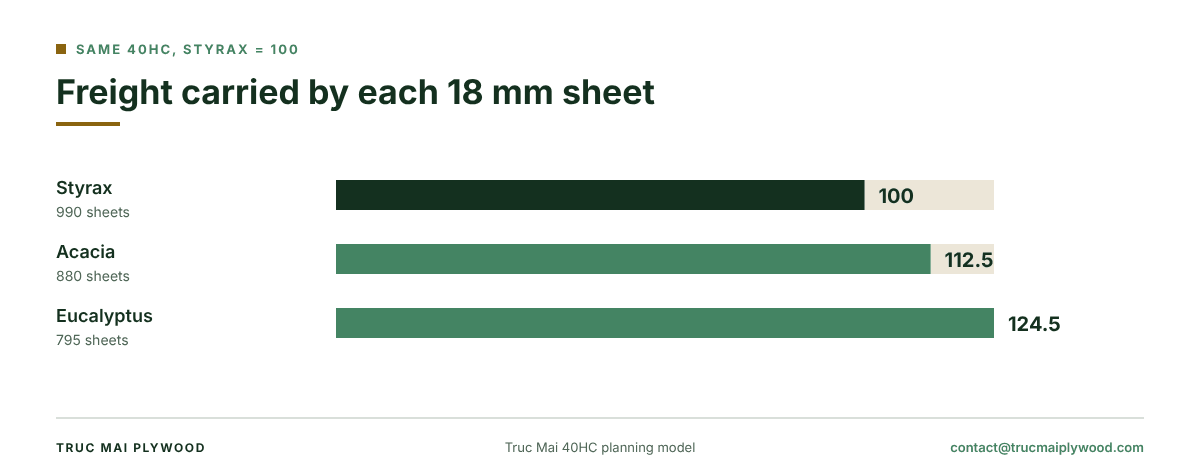
On the Truc Mai packing model, a 40HC carries 990 sheets of 18 mm plywood on Styrax core, 880 on Acacia and 795 on Eucalyptus, all 1220 × 2440 mm. Those are planning figures from packs about 1,000 mm high and a 28,000 kg cargo payload, container tare excluded. The 40HC loading page shows how the packs sit in the box.
| Planning line, 18 mm 4 × 8 ft | Styrax | Acacia | Eucalyptus |
|---|---|---|---|
| Density used for the plan | 500 kg/m³ | 580 kg/m³ | 650 kg/m³ |
| Weight of one sheet | 26.8 kg | 31.1 kg | 34.8 kg |
| Sheets in one 40HC | 990 | 880 | 795 |
| Volume in one 40HC, m³ | 53.0 | 47.2 | 42.6 |
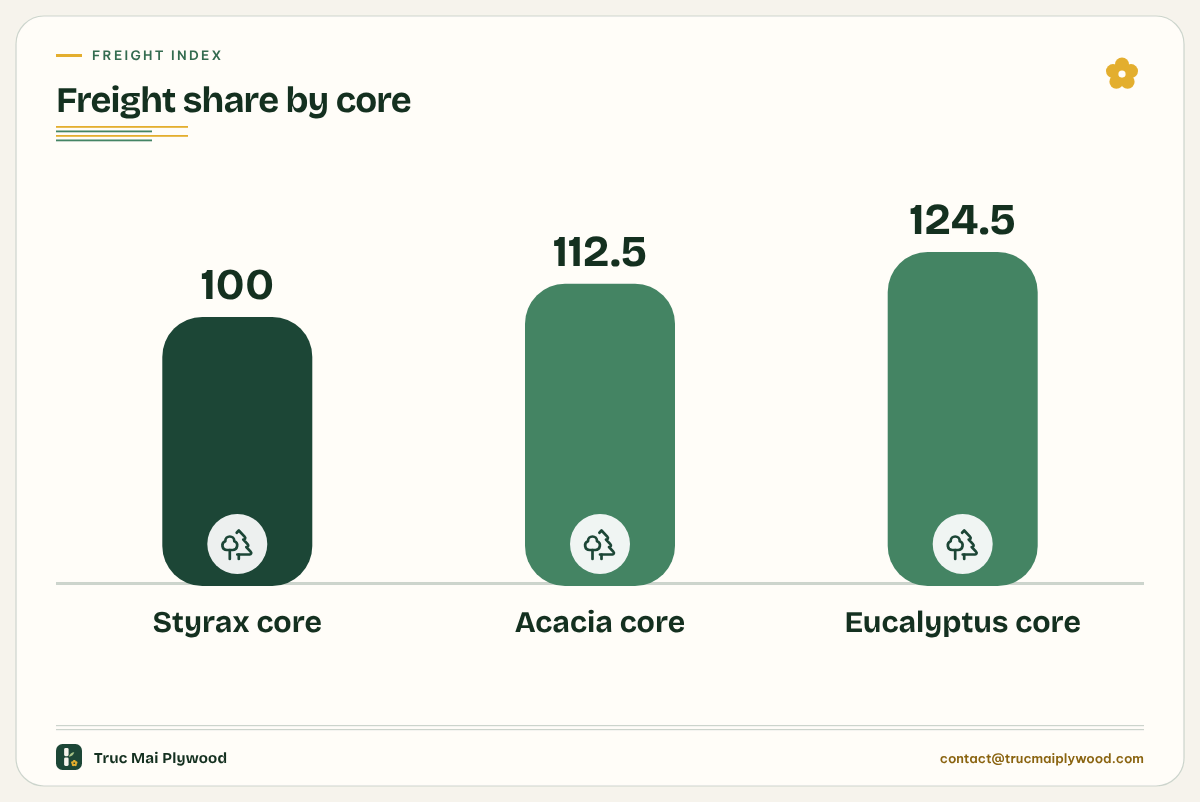
| Freight share per sheet (Styrax = 100) | 100 | 112.5 | 124.5 |
The last row needs no price at all. The same container freight is divided by 990 Styrax sheets or by 795 Eucalyptus sheets, so each Eucalyptus sheet carries 24.5% more freight than a Styrax sheet, and each Acacia sheet 12.5% more. Port charges, inland haulage and customs entry fees per container follow the same ratio.
A denser core is not wrong. Eucalyptus and Acacia give a heavier, firmer panel, and some buyers price the sheet rather than the m³. But the comparison should be made on delivered cost per sheet, not on the mill rate alone. For a furniture line, switching an Acacia core for Styrax tends to pay three times on the quote: a cleaner face, less weight per sheet and more m³ in every box the freight is paid on.
How does a full 40HC lower the cost per cubic meter?
A full 40HC lowers the cost per cubic metre because freight, insurance, port handling and customs entry are paid per container, not per m³. Every extra m³ the box carries shares those fixed costs. A load that fills the payload with a light core spreads them over the most panel.
Over a year the gap adds up. Styrax ships 53.0 m³ of 18 mm panel per 40HC, Eucalyptus 42.6 m³. On a programme of 12 containers a year, Styrax moves about 125 m³ more panel for the same twelve freight bills, port charges and customs entries.
Three things lower the cost per m³ inside one container:
- Choose the core by m³ per container as well as by mill rate.
- Fill the payload: a half-empty box doubles the fixed cost per m³ of what it carries.
- Mix by agreement: three to six products can share one container, so a thin product that would fill a container slowly can travel with thick panels.
Squeezing extra sheets into each pack looks cheaper on the quote and is not. A pack that is too heavy cracks its pallet feet, and one pack lost at the discharge port wipes out the freight saved on every added sheet. That is why the packing model limits sheets per pack by weight. Run any mix of core and thickness in the 40HC load calculator.
How do thickness and ply count move the price?
Thin plywood costs more per m³ than thick plywood, because a thin sheet holds more glue lines and more sheets per m³ to press, sand, grade and pack. A 3 mm sheet is 0.0089 m³, so one m³ of 3 mm panel takes 112 of them, against about 18.7 at 18 mm. The m³ rate rises as the sheet gets thinner.
Veneer is part of the story. Thin 3–5 mm panels are always 5 plies, and 4 mm panels use 1.3 mm core veneer. Good thin veneer is scarce, so 4 mm can take longer to produce, and scarcity shows in the rate. At 18 mm, the usual build is 11 plies; 11–13 plies are made to order, and an extra ply adds glue and labour.
A buyer comparing prices across thicknesses should therefore compare per m³ and expect thin panels to sit higher. A buyer comparing two quotes for the same thickness should check the ply count on both: an 18 mm sheet of 11 plies and one of 13 plies are not the same panel.
Thickness tolerance follows thickness. Sanding to ±0.3 mm takes more passes and rejects more sheets than a commercial ±0.5 mm. The two are priced differently, and a quote that leaves the tolerance blank has not said which panel it prices.
Which face choices move the price most?
The face species and the grade pair move the price most among the visible choices. Plain hardwood and commercial-grade faces cost least, white poplar EV and bleached poplar sit in the middle, and imported birch, okoume and sapele faces cost more. Asking for the top grade on both faces adds again.
| Face choice | Price position | Typical use |
|---|---|---|
| Commercial hardwood face, open grade | Lowest | Packing, hidden parts, substrates |
| Eucalyptus or pine face | Low to middle | Commercial panels, pallets of furniture parts |
| White poplar EV, bleached poplar | Middle | Painted furniture, carcasses |
| Birch, okoume, sapele, bintangor, gurjan | Higher | Lacquered or stained furniture, doors |
| Top grade on both faces | Highest for the species | Doors, open shelving, visible ends |
| Melamine, HPL, paper overlay | Priced on the overlay | Carcasses with no finishing |
EV (engineered veneer) on Truc Mai panels is reconstituted veneer made from plantation poplar and imported in 2500 × 1300 mm sheets, 0.3 or 0.4 mm thick. It gives a uniform face at a lower cost than many natural veneers, which is why it covers so many furniture carcasses.
The cheapest move on faces is grading by part. Face and back grades are quoted as pairs at Truc Mai, against the approved sample, so a cabinet buyer can order the top pair for doors and a lower back for hidden sides. The plywood grades for cabinets guide sets out those pairs. Face veneer thickness, 0.2–0.5 mm and usually 0.3 mm for Europe, is a second face line to write down.
How do glue, emission and certificates move the price?
Glue type and emission class move the price as two separate lines. UF glue at E0 emission is the default build; melamine-fortified glue for a 12-hour boil costs more, with emission then usually E1. CARB P2, FSC claims and the EUDR file set add testing, paperwork and segregation, which belong in the price.
UF glue at E0 resists about 6 hours of boiling, enough for dry interiors. A buyer who asks for “waterproof” without saying what test is meant leaves the mill to guess, and the two guesses are priced differently. Write the glue, the boil test and the emission class as separate items.
Certificates on the Truc Mai file:
- CARB Phase 2 and TSCA Title VI, certificate CARB/EPA 26053, hardwood plywood with veneer core, 3–25 mm.
- FSC 100% chain of custody, licence FSC-C196493, certificate SA-COC-014545, no FSC Mix.
- ISO 9001:2015 (W2012) and ISO 14001:2015 (W2012E) management systems.
- EUDR file set with plot geolocation for the Vietnamese core and the face veneer.
For the US market, 40 CFR 770.10 caps veneer-core hardwood plywood at 0.05 ppm of formaldehyde. A panel sold into the US without a compliant certificate cannot be sold there at any price, so the certificate is part of the product, not an extra.
For EU orders, Regulation (EU) 2023/1115 asks for plot geolocation with at least six decimal digits. Collecting those records for the core logs and the face veneer is work, and a quote that includes the EUDR file set prices that work in.
How do tolerance, sanding and grade move the price?
Tighter tolerance, more sanding and a better core grade each add to the rate. A furniture panel on an A-grade stitched core, sanded and calibrated to ±0.3 mm, costs more than a commercial panel on an AB loose-laid core at ±0.5 mm, and a packing panel at ±0.5–1.0 mm costs less again.
| Line | Core build | Surface | Thickness tolerance | Price position |
|---|---|---|---|---|
| Furniture and interior | A-grade core, stitched | Sanded and calibrated | ±0.3 mm | Highest |
| Commercial | AB core, loose-laid or jointed | Unsanded or lightly sanded | ±0.5 mm | Middle |
| Packing | AB core, loose-laid | Unsanded | ±0.5–1.0 mm | Lowest |
Length and width hold ±2 mm on every line. The line a buyer picks should follow the use: an export crate gains nothing from a calibrated face, and a CNC-nested cabinet part loses money on every sheet that is out of tolerance.
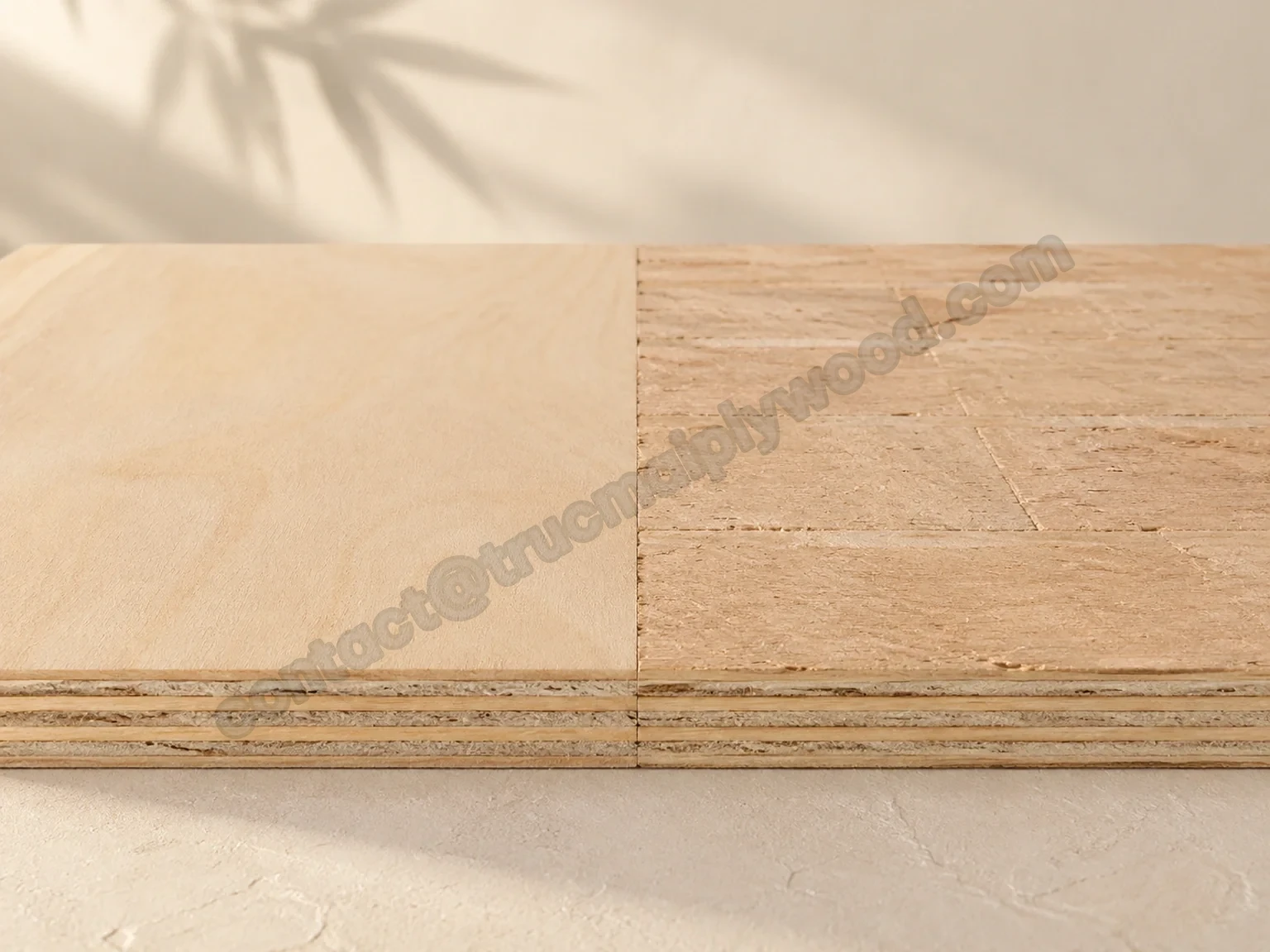
Core stitching is part of the grade. Usually the outer 2–4 plies are stitched; all plies can be stitched on request, at extra labour. A loose-laid core is cheaper and fine for packing panels, where an open joint inside the sheet does no harm.
How do sheet size, cut-to-size and packing move the price?
Standard sheets cost least per m³; custom sizes and cut-to-size panels add trimming waste and labour. Truc Mai’s standard sheets are 1220 × 2440 mm, 1220 × 2280 mm and 1250 × 2500 mm. Anything else is a custom size, made up to a 1250 × 2500 mm maximum, and a cut-to-size order divides each sheet into 2, 3, 4 or 6 panels at the mill, which the rate then has to carry.
The shorter 1220 × 2280 mm sheet can lower cost for a furniture line whose parts fit it, because the buyer stops paying for offcut. Run the cutting list on both sizes; the shorter sheet only saves money when the parts fit. Nothing larger than 1250 × 2500 mm is made, so 1500 × 3000 mm or 1525 × 1525 mm panels are cut from standard sheets.
Packing is a smaller line, but it shows in the price. Export packs about 1,000 mm high stand on pallets with straps and covers. Solid-wood pallets, battens and dunnage fall under ISPM 15, while the plywood itself is processed wood outside it. The PPWR packaging test on file covers the packaging materials, not the panel.
What is the cheapest way to buy plywood by the container?
The cheapest way to buy plywood by the container is to fix one order line that matches the use, fill a 40HC to its payload with the lightest core that suits the product, and repeat the same line every month. Each step removes cost: no over-specification, no empty space, no new samples or trials.
- Write the use first: furniture, interior, commercial or packing. The line decides the core, tolerance and face.
- Grade by part: top grades only where they show.
- Choose the core for delivered cost per sheet, not the mill rate alone.
- Fill the container: one or two products, or three to six mixed by agreement.
- Use standard sheet sizes unless the cutting list proves a custom size saves more.
- Repeat the order line monthly so the mill builds the same panel without new trials.
A repeat programme also removes the hidden costs of a first order: samples, a trial container, an inspection trip and the time spent comparing quotes. With the Ha Hoa mill shipping around 60,000 m³ a year, about 5,000 m³ in a typical month, one or two 40HC a month is a small, steady share of output, and the rate for it can stay put.
Does Ha Hoa core wood lower the mill price?
Yes. Ha Hoa, in Phu Tho province, sits near plantation forest that supplies core wood at low cost, and skilled labour there costs less than in larger industrial centres, so a mill in Ha Hoa can price the same quality lower. Core logs are the largest material line in a hardwood-core panel, which is why that local supply shows in the rate.
The saving is in the core, not in an imported face. A birch or okoume face costs about the same wherever it is laid; the Styrax, Acacia or Eucalyptus core under it is where local wood matters. That is one reason Vietnamese plywood is quoted on hardwood cores with imported faces, and why core choice matters so much in a comparison.
Location does not change the certificate work. Core logs still need their origin records for an EU order. Truc Mai’s EUDR file set traces core logs to the plantation plot and the face veneer to its own source, so the EU importer can file its due-diligence statement.
Why are two quotes for the same product name often different?
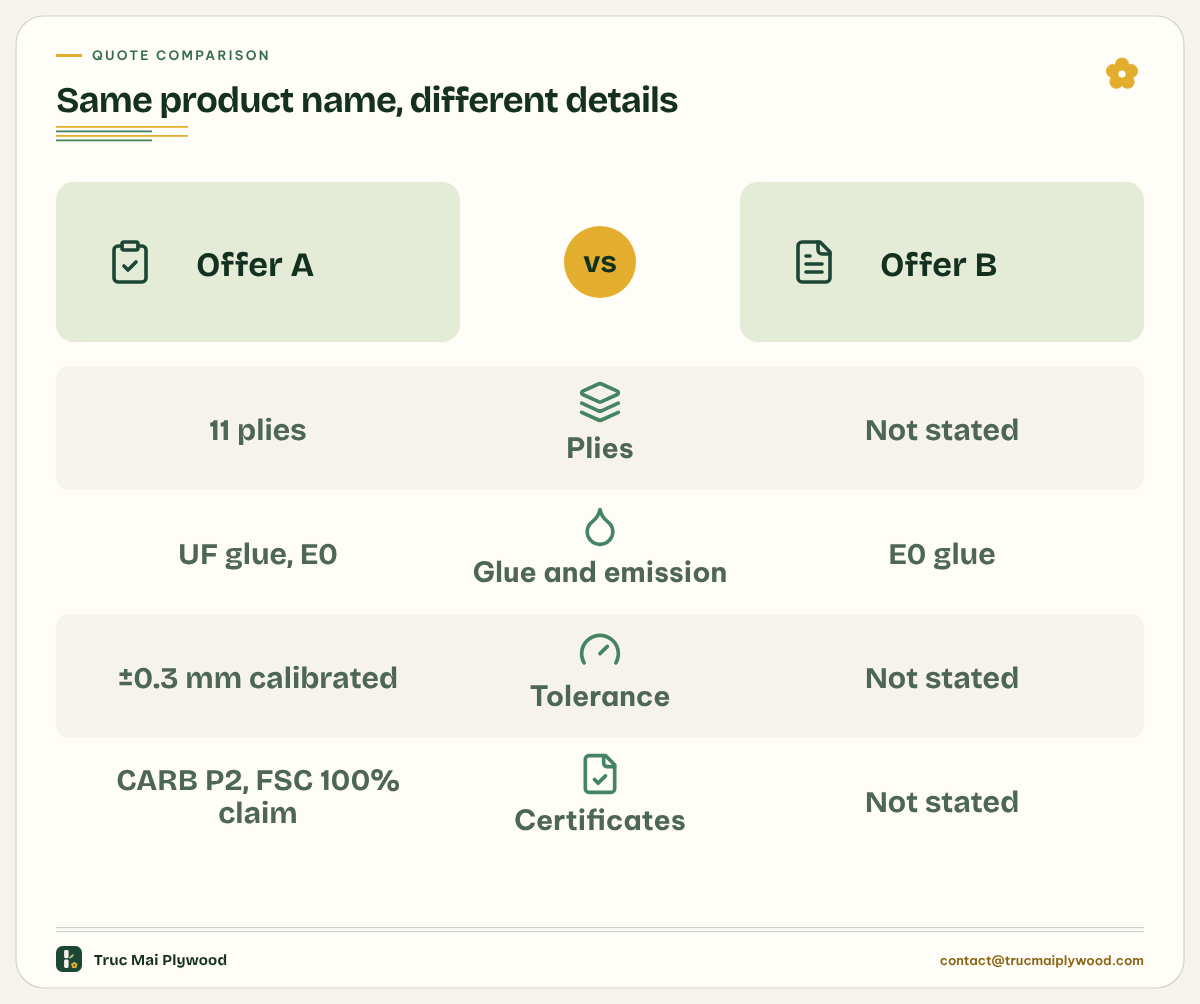
Two quotes for the same product name are often different because they price different panels. Core grade, joining method, face preparation, adhesive system and tolerance can all change under one name such as “18 mm poplar plywood”. The lower quote is usually a lower line, not the same panel for less.
A typical pair of offers for “18 mm poplar plywood, E0”:
| Line | Offer A | Offer B |
|---|---|---|
| Face | White poplar EV, sanded | Poplar, unsanded, open grade |
| Core | Styrax, A-grade, stitched | Mixed hardwood, loose-laid |
| Plies | 11 plies | Not stated |
| Glue and emission | UF glue at E0 emission | “E0 glue” |
| Tolerance | ±0.3 mm calibrated | Not stated |
| Size | 1220 × 2440 mm | 1220 × 2440 mm |
| Certificates | CARB P2, FSC 100% claim per order | Not stated |
Offer B may be the right panel for a packing line, but it is not the same panel as offer A. The fix is to send every mill the same order line and ask each to quote against it, line by line. Start the RFQ from the application, then core, glue and emission, face, sheet, packing and quantity.
How do you read a plywood quotation line by line?
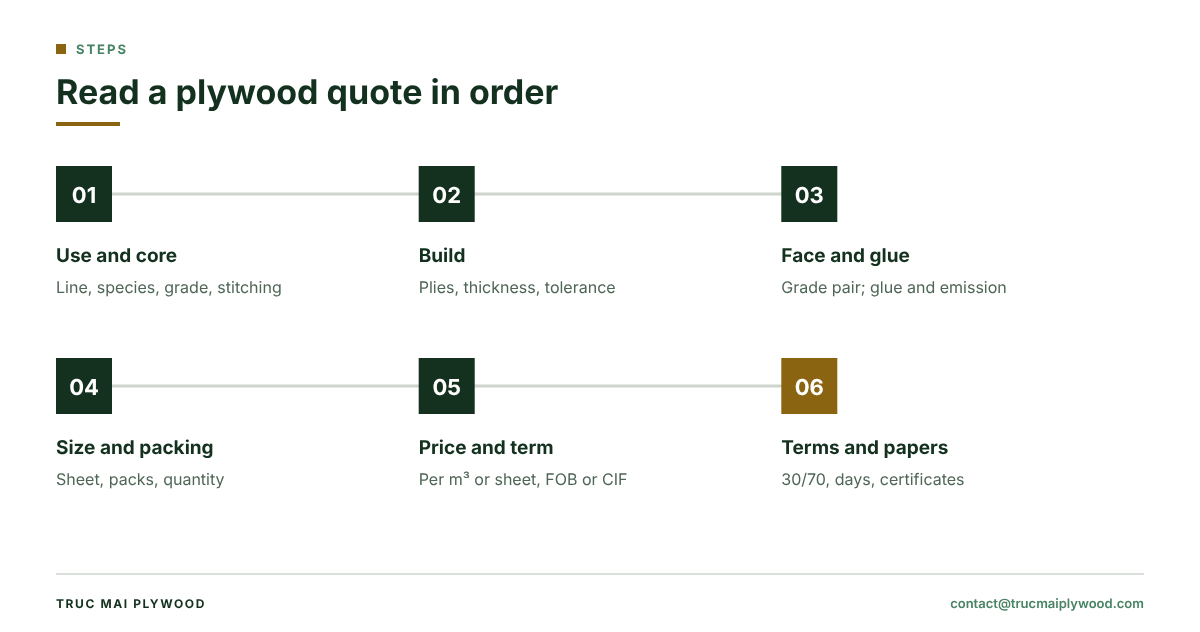
Read a plywood quotation line by line against your own order line: product and use, core, plies, face and back pair, glue and emission, thickness and tolerance, size, packing, quantity in sheets and m³, rate per m³ or per sheet, delivery term and port, payment terms, production time and certificate documents. A missing line is a question, not a saving.
- Product and use: does the quote name the line (furniture, commercial, packing)?
- Core: species, grade and stitching, written, not implied.
- Plies and thickness: ply count and the tolerance in mm.
- Face and back: species and grade pair, with the sample reference.
- Glue and emission: two lines, for example “UF glue at E0 emission” or CARB P2 with the certificate number.
- Size and packing: sheet size, pack height, pallet and labels.
- Quantity: sheets and m³ per container, and whether the count is a planning figure.
- Price basis: per m³ or per sheet, and the currency.
- Term: FOB Hai Phong, CFR or CIF, and the named port.
- Payment and time: deposit, balance, production days after deposit.
- Documents: which certificates and file sets travel with the container.
On a Truc Mai quote, the payment line reads as a deposit at order and the rest once the scanned B/L is shown, and the time line counts production days from the deposit, longer for bigger quantities. Both lines, with the delivery terms, are on the MOQ, payment and FOB page.
What do FOB, CFR and CIF include in a plywood price?
An FOB Hai Phong price covers the panels packed for export, delivered on board the vessel at Hai Phong, with export clearance. A CFR price adds ocean freight to the named destination port. A CIF price adds marine insurance on top of CFR. Whichever of the three is quoted, the buyer still pays import duty, the destination port and the haul inland.
| Who pays | FOB Hai Phong | CFR | CIF |
|---|---|---|---|
| Panels, packing, export clearance | Mill | Mill | Mill |
| Loading on board at Hai Phong | Mill | Mill | Mill |
| Ocean freight | Buyer | Mill | Mill |
| Marine insurance | Buyer | Buyer | Mill |
| Destination port and customs | Buyer | Buyer | Buyer |
| Import duty and inland delivery | Buyer | Buyer | Buyer |
For pricing, the choice is about who buys freight more cheaply. A buyer holding its own forwarder and contract rate usually compares on FOB; a buyer who wants a single figure delivered to its port asks for CFR or CIF. Under CIF, insurance papers travel with the shipping documents.
Days at sea set how long the buyer’s cash is tied up before the panels can be sold. A Northern European buyer waits roughly 30–40 days on the water and a US West Coast buyer 20–30, depending on carrier and route; the other lanes are listed on sea freight per m³.
From FOB to landed cost: which duties change a plywood price?
Duties can change a landed plywood price more than any mill line. Vietnamese hardwood and decorative plywood faces US antidumping and countervailing duty cases, while the EU’s anti-dumping duty targets Chinese hardwood plywood and leaves Vietnam out. Check the rate for the exact product before comparing origins.
United States
The affirmative USITC vote covered hardwood and decorative plywood from Vietnam, China and Indonesia, which means Commerce now issues antidumping and countervailing duty orders for it. The softwood structural plywood part of the case ended as negligible.
Two case numbers belong on a US buyer’s costing sheet: A-552-851, the antidumping final determination for Vietnam, and C-552-852, the countervailing duty final determination for the same hardwood and decorative plywood.
| Final determination | Rate a buyer prices in |
|---|---|
| A-552-851, Vietnam-wide entity | 90.12% (84.95% cash deposit) |
| C-552-852, all-others rate | 47.68% |
Scope matters: structural PS 1 and PS 2 plywood, phenolic film-faced plyform, flooring and ready-to-assemble furniture are outside these cases. A US buyer adds the applicable deposit to the entered value when comparing a Vietnamese panel with another origin. The full order notice is the document to check for the final scope and rates of any exporter.
European Union
Regulation (EU) 2025/2333 puts anti-dumping duty on Chinese hardwood plywood, charged on the net free-at-Union-frontier price: 86.8% for most companies and 43.3% for a single named exporter. A panel made in Vietnam is outside it. The rate belongs in a landed-cost comparison as a fact, not as a reason to choose an origin.
Why is a store sheet price different from a container price?
A store sheet price and a container price measure different things. The store price includes the merchant’s freight, warehousing, stock risk, cutting service, margin and local taxes, and buys one sheet today. A container price from a mill buys one written build in volume, delivered to a port weeks later, before duty, inland haulage and storage.
That is why a per-sheet shelf price and a mill rate per m³ cannot be set side by side without converting both to the same basis. A fair comparison takes the mill rate per m³, converts it per sheet with the sheet volume, then adds freight per sheet from the container plan, insurance, duty, port and inland costs, and the cost of the cash tied up from deposit to sale.
The comparison also has to match the panel. Shelf panels in North America and Europe are often sold under a product name with no core grade, ply count or tolerance on the label. A mill quote that names all three may look dearer per sheet than a shelf panel with none of them, and still be the cheaper panel per usable part on a cabinet line.
For an importer, the useful number is the margin between its landed cost per sheet and the local merchant price for the same build. For a factory buying direct, it is the cost per finished part, which falls when the core is lighter, the grade follows the part and the container is full.
What do payment terms and timing do to the price?
Payment terms and timing change the real cost of a plywood price because the buyer’s cash is tied up from the deposit to the sale of the last sheet. A 30% deposit at order, 15–45 days of production, the 70% balance against the scanned B/L and the days at sea together set how long that cash works for the shipment.
A letter of credit at sight costs bank charges, and in return the balance is only released once the documents are presented. A T/T transfer on the scanned B/L saves those charges, which is why repeat buyers usually switch to it after the first shipments. Neither changes the mill rate; both change what the panel costs the buyer.
Samples barely touch the price: the panels themselves cost nothing, and a first-time buyer’s courier fee comes back as a credit once a real order follows (ordering samples). Draft shipping documents go to the buyer for approval after loading, before the balance is paid.
What should a plywood price request say?
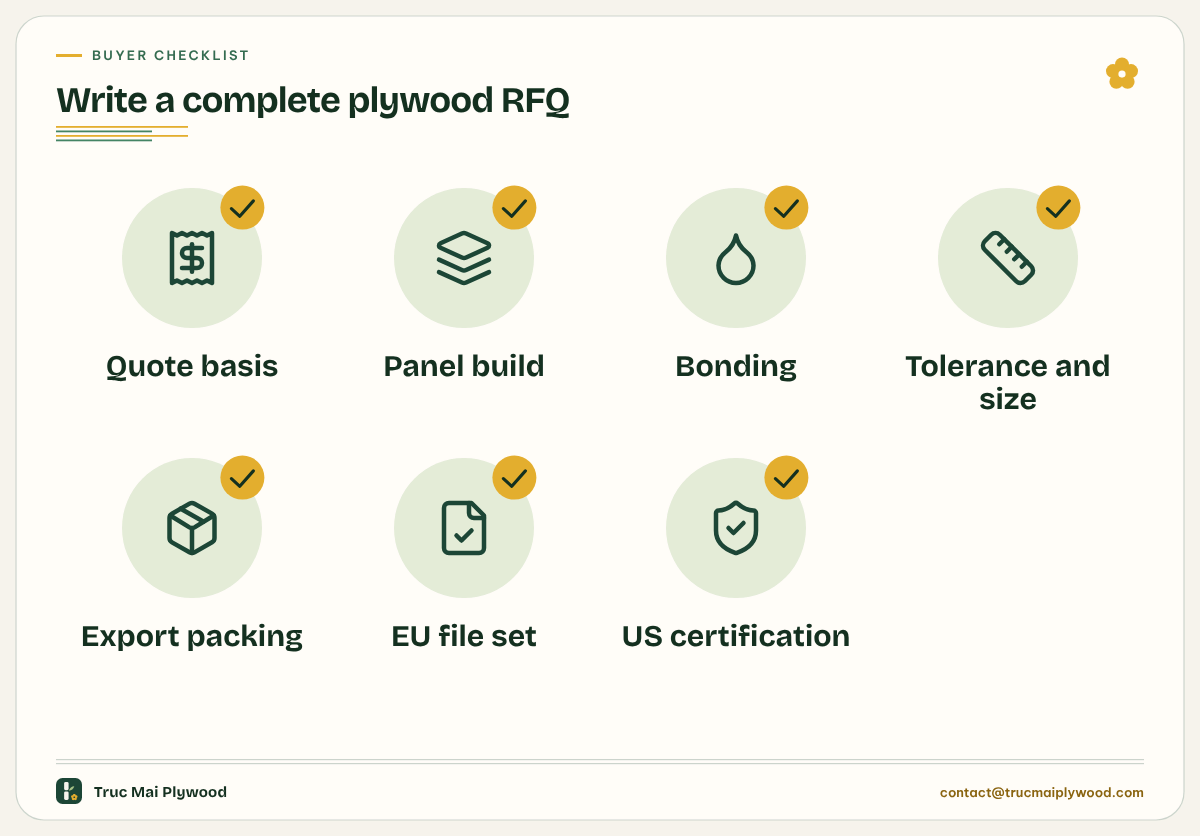
A plywood price request should say the use, core species and grade, plies, face and back pair, glue and emission, thickness and tolerance, sheet size, packing, quantity per container, delivery term and port, and the certificates the order needs. With every line filled, each mill quotes the same panel, and the cheapest quote is a real saving.
A filled request for a furniture line in Northern Europe:
Price basis: per m³ and per sheet, CIF a named Northern European port, one 40HC a month. Panel for painted furniture carcasses: Styrax A-grade core with stitched plies, 11 plies at 18 mm; face white poplar EV, back poplar. Bonding UF, emission class E0. Thickness held to ±0.3 mm by sanding and calibration; sheet 1220 × 2440 mm, ±2 mm on length and width. Packed in export packs of about 1,000 mm. Papers: FSC 100% claim, EUDR file set with geolocation for core and face.
A US buyer adds “CARB P2 / TSCA Title VI, certificate CARB/EPA 26053” and names its port. A packing buyer changes the line to an AB loose-laid core, packing grade, ±0.5–1.0 mm. Send the request to the quotation desk or to contact@trucmaiplywood.com; the import guide walks through the rest of the order.
Questions buyers ask
How is plywood priced?
Mills price plywood per m³ for a written construction: core, face, glue and emission, thickness, tolerance, size and packing. The per-sheet price is the m³ rate times the sheet volume.
How do I convert a plywood price per m³ into a price per sheet?
Multiply the rate per m³ by the sheet volume. A 1220 × 2440 × 18 mm sheet is 0.0536 m³, so it costs 0.0536 times the m³ rate, and about 18.7 such sheets make one m³.
Why is thin plywood more expensive per m³?
A thin sheet has more glue lines and more sheets per m³ to press, sand, grade and pack, and good thin veneer is scarce. The m³ rate of 3–6 mm panels is therefore higher than that of 18 mm.
Does the core species change the plywood price?
Yes, twice: the core grade and species change the mill rate, and the core density changes how many m³ fit under the container payload. On the planning model a 40HC carries about 53 m³ of 18 mm Styrax against 42.6 m³ of Eucalyptus.
Which face is cheapest?
Plain Vietnamese hardwood and commercial-grade faces cost least; white poplar EV and bleached poplar sit in the middle; birch, okoume and sapele faces cost more, and the top grade on both faces costs most.
Why are two plywood quotes for the same product so different?
Because the panels are not the same: core grade, joining method, face preparation, adhesive system and tolerance differ under one product name. Compare quotes on a written order line.
Does a full container lower the price of plywood?
A full container spreads freight, port and handling costs over more m³. Choosing a lighter core puts more m³ into the same 40HC, which lowers freight per m³ and per sheet.
What is included in an FOB Hai Phong price?
FOB covers the panels packed for export, loaded on board at Hai Phong, with export clearance. Ocean freight, insurance, import duty and inland delivery are the buyer's, unless the quote is CFR or CIF.
Is there US duty on Vietnamese hardwood plywood?
Yes, for hardwood and decorative plywood in scope. The antidumping rate for the Vietnam-wide entity is 90.12% (cash deposit 84.95%), and the countervailing rate for all others is 47.68%, both from Commerce's final determinations.
Does EU anti-dumping duty apply to Vietnamese plywood?
No. Regulation (EU) 2025/2333 charges 43.3% or 86.8% on Chinese hardwood plywood only; a panel made in Vietnam pays no such duty.
Does Truc Mai publish a plywood price list?
No. Truc Mai quotes each order line on request, because the price follows the build, the certificates and the container plan.
What is the minimum order to get a container price?
One 40HC, priced per order line. Most boxes hold one or two products; up to six can share a box if agreed.