
Mill · Private label
Private label plywood from Vietnam: an own-brand OEM programme filled on one written spec
An OEM plywood programme at Truc Mai puts the buyer's brand on the pack and holds the panel to one written spec, container after container. Any face goes on a chosen core in 1220 × 2440, 1220 × 2280 or 1250 × 2500 mm sheets, the minimum is one 40HC, and the FSC 100% claim stays on the sales documents for the products that are eligible.
The page is written for a distributor, importer or panel brand that sells plywood under its own name and needs the second container to match the first. It shows what can carry a label, what is fixed once and what repeats, how the first sample pack is approved, where an own-brand programme usually drifts and what to write on the purchase order. Dated prices are not on this page; they come with a quotation.
- 1 × 40HCminimum order for a programme, one or two products per container
- 3–40 mmthickness range, on any face and core in the range
- 3 sizes1220 × 2440, 1220 × 2280 and 1250 × 2500 mm, custom up to 1250 × 2500 mm
- ~5,000 m³pressed in an average month, so a spec can be held month after month
Planning figures from the Truc Mai packing model; the programme terms follow the standard order terms.
Certificates
Which certificates can a private-label buyer rely on, and which claims stay with the mill?
FSC, CARB P2, ISO 9001 and ISO 14001, plus EU file sets.
- FSC 100% FSC-C196493 · SA-COC-014545
- CARB P2 and TSCA Title VI CARB/EPA 26053 · TPC-43
- ISO 9001:2015 W2012 · WCERT
- ISO 14001:2015 W2012E · WCERT
Look the FSC code up in the FSC database, read the CARB listing at the California Air Resources Board and the federal rule under the US formaldehyde standards, and read the EU file set against Regulation (EU) 2023/1115.
At a glance
What is a private label plywood supplier programme, and how is it different from a single order?
A private-label programme is a standing agreement that one written spec and one pack marking are filled again and again, so that the buyer's brand always means the same panel. A single order fixes a container; a programme fixes the spec the containers repeat.
Three things stay fixed once the programme starts: the panel spec, the grade pair agreed against the sample and the pack marking. Three things move with every container: the quantity, the production slot and the documents drafted for that load. That split is what lets a distributor sell its own brand without checking each container line by line.
The mill does not rename a stock panel and ship it. The spec is written for the buyer, with the buyer's face, core, glue, thickness and tolerance on it, and the pack carries the buyer's marking.
| Part of the programme | Fixed once | Changes per container |
|---|---|---|
| Panel spec | Face, core, glue and emission, thickness, tolerance, sheet size | Quantity |
| Grade pair | Face and back grade agreed against the sample, one kept by each side | Nothing, unless the sample is replaced |
| Pack and marking | Pack label content, edge marking if any, pallet type | Sheet counts and the container number |
| Documents | Which files and papers the buyer needs | Draft invoice, packing list and B/L |
| Slot | The expected rhythm of containers | The slot confirmed after each deposit |
What can carry a label
Which faces, cores and sizes can an OEM plywood manufacturer put under your label?
Every face and core that Truc Mai presses can carry an own-brand label: EV, poplar and bleached poplar, birch, okoume, bintangor, pine, eucalyptus, gurjan and sapele faces, on Eucalyptus, Acacia, Styrax or Pine cores, or combined cores, from 3 to 40 mm.
Birch is an imported face veneer on a Vietnamese core, so an own-brand birch line is described as birch-faced plywood on the label and the spec, never as all-birch. The same rule keeps an own-brand okoume or gurjan line honest: the species named is the face.
Faces and panels outside the range are not forced into a programme. Truc Mai does not make film-faced, formwork, structural or marine plywood.
| Choice | Options | Note |
|---|---|---|
| Face | EV, poplar and bleached poplar, birch, okoume, bintangor, pine, eucalyptus, gurjan, sapele, others on request | Face and back grade written as a pair |
| Core | Eucalyptus, Acacia, Styrax, Pine, or combined species | Core sets weight and m³ per 40HC; no rubberwood core |
| Thickness | 3, 4, 5, 6, 9, 12, 15, 18, 21, 25, 30, 40 mm | Nothing thinner than 3 mm |
| Sheet size | 1220 × 2440, 1220 × 2280, 1250 × 2500 mm, custom up to 1250 × 2500 mm | Nothing larger; cut to size from standard sheets |
| Surface | Sanded and calibrated; polished on request; UV-ready; melamine, HPL or paper-overlay faced | UV-ready means prepared for the buyer's own coating |
| Tolerance | ±0.3 mm sanded furniture panels; ±0.3–0.5 mm per order | Never tighter than ±0.3 mm |
Steps
How does OEM plywood in Vietnam start and run as a programme, step by step?
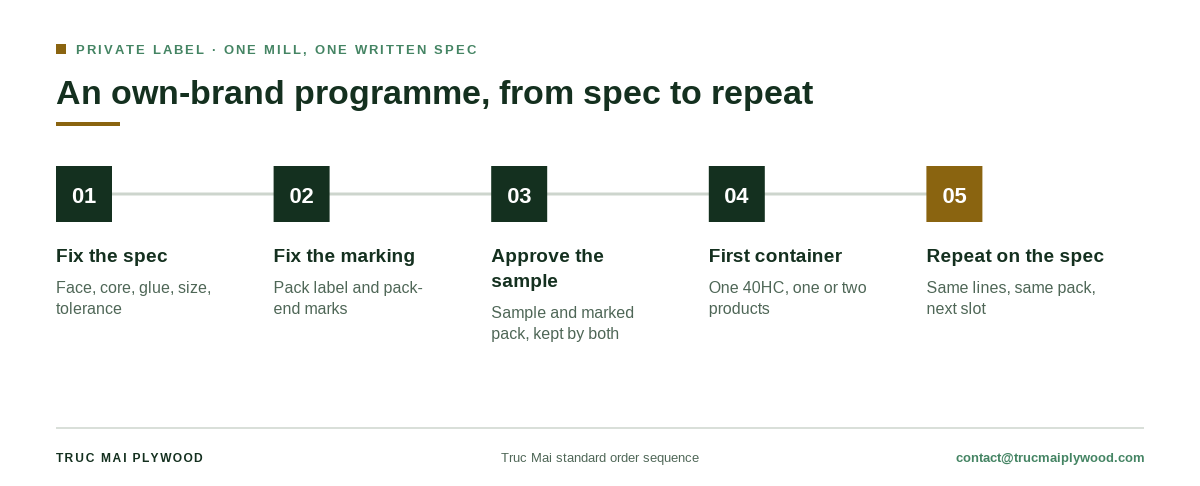
Seven steps take a distributor from an idea to a repeating programme, and the first six are done once.
- Write the spec
State the application, then face, core, glue and emission class, thickness with tolerance, sheet size and quantity. Check: the spec has one line per item, so a second mill's quote could be compared with it.
- Write the marking
Decide what goes on the pack: your brand and product code on the pack label, a stamp or print on the edge if wanted, and the pallet type. Check: the marking is described in words and, if there is artwork, in a file with a revision number.
- Confirm the right to the brand
The buyer states in writing that it may use the brand and artwork on packs it orders. Check: the confirmation sits with the written spec.
- Make the sample
The mill makes a sample panel of the spec and, where the marking needs it, a marked sample pack. Check: the sample carries a label that says which spec it stands for.
- Approve and keep
The face and back grade pair is agreed against the sample and written on the order; buyer and mill each keep one sample. Check: both samples bear the same reference.
- Fill the first container
The first 40HC is made to the spec and the marking, checked at the pack stage and loaded to the plan. Check: pack labels match the approved artwork; counts match the packing list.
- Repeat on the spec
Later containers start from the signed spec revision. Only quantity, slot and documents are new. Check: the order quotes the spec reference; any change raises a new revision.
Photos
What does a plywood stack look like before it carries a brand?
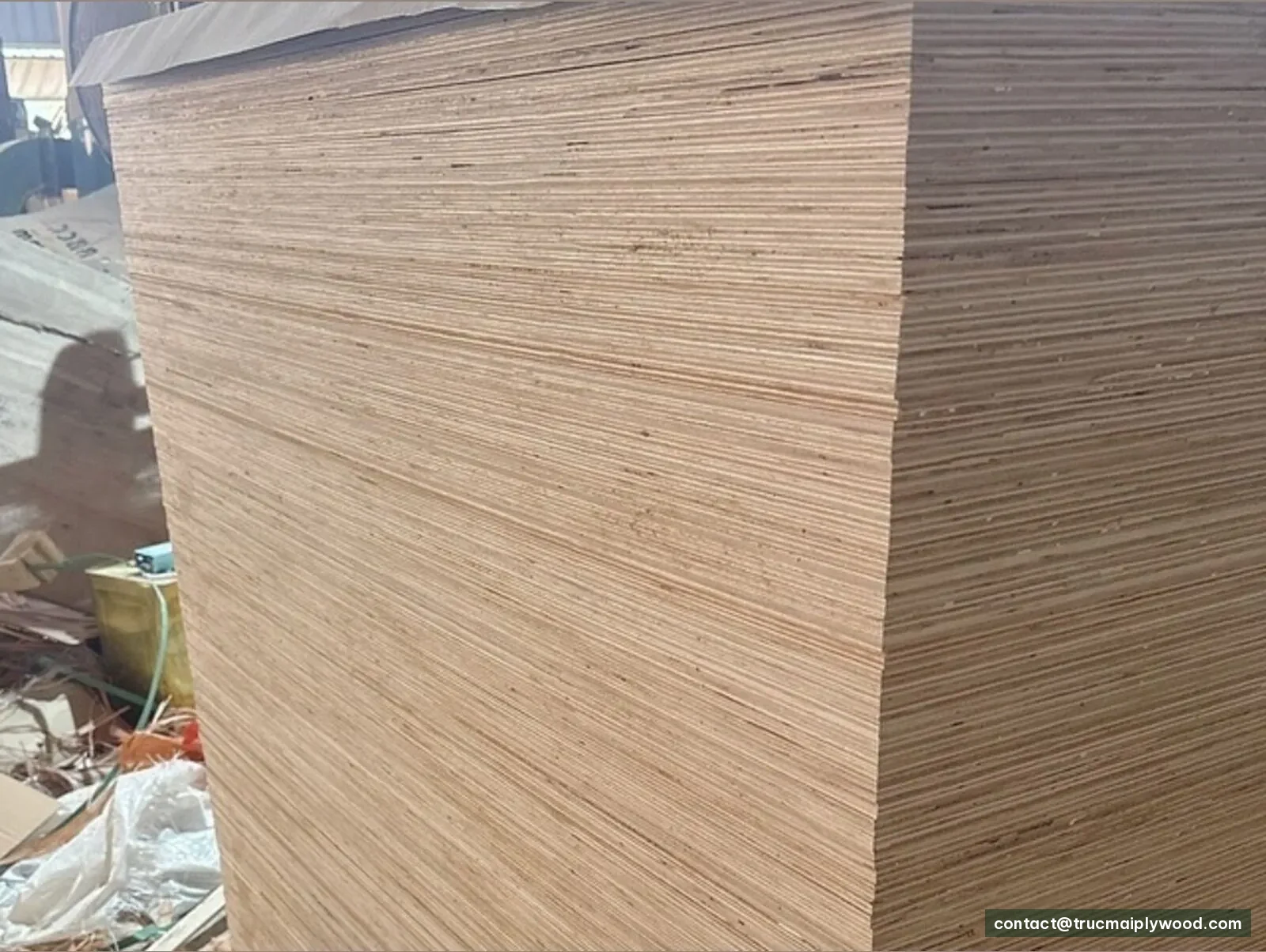
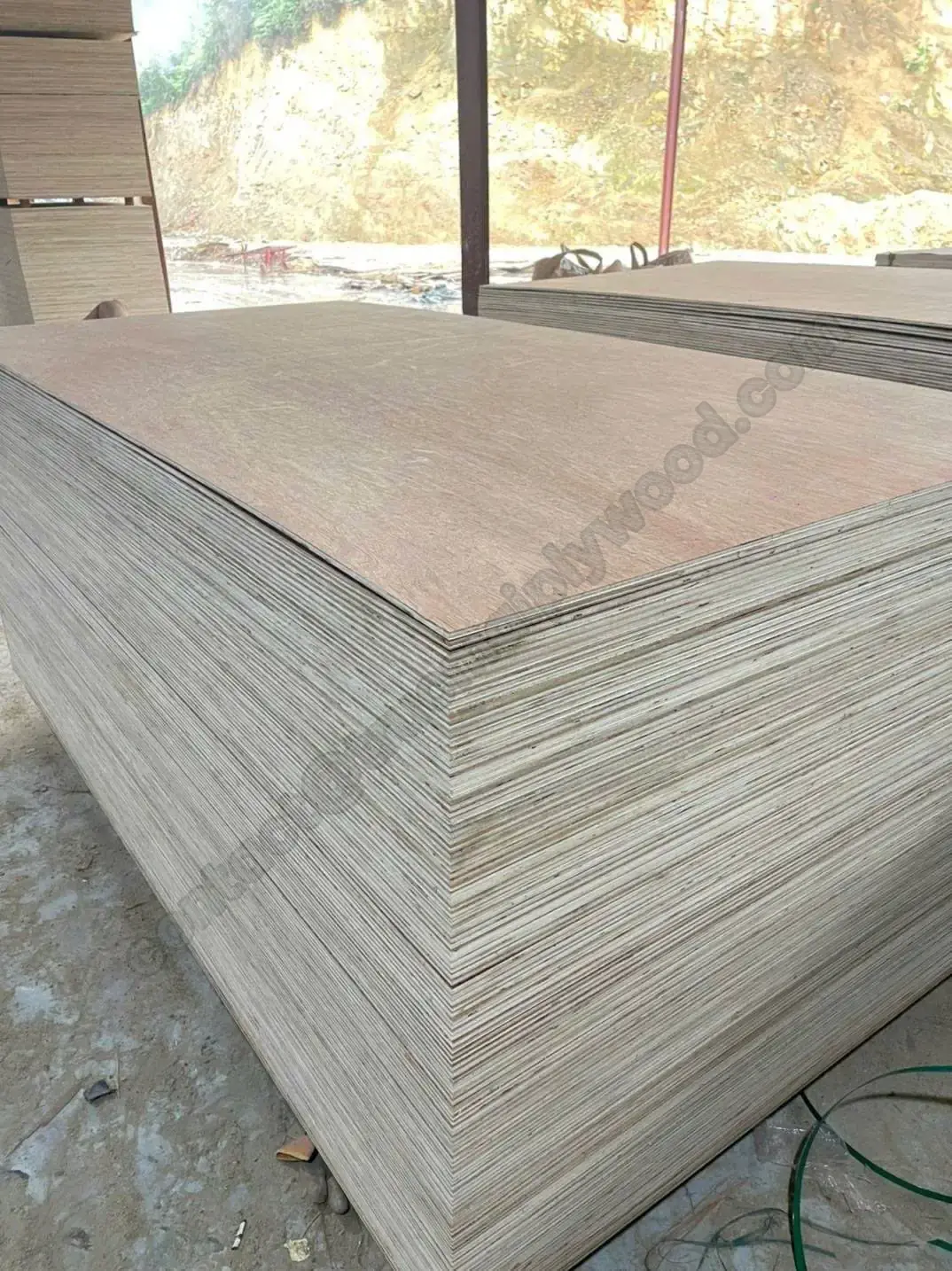
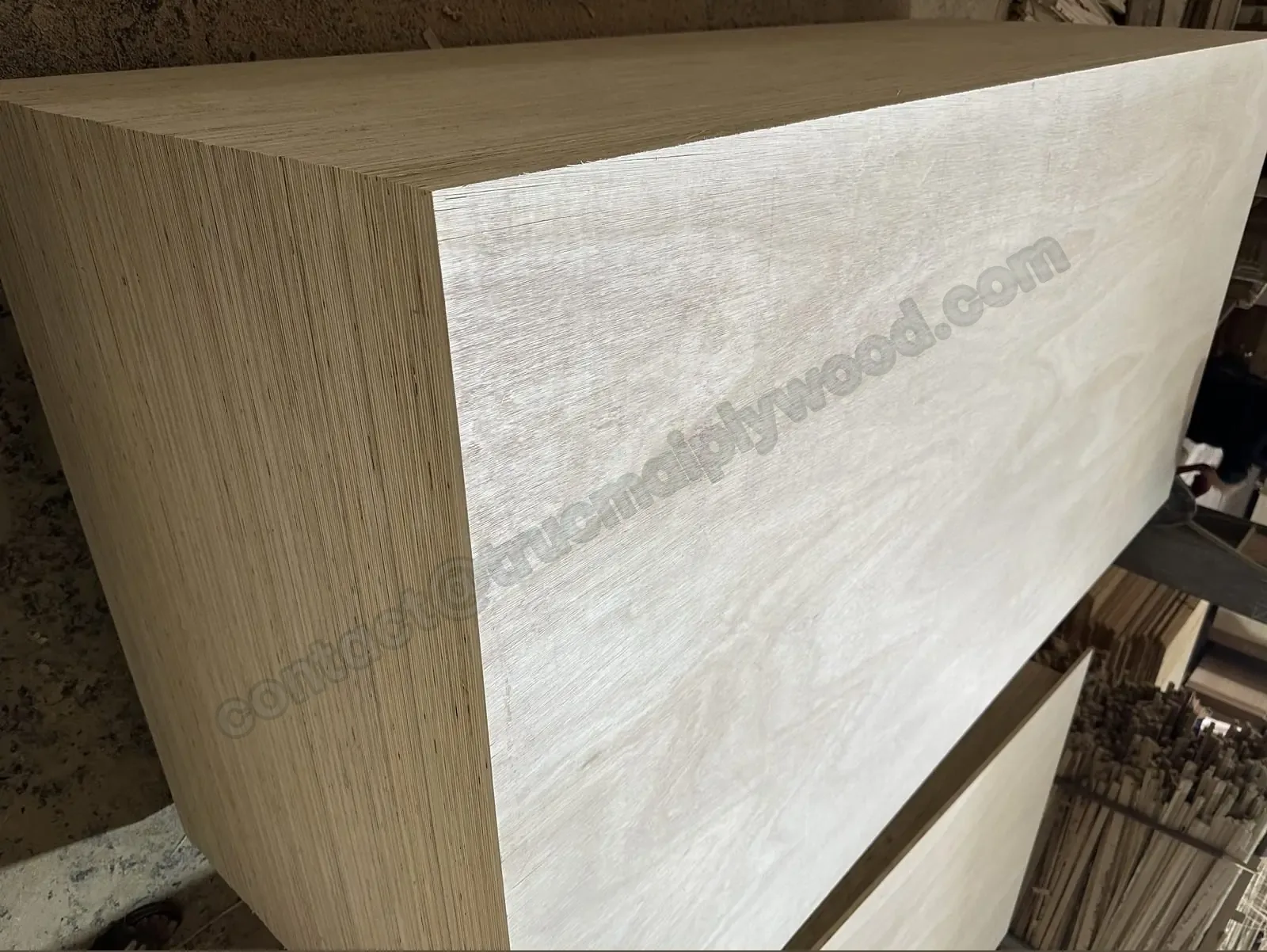
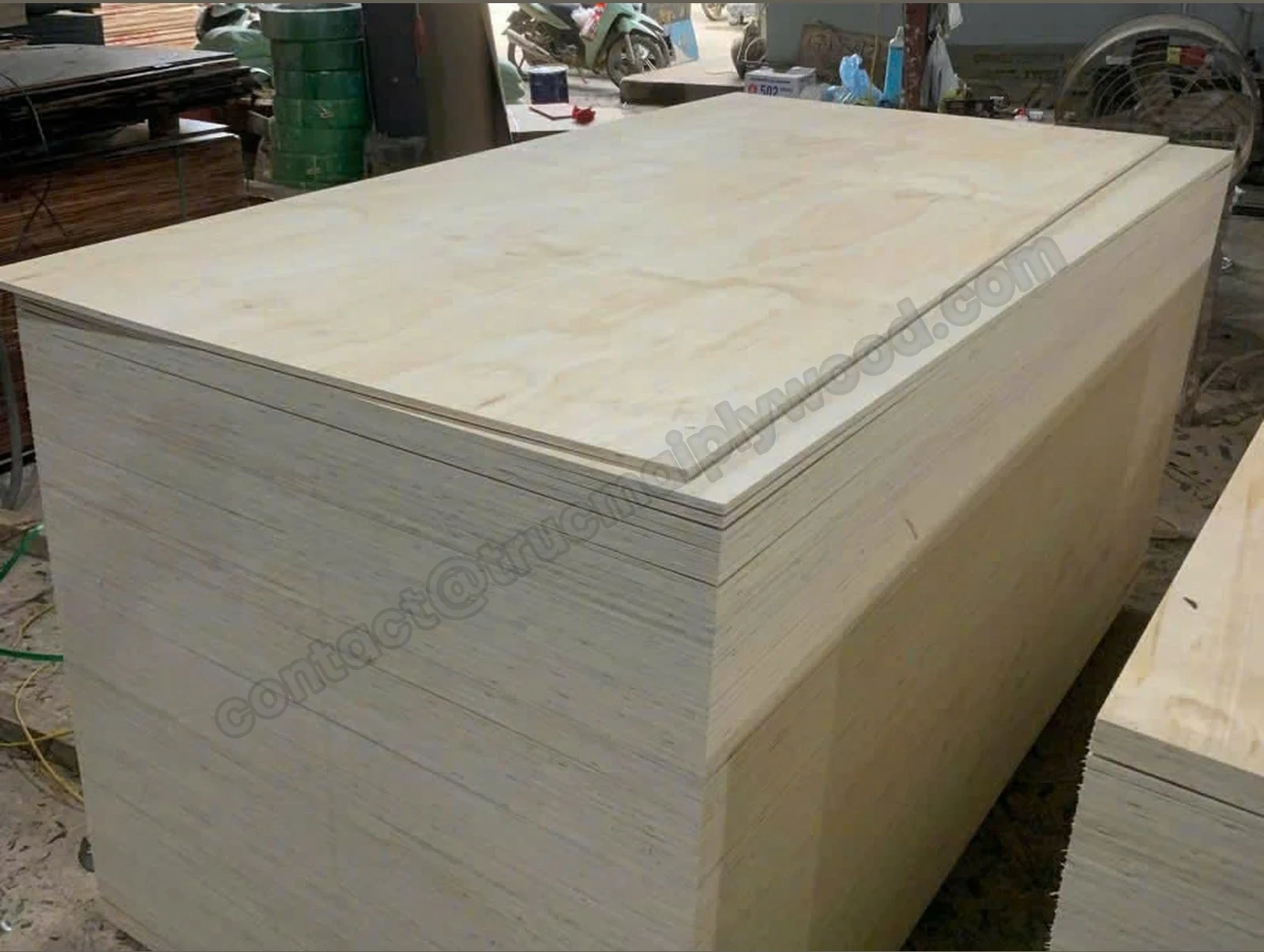
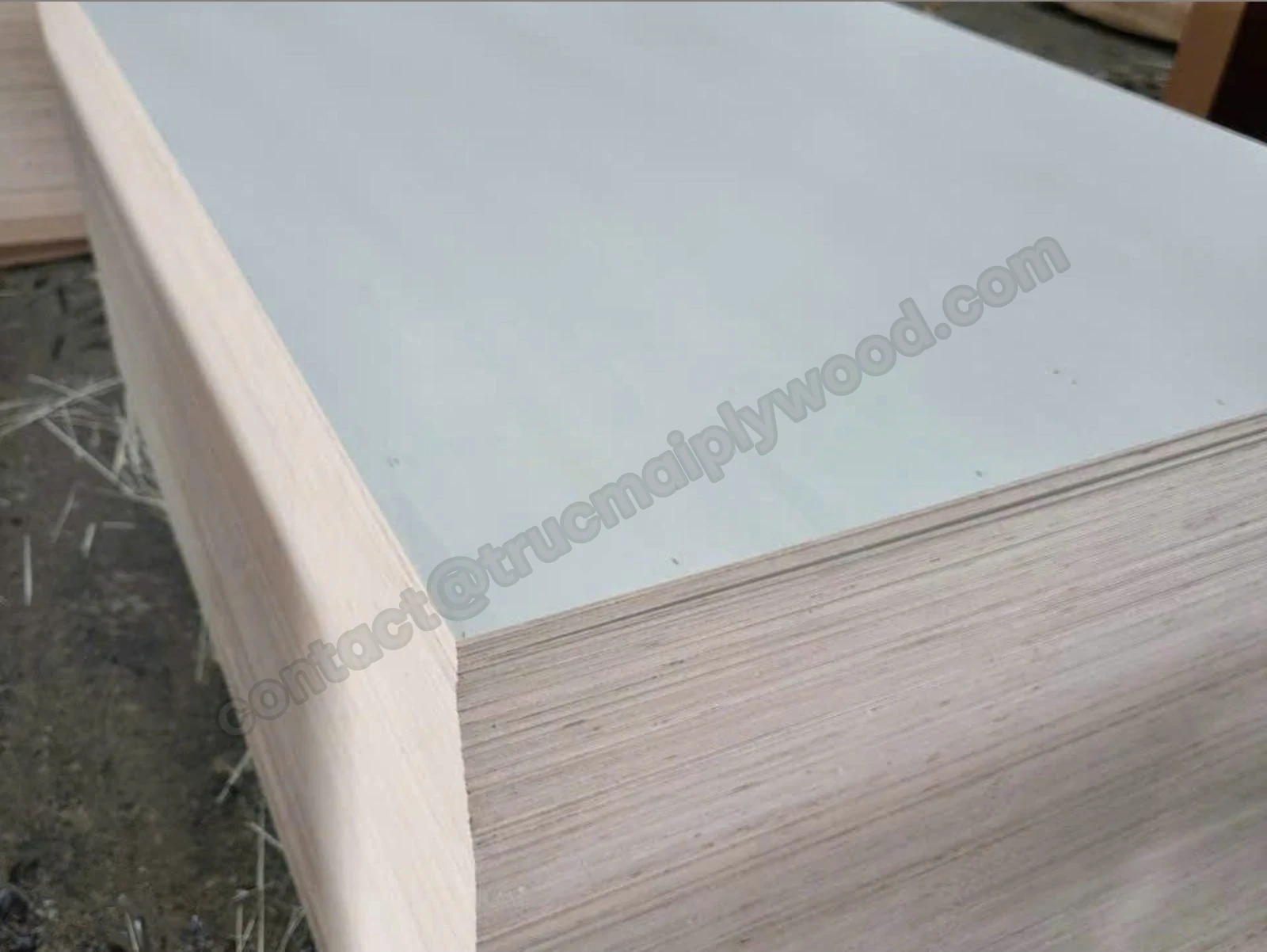
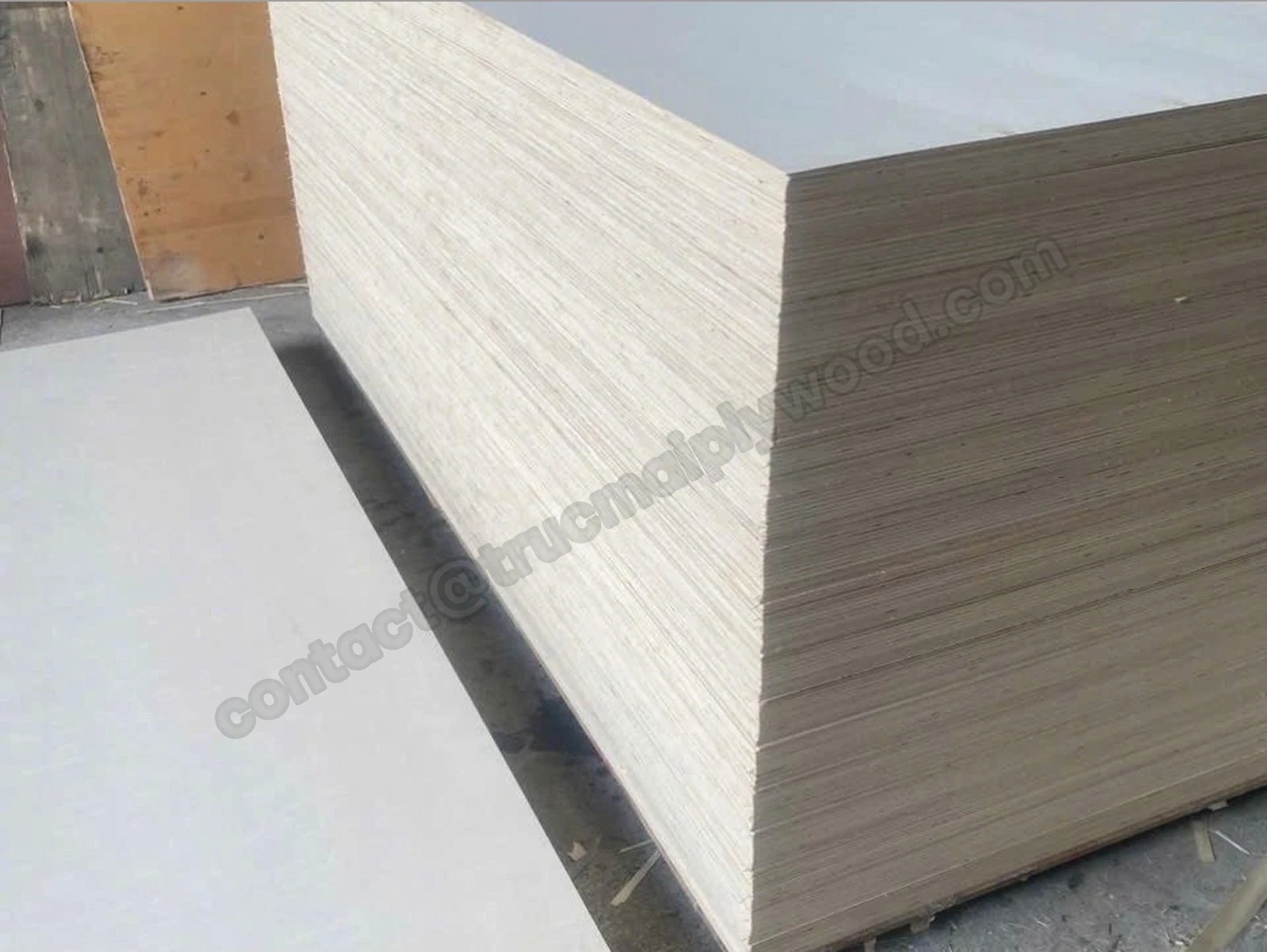
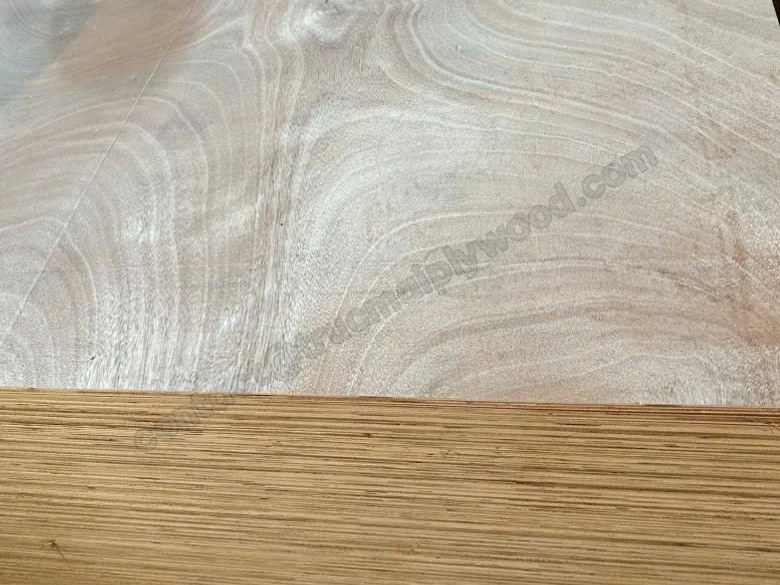
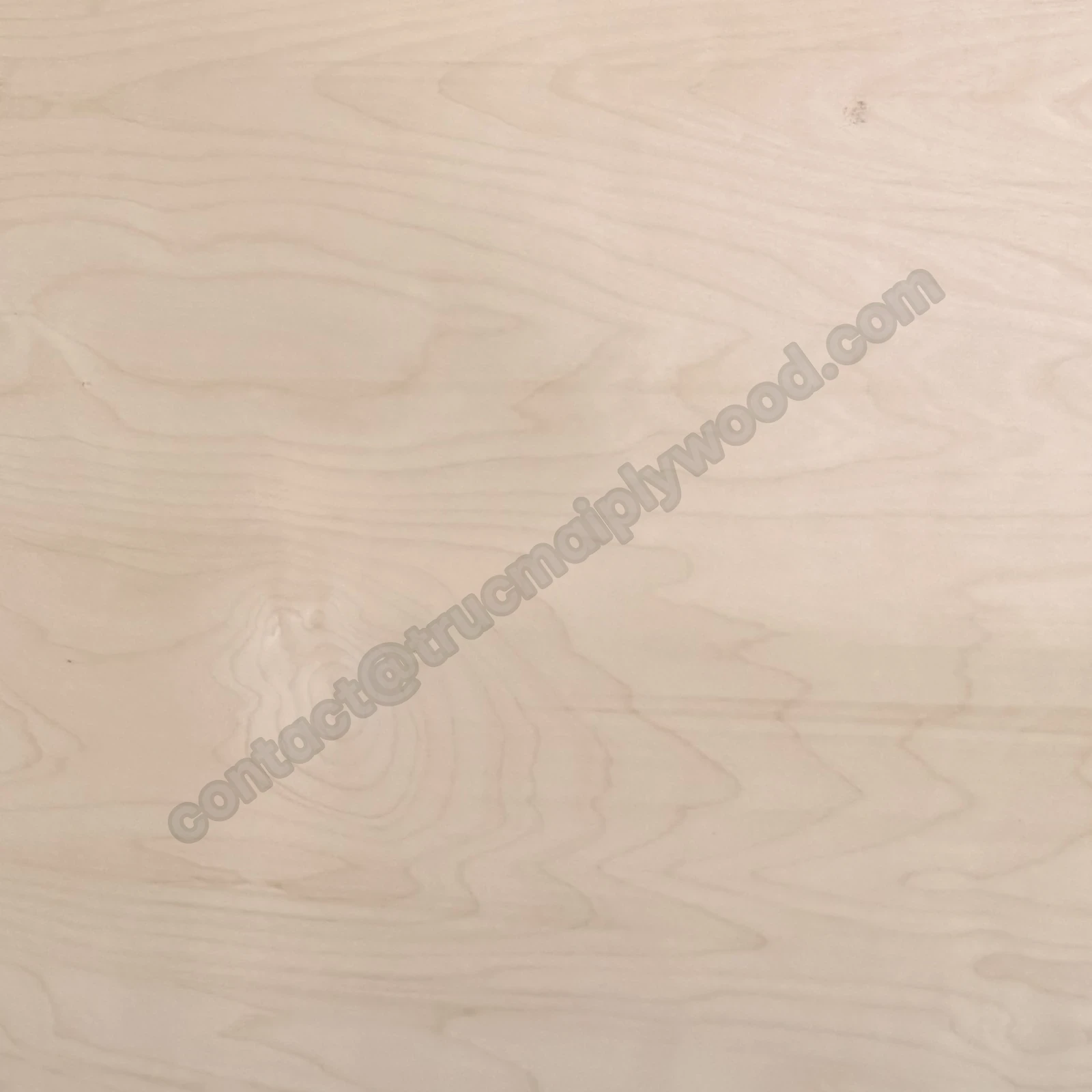
Before marking, an own-brand pack is plain plywood: a square stack, a clean edge and a face that matches the sample. These photos show stacks of three different faces, all taken before any label or stamp.
The edge of a stack is where a stamp or edge print would go, so a clean, square edge is the first thing to look at. A face that matches the sample is the second; the face photos on the grading page show how a face is sorted against it.
Where programmes drift
Where does an own-brand plywood programme drift, and how is it caught?
An own-brand programme drifts in five places: the face tone between batches, the label artwork between revisions, the pack build, the thickness between presses and the claims printed on the pack. Each one is caught by something written down.
Drift is rarely a single bad container; it is a series of small changes that each look acceptable. The defence is an order that quotes the same spec reference every time and a sample that both sides still hold.
| Drift | Cause | Control |
|---|---|---|
| Face tone changes | Veneer from a new lot sorted by eye without the sample at hand | Face veneer sorted against the kept sample; grade pair on the order |
| Label differs from the last container | Old artwork file reused, or a text change not recorded | Artwork carries a revision number; the order quotes it |
| Pack looks different | Pallet, guards or strap changed to suit stock on hand | Pack plan is part of the spec revision |
| Thickness creeps | Sanding settings drift between presses | Tolerance per line on the order; caliper readings on the pack-check sheet |
| Claim printed on the pack that the documents do not support | A claim copied from another product | Claims printed only if the spec and the documents carry them |
Numbers
How many sheets of 18 mm own-brand panels fill a 40HC?
At 18 mm and 1220 × 2440 mm, a 40HC takes 990 sheets of Styrax core, 880 of Acacia or 795 of Eucalyptus: about 53, 47 or 43 m³. The core on the spec therefore sets how many m³ an own-brand container carries.
A programme that sells by the container should choose the core with the container in mind: a Styrax core fills the volume of a 40HC, while a heavier core reaches the weight limit first. The full table by thickness and size is on the loading page.
| Core | Packs per 40HC | Sheets | Volume, about |
|---|---|---|---|
| Styrax | 18 (55 sheets each) | 990 | 53 m³ |
| Acacia | 16 (55 sheets each) | 880 | 47 m³ |
| Eucalyptus | 15 (53 sheets each) | 795 | 43 m³ |
Sheet counts and weights are planning figures from our packing model, panels only, not a loading record; the carrier and route decide the final payload. Full table: loading a 40HC and the 40HC load calculator.
Buyer guide
How should a distributor write the own-brand spec so it can be repeated?
Write the spec as eight lines and give it a revision number: application, face and back grade, core, glue and emission class, thickness with tolerance, sheet size, pack marking and quantity per container. Anything not on those lines can change without notice.
A spec that reads like a product name leaves the mill and the buyer with different pictures. A spec that reads like a purchase order leaves both with the same one, and it is the same document that a second supplier would be asked to quote against, which is also its main use as a control.
| Line | Example | Why it matters |
|---|---|---|
| Application | Kitchen carcasses, painted fronts | Sets face preparation and core grade |
| Face and back | Pair against a sample, with the species named | Fixes the appearance |
| Core | Styrax, or Acacia and Eucalyptus combined | Sets weight and m³ per container |
| Glue and emission | UF glue at E0 emission | Two separate lines, never one |
| Thickness and tolerance | 18 mm ±0.3 mm | Sets sanding and calibration |
| Sheet size | 1250 × 2500 mm | Sets cut yield and load |
| Pack marking | Label text, artwork revision, edge mark if any | Fixes the brand on the pack |
| Quantity per container | 1 × 40HC, one product | Sets the programme rhythm |
What you hold
What does a distributor hold once a programme is running?
Once the programme runs, the distributor holds five records that make a repeat container a copy of the last: the signed spec, the kept sample, the approved artwork, the pack-check sheet and the document template.
- Signed spec All eight lines with a revision number
- Kept sample The sample and the marked sample pack, with the matching reference
- Approved artwork The label and edge marking, with the revision the mill prints
- Pack-check sheet Counts, thickness readings and edge notes for each container
- Document template The drafts approved for the first container, reused for the next
Documents
Which documents change when the panels carry an own brand?
Three documents carry the programme: the invoice and packing list with the spec reference, the test and EU files for the agreed build, and the artwork approval. The shipping documents themselves follow the standard set.
- Invoice and packing list
Quote the spec reference and revision; the chain-of-custody claim appears here for eligible products.
The scans, the emission report and test reports for the agreed configuration, and the EU file set for EU lots.
- Artwork approval
The signed artwork with its revision, kept with the spec.
Drafts go to the buyer for approval; the order steps page has the full sequence.
Volume
Can one mill hold an own-brand spec month after month?
It can, because the volume is there: the mill presses around 60,000 m³ a year, about 5,000 m³ in an average month, so a monthly own-brand container is a small share of one mill's output and the spec never has to be split between plants.
The first containers set the rhythm; the supply rules for a monthly programme and the checks that keep the second container equal to the first have their own pages. Here the point is narrower: a programme needs one mill that makes the whole panel, the pack marking included.
Order checklist
Which six lines belong on an own-brand purchase order?
Six lines on the order turn a programme into something that can be repeated.
The spec reference and revision, so the container is made to a signed document.
The sample reference for the face and back grade pair.
The artwork reference and revision for the pack label and any edge marking.
The core, glue and emission class as separate lines, and the tolerance per line.
Products per container: one or two, or three to six by agreement, and the sheet size.
Claims allowed on the pack, and the documents the buyer wants before confirmation.
FAQ
Private-label questions from distributors
Direct answers on what can be labelled, what repeats and what stays with the buyer.
Can distributors get private-label plywood from a Vietnamese mill?
Yes. Truc Mai makes panels to a distributor's written spec and marks the packs with the buyer's brand. The mill presses the whole panel itself, from the core to the packed container, so the spec is held in one place.
Does an own-brand programme need a bigger order than one container?
No. The minimum for a programme is the same as for any order, one 40HC, usually of one or two products. The terms are on the page for MOQ, payment and FOB.
Can the same spec be repeated every month without drift?
Yes, if the order quotes one signed spec and the sample stays with both sides. The face is sorted against the sample, the tolerance is written per line and the pack-check sheet records counts and thickness for each container.
Which faces and cores can carry an own-brand label?
Any face the mill presses: EV, poplar, bleached poplar, birch, okoume, bintangor, pine, eucalyptus, gurjan, sapele. Cores are Eucalyptus, Acacia, Styrax, Pine or a combination, at 3 to 40 mm.
Can an FSC 100% claim appear on private-label shipments?
Yes, on the invoice and the packing list, for products on the mill's current product schedule. Whether your own pack artwork may carry the forest label is decided under the label owner's trademark rules, so ask the label owner or your auditor before artwork goes to print.
How many m³ of 18 mm private-label panels fill a 40HC?
About 53 m³ on Styrax core (990 sheets), 47 m³ on Acacia (880 sheets) and 43 m³ on Eucalyptus (795 sheets) at 1220 × 2440 mm. These are planning figures from the packing model.
What goes on an own-brand pack?
Your brand and product code on the pack label, and an edge stamp or print if you want one, with the pallet type. The marking is written on the spec and approved on a sample pack before the first container.
What happens if the buyer wants to change the face or the label later?
The change becomes a new spec or artwork revision and, for a new face, a new sample. The old revision stays on file, so the next container is made to whichever revision the order names.
Who owns the brand and the artwork?
The buyer. The buyer confirms in writing that it may use the brand on the packs it orders, and the mill prints only the artwork revision that the order names.
Start a programme
Send the spec for an own-brand programme
Send the eight spec lines and the marking you want; the quotation comes back with the build, the planning load per 40HC and the delivery term.
Application, face and back, core, glue and emission, thickness and tolerance, sheet size, pack marking and quantity per container.