
Commercial plywood · Ha Hoa, Phu Tho, Vietnam
Commercial plywood by the container: faces, cores and sheets per 40HC
This page is for distributors, crate makers and interior contractors who buy commercial plywood by the 40HC and reorder it. Truc Mai builds it on an AB core, loose-laid or jointed, faces unsanded or lightly sanded, ±0.5 mm per order. As a planning figure, 990 sheets of 18 mm on Styrax fill a 40HC, about 53 m³.
The Ha Hoa mill makes around 60,000 m³ a year across this commercial line and the furniture and interior line. Commercial plywood is bought on cost per container. This page therefore starts from the container: which face and core go in it, how many sheets fit by core and thickness, how far a load can be mixed, and what has to stay fixed so the next container prices and stacks like the last one. Panels with a stitched A-grade core and calibrated faces are on the furniture and interior line.
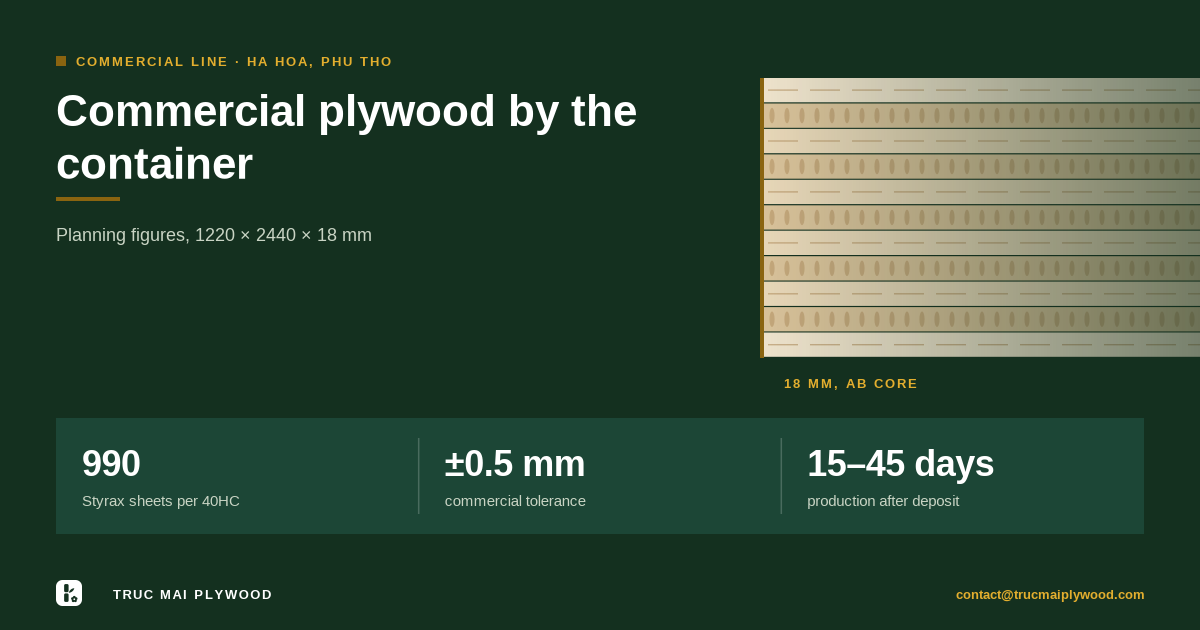
- 990 sheets18 mm Styrax per 40HC, planning figure
- ±0.5 mmcommercial thickness tolerance
- 3–40 mmthickness range
- about 5,000 m³average month at the mill
Updated 12 November 2026
Cost per container
Commercial plywood sheets per container, by core and thickness
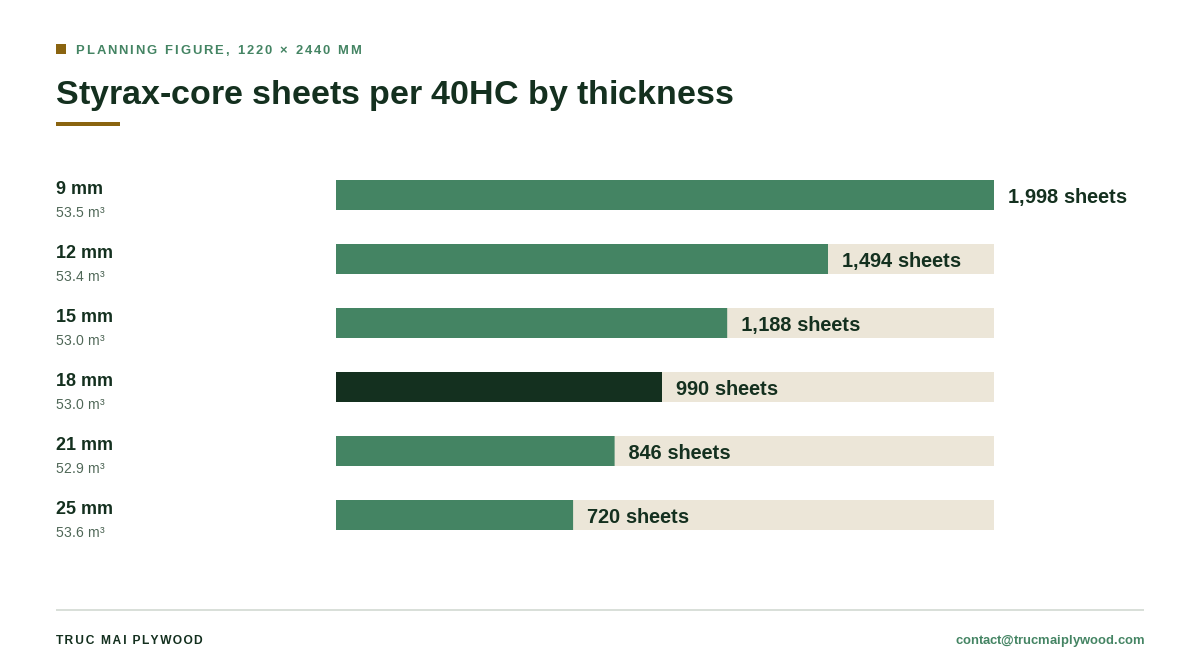
On a Styrax core a 40HC holds about 53 m³ at almost any thickness, from 1,998 sheets of 9 mm to 720 sheets of 25 mm. The core species, not the thickness, moves the cubic metres: Acacia fills about 47 m³ and Eucalyptus about 43 m³.
That changes how a commercial buyer should compare offers. Two quotations for 18 mm commercial plywood at the same price per sheet are not the same deal if one is on Styrax and the other on Eucalyptus: the Styrax container carries 990 sheets, the Eucalyptus container 795, because the heavier sheets reach the planning payload first. Freight, duty handling and unloading are paid per container, so cost per sheet landed follows the core.
The reverse also holds. Where a buyer resells by the sheet and the end user wants a heavy, hard panel, Eucalyptus is worth its lower count; where the panel is sold by the cubic metre or used for crating, Styrax or Acacia usually lands cheaper. The full m³ per 40HC by thickness guide gives the working for each thickness.
Video
Commercial plywood on film
A short film of commercial packs being built and loaded at the Ha Hoa mill is being edited and will sit here.
Range
Commercial plywood range by face, core and glue
The commercial line carries most faces the mill runs on an AB core. The panels below have their own pages; any other face on the commercial build is quoted on request.
Panels that need a graded, stitched core and calibrated faces belong to the furniture and interior line, and melamine or HPL faces are listed under laminate-faced panels. The full index of sheets lists every face, core and format in one place.
Reddish-brown bintangor face on Eucalyptus, Acacia or Styrax core; the usual face on 4 × 8 ft commercial sheets.
Pinkish-brown okoume face, lighter in colour, for interior and general use.
Gurjan face veneer on a Vietnamese core; gurjan is a face only, never a core.
Eucalyptus face and core for a harder, heavier sheet; fewer sheets per 40HC because of weight.
Pine face for interior panelling, shelving and display.
1220 × 2440 × 18 mm hardwood-faced ply, the board most merchants stock.
Melamine-fortified glue line for parts that see moisture; not marine and not structural.
AB loose-laid core, usually E2, ±0.5–1.0 mm, for crates, pallets and packing.
Real panels
What a commercial plywood pack looks like on arrival
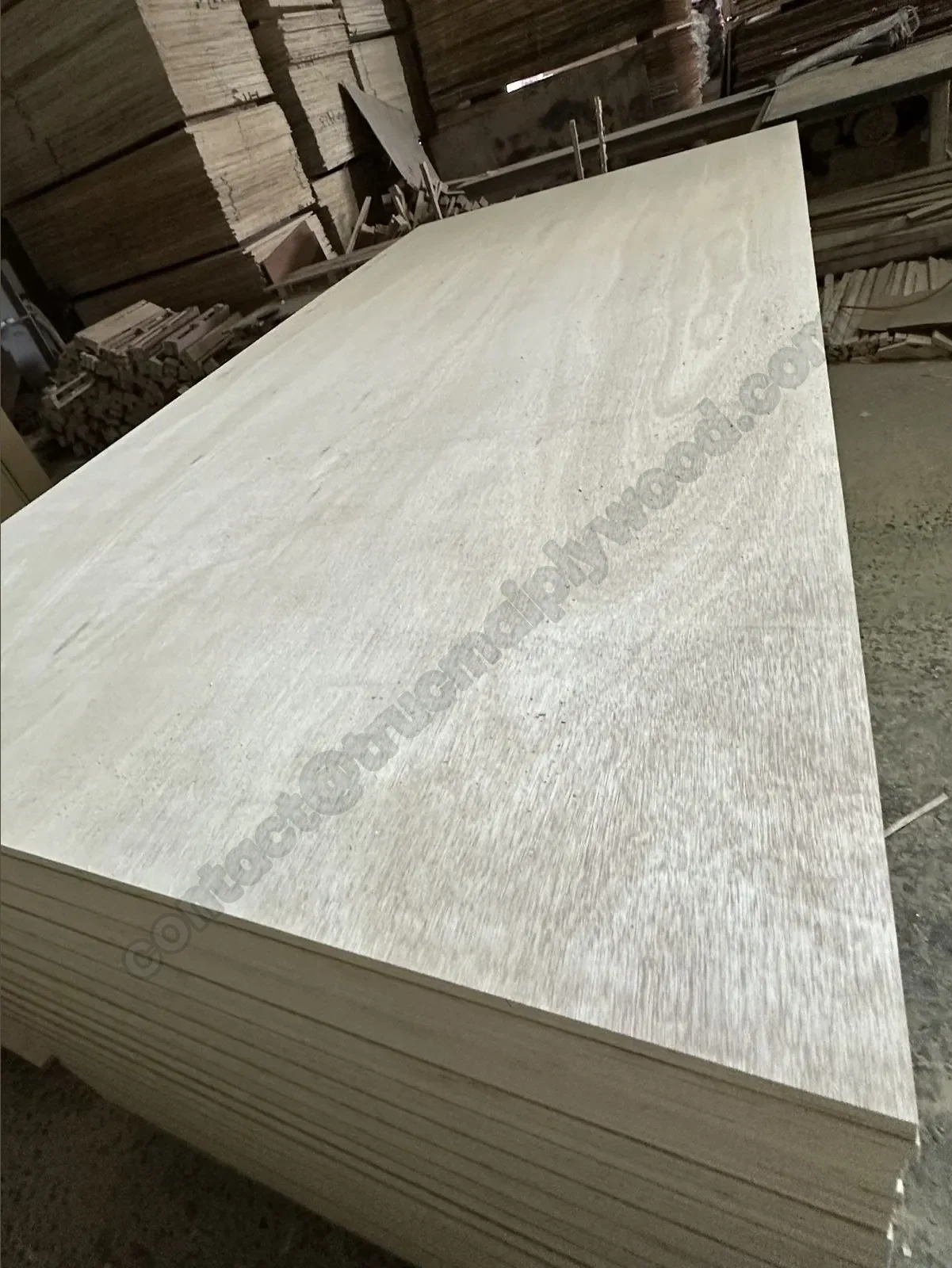
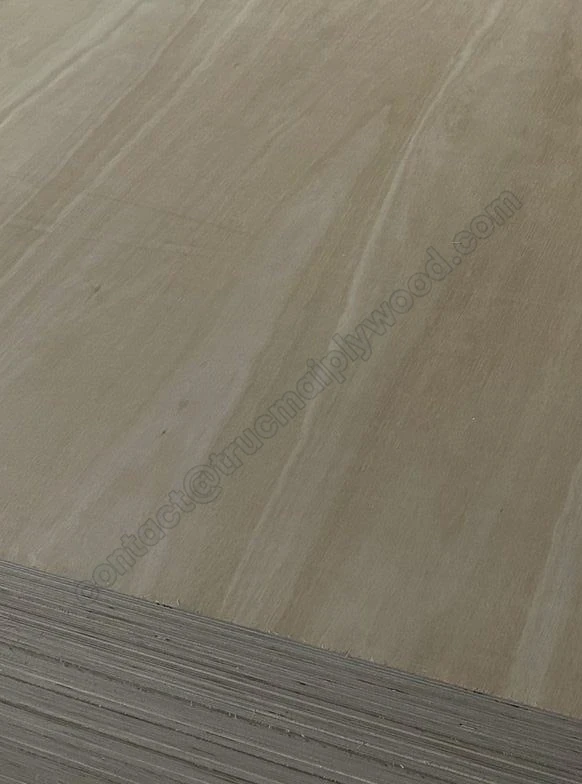
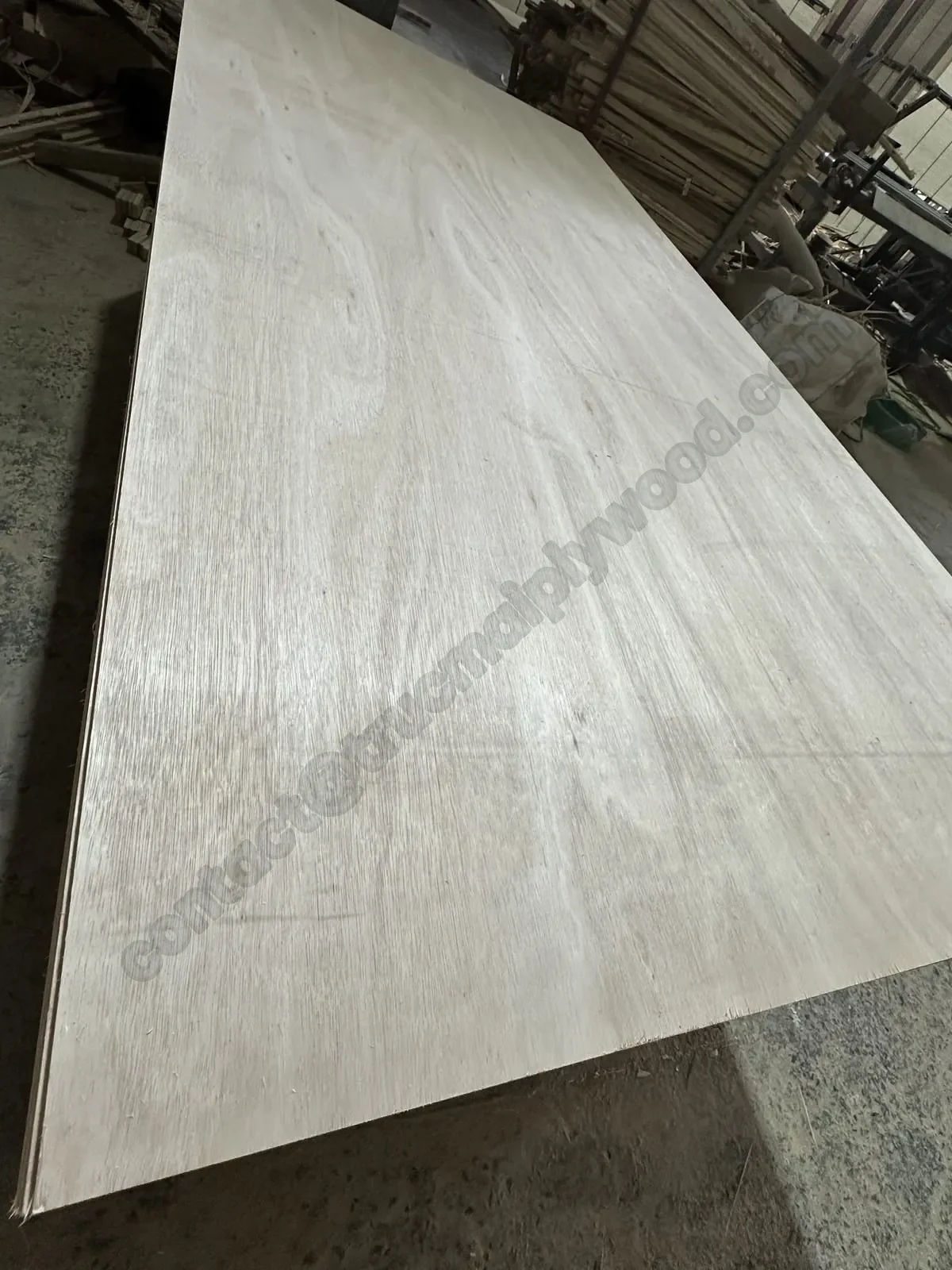
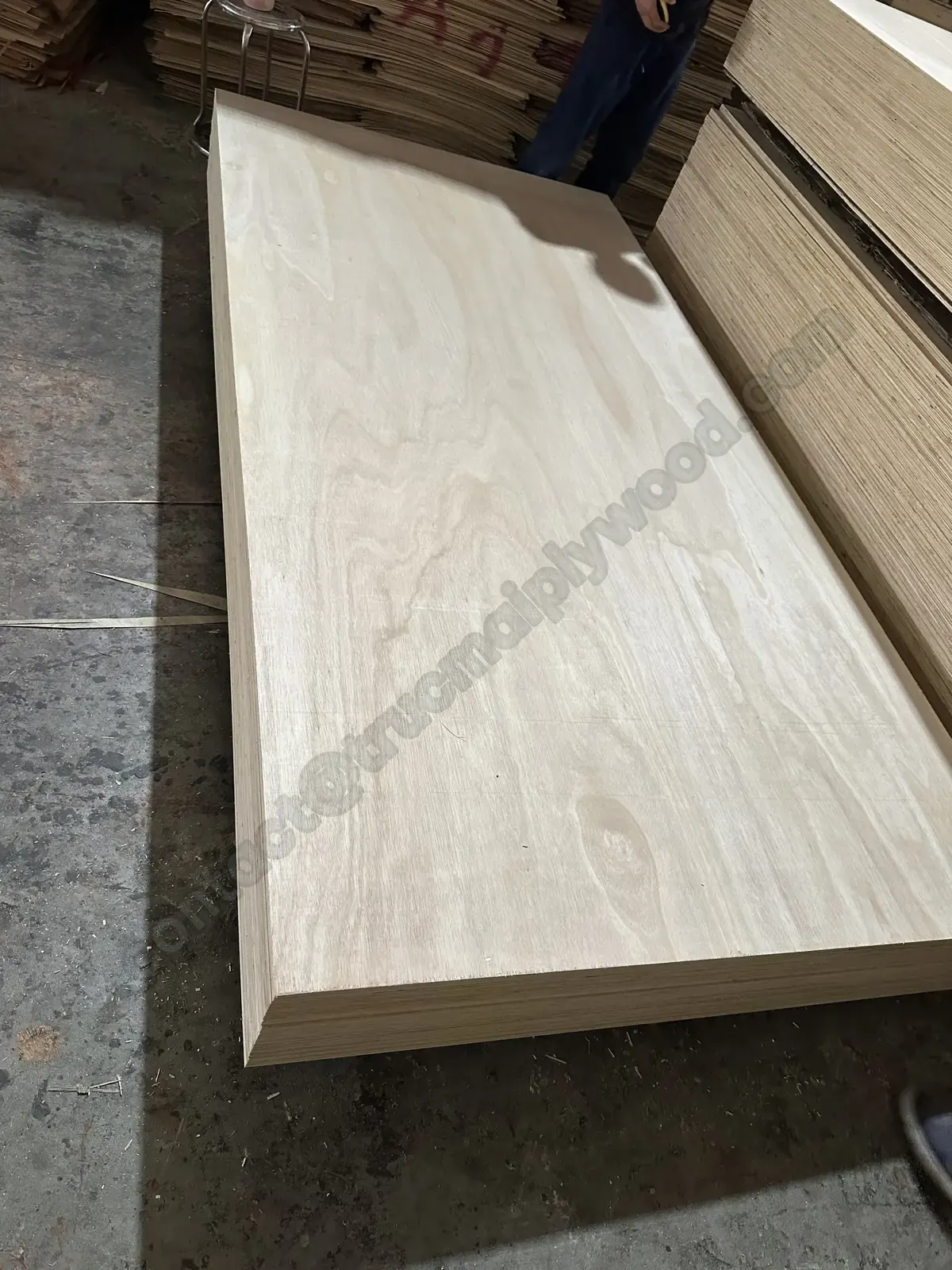
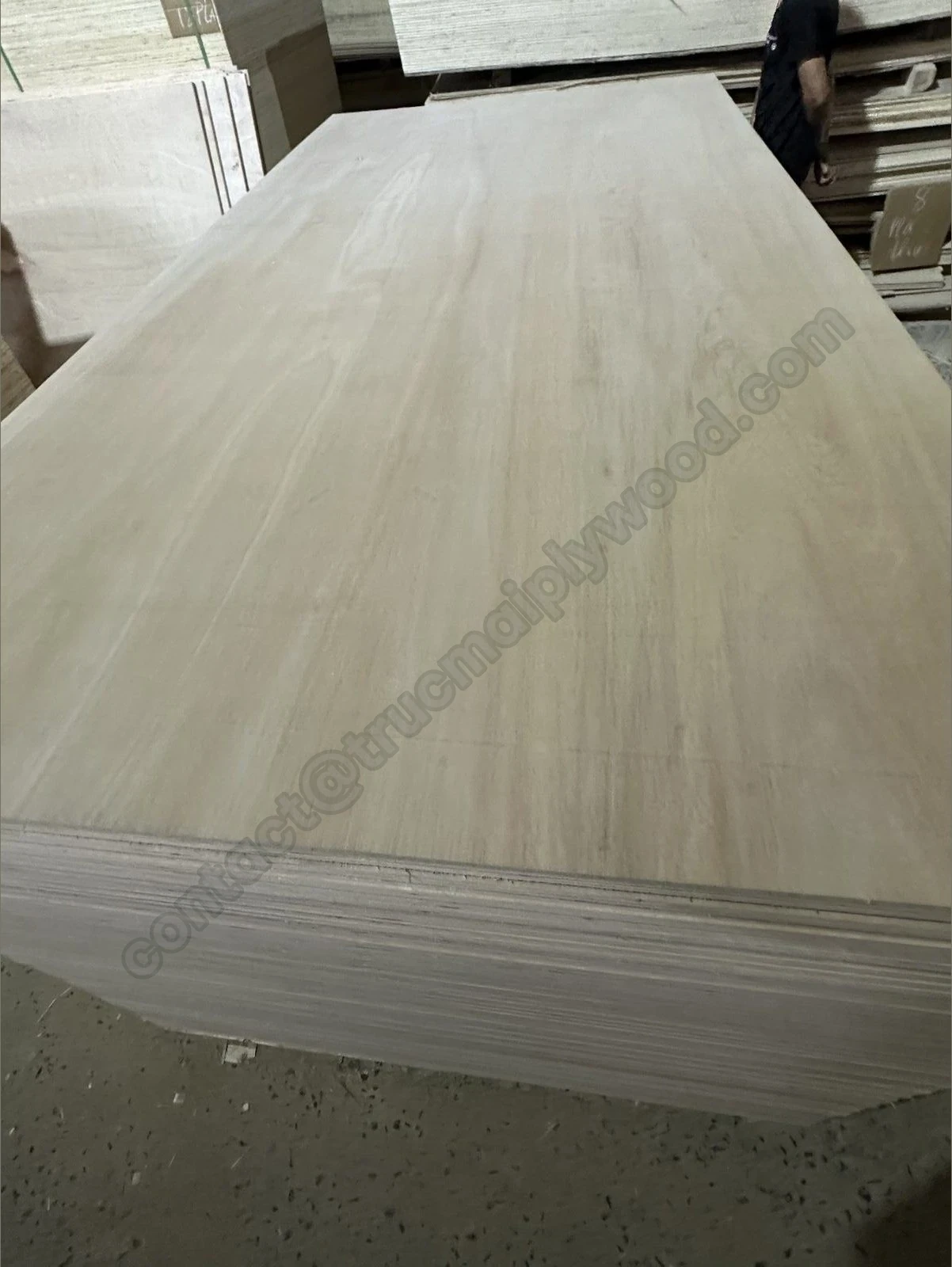
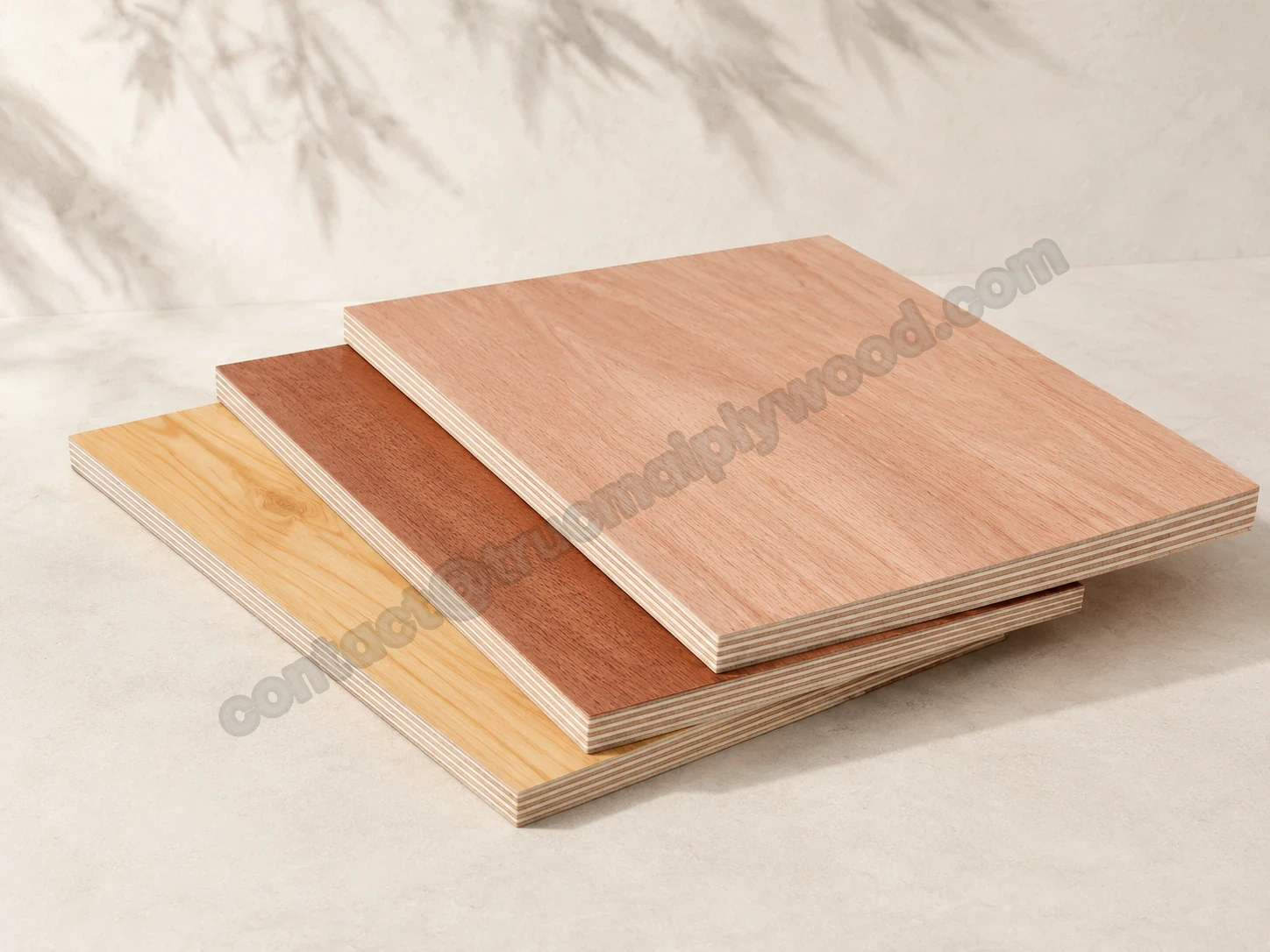
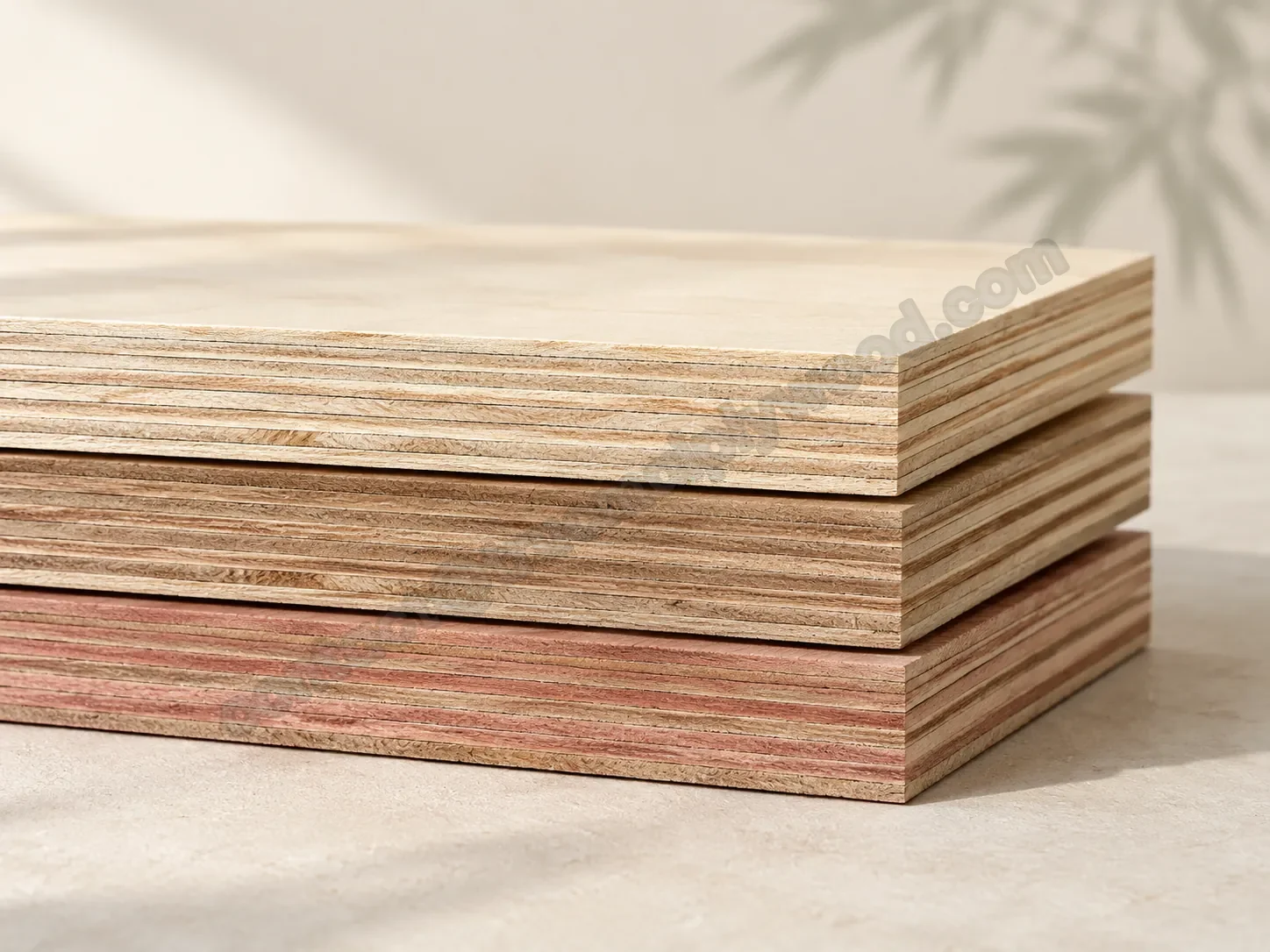
A commercial pack is judged on four things at the destination: sheet count, thickness against ±0.5 mm, face grade against the agreed sample, and an edge with no open core gaps.
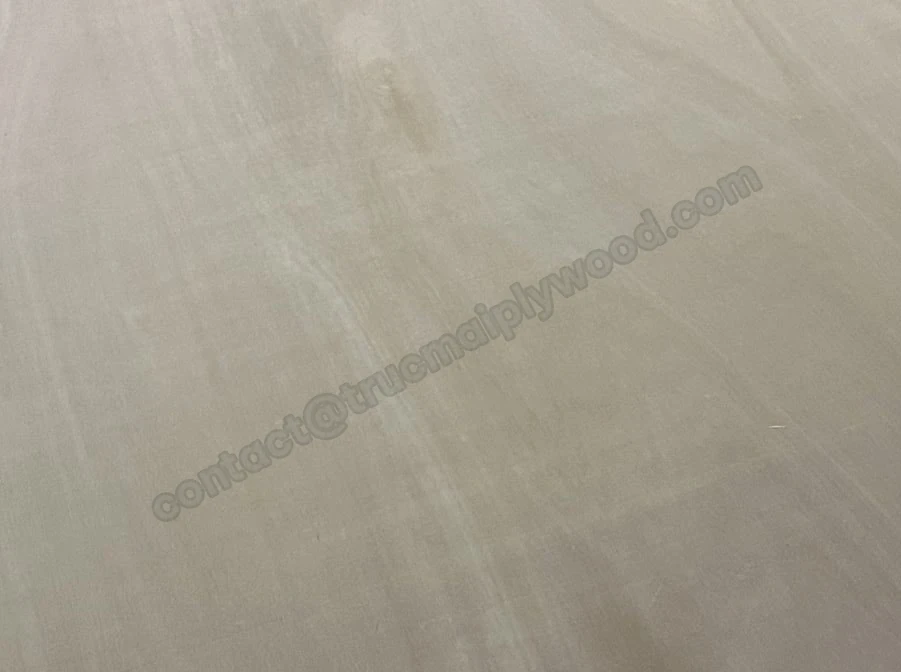
Commercial faces are unsanded or lightly sanded, so they show press marks and small colour changes that a sanded furniture face would not; that is normal for the grade and is priced in. Delamination, a blister under the face or a core gap visible at the sheet edge are not.
The core is AB grade, loose-laid or jointed rather than stitched, so a cut through the middle of a sheet can show small overlaps or gaps inside; how many are accepted is part of the pair fixed on the sample.
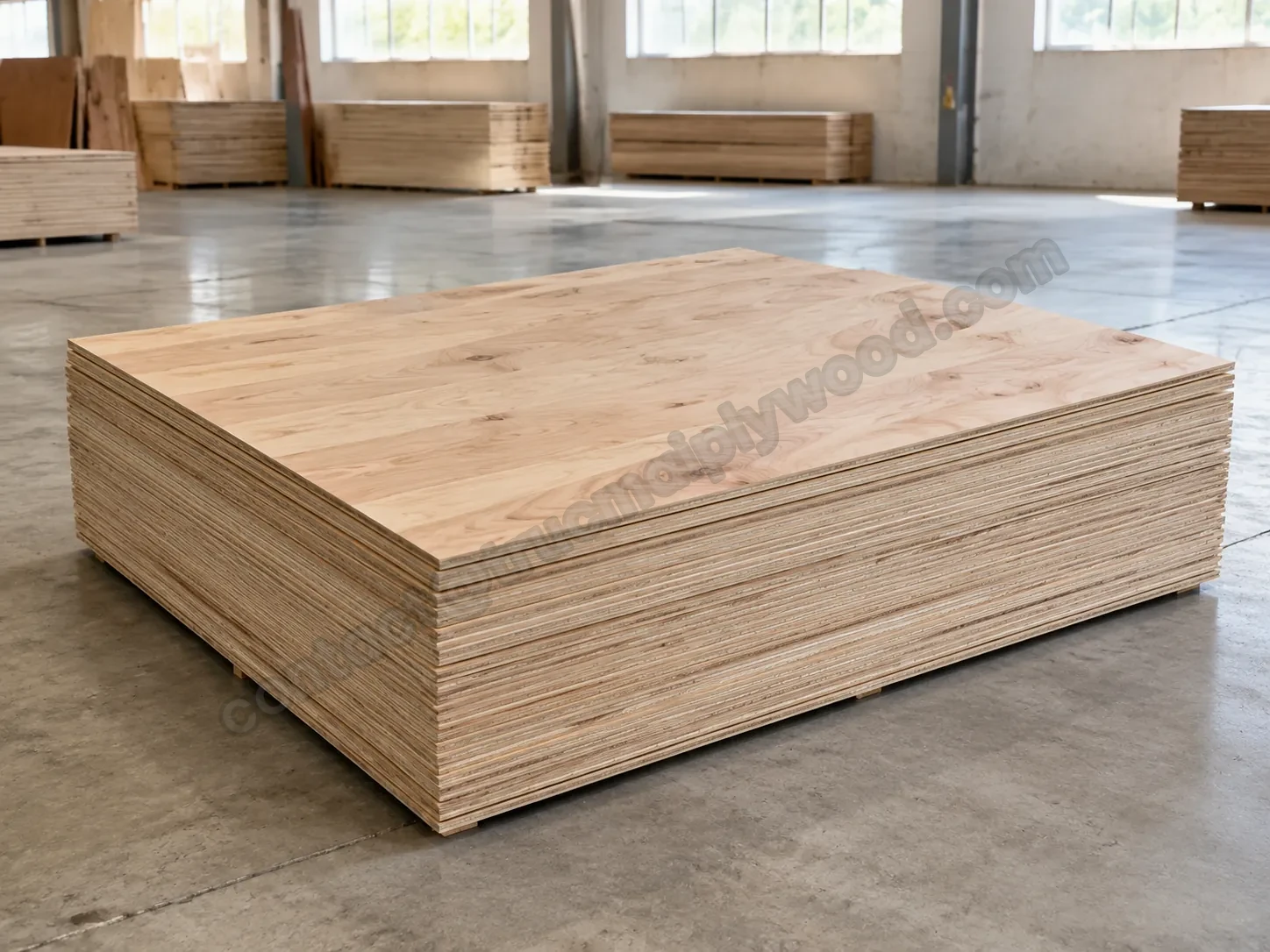
The photos show eucalyptus-faced sheets and stacks: compare the face and the edge with the four checks above.
How to choose
How to choose commercial plywood for a container order
Choose the use first, then the core for weight and cost per container, then the face, then the glue line. Thickness and sheet size follow from the use.
Commercial plywood 12mm and 18 mm are the two thicknesses most often filled into whole containers: 12 mm for walls, partitions and packing, 18 mm for shelving, general interiors and resale. Commercial plywood 4x8 means 1220 × 2440 mm; 1250 × 2500 mm is the European format and the largest sheet made, and 1220 × 2280 mm is the shorter furniture sheet.
Two offers called commercial plywood with the same thickness and face are often not the same panel: the difference comes from core grade, joining method, face preparation, glue system and tolerance. Asking for those five lines on every quotation makes offers comparable.
| Use | Panel to order | Why |
|---|---|---|
| Distribution, general use | Bintangor or okoume face, Styrax or Acacia core, 18 mm | The board most merchants stock |
| Interior walls, ceilings, partitions | Okoume or pine face, 9–12 mm | Light sheets, easy to fix |
| Crates and heavy packing | Packing-grade panel, AB loose-laid core | Lowest cost per m³ |
| Parts that see damp, not weather | Exterior-glue panel | Melamine-fortified glue line |
| Hidden furniture backs and bases | Commercial thin panels on Styrax | Thin, flat, low cost |
| Shop counters and visible fit-out | Furniture-line panel instead | Sanded faces and ±0.3 mm are needed |
Faces
Which faces commercial plywood carries, and how each one varies
Bintangor is the most asked commercial face; okoume, gurjan, eucalyptus, pine and poplar run on the same AB build. Each face varies in its own way, so the sample fixes a different thing for each.
Gurjan, okoume and bintangor are faces only: the core under them is Styrax, Acacia, Eucalyptus or Pine, or a mix of species laid together, never rubberwood. On a commercial order the back is usually one grade below the face; the pair is written as face grade and back grade and kept with the sample.
Where a buyer sells to painters and decorators, a lightly sanded face saves them work and costs little; where the panel goes into crates or behind linings, unsanded is the cheaper and normal choice.
Face choice also moves the container. A eucalyptus face usually rides on a Eucalyptus core, so that board is heavy and loads by weight; bintangor and okoume faces are pressed on Styrax as often as on Acacia, which keeps the container near 53 m³ as a planning figure. A buyer who stocks two faces for two price points does best to keep one core under both, so the packs weigh alike and the mixed load is planned once and repeated every month.
| Face | How it looks | What varies between lots | What the sample fixes |
|---|---|---|---|
| Bintangor | Reddish-brown, interlocked grain | Depth of red, stripe width | Colour band and accepted patches |
| Okoume | Pinkish-brown, mild figure | Pink to brown tone | Tone range and splits |
| Gurjan | Reddish, coarser grain | Darkness, mineral streaks | Streaks accepted on the face |
| Eucalyptus | Pale to reddish-brown, hard | Colour spread within a sheet | Colour spread and small knots |
| Pine | Yellow with knots | Knot size and count | Knot size per sheet |
| Poplar | Pale cream | Grey streaks | Streaks and joints |
Specs
Commercial plywood 18mm and the commercial spec sheet
These are the defaults on a commercial order. Any change, such as sanding both faces or another emission class, is a separate line on the order and in the price.
- Faces Bintangor, okoume, gurjan, eucalyptus, pine, poplar and others; face and back quoted as a pair
- Cores Styrax, Acacia, Eucalyptus or Pine, or combined; no rubberwood core
- Core grade and joining AB core, loose-laid or jointed
- Surface Unsanded or lightly sanded; sanded both sides on request
- Thickness 3, 4, 5, 6, 9, 12, 15, 18, 21, 25, 30 and 40 mm
- Thickness tolerance ±0.5 mm written per order; length and width ±2 mm
- Plies at 18 mm Usually 11–13 plies
- Sheet sizes 1220 × 2440 mm (4 × 8 ft), 1220 × 2280 mm, 1250 × 2500 mm; custom sizes up to 1250 × 2500 mm
- Glue and emission UF glue at E0 emission by default; melamine-fortified glue on request
Comparison
How commercial plywood differs from furniture-grade plywood at the mill
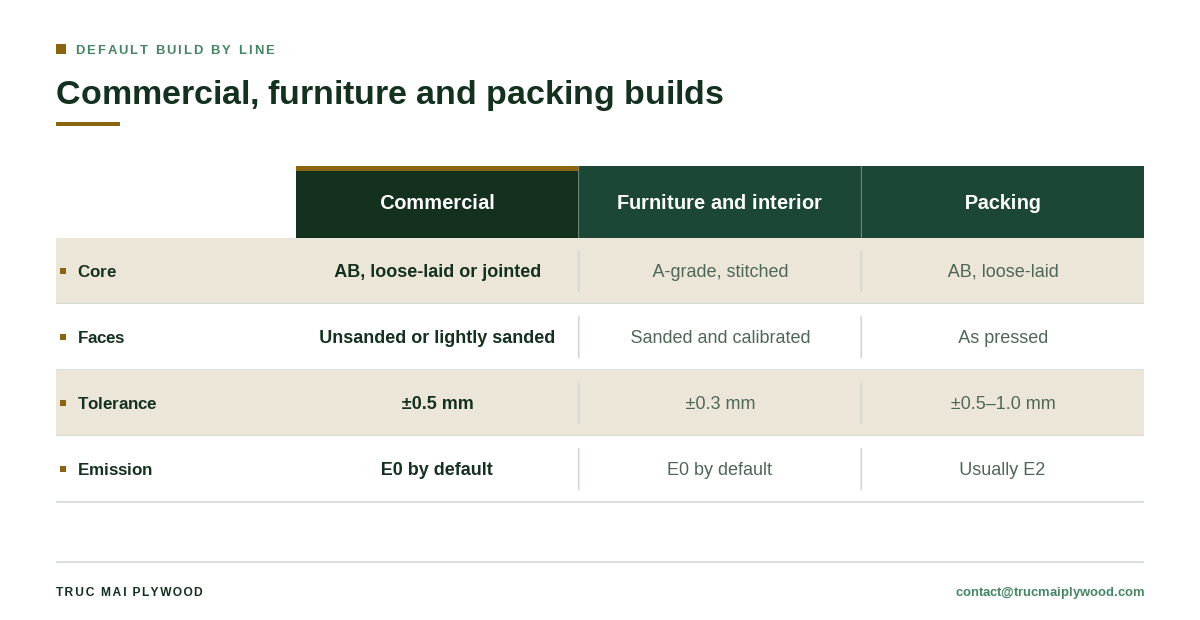
The mill presses both lines on the same faces and cores; what changes is core grade, joining, sanding, tolerance and price. Commercial is built for cost per container, furniture for a clean edge and a calibrated face.
A commercial buyer who starts supplying furniture makers often moves part of the container to the furniture line rather than asking for commercial sheets sanded harder: the stitched A-grade core is what keeps the cut edge closed, and sanding cannot add it later. The reverse move, from furniture to commercial for hidden parts, saves money without any change in face species.
| Line | Commercial | Furniture and interior | Packing |
|---|---|---|---|
| Core grade | AB | A | AB |
| Core joining | Loose-laid or jointed | Stitched across and along | Loose-laid |
| Faces | Unsanded or lightly sanded | Sanded and calibrated | As pressed |
| Thickness tolerance | ±0.5 mm | ±0.3 mm | ±0.5–1.0 mm |
| Usual emission | E0 | E0 | E2 |
| Bought for | Cost per container | Edge and face quality | Lowest cost per m³ |
Applications
Where commercial plywood is used
Commercial panels go where cost per sheet matters more than a finished face: resale stock, interior building, crates and packaging, and low-cost furniture parts.
Truc Mai does not make film-faced, formwork, structural or marine plywood.
- Timber merchants and distributors
Mixed stock of 9, 12, 15 and 18 mm bintangor or okoume, reordered by the container.
- Interior building and fit-out
Partition walls, ceilings, sub-layers and hoarding inside buildings.
- Crates, pallets and packaging
Packing-grade panels where ±0.5–1.0 mm is enough and E2 is accepted.
- Low-cost furniture parts
Backs, bases and hidden parts that are covered or painted later.
- Display and exhibition stands
Pine or okoume faces painted or covered on site.
- Damp interior areas
Exterior-glue panels for parts that see moisture but not weather.
Repeat containers
Mixing a commercial container and keeping the reorder the same
A commercial container usually carries one or two products; three to six products, cores or thicknesses can be mixed by agreement. Each is packed in its own packs, so the mix is planned pack by pack before pressing starts.
What drifts on a commercial reorder is rarely the face species; it is the core and the thickness. A core swapped to a heavier species changes the sheet count and the weight, and thickness creeping to the loose end of ±0.5 mm shows when packs are stacked. Both are order lines, checked before packing; repeat-spec control describes how the reference is kept, and monthly container programmes describe how a buyer books the same container every month.
With a mill output of about 5,000 m³ in an average month, a buyer reordering the same commercial build can book production a month ahead and keep the same core species and pack plan across loads.
| Mix in one 40HC | Why buyers mix it | What to watch |
|---|---|---|
| 12 mm and 18 mm, same face and core | Merchant stock in two thicknesses | Pack counts per thickness |
| Bintangor and okoume, same core | Two price points for resale | Face pair written for each face |
| Commercial and packing-grade panels | Resale stock plus own crating | E0 and E2 packs marked apart |
| Styrax and Eucalyptus cores | Light and heavy boards in one load | Weight: Eucalyptus reaches the payload first |
| UF and exterior-glue panels | Interior stock plus damp-area stock | Glue line written per pack |
Core and glue
Which core and glue line for commercial plywood
Styrax gives the most cubic metres per container and the lightest sheet; Acacia is harder and heavier; Eucalyptus is the densest and loads by weight. The glue line defaults to UF at E0 emission for interior use.
Glue type and emission class are two separate lines on the order: the default is UF glue at E0 emission, and a melamine-fortified glue for damp rooms usually gives E1. Commercial plywood runs 3–40 mm; the CARB P2 and TSCA Title VI scope (certificate CARB/EPA 26053) covers 3–25 mm and 3–15 plies, so 30 and 40 mm commercial panels are sold without that claim. Limits and methods are on emission class per order and the EPA formaldehyde standards for composite wood.
| Core | Reference density | Sheet weight |
|---|---|---|
| Styrax | 500 kg/m³ | 26.8 kg |
| Acacia | 580 kg/m³ | 31.1 kg |
| Eucalyptus | 650 kg/m³ | 34.8 kg |
Quality control
What thickness tolerance is written on a commercial plywood order
±0.5 mm on thickness and ±2 mm on length and width. What the commercial line sorts differently from furniture is below.
How the reference sample and check records are kept is on repeat-spec control.
- Core laid AB, loose or jointed
Open gaps at the sheet edge are rejected; small inner overlaps follow the sample.
- Thickness read before packing
Several points per sheet against ±0.5 mm.
- Face sorted by colour band
Bintangor and gurjan by depth of red, okoume by tone.
- Packs counted to the plan
Sheet count per pack checked so the container plan holds.
Certificates
Certificates that come with commercial plywood
FSC, CARB P2, ISO 9001 and ISO 14001, plus EU file sets.
- FSC 100% FSC-C196493 · SA-COC-014545
- CARB P2 and TSCA Title VI CARB/EPA 26053 · TPC-43
- ISO 9001:2015 W2012 · WCERT
- ISO 14001:2015 W2012E · WCERT
Packing
How many 18 mm commercial sheets fit in a 40HC
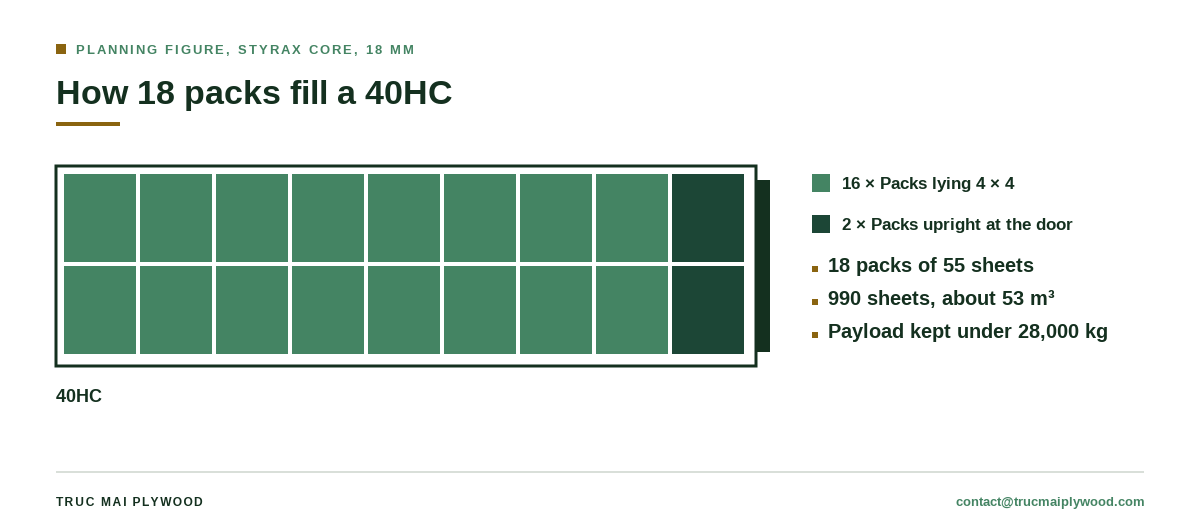
990 sheets on Styrax, 880 on Acacia and 795 on Eucalyptus at 1220 × 2440 × 18 mm, as planning figures.
Sheet counts and weights are planning figures, not a loading record.
Commercial Styrax loads fill by volume, Eucalyptus loads stop on weight. Every thickness is in the 40HC load calculator; the pack plan is on loading a 40HC.
| Core | Packs | Sheets per 40HC | Volume per 40HC |
|---|---|---|---|
| Styrax | 18 × 55 sheets | 990 sheets | 53.0 m³ |
| Acacia | 16 × 55 sheets | 880 sheets | 47.2 m³ |
| Eucalyptus | 15 × 53 sheets | 795 sheets | 42.6 m³ |
Terms
Order terms for a commercial plywood container
Full containers direct from the mill; these terms apply unless the contract says otherwise.
Full terms are on MOQ, payment and FOB. A commercial quotation states the planned sheets per 40HC for the chosen core, so offers can be compared per container.
- Minimum order One 40HC
- Production time 15–45 days after the 30% deposit, by quantity and agreement
- Payment 30% deposit; 70% against the scanned B/L by T/T, or irrevocable L/C at sight
- Delivery terms FOB Hai Phong, CFR or CIF
- Documents Invoice, packing list, B/L, certificate of origin, phytosanitary, fumigation, order certificates
- Price Quoted per order against the written specification
FAQ
Commercial plywood: buyer questions
How many sheets of 18 mm commercial plywood fit in a 40HC container?
As a planning figure at 1220 × 2440 mm: 990 sheets on a Styrax core (18 packs of 55, about 53 m³), 880 on Acacia (47.2 m³) and 795 on Eucalyptus (42.6 m³). Sheets are weighed before final loading.
Can I mix core types or thicknesses in one 40HC container?
Yes, by agreement. One or two products per container is usual and three to six can be mixed. Each core and thickness goes in its own packs, and a mix with Eucalyptus is checked against the payload first because the heavier sheets reach it sooner.
How does commercial plywood differ from furniture-grade plywood at the mill?
Commercial uses an AB core, loose-laid or jointed, unsanded or lightly sanded faces and ±0.5 mm. Furniture grade uses an A-grade core stitched across and along and faces calibrated to ±0.3 mm. At the Ha Hoa mill both lines share faces, cores and glue.
Which faces can commercial plywood carry, and is bintangor available?
Yes, bintangor is the most asked commercial face. Okoume, gurjan, eucalyptus, pine and poplar also run on the commercial build. Gurjan, okoume and bintangor are faces only; cores are Styrax, Acacia, Eucalyptus, Pine or combined.
What thickness tolerance is written on a commercial plywood order?
±0.5 mm on thickness and ±2 mm on length and width. Across the mill's lines thickness is written per order within ±0.3–0.5 mm; packing-grade panels are looser at ±0.5–1.0 mm.
Why is an 18 mm Eucalyptus container cheaper per sheet but dearer per cubic metre landed?
Eucalyptus is the densest core, so a 40HC holds 795 sheets (42.6 m³) against 990 on Styrax (53.0 m³). Freight is paid per container, so each Eucalyptus sheet carries more freight; it is worth it where the end user wants a heavy, hard board.
Does a 9 mm commercial container hold more cubic metres than an 18 mm one?
Hardly. On Styrax the planning figures are 1,998 sheets and 53.5 m³ at 9 mm against 990 sheets and 53.0 m³ at 18 mm. The core species moves the cubic metres far more than the thickness.
What should stay fixed between two commercial containers?
Face species and grade pair, core species, thickness and tolerance, glue and emission class, and the pack plan. A swapped core changes sheet count and weight; it is an order line and checked before packing.
Can commercial plywood be sanded on both faces?
Yes, as a separate order line. If the buyer needs a closed cut edge as well, the furniture line with its stitched A-grade core is the better buy, because sanding does not change the core.
Quotation
Ask for a commercial plywood quotation
Write the use, core, glue and emission class, face and grade pair, thickness, sheet size and the mix per container. A quotation with the planned sheets per 40HC and certificate files comes back by email.