
Furniture and interior plywood · Ha Hoa, Phu Tho, Vietnam
Furniture grade plywood, written as one repeat build per 40HC
This page is for cabinet and furniture factories that fill a 40HC every month. Furniture grade plywood at Truc Mai is a written build: an A-grade stitched core, faces sanded and calibrated to ±0.3 mm, UF glue at E0 emission and a face and back pair fixed on a sample, so the reorder matches the first load.
The mill in Ha Hoa, Phu Tho makes around 60,000 m³ of plywood a year, about 5,000 m³ in an average month, across this line and the commercial line. Below are the faces, formats and LVL stock of the furniture line, the core to put under each face, what a monthly container usually carries and what has to stay identical from one load to the next. The full index of every panel the mill runs sits one level up.
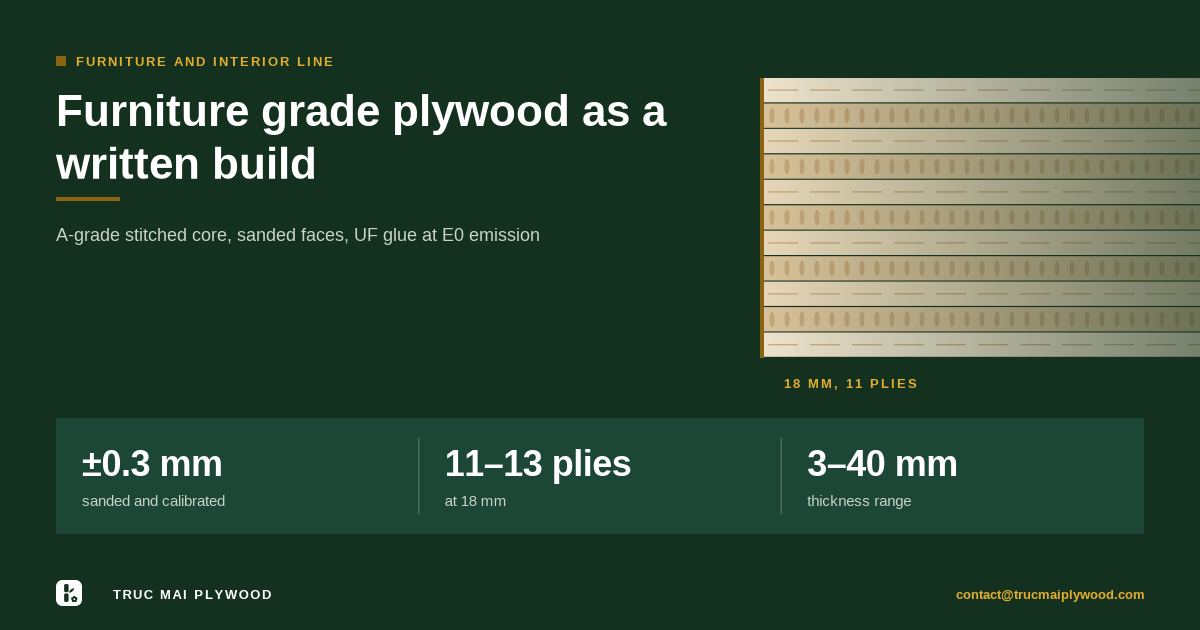
- ±0.3 mmsanded and calibrated faces
- 3–40 mmthickness range
- 11–13 pliesusual build at 18 mm
- about 53 m³18 mm Styrax per 40HC, planning figure
Updated 12 November 2026
Video
Furniture grade plywood on film
A short film of this line, from the sanded face to the strapped pack, is being cut from footage at the Ha Hoa mill and will sit here.
Range
Faces, formats and LVL from a Vietnam furniture plywood manufacturer
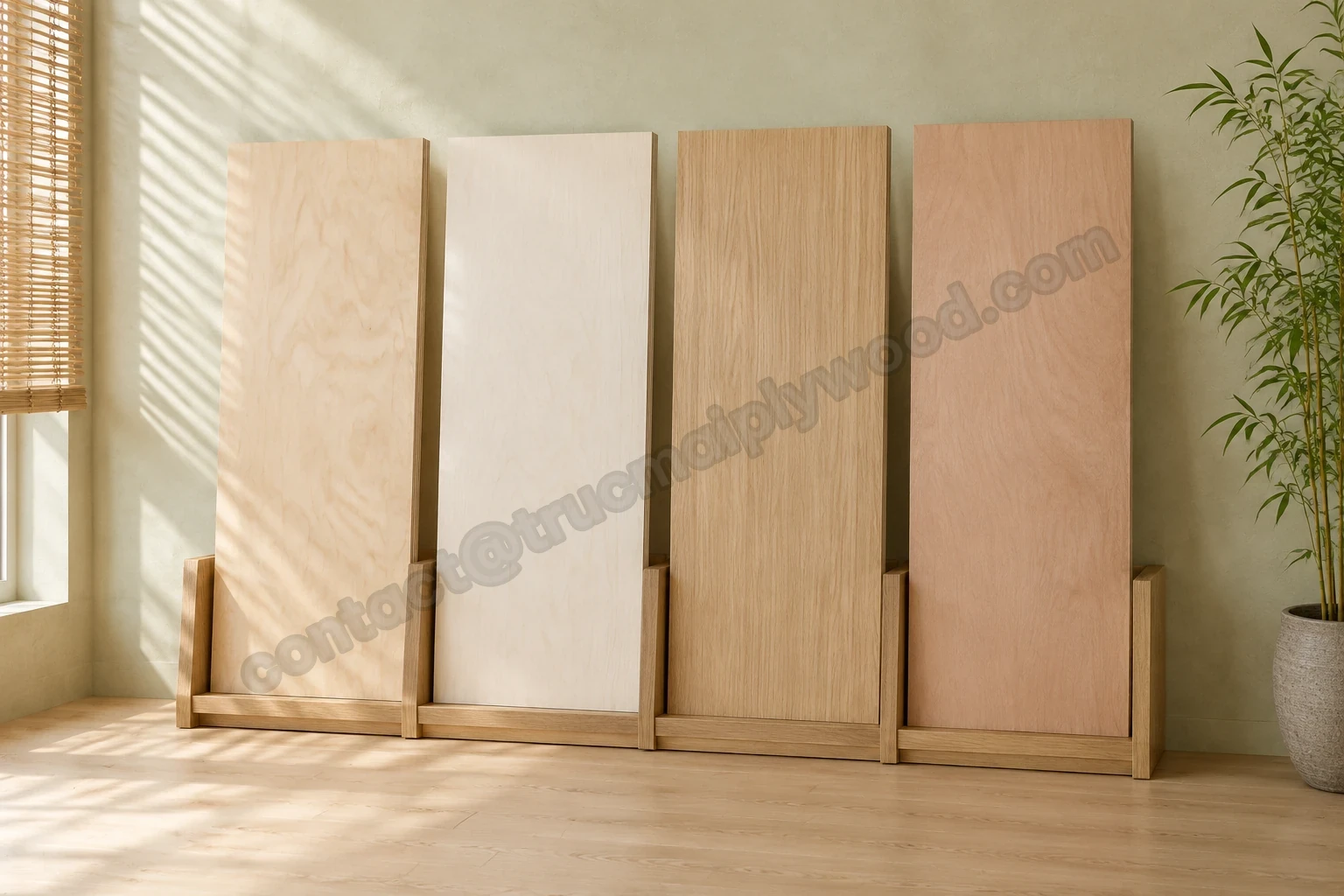
Every panel below starts from the furniture default: A-grade core, stitched, sanded both sides. Choose the face for the finish your factory applies, then the format your saw plan uses.
Faces without their own page, such as Sapele, are pressed on request on the same build. Panels faced with melamine, HPL or paper overlay are grouped as laminate-faced plywood, and unsanded panels for crating and general interiors are listed as commercial plywood.
Pale natural poplar or white poplar EV face; the usual choice for painted doors and carcasses.
Poplar bleached to a whiter, even tone for white or light lacquer, where a natural face would show colour shifts.
Reconstituted plantation-poplar veneer in 0.3 or 0.4 mm; the face of the tenth load looks like the first.
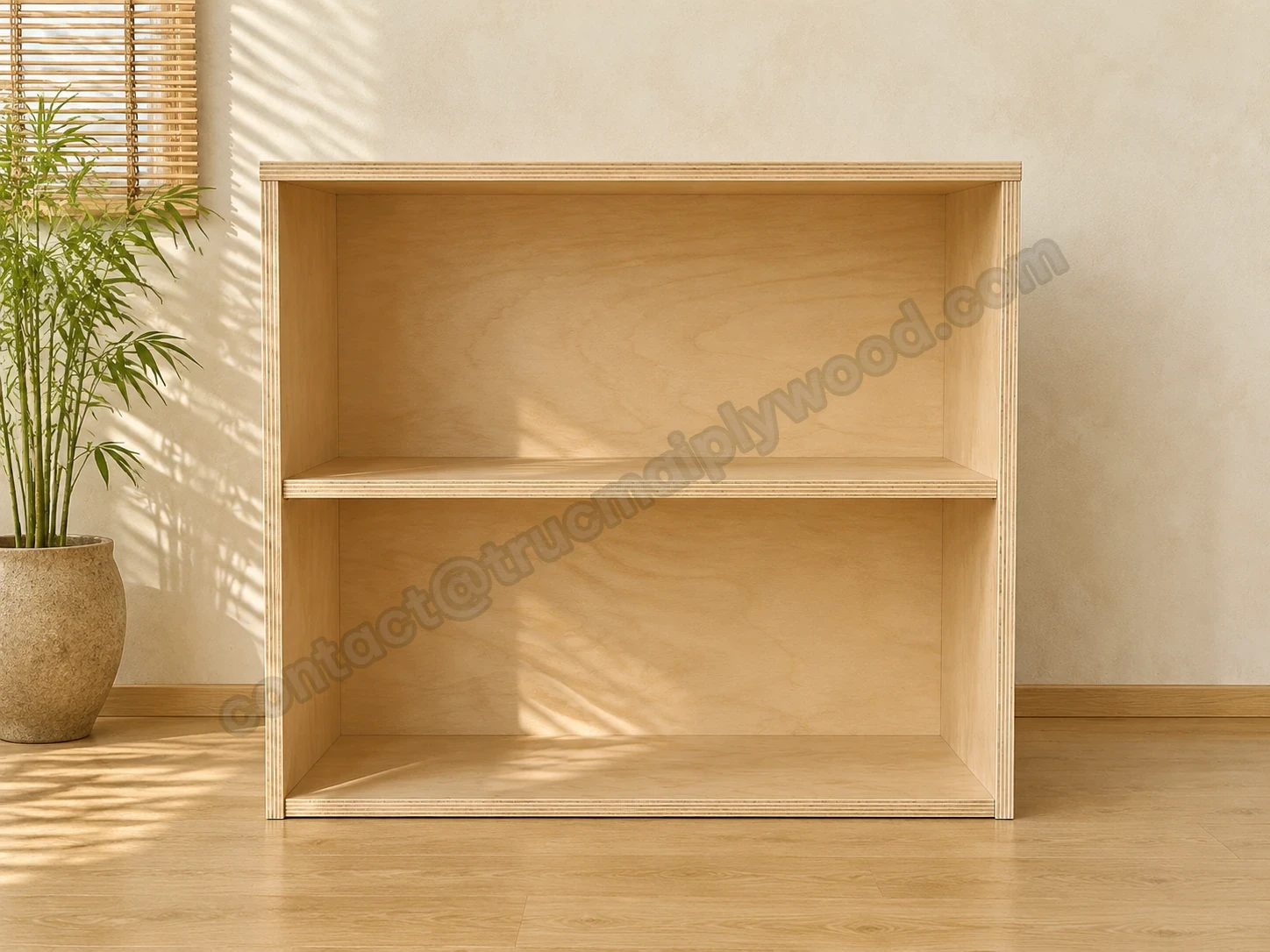
Imported birch face veneer on a Vietnamese core for visible-grain fronts, shelving and display work.
Pinkish-brown okoume face for interior panels and furniture where a warmer tone is wanted.
Bintangor face on the furniture build for stained or clear-coated parts; also run on the commercial build.
Pine face with knots graded on the sample, for rustic furniture, wall panelling and shelving.
Eucalyptus face and core for parts that need a harder surface and higher screw holding.
Drawer bottoms, cabinet backs and bending parts; ply count and veneer notes are on that page.
The shorter furniture sheet that fits cabinet heights with less offcut.
One sheet split into 2, 3, 4 or 6 panels before packing, so parts arrive ready for edge banding.
Laminated veneer lumber with the veneers in one direction, for furniture frames and rails.
LVL blanks for door cores, jambs and mouldings, sized to the profile drawing.
Flat or curved LVL slats cut to length for bed and sofa bases.
Melamine, HPL and white melamine faces pressed on a calibrated substrate.
Real panels
What a furniture panel shows when you open the pack
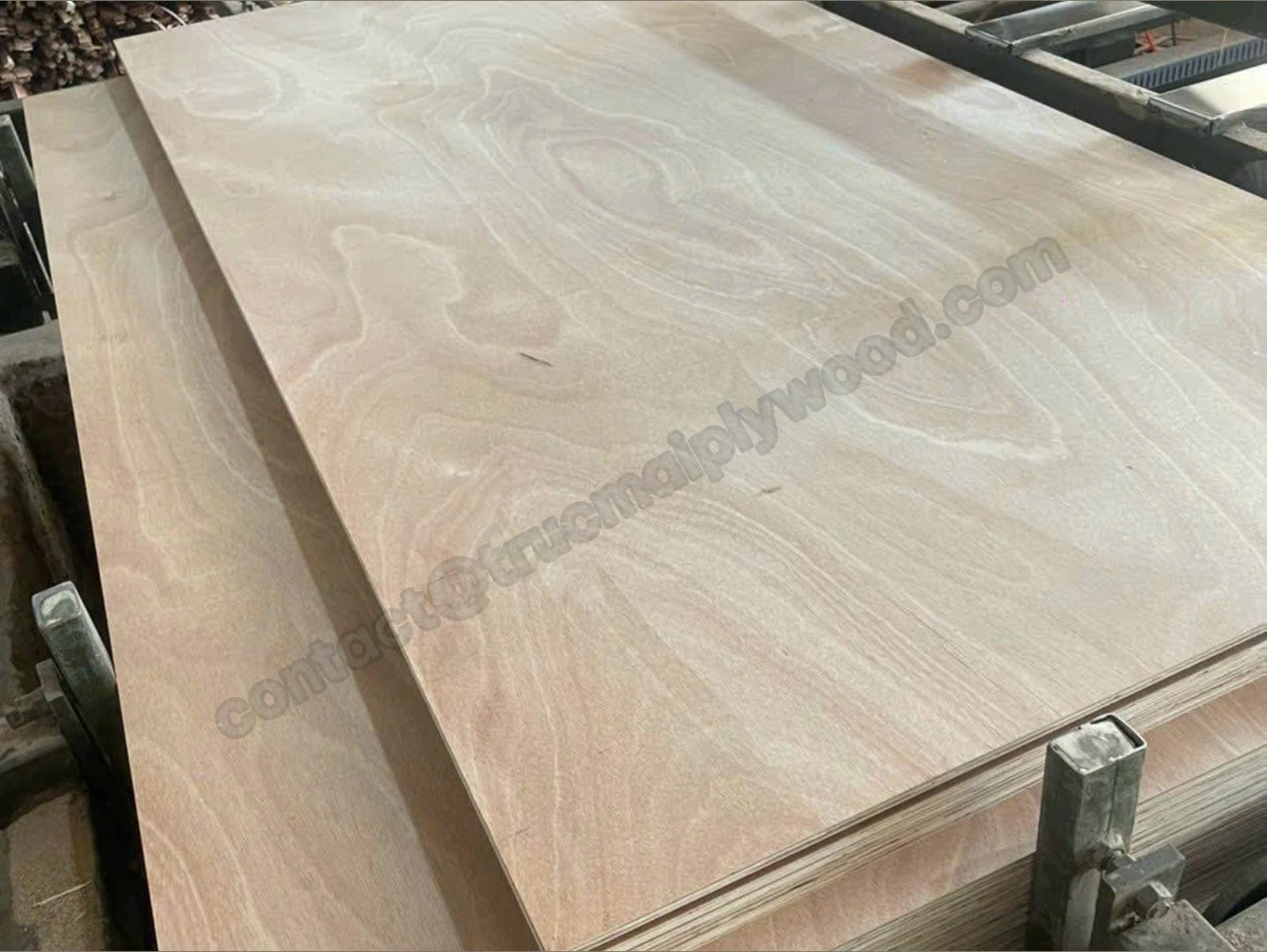
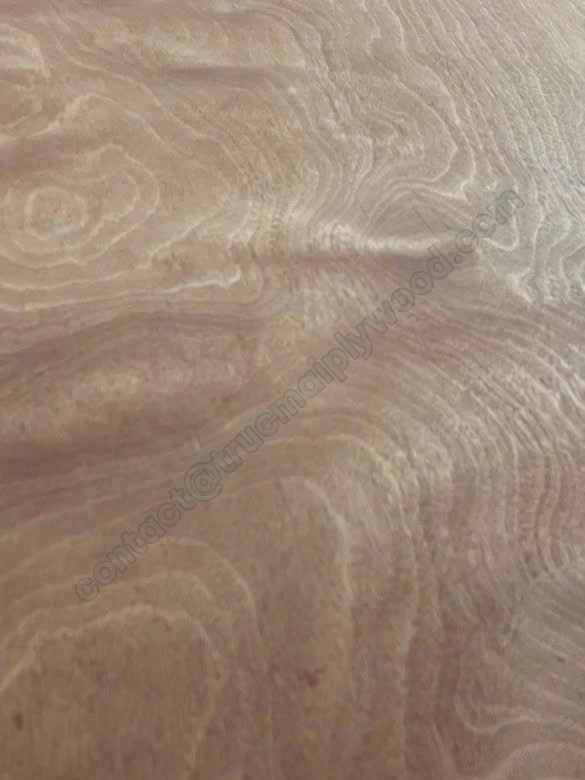
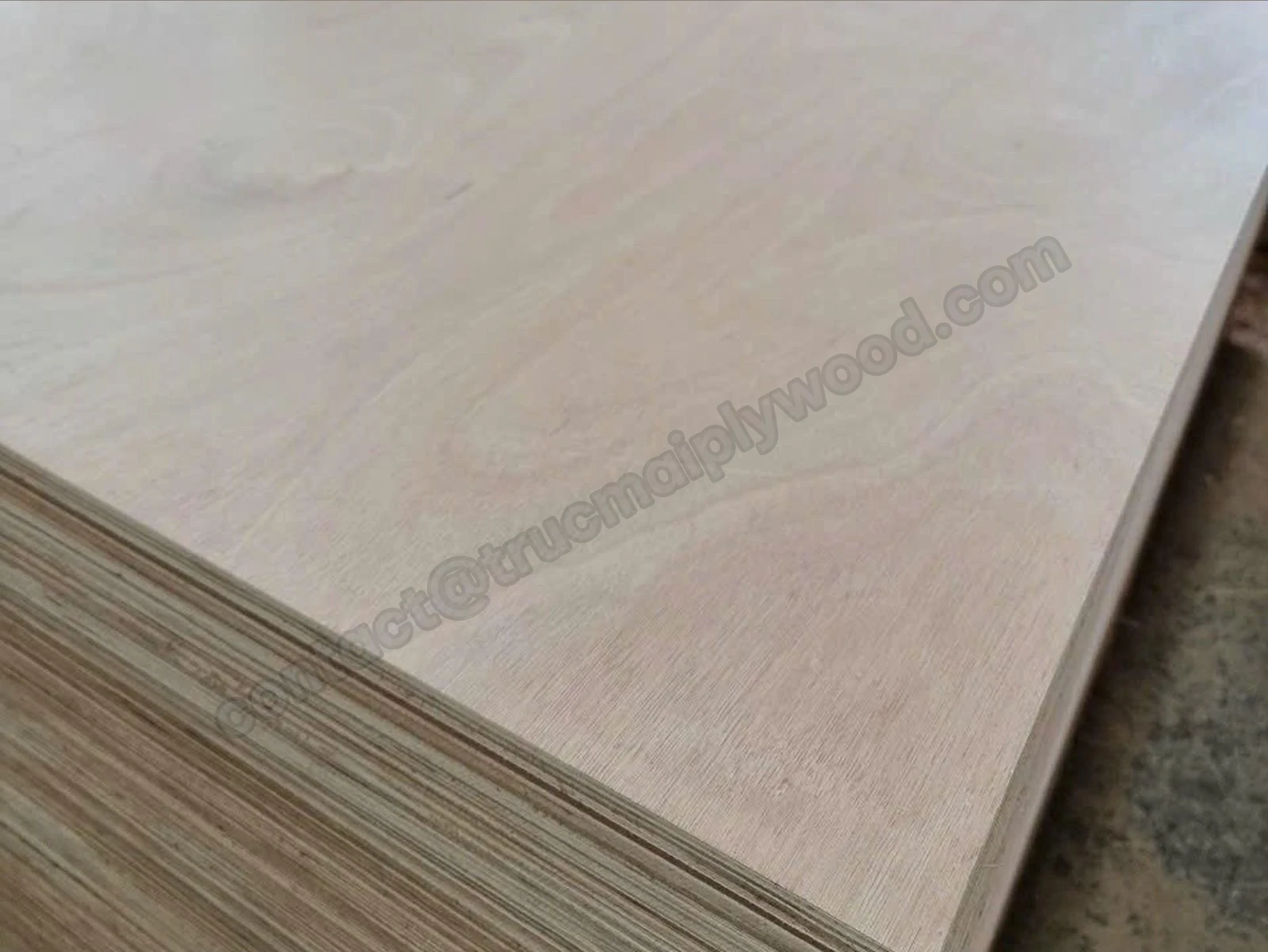
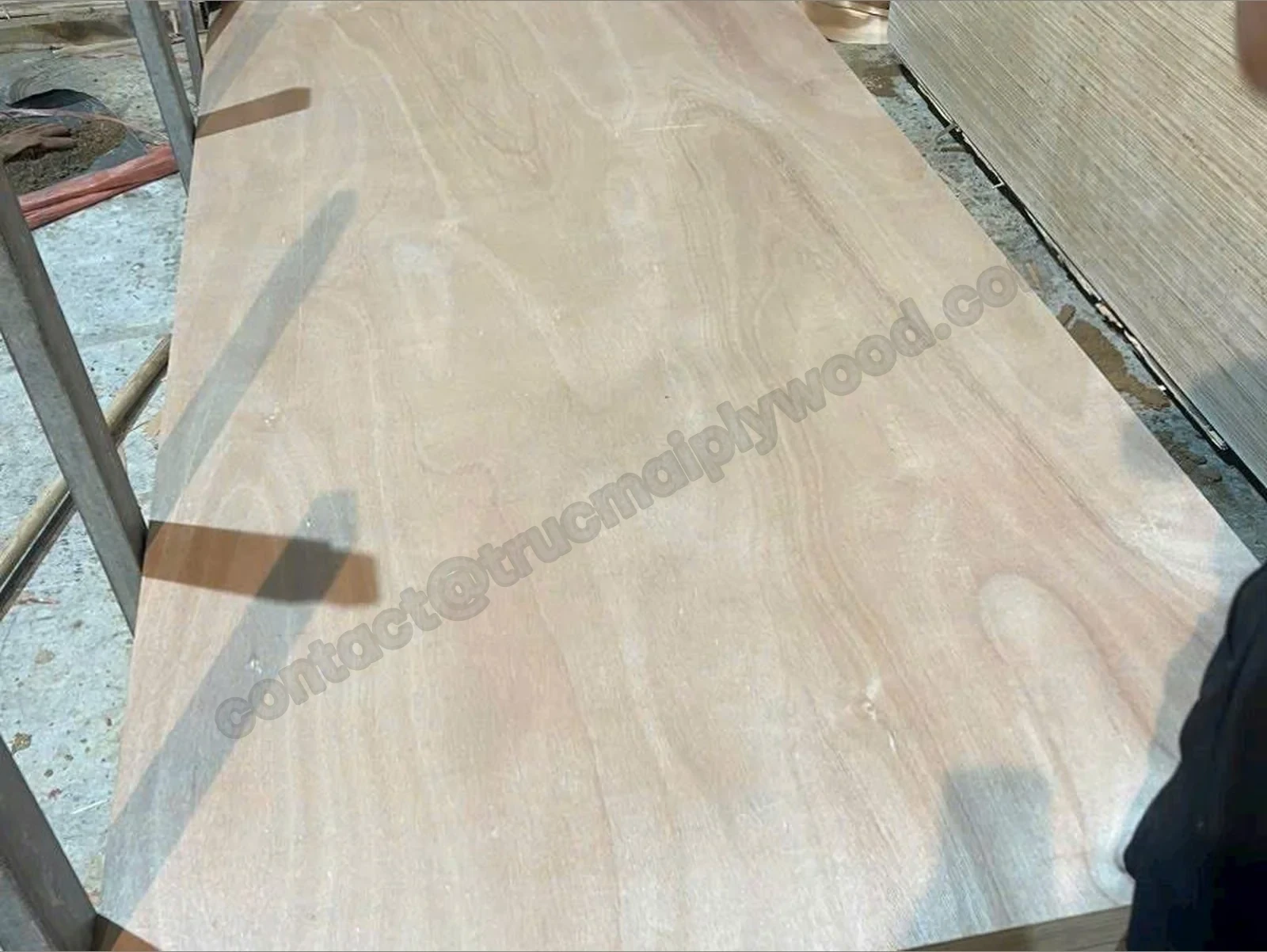
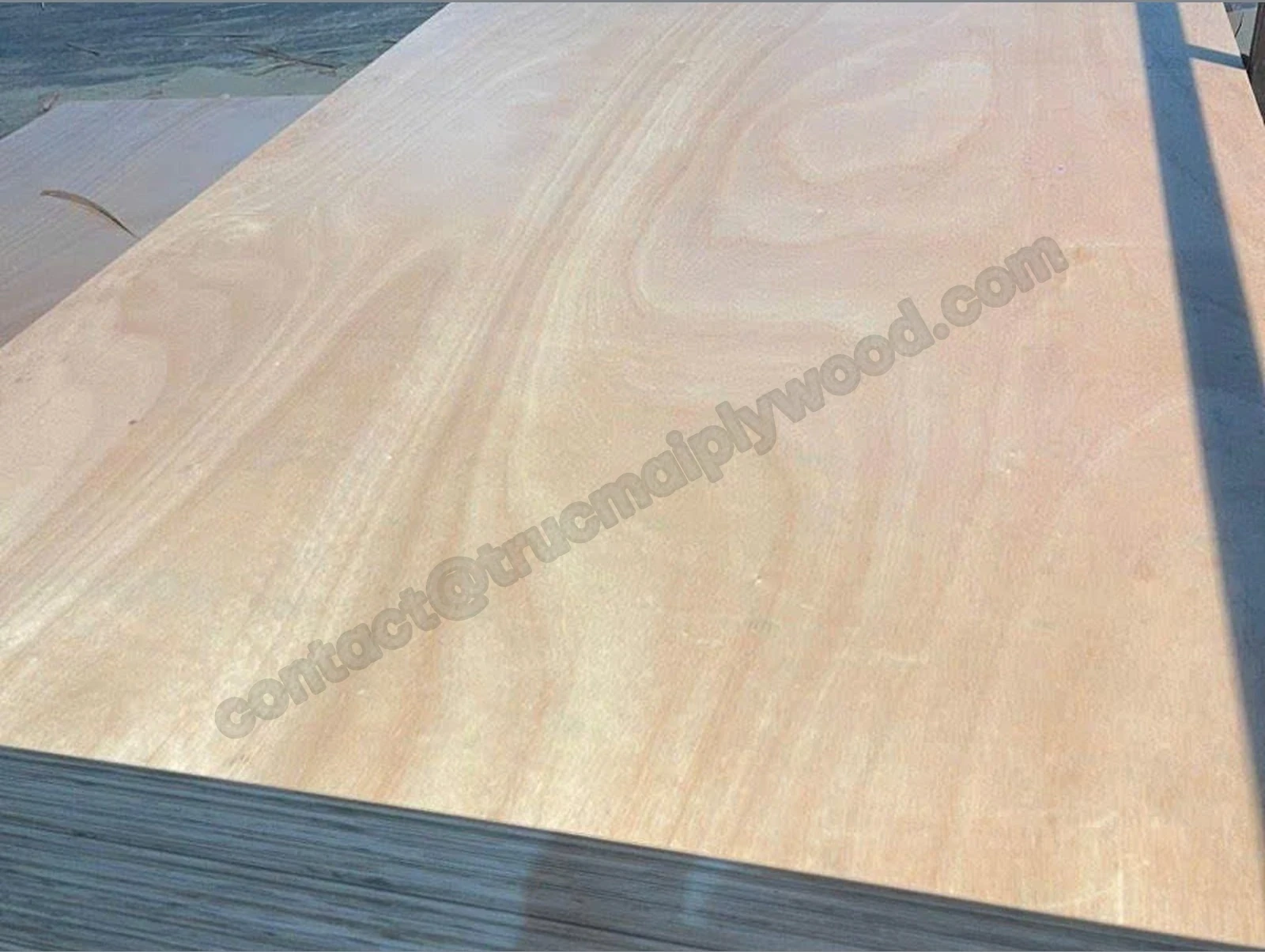
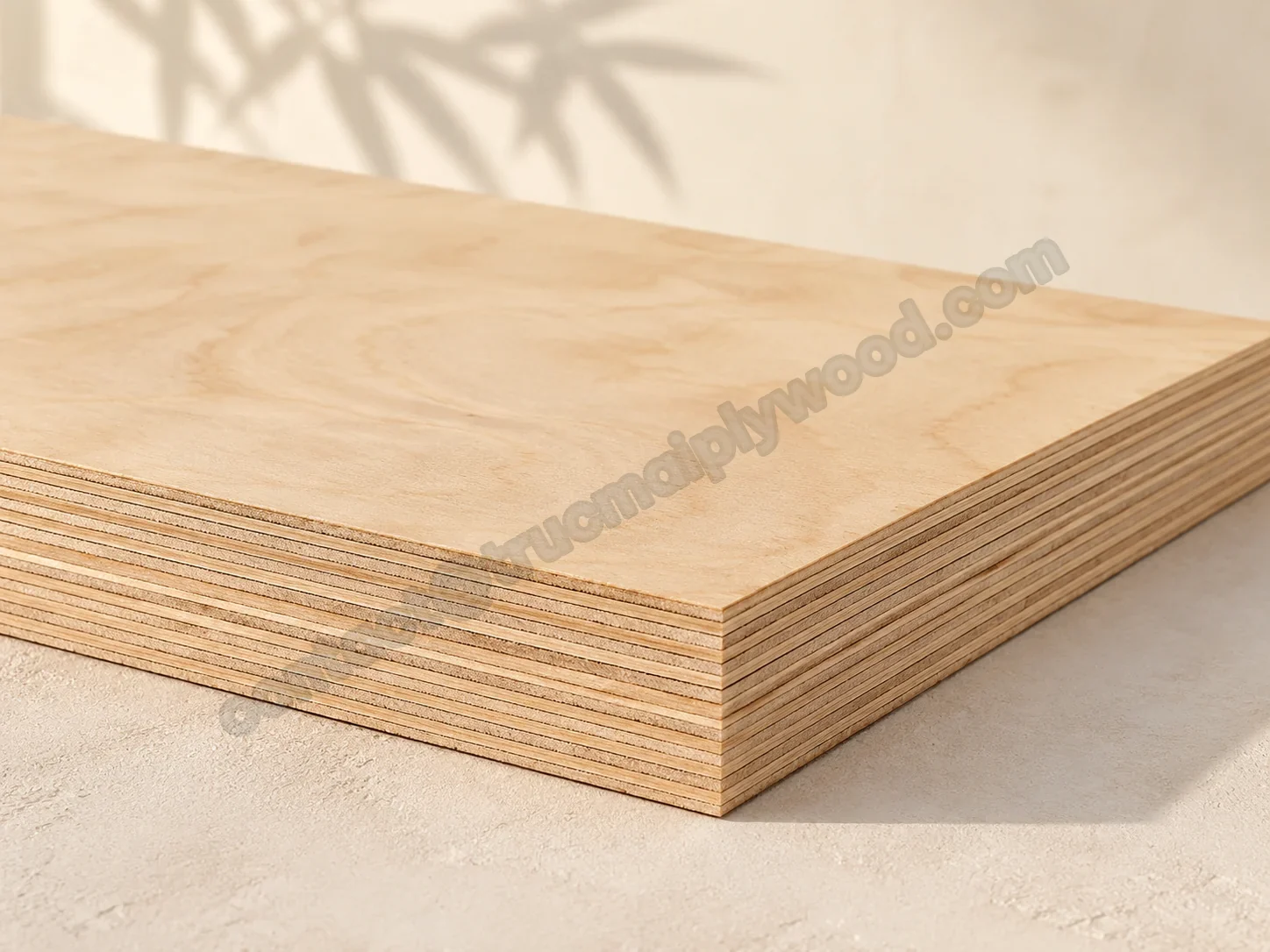
A furniture panel proves its grade in three places: the face under raking light, the edge after a saw cut, and the thickness at the corners and the middle of the sheet.
On the face, the agreed pair decides how many small knots, colour streaks and patches are allowed; anything outside the sample is a defect, not a matter of taste. A sanded face shows no sanding-through to the cross-band, no glue bleed and no open joint in the veneer.
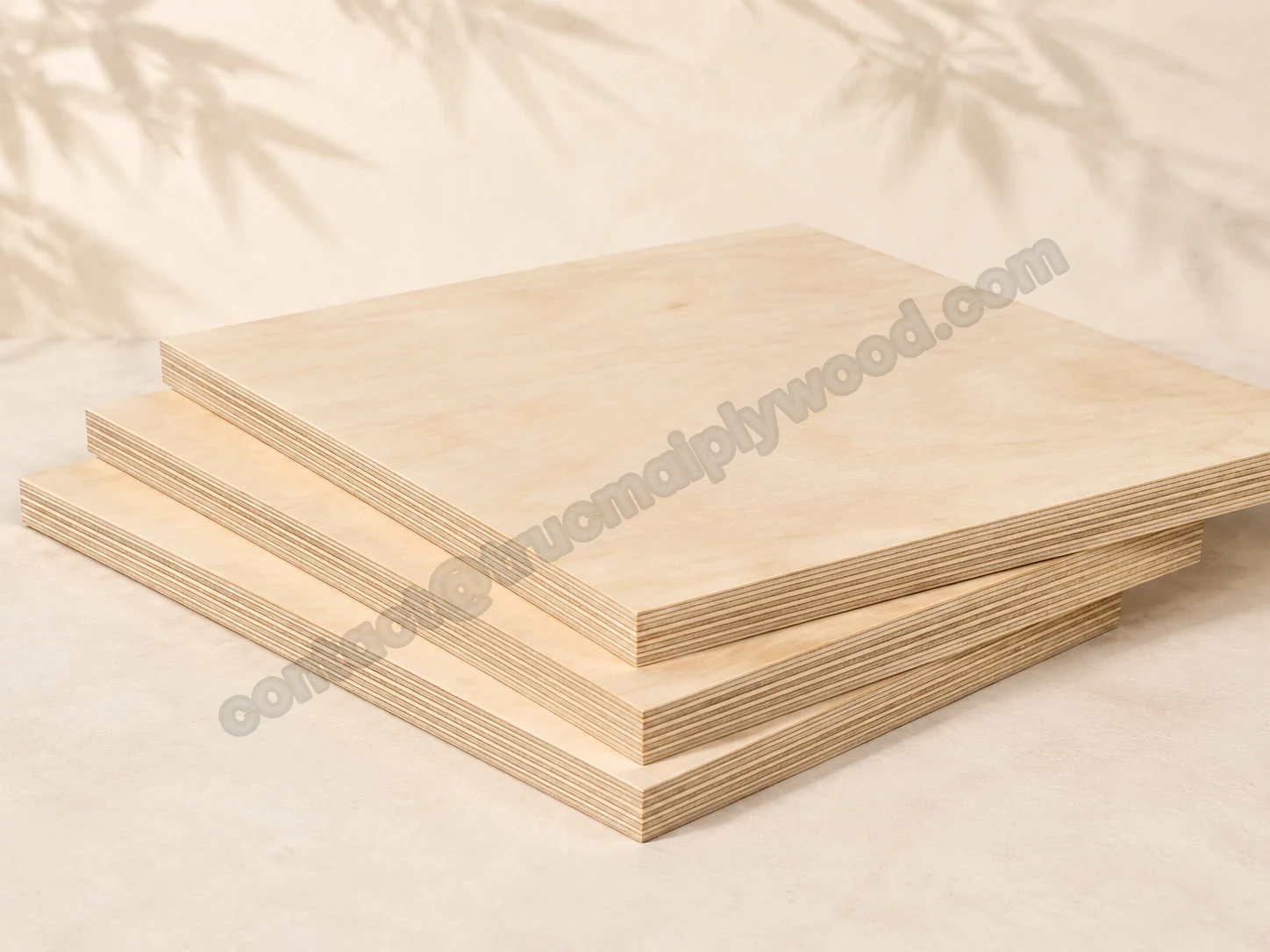
On the edge, a stitched A-grade core shows tight plies with no gaps, overlaps or soft spots, and cross-bands that alternate cleanly. That edge is what the factory sees after every cut, so it is judged on cut pieces as well as on whole sheets.
Thickness is read at several points per sheet against the order line. The photos show okoume faces from calm to strongly figured, with the edges under them: the range an agreed face pair has to pin down.
How to choose
How to choose a furniture plywood build for a monthly container
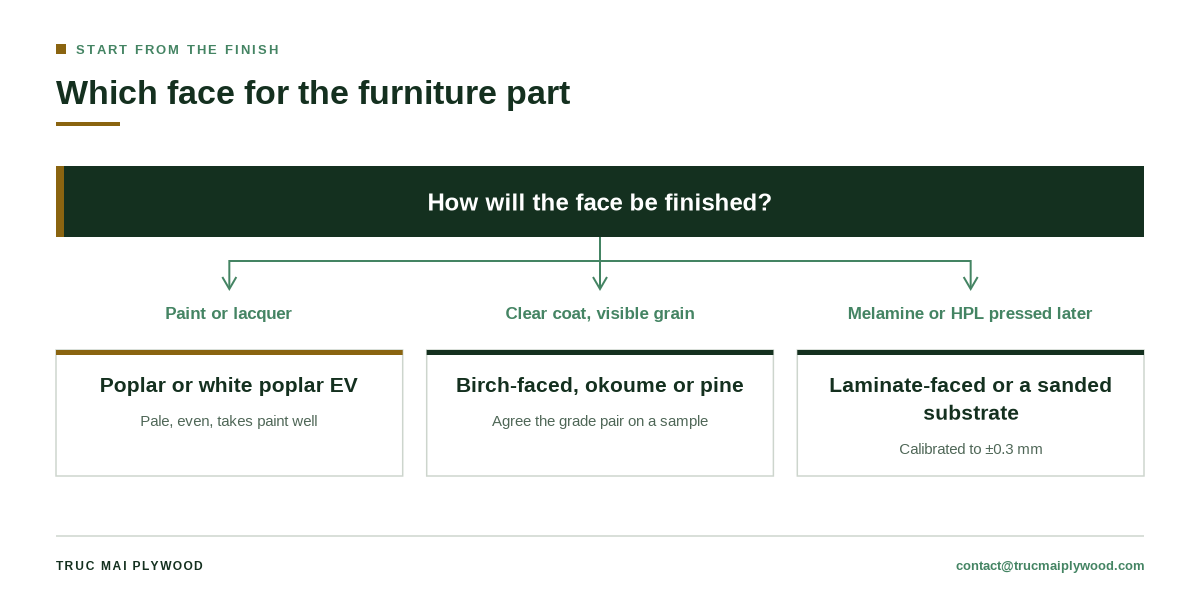
Start from what the factory does to the panel, not from the face name. The finish decides the face, the part decides thickness and format, and the core decides weight, flatness and how much fits in the container.
Under a painted or laminated face, Styrax is usually the right export core: the reference density is 500 kg/m³ against 580 kg/m³ for Acacia, so an 18 mm sheet weighs 26.8 kg instead of 31.1 kg and the face lies flatter. A furniture buyer moving from Acacia to Styrax usually gets a better face, a lighter sheet and more cubic metres per container. Acacia stays the choice where edges take knocks; Eucalyptus suits parts that need density and screw holding.
A typical monthly furniture container carries one or two products, for example 18 mm carcass sheets and 3–6 mm backs on the same core; three to six products can be mixed by agreement. Keeping the same core across the mix keeps the pack plan simple and the weight predictable.
UV-ready means both faces are sanded and prepared for your own UV line; the mill does not apply UV coating, so the order says UV-ready, never UV-coated.
| Job in your factory | Panel to order | Why |
|---|---|---|
| Painted cabinet doors and carcasses | Poplar or white poplar EV face, Styrax core, 18 mm | Pale, even face takes paint; Styrax keeps the sheet light |
| Clear-coated fronts and shelving | Birch-faced or okoume, A-grade stitched core | Visible grain; the pair is fixed on a sample |
| White lacquered kitchens | Bleached poplar on Styrax or Acacia | Even white tone under light lacquer |
| Tall cabinet sides | 1220 × 2280 mm sheets | Less offcut on cabinet heights |
| Bed bases and frames | LVL slats or LVL frame stock | Long, straight, non-structural parts |
| Parts the factory laminates itself | Sanded substrate calibrated to ±0.3 mm | A flat face so melamine or HPL does not telegraph |
Repeat orders
What stays the same on the reorder, and what goes wrong
On a monthly programme the second container matters more than the first. Seven lines are copied unchanged from load to load: face species, grade pair, core species, thickness, tolerance, glue and emission class, and the pack size.
Thickness is written per order within ±0.3–0.5 mm, and the furniture line holds the tight end, ±0.3 mm on sanded and calibrated faces. The reference sample sits with both sides; repeat-spec control describes how that reference is kept, and the face grading line shows where the pair is sorted.
When is another product the better buy? If parts are hidden or covered on site, commercial plywood costs less per container. If every face must look the same across a year of loads, EV beats a natural veneer. If the factory presses its own melamine, buy the sanded substrate rather than a finished laminate face.
| What drifts | What the factory sees | How it is caught |
|---|---|---|
| Face colour between veneer lots | Doors in one kitchen that do not match | Each lot graded against the kept sample; EV where colour must not move |
| Core species swapped to save weight or cost | Heavier sheets, different screw holding | Core species is an order line and checked at the edge |
| Thickness creeping to the loose end | Hinges and drawer runners set off | Readings against ±0.3 mm before packing |
| Back grade slipping | Visible backs on open shelving | Back grade is half of the pair, not an afterthought |
| Pack size changed | Unloading and storage plans broken | Pack size written on the order |
Specs
Furniture plywood 18mm and the full furniture spec sheet
These are the defaults on a furniture and interior order. Anything else, such as all plies stitched or another emission class, is a line you add.
- Faces Poplar, bleached poplar, white poplar EV, birch-faced, okoume, bintangor, pine, eucalyptus, gurjan; Sapele and others on request
- Cores Styrax, Acacia, Eucalyptus or Pine, or combined species laid together; no rubberwood core
- Core grade and joining A-grade core, stitched across and along the sheet; outer 2–4 plies stitched by default, all plies on request
- Thickness 3, 4, 5, 6, 9, 12, 15, 18, 21, 25, 30 and 40 mm
- Thickness tolerance ±0.3 mm on sanded and calibrated panels; length and width ±2 mm
- Plies at 18 mm Usually 11–13 plies, most often 11
- Veneer Face 0.2–0.5 mm, usually 0.3 mm for Europe; core veneer 1.4–2.0 mm
- Sheet sizes 1220 × 2440 mm, 1220 × 2280 mm, 1250 × 2500 mm; custom sizes up to 1250 × 2500 mm
- Surface Sanded and calibrated both sides; polished or UV-ready on request
- Glue and emission UF glue at E0 emission by default; emission class is its own order line
Comparison
Furniture grade plywood compared with commercial and packing builds
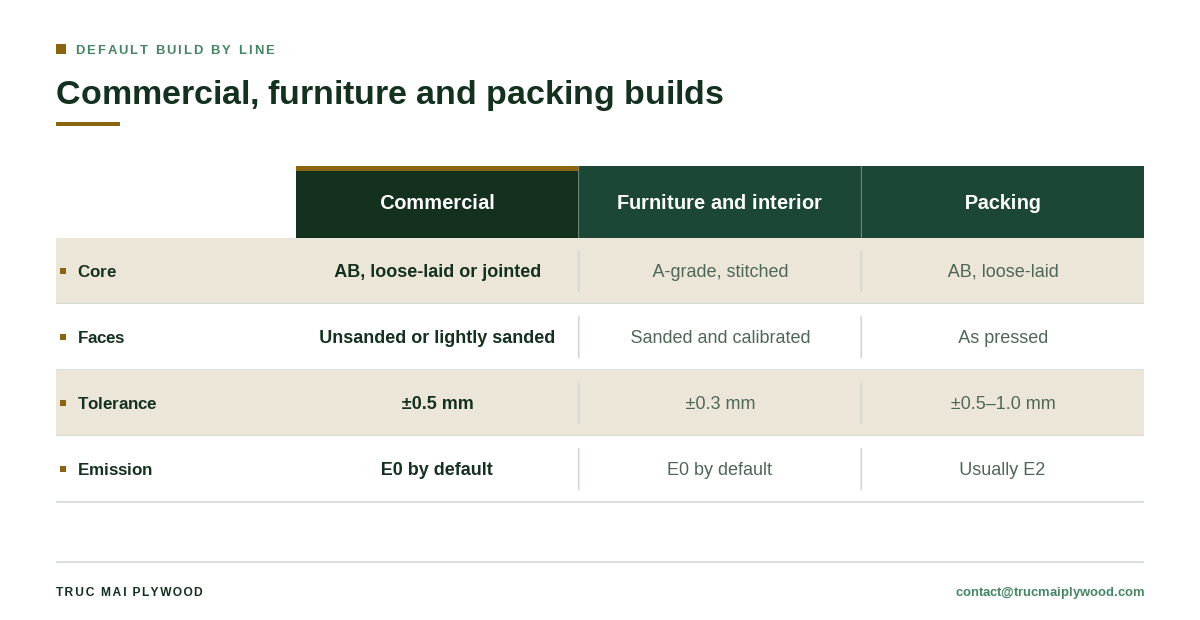
Two offers called furniture plywood are often different panels. The difference sits in core grade, joining, face preparation, glue and tolerance, so compare those five lines and not the product name.
Unsanded commercial panels are cheaper per sheet, but a furniture factory then pays for sanding, rejects and offcuts. Furniture panels cost more per sheet because the core is graded and stitched and both faces are calibrated, which keeps edges clean and lets a CNC run without re-measuring each sheet.
| Line | Furniture and interior | Commercial | Packing |
|---|---|---|---|
| Core | A-grade, stitched | AB, loose-laid or jointed | AB, loose-laid |
| Faces | Sanded and calibrated | Unsanded or lightly sanded | As pressed |
| Thickness tolerance | ±0.3 mm | ±0.5 mm | ±0.5–1.0 mm |
| Usual emission | E0 | E0 | E2 |
| Bought for | Clean edge, flat face | Cost per container | Lowest cost per m³ |
Applications
Where furniture and interior plywood goes
Most of this line ends up as cabinet carcasses, doors, shelving and flat-pack parts; the rest as interior panelling, shopfitting and bed and sofa frames.
Truc Mai does not make film-faced, formwork, structural or marine plywood.
- Kitchen and bathroom cabinets
Carcasses in 15 or 18 mm on Styrax or Acacia, doors on poplar or EV for paint, backs in thin panels.
- Wardrobes and bedroom furniture
Sides on 1220 × 2280 mm sheets, shelves in 18 mm, drawer bottoms in thin panels.
- Flat-pack parts
Panels cut at the mill into 2, 3, 4 or 6 pieces, ready for edge banding and drilling.
- Shopfitting and display
Birch-faced or okoume faces for visible fronts; laminate-faced panels for counters.
- Interior wall and ceiling panelling
Pine, okoume or EV faces, sanded for stain or clear coat.
- Bed bases and upholstered frames
LVL slats and frame stock, non-structural, cut to length.
Core and glue
Which core is best for furniture grade plywood ordered for export
Styrax for painted and laminated furniture, Acacia where edges need to be harder, Eucalyptus for density. The glue line under every furniture face defaults to UF at E0 emission.
Glue type and emission class are two separate lines on the order: the default is UF glue at E0 emission, and a melamine-fortified glue for damp rooms usually gives E1. The furniture line runs 3–40 mm, while the CARB P2 and TSCA Title VI scope covers 3–25 mm and 3–15 plies, so 30 and 40 mm furniture panels are sold without that claim. Limits and test methods are on emission class per order and the EPA formaldehyde standards for composite wood.
Quality control
What thickness tolerance is written for sanded furniture panels
±0.3 mm on sanded and calibrated furniture panels, ±2 mm on length and width. What the furniture line checks differently from commercial is below.
How the reference sample and check records are kept is on repeat-spec control.
- Core laid A-grade and stitched
Gaps and overlaps are taken out before pressing, so cut edges stay closed.
- Both faces calibrated
Thickness read at several points per sheet against ±0.3 mm.
- Face and back sorted as a pair
Against the kept sample, including colour band on natural veneers.
- Cut pieces checked
On cut-to-size orders the edge is judged on the pieces, not only the sheet.
Certificates
Certificates for furniture grade plywood
FSC, CARB P2, ISO 9001 and ISO 14001, plus EU file sets.
- FSC 100% FSC-C196493 · SA-COC-014545
- CARB P2 and TSCA Title VI CARB/EPA 26053 · TPC-43
- ISO 9001:2015 W2012 · WCERT
- ISO 14001:2015 W2012E · WCERT
Packing
How many m³ of 18 mm furniture plywood fit in a 40HC
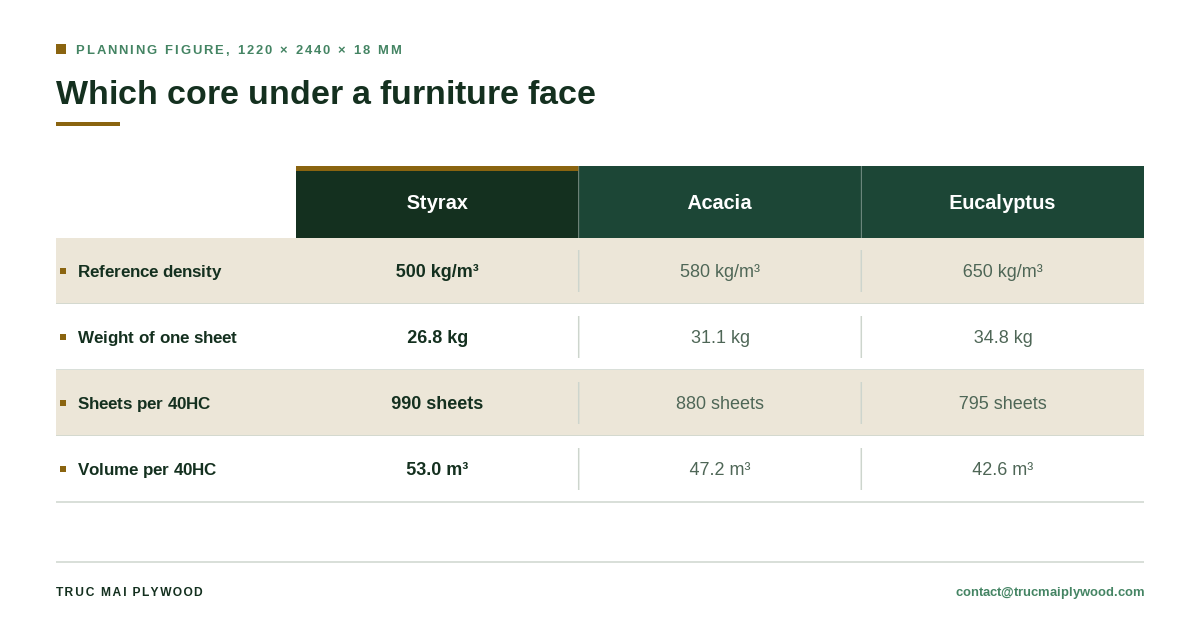
About 53 m³ on a Styrax core, about 47 m³ on Acacia and 42.6 m³ on Eucalyptus, at 1220 × 2440 × 18 mm as planning figures.
Sheet counts and weights are planning figures, not a loading record.
Styrax furniture loads fill by volume; Eucalyptus loads stop on weight first. A mixed furniture container of 18 mm carcass sheets and thin backs is planned pack by pack. Every thickness and format is in the 40HC load calculator, and the pack plan is on loading a 40HC.
| Core | Sheet weight | Sheets per 40HC | Volume per 40HC |
|---|---|---|---|
| Styrax | 26.8 kg | 990 sheets | 53.0 m³ |
| Acacia | 31.1 kg | 880 sheets | 47.2 m³ |
| Eucalyptus | 34.8 kg | 795 sheets | 42.6 m³ |
Terms
Order terms for a furniture plywood container
Full containers direct from the mill; these terms apply unless the contract says otherwise.
Full terms are on MOQ, payment and FOB. On a monthly furniture programme the reorder is quoted against the same written specification and sample as the first container.
- Minimum order One 40HC
- Production time 15–45 days after the 30% deposit, by quantity and agreement
- Payment 30% deposit; 70% against the scanned B/L by T/T, or irrevocable L/C at sight
- Delivery terms FOB Hai Phong, CFR or CIF
- Documents Invoice, packing list, B/L, certificate of origin, phytosanitary, fumigation, order certificates
- Price Quoted per order against the written specification
FAQ
Furniture grade plywood: buyer questions
What is considered furniture grade plywood?
At Truc Mai it is a written build, not a label: an A-grade core stitched across and along the sheet, faces sanded and calibrated, UF glue at E0 emission and a face and back pair fixed on a sample. Thickness is written per order within ±0.3–0.5 mm, and the furniture line holds ±0.3 mm.
Which core is best for furniture grade plywood ordered for export?
Usually Styrax for painted or laminated furniture: 500 kg/m³ reference density, a 26.8 kg sheet at 18 mm and about 53 m³ per 40HC as a planning figure, against about 47 m³ for Acacia. At the Ha Hoa mill's output of about 5,000 m³ a month, the same core species can be held across a monthly programme.
What thickness tolerance is written for sanded furniture panels?
±0.3 mm on sanded and calibrated furniture panels, with ±2 mm on length and width. Commercial panels are written at ±0.5 mm and packing panels at ±0.5–1.0 mm.
How are face and back grades specified on the order?
As a pair, face grade and back grade, fixed on a physical sample that both sides keep. Each sheet is sorted against that sample, so a repeat container is graded to the same reference instead of a written description.
What does UV-ready mean on a furniture panel?
Both faces are sanded and prepared so your own line can apply UV coating. The mill does not apply UV, so the order says UV-ready, not UV-coated.
How many m³ of 18 mm furniture plywood fit in a 40HC?
As a planning figure at 1220 × 2440 mm: about 53 m³ (990 sheets) on Styrax, about 47 m³ (880 sheets) on Acacia and 42.6 m³ (795 sheets) on Eucalyptus. Real sheets are weighed before final loading.
How many plies does 18 mm furniture plywood have?
Usually 11–13 plies, most often 11, with face veneers of 0.2–0.5 mm and core veneers of 1.4–2.0 mm.
Why does a face colour change between two containers, and how is it stopped?
Natural veneers vary from lot to lot. Each lot is sorted against the kept sample, and where colour must not move at all, white poplar EV is the safer face because it is a reconstituted veneer with a repeatable look.
Which sheet size wastes least on cabinet sides?
For many cabinet heights the 1220 × 2280 mm sheet leaves less offcut than 1220 × 2440 mm. The 1250 × 2500 mm European format is the largest sheet made; bigger parts are cut from standard sheets.
Can carcass sheets and thin backs travel in one 40HC?
Yes. One or two products per container is usual and three to six can be mixed by agreement. Keeping one core species across the mix keeps the pack plan and the weight predictable.
Quotation
Ask for a furniture plywood quotation
Write the application, core, glue and emission class, face and grade pair, sheet size, thickness and tolerance, and the quantity per container. A quotation and certificate files come back by email; samples can follow.