
Non-structural LVL · Ha Hoa, Phu Tho, Vietnam
LVL manufacturer in Vietnam: non-structural LVL pressed on the plywood veneer lines
Truc Mai is a plywood mill that presses non-structural LVL on the same veneer lines as its plywood. This page is for furniture, door and packing factories that want LVL parts on a container with their panels: which veneer and glue go in, what the stock is used for, how it is cut and bundled, and what is written so the next load matches the first.
LVL, laminated veneer lumber, is veneer glued with the grain of every layer running the same way, so it behaves like a long straight piece of timber instead of a flat stable sheet. Truc Mai lays it up from Eucalyptus, Acacia, Styrax or Pine veneer, the same species that go into its plywood cores, and presses it with UF glue at E0 emission.
The mill makes it for four uses: furniture parts, door and frame stock, bed slats and packing. The LVL door and frame stock page and the LVL slats for beds page go into those two in detail. No LVL export history is claimed: LVL is made on request, and the first container starts from your drawing and an approved sample piece.
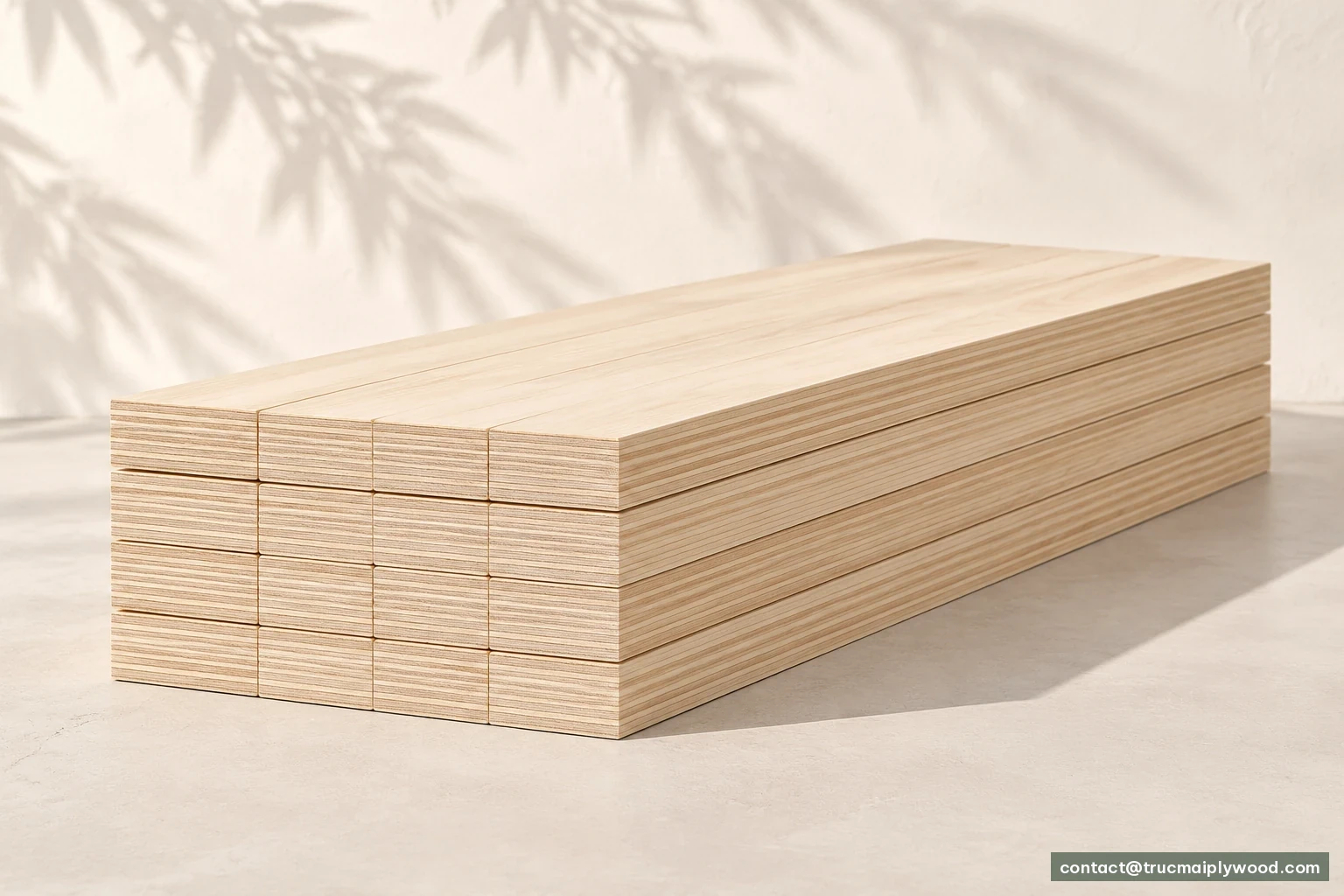
- Parallel veneer, grain along the lengthBuild
- Eucalyptus, Acacia, Styrax or PineVeneer
- UF glue at E0 emissionGlue
- Non-structural onlyUse
- About 5,000 m³ in an average monthMill output
From the plywood line
Why buy from an LVL manufacturer in Vietnam that also presses plywood?
Because the veneer, glue, drying and pressing are the ones the plywood already uses, and the LVL can ride in the same container as the panels. A furniture or door factory that buys both gets one supplier, one file set and one set of written lines.
A plywood mill peels logs into veneer, dries and grades it, spreads glue and presses it. LVL uses every one of those steps; only the lay-up changes. Instead of turning every second veneer across the sheet, the layers are all laid lengthwise, and the pressed billet is then ripped into strips of the section you need. The how our plywood is made page walks through the shared line.
That shared line is why the species list is the same. Eucalyptus, Acacia and Styrax come from plantation forest close to Ha Hoa, and Pine is added for light packing parts. Core veneer is usually 1.4–2.0 mm thick, and an LVL piece is built from as many of those layers as its thickness needs.
For the buyer it also means the paperwork is the same. The EUDR file set that covers the plywood core covers LVL veneer from the same plots, glue and emission are written the same way, and the LVL travels on the same commercial documents as the panels it is loaded with.
Photographs of LVL pressing, cut sections and bundled slats at the Ha Hoa mill will be added to this block as they are taken. Until then the image above shows what a parallel lay-up looks like at a cut end.
Specification
Which veneer species and glue go into the LVL?
Eucalyptus, Acacia, Styrax or Pine veneer, laid with the grain parallel and pressed with UF glue at E0 emission by default. A melamine-fortified glue line can be written for parts that see damp, as on the plywood.
The species decides the weight and the look of the wide face. Styrax is the lightest and palest; Acacia is golden-brown and harder; Eucalyptus is pink-brown, the hardest and the heaviest; Pine is light and soft and suits packing. Species can be combined, with harder veneers on the outside of a part where screws go in and lighter ones inside.
Glue type and emission class are two separate lines on the order: the default is UF glue at E0 emission, and a melamine-fortified glue for damp rooms usually gives E1. The LVL limits and moisture guide explains what LVL should not be asked to do, including standing in the weather.
Write the face that will be seen. A furniture rail or a door jamb has one or two show faces, and the outer veneers on those faces are selected and sanded; the hidden faces can take a lower veneer, which keeps the price down.
- Veneer species Eucalyptus, Acacia, Styrax or Pine; or combined for weight and face
- Veneer thickness Core veneer, usually 1.4–2.0 mm
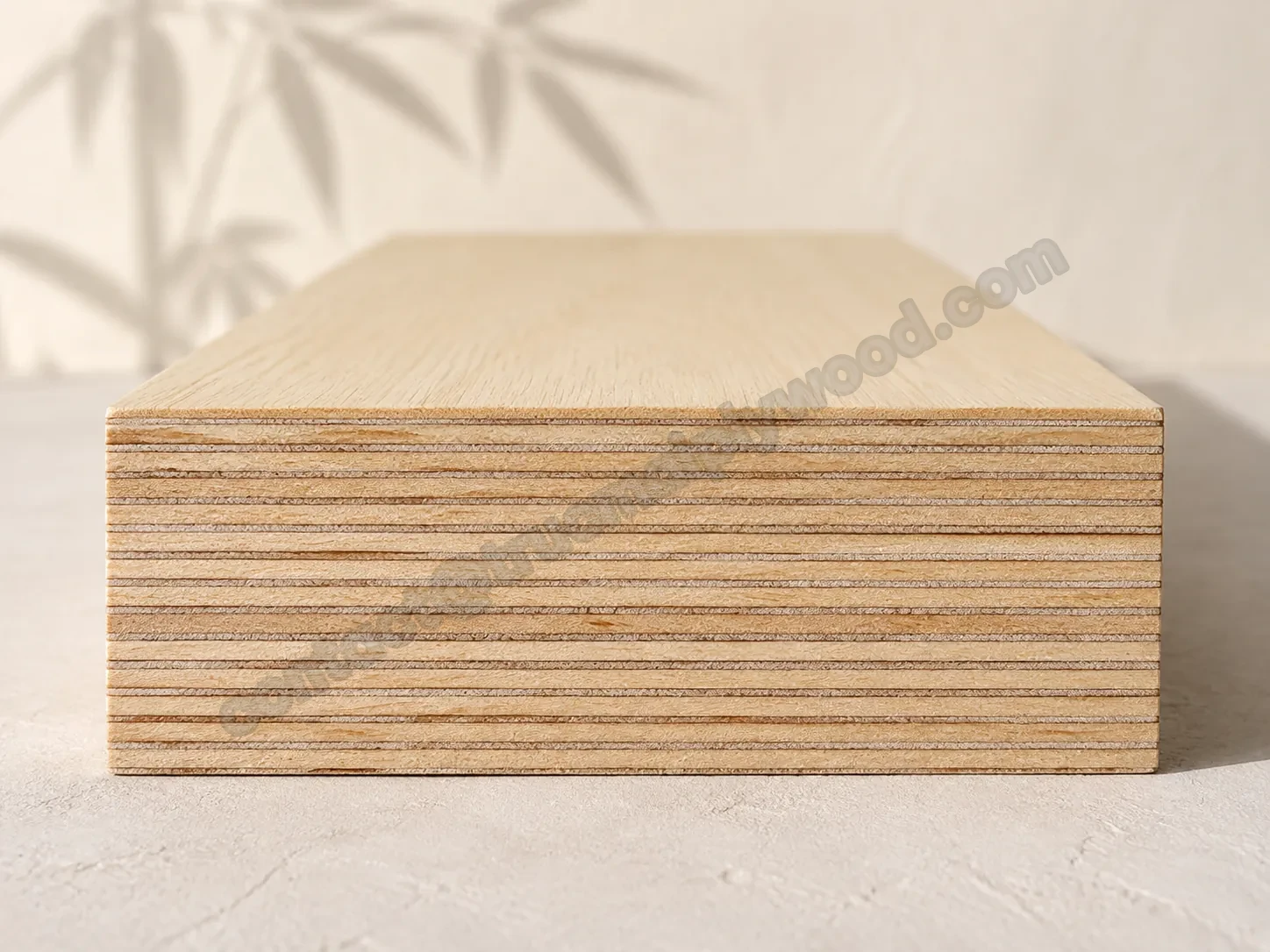
- Lay-up All layers grain-parallel along the length
- Glue UF glue at E0 emission by default
- Damp-area option Melamine-fortified UF, usually E1 emission
- Faces Sanded for furniture and door stock; unsanded for packing
- Tolerance ±0.3–0.5 mm on thickness by line, written per order
- Length and section Per drawing, ripped from pressed billets
- Use Non-structural; no structural rating or stamp
Grades
Which LVL grades does a plywood mill press for furniture, door stock and packing?
Four: a furniture grade with selected, sanded outer veneers and a tight build, a door-stock grade sized for profiling, a slat grade cut straight or curved, and a packing grade with lower veneers and unsanded faces. The grade follows the use, as the plywood is built by line.
The grade is agreed on a sample piece and written on the order in words, as the plywood face grade is. A furniture buyer approves the show face; a packing buyer approves straightness and how the piece takes a nail.
Packing LVL follows the packing plywood line: an AB veneer, loosely laid, usually at E2 emission. It is the cheapest grade and should not be used where it will be seen or where people live with it.
- Furniture grade
Selected outer veneers on the show faces, sanded; layers tight with no open gaps at the edge. Sofa and chair frames, table rails, bed frame members, shelf edges and other parts that are glued, screwed or finished.
- Door-stock grade
Sanded blanks with an even density through the section, sized so a profile clears the outer layers. Door cores and stiles, jambs, stops, frame and moulding blanks; details on the door and frame stock page.
- Slat grade
Straight or gently curved strips, sanded, with clean ripped edges and rounded corners on request. Bed and sofa slats; details on the bed slats page.
- Packing grade
Lower-grade veneers, unsanded, built for straightness and nailing rather than appearance. Pallet runners, crate battens and skids for export packing; usually E2 emission like packing plywood.
Species
Which veneer species suits which LVL part?
Styrax for light rails and long slats, Acacia for frame parts that take screws, Eucalyptus for hard-wearing parts and door stock that is heavily machined, and Pine for light packing. The species is a written line and is kept on every reorder.
The densities are the reference figures the mill uses for planning plywood loads; LVL of the same species sits in the same range. Eucalyptus is measured at 650–750 kg/m³, so a Eucalyptus LVL part is the heaviest choice for its size.
Choosing between Acacia and Eucalyptus works the same way as for plywood cores; the Acacia against Eucalyptus cores guide sets out the trade-off. For LVL the extra question is machining: door stock that is routed into deep profiles favours an even, hard species.
| Veneer | Reference density | Look | Strength in use | Choose it for |
|---|---|---|---|---|
| Styrax | 500 kg/m³ | Pale cream | Light; moderate screw holding | Long rails, slats, light furniture frames |
| Acacia | 580 kg/m³ | Golden brown | Harder; good screw holding | Sofa and chair frames, bed frame members |
| Eucalyptus | 650 kg/m³ | Pink-brown | Hardest; best screw holding | Door stock, heavily machined parts |
| Pine | Per order | Pale yellow | Light and soft; nails well | Packing runners and crate battens |
| Combined | Per order | Hard faces, light centre | Balanced | Parts with fixings at the faces |
Glue and emission
Which glue and emission line does LVL carry?
UF glue at E0 emission by default; melamine-fortified UF for parts in damp places, usually E1; packing LVL usually E2. LVL is not hardwood plywood, so it is outside the CARB P2 and TSCA plywood certificate.
Glue type and emission class are two separate lines on the order: the default is UF glue at E0 emission, and a melamine-fortified glue for damp rooms usually gives E1. UF glue holds about six hours in a boil test; melamine-fortified glue holds twelve.
Emission class per order explains how the class is written. US buyers of LVL parts should confirm at enquiry which formaldehyde rule applies to their part, because the mill's CARB/EPA 26053 certificate covers hardwood plywood with veneer core, not LVL.
| Glue line | Emission | Boil resistance | LVL use |
|---|---|---|---|
| UF | E0 | About six hours | Furniture, door stock and slats for dry rooms |
| Melamine-fortified UF | Usually E1 | Twelve hours | Parts in kitchens, bathrooms and damp storage |
| Packing line | Usually E2 | Per order | Pallet runners and crate battens |
Cutting
Can LVL be cut to length for pallets and crates?
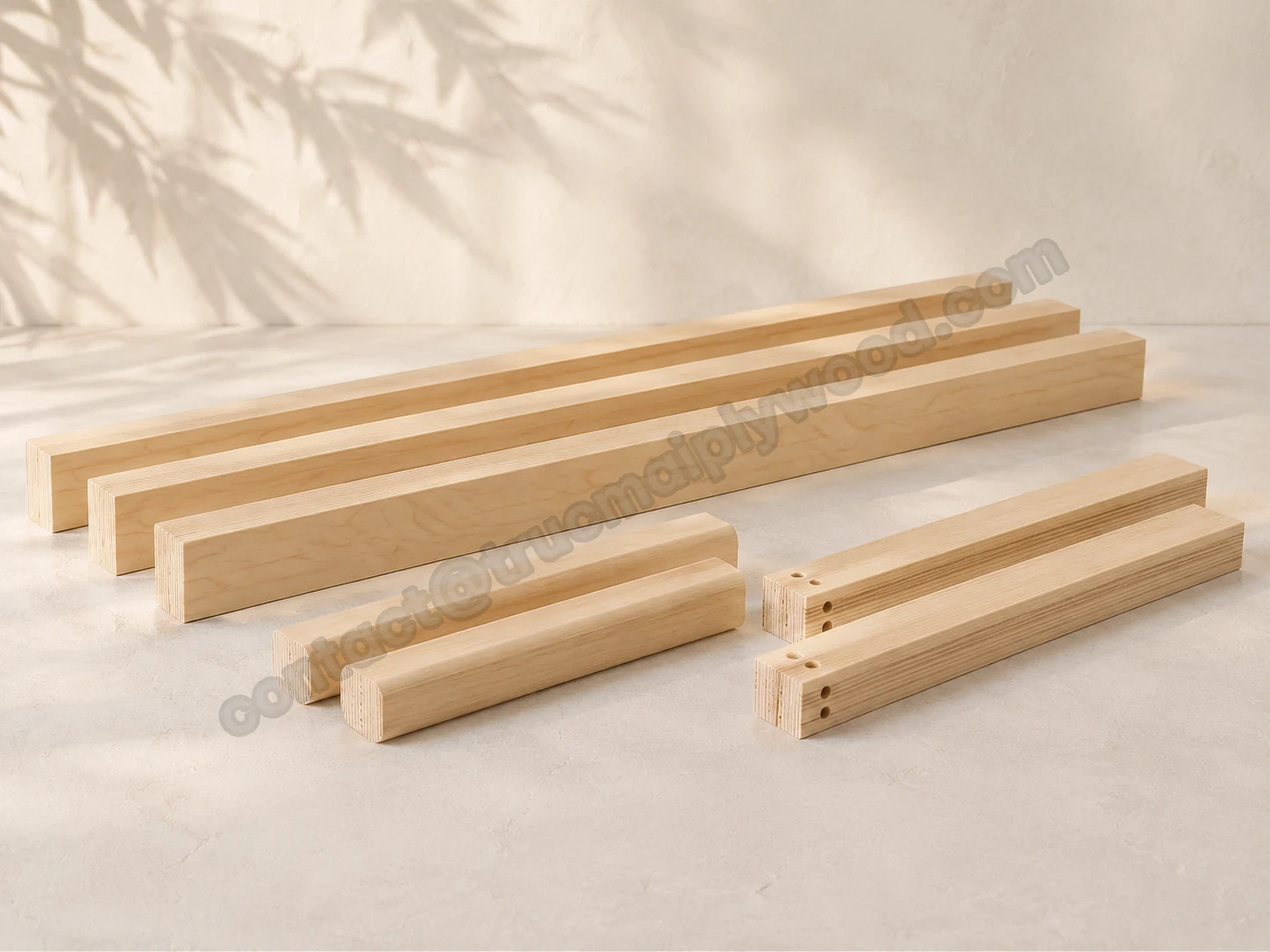
Yes. Packing LVL is ripped and cut to the runner, batten or skid length on your drawing and bundled by size, so it arrives ready for the pallet line. Furniture and door stock is cut the same way, to the finished length and section of each part.
LVL comes off the plywood presses as billets and is ripped into strips, so the press sets the longest piece. State the length you need on the drawing and the quotation confirms it; parts longer than the press are finger-jointed by the buyer or redesigned in two pieces.
Packing LVL is often ordered with packing-grade panels in one container, so a crate maker receives the battens and the sheathing together. Plywood and LVL are processed wood products, so they are outside ISPM 15; solid-wood dunnage loaded with them is not.
- Furniture parts Cut to finished length and section; drilled or rounded on request
- Door and frame stock Blanks sized to the profile drawing
- Bed slats Flat or curved, cut to length and width
- Packing Runners, battens and skids cut to length, bundled by size
| Part | What the drawing gives | How it is bundled |
|---|---|---|
| Pallet runner | Length, width, thickness, nail pattern if any | Strapped bundles of one size |
| Crate batten | Length and section | Strapped bundles of one size |
| Furniture rail | Length, section, show face, holes or radius | Bundles per part number |
| Door stile or jamb blank | Profile, finished section, length | Bundles per profile |
Uses
What can LVL from a plywood mill be used for?
Furniture parts, door and frame stock, bed slats and packing: places where a long, straight, stable piece of wood is needed and nothing structural rests on it. Truc Mai LVL is not sold for building beams or frames.
Truc Mai LVL is non-structural. Truc Mai does not make film-faced, formwork, structural or marine plywood.
Furniture factories often buy LVL with plywood in the same container: plywood for headboards, bases and carcasses, LVL for the slats and frame members, solid wood only for visible legs. Door factories pair thin plywood skins with LVL stiles and frame stock.
- Furniture frames and rails
Sofa and chair frames, table rails, bed frame members and drawer runners that must stay straight and hold screws.
- Door and frame stock
Door cores and stiles, jambs, stops and moulding blanks that are profiled and finished at the door factory.
- Bed and sofa slats
Flat or gently curved slats cut to length, for sprung bed bases and sofa seats.
- Packing
Pallet runners, crate battens and skids that must be straight, nail cleanly and carry the load of the pack.
- LVL frame stock, not LVL timber frame construction
LVL frame stock here means furniture and door frames. Timber-frame building, beams and joists need a structurally rated LVL, which Truc Mai does not make.
Compare
LVL, plywood or sawn wood for a long part?
Use LVL for long, narrow parts that must stay straight along their length; plywood for wide, flat parts that must be stable in two directions; sawn wood where its look is the point. Finger-jointed timber sits between LVL and sawn wood on price and straightness.
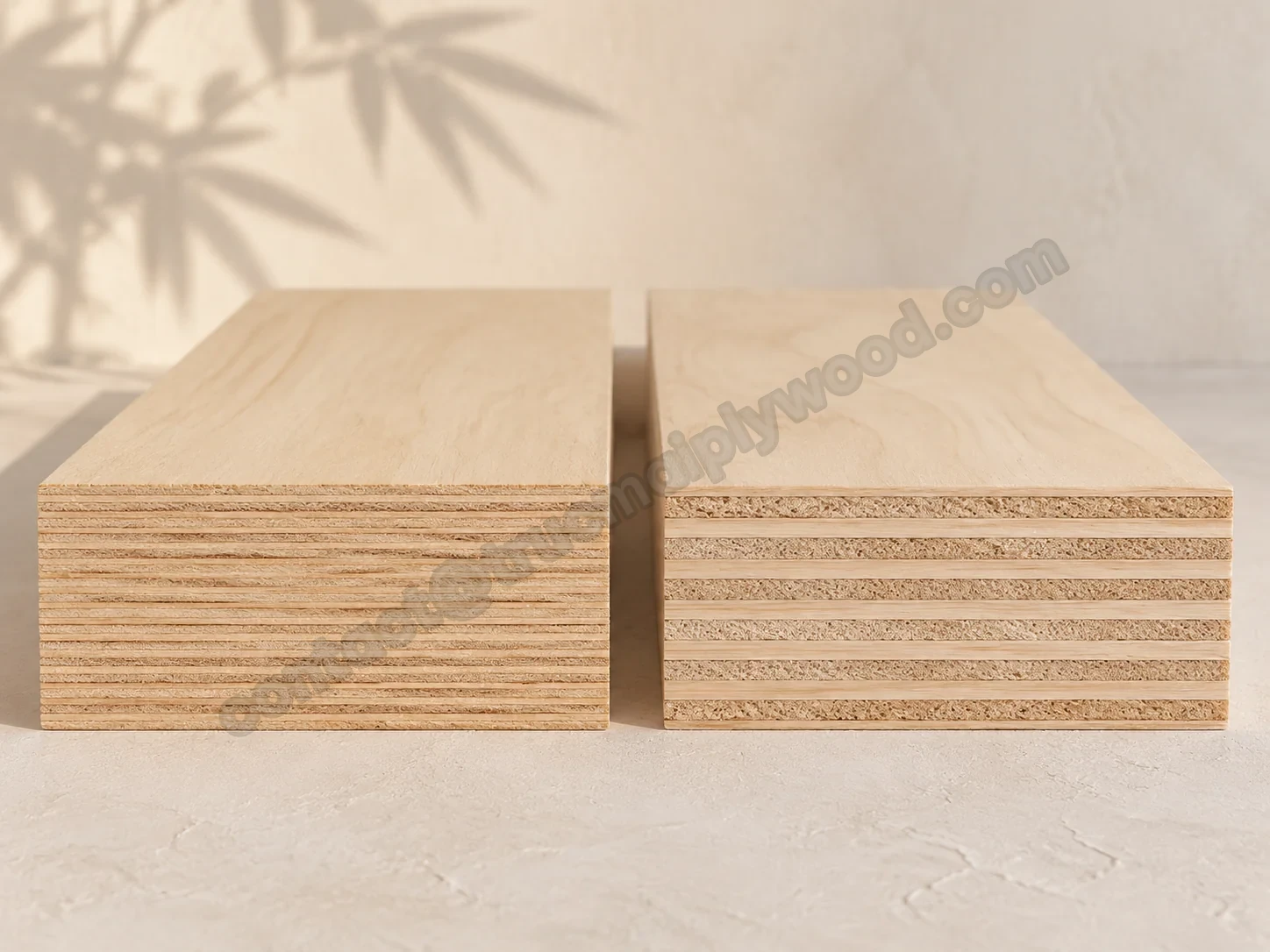
The image below shows the difference at a cut end. In LVL every layer shows end grain, because every layer runs the same way. In plywood the layers alternate between end grain and long grain, which is what makes a sheet stable in both directions but a narrow strip ripped from it less stiff along its length.
The LVL or plywood guide and the LVL or solid wood parts guide go deeper into each choice. In short: if the part is longer than it is wide by a large margin and has to stay straight, LVL is usually the cheaper reliable answer.
| Material | Grain | Straightness of a long part | Stability across the width | Best for |
|---|---|---|---|---|
| LVL | All layers one way | Very good | Moderate | Rails, stiles, slats, runners |
| Plywood | Layers crossed | Moderate in narrow strips | Very good | Panels, carcasses, doors, tops |
| Sawn hardwood | One piece | Varies by board; can twist | Can cup | Visible legs and solid parts |
| Finger-jointed timber | Short pieces end-joined | Good | Can cup | Mouldings, painted frames |
Checks
What is checked differently on LVL?
LVL is checked for what a long part shows: straightness, open layers at the ends and the section size. The rest of the routine is the mill-wide repeat spec control.
The LVL checks page sets out the inspection in full, and arrival checks follow repeat spec control.
Veneers are graded so no open defect lines up through several layers.
Ripped strips are sighted along their length for bow and twist.
Section and length are measured against the drawing on sample pieces from each bundle.
Cut ends are checked for open glue lines or delamination.
Certificates
Can LVL ship with an FSC claim?
FSC, CARB P2, ISO 9001 and ISO 14001, plus EU file sets.
- FSC 100% FSC-C196493 · SA-COC-014545
- CARB P2 and TSCA Title VI CARB/EPA 26053 · TPC-43
- ISO 9001:2015 W2012 · WCERT
- ISO 14001:2015 W2012E · WCERT
Container
How is LVL bundled and loaded in a 40HC?
LVL is strapped in bundles of one part size and loaded as a dense block, usually low in the container with plywood packs beside or above it. Because LVL is solid wood fibre with no voids, a full LVL load reaches the weight limit before the box is full.
There is no planning table for LVL yet, because counts depend entirely on the part sizes on your drawing; the quotation gives the pieces per bundle and bundles per container for your parts. A full Eucalyptus LVL load is weight-capped; a Styrax or Pine load goes further by volume. The 40HC load calculator handles the plywood share of a mixed load, and loading a 40HC shows how packs are placed.
| LVL part | Bundle | Position in a mixed 40HC |
|---|---|---|
| Furniture rails | One part number per bundle, protected corners | Low, beside plywood packs |
| Door and frame stock | One profile per bundle | Low, along the side walls |
| Bed slats | Counted bundles of one length | On top of or beside panel packs |
| Packing runners and battens | Strapped bundles of one size | Floor level, often a full load |
Terms
What is the minimum order for LVL?
Full containers direct from the mill; these terms apply unless the contract says otherwise.
Full terms are on MOQ, payment and FOB. LVL can fill a container on its own or share one with plywood, and the 40HC minimum counts both.
- Minimum order One 40HC
- Production time 15–45 days after the 30% deposit, by quantity and agreement
- Payment 30% deposit; 70% against the scanned B/L by T/T, or irrevocable L/C at sight
- Delivery terms FOB Hai Phong, CFR or CIF
- Documents Invoice, packing list, B/L, certificate of origin, phytosanitary, fumigation, order certificates
- Price Quoted per order against the written specification
How to order
What to send for an LVL quotation
Four things are particular to an LVL order.
Deposit, documents and balance follow from enquiry to loading.
Send one drawing per part: length, section, show face, profile or curve.
Name the use and species: furniture, door stock, slats or packing.
Give pieces per bundle and the plywood it ships with.
Approve a sample piece; one stays at the mill.
FAQ
LVL questions from furniture, door and packing buyers
Is Truc Mai LVL sold for beams, joists or other load-bearing building parts?
No. Truc Mai LVL is non-structural: it is pressed for furniture parts, door and frame stock, bed slats and packing, and it carries no structural rating or stamp. For building frames, use a structurally rated LVL from a producer certified for it.
Has Truc Mai shipped LVL in export containers before?
No LVL export history is written here. LVL is made on request on the same veneer and press lines as the plywood, which press around 60,000 m³ of plywood a year, and the first order is built from your drawing and an approved sample piece.
Which veneer species gives the lightest LVL part?
Styrax. It has the lowest reference density of the mill's species, 500 kg/m³ in the planning model, against 580 for Acacia and 650 for Eucalyptus. Styrax LVL suits long furniture rails and packing that must be light; Eucalyptus suits parts that take screws and wear.
Can LVL and plywood go in the same 40HC?
Yes, by agreement. A container usually carries one or two products and three to six can be mixed. LVL bundles stack as a dense block, so they are usually placed low in the container with plywood packs above or beside them.
Is the LVL sanded?
Furniture and door-stock LVL is sanded on its wide faces so it can be profiled, glued and finished; packing LVL is usually left unsanded. Sanding is a written line on the order, like the tolerance, which is ±0.3–0.5 mm by line.
Can LVL be profiled into mouldings and door parts?
Yes. Parallel-laid veneer machines evenly along its length, so LVL blanks are routed into jambs, stops and mouldings. Send the profile drawing; the blank is sized so the profile clears the outer veneers cleanly.
Why does LVL stay straighter than sawn timber of the same size?
Because it is built from thin dried veneers glued together, so knots and grain faults are spread through many layers instead of sitting in one board. Long LVL parts therefore twist and bow less than sawn parts cut from a single log.
How is the emission class written for LVL in an EU order?
As for plywood, glue type and emission class are two separate lines: UF glue at E0 emission by default. The EU importer files its own due-diligence statement with the EUDR file set, which carries plot geolocation for the Vietnamese veneer.
Can LVL be made in curved pieces for bed slats?
Yes. Bed slats can be pressed flat or with a gentle curve, then cut to length; the LVL slats for beds page covers lengths, widths and how slats are bundled.
What should an LVL drawing show for a quotation?
The finished length, width and thickness of each part, which face is seen, any profile or curve, the tolerance you need, the veneer species if you have a preference, and how many pieces per bundle and per container. One drawing per part keeps the order simple to repeat.
Quotation
Request an LVL quotation
Send the part drawings, use, species, pieces per bundle and the plywood it ships with, and Lucy replies with a written specification and price. Write to contact@trucmaiplywood.com or use the quotation form.
Eucalyptus, Acacia, Styrax or Pine veneer, grain-parallel, UF glue at E0, cut to your drawing.