
Okoume plywood · Ha Hoa, Phu Tho, Vietnam
Okoume plywood: okoume-faced panels for interiors and commercial use, made in Vietnam
Truc Mai okoume plywood is an okoume face veneer pressed on a Vietnamese Acacia, Eucalyptus or Styrax core. It comes as a commercial build at ±0.5 mm or as a sanded furniture build at ±0.3 mm, in 3–40 mm. This page is for distributors and joinery buyers who restock okoume by the container; it is an interior and commercial panel, not a marine one.
Okoume sits in two Truc Mai lines: the commercial panels by the container that distributors restock every month, and the furniture line for joinery and interior work. The mill in Ha Hoa, Phu Tho, makes around 60,000 m³ of plywood a year, about 5,000 m³ in an average month.
The page covers which build to stock, which core to choose, how a 40HC fills and what keeps the face the same from one container to the next.
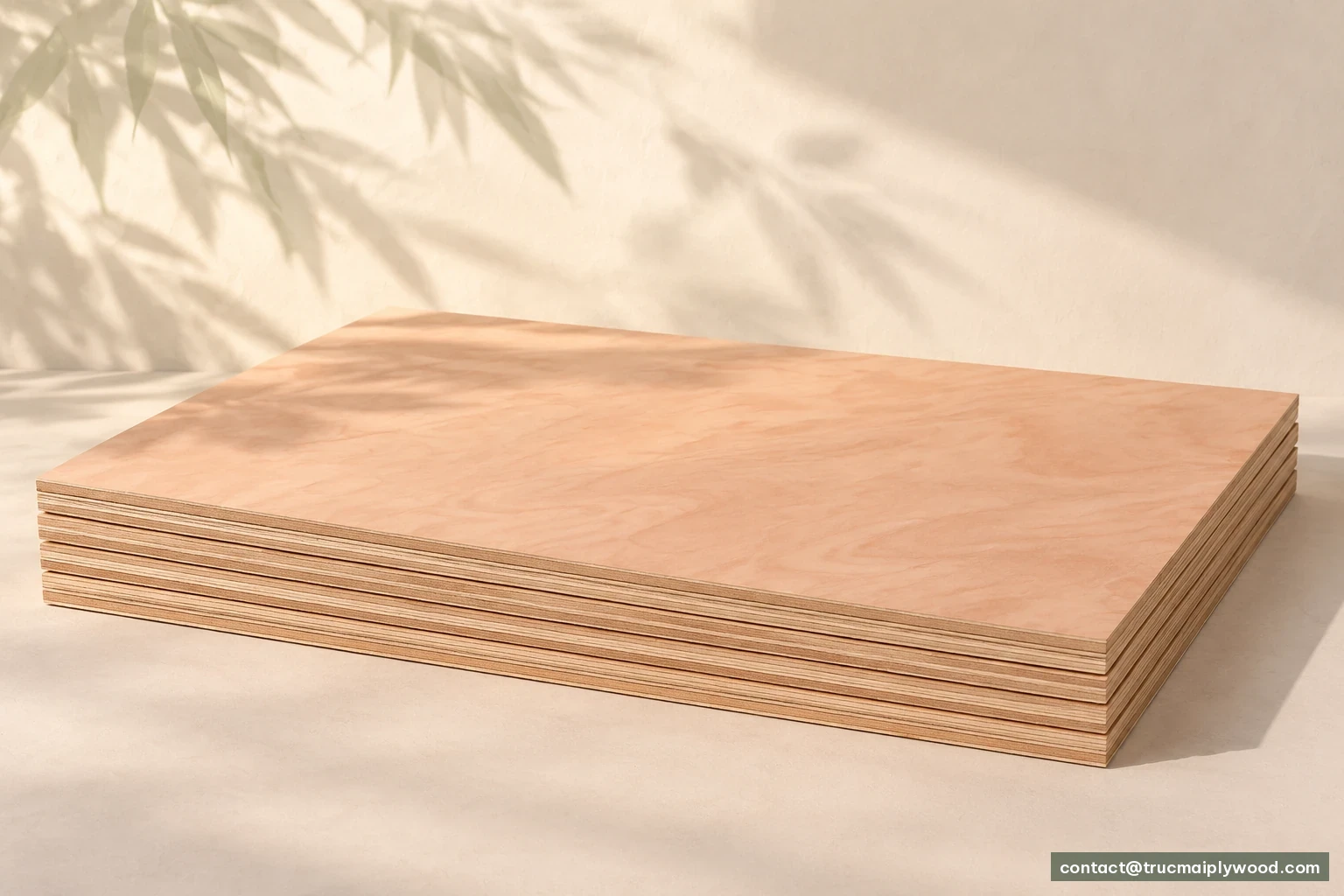
- Okoume veneerFace
- Acacia, Eucalyptus or StyraxCore
- ±0.5 mm commercial, ±0.3 mm sandedTolerance
- UF at E0; twelve-hour boil optionGlue
- MOQ 1×40HC, 15–45 daysOrder
Face and core
Is the face really okoume, and what is the core?
Yes: the face and back are okoume veneer, a pink-brown African hardwood with a soft, wide figure. Under it sits a Vietnamese Acacia, Eucalyptus or Styrax core, because Truc Mai uses okoume only as a face.
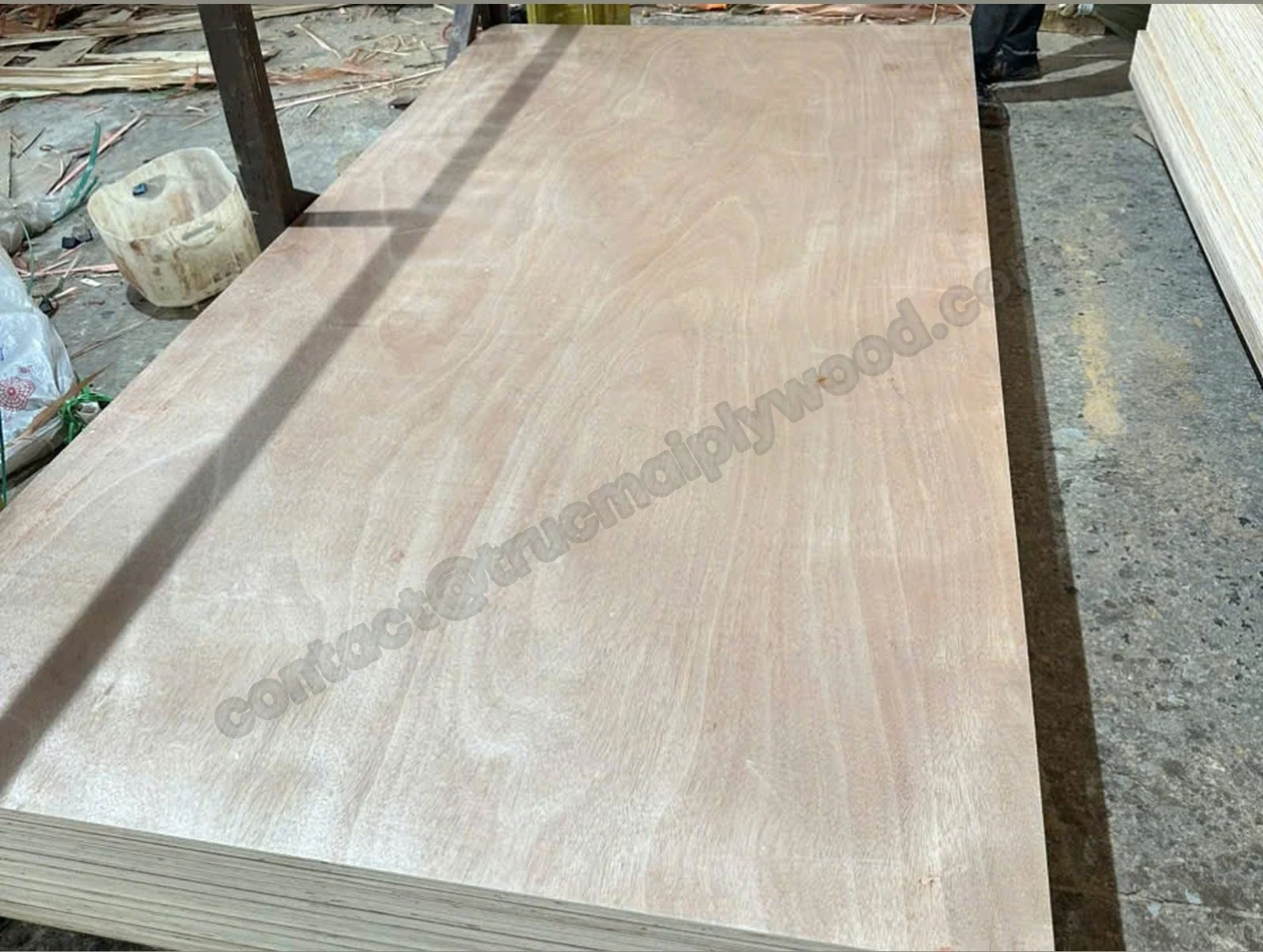
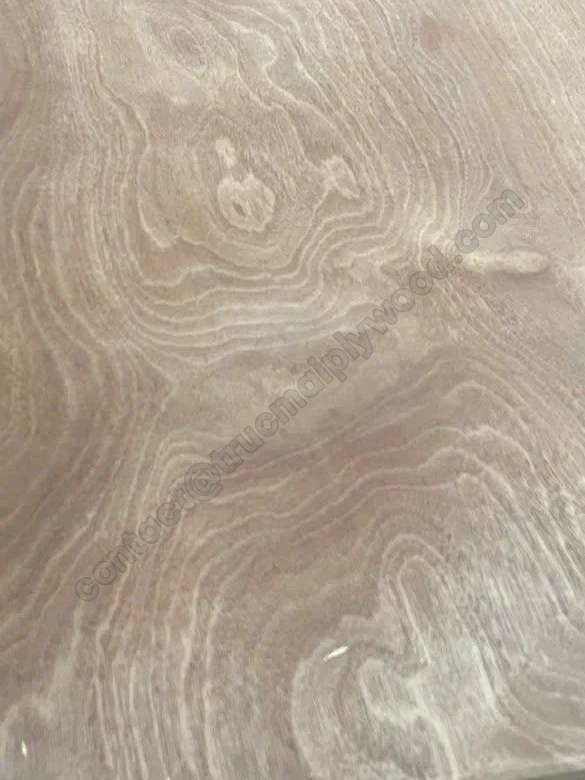
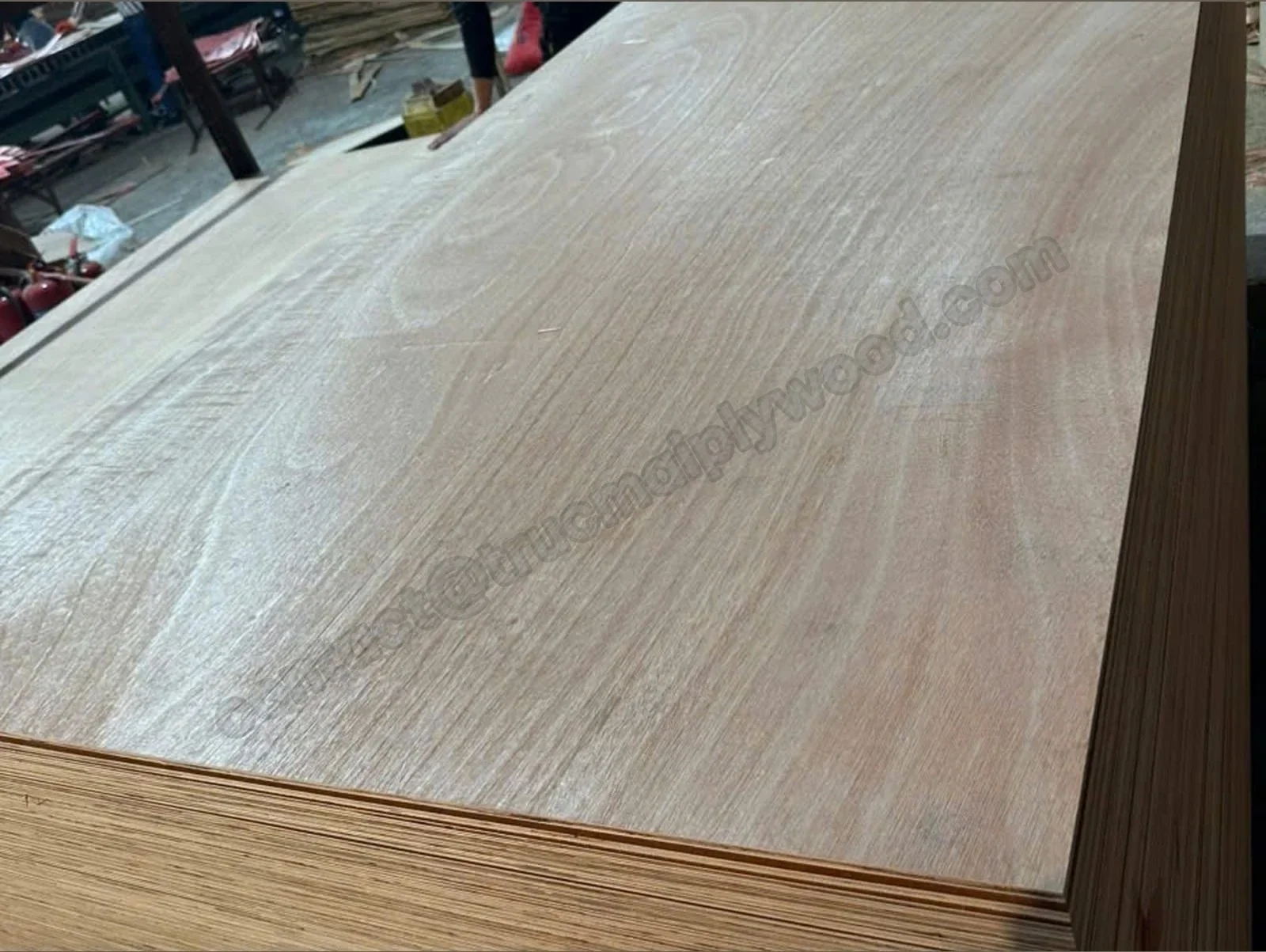
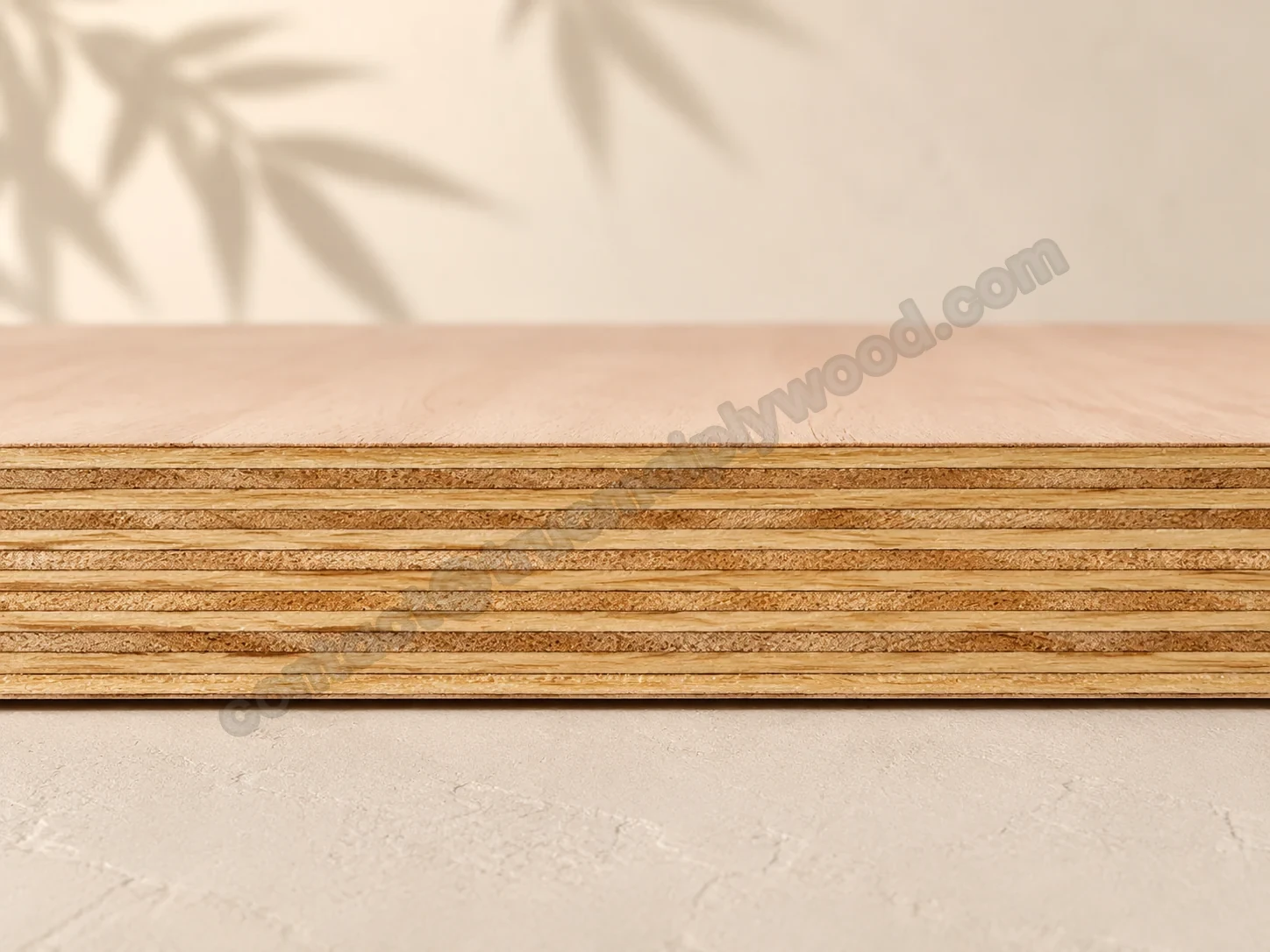
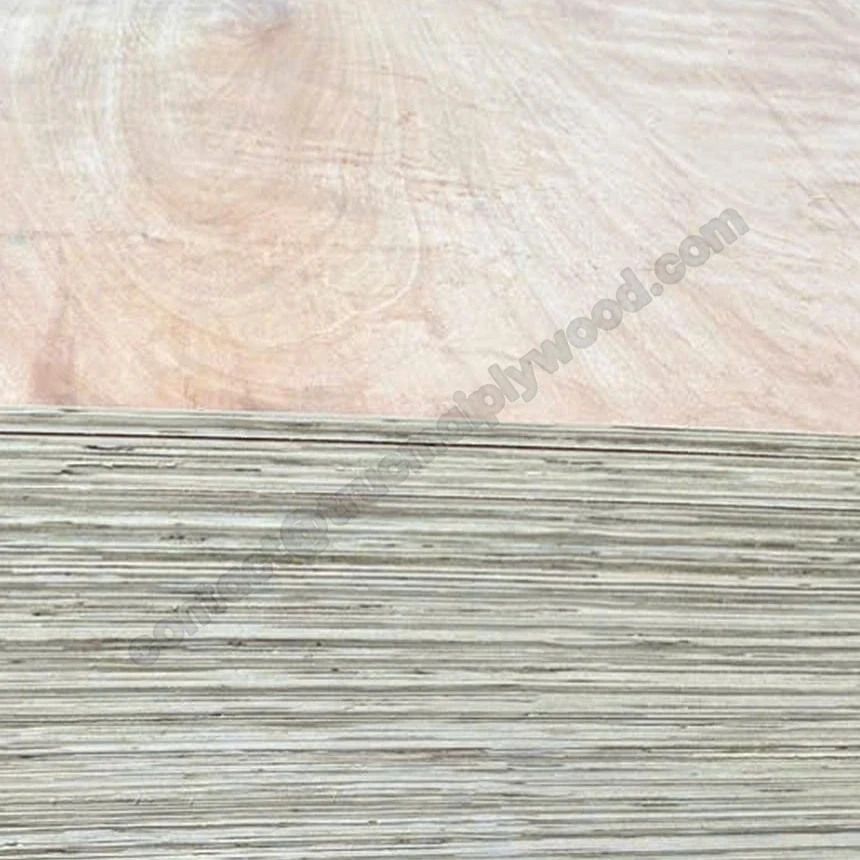
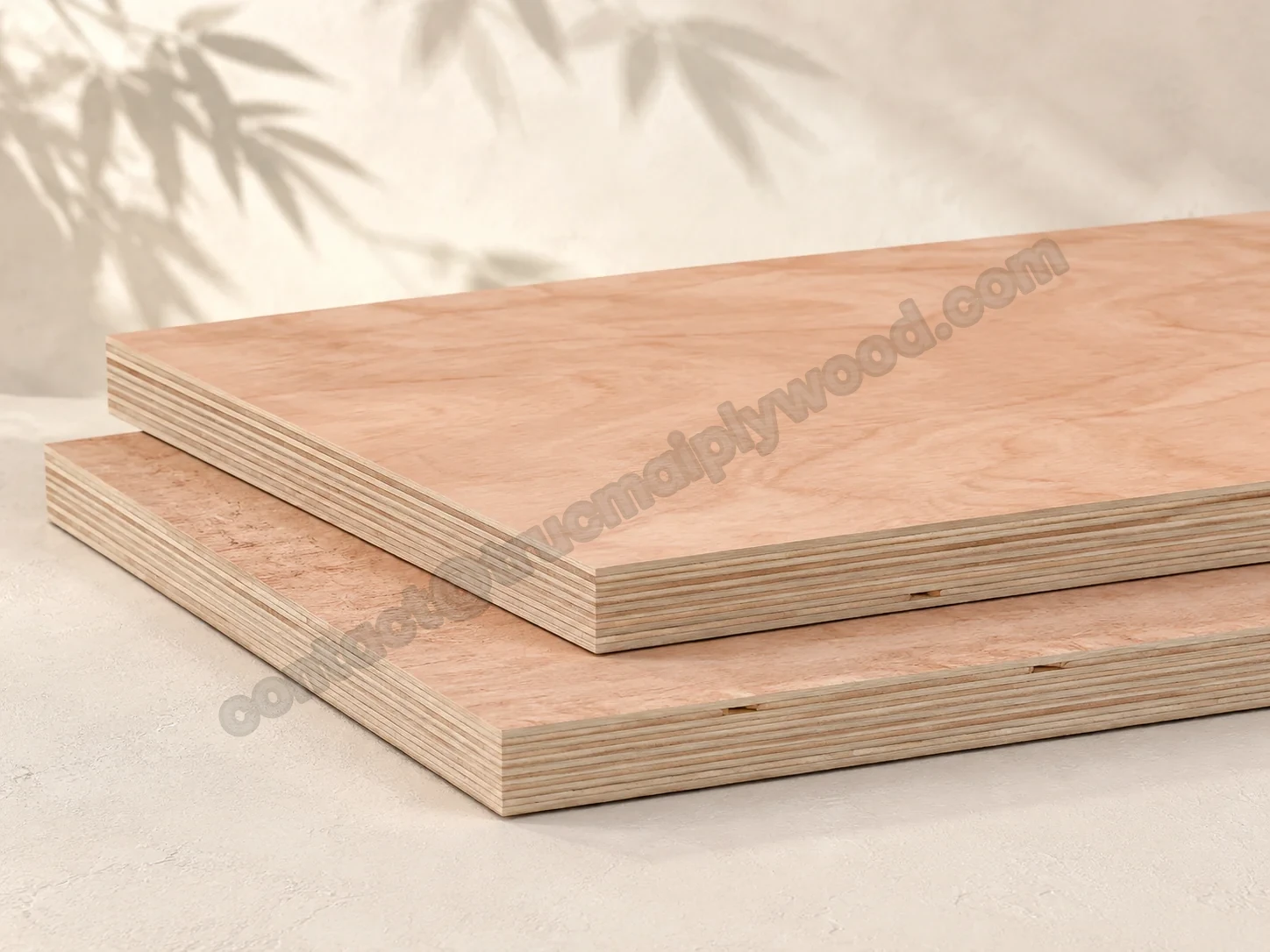
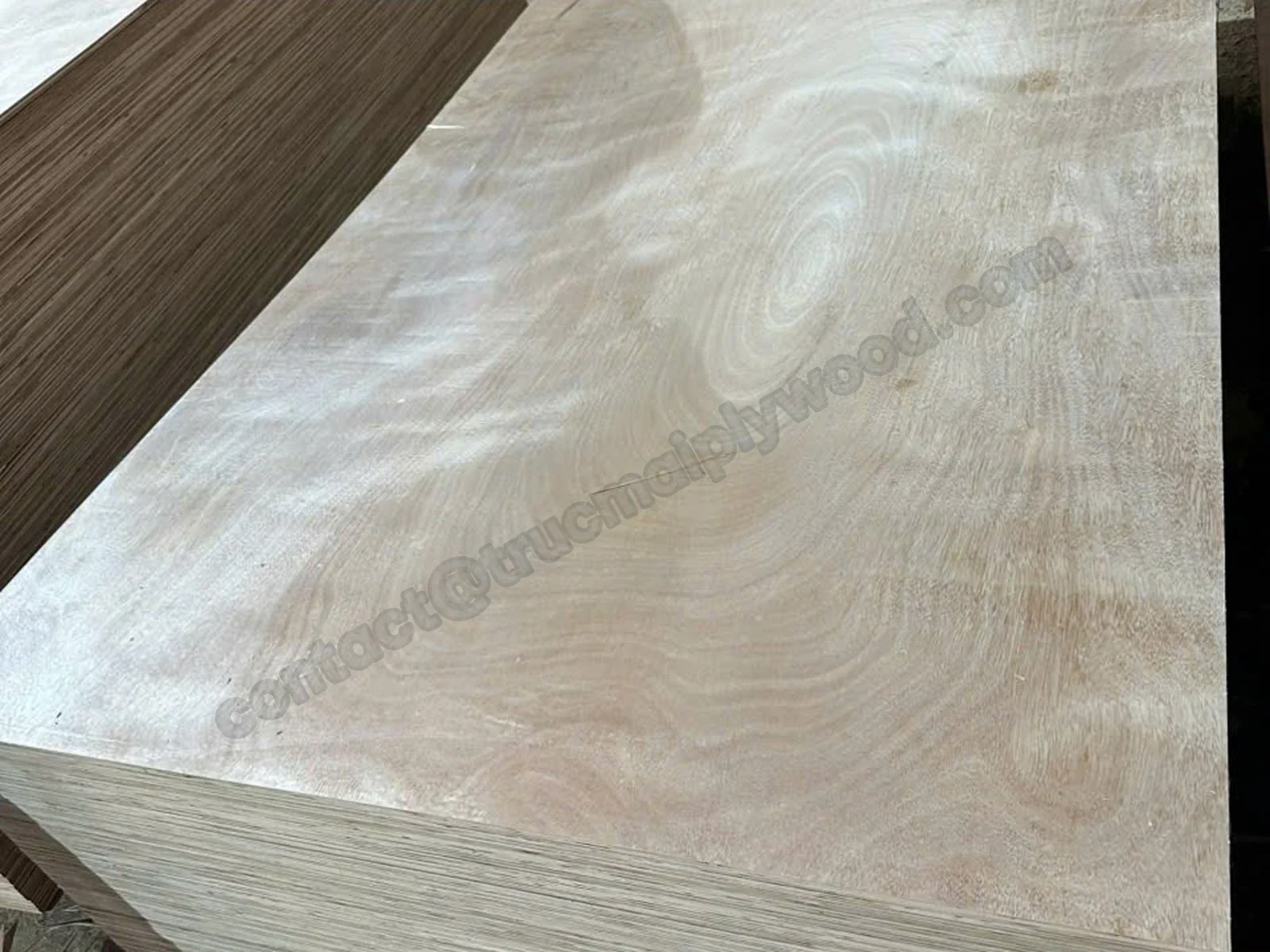
Okoume veneer is lighter in colour and less red than sapele or mahogany. In the photos it reads as salmon to light pink-brown with a broad wavy figure, and it darkens a little with light and finish. A buyer who has seen an okoume sample will recognise the face at once; the edge is what tells you the core.
The botanical name is Aucoumea klaineana. It is a light hardwood, peeled on a rotary lathe into wide face sheets, and its figure is soft and wavy rather than striped. That is why buyers who want a warm wood face without the weight or the price of a dense tropical species have used okoume faces for decades.
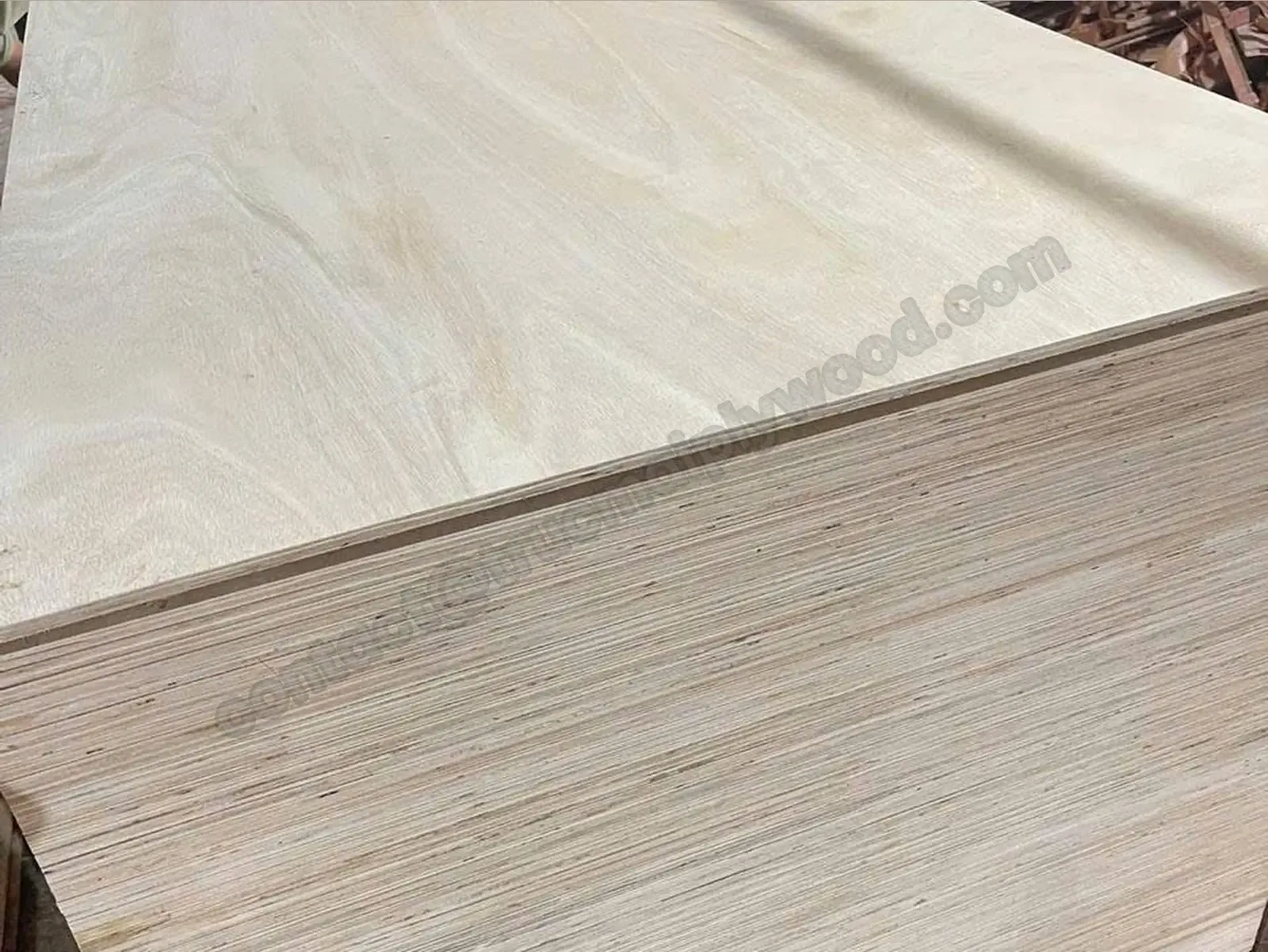
On an Acacia core the plies at the edge show light brown; on Eucalyptus they are pink-brown and close in tone to the face; on Styrax they are almost white. None of these is a fault. The edge colour is a choice made on the order, together with weight and screw holding.
Faces are sorted on the face grading line before lay-up. Okoume veneer varies in colour from log to log more than an engineered veneer does, so faces for one order are kept together and checked against the approved sample.
When you open the first okoume container, compare a sheet from the door end with your sample in daylight. Okoume colour shifts under warm warehouse lighting, so a face that looks too red indoors often matches the sample outside.
A container of okoume is never one colour. Logs from different trees range from pale salmon to a deeper pink-brown, and the figure from calm to strongly wavy, as the photos show. The approved pair marks the two ends of the range your customers will accept, and sheets outside it go to another order instead of your packs.
Specification
Okoume plywood specifications the order is written against
An okoume order names one of two builds, commercial or furniture, and then the lines below. The commercial build is the lower-cost panel for distributors; the furniture build is sanded and calibrated for joinery.
The furniture build belongs to our furniture and interior plywood line and suits stained joinery and cabinet work. The commercial build is the one panel distributors stock in 9, 12 and 18 mm for general interior use.
Thin okoume sheets of 3–6 mm follow the rules on the thin panels page.
In the furniture build, the outer 2–4 plies of the core are stitched across and along the sheet, and all plies can be stitched on request. The commercial build is not stitched unless the order says so.
Both faces of the furniture build can be prepared UV-ready for a buyer's own coating line, or polished on request. The mill does not apply UV lacquer itself. For the commercial build, say if one face must be sanded, because the default leaves it unsanded or only lightly sanded.
Two okoume offers with the same product name are often not the same panel. The difference sits in the core grade, how the core is joined, how the face is prepared, the glue and the tolerance. Compare offers line by line against this table, starting from the use, then the core, glue and emission, face, sheet size, packing and quantity.
A distributor's first okoume order often settles the stock pattern for a year. Fix the build, the face pair and the thicknesses on that order, and keep them; every change to those lines resets the reference sample and the checks that follow it.
- Face and back veneer Okoume, 0.2–0.5 mm, quoted as a pair against the approved sample
- Core species Acacia, Eucalyptus, Styrax or a combined core
- Commercial build AB core, loose-laid or jointed, unsanded or lightly sanded, ±0.5 mm
- Furniture build A-grade stitched core, faces sanded and calibrated, ±0.3 mm
- Thickness steps 3, 4, 5, 6, 9, 12, 15, 18, 21, 25, 30, 40 mm
- Ply count Five in 3–5 mm sheets; 18 mm usually eleven to thirteen
- Sheet 1220 × 2440 mm (4 × 8 ft), 1250 × 2500 mm or 1220 × 2280 mm, ±2 mm
- Glue line Glue and emission written as two lines; UF glue at E0 emission by default
- Pack label Build, thickness, face pair and sheet count on every pack
Face pairs
Which okoume face pair should you order?
Order the face pair by the finish and by which side is seen. A clear pair suits stained joinery, a clear face with a sound back suits cabinets, and a sound pair suits painted and commercial stock. The approved sample fixes what each pair allows.
Every pair is written on the order against an approved sample, kept at the mill and on your side. Letter grades from other suppliers often mean different things, so the sample is the reference our batch checks use.
Colour matching between sheets matters more on okoume than on a painted face. For stained work, ask for faces from one veneer batch; the order then notes that the pack must be one batch.
A distributor who sells to both joiners and general builders can stock two pairs: a clear face with a sound back for joinery, and a sound pair for painted work. Both are pressed on the same core, so they stack and load together, and each pack label names its pair.
The back of a sheet carries the same sorting as the face when the order asks for a clear pair. For a clear face over a sound back, the back is sorted for soundness, not colour, so it can be darker or streaked without failing the order.
For a distributor, the sound pair is usually the volume line and the clear pairs are the margin line. Keeping both on one core and one glue line means a joiner who buys a clear sheet and a builder who buys a sound one get the same stiffness and the same thickness, only a different face.
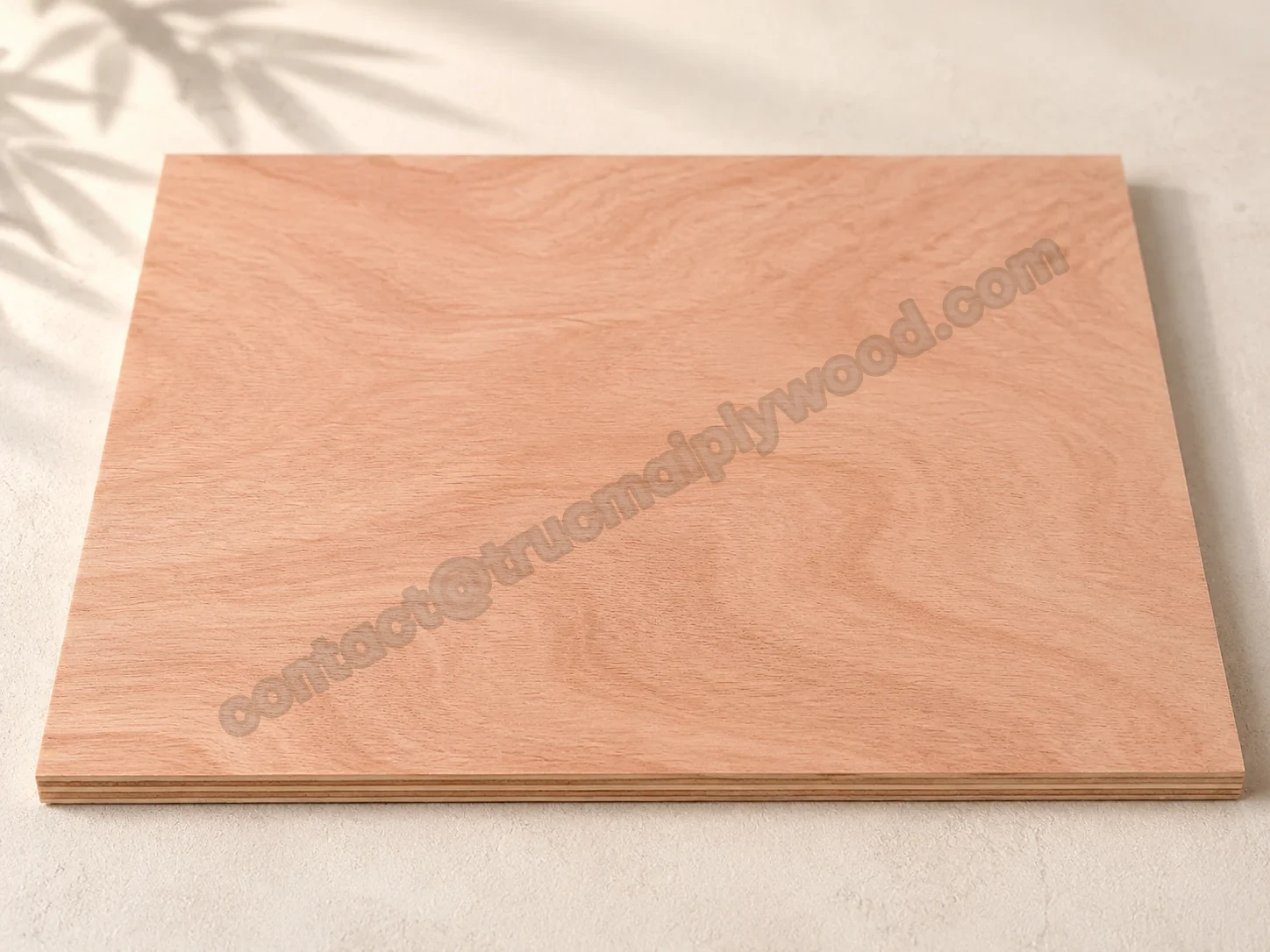 Clear okoume face and back
Even pink-brown on both sides, soft figure, no open defects and very few closed marks. Stained or clear-finished joinery and furniture seen from both sides.
- Clear face, sound back
Clear okoume face; the back may show colour streaks, small closed knots and neat patches. Cabinets, wall panels and furniture with one visible face.
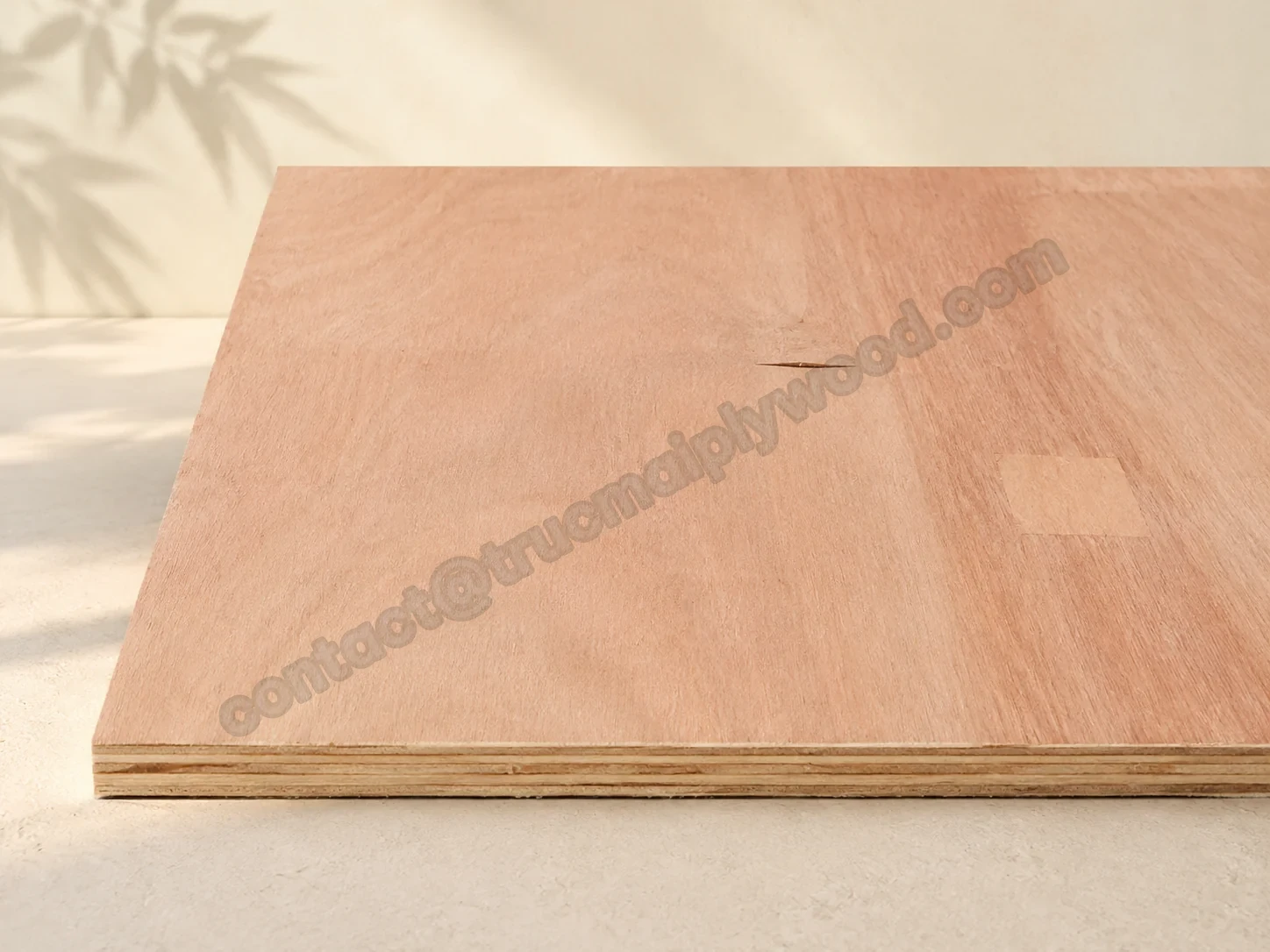 Sound okoume pair
Colour variation, closed knots and patches on both faces, sanded flush, no open splits. Painted interior parts and commercial stock for distributors.
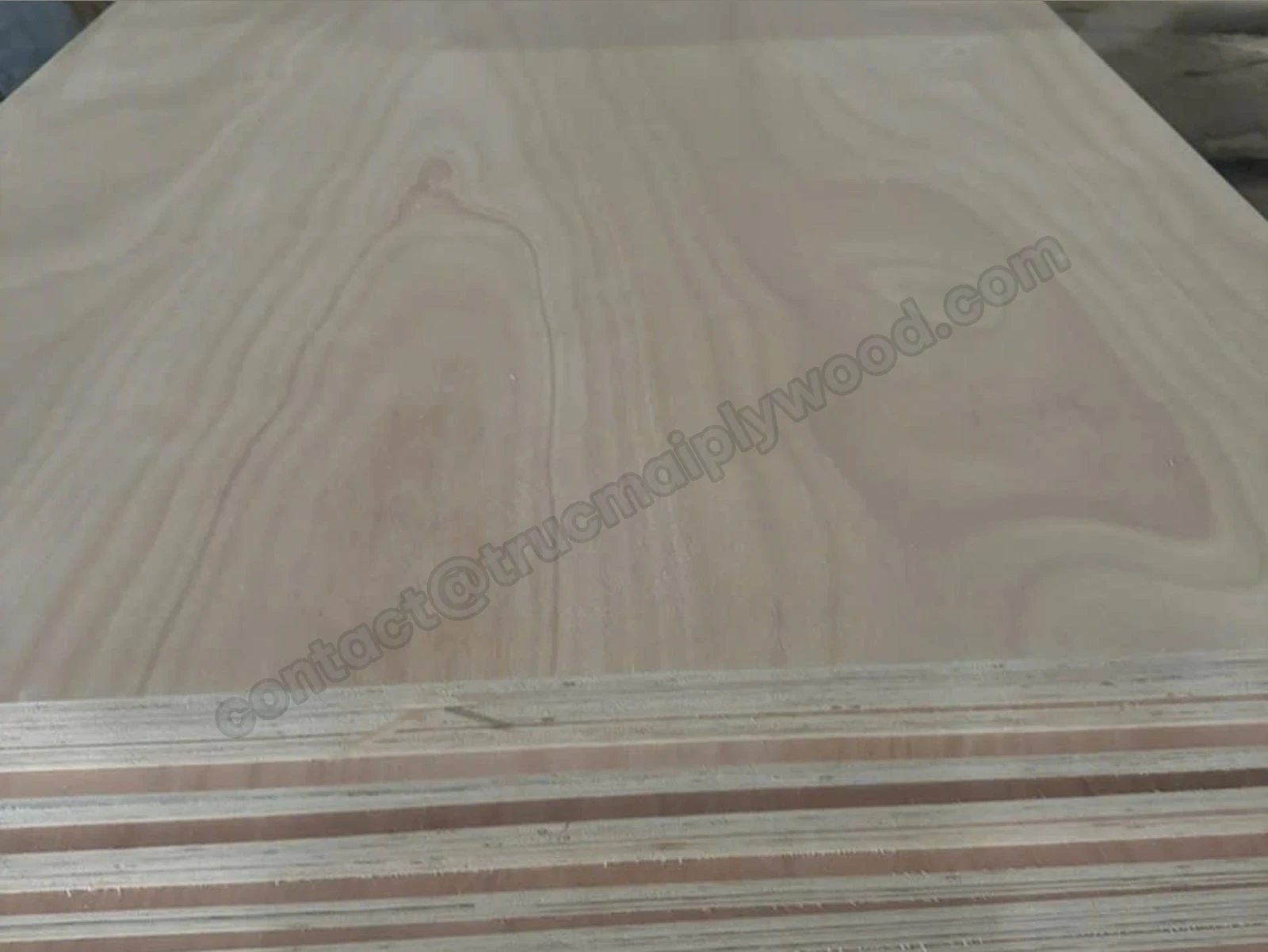
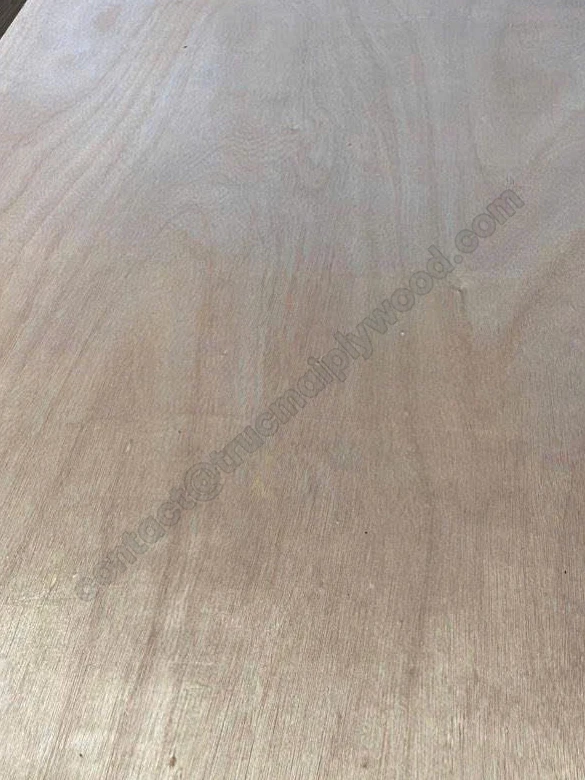
Core
Acacia, Eucalyptus or Styrax under okoume: what changes?
Acacia or Eucalyptus under okoume gives a heavier, stiffer sheet with better screw holding; Styrax gives a lighter sheet and more sheets per container. The okoume face looks the same on each, so the core is a choice of weight, stiffness and load.
Distributors who sell okoume by the sheet to joiners usually choose Acacia: the sheet feels solid and holds a screw near the edge. Buyers who resell into fit-out, where weight on site matters, often move to Styrax.
Sheet weights are planning figures from reference densities. Measured Eucalyptus runs 650–750 kg/m³, so real sheets are weighed before loading.
A combined core lays a harder species next to the faces and a lighter one in the centre. Under okoume, Eucalyptus outer plies with a Styrax centre give a firm bed for the face and a sheet lighter than all-Eucalyptus. The species and their order are written on the order, so the next container is laid up the same way.
Vietnamese plywood has no okoume core: okoume, bintangor and gurjan are used as faces only. If an offer for okoume plywood from Vietnam does not name the core species, ask before you compare prices.
A core change shows at once on an okoume edge. Acacia gives light brown plies, Eucalyptus pink-brown plies close to the face, Styrax plies that are almost white. Distributors whose customers leave edges visible on shelving usually keep one core for years, because a sudden pale edge on a restock reads as a different product even when the face is the same.
| Core | Planning density | 18 mm sheet weight, 1220 × 2440 mm | What it gives an okoume panel |
|---|---|---|---|
| Acacia | 580 kg/m³ | About 31.1 kg | Stiffness and screw holding for joinery and cabinets |
| Eucalyptus | 650 kg/m³ | About 34.8 kg | The hardest, heaviest sheet for shelves and tops |
| Styrax | 500 kg/m³ | About 26.8 kg | A light sheet and the most m³ in each 40HC |
| Combined | Per order | Per order | Harder outer plies with a lighter centre |
Water and glue
Is okoume plywood waterproof, or does that depend on the glue?
The glue decides, not the okoume face. Glue type and emission class are two separate lines on the order.
Okoume has a long history in boat building, but on these panels water resistance comes only from the glue line written on the order. The default is UF glue at E0 emission, and a melamine-fortified glue for damp rooms usually gives E1.
Okoume sheets of 3–25 mm are inside the US formaldehyde scope under certificate 26053. How the class is chosen is on emission class per order; outdoor use is covered by exterior glue panels.
UF glue holds about six hours in a boil test; melamine-fortified glue holds twelve.
| Glue on the order | Boil test | Emission | Fits |
|---|---|---|---|
| UF | About six hours | E0 | Dry interiors: furniture, joinery, panelling |
| Melamine-fortified UF | Twelve hours | Usually E1 | Kitchens, bathrooms and humid interiors |
| UF, US lots 3–25 mm | About six hours | CARB P2 / TSCA Title VI | Hardwood plywood with veneer core |
Thickness
What thickness and tolerance are written for okoume-faced panels?
Okoume-faced panels run from 3 mm to 40 mm. The commercial build is written at ±0.5 mm and the sanded furniture build at ±0.3 mm; length and width are ±2 mm on every sheet.
Thin panels of 3–6 mm follow their own rules for plies and lead time, and they share a container with thicker okoume sheets without trouble. Sheets are pressed in 1220 × 2440 mm, 1250 × 2500 mm and 1220 × 2280 mm, with custom sizes up to 1250 × 2500 mm.
Measure tolerance after the sheet has rested in your warehouse, and at several points, not only at one corner. The order states which build you bought, so the right number is checked.
For distributors, the three thicknesses that sell fastest are usually 9, 12 and 18 mm. Keeping the same three on every monthly container makes stock planning simple, and a fourth thickness can be added for a project without changing the rest of the load.
Most okoume buyers in the EU take 1250 × 2500 mm, and buyers in the US and the Gulf take 1220 × 2440 mm. The 1220 × 2280 mm sheet suits a furniture factory whose carcass parts fit the shorter length.
Thin okoume of 3–5 mm is pressed with five plies and takes longer to make than the thicker sheets, because good thin core veneer is scarce. On a mixed container, put the thin packs on the order early rather than adding them in the last week before loading.
- Thin okoume panels 3, 4, 5 and 6 mm for backs, linings and curved work
- Middle thicknesses 9, 12 and 15 mm for drawer parts, shelves and panelling
- Carcass and tops 18, 21 and 25 mm
- Heavy sections 30 and 40 mm for heavy tops and bases
| Build | Thickness tolerance | Length and width |
|---|---|---|
| Commercial okoume | ±0.5 mm | ±2 mm |
| Furniture okoume, sanded and calibrated | ±0.3 mm | ±2 mm |
| Any build, by agreement | ±0.3–0.5 mm, written per order | ±2 mm |
Uses
What is okoume plywood used for?
Okoume plywood is used for interior furniture, joinery, wall panelling, shopfitting and as general commercial panel stock. Buyers pick it for a warm pink-brown wood face that stains evenly, at a price close to other commercial faces.
Okoume plywood from Truc Mai is for interiors and commercial use. Truc Mai does not make film-faced, formwork, structural or marine plywood.
A distributor's monthly okoume container often carries the commercial build in three thicknesses, with one or two packs of the furniture build for joinery customers. Mixing builds is fine as long as each pack is labelled with its build and tolerance.
Okoume takes stain evenly and sands to a smooth surface, which is why joiners like it for stained doors. For a clear finish, order the furniture build: the face is calibration-sanded, so the coating line removes less wood and the colour stays even across the sheet.
For curved work and linings, thin okoume panels of 3–5 mm bend more easily on a light Styrax core. Thicker sheets of 15–25 mm on Acacia or Eucalyptus suit shelves, worktop bases and carcass sides that carry load.
Stained okoume shows sanding marks more than painted work does. For stained doors and panels, ask for the furniture build and say on the order that the faces will be stained, so faces are sorted for an even colour band as well as for defects.
- Stained joinery and furniture
The furniture build, sanded to ±0.3 mm, for cabinet doors, shelving and joinery that keeps a visible wood face.
- Wall panelling and shopfitting
Clear-face panels on a light Styrax core, easy to lift on site, in 9–18 mm.
- Distributor stock
The commercial build in 9, 12 and 18 mm for timber merchants who sell okoume by the sheet.
- Painted interior parts
Sound okoume pairs where the face will be primed and painted but a hardwood face is still wanted under the paint.
- Door skins and linings
Thin okoume sheets of 3–5 mm on a light core, for flush door skins, wall linings and curved panels that are stained after fitting.
Compare
How is a commercial okoume build different from a furniture build?
The commercial build is an AB core, loose-laid or jointed, unsanded or lightly sanded, at ±0.5 mm. The furniture build is an A-grade stitched core with sanded and calibrated faces at ±0.3 mm. The table also sets okoume against bintangor and poplar faces.
Okoume and bintangor plywood are the two common commercial wood faces. Bintangor is redder and harder; okoume is lighter, softer and more pink. Many distributors keep both and load them in one container.
Poplar plywood is the pale alternative when the panel will be painted, laminated or kept white. Its cores and builds match those of okoume, so the face is the only change.
Which build should a distributor stock? If customers are joiners who stain the face, the furniture build pays for itself in sanding time. If the sheets go into hidden or painted work, the commercial build is the better buy.
What goes wrong on an okoume reorder is rarely the core or the glue; it is the face colour or the build. A distributor who once took the furniture build and then receives commercial sheets has a tolerance argument, not a colour one. Writing the build on every pack label, and checking it at packing, is what prevents that.
When is another Truc Mai face the better buy? For painted work, a poplar face on the same core is paler and usually cheaper; for a figured pale face under a clear coat, birch; for a darker commercial face, bintangor. Okoume stays the right choice for a warm, even, stainable face at a commercial price.
| Panel | Core build | Faces | Tolerance | Buyer |
|---|---|---|---|---|
| Okoume, commercial build | AB core, loose-laid or jointed | Unsanded or lightly sanded | ±0.5 mm | Distributors, general interior use |
| Okoume, furniture build | A-grade core, stitched | Sanded and calibrated | ±0.3 mm | Joinery, cabinets, stained work |
| Bintangor, commercial build | AB core | Red-brown, harder face | ±0.5 mm | Commercial stock, darker face |
| Poplar, furniture build | A-grade core, stitched | Pale, plain face | ±0.3 mm | Painted and laminated furniture |
Checks
What is checked differently on an okoume order?
Okoume is checked for colour band and build, because okoume colour moves log to log and the two builds look alike in a pack.
How an okoume container is checked on arrival against the kept sample is on repeat spec control.
Faces are sorted in daylight against the approved pair; okoume looks redder under warm lamps, so colour is never judged indoors.
For stained work, faces for one order come from one veneer batch.
Each pack label names the build, commercial or furniture, and the label is checked against the sheets.
Thickness is measured against ±0.5 mm or ±0.3 mm, whichever the build says.
Certificates
Which certificates come with okoume plywood?
FSC, CARB P2, ISO 9001 and ISO 14001, plus EU file sets.
- FSC 100% FSC-C196493 · SA-COC-014545
- CARB P2 and TSCA Title VI CARB/EPA 26053 · TPC-43
- ISO 9001:2015 W2012 · WCERT
- ISO 14001:2015 W2012E · WCERT
Container
Okoume plywood 18 mm and other thicknesses: how many sheets fit in a 40HC?
Okoume plywood 18 mm in 1220 × 2440 mm plans at about 880 sheets per 40HC on Acacia and 795 on Eucalyptus; a Styrax core plans at about 990. Sheet counts and weights are planning figures from our packing model, panels only, not a loading record.
An okoume load on Acacia or Eucalyptus is weight-capped and stops near 47 or 43 m³ before the box is full. The carrier and route decide the final payload. Okoume often shares the container with bintangor, the other commercial face; each keeps its own labelled packs, and lighter or thinner packs go at the door end. For other mixes use the 40HC load calculator; loading a 40HC shows how packs are placed.
| Thickness | Acacia core: sheets | Acacia: m³ | Eucalyptus core: sheets | Eucalyptus: m³ |
|---|---|---|---|---|
| 6 mm | 2,656 | 47.4 | 2,400 | 42.9 |
| 9 mm | 1,776 | 47.6 | 1,605 | 43.0 |
| 12 mm | 1,328 | 47.4 | 1,200 | 42.9 |
| 15 mm | 1,056 | 47.2 | 960 | 42.9 |
| 18 mm | 880 | 47.2 | 795 | 42.6 |
| 21 mm | 752 | 47.0 | 675 | 42.2 |
Terms
Terms for okoume plywood by the container
Full containers direct from the mill; these terms apply unless the contract says otherwise.
Full terms are on MOQ, payment and FOB. An okoume reorder that keeps the same build, face pair and thicknesses needs no new sample.
- Minimum order One 40HC
- Production time 15–45 days after the 30% deposit, by quantity and agreement
- Payment 30% deposit; 70% against the scanned B/L by T/T, or irrevocable L/C at sight
- Delivery terms FOB Hai Phong, CFR or CIF
- Documents Invoice, packing list, B/L, certificate of origin, phytosanitary, fumigation, order certificates
- Price Quoted per order against the written specification
Ordering
What to send for an okoume plywood quotation
Four things are particular to an okoume order.
Deposit, documents and balance follow from enquiry to loading.
Name the build: commercial at ±0.5 mm or furniture at ±0.3 mm.
Name the face pair, core and thickness mix per container.
Approve a sample of each build you will stock.
Say whether stained work needs one veneer batch.
FAQ
Okoume plywood questions from container buyers
What is okoume plywood used for?
Interior furniture, joinery, wall panelling, shopfitting and general commercial panel stock. Its pink-brown face takes stain and clear finishes well, and a commercial build gives a warm wood look at a container price.
Is the face really okoume, and what is the core?
Yes, the face and back are okoume veneer. The core is Vietnamese Acacia, Eucalyptus or Styrax, because okoume is used here only as a face, and the furniture build is calibrated to ±0.3 mm.
How is a commercial okoume build different from a furniture build?
The commercial build uses an AB core, loose-laid or jointed, unsanded or lightly sanded, at ±0.5 mm. The furniture build uses an A-grade stitched core with sanded, calibrated faces at ±0.3 mm.
Is okoume plywood waterproof?
The face does not decide that; the glue does. UF glue at E0 emission lasts about six hours in a boil test, and melamine-fortified glue lasts twelve hours, usually at E1. Truc Mai sells okoume as an interior and commercial panel, built to the ±0.5 mm or ±0.3 mm line on the order.
What thickness tolerance is written for okoume-faced panels?
±0.5 mm for the commercial build and ±0.3 mm for the sanded, calibrated furniture build. The tolerance is written on each order; length and width are ±2 mm.
How many okoume-faced sheets fit in a 40HC?
At 18 mm and 1220 × 2440 mm, about 880 sheets in 16 packs on an Acacia core, 795 on Eucalyptus or 990 on Styrax. These are planning figures from the Truc Mai packing model, not loading records.
Can okoume and bintangor faces go in one container?
Yes. Two products in one container is normal, and three to six can be mixed by agreement, so okoume and bintangor commercial panels often load together.
Can okoume plywood be stained?
Yes. Okoume takes stain evenly. Order the sanded furniture build so the face is calibrated before finishing.
Which okoume face pair should a distributor keep in stock?
Most keep a sound pair as the volume line for painted and hidden work and a clear face over a sound back for joiners. Both go on the same core and glue line, so stiffness and thickness match and only the face differs.
Can thin okoume sheets go in the same container as 18 mm?
Yes. Thin 3–5 mm okoume is five plies and often takes longer to make, so put it on the order early; the thin packs then load at the door end of the same container.
Why does okoume look redder in the warehouse than on the sample?
Warm lamps push okoume towards red. Compare a sheet from the door end with your sample in daylight; faces are sorted in daylight at the mill for the same reason.
Can a distributor stock both builds in one container?
Yes. The commercial and furniture builds use the same face and cores, so they load together; each pack label names its build and tolerance so the two never get mixed on your shelf.
When is bintangor the better buy than okoume?
When the customer wants a darker, redder and harder face for commercial stock. Okoume is lighter, softer and pinker, and takes stain more evenly; many distributors keep both and load them in one container.
What usually goes wrong on an okoume reorder, and how is it caught?
A shift in face colour between log batches, or the wrong build in a pack. Faces are sorted against the approved pair, stained-work orders stay on one veneer batch, and every pack label names the build before the container closes.
Quotation
Request an okoume plywood quotation
Send the build, core, thicknesses, size and quantity, and Lucy replies with a written specification and price. Write to contact@trucmaiplywood.com or use the quotation form.
Okoume face on Acacia, Eucalyptus or Styrax core, commercial ±0.5 mm or sanded ±0.3 mm, 3–40 mm.