
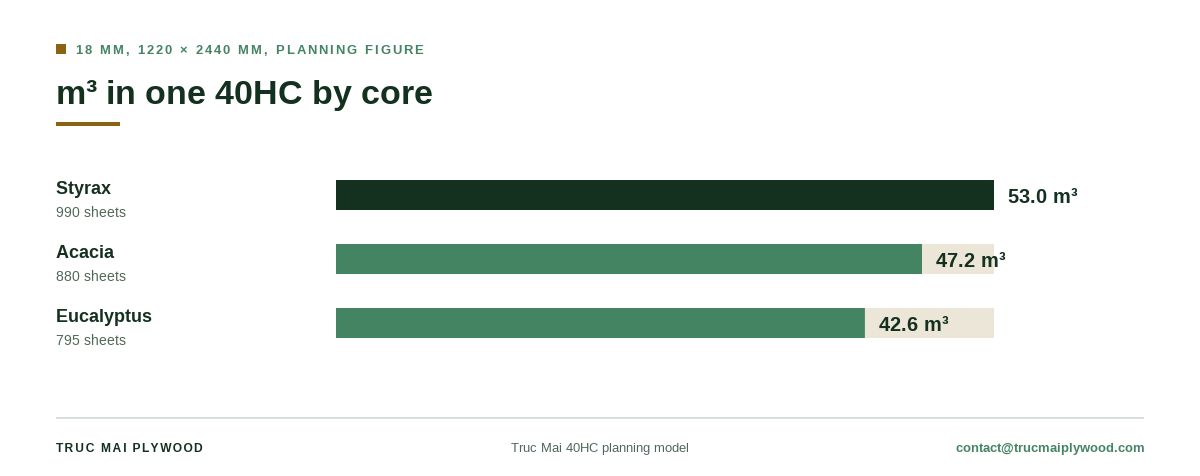
Sea freight is quoted per container, so the cost per m³ of plywood is the box rate divided by the m³ that fit in it. A 40HC of 18 mm Styrax plywood holds about 53 m³ and a Eucalyptus one about 43 m³ (planning figures), so the same rate costs about 24.5% more per m³ on the heavier core. This page gives the method and the public indices to follow, and no invented rate.

How do you work out plywood shipping cost per m³ from Vietnam?
Divide the all-in box rate for one 40HC by the m³ of plywood loaded in it. A forwarder quotes freight per container, so the cost per m³ is the rate divided by about 53 m³ on Styrax core, 47 m³ on Acacia or 43 m³ on Eucalyptus at 18 mm. The same rate is higher per m³ on the heavier core.
The calculation has only two inputs. The first is the rate, which comes from your forwarder or from the mill’s CFR or CIF quote, and changes by week, route and carrier. The second is the m³ in the box, which comes from the packing plan. This page holds the second input and the method; it does not quote the first, because no freight rate is on file and a rate printed on a page is out of date before it is read.
That is why the page gives ratios rather than amounts. Whatever the rate, a Styrax box carries 53.05 m³ and a Eucalyptus box 42.60 m³ of 18 mm board, so the cost per m³ of the Eucalyptus box is 53.05 ÷ 42.60 = 1.245 times that of the Styrax box. The ratio holds from week to week.
Use it in three steps: get the box rate from the forwarder for your port pair, divide by the m³ in your planned container, and add the lines the forwarder lists on top. The sections below give the box sizes, the surcharges to ask about, the days at sea for each lane and the public indices worth following.
How many m³ of plywood fit in a 40HC on Styrax, Acacia or Eucalyptus core?
At 18 mm and 1220 × 2440 mm, a 40HC holds 990 sheets and 53.0 m³ on Styrax core, 880 sheets and 47.2 m³ on Acacia, and 795 sheets and 42.6 m³ on Eucalyptus. These are planning figures from the Truc Mai packing model, with a 28,000 kg payload and packs about 1,000 mm high.
| 18 mm, 1220 × 2440 mm | Sheets per 40HC | Volume | Cargo weight |
|---|---|---|---|
| Styrax core | 990 sheets | 53.0 m³ | 26,523 kg |
| Acacia core | 880 sheets | 47.2 m³ | 27,348 kg |
| Eucalyptus core | 795 sheets | 42.6 m³ | 27,689 kg |
Across thicknesses the box moves little. The planning table for Styrax runs from about 52.9 to 53.6 m³ between 3 and 40 mm, because the sheets per pack are 1,000 mm divided by the thickness and the 18 pack positions stay the same. The m³ per box therefore depends mostly on the core, and the full table for every thickness is on the m³ per 40HC page.
The figures are not a loading record. Truc Mai’s packing lists have not been checked against the table yet, so they are written as planning figures. Before the plan is closed the mill weighs real sheets, and the payload that counts is the one the carrier and route allow, as written on the booking.
Try your own thickness and core in the 40HC load calculator, and see how the mill packs and lashes a box on loading a 40HC.
Why does Eucalyptus core reach the weight limit before the container is full?
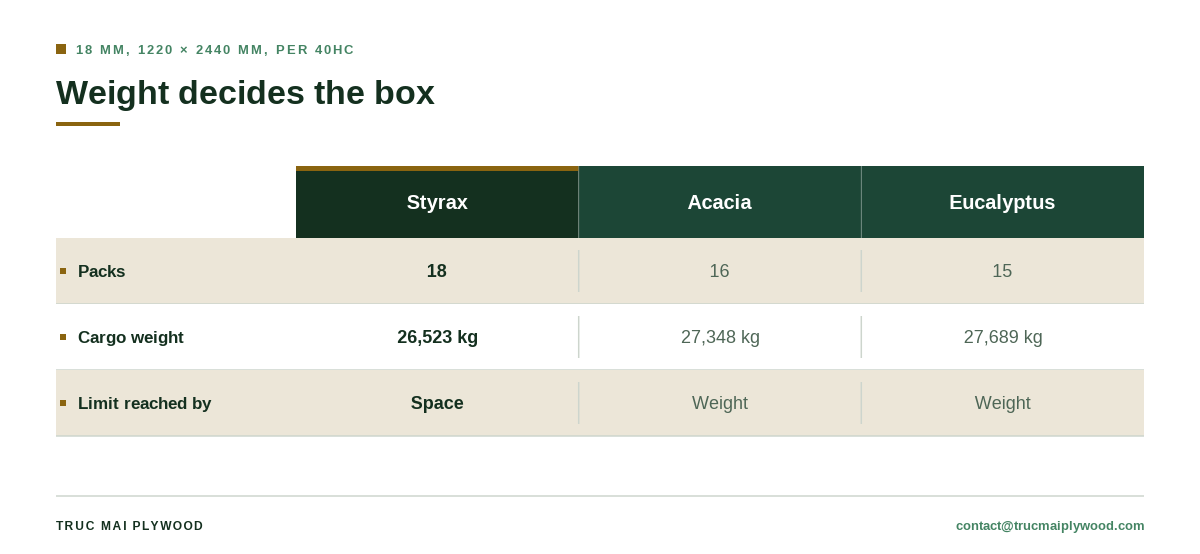
Eucalyptus is the densest of the three cores, at a reference 650 kg/m³ against 580 for Acacia and 500 for Styrax, so a pack of it weighs more. The 28,000 kg planning payload is reached with fewer packs than the container has space for, and the rest of the box stays empty. The load is weight-capped, not volume-capped.
The packing model allows at most 18 packs on Styrax, 16 on Acacia and 15 on Eucalyptus, and then caps the sheets per pack by weight where needed. At 18 mm a pack 1,000 mm high holds 55 sheets. Eighteen Styrax packs weigh about 26,523 kg, under the payload, so Styrax fills the box. Fifteen Eucalyptus packs of 53 sheets weigh about 27,689 kg, and a sixteenth would break the payload, so the Eucalyptus box stops at 42.6 m³.
The effect on freight is arithmetic. The forwarder charges for the container whether it is full or not, so the unused space is paid for and carries nothing. At 18 mm the Eucalyptus box leaves about 10.5 m³ of volume unused compared with Styrax, which is 53.05 minus 42.60. The buyer pays the same rate for 80% of the board.
Sheet weight explains the rest. A 1220 × 2440 × 18 mm sheet weighs about 26.8 kg on Styrax, 31.1 kg on Acacia and 34.8 kg on Eucalyptus. Measured Eucalyptus runs at 650–750 kg/m³, and at the top of that range the same sheet weighs about 40.2 kg, which is why real sheets are weighed before the plan is fixed. The sheet-by-sheet working is on 18 mm plywood by core.
For freight, a furniture buyer leaving Acacia for Styrax puts more m³ of board in every box, and usually gets a better face and a lighter sheet as well. A buyer who needs the heavier core for strength should price the box cost into the comparison and not only the mill rate.
Does the 1250 × 2500 mm format load more m³ than 1220 × 2440 mm?
On Styrax core, yes: the same 990 sheets fill about 55.7 m³ at 1250 × 2500 mm, against 53.0 m³ at 1220 × 2440 mm, because each sheet is about 5% larger. On Acacia and Eucalyptus the weight cap still binds, so the load drops to 848 and 765 sheets and the gain in m³ is small.
| 18 mm | 1220 × 2440 mm | 1250 × 2500 mm |
|---|---|---|
| Styrax core | 990 sheets, 53.0 m³ | 990 sheets, 55.7 m³ |
| Acacia core | 880 sheets, 47.2 m³ | 848 sheets, 47.7 m³ |
| Eucalyptus core | 795 sheets, 42.6 m³ | 765 sheets, 43.0 m³ |
On Styrax the larger sheet is a pure gain for the freight line: the box carries the same number of packs and more board. The cost per m³ falls by the ratio 53.05 ÷ 55.7, about 5%. On the heavier cores the packs hold fewer sheets (53 instead of 55 on Acacia, 51 instead of 53 on Eucalyptus) because the bigger sheet weighs more, so the gain is mostly eaten.
The format also changes what the buyer cuts. The European 1250 × 2500 mm sheet suits panel lines set up in metric, and 1220 × 2440 mm is the 4 × 8 ft standard. A buyer should pick the size from the cutting plan first, and the freight second. If the cutting plan is neutral, Styrax at the larger size lowers the box cost per m³; if not, the saving is not worth wasting sheet.
A third size, 1220 × 2280 mm, is the shorter furniture sheet. Each sheet is about 6.6% smaller than the 2440 mm one, so a box of it holds less volume at the same sheet count. Write the size on the RFQ, so the container plan and the rate refer to the same sheet.
What do public freight indices say about the rate from Hai Phong?
Public indices show the direction of the container market, not your rate. The Freightos Baltic Index publishes freight rates for 40-foot containers on twelve lanes, and the Shanghai Containerized Freight Index covers export lanes from Shanghai. Neither quotes Hai Phong, so use them to see whether freight is rising or falling and a forwarder’s quote for the number.
The Freightos Baltic Index states that it provides “freight market rates for 40′ containers (FEUs)” and covers twelve trade lanes, including China and East Asia to North America West Coast and East Coast, to North Europe and to the Mediterranean. Its East Asia region lists ports such as Shanghai, Ningbo, Busan and, in Vietnam, Vung Tau, not Hai Phong. The index is built from the median of rolling spot tariffs on the Freightos platform.
The Shanghai Containerized Freight Index is published by the Shanghai Shipping Exchange. It tracks routes from Shanghai, so it is a second view of the same market and not a Vietnam rate. Drewry’s World Container Index is a third weekly benchmark for major east-west lanes.
Three uses are sound. First, as a trend line: if the index has risen for several weeks, expect a forwarder’s quote for Hai Phong to have risen too. Second, as a reason to ask for a fresh quote near the booking date, since a rate quoted weeks earlier may no longer hold. Third, as a way to check whether a quote is moving with the market. What an index cannot do is replace the quote: a lane that does not include Hai Phong gives the direction and not the figure.
For a budget, take the forwarder’s rate for your port pair, divide by the m³ in your planned box, and keep the index as the early-warning signal for the next order.
What surcharges are added on top of the base ocean freight?
Surcharges are lines a carrier or forwarder adds to the base ocean rate: fuel or bunker adjustment, peak-season or general rate increase charges, terminal handling at one or both ends, documentation, seals and any equipment charge. They are quoted per container, so they add to the box rate and fall per m³ in the same way.
Under FOB Hai Phong the mill delivers the container on board at Hai Phong, with loading and export clearance in its price. The origin handling the mill pays stays in the FOB rate. The buyer’s forwarder then quotes the ocean leg and the lines after it: destination handling, customs clearance and inland delivery. Under CFR and CIF the mill’s quote already contains the ocean freight to the named port, and the destination lines still belong to the buyer.
Ask the forwarder to itemise every line and to state what each covers. A box rate that says “all-in” can hide a different list from one that says “plus surcharges”. Comparing two freight quotes is only possible when both list the same lines, and the cost per m³ is only meaningful when the same lines sit on both sides.
Two paper items feed the freight. The carrier needs the verified gross mass of the packed container, and the International Maritime Organization explains that SOLAS regulation VI/2 requires the shipper to obtain and document it, adding the mass of pallets, dunnage and securing material and the tare of the container. And the solid-wood pallets, battens and dunnage in the box need a treatment mark under USDA APHIS guidance on wood packaging material, as ISPM 15 requires, while the plywood panels stay outside that standard.
Amounts are not quoted here: no surcharge rate is on file, and they change by carrier and season.
How long does sea freight from Hai Phong to Northern Europe take?
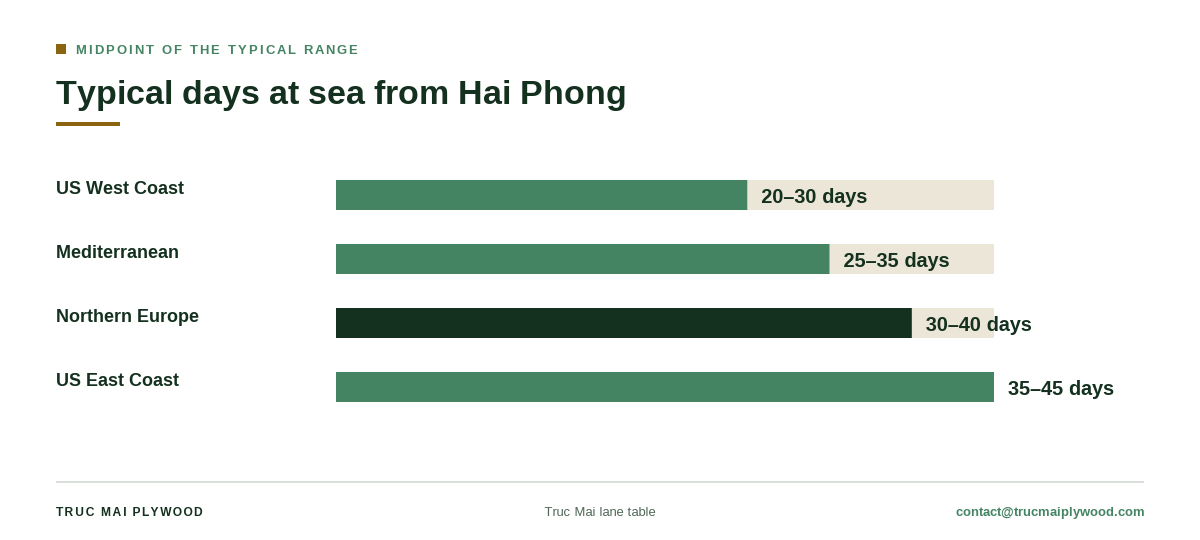
Typical days at sea from Hai Phong to Northern Europe are 30–40 and to the Mediterranean 25–35, varying by carrier and route. Add them to the 15–45 days of production after the 30% deposit to get the arrival month. The days do not include loading, customs or inland delivery at either end.
Every lane the mill ships on, with the usual sailing time from the loading port:
| Lane from Hai Phong | Days at sea, usually |
|---|---|
| South-East Asia | 5–12 |
| Middle East | 15–25 |
| US West Coast | 20–30 |
| Mediterranean | 25–35 |
| Northern Europe | 30–40 |
| US East Coast | 35–45 |
| West Africa | 35–50 |
For a European buyer the sum is a production window plus the sea window. A container placed with a deposit in early spring, produced in 15–45 days and shipped in 30–40 days, reaches Northern Europe in about 45–85 days after the deposit. That span is wide because both parts are ranges, and a monthly programme narrows it by fixing the production slot in advance.
The EUDR statement belongs in the same timeline. The EU importer files a due-diligence statement before the goods are placed on the market, so the mill’s geolocation files should be with the buyer well before the vessel arrives. The steps are on the page about importing plywood from Vietnam to Europe.
Longer days at sea also mean more days of cash tied up. The 30% deposit goes at order and the 70% balance is paid against the scanned B/L, so the buyer’s money is out for the whole production and sea window before the panels can be sold.
How many days does it take to reach the US West Coast and East Coast?
A ship out of Hai Phong usually needs 20–30 days to reach the US West Coast and 35–45 days for the East Coast, depending on carrier and routing. Production adds 15–45 days after the deposit. A West Coast lot therefore lands about 35–75 days after the deposit, and an East Coast lot about 50–90 days.
The two coasts differ by about two weeks at sea, and the East Coast is the longer of the two. The forwarder’s quote states the sailing it is based on, so ask which one the rate covers.
A US buyer adds paper to the freight. The importer of record files the entry, and the container arrives under the cash deposit rules for any antidumping and countervailing duty case that applies to the product. Duty is stated neutrally, never as a reason to choose a supplier. The import steps, including the importer security filing, are on the page about importing plywood from Vietnam to the USA.
Plywood shipping cost from Vietnam to USA: what to add
A US lane quote needs the same box rate divided by the same m³, plus the lines the US importer adds: the importer security filing, entry fees and inland haulage from the port. Ask the forwarder to name the US port and to list each line, so the cost per m³ is built on one basis for both coasts.
For cost, the longer lane does not change the ratio between cores. A Eucalyptus box still carries about 24.5% less board than a Styrax box on either coast. What changes is the box rate, which only the forwarder can quote for the date of the booking.
Plywood shipping cost per cbm: the same figure under another name
Buyers also write the cost per cbm, which is the same number as the cost per m³: the box rate divided by the cubic meters loaded.
Which delivery terms are offered from Hai Phong?
Truc Mai offers three delivery terms from Hai Phong: FOB, CFR (also written CNF) and CIF. FOB puts ocean freight and marine insurance with the buyer. CFR adds freight to a named destination port. CIF adds marine insurance to CFR. Under all three, the buyer pays destination duty, port charges and inland delivery.
| Who pays for | FOB Hai Phong | CFR | CIF |
|---|---|---|---|
| Panels, export packing and clearance in Vietnam | Mill | Mill | Mill |
| Sea freight to the named port | Buyer | Mill | Mill |
| Cargo insurance at sea | Buyer | Buyer | Mill |
| Port, duty and inland haulage at destination | Buyer | Buyer | Buyer |
Which to choose depends on who buys freight better. A buyer with a regular forwarder and a contract rate usually takes FOB and keeps control of the booking. A buyer who ships a few times a year may take CFR or CIF and use the mill’s forwarder. Name the destination port, not only the country, since a quote to Hamburg and one to a Mediterranean port differ.
For tax purposes the term matters in the EU. Regulation (EU) No 952/2013 lists “the cost of transport and insurance” among the elements added to the transaction value when the customs value is set, so an importer on FOB adds the freight and the insurance before applying duty and VAT. The complete route is worked through on one container costed to your door.
For the price side of the term, see how an FOB Hai Phong rate is built. Payment does not change with the delivery term: a 30% deposit, then the balance once the scanned B/L is issued, as set out on MOQ, payment and FOB.
How does mixing products in one 40HC change the freight per m³?
A mixed container keeps the full box if the weight stays under the payload. On the planning model, 12 packs of Styrax and 6 packs of Acacia at 18 mm still fill all 18 positions and weigh about 27,940 kg, so the freight per m³ is that of a full Styrax box. A seventh Acacia pack would break the 28,000 kg payload.
The arithmetic uses pack weights from the model. An 18 mm Styrax pack of 55 sheets weighs about 1,473.5 kg, which is 26,523 kg divided by 18 packs, and an Acacia pack about 1,709 kg, which is 27,348 kg divided by 16. Replacing x Styrax packs by Acacia packs adds about 235.5 kg each, and the room under 28,000 kg is 1,477 kg, which allows six swaps and not seven.
| 18 mm, 1220 × 2440 mm | Packs | Sheets | Cargo weight |
|---|---|---|---|
| 18 Styrax | 18 | 990 | 26,523 kg |
| 12 Styrax and 6 Acacia | 18 | 990 | about 27,940 kg |
| 16 Acacia | 16 | 880 | 27,348 kg |
Two lessons follow. A buyer who needs a heavier core for one product need not move the whole container to it: a small share of heavy packs costs little freight per m³, while a full load of them costs a lot. And the lightest core carries the freight line, so mixing a light-core product with a heavier-core one lets the light one set the box.
Most boxes carry one or two products, and three to six can share one by agreement. Every extra product is another run on the production plan, so a long mix can lengthen the lead time. The mix is agreed with the order, and the weighed sheets set the final loading plan and with it the freight per m³.
How do you check a freight quote for plywood?
Check a freight quote in five points: the equipment, the port pair, the lines included, the validity date and the cost per m³ it gives with your container plan. A quote that does not name a 40-foot high-cube, a loading port and a destination port is not yet comparable with another.
- Equipment: a 40-foot high-cube, since the planning model assumes 40HC.
- Port pair: Hai Phong to a named destination port, not a country.
- Lines: base rate, fuel, peak-season, handling at each end, documentation and any equipment charge, itemised.
- Validity: the date until which the rate holds, and what happens if the ship is rolled.
- Cost per m³: the total of the lines divided by the m³ in your plan, for your core and sheet size.
A sixth check applies under FOB, where the buyer holds the booking: confirm the cut-off date for the container and the time the mill needs between loading and the carrier’s gate-in. The loading plan, the verified gross mass and the draft shipping documents follow the schedule, and a late document set can hold a container at the port.
If you compare a forwarder’s quote with the mill’s CFR or CIF quote, subtract the freight from the CFR price to compare the FOB parts, or add the freight to the FOB rate to compare the CFR parts. Both sides should list the same lines before you decide.
The container plan is the other half of the check. Ask the mill for the sheet count and the m³ per 40HC for your exact build, and for the weight line, then divide your total box cost by it. A quote that gives a low box rate for a container that fills to 43 m³ may cost more per m³ than a higher rate for one that fills to 53 m³.
How do you compare plywood freight savings with the total landed cost?
Compare offers on the same delivered basis, not just the ocean rate. Calculate the plywood value, ocean freight, insurance, destination charges, duty, clearance, inland delivery and inspection costs for each specification. Divide the resulting total by usable m³ or accepted sheets, using the actual packing plan rather than a theoretical full container.
| Cost line | Evidence to request | Comparison risk |
|---|---|---|
| Panel price | Itemised FOB quote and agreed grade | Different core, face, glue or tolerance |
| Ocean freight | Dated 40HC quote with named ports | Different validity periods or surcharges |
| Insurance | Policy or premium quote | Different insured values and exclusions |
| Destination charges | Forwarder and broker estimates | Terminal, storage or clearance omitted |
| Duty and taxes | Broker calculation for the declared classification | Different origin or customs assumptions |
| Quality losses | Inspection criteria and agreed remedy | Rejected or unusable panels inflate cost |
A lower FOB price does not establish a lower landed cost. If a heavier core reduces the m³ loaded, divide the freight by that smaller quantity. For EU imports, the Union Customs Code provides the legal framework for customs valuation; confirm the actual duty and tax treatment with the importing broker.
Can changing plywood grade or packing reduce shipping cost without increasing waste?
Yes, when the replacement still meets the intended use and the packing protects the shipment. Compare core density, face grade, bond requirements, thickness tolerance and cutting yield before selecting the cheaper build. A lighter core may increase loaded m³, but the saving disappears if the buyer rejects more sheets or must use extra material.
Ask the mill for a packing drawing showing bundle dimensions, pallet or dunnage materials, weight per bundle and securing method. Request a pre-shipment inspection against the purchase specification, with photos of panel edges, dimensions, surface condition and packaging. For solid-wood packing entering the United States, USDA APHIS explains the ISPM 15 treatment and marking requirements. It also identifies plywood and other processed alternatives outside that wood-packaging regime.
When should a buyer lock the freight quote and review it again?
Request a fresh freight quote when the production completion date and destination port are known. Confirm the carrier, sailing, validity period, included charges, free-time terms and the consequences of a rolled booking. Recheck the quote before the booking is confirmed, particularly when production or the delivery date changes.
A monthly procurement review can track three separate inputs: the supplier’s FOB specification and price, the forwarder’s current all-in box rate, and the verified load volume. Veneer and resin costs affect the first input; carrier and port charges affect the second; density, size and packing affect the third. Do not treat a competitor’s published plywood price table or a regional freight index as a binding quote for your own build and lane.
What should you compare when sourcing plywood from Vietnam against another country?
Compare equivalent panel specifications and a common destination, rather than broad country-level quality or price rankings. Request the same core, face grade, adhesive performance, dimensions, inspection method, delivery term and documentary evidence from each supplier. Then calculate the landed cost per accepted sheet and assess delivery risk against the same required arrival date.
| Buyer question | Comparable evidence |
|---|---|
| Will the panels perform the same job? | Samples, agreed specifications and applicable test reports |
| Is the price on the same basis? | Dated FOB or CFR/CIF quotations with named ports |
| Will the load be equally efficient? | Sheet count, m³, cargo weight and packing layout |
| Are compliance documents available? | Product-specific origin, legality and certification records where required |
| What happens if panels fail inspection? | Acceptance criteria and written claims procedure |
Country-of-origin comparisons cannot replace supplier-specific evidence. A low quoted panel price can be offset by freight, documentation, delay or rejection costs. The freight-per-m³ method on this page supplies one part of that decision, not a claim that one sourcing country is universally cheaper.
What should you send to get a freight-ready plywood quote?
Send the order line with the destination port and the delivery term, so the mill can state the container plan and the rate on the same basis. The line names the use, core, glue and emission, face and back, thickness and tolerance, sheet size, packing, quantity and the certificate files, with the port and CFR, CIF or FOB.
An example for a European buyer:
Freight basis: 18 mm plywood on Styrax core, 1220 × 2440 mm, export packs about 1,000 mm high, 990 sheets in 1×40HC. Term: CFR [Northern European port]. Build: as on the attached order line, with FSC 100% claim and EUDR file set. Please quote the freight as its own line and show the container plan with sheets, m³ and cargo weight, so the cost per m³ can be worked out.
Ask the mill to state the container plan as a planning figure and to confirm it with the packing list after loading. A free sample of the build can go out before the booking; how samples and courier costs are handled is on ordering samples.
The line goes to the quotation desk, or by email to contact@trucmaiplywood.com, with the destination port written out in full. The ten lines of the sheet are explained in writing a plywood RFQ.
Questions buyers ask
Is the freight per m³ the same for every plywood thickness?
Almost. On the planning model a Styrax 40HC holds between about 52.9 and 53.6 m³ from 3 to 40 mm, so thickness moves the box by under 1.5%. The core moves it by far more: about 53 m³ on Styrax, 47 m³ on Acacia and 43 m³ on Eucalyptus.
Why does the packing list weight differ from the planning figure?
The planning figure comes from reference densities and a packing model. The mill weighs real sheets before the final loading plan, and the packing list is the record. The verified gross mass for the booking is taken from the real weights.
Who pays the ocean freight under FOB Hai Phong?
The buyer. Under FOB the mill delivers the container on board at Hai Phong, and the buyer or its forwarder holds the freight contract. CFR and CIF put the freight on the mill's quote to a named port.
Do public freight indices show the rate from Hai Phong?
Not directly. The Freightos Baltic Index covers twelve lanes from China and East Asia, and its East Asia ports include Vung Tau but not Hai Phong. Use an index to see the direction of the market, and a forwarder's quote for your rate.
Does a weight-capped container always cost more per m³?
Yes, against a container that fills by volume at the same rate. A weight-capped load leaves part of the box empty, so the same box rate is spread over fewer m³.
Can the mill load 1250 × 2500 mm sheets to lower the cost per m³?
On Styrax core, yes: the same 990 sheets of 18 mm fill about 55.7 m³ instead of 53.0 m³. On Acacia and Eucalyptus the weight cap still holds, so the gain is smaller.
What does verified gross mass have to do with freight?
The carrier needs the verified gross mass of the packed container before loading it on the ship. The packing list weight, pallets, dunnage and container tare all go into that figure, so the weights per sheet matter beyond the loading plan.
Do solid-wood pallets in the container need a treatment mark?
Yes. Solid-wood pallets, battens and dunnage fall under ISPM 15 and carry a treatment mark. The plywood panels themselves are outside it.
How many days does production add before the ship sails?
Production takes 15–45 days after the 30% deposit, depending on quantity, production conditions and the agreed schedule. Add days at sea from the lane table to get the arrival month.
Is there a surcharge I can ask the forwarder to itemise?
Ask for every line the forwarder adds to the base rate: fuel or bunker, peak season, terminal handling, documents and any equipment charge. Comparing two quotes is only possible when both list the same lines.