
The landed cost of one 40HC of plywood is the FOB value plus freight and insurance, then duty and VAT on the customs value, then port and inland costs. Truc Mai holds no dated price, so the worked example below uses index units and marks every price input as yours to replace. What is sourced is the box: about 53 m³ on Styrax, 47 m³ on Acacia and 43 m³ on Eucalyptus, and the rules that set the duty base.

What does one container of Vietnamese plywood cost to your door?
One 40HC costs the FOB value of the panels, plus ocean freight and insurance, plus import duty and VAT on the customs value, plus destination port, customs clearance and inland haulage. Divide the total by the m³ in the box to get the landed cost per m³. The box holds about 53 m³ on Styrax core and about 43 m³ on Eucalyptus.
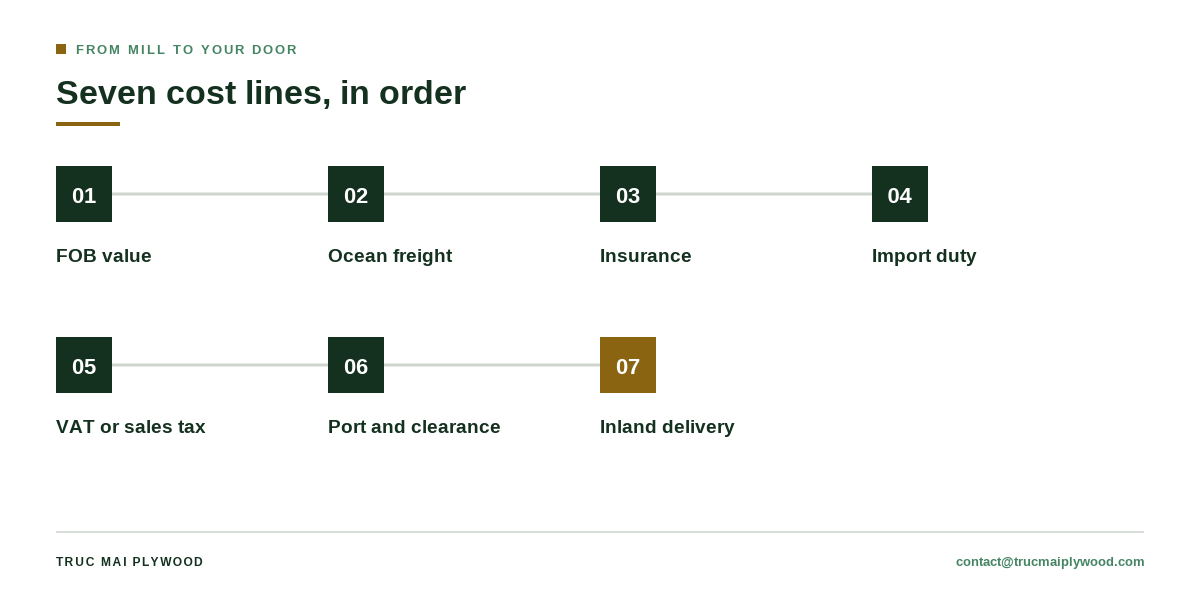
Seven lines make the total, and they follow the order of the journey. The mill sets the first, the forwarder the next two, the customs authority of your country the next two, and your port and haulier the last two. A buyer who sees all seven can compare origins and cores on one basis; a buyer who sees only the first compares a part of the cost.
Truc Mai holds no dated price, so this page does not print a rate. The worked example uses index units, with the FOB rate set at 100 units per m³ so that the box effect can be seen on its own. The units are not dollars or euros. Every input that is a price is marked as a buyer input, and every input that is a rule or a quantity carries its source.

What are the seven cost lines of a landed container?
The seven lines are the FOB value, ocean freight, marine insurance, import duty, VAT or sales tax, destination port and customs charges, and inland delivery. The first three together make the CIF value, which is the base for EU duty. Each line has an owner and a place to read the number.
| Line | Who sets it | Where the number comes from |
|---|---|---|
| 1. FOB value | The mill | The quote: rate per m³ × m³ per box (buyer input) |
| 2. Ocean freight | Carrier or forwarder | The forwarder’s quote for the port pair (buyer input) |
| 3. Insurance | Insurer | The policy; CIF default is Institute Cargo Clauses (C) |
| 4. Import duty | Customs of the importing country | The tariff code and the rule for the customs value |
| 5. VAT or sales tax | Tax authority | The rate of the member state or state, on a base set by law |
| 6. Port and clearance | Port, broker | The broker’s quote (buyer input) |
| 7. Inland delivery | Haulier | The haulier’s quote (buyer input) |
Lines 1 to 3 are what a CIF quote from the mill contains. Under FOB the buyer holds lines 2 and 3, and under CFR the buyer holds line 3. Lines 4 to 7 sit with the buyer under every term, which is why a CIF price is not a delivered price. The terms are compared in the section on delivery terms below.
The order matters because each line feeds the next. Duty is a percentage of a value that already contains freight and insurance in the EU; VAT is a percentage of a value that already contains duty; and the destination charges are added last. A buyer who adds the percentages instead of building the base in order will get a number that is wrong by more than any single line.
Freight and duty to export plywood from Vietnam: which lines are which
Freight and duty are two of the seven lines; the others are product, packing, insurance, VAT and local charges.
Which inputs are sourced and which are yours?
Quantities and rules are sourced; prices are yours. The m³ and sheets per box, the days at sea and the delivery terms come from Truc Mai’s packing model and standard terms. The duty basis comes from law. The FOB rate, the freight, the insurance, the duty percentage and the port and haulage costs are buyer inputs, because they come from quotes you hold.
| Input | Status | Source |
|---|---|---|
| m³ and sheets per 40HC, by core | Sourced, planning figure | Truc Mai packing model: 28,000 kg payload, packs about 1,000 mm high |
| Days at sea from Hai Phong | Sourced, typical range | Truc Mai lane table, varies by carrier and route |
| Delivery terms, deposit, balance | Sourced | Truc Mai standard terms: FOB, CFR, CIF; 30% and 70% |
| EU customs value rule | Sourced | Regulation (EU) No 952/2013 |
| EU VAT base rule | Sourced | Directive 2006/112/EC |
| US customs value rule | Sourced | 19 U.S.C. 1401a |
| FOB rate per m³ | Buyer input | The mill’s quote for your build |
| Freight per box | Buyer input | Your forwarder, for your port pair and date |
| Insurance | Buyer input | Your policy |
| Duty percentage | Buyer input | The tariff for your code and origin, read by your broker |
| Port, clearance, inland | Buyer input | Broker and haulier quotes |
The statuses are the point of the table. A cost sheet that blends sourced quantities and guessed prices looks precise and is not. Keeping the two apart means that when a quote changes, one cell changes, and the rest of the sheet still stands.
For the worked example below, the buyer inputs are placeholders in index units, stated before they are used. None of them is a rate that Truc Mai quotes or a market price.
How does the core choice change the cost per m³ of one 40HC?
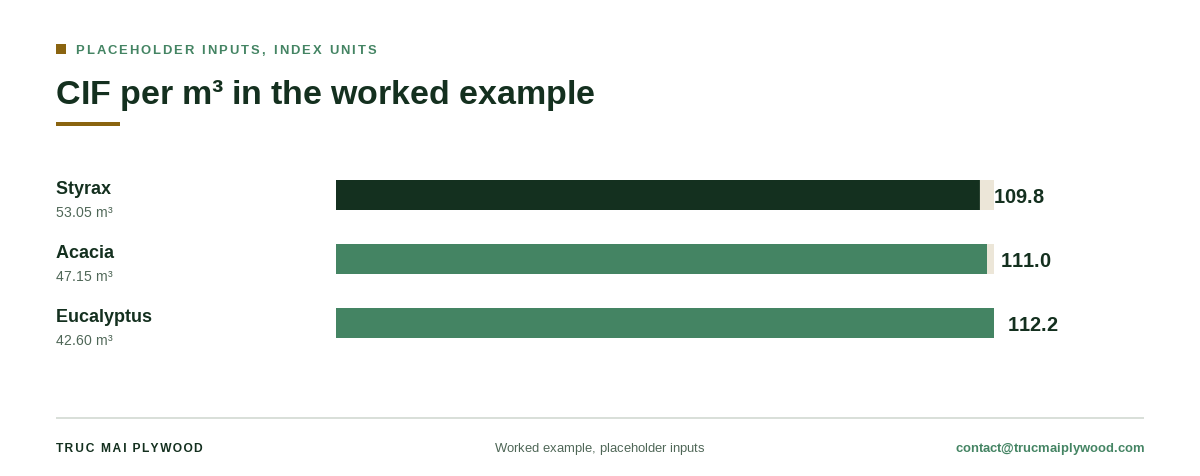
The core changes the cost per m³ through the box. Styrax loads about 53.05 m³ of 18 mm board in a 40HC, Acacia 47.15 m³ and Eucalyptus 42.60 m³ (planning figures), so the same box lines, freight and insurance, are spread over about 20% fewer m³ on Eucalyptus than on Styrax. The mill rate is a separate input.
To isolate the box effect, the example gives all three cores the same FOB rate of 100 units per m³. In practice the rates differ by core, and the quote tells you how. What the example shows is how much the box adds on top of any rate.
Assumptions, all buyer inputs and placeholders: FOB rate 100 units per m³; freight 500 units per box; insurance 20 units per box. Panels are 18 mm, 1220 × 2440 mm.
| 18 mm, 1220 × 2440 mm | Styrax | Acacia | Eucalyptus |
|---|---|---|---|
| m³ per 40HC | 53.05 | 47.15 | 42.60 |
| Sheets per 40HC | 990 | 880 | 795 |
| FOB value, 100 units per m³ | 5,305 | 4,715 | 4,260 |
| Freight and insurance, 520 per box | 520 | 520 | 520 |
| CIF value per box | 5,825 | 5,235 | 4,780 |
| CIF per m³ | 109.8 | 111.0 | 112.2 |
| CIF per sheet | 5.88 | 5.95 | 6.01 |
On these placeholders the Eucalyptus box costs about 2.2% more per m³ than the Styrax box. The gap grows with the freight share. Doubling the freight to 1,000 units per box, with the same insurance, gives 119.2, 121.6 and 123.9 units per m³, a gap of about 4.0%. The cost of the box is spread over the m³, so the more it weighs in the total, the more the core matters.
Read the table the other way too. If the Eucalyptus mill rate is lower than the Styrax rate by more than the gap, Eucalyptus is cheaper delivered; if not, Styrax is. The quote and the container plan settle it together. The loads behind the rows are explained in sea freight per m³ and on 18 mm plywood by core.
How do you cost one 18 mm Styrax container for the EU, step by step?
Plywood landed cost calculation in seven steps
Build the EU cost in order: FOB value, add freight and insurance to get the customs value, apply the duty rate, then apply VAT to the sum of customs value, duty and the costs to the first destination. The Styrax example below stops at the customs value and shows what each percentage point of duty adds, because the real rate is your input.
- FOB value: 53.05 m³ × 100 units = 5,305 units (FOB rate is a buyer input).
- Add freight and insurance: 5,305 + 500 + 20 = 5,825 units, the CIF value (both are buyer inputs).
- Customs value in the EU: the transaction value plus transport and insurance to the place of entry, so 5,825 units for a CIF box.
- Duty: the rate for your code × 5,825. Each percentage point adds 58.25 units.
- VAT: the member state rate × (customs value + duty + incidental costs to the first destination).
- Add port, clearance and inland costs (buyer inputs).
- Divide by 53.05 m³ for the landed cost per m³.
The rule behind step 3 is in Regulation (EU) No 952/2013: the customs value is built from the transaction value, and the elements added include “the cost of transport and insurance” up to the place where the goods enter the Union. That is why an FOB quote and a CIF quote have the same customs value once the freight is added.
The rule behind step 5 is in Directive 2006/112/EC: the taxable amount on importation is “the value for customs purposes”, and it includes duties and incidental expenses such as transport and insurance “up to the first place of destination” in the importing member state. A VAT-registered importer normally reclaims import VAT, so for it VAT is a cash-flow item and not a cost; confirm that with your adviser.
The duty rate itself comes from the tariff: heading 4412 for plywood, and a code that depends on the face species and the build. The broker reads the rate for your code, and the steps from heading to statement are on the page about importing plywood from Vietnam to Europe.
Does the EU anti-dumping duty on Chinese hardwood plywood apply to plywood made in Vietnam?
No. The EU anti-dumping duty is imposed on hardwood plywood originating in the People’s Republic of China, at 43.3% for one named exporter and 86.8% for all other companies, on the net free-at-Union-frontier price. Plywood made in Vietnam is outside it, and the origin papers say Vietnam. The duty is context, never a reason to choose a supplier.
Article 1 of Regulation (EU) 2025/2333 imposes the definitive duty on hardwood plywood “originating in the People’s Republic of China”. The scope also describes the panel, with each ply not exceeding 6 mm, so the measure is narrower than the whole of heading 4412.
For the cost sheet, the consequence is simple: the line for anti-dumping duty on a Vietnamese-origin lot is zero because the measure does not apply, and the ordinary duty line stays. The caution is about origin. Customs rules decide origin, so if some material in the panel (a face veneer, say) was produced in another country, have the broker check the origin shown on the documents before the container ships.
A comparison of origins on landed cost should use the same method for each: FOB value, freight and insurance, ordinary duty, any anti-dumping duty that applies to that origin and product, then VAT. A Chinese-origin panel in scope carries the extra line; a Vietnamese-origin panel does not. The rest of the sheet is identical.
Is there anti-dumping duty on plywood from Vietnam into the US?
Yes, for hardwood and decorative plywood from Vietnam in scope. The US International Trade Commission voted in the affirmative, and Commerce’s final determinations in cases A-552-851 and C-552-852 gave a Vietnam-wide dumping margin of 90.12% with a cash deposit of 84.95%, and a countervailing duty of 47.68% for all others. Scope and exporter rates decide the deposit for a given entry.
The ITC news release says “Commerce will issue antidumping and countervailing duty orders” on hardwood and decorative plywood from China, Indonesia and Vietnam. The final determinations are in the Federal Register: antidumping and countervailing duty. Structural plywood to PS 1 and PS 2, phenolic film-faced plyform, flooring and ready-to-assemble furniture are outside the cases.
The cash deposit is a percentage of the entered value, and the entered value is not the EU base. US law takes the price actually paid or payable “exclusive of any costs, charges, or expenses incurred for transportation, insurance, and related services incident to the international shipment”, in 19 U.S.C. 1401a. A US entry is therefore valued near the FOB figure, not the CIF figure.
In the cost sheet, the US column changes in two places. The duty base is the FOB value, 5,305 units in the Styrax example, and the duty line is the ordinary rate plus any cash deposit that applies to the exporter and the product. Both percentages are buyer inputs read from the order and the broker, and the deposit is the largest line when it applies. The details are on the page about importing plywood from Vietnam to the USA; re-check the notice of the order and the exporter’s own rate before relying on any figure.
How do you find the duty rate for your plywood code?
Import duty on plywood from Vietnam: where the rate comes from
Read it from the official tariff for the importing market, by commodity code and origin: TARIC for the EU, the Trade Tariff for the UK, the Harmonized Tariff Schedule for the US. The broker fixes the code from the face species and the build, because the rate differs between subheadings of heading 4412.
For the EU, Annex I of Regulation (EU) 2023/1115 lists heading 4412 (“Plywood, veneered panels and similar laminated wood”), which brings each plywood shipment inside the deforestation regulation’s scope; the same four digits also open the tariff code on the cost sheet. The tariff line below it depends on the face and on whether the panel is coated.
For the UK, the Trade Tariff shows both the third-country duty and any preference by origin. For commodity code 4412 33 20 10, with a face of poplar, it lists a third-country duty of 6.00% and a preferential rate of 0.00% for Vietnam: see the UK Trade Tariff entry. The preferential rate has applied since 1 January 2025. Check your own code on the day of the order, because codes and preferences change.
For the United States, the HTS lists the ordinary rate for each ten-digit line and the additional measures that apply, and the broker adds the AD/CVD deposit when the product is in scope.
Whatever the market, the output of this step is one percentage per line, written next to the code and the date it was read. That is the buyer input for line 4, and it is the number to recheck when the order is placed.
Which delivery terms can be quoted from Hai Phong?
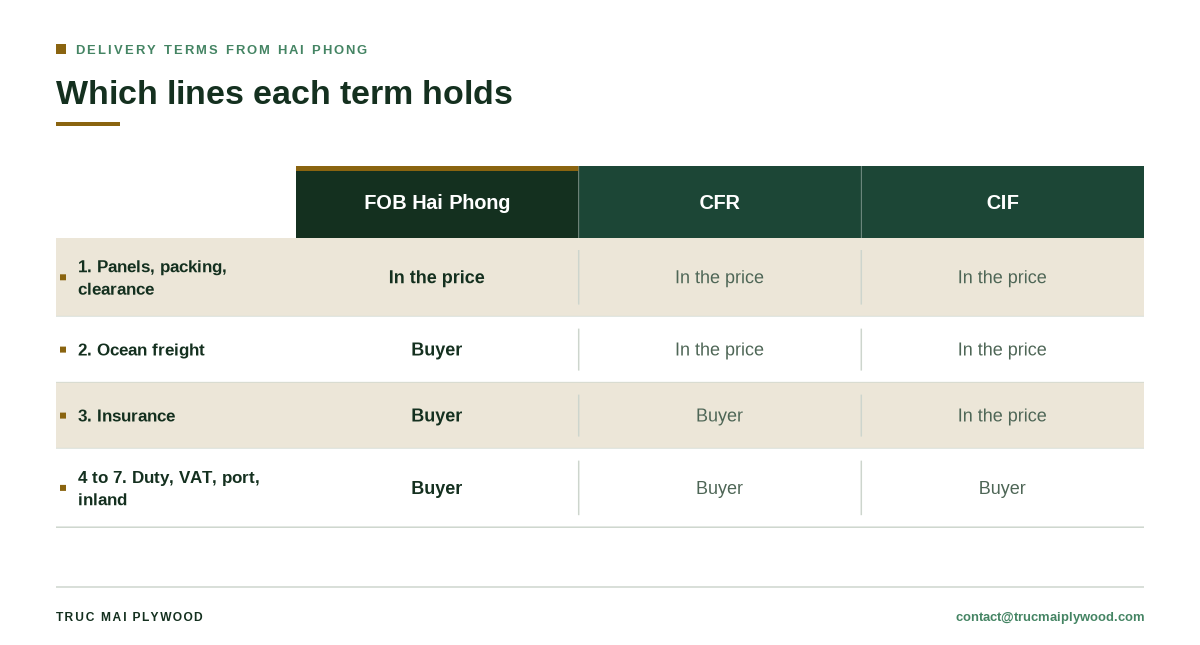
Truc Mai quotes three terms: FOB Hai Phong, CFR (also written CNF) and CIF. They differ in how many of the seven lines the mill’s price already contains. FOB holds line 1, CFR holds lines 1 and 2, and CIF holds lines 1 to 3. Lines 4 to 7 are the buyer’s under every term.
| Line | FOB Hai Phong | CFR | CIF |
|---|---|---|---|
| 1. Panels, export packing, clearance | In the price | In the price | In the price |
| 2. Ocean freight | Buyer | In the price | In the price |
| 3. Insurance | Buyer | Buyer | In the price |
| 4 to 7. Duty, VAT, port, inland | Buyer | Buyer | Buyer |
Under CIF the level of insurance is a choice. In the International Chamber of Commerce’s account of Incoterms 2020, Institute Cargo Clauses (C) are the CIF default, and buyer and seller are free to agree wider cover. State the level on the RFQ, so the quote and the policy match.
Which term is cheaper depends on the freight each side can buy. A buyer with a contract rate often does better on FOB; a buyer who ships rarely may do better on CFR or CIF. The only fair test is to ask for the same build on two terms and put both into the seven-line sheet, which turns the question into arithmetic. The price side of the same question is on how an FOB Hai Phong rate is built.
Can different specifications be mixed in one container?
Plywood cost per m3 container when two products share the box
Yes. One or two products per box is normal, and by agreement three to six can share it. For the cost sheet, keep each product’s own FOB rate and share the box lines, freight and insurance, by m³. Each product’s landed rate is then its own FOB rate plus an equal share of box cost per m³.
An example on Styrax, with the planning split from the packing model: 9 packs of 18 mm (495 sheets, 26.5 m³) and 9 packs of 9 mm (999 sheets, 26.8 m³) make a box of 53.3 m³. With the placeholder box cost of 520 units, each m³ carries about 9.8 units of freight and insurance, whichever product it is. The 18 mm and the 9 mm lines then add their own FOB rates and the ordinary duty for their codes.
Two cautions apply. A different face or core on a line can change the tariff code and so the duty percentage, which is why every product line gets its own code in the sheet. And each extra product adds a line to the production plan, which can lengthen the lead time. The mix is agreed when the order is placed, and the weighed sheets, not this arithmetic, set the final plan; the sums above are for planning, not a loading record.
How many days at sea from Hai Phong to Northern Europe or the US East Coast?
Typical days at sea from Hai Phong are 30–40 to Northern Europe and 35–45 to the US East Coast, varying by carrier and route. They come after 15–45 days of production following the 30% deposit, so cash is out for about 45–85 days to Northern Europe and 50–90 days to the US East Coast before the goods are sold.
| Lane | Production after deposit | Days at sea | Cash out before the goods arrive |
|---|---|---|---|
| Hai Phong to Northern Europe | 15–45 days | 30–40 days | about 45–85 days |
| Hai Phong to US East Coast | 15–45 days | 35–45 days | about 50–90 days |
Other lanes, from South-East Asia to West Africa, are in the transit table of the sea freight per m³ guide; put the lane you ship on into the sheet the same way.
The days are a cost line of their own, the cost of money. The deposit of 30% leaves your account at order, the balance of 70% is paid against the scanned B/L (see deposit and balance terms), and the panels reach your warehouse only after the sea window, the port and the haulage. Multiply the cash out by the days and by your cost of funds to get that line; the rate is a buyer input.
Settling the balance by L/C at sight costs bank fees, but the documents are in view before the money moves. T/T on the scanned B/L is the cheaper route in fees. The comparison belongs in the sheet, next to freight, because it changes the cost of the same panel by a small but real amount.
How do you keep the sheet honest when quotes change?
Keep one cell per input, mark each as sourced or buyer input, and change only the cell that changed. When the forwarder’s rate moves, the freight cell changes and every dependent line recomputes. When the mill weighs real sheets, the m³ per box changes, and so does every per-m³ result. Date every buyer input.
Three habits keep the sheet useful. First, record the date and the source beside each buyer input, so a number from last month is not mistaken for today’s. Second, keep the planning figure and the packing-list figure side by side after loading, because the packing list is the record. Third, compare quotes only after both are in the same sheet, with the same terms and the same codes.
The sheet also answers the question behind this page, which is whether a cheaper mill rate is really cheaper. It is if it survives the box, the duty and the money. A rate that looks lower and comes with a heavier core, a wider tolerance or a longer lead time may not.
To start, send the order line with your destination port and ask for the container plan with the quote. The first request can include a free sample of the same build, so the cost sheet is checked against a real panel; a new buyer pays the courier and gets that amount back as a credit on a real order. The quotation desk takes the line, or mail it with your port to contact@trucmaiplywood.com.
Questions buyers ask
Why does an EU importer add freight before applying duty?
Because the EU customs value is the transaction value plus the cost of transport and insurance up to the place where the goods enter the Union. A CIF price already holds them, and an FOB price needs them added before the duty rate is applied.
Is the freight line part of the US customs value?
No. US law excludes the costs of international transport and insurance from the price actually paid or payable, so the entered value is closer to the FOB value. That is why the same container is costed on a different base for a US importer than for an EU importer.
How do I rerun the worked example with my own quote?
Replace four inputs: your FOB rate per m³, your forwarder's box rate, the insurance cost and the duty rate for your code. Keep the m³ per box for your core and size, then recompute each line.
Where does the cost of money enter the calculation?
As the days between the 30% deposit and the sale of the last sheet. Production takes 15–45 days after the deposit, days at sea follow, and the 70% balance is paid against the scanned B/L, so cash is out for the whole window.
Which lines can the mill not quote before the order?
Duty, VAT, destination port charges and inland haulage, because they depend on your code, your country and your carrier. The mill quotes the panels under FOB, plus freight under CFR and plus insurance under CIF.
Does the container plan change after the quote?
It can. The 40HC counts are planning figures from the packing model, and the mill weighs real sheets before the final plan, so the packing list is the record. Recompute the cost per m³ from the packing list when it arrives.
How are freight costs shared when one container carries two products?
Share the box lines by m³ and keep each product's own FOB rate. Most boxes carry one or two products, though three to six can be agreed, and each product's landed rate is its FOB rate plus its m³ share of the box cost.
Does the origin certificate decide the duty?
It can support a preferential rate, but the rate depends on your code and the agreement in force, which your broker checks. The mill supplies a certificate of origin, which is a EUR.1 for EU-bound lots, with the other shipping documents.
Where do I check whether an antidumping case covers my panel?
In the scope text of the case notice and the order. For the United States the cases on hardwood and decorative plywood from Vietnam are A-552-851 and C-552-852; structural plywood, phenolic film-faced plyform, flooring and ready-to-assemble furniture are outside them.