
A Vietnam plywood price is a rate per m³ for one written build, delivered on board at Hai Phong, and it moves with the core, the face, the glue, the tolerance, the sheet size and how many m³ the container holds. Truc Mai publishes no price list and no from-US$ line here, because no dated price is on file. This page shows how the rate is built so two quotes can be compared on the same basis.
What is the price of plywood in Vietnam, FOB Hai Phong?
Truc Mai quotes plywood as a rate per m³ for one written build, delivered on board at Hai Phong, and publishes no price list. The rate depends on the core, face, glue and emission class, tolerance, sheet size and how many m³ fit in the 40HC. This page explains each driver and shows how to compare two quotes.
A single Vietnam plywood price does not exist, because the product is not one product. A 9 mm packing sheet with an open face and a 18 mm furniture sheet with an engineered veneer face share a name and little else. Any number quoted without its build is a number for a panel nobody described.
What a buyer can do is fix the build, ask for the rate, and compare it line by line. The sections below follow the order in which the rate is built: what FOB covers, the cost drivers, why a Ha Hoa mill can price the same quality lower, how the core and the container load change the cost per sheet, and how to read the quote.
Why is there no price list on this page?
There is no price list because a rate belongs to a build, and the page holds no dated price fact. A list would put a number beside a product name and leave out the five lines that move it. Truc Mai quotes against the order line the buyer sends, and states a “from US$” figure only when it carries a date.
A price list also goes out of date faster than the panel changes. Veneer, glue and freight each move on their own timetable, so a rate printed on a page is a rate for the day it was printed. Quoting against a written line keeps the rate and the panel together.
The cost of this approach is one email. The ten-line order sheet in writing a plywood RFQ is the shortest route to a rate, and the reply states the build it prices. Until then, this page gives the method, which holds whatever the rate is.
What does an FOB Hai Phong price cover?
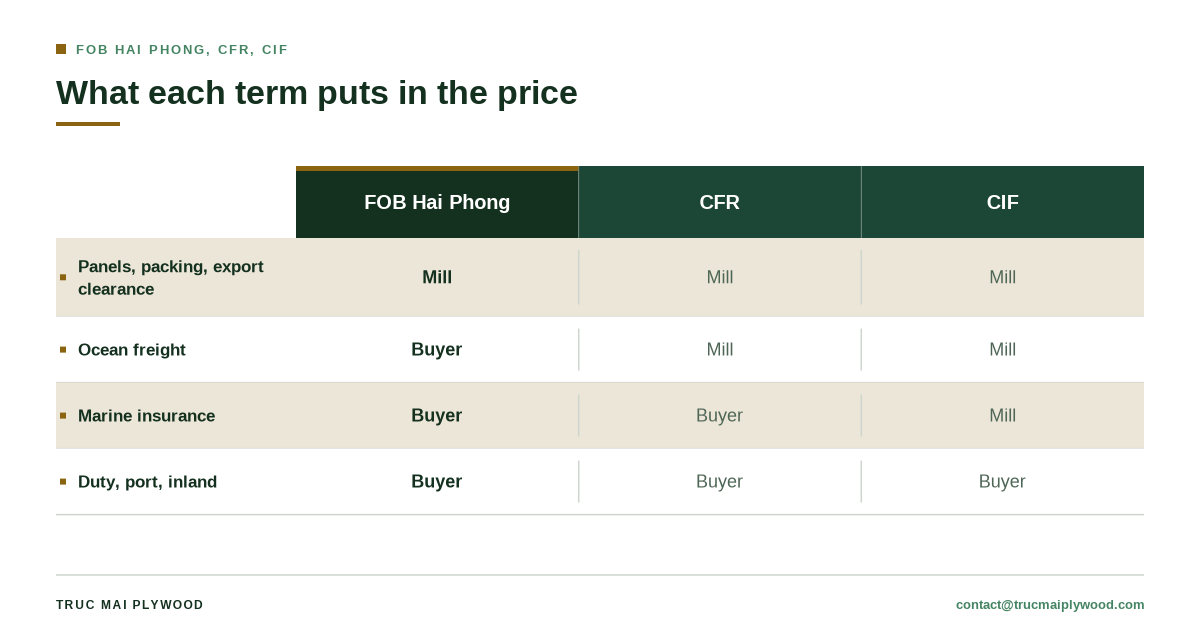
An FOB Hai Phong price covers the panels, their export packing, export clearance and loading on board the vessel at Hai Phong. Ocean freight, marine insurance, destination port charges, import duty and inland delivery stay with the buyer. FOB is the cheapest-looking term because it stops at the ship’s rail.
| Line of cost | FOB Hai Phong | CFR | CIF |
|---|---|---|---|
| Panels, export packing, export clearance | Mill | Mill | Mill |
| Loading on board at Hai Phong | Mill | Mill | Mill |
| Sea freight to the port the buyer names | Buyer | Mill | Mill |
| Cargo insurance on the voyage | Buyer | Buyer | Mill |
| Import duty, port at destination, haul inland | Buyer | Buyer | Buyer |
Truc Mai offers three delivery terms: FOB Hai Phong, CFR (CNF) and CIF. A buyer with a freight contract usually takes FOB and keeps control of the booking. A buyer who wants one price to its port takes CFR or CIF. On a CIF quote, state the cover you want: by default Incoterms 2020 only asks for the minimum Institute Cargo Clauses (C) under CIF, according to the International Chamber of Commerce, and wider cover can be agreed at a price.
The terms change more than the price. They change when the cash is tied up, who carries the risk on the water and what the customs value will be at destination. A comparison of an FOB rate with a CIF rate that skips these differences compares two different things. The section on comparing quotes shows how to convert one to the other.
What factors affect the export price of plywood from Vietnam?
Six factors set the rate: the core species and grade, the face and back, the glue and emission class, the thickness and tolerance, the sheet size, and the container load. The build decides how much veneer, and of what quality, goes into one m³ of board.
| Driver | What it changes | Direction |
|---|---|---|
| Core species and grade | Density, veneer, sheet weight | A-grade stitched core is a different build from AB loose-laid |
| Face and back | Face veneer cost, sorting, sanding | A graded, matched face takes more steps than an open grade |
| Glue and emission | Adhesive system, press settings, tests | UF glue at E0 is the default; a 12-hour boil needs melamine-fortified glue |
| Thickness and tolerance | Veneer sheets per m³, sanding and calibration | Thin sheets need more veneer per m³; ±0.3 mm needs sanding and calibration |
| Sheet size | Volume per sheet, trimming waste | 1250 × 2500 mm gives more m³ per sheet than 1220 × 2440 mm |
| Container load | Freight and handling per m³ | A full 40HC lowers cost per m³; a weight-capped load raises it |
The direction column is qualitative on purpose. Truc Mai does not publish the size of each step, because the step depends on the build and on the supply of veneer at the time. What a buyer can see is the order of the drivers: the first three are about what the panel is, the next two about how precisely it is made, and the last about how it travels.
A seventh factor sits outside the panel: the paperwork. An EU order carries the EUDR geolocation file set for core and face; a US order carries the CARB P2 and TSCA Title VI certificate number; both carry the commercial set. The files are part of the supply, and a quote that lists them is describing the full product. Ask for the files as lines on the quote, so you can see what each adds.
Finally, the plan of the container is a price factor even though it is not a panel factor. The planning model that sets the load for each core is on the m³ per 40HC page, and its effect on freight is in sea freight per m³.
Why can a Ha Hoa mill price the same quality lower?
A Ha Hoa mill can price the same quality lower because the plantation forest nearby supplies core wood at low cost and skilled labour costs less in Phu Tho, so the base of the rate starts lower. Truc Mai is in Ha Hoa, Phu Tho, and makes around 60,000 m³ a year, with about 5,000 m³ in an average month.
The saving is real only when the panel is the same. A lower rate for a panel with an open face, a looser core or a wider tolerance is a rate for a different panel, and the location has nothing to do with it. That is why the advantage of the region is worth stating only after the order line is fixed: once the line is fixed, a lower base shows up as a lower rate for the identical build.
A second effect is on planning. A mill that makes around 5,000 m³ in an average month can plan a monthly container programme, and a monthly buyer is quoted on a written line that stays the same from container to container.
None of this replaces a check. Ask each mill for the same order line, read the replies side by side, and let the identical-build prices decide. The page on monthly container programmes describes how the repeat rhythm is planned.
How does core species change FOB cost per m³?
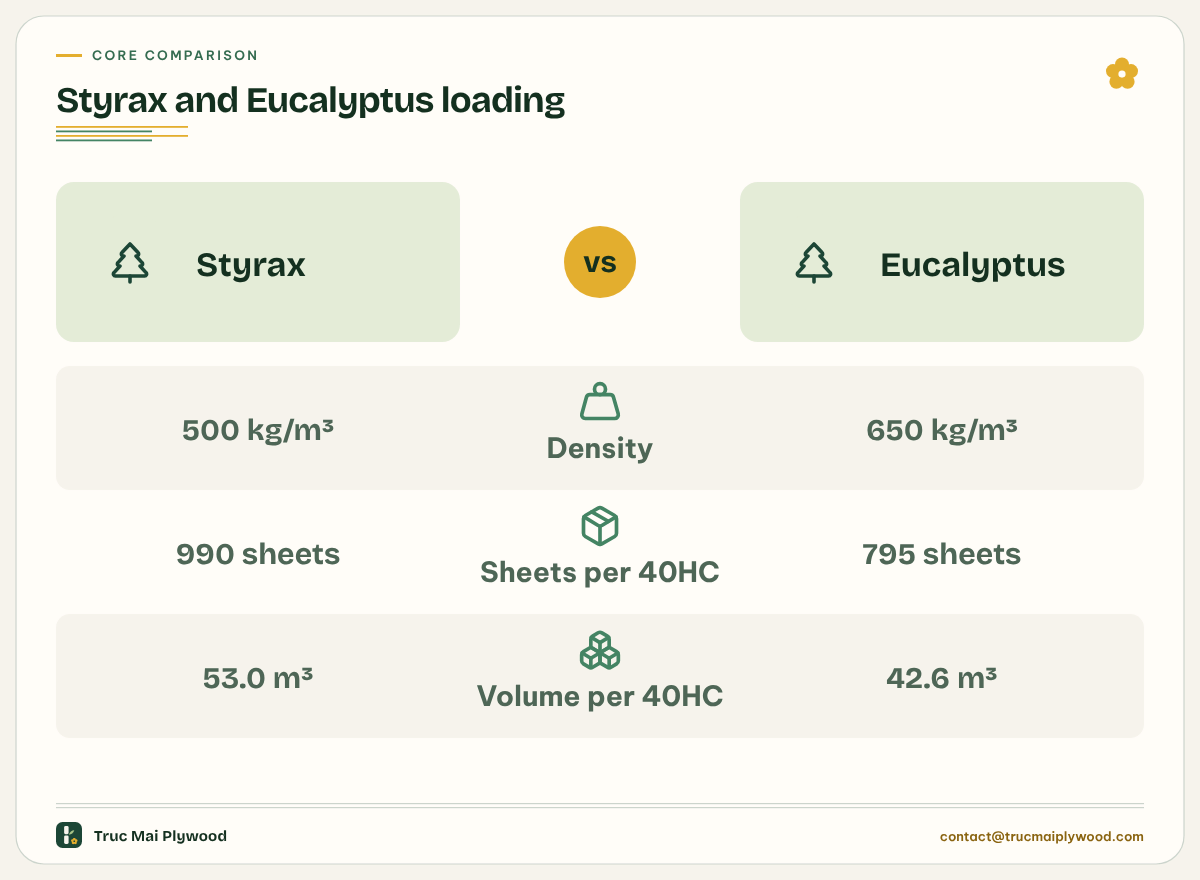
Core species changes the FOB cost per m³ in two ways: the mill rate for the core and the number of m³ that fit in the box. On reference densities Styrax (500 kg/m³) is lighter than Acacia (580 kg/m³) and Eucalyptus (650 kg/m³), so Styrax loads more m³ under the same payload.
At 18 mm and 1220 × 2440 mm the planning model gives these loads, with a 28,000 kg planning payload:
| Core | Reference density | Sheets per 40HC | Volume per 40HC | Sheet weight |
|---|---|---|---|---|
| Styrax | 500 kg/m³ | 990 sheets | 53.0 m³ | 26.8 kg |
| Acacia | 580 kg/m³ | 880 sheets | 47.2 m³ | 31.1 kg |
| Eucalyptus | 650 kg/m³ | 795 sheets | 42.6 m³ | 34.8 kg |
The mill rate per m³ is one number and the box is another. A box that carries 42.6 m³ instead of 53.0 m³ spreads every box-based cost, such as freight, container handling and loading, over fewer m³. Per m³, the Styrax box carries about 24.5% more board than the Eucalyptus box: 53.05 divided by 42.60 is 1.245. A buyer who compares an Acacia rate with a Styrax rate without the box count compares two different delivered costs.
On an FOB comparison, a furniture buyer who swaps Acacia for Styrax tends to see the delivered rate fall even at the same mill rate, because the sheet is lighter, the face cleaner and the box holds more m³. A packing buyer, who needs strength under load and does not mind weight, may prefer a heavier core and accept the box cost. The choice is about the use; the RFQ should state the use first, and the mill proposes the core.
Treat the rows as planning figures, not loading records. The final plan follows a weighing of the actual sheets, and the payload on a given voyage is whatever the carrier and route allow. The 18 mm loading page works through the packs and the payload behind each row.
How does the sheet count per 40HC change the delivered cost per sheet?
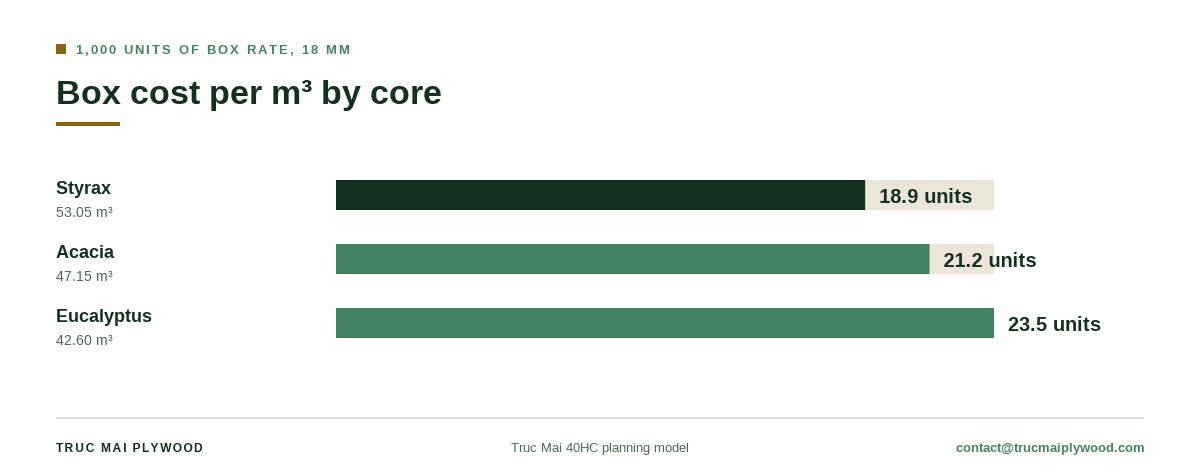
The sheet count per 40HC divides every box-based cost, so more sheets in the box means a smaller share of freight on each sheet. On the planning model a Styrax 40HC holds 990 sheets of 18 mm, Acacia 880 and Eucalyptus 795, so the same box rate lands on each sheet in the ratio 1.00 to 1.13 to 1.25.
Take a box rate of 1,000 units, which is a placeholder and not a rate, and divide it by the sheets and by the m³:
| 18 mm, 1220 × 2440 mm | Sheets per 40HC | Box cost per sheet | Box cost per m³ |
|---|---|---|---|
| Styrax | 990 | 1.01 units | 18.9 units |
| Acacia | 880 | 1.14 units | 21.2 units |
| Eucalyptus | 795 | 1.26 units | 23.5 units |
The ratios are what matter. Whatever the real box rate is, a Eucalyptus sheet carries about 24.5% more of it than a Styrax sheet, and so does a Eucalyptus m³, because the two sheets have the same volume. The calculation applies to any box-based line: freight, port handling at origin and a container deposit all behave the same way.
The mill rate then adds on top. If the Eucalyptus rate per m³ is lower than the Styrax rate, the box cost narrows the gap or closes it; if it is the same, the Styrax panel is cheaper delivered. Only the two numbers together decide, which is why the quote should show the container plan and the sheet count beside the rate. The effect on a full landed cost is worked through on the page about one container costed to your door.
Thickness changes the box in a smaller way. Because packs are about 1,000 mm high and the sheets per pack are 1,000 mm divided by the thickness, Styrax at 3 to 40 mm fills about 53 m³ across the range in the planning table. The m³ per box is steadier across thicknesses than across cores, so core is the larger lever.
How do you turn a plywood price per cubic meter into a price per sheet?
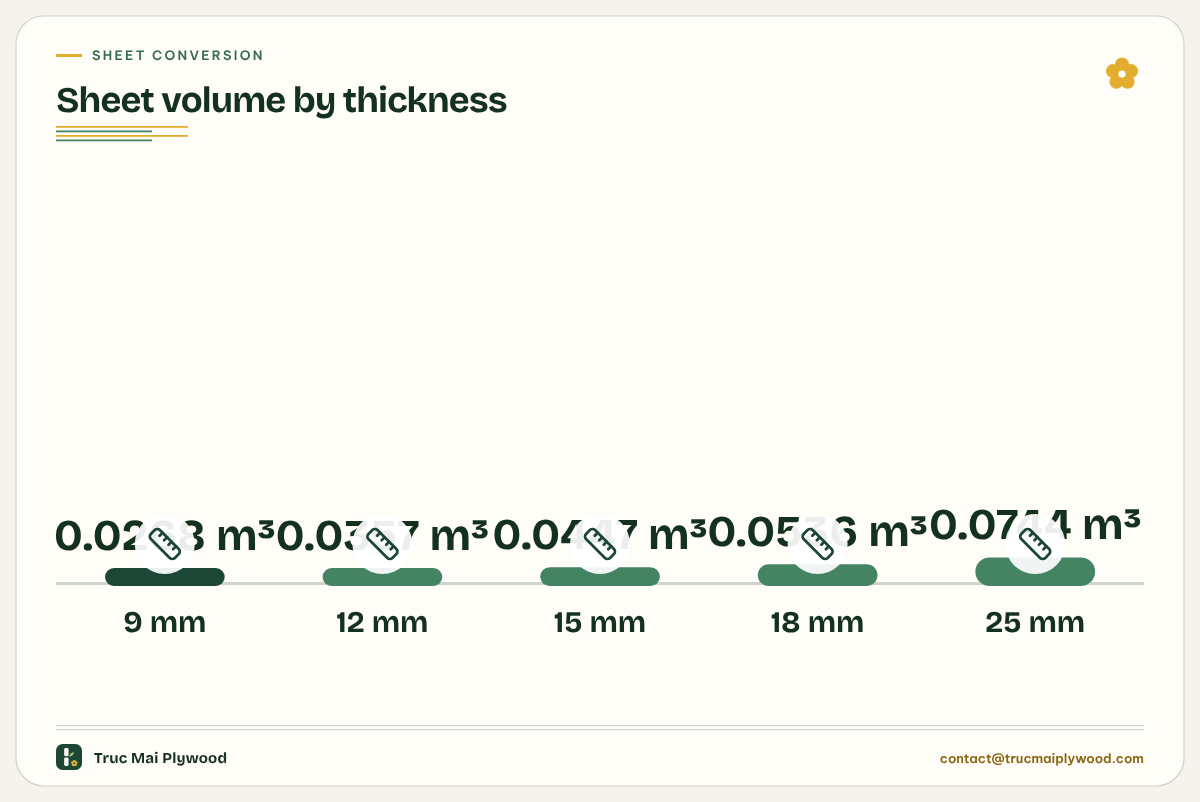
Multiply the rate per m³ by the volume of one sheet. A 1220 × 2440 × 18 mm sheet is 1.22 × 2.44 × 0.018 = 0.0536 m³, so a rate per m³ times 0.0536 is the raw FOB rate per sheet. Divide the other way for sheets per m³: about 18.7 sheets of 18 mm make one m³.
| Thickness, 1220 × 2440 mm | Volume per sheet | Sheets per m³ |
|---|---|---|
| 9 mm | 0.0268 m³ | 37.3 |
| 12 mm | 0.0357 m³ | 28.0 |
| 15 mm | 0.0447 m³ | 22.4 |
| 18 mm | 0.0536 m³ | 18.7 |
| 25 mm | 0.0744 m³ | 13.4 |
The conversion is the same for every core, because it only uses the size of the sheet. What differs between cores is the rate per m³ and the weight. A per-sheet figure obtained this way is a raw FOB figure: it leaves out freight, duty and the cost of your cash, and it must not be set beside a shelf price. The reasoning behind that is in the section on store prices in how plywood is priced.
Use the conversion to check a quote, not to build one. If a mill gives a rate per sheet and a rate per m³ for the same build, divide one by the other: the result should be the sheet volume. A mismatch means the two figures are for different sizes or thicknesses, and the quote should be corrected before it is compared.
Sheet size matters because the volume changes with it. A 1250 × 2500 mm sheet at 18 mm is 0.05625 m³, about 5% larger than the 0.0536 m³ of the 1220 × 2440 mm sheet. A rate per sheet at the larger size is therefore a higher number for the same rate per m³, and a buyer who compares sheet rates across sizes is comparing volumes as much as prices.
What changes between FOB Hai Phong, CFR and CIF?
Between FOB, CFR and CIF the price gains ocean freight and then insurance, and the buyer’s exposure moves with it. FOB leaves both to the buyer; CFR adds freight to a named port; CIF adds insurance on top. Days at sea decide when the cash is tied up under each, and the destination decides the freight.
Transit is added to the 15–45 days of production that start with the deposit: a South-East Asian port is roughly 5–12 days from Hai Phong and a Northern European one 30–40, depending on carrier and route. The full lane list sits on sea freight per m³.
The term matters for tax as well as price. In the EU the customs value is built from the transaction value and adds transport and insurance up to the place of entry: Regulation (EU) No 952/2013 counts the cost of transport and insurance among those additions. A CIF price already contains them, and an FOB price does not, so the importer adds them before applying the duty rate and the VAT. The full route from rate to landed cost is on one container costed to your door.
Which term to choose is a question of who is better placed. A buyer with a regular forwarder and a contract rate often does better on FOB. A buyer who ships once or twice a year and has no contract rate may do better on CFR or CIF, because the mill’s forwarder buys the freight for many containers. The only way to know is to ask for the quote on two terms and convert them to the same basis.
How do you compare two FOB quotes?
Compare two FOB quotes by putting them on the same build, the same unit, the same term and the same payment route, and only then reading the rates. A quote that matches on every line is comparable; a quote that differs or is silent on a line is a question to send back, not a saving.
Five steps do the work:
- Write your order line once and send it to both mills unchanged.
- List each reply against the line and mark every cell as matches, differs or missing.
- Convert both rates to the same unit, using 0.0536 m³ per 18 mm sheet at 1220 × 2440 mm, and check that the sheet and m³ rates agree.
- Convert both to the same term. Add freight and insurance to the FOB rate, or take them off the CFR or CIF rate, using the forwarder’s real figures.
- Compare the container plans. A reply that does not give sheets and m³ per 40HC leaves the box cost unknown.
Only after the five steps does the difference between rates mean something. A buyer who reads the rate first tends to choose the reply with the most missing cells, because a shared product name can hide a different panel underneath; how plywood is priced shows which build lines usually differ.
Add the payment route last. At Truc Mai a deposit is paid at order and the remainder when the scanned B/L arrives, by T/T or L/C at sight; a mill asking for more money earlier, or a buyer needing a letter of credit, changes what the same FOB rate really costs. The MOQ, payment and FOB page sets out the terms in one place.
What do glue, emission and certificate files add to a quote?
Glue, emission and certificate files add lines to a quote rather than a fixed amount, and the quote should show them as lines. Unless the RFQ says otherwise, Truc Mai prices UF glue with E0 emission, which survives roughly 6 hours of boiling. Ask for a 12-hour boil for outdoor parts and the quote moves to melamine-fortified glue, usually at E1.
The glue and the emission class are two separate lines. “E0 glue” is not a specification: E0 is a class, and glue is a material. A quote that mixes them has not said what the panel is. The page on emission class per order explains how the class is fixed by the order.
For the United States, the federal limit for hardwood plywood with veneer core is 0.05 ppm formaldehyde under 40 CFR 770.10. The certificate behind a US quote, CARB/EPA 26053 for CARB P2 and TSCA Title VI, runs from 3 to 25 mm, so a rate for 30 or 40 mm veneer-core panels carries no certificate line.
For the EU, Regulation (EU) 2023/1464 created REACH Annex XVII entry 77 for formaldehyde; since 6 August 2026 an EU lot of wood-based articles or furniture must test at or below 0.062 mg/m³ in the Appendix 14 chamber, so the quote should name the emission report that proves it.
The EUDR file set is the other line. Truc Mai supplies origin records and GeoJSON files with plot geolocation for both the core and the face veneer, so the importer can file its own statement under Regulation (EU) 2023/1115. A quote for an EU lot should list it; a quote that is silent on it leaves the importer to ask later, when the container is already booked.
None of these lines is a reason to pay more by default. They are reasons to ask what the quote includes, and to see the file set named before the order is confirmed. Certificate files are sent before the order is confirmed.
How do tolerance, face and sanding move the rate?
Tolerance, face and sanding move the rate because each is a manufacturing step, not a label. A sanded and calibrated panel at ±0.3 mm goes through more passes than an unsanded one at ±0.5–1.0 mm, and a matched, graded face takes sorting time that an open grade does not. The rate follows the steps the order asks for.
Each order carries its own thickness tolerance, and each costs differently: packing grade at ±0.5–1.0 mm is the cheapest, commercial grade holds ±0.5 mm, and a furniture panel sanded and calibrated to ±0.3 mm is the dearest; length and width stay at ±2 mm throughout. The number belongs on the RFQ with the thickness, because the same number has a different meaning at 6 mm than at 25 mm.
Face and back are quoted as pairs, graded against an approved sample. A face grade that holds on both sides costs more than one that holds on one, and a face of a certified imported veneer, such as an engineered white poplar face, costs differently from a local one. The buyer’s choice is whether the second side needs to match the first.
The practical rule for a buyer is to pay for precision where the machine downstream needs it and nowhere else. A CNC furniture line needs repeat thickness; a pallet-deck saw does not. A quote with the tolerance left out is not cheaper, only unfinished: the mill will assume its commercial default, and the parts will come out wider than the line allows.
Last, the effect on lead time. Thin sheets are a case in point: good thin veneer is scarce, and 4 mm panels use 1.3 mm core veneer and can take longer. The price and the schedule move together, so ask for both.
How do you ask Truc Mai for an FOB Hai Phong rate?
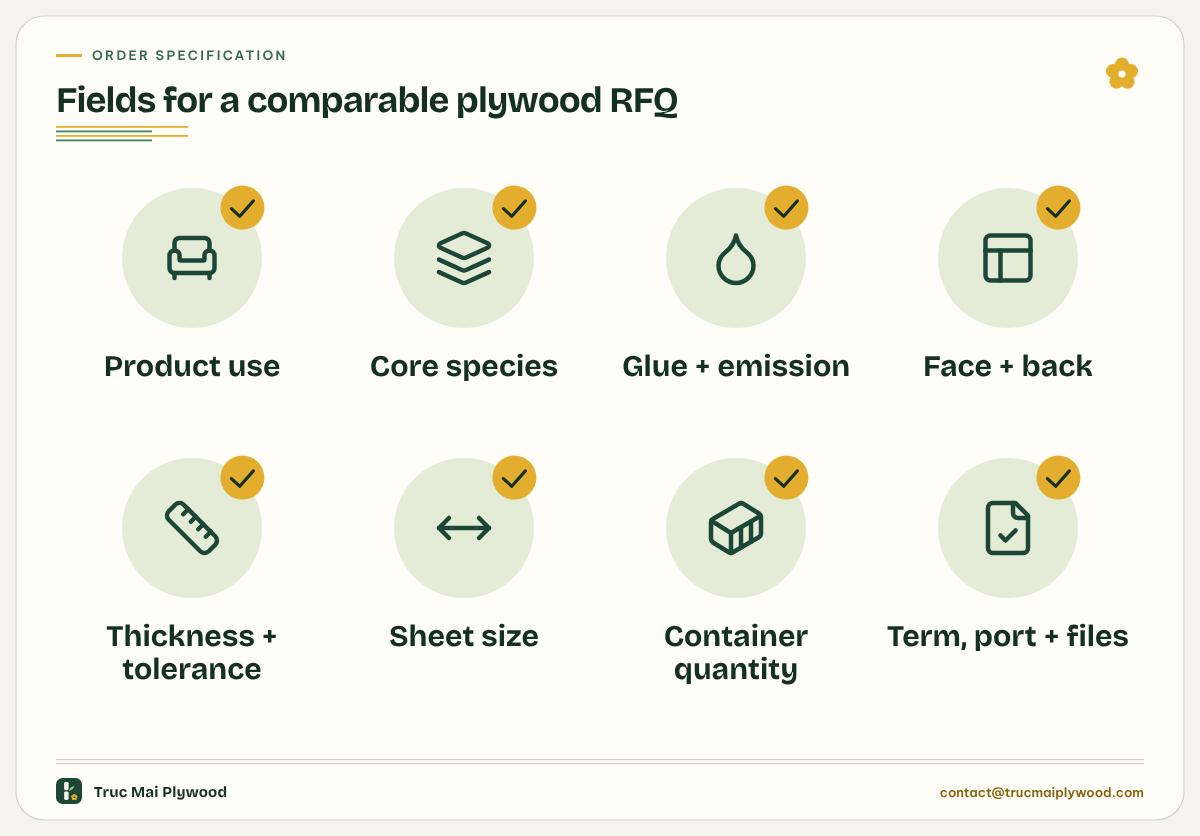
Send the order line: use, core, glue and emission, the face/back pair, thickness and its tolerance, sheet size, packing, the 40HC quantity, the term and port, and the certificate files you need. The reply states the build it prices, the rate per m³ and per sheet, the container plan, the payment terms and the production time.
An example for a monthly furniture buyer, to edit:
Rate wanted: FOB Hai Phong, per m³ and per sheet, with the container plan shown, one 40HC (planning count 990 sheets). Build: kitchen carcass panel at 18 mm on an A-grade Styrax core, stitched, 11 plies; white poplar EV on the face and poplar on the back, both graded to the approved sample; E0 emission on UF glue. Sheet 1220 × 2440 mm, sanded and calibrated to ±0.3 mm, ±2 mm on length and width, in export packs about 1,000 mm high.
Ask for a sample of the same build with the first request: it costs nothing, a new buyer’s courier fee is credited back on a real order, and the face and back grade in the FOB rate is agreed against it.
Send the line to the quotation desk or by email to contact@trucmaiplywood.com. The writing a plywood RFQ page explains each of the ten lines, and the reply comes back on the same ten.
Questions buyers ask
Why can thin plywood cost more per m³ than thick plywood?
A thin panel needs more veneer sheets and more handling for each m³ of finished board, and good thin core veneer is scarce. At Truc Mai, 4 mm panels use 1.3 mm core veneer and can take longer to produce, which is why thin lines are quoted per order.
Does a lighter core always lower the shipping cost per sheet?
Yes, for the same box rate. Styrax loads 990 sheets of 18 mm in a 40HC against 795 for Eucalyptus on the planning model, so each Styrax sheet carries a smaller share of the freight.
Does an FOB price include packing and pallets?
Yes. An FOB Hai Phong price covers the panels packed for export, loaded on board at Hai Phong, with export clearance. Say on the RFQ if you need a different pack height or special marking, because that changes the packing line.
Who books the ship under FOB?
The buyer, or the buyer's forwarder. On FOB terms the mill’s job ends once the container is on board at Hai Phong; the freight contract and marine insurance are the buyer’s. CFR and CIF move those lines to the mill's quote.
Does the quoted rate change with the destination country?
An FOB rate does not include freight, so it does not depend on where the container goes. A CFR or CIF rate does, because it adds freight to a named port, so name the port when you ask for one.
Is the sheet size part of the price?
Yes. A 1250 × 2500 mm sheet holds more volume than a 1220 × 2440 mm sheet, so a rate per sheet and a rate per m³ tell different stories. Compare both on the same size.
Should the quote show the FSC claim as a separate line?
Ask for it as a visible line so you can see what it adds. Truc Mai states the FSC 100% claim on sales and shipping documents for eligible products on its current product schedule, not on every panel automatically.
Can I get a price for a 30 mm or 40 mm panel with the same certificate?
You can get a price, but the CARB P2 and TSCA Title VI certificate covers 3–25 mm, so 30 and 40 mm panels are outside it. Say which certificate files you need so the quote matches.
Why does a quote say planning figure for the container count?
The sheet count comes from a packing model, not from a loading record. The mill weighs real sheets before the final plan, so the cost per sheet is confirmed on the packing list.
What currency should I ask the quote in?
Ask for the currency you will pay in and the term next to it, for example the rate per m³ under FOB Hai Phong. Then every reply is on the same basis before you read the number.