
A plywood RFQ gets one comparable reply when it names the use first, then the core, glue and emission, face and back pair, sheet size, tolerance, packing and quantity in a 40HC. Leave a line out and each mill fills the gap with its own default, so the quotes cannot be compared. Below is the order sheet Truc Mai works from, line by line, with three filled examples to copy.
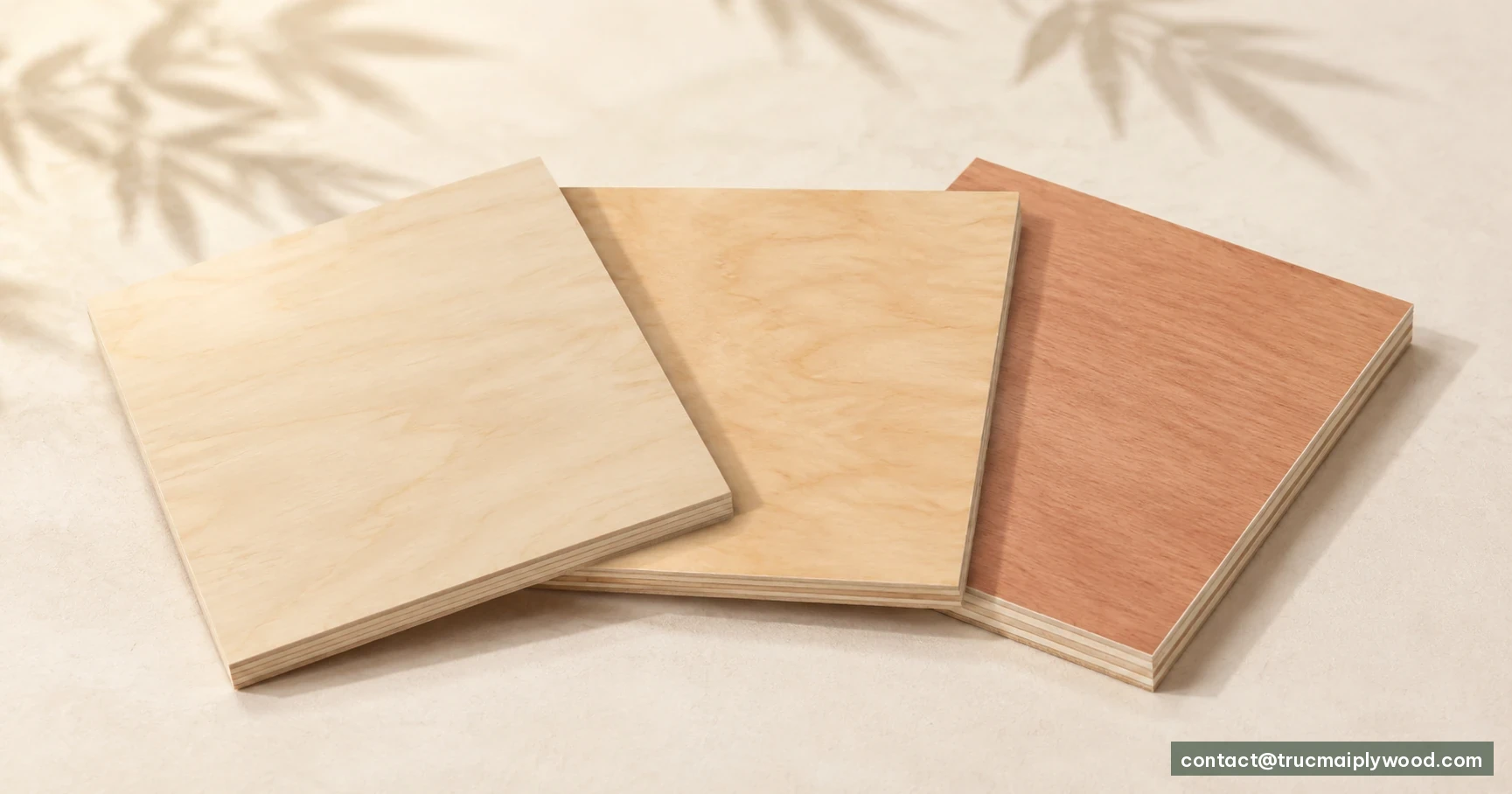
What should I specify when ordering commercial plywood from Vietnam?
Write ten things: the use, the core, the glue and emission class, the face and back pair, thickness with tolerance, sheet size, packing, quantity in a 40HC, the delivery term with port, and the certificate files you need. In that order, a mill can price the request in one reply, because every line it would otherwise guess is already fixed.
The order matters. Start from the application, because the use decides most of the other lines: a kitchen carcass needs a calibrated, sanded sheet, a pallet deck needs a packing grade, and a wall lining may accept an open grade. A mill that reads “kitchen carcasses” first can choose the core and the tolerance sensibly before it reads the next line.
Each line below is explained in its own section, and the sheet that follows it is the one Truc Mai works from. Copy it into an email or a Word file, fill every line you can, and mark the rest “mill to propose”. The mill will treat that as a question, not as a gap to fill with its cheapest default.
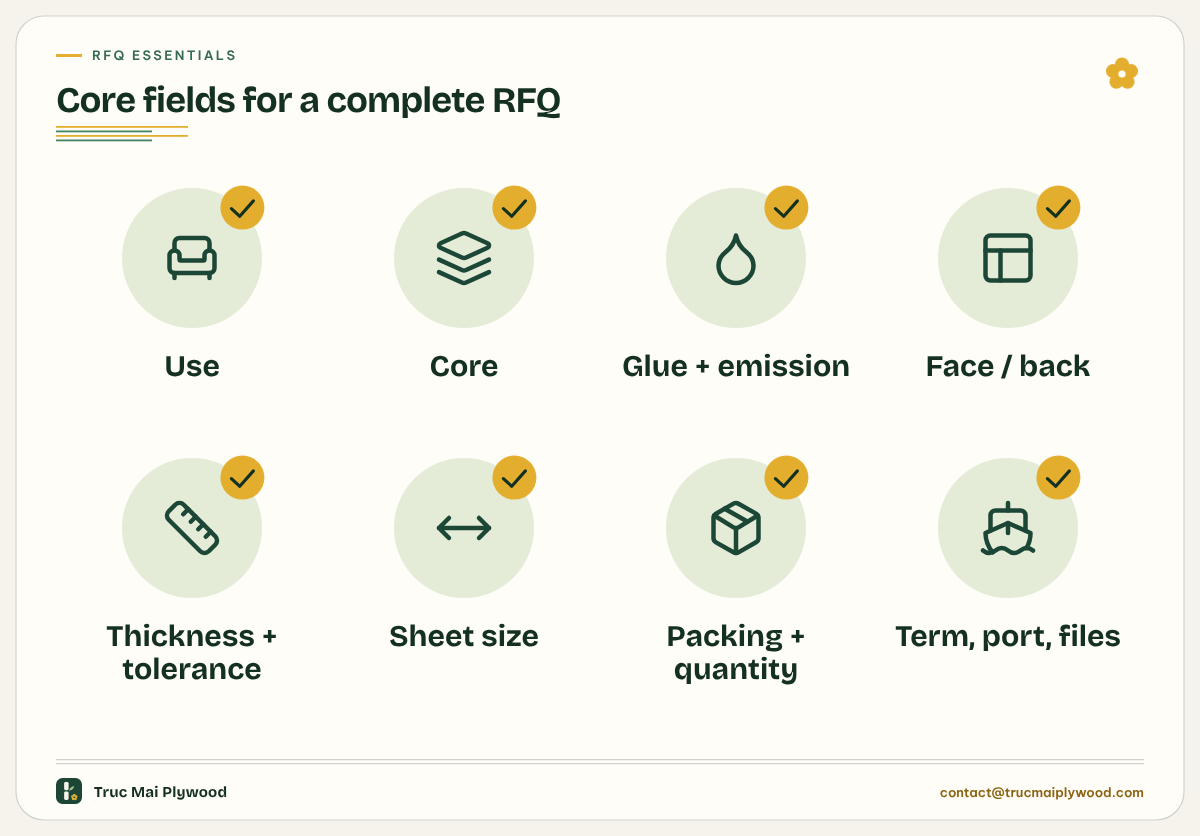
What does a plywood quotation format look like?
A plywood quotation format is a short order sheet with one line per decision a mill must make, followed by a quantity and a delivery term. The version below is plain text, so it pastes into any email and into a spreadsheet column without editing. Fill the brackets and delete nothing.
RFQ: plywood, 1 x 40HC
1. Use:            [kitchen carcasses / door skins / packing / ...]
2. Core:           [Styrax / Acacia / Eucalyptus / Pine / combined; grade; stitched or loose-laid]
3. Glue/emission:  [UF glue at E0 / MR / melamine-fortified WBP] + [emission class or CARB/TSCA]
4. Face / back:    [species] grade [ ] / [species] grade [ ], approved sample ref [ ]
5. Thickness:      [ ] mm, plies [ ], tolerance [±0.3 / ±0.5 / ±0.5-1.0] mm
6. Sheet size:     [1220 x 2440 / 1250 x 2500 / 1220 x 2280] mm, length and width ±2 mm
7. Packing:        [export packs, pack height, pallets / crates / cut-to-size panels]
8. Quantity:       [ ] sheets = [ ] m3, 1 x 40HC, monthly or one-off
9. Term and port:  [FOB Hai Phong / CFR / CIF] [destination port]; payment [T/T or L/C at sight]
10. Documents:     [FSC claim / emission certificate / EUDR file set / test reports]
Quote per m3 and per sheet. Please confirm lead time and a free sample of the same build.
Plywood quotation format free download
There is no file to download: the block above is the whole format, so copy it into an email, a Word file or a spreadsheet column and fill the brackets. A plain text sheet survives every mail system and every purchasing tool.
Plywood quotation format pdf
If your purchasing team needs a PDF, paste the sheet into a document and print it to PDF. Send the same text in the body of the email as well, so the mill can copy a line into its reply.
The sheet is deliberately short. A request with thirty lines is read less carefully than one with ten, and the ten lines carry the cost drivers. Anything else, such as a drawing, a label design or a delivery address, goes in a separate attachment that the sheet mentions by name.
| Line | What it fixes | If you leave it out |
|---|---|---|
| 1. Use | Core grade, tolerance, face quality | The mill assumes a general-purpose panel |
| 2. Core | Weight per sheet, m³ per 40HC, price per m³ | A mixed hardwood core may be quoted |
| 3. Glue and emission | Boil resistance and formaldehyde class | “E0 glue” or an unstated class |
| 4. Face and back | Appearance and sanding cost | Open grade on one or both sides |
| 5. Thickness and tolerance | Fit in the buyer’s machine or joint | ±0.5–1.0 mm commercial tolerance |
| 6. Sheet size | Yield, m³ per sheet, container load | The 1220 × 2440 mm default |
| 7. Packing | Damage risk, pack height, handling | Standard export packs |
| 8. Quantity | Rate per m³ and production slot | A price per sheet with no volume |
| 9. Term and port | What the price includes | An FOB price compared with a CIF one |
| 10. Documents | Whether the load can be cleared | Certificates asked for after the order |
Why do two quotes with the same product name differ?
Two quotes with the same product name differ because the name does not fix the panel. “18 mm poplar plywood” can be a sanded, stitched, A-grade Styrax core with an engineered veneer face, or an unsanded, loose-laid mixed core with a rotary-cut face. Both are plywood, and both carry the name, at very different costs per m³.
Truc Mai’s own working rule is that the difference comes from five places: core grade, joining method, face preparation, adhesive system and tolerance. A request that fixes those five makes the quotes comparable; a request that does not leaves the buyer to guess which offer is the better panel.
Take the lines one at a time and ask what a lower price would have to leave out. Lower core grade shows up as voids and overlaps that appear when the panel is machined. A loose-laid core shows up as gaps that open at the edge. An unsanded face shows up as sanding hours at the buyer’s plant. A looser tolerance shows up as thickness variation across the load, so joints and edge-banding do not sit flush. A cheaper adhesive system shows up as a lower boil resistance, or a higher emission class, or both.
None of these is wrong for every use. A packing line does not need a calibrated face, and paying for one is waste. The point of the RFQ is that the buyer chooses what to leave out, in writing, instead of the mill choosing it silently. For the cost side of the same question, read how plywood is priced.
The same reasoning is why Truc Mai asks for the application first. Two buyers sending “18 mm plywood, 990 sheets” may need panels that differ in five lines, and only the use line tells the mill which five.
What use do you write, and why does it come first?
Write the use as a plain phrase, such as kitchen carcasses, wardrobe doors, shelving, bed bases, packing crates, wall lining or a pallet deck. The use tells the mill which line of the factory the order belongs to: furniture and interior panels, commercial panels or packing panels. Each line has a default build, and the default is what the quote is based on.
Truc Mai’s three lines differ in build, not in name:
| Line | Core | Faces | Emission, usual |
|---|---|---|---|
| Furniture and interior | A-grade core, stitched | Sanded and calibrated | UF glue at E0 |
| Commercial | AB core, loose-laid or jointed | Unsanded or lightly sanded | By order |
| Packing | AB loose-laid core | Unsanded | Usually E2 |
If the use is something else, say so and describe the load or the finish. “Shelving, 600 mm span, painted” gives the mill more to work with than “18 mm plywood”. The mill may answer with a thicker panel or a different core, and that answer is the reason to give the use at all.
A buyer who serves several uses sends one RFQ per use. A single RFQ that mixes kitchen carcasses and pallet decks asks the mill to quote two products under one name, and the comparison with other mills becomes harder, not easier. The container can still carry both, as the section on mixed thicknesses shows below.
How do core, glue and emission go on the RFQ?
Write core, glue and emission as three separate facts: the core species and grade, the glue type, and the emission class or certificate. “E0 glue” is not a line, because E0 is an emission class and not a glue. On a Truc Mai RFQ, leaving the glue line blank means UF glue at E0 emission, which resists boiling for about 6 hours; if the panel goes outdoors and must pass a 12-hour boil, write melamine-fortified glue and expect the emission to move to E1 in most cases.
The core has four choices at Truc Mai: Eucalyptus, Acacia, Styrax or Pine, or combined species laid together to balance price, weight and appearance. There is no rubberwood core, and gurjan, okoume and bintangor are faces only. A plywood core in Vietnam is never poplar or birch.
The core choice moves three numbers on the quote. It sets the sheet weight, which sets how many sheets fit under the container payload. It sets the price per m³, because a lighter, paler core costs more or less depending on supply. And it sets the colour of the edge, which matters when the edge stays visible. At 18 mm the planning figures are 26.8 kg for a Styrax sheet, 31.1 kg for Acacia and 34.8 kg for Eucalyptus; the 18 mm loading page gives the container counts.
Core grade and joining method belong on the same line. Furniture and interior panels use an A-grade core that is stitched across and along the sheet, usually the outer 2–4 plies and all plies on request. Commercial and packing panels use an AB core, loose-laid or jointed. A buyer who writes “A-grade core, stitched” gets the first; one who writes “commercial” gets the second.
For glue and emission, write what you must meet, then let the mill name the glue that gets there. The step from glue to emission class is explained on the page about emission class per order, and the certificate wording is covered further down.
How are face and back grades written on a quotation?
Write face and back as a pair, with the species and the grade of each side, and name the approved sample the grade is judged against. For example: white poplar EV face, grade A, with a poplar back, grade B, against sample 2. Truc Mai quotes face and back grades as pairs, and the grade is agreed against the approved sample and written on the order.
A grade letter alone is not enough. Face grade letters differ between mills and between markets, so “B/BB” from one factory may be closer to “BB/CC” from another. A physical sample, or a clear photograph of one, fixes the meaning. That is why the order sheet has a field for the sample reference: it turns a letter into something a quality controller can compare on the day of loading.
The face species is the other half. On the RFQ, pick one name from the Truc Mai face list: EV (engineered veneer, which European buyers call white poplar EV), poplar, bleached poplar, birch, okoume, bintangor, pine, eucalyptus, gurjan or sapele; others can be asked for. A birch face is imported veneer over a Vietnamese core, so write birch-faced plywood. Write the face species as you would on a drawing, not as a trade name.
Three mistakes show up again and again. The first is writing one grade for the whole panel, which hides that the back is usually a lower grade. The second is writing a grade without a sample, which leaves the mill to interpret it. The third is writing a face species without saying whether the face must be sanded, polished or prepared for a UV coating. “UV-ready” means both faces are prepared for the buyer’s own UV coating; the mill does not apply the UV.
If the buyer needs a matched face across several sheets, such as doors that sit side by side, say so on the line. Ask the mill whether matching a face across sheets adds time or cost, so the answer sits in the quote and not in a later email.
Which tolerance should a furniture RFQ write?
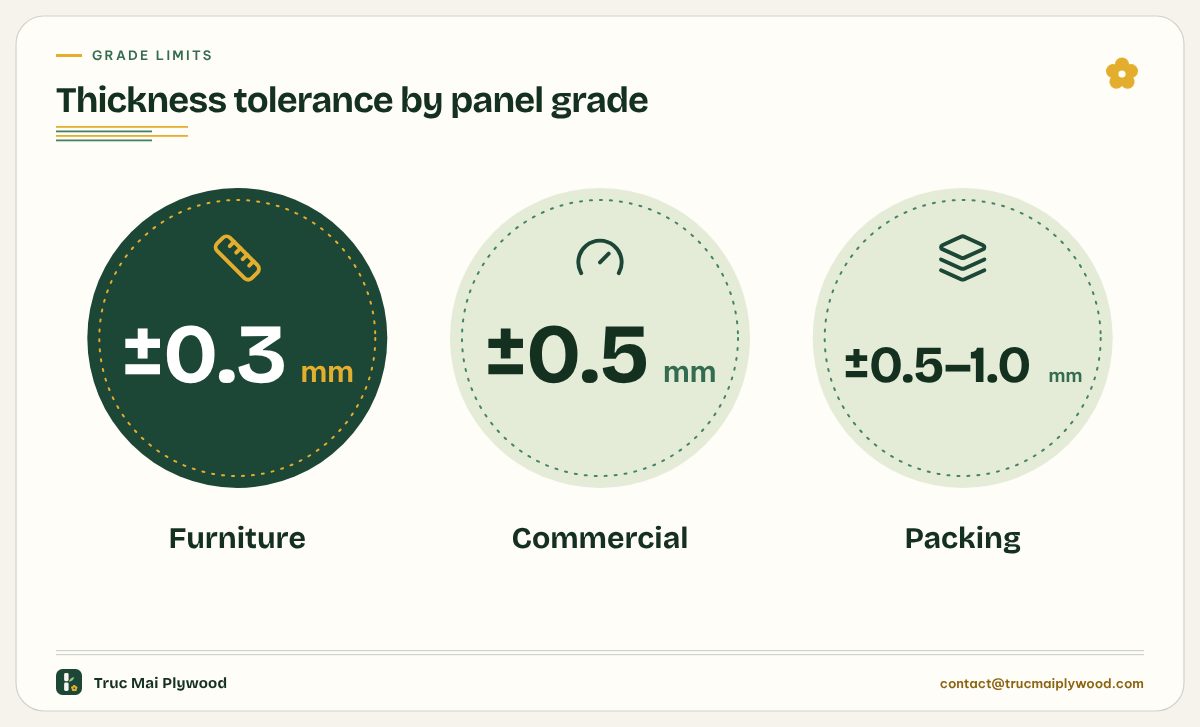
A furniture RFQ should write ±0.3 mm on thickness for sanded and calibrated panels, and ±2 mm on length and width. Truc Mai sets the thickness tolerance order by order within ±0.3–0.5 mm, so the RFQ should name the grade it is writing for: furniture panels that are sanded and calibrated hold ±0.3 mm, commercial grade ±0.5 mm, and packing grade anywhere in ±0.5–1.0 mm.
| Line | Thickness tolerance | Length and width |
|---|---|---|
| Furniture, sanded and calibrated | ±0.3 mm | ±2 mm |
| Commercial | ±0.5 mm | ±2 mm |
| Packing | ±0.5–1.0 mm | ±2 mm |
Choose the number from the machine that receives the panel. A CNC line that cuts rebates for a joint, an edge-bander that sets its pressure by thickness and a press that glues a laminate all need the thickness to repeat from sheet to sheet. A cut-to-length saw for a packing crate does not. Asking for ±0.3 mm on a pallet deck pays for sanding that nobody uses; asking for ±0.5–1.0 mm on a kitchen carcass costs the buyer more in scrap and adjustment than the mill saved.
Write the tolerance as a plus-or-minus value in millimetres, not as “calibrated” or “precision”. The two words mean different things at different mills, and neither is a number. The number also needs a reference thickness: “18 mm, ±0.3 mm” is complete, while “±0.3 mm” with no thickness is not.
Do not ask for a tolerance tighter than ±0.3 mm. It is outside what Truc Mai writes on an order, and a mill that offers more should be asked how it measures it. Truc Mai’s repeat-control routine measures sanded panels against the written tolerance at loading, and the repeat specification control page describes the checks.
What thickness, plies and sheet size should the RFQ name?
Name the thickness in millimetres, the ply count when it matters, and one of three sheet sizes. Truc Mai makes 3, 4, 5, 6, 9, 12, 15, 18, 21, 25, 30 and 40 mm; thin 3–5 mm panels are always five plies, 6 mm plies are set per order, and 18 mm is usually 11–13 plies, most often 11. Sheets are 1220 × 2440 mm, 1250 × 2500 mm or 1220 × 2280 mm.
A buyer in the United States who writes “3/4 inch” must say whether the panel is a true 19.05 mm or an 18 mm panel sold under that nominal size. Under the Weights and Measures Act 1985, Schedule 1, a yard is 0.9144 metre and an inch is a thirty-sixth of it. That gives 25.4 mm per inch, so three quarters of an inch is 19.05 mm, and a caliper will show the gap to an 18 mm panel at once. The page on 18 mm plywood by core works through that conversion.
| Sheet size | Common name | Typical use |
|---|---|---|
| 1220 × 2440 mm | 4 × 8 ft | Standard sheet for most markets |
| 1250 × 2500 mm | European format | Furniture and panel lines set up in metric |
| 1220 × 2280 mm | Shorter furniture sheet | Parts that waste less from a shorter sheet |
Custom sizes go up to 1250 × 2500 mm and no larger: there are no 1500 × 3000 mm or 1525 × 1525 mm sheets, which are cut from the standard sizes instead. Cut-to-size orders split one sheet into 2, 3, 4 or 6 panels before packing, and the RFQ should give the finished panel dimension and the tolerance on each side.
The size is also a cost line, because it changes the container load. At 18 mm on Styrax, the planning model loads 990 sheets of 1220 × 2440 mm in a 40HC and the same 990 sheets at 1250 × 2500 mm, which is a larger volume for the same sheet count. That shows up in the quote as a different price per m³ and per sheet, so write the size before the quantity.
Can one RFQ cover several thicknesses in one 40HC?
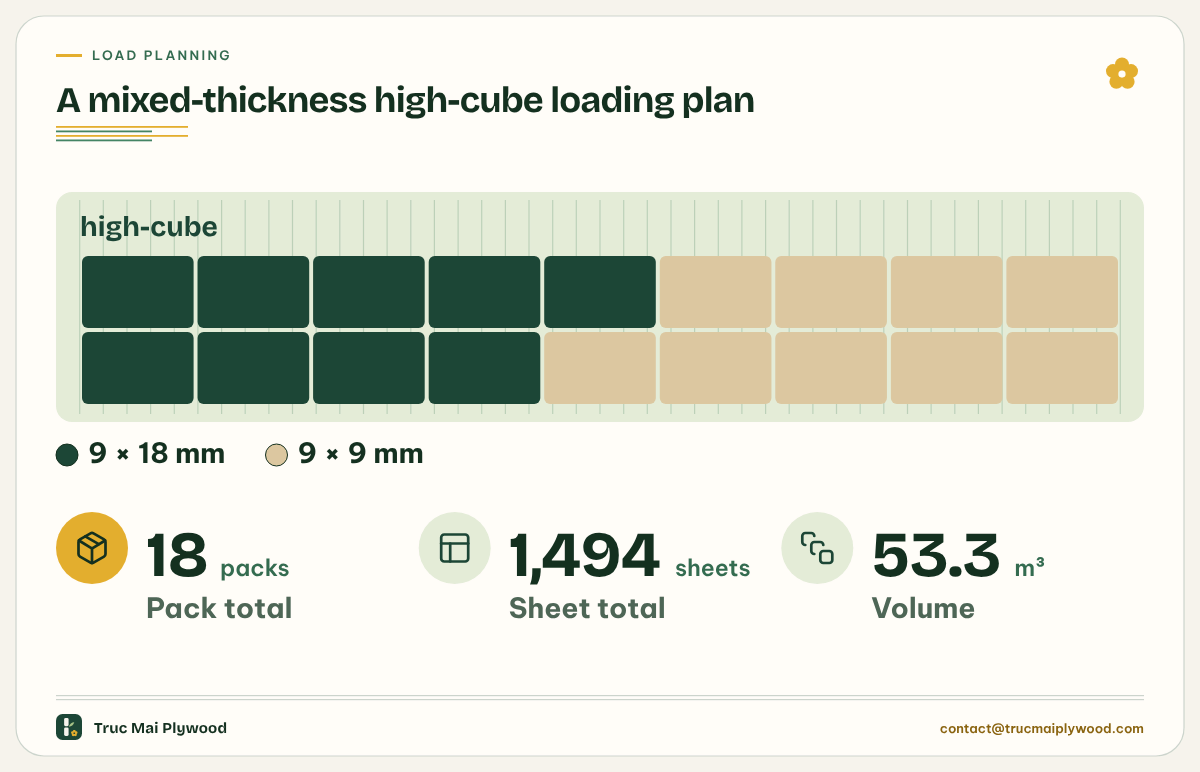
Yes. Most containers hold one or two products, and mixing three to six is possible when agreed in advance, so one RFQ can list several thicknesses with a sheet count for each. Write each thickness as its own line with its own core, face and tolerance, then give one total: “1 × 40HC, mixed”. The mill returns one rate per line and one container plan.
Mixing is attractive because most buyers do not need a full container of one thickness. A cabinet maker buys 18 mm for carcasses, 9 mm for backs and perhaps 12 mm for drawers. The planning model works in packs about 1,000 mm high, and a 40HC holds at most 18 packs on Styrax core. Each pack holds a single thickness, so a mix is a split of the 18 pack positions.
A worked split on Styrax core, 1220 × 2440 mm, as a planning figure:
| Product | Packs | Sheets per pack | Sheets | Volume | Cargo weight |
|---|---|---|---|---|---|
| 18 mm | 9 | 55 | 495 sheets | 26.5 m³ | 13,266 kg |
| 9 mm | 9 | 111 | 999 sheets | 26.8 m³ | 13,387 kg |
| Total | 18 | 1,494 sheets | 53.3 m³ | 26,653 kg |
The sheets per pack come from the model: 1,000 mm divided by the thickness, rounded down. The weights use a reference density of 500 kg/m³ for Styrax and stay under the 28,000 kg planning payload. The split is arithmetic, not a loading record, and the real plan is fixed after the mill weighs sample sheets.
Two cautions apply. A heavier core, such as Eucalyptus, reaches the payload before it uses all the pack positions, so a mixed Eucalyptus load holds fewer packs. And every extra product adds a line to the production plan, which can lengthen the lead time. Run your own mix in the 40HC load calculator before sending the RFQ, and read how packs are built and lashed on loading a 40HC at the mill.
What should you write for packing and quantity?
Write the quantity in sheets and in m³ per container, and state whether the order is one container or a monthly programme. Add the packing requirement: export packs about 1,000 mm high on pallets, crates, or cut-to-size panels packed by size. The minimum order is one 40HC, so the quantity line is really a container line.
Quantity is the line a mill uses to set the rate. A full 40HC lets the mill price against a complete production run and a complete container plan, which is why the price per m³ falls as the container fills. A request for “500 sheets” with no container context gives the mill no basis to quote a rate per m³; a request for “990 sheets, 1 × 40HC” does.
Write the count as sheets and as m³, and say which one governs. If you need exactly 990 sheets, the volume follows from the thickness and the size. If you have a budget in m³, the sheet count follows. State the monthly rhythm if there is one: a buyer who reorders each month can be planned into a production schedule, and repeat orders reuse the same written line.
For packing, say what your warehouse and your handling equipment need. Packs of about 1,000 mm give the planning counts used throughout these pages; a different pack height changes the counts and should be agreed before the quote. Overfilled packs can break pallet feet, so the pack height and the sheet count per pack are part of the plan, not a detail. Pallets, battens and dunnage of solid wood fall under ISPM 15; the plywood itself is outside it.
Labels and marking go on the packing line too, if you need them. A buyer who wants each pack marked with a reference, or each sheet edge painted, should say so, because it is a step in the packing line. Details of how packs are built are on the export crates page.
Which delivery term and payment terms belong on the RFQ?
Name one delivery term and the port: FOB Hai Phong, CFR or CIF with a named destination port. These are the three terms Truc Mai offers. State the payment route you want, which is T/T or an irrevocable L/C at sight, and note whether you need a quote for more than one term to compare them.
The term decides what the quote contains. An FOB price covers panels packed for export and delivered on board at Hai Phong. CFR adds ocean freight to the named port, and CIF adds marine insurance. Import duty, port charges at destination and inland delivery stay with the buyer under all three. A buyer who compares an FOB quote with a CIF quote without converting one to the other is comparing two different things.
On the payment side, Truc Mai takes a 30% deposit with the order and the 70% balance once the B/L scan is sent, by T/T or by an irrevocable sight L/C. Production runs 15–45 days from the deposit, depending on quantity, production conditions and the agreed schedule. The full terms are set out on the MOQ, payment and FOB page, and the RFQ does not need to repeat them; it only needs to say which route you prefer.
If you want freight included, name the destination port, not the country. A CFR quote to Hamburg and one to a port in the Mediterranean are not the same quote. Hamburg, for example, is typically 30–40 days at sea from Hai Phong and a US West Coast port about 20–30, with carrier and route deciding the rest; the other lanes are on sea freight per m³.
Ask for the quote in per m³ and per sheet. Per m³ is how mills compare; per sheet is how a buyer budgets for a cutting plan. The conversion from one to the other uses the sheet volume, so a mill that gives both lets you check its arithmetic.
Which certificate files should the RFQ ask for?
Ask for the certificate and file set your market needs, by name, on the RFQ itself. For the EU that is the FSC claim, the emission line and the EUDR geolocation file set; for the United States it is the CARB P2 and TSCA Title VI certificate number. Certificate files go to the buyer before the order is confirmed, so ask for them with the request.
Name each document and what it must show, not just “certificates”. The table lists what Truc Mai holds and what each file proves.
| Request line | What the buyer receives | Used for |
|---|---|---|
| FSC claim | FSC 100% chain of custody, licence code FSC-C196493, certificate SA-COC-014545, stated on sales and shipping documents for eligible products | A chain-of-custody claim on the invoice |
| Emission | UF glue at E0 or the agreed class; CARB P2 and TSCA Title VI certificate CARB/EPA 26053 for 3–25 mm | EU REACH line; US CARB and TSCA |
| EUDR | Origin records and GeoJSON files for the core and the face veneer | The importer’s due-diligence statement |
| Management systems | ISO 9001:2015 certificate W2012; ISO 14001:2015 certificate W2012E | Supplier file |
| Packaging | PPWR packaging test | EU packaging file |
Two limits are worth writing on the request. The CARB P2 and TSCA Title VI certificate covers hardwood plywood with veneer core from 3–25 mm, so panels of 30 and 40 mm are outside it. And the FSC claim covers eligible products on the current product schedule, not every panel automatically, so ask the mill to confirm the claim for the exact build.
For the EU emission line, write the limit the panel has to meet, not just a class. Regulation (EU) 2023/1464 puts formaldehyde into REACH Annex XVII (entry 77).
Its limit for furniture and wood-based articles sold in the EU from 6 August 2026 is 0.062 mg/m³, measured under the chamber conditions of its Appendix 14, so that figure belongs on the RFQ.
The regulation behind the geolocation file is Regulation (EU) 2023/1115: it asks for the geolocation of every production plot, using at least six decimal digits. A panel with an imported face has two origins, the core logs and the face veneer, and both need their file. The importer files its own statement; the mill supplies the data. How the steps run is on the page about importing plywood from Vietnam to Europe.
For the United States, write 0.05 ppm formaldehyde, the federal limit that 40 CFR 770.10 sets for veneer-core hardwood plywood. Put the certificate number on the order, so each panel can be traced to it; the US import steps page explains the rest of the entry.
What does a filled RFQ look like for three buyers?
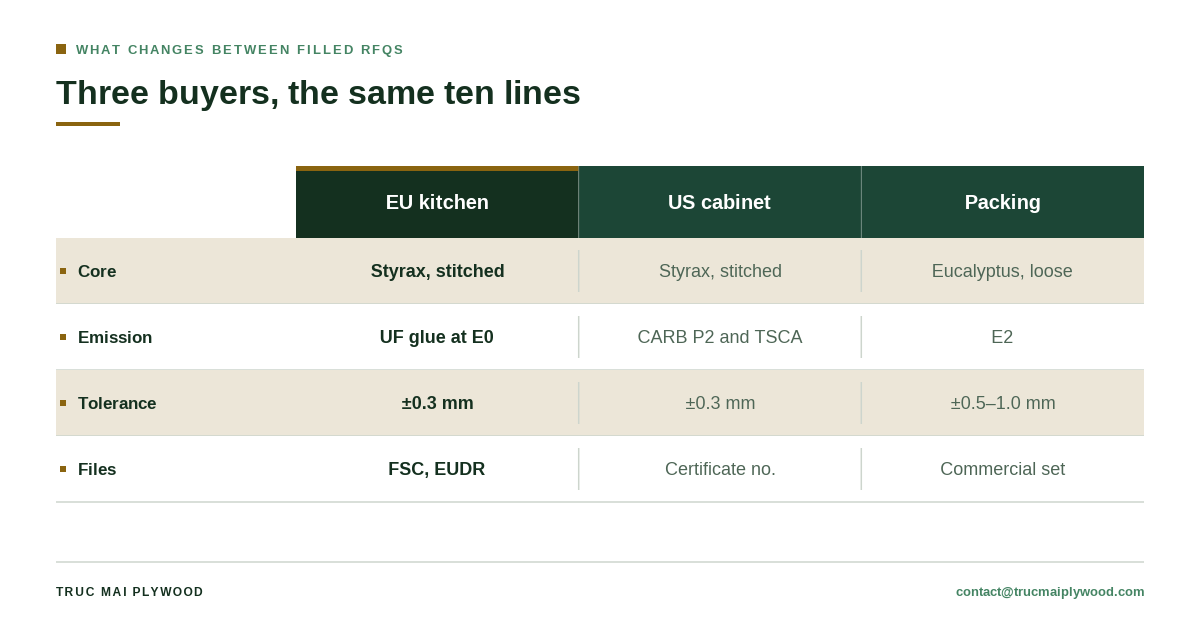
A filled RFQ is the ten-line sheet with every bracket replaced. Three examples follow, one for a European furniture plant, one for a US cabinet buyer and one for a packing buyer. They change the same lines: core, glue and emission, tolerance, documents and port. Copy the one closest to your use and edit it.
European kitchen-carcass buyer
RFQ: plywood, 1 x 40HC, monthly
1. Use:            kitchen carcasses
2. Core:           Styrax, A-grade, stitched, 11 plies
3. Glue/emission:  UF glue at E0 emission
4. Face / back:    white poplar EV / poplar, grade as sample 2
5. Thickness:      18 mm, tolerance +-0.3 mm sanded and calibrated
6. Sheet size:     1220 x 2440 mm, length and width +-2 mm
7. Packing:        export packs about 1,000 mm high
8. Quantity:       990 sheets, 1 x 40HC
9. Term and port:  CIF [Northern European port]; T/T, 30% deposit, 70% against B/L
10. Documents:     FSC 100% claim, EUDR file set with core and face geolocation
US cabinet buyer
RFQ: plywood, 1 x 40HC
1. Use:            cabinet boxes, finished in the US
2. Core:           Styrax, A-grade, stitched
3. Glue/emission:  CARB P2 / TSCA Title VI, certificate CARB/EPA 26053
4. Face / back:    birch-faced / birch-faced back, grade as sample
5. Thickness:      18 mm or true 19.05 mm [choose], tolerance +-0.3 mm
6. Sheet size:     1220 x 2440 mm
7. Packing:        export packs, pallets
8. Quantity:       [ ] sheets, 1 x 40HC
9. Term and port:  FOB Hai Phong; payment T/T
10. Documents:     emission certificate number, FSC claim if eligible
Packing buyer
RFQ: plywood, 1 x 40HC
1. Use:            export crates and pallet decks
2. Core:           Eucalyptus or combined, AB, loose-laid
3. Glue/emission:  glue to suit the use, emission E2
4. Face / back:    open grade / open grade
5. Thickness:      12 mm, tolerance +-0.5-1.0 mm
6. Sheet size:     1220 x 2440 mm
7. Packing:        export packs about 1,000 mm high
8. Quantity:       [ ] sheets, 1 x 40HC
9. Term and port:  CFR [port]; T/T
10. Documents:     commercial set, no certificate files
The three examples differ in the lines that cost money, which is the point. The US buyer adds the certificate number and a thickness choice, the packing buyer drops the sanded face and the tight tolerance, and the European buyer carries the longest file set. Send any of them to the quotation desk and the reply starts from the same page.
What should a complete reply to your RFQ contain?
A complete reply repeats your ten lines, fills each with the mill’s answer, and adds a rate per m³ and per sheet, a container plan with sheets and m³, the delivery term, payment terms, production time and the list of documents. A reply that skips a line, or answers it with a general phrase, is asking you a question.
Check the reply against your sheet in order. Use and core should be restated, so you can see the mill understood. The glue and emission line should name both the glue and the class. The face and back should name the species and grade of each side and the sample. The tolerance should be a number with its thickness. The size, packing and quantity should match, and the quantity should be shown as sheets and as m³ with the container plan behind it.
Then check the commercial lines. The rate should say per m³, per sheet or both, in a named currency, under a named term and port. The payment terms should say deposit, balance and route. The production time should say days after deposit. The documents should list what travels with the container and what is sent before the order is confirmed. Draft shipping documents go to the buyer for approval after loading.
A good reply also names what it does not promise. Truc Mai’s container counts are planning figures, not loading records, and a reply should say so. If a reply states a container count as a certainty before the mill has weighed sheets, treat the count as a claim to check.
What a reply should not do is change your line without saying so. If the mill proposes 15 mm where you wrote 18 mm, or a different core, it should show that as a proposal, with the reason and the price difference. A silent substitution is the commonest way for two quotes to look the same and not be.
How do you set the replies side by side?
Set the replies side by side on one sheet: your ten lines down the left, each mill’s answer across, and a last row for the delivery term. Then convert every price to the same basis before reading it. A missing cell is a question to send back, not a saving to bank.
Use three states for each cell. “Matches” means the mill’s line equals yours. “Differs” means it proposes something else, and you note what and why. “Missing” means the reply does not say. A quote with three “missing” cells is not yet a quote; it is an opening, and the price in it is for a panel nobody has described.
Convert prices last. Put every rate on the same unit, the same currency and the same term. An FOB rate and a CIF rate differ by freight and insurance; a rate per sheet and a rate per m³ differ by the sheet volume, which is 0.0536 m³ for a 1220 × 2440 × 18 mm sheet. Then look at the price difference between replies that match on every line. That difference is the only real price difference; the rest is panel difference.
Do not read the lowest price first. Read the “differs” and “missing” cells first, decide what each one is worth to you, and only then read the prices. A buyer who does this usually finds that the cheapest reply is the one with the most missing cells, and that the second or third reply is the right panel at a fair price. Truc Mai suggests the same sheet for its own quotes: if the answer to a line is not clear, ask.
The sheet also becomes the order line. Once a reply has no “missing” cells and every “differs” is accepted, the sheet is your order line for the first container and the template for every repeat. The mill checks each container against it.
How should a repeat RFQ differ from the first one?
A repeat RFQ should be the first order line, copied unchanged, with a new quantity, a new shipping month and a list of changes. Any difference from the first line is written as a difference. The mill checks each repeat container against the written line, so what you do not change is what you get again.
The first container is where the line is built: the sample is approved, the face and back are agreed against it, and the tolerance is measured against the number on the sheet. From the second container on, the line is a standard, and the reference sample stays with it. A repeat order that says “same as container 1, 990 sheets, shipping March” is complete only if the first order line is attached or identical on both sides.
Changes need to be explicit. A new face species, a different thickness mix, a new certificate file or a change of delivery port each get a line. If one change leads to another, such as a heavier core that changes the sheet count, the mill should show the new container plan. The buyer’s side of the discipline is to keep the one current line in a file where the purchasing team and the warehouse can both read it.
For buyers on a monthly programme, the repeat RFQ can be a one-line email, because the line is already agreed. The checks are described on the repeat specification control page.
Which mistakes slow down a plywood quotation?
Five mistakes slow a plywood quotation: a missing use, a grade without a sample, a tolerance without a thickness, a certificate request that says only “all certificates”, and a quantity without a container. Each sends the mill back to ask, and each question is a day.
The most common vague phrases are easy to spot. “Good quality” is not a line. “E0 glue” mixes glue and emission. “Standard size” can mean 1220 × 2440 mm, 1250 × 2500 mm or neither. “Calibrated” is not a tolerance. “FSC” without a claim type is not a request: FSC 100% is what Truc Mai holds, and there is no FSC Mix. Replace each with the number or the name.
Other slow-downs come from the order of the request. A thickness table with thirty rows and no totals asks the mill to build a container plan for you. A request that lists three faces but no sheet count per face cannot be priced. A request that names a port but no term leaves “FOB or CIF” open, and the two quotes that come back cannot be compared.
Last, do not bundle other questions into the RFQ. Samples, a visit to the mill and a certificate copy are all reasonable, but they are separate requests with their own answers. Put them under the sheet, one line each, so the quotation itself stays clean. Samples are free; a new buyer only arranges the courier, and that cost comes back as a credit once an order is placed.
What happens after the RFQ is answered?
After the RFQ is answered, the buyer approves the line and a sample, pays a 30% deposit and production starts. Production takes 15–45 days after the deposit. Draft shipping documents go to the buyer after loading, and the 70% balance is paid against the scanned B/L. Then the container spends its days at sea.
The sample comes first. A sample of the same build lets the buyer check the face, the core edge, the thickness and the weight against the line. It is the sample that the face and back grade are judged against, so it should be kept with the order line. If the buyer asks for a change after the sample, the line is changed on paper first.
During production, the mill works from the written line. At loading, the packing list shows the sheets and the packs, the container plan is checked against the planning figures and the real weights, and the documents are drafted. The papers that travel with each container are listed on the page about documents needed to import plywood.
For the buyer, the RFQ is the start of a record. It, the sample, the order confirmation, the packing list and the certificate files belong in one folder, because an EU importer keeps its due-diligence records for five years and a customs query asks for them in the same order.
When the ten lines are filled in, paste the sheet into the quotation desk or mail it to contact@trucmaiplywood.com; add one line under it asking for a free sample built exactly to that sheet.
Questions buyers ask
How many lines should one plywood RFQ have?
Ten lines are enough for a first request: use, core, glue and emission, face and back pair, thickness and tolerance, sheet size, packing, quantity, delivery term and certificate files. Add a line only when your market needs it, such as a CARB certificate number for the United States.
Should an RFQ name the destination country?
Yes. The destination decides which file set travels with the container: the EUDR geolocation data and REACH emission line for the EU, or the CARB P2 and TSCA Title VI certificate for the United States. It also fixes the port for CFR or CIF quotes.
What do I write if I do not know which core I need?
Write the application and the sheet weight you can handle, and ask the mill to propose the core. Styrax gives the lightest 18 mm sheet at about 26.8 kg, Acacia 31.1 kg and Eucalyptus 34.8 kg, so weight and load per container usually settle the choice.
Do I need to write E0 or E1 on the RFQ?
Write the emission class you must meet, and write it separately from the glue. Truc Mai's default is UF glue at E0 emission; a 12-hour boil needs melamine-fortified glue and is usually E1.
Can I ask the mill to match a reference sample?
Yes, and it is the safest way to write a face grade. Name the sample, say which face and back it shows, and ask the quote to be made against it. The grade is then agreed against the approved sample and written on the order.
How do I write a repeat order after the first container?
Copy the order line of the first container unchanged and add only the quantity, the shipping month and any change. The mill checks each repeat container against the same line, so a changed line should be shown as a change.
Can I ask for two faces in one container?
Yes. Write each face as its own line with its own sheet count. One or two products per container is the usual load; three to six can share a 40HC if agreed.
Which sheet size should a European furniture RFQ write?
1220 × 2440 mm is the standard 4 × 8 ft sheet, 1250 × 2500 mm is the European format, and 1220 × 2280 mm is the shorter sheet for furniture parts. Pick the size your cutting plan nests best, because the size also changes how many m³ fit in the container.
What does stitched core mean on a quotation?
It means the core veneers are stitched together across and along the sheet before pressing, so gaps do not open. Truc Mai usually stitches the outer 2–4 plies on furniture panels and all plies on request.
Is a face veneer thickness something to specify?
Only when it matters for sanding or finishing. Face veneer is 0.2–0.5 mm, usually 0.3 mm for Europe, and a thinner face leaves less margin if the buyer sands or re-sands the panel.
What happens after the RFQ is answered?
The buyer approves the line and the sample, the 30% deposit starts production, and the 70% balance is paid against the scanned B/L. Production takes 15–45 days after the deposit, then days at sea.
Does the RFQ have to be in a template file?
No. A plain email with the ten lines in order works as well as a spreadsheet, because the reader is a person who builds the order from it. A table is easier to compare, but the lines matter more than the file type.