
To find a reliable plywood supplier, score each mill on claims you can check: monthly output, tolerance written per order, certificate codes in public databases, origin data for core and face, a sheets-per-40HC table by core, and standard terms. A mill scored on its brochure looks reliable until the first container arrives.
How to find a reliable plywood supplier for container orders
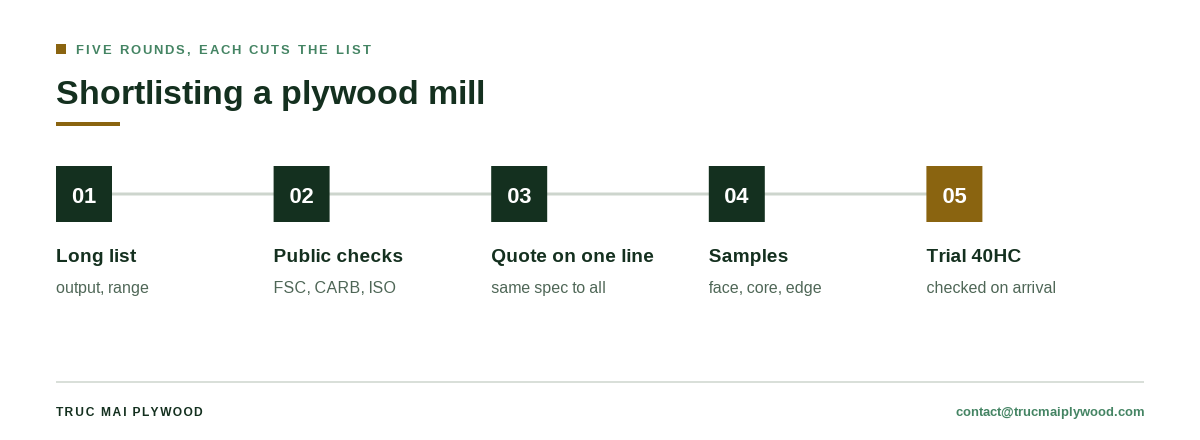
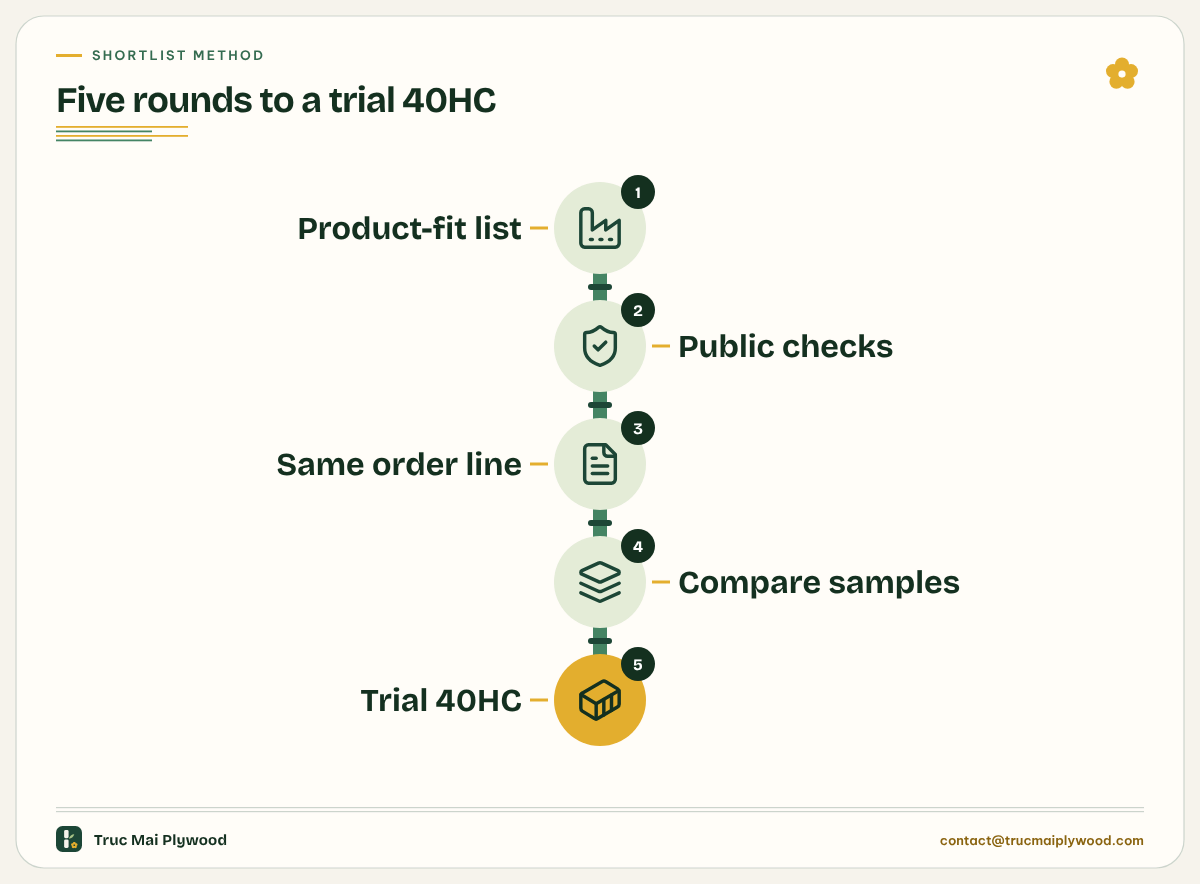
Find a reliable plywood supplier in five rounds: build a long list of mills that make your product, run public certificate checks, send every mill the same written order line for a quote, compare samples, and place one trial 40HC with the best scorer. Each round costs more, so it runs on fewer mills.
The rounds are ordered by cost. A public lookup is free and takes minutes. A quote takes a day of the buyer’s time to compare. A sample costs a courier. A trial container costs a deposit and two months. Spending money only on mills that passed the cheaper rounds keeps the search short.
“Reliable” needs a definition before the search starts, or every mill will claim it. For a buyer of full containers it means four things: the panel on arrival matches the line and the sample; it does so on every container; the files arrive complete; and the timing follows the agreed schedule. Everything on the scoring list below is a way of predicting those four things before money moves.
The list is written for any buyer checking any mill. Truc Mai’s own answers are in a separate section near the end, so they can be compared with the others rather than mixed into the method.
How to find a plywood supplier in Vietnam: where the long list comes from
A long list of Vietnamese plywood suppliers comes from four places: the FSC certificate database, trade fairs and their exhibitor lists, referrals from other buyers or freight forwarders, and the mills’ own sites. Each source gives names; none gives proof. The proof comes in the next round.
Start with the product, not the country. “Furniture plywood, 18 mm, white poplar EV face, stitched core, FSC 100%” finds a different list from “plywood Vietnam”. Write the product and the use first, and drop any name that does not make it.
For each name, note five facts before contacting anyone:
- Is the company a mill, a group with several mills, or a trader?
- Which product lines does it list, and is yours among them?
- Which certificate codes does it publish?
- Which markets does its file set cover?
- Where is the mill, by province?
Regions matter for cost. Mills in Ha Hoa, Phu Tho, sit near plantation forest that supplies core wood, and skilled labour costs less there, so the same quality can be priced lower. The point is not to prefer a province but to understand why two quotes differ.
What are the main Vietnam plywood supplier types?
Vietnam plywood suppliers come in four types: a single mill that presses its own panels, a group that runs several mills, a trading company that buys from mills, and a broker or agent who introduces buyers for a commission. Each can be the right supplier for a buyer; each must be scored on the same list.
| Type | What it controls | Good fit for | What to ask |
|---|---|---|---|
| Single mill | Its own press line, core and spec | Repeat containers of one or two lines | Monthly output, video audit |
| Group of mills | Several lines, more capacity | Large or mixed programmes | Which mill makes your panel |
| Trading company | Combination and logistics | Small or mixed orders from several mills | Which mill, whose certificates |
| Broker or agent | An introduction | First contact in a new market | Who will invoice and who will press |
The question that separates them is simple: who controls the press that makes your panel? If the answer is “us”, ask to see it. If it is “a partner mill”, ask for its name, its certificates and whether the certificates’ holder is the company on the invoice. A difference is not wrong, but it should be in writing.
Some buyers want to know whether a supplier is a real factory and not a trading company. The fastest test is a live video of the press line that will make the order, and a certificate whose holder matches the proforma. Both are covered in verify a mill before the deposit.
What annual and monthly output should a mill show for repeat containers?
A mill for repeat containers should state its annual and monthly output in m³, and the figure should be large compared with your order. One 40HC of 18 mm plywood is roughly 43–53 m³ depending on the core, so a monthly container should be a small share of the mill’s month.
Score output in proportion, not in absolute size:
| Your monthly container as a share of the mill’s month | Score |
|---|---|
| Small (a few per cent) | 2: the mill can absorb a delay or a change |
| Moderate | 1: workable, plan deposits early |
| Large (a quarter or more) | 0: your order is the mill’s month |
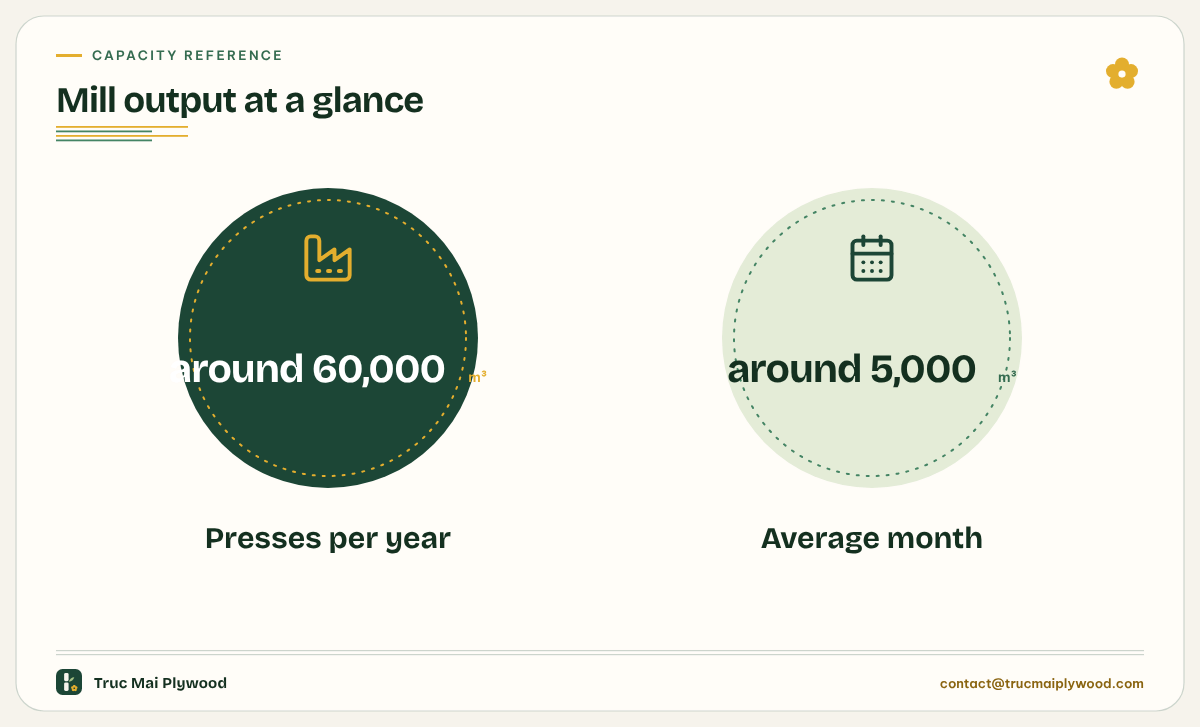
For reference, Truc Mai presses around 60,000 m³ a year and around 5,000 m³ in an average month; one 18 mm Styrax-core container of about 53 m³ is roughly 1% of that month. A mill that gives no figure scores 0 on this line until it does.
Check the figure against what the camera shows. A mill claiming several thousand m³ a month should show several presses running and packs waiting to load.
Which certificates can be checked in public before shortlisting?
Before shortlisting, check FSC chain of custody in the FSC certificate database, CARB P2 and TSCA Title VI through the certifier and the certificate number, and ISO 9001 or ISO 14001 through the issuing body. Each check takes minutes and needs only the code the mill publishes.
FSC plywood supplier in Vietnam: the lookup
For a shortlist, the FSC public search settles one score in a minute: it is FSC’s own tool for confirming whether a chain-of-custody or forest-management certificate is valid and what it covers, see FSC UK.
On each candidate’s record, read the holder, the status, the product type and the claim. FSC 100% and FSC Mix are different claims: FSC defines FSC 100% as “All materials used come from responsibly managed, FSC-certified forests”, see FSC labels. Ask which claim applies to your product, and whether your product is on the certificate’s product schedule. A step-by-step lookup is on how to check an FSC licence code.
CARB P2 and TSCA Title VI
A mill shortlisted for US orders must meet 0.05 ppm formaldehyde, the federal limit that 40 CFR 770.10 sets for veneer-core hardwood plywood. Read the certificate’s product type and thickness range, and confirm the certifier is an approved third-party certifier. A certificate that covers 3–25 mm does not cover a 30 mm panel.
ISO 9001 and ISO 14001
Read the number, the issuer and the scope, and confirm them with the issuer. The scope line is the one that matters: “manufacture of plywood” describes a press line; “trading” does not. ISO 14001 certifies a management system, not a panel.
What certifications should you require from any Vietnam plywood supplier?
Require the certifications your market and your customers need, and no more: for the EU, an FSC claim if your customers ask for it, EUDR origin data for core and face, and a formaldehyde emission class; for the US, CARB P2 and TSCA Title VI for the product; for both, a quality system covering plywood manufacture.
| Requirement | EU buyer | US buyer | Why |
|---|---|---|---|
| FSC chain of custody | If customers ask for the FSC claim | If customers ask for the FSC claim | Claim on sales documents |
| EUDR origin data | Required for the importer’s DDS | Not applicable | Plot geolocation for core and face |
| Formaldehyde | Emission class per order | CARB P2 and TSCA Title VI | Market limits |
| Packaging test | PPWR, for the packaging | Not applicable | Packaging rules |
| Quality management | ISO 9001 with plywood scope | ISO 9001 with plywood scope | Records behind the line |
The packaging line is new. Since 12 August 2026, Regulation (EU) 2025/40 on packaging and packaging waste caps the combined content of lead, cadmium, mercury and hexavalent chromium in packaging at 100 mg/kg. Score a mill on whether it can show a PPWR test, and remember that the test speaks for the packaging materials it covered, not for the panel.
Certificates the mill does not need for your market add nothing to the score. A buyer who asks for every logo gets a mill that claims every logo.
How should thickness tolerance be written into the order?
Write thickness tolerance as a figure in millimetres on the order line, beside the nominal thickness, for each product: for example “18 mm, ±0.3 mm” for a sanded, calibrated furniture panel. A tolerance that is only promised in an email, or described as “tight”, cannot be checked on arrival.
Score the mill on how it answers the tolerance question:
- 2: it states a figure per line and grade without being asked twice, and writes it on the proforma.
- 1: it states a figure but not per grade.
- 0: it answers “good” or “standard”.
Typical figures from a Vietnamese mill differ by line, which is why a single number for every grade scores low. Truc Mai sets the figure on each order, within ±0.3–0.5 mm: the tightest, ±0.3 mm, for furniture panels that are sanded and calibrated; ±0.5 mm for commercial grade; ±0.5–1.0 mm for packing grade; length and width ±2 mm. A supplier that offers a tighter figure than the grade can hold is a warning sign, not a strength.
What EUDR data should a supplier send for core and face veneer?
Score an EUDR plywood supplier on the data it can send for each layer, core and face veneer alike: the quantity, each species by its scientific and common name, the producing country, and where every plot lies, as points with six or more decimal digits, or as a polygon once a plot exceeds 4 ha. Without those fields the importer’s statement cannot be written.
There is no EUDR certificate. The EU importer is the operator and files its own due-diligence statement; Regulation (EU) 2023/1115 bars an operator from putting relevant products on the EU market, or exporting them, until that statement has been submitted. A supplier earns its points by making the statement possible.
Plywood has at least two origins: the core and the face. A face veneer often comes from another country than the core, so a file that covers only the Vietnamese core is half a file. Score:
- 2: sends a sample file for core and face, with GeoJSON or equivalent coordinates.
- 1: describes the data but sends nothing before the order.
- 0: offers “EUDR compliant” without data.
For a shortlist drawn up now, the date that matters is 30 December 2026: from then EUDR binds plywood importers that are large or medium operators, and micro and small ones that already fell under EUTR.
Why can two offers with the same product name differ?
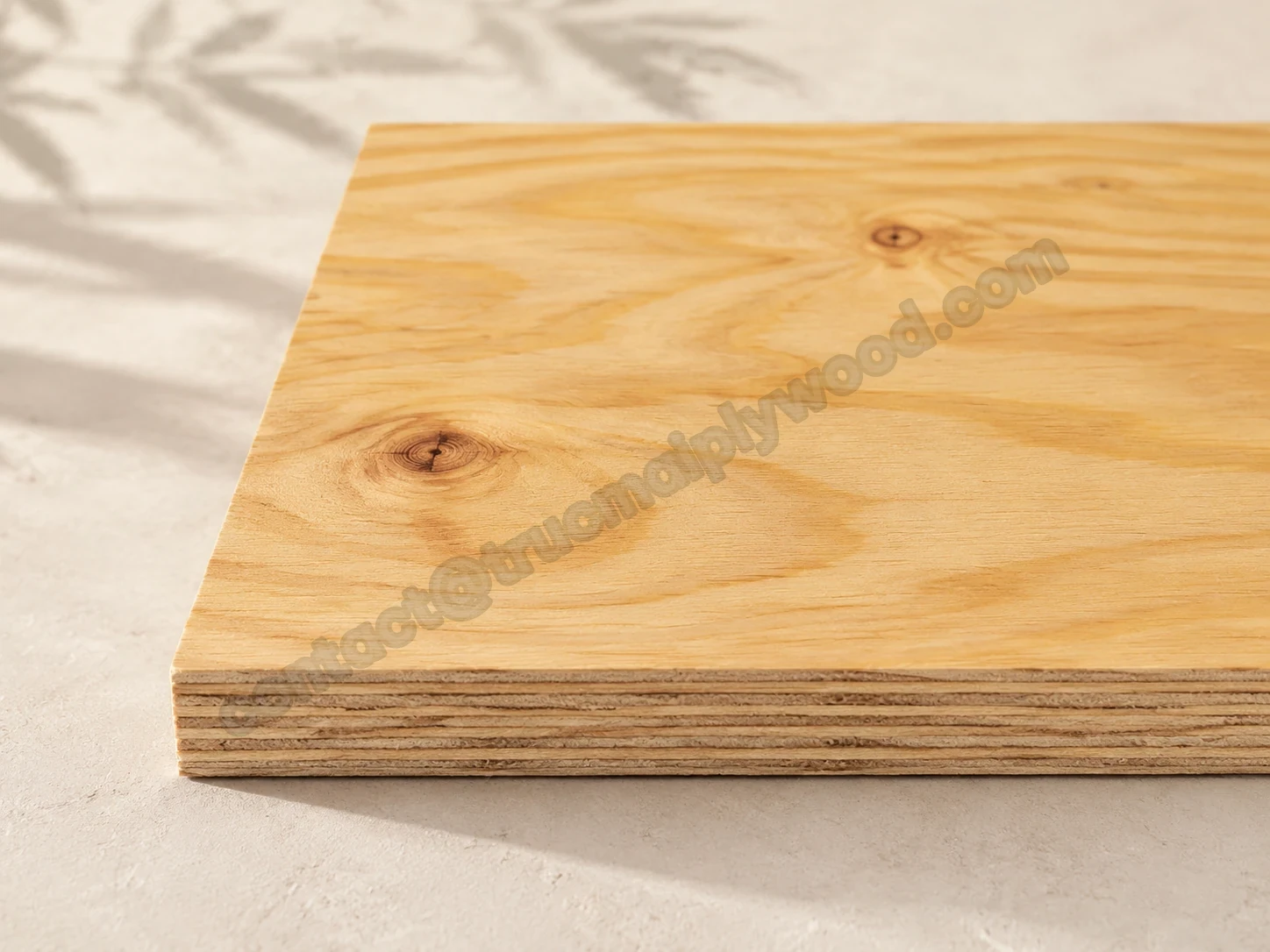
Two offers with the same product name can differ because the name does not fix the panel. The difference comes from five places: core grade, joining method, face preparation, adhesive system and tolerance. Two quotes for “18 mm poplar plywood” can describe panels that differ on all five.
Compare quotes only after every mill has priced the same written line. Each missing line is a place where a mill fills the gap with its own default:
| Line | What a lower price can leave out |
|---|---|
| Core grade | Voids and overlaps that show when the panel is machined |
| Joining method | Gaps that open at the edge in a loose-laid core |
| Face preparation | Sanding hours at the buyer’s plant |
| Adhesive system | Lower boil resistance, higher emission class |
| Tolerance | Thickness variation across the load |
None of these is wrong for every use. A packing panel does not need a calibrated face. The point is that the buyer chooses what to leave out, in writing. The order line format is in writing a plywood RFQ, and the cost side in how plywood is priced.
Which payment and delivery terms are standard?
Most Vietnamese plywood mills quote much the same frame: 30% up front by T/T, the remaining 70% once the container is loaded, by T/T or letter of credit, and FOB, CFR or CIF from a Vietnamese port. Score a mill on whether its terms tie the balance to a document, such as the bill of lading, rather than to a date.
| Term | What to look for | Score |
|---|---|---|
| Deposit | 30% or less, after files and sample | 2 if after, 0 if before files |
| Balance trigger | A document: scanned B/L, L/C presentation | 2 for a document, 0 for “before shipment” |
| Balance instrument | T/T or irrevocable L/C at sight | 1 each |
| Delivery term | FOB, CFR or CIF with a named port | 1 if stated |
| Production time | A window from the deposit | 1 if stated |
Truc Mai would score full marks on this line: a 30% deposit starts 15–45 days of production, and the remaining 70% falls due on a document, the scanned B/L, by T/T or irrevocable L/C at sight, with delivery on FOB Hai Phong, CFR or CIF. The schedule is set out in deposit and balance terms.
What does a reliable plywood supplier in Vietnam send with a quote?
A reliable plywood supplier in Vietnam sends, with its quote, the order line it priced, the certificate codes and files for your market, the sheets per 40HC for your thickness and core, the delivery term and port, the payment terms, the production time and an offer of a sample of the same build.
That list is the first test of reliability, before any visit. A mill that sends it unprompted is used to buyers who check. A mill that sends a price per sheet and nothing else will have to be asked for each line, and the comparison takes longer.
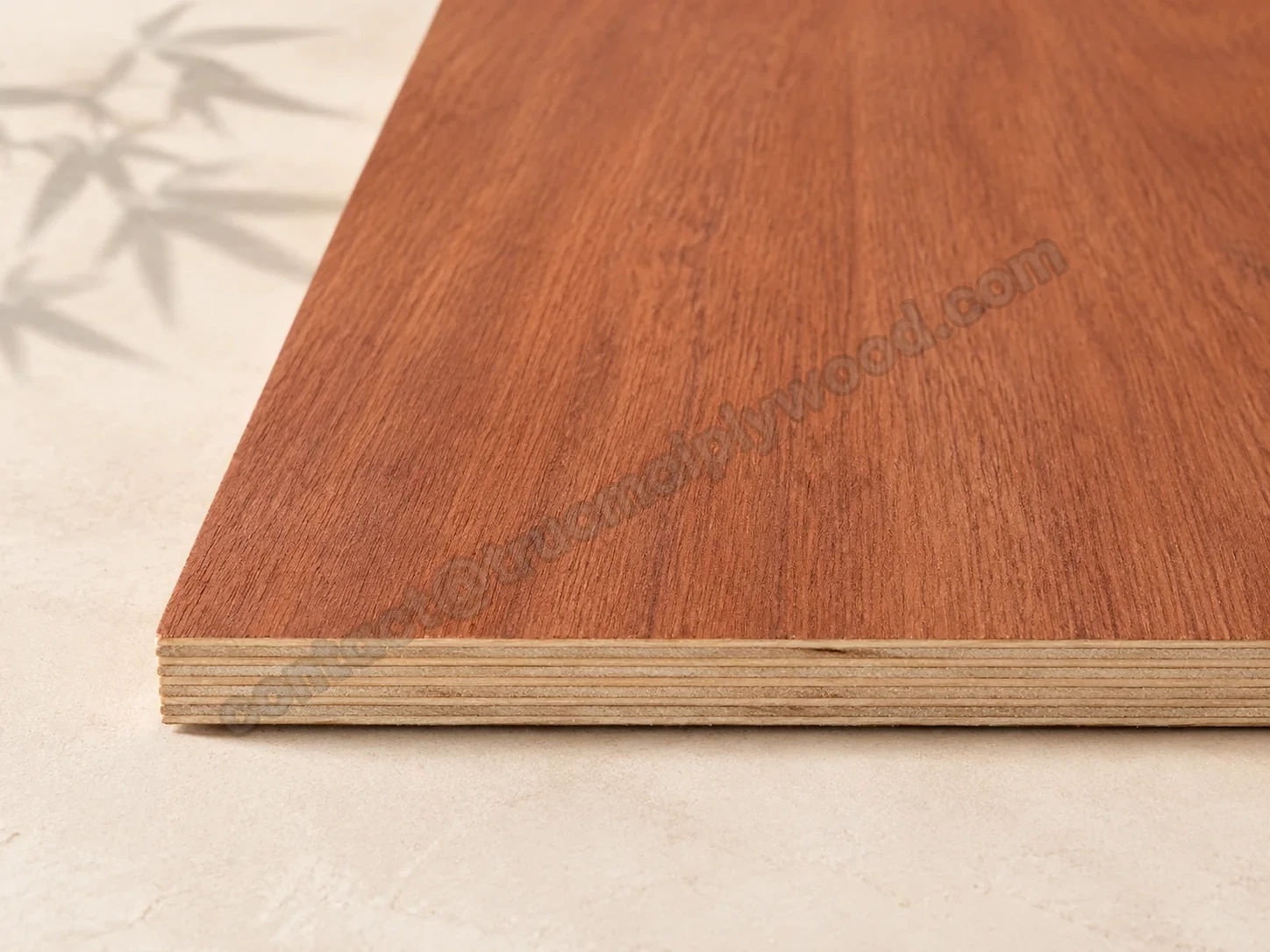
The sheets per 40HC line is often missing, and it is the one that turns a price per sheet into a cost per container. At 18 mm, 1220 × 2440 mm, a planning table shows the difference the core makes: on Styrax core 990 sheets, on Acacia 880, on Eucalyptus 795. A quote without it cannot be compared with a quote that has it.
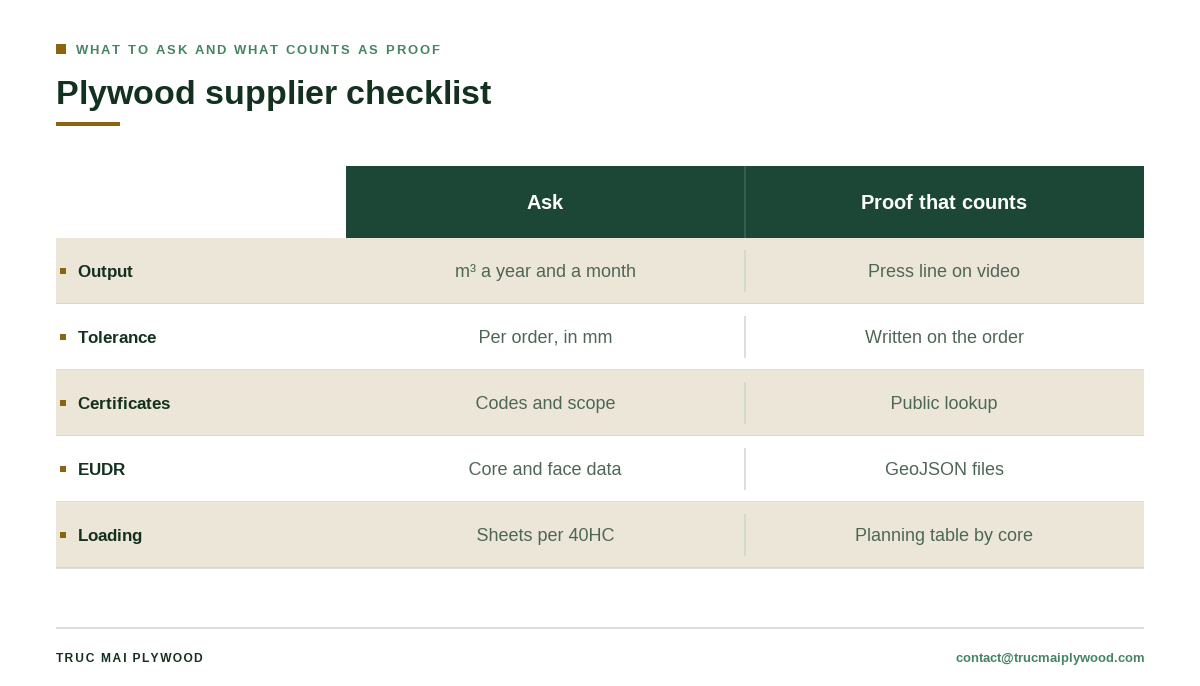
How do you score a plywood mill? The checklist
Score each mill from 0 to 2 on ten criteria, each with the proof that earns the points: output, tolerance, certificates, EUDR data, loading plan, quote completeness, sample match, video audit, terms and response. A mill scores only what it has shown.
| Criterion | Ask | Proof that earns 2 points |
|---|---|---|
| 1. Output | m³ a year and a month | Figures plus presses on video |
| 2. Tolerance | Per line, in mm | Figure written on the proforma |
| 3. Certificates | Codes and scope | Found in public lookup, holder matches |
| 4. EUDR data (EU) | Core and face | Sample file with coordinates |
| 5. Loading | Sheets per 40HC by core | Planning table for your thickness |
| 6. Quote | Every line priced | No line filled with a default |
| 7. Sample | Same build as the quote | Matches on face, core and edge |
| 8. Video audit | Live, on request | Veneer, presses, sanding, packs |
| 9. Terms | Deposit and balance trigger | 30% after files; balance on a document |
| 10. Response | Answers in writing | Clear, numbered, on time |
Plywood manufacturer scoring criteria: how to weigh them
A total out of 20 ranks the shortlist, but two criteria should be pass or fail rather than points: certificates found in a public lookup, and a sample that matches. A mill that fails either does not reach the trial container, whatever its total. For a US buyer, replace the EUDR line with the CARB certificate scope.
How do samples and a trial container enter the score?
Samples enter the score as a pass or fail against the order line, and the trial container as the final test: it either matches the sample and the line across a full load, or it does not. Only the mill that passes both becomes the supplier for monthly containers.
Ask each shortlisted mill for a sample of the same build it quoted, not a showroom piece. Compare the samples side by side, in daylight, on face and back, edge, thickness and weight. Note the courier time: a mill that takes weeks to send a sample will take longer to answer a production question.
The trial container is one 40HC with one or two products. Write the arrival check before it ships: faces against the sample, thickness against the tolerance, core at the edge, packs against the packing list, files against the order. The way a trial becomes a programme is set out in from first order to monthly supply.
Which warning signs lower a score?
A score drops when a certificate code is not found or belongs to another company, when the mill will not show its press line live, when a quote leaves lines unpriced, when a tolerance is promised but not written, or when the deposit is requested before any file is sent.
Other signs that call for a question:
- A certificate scope that does not mention plywood manufacture.
- A formaldehyde claim on a thickness outside the certificate’s range.
- “Any face, any core, any size” without a question back about the use.
- A sheets-per-container figure that does not change with the core.
- A bank account in a name other than the company on the proforma.
None of these alone proves a supplier is unreliable. Each one is a claim that has not been shown yet. Ask, wait for the written answer, and score the answer.
How does Truc Mai answer the checklist?
Truc Mai answers the checklist with figures and codes: around 60,000 m³ a year, tolerance written per order at ±0.3–0.5 mm, FSC-C196493, ISO 9001:2015 certificate W2012, CARB/EPA 26053, EUDR geolocation for core and face, a sheets-per-40HC planning table by core, and a 30% deposit with the balance against the scanned B/L.
| Criterion | Truc Mai’s answer |
|---|---|
| Output | Around 60,000 m³ a year, around 5,000 m³ in an average month |
| Tolerance | ±0.3–0.5 mm per order; ±0.3 mm sanded and calibrated furniture panels |
| FSC | FSC-C196493, certificate SA-COC-014545, FSC 100% only |
| ISO | ISO 9001:2015 W2012 and ISO 14001:2015 W2012E, WCERT, manufacture of plywood |
| CARB P2 and TSCA Title VI | CARB/EPA 26053, hardwood plywood with veneer core, 3–25 mm |
| EUDR | Origin records and GeoJSON files for core and face veneer |
| PPWR | Packaging test held |
| Loading | 990 / 880 / 795 sheets of 18 mm on Styrax / Acacia / Eucalyptus, planning figures |
| Terms | 30% deposit, 15–45 days, 70% against the scanned B/L by T/T or L/C at sight |
| Samples | Free; a new buyer books the courier, cost credited against a real order |
Truc Mai makes furniture and interior plywood and commercial plywood in Ha Hoa, Phu Tho: veneer-faced panels on Eucalyptus, Acacia, Styrax, Pine or combined cores, UV-ready, melamine-, HPL- and paper-overlay-faced panels, packing plywood and non-structural LVL, from 3 to 40 mm. Score it the same way as any other mill on the list. The files are collected on quality and compliance, and the mill itself on the mill page.
What should the first message to a shortlisted mill say?
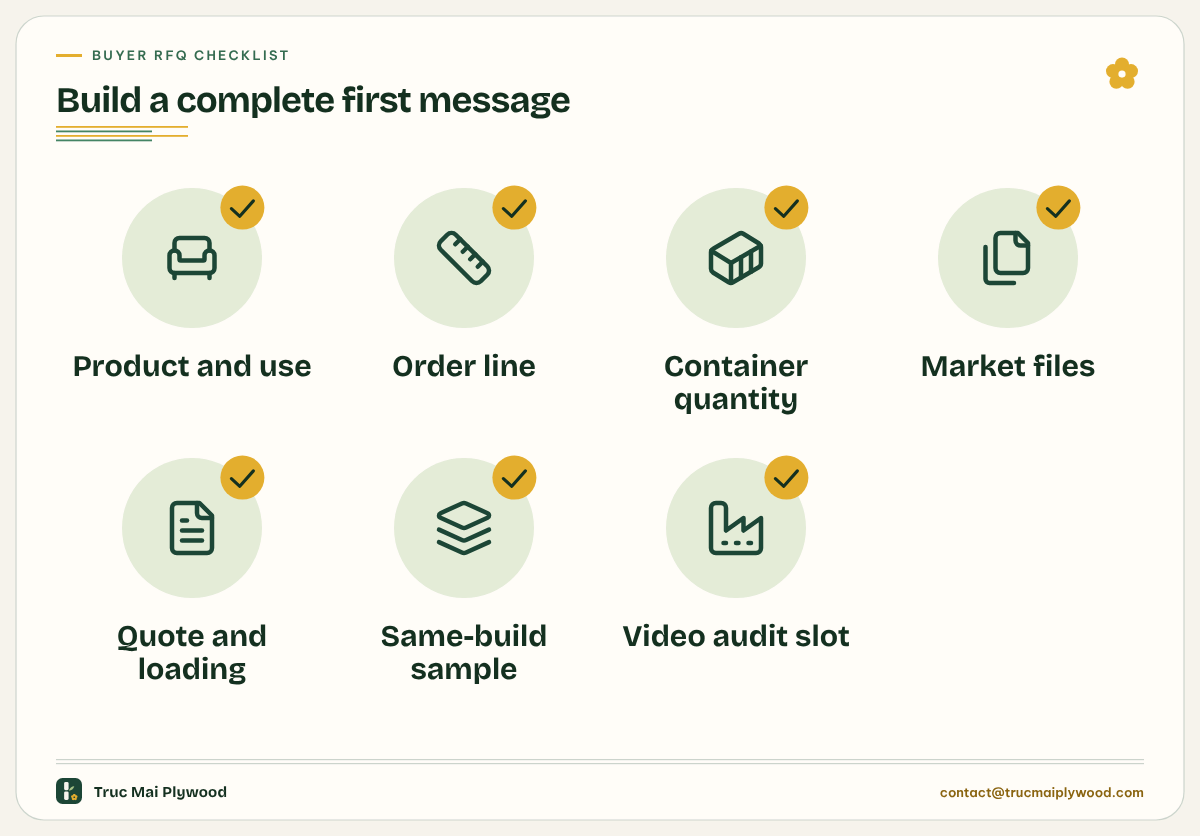
The first message to a shortlisted mill should give the product and use, the order line, the quantity in containers, the market and the files needed, and ask for the quote, the sheets per 40HC, a sample of the same build and a video audit slot. Send the same message to every mill on the list.
| Line | What to write |
|---|---|
| Product | 18 mm white poplar EV face, Styrax core, stitched, UF glue at E0 emission |
| Use | kitchen carcasses |
| Tolerance | ±0.3 mm; sheet 1220 × 2440 mm |
| Quantity | 1 × 40HC trial, then monthly |
| Market | EU (FSC claim, EUDR data for core and face) |
| Please send | quote per m³ and per sheet, sheets per 40HC, certificate codes, production time, payment terms, a sample of the same build, and a slot for a live video audit |
Identical messages make the replies comparable, which is the whole purpose of the scoring list. If Truc Mai is one of the mills you are scoring, the same message goes to the quotation desk or to contact@trucmaiplywood.com.
Questions buyers ask
How many mills should a shortlist have?
Three to five is workable. Fewer leaves no comparison; more makes the sample and video-audit rounds slow and expensive.
Is a trading company a bad choice?
Not in itself. A trader can combine several mills or handle small orders. Score it on the same list, and ask in writing which mill makes your panel and whose certificates apply.
Which certificate can be checked fastest?
The FSC licence code. Type it into the FSC certificate search and read the holder, status, product type and claim in a few minutes.
Should the supplier with the lowest price score lowest?
No, but its quote should be checked line by line. A low price with no core species, glue, emission class or tolerance behind it is usually a quote for a different panel.
What tolerance should I expect from a Vietnamese mill?
Ask for the tolerance per order, in millimetres. Truc Mai writes ±0.3–0.5 mm, with ±0.3 mm on sanded and calibrated furniture panels and ±0.5 mm on commercial grade.
Do I need EUDR data if I buy for the US?
No. EUDR data is for EU importers. A US buyer needs the CARB P2 and TSCA Title VI certificate for the product instead.
How do I score a mill I cannot visit?
Use a live video audit. It covers the press line, the sanding and the packs, and the certificate originals can be shown to the camera.
Is a bigger mill always more reliable?
No. Output matters in proportion to your order: a monthly container should be a small share of the mill's month. Beyond that, the written line and the files decide.
What should a reliable supplier send with its first quote?
The order line it priced, the certificate codes and files, the sheets per 40HC for your thickness and core, the delivery term and port, the payment terms and the production time.
How long does a shortlist take?
The public checks take a day. Quotes and samples take a few weeks, mostly courier time, and a trial container adds 15–45 days of production plus the sea leg.
Which payment terms are normal for a first order?
A 30% deposit and a 70% balance after loading are common. At Truc Mai the balance is paid against the scanned B/L, by T/T or irrevocable L/C at sight.