
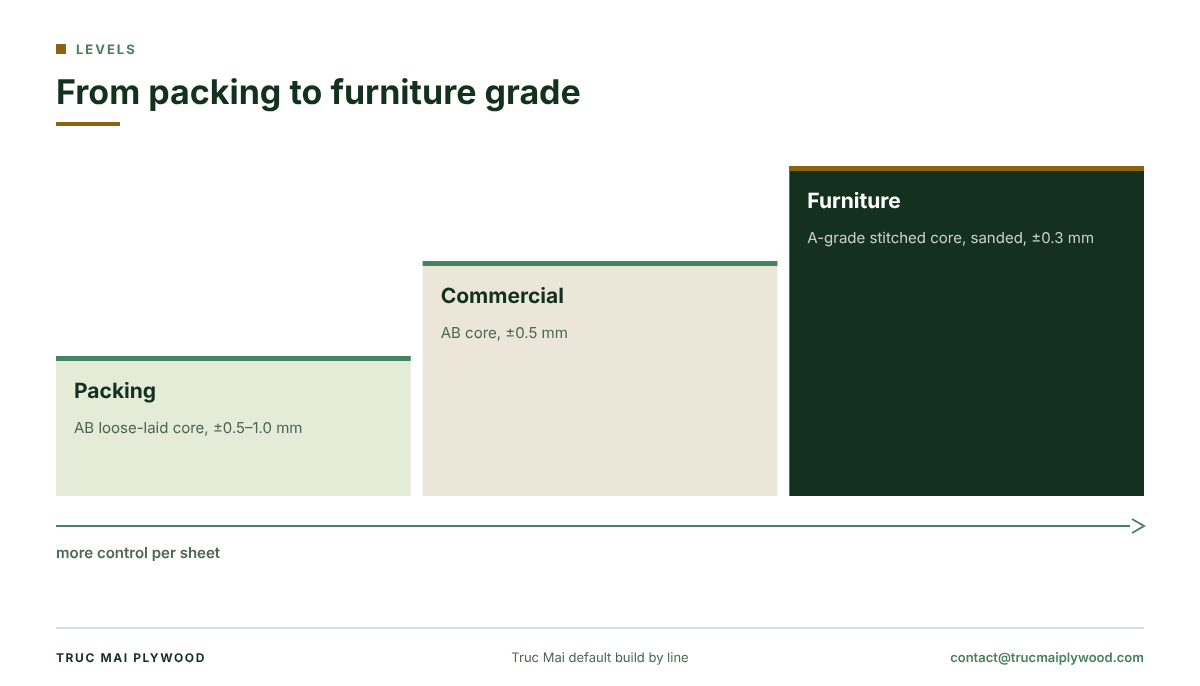
Vietnamese plywood is as good as the line you order. Furniture panels get an A-grade stitched core, sanded faces and ±0.3 mm; commercial panels an AB core and ±0.5 mm; packing panels an AB loose-laid core, usually E2, at ±0.5–1.0 mm. Order the wrong line under the right name and the container arrives as specified but unusable.
Is Vietnamese plywood good quality?
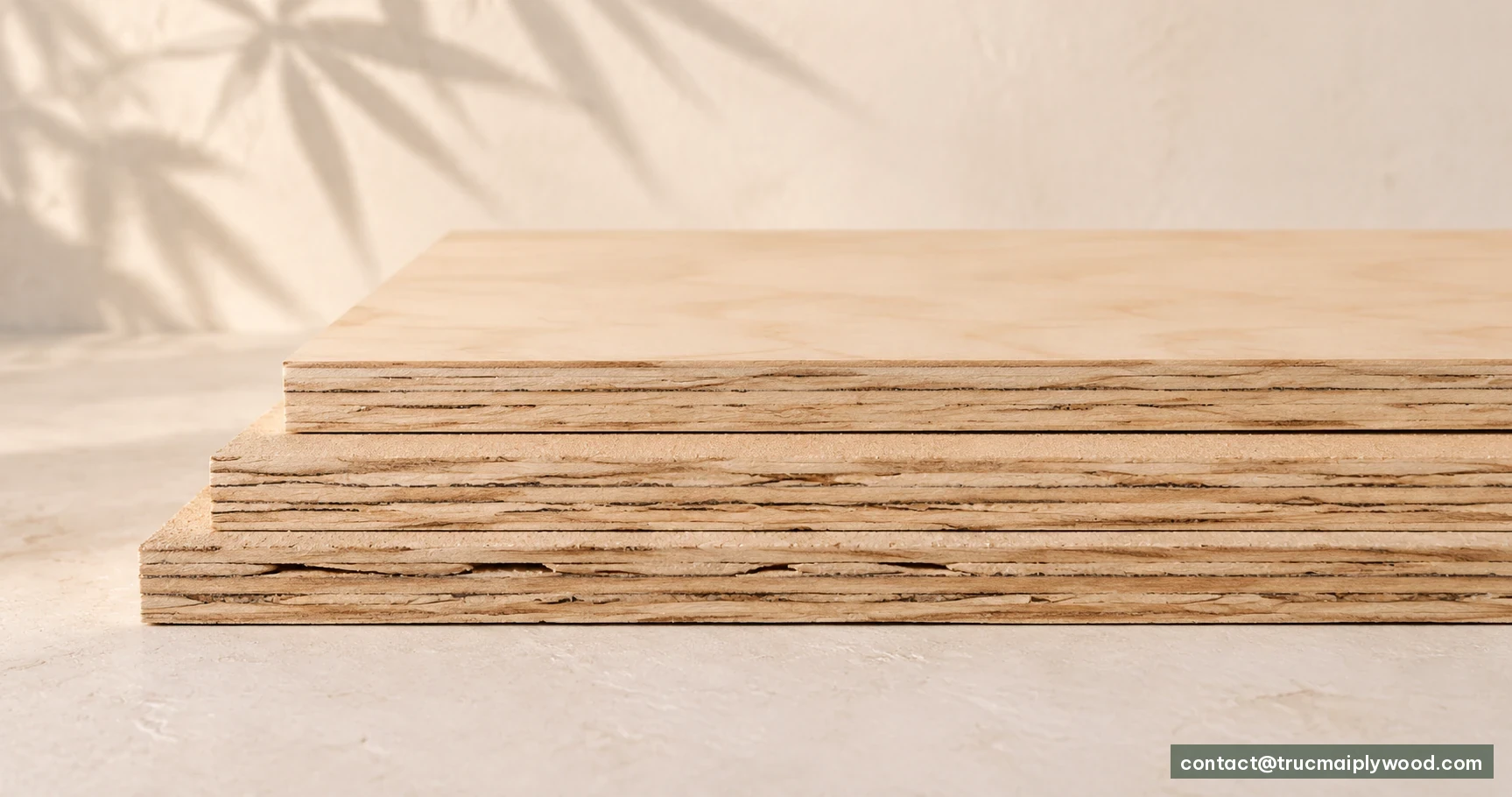
Yes, when the grade matches the use. Vietnamese mills make three lines from the same plantation logs: furniture panels with an A-grade stitched core and sanded faces, commercial panels with an AB core, and packing panels with a loose-laid core. Each is good for its job. Complaints usually come from a packing or commercial build sold under a furniture name.
The country of origin says little on its own. Two Vietnamese 18 mm offers can differ in core grade, joining method, face preparation, glue system and tolerance, and those five lines decide whether the panel lies flat in a kitchen carcass or bows on the job site. That is why this guide sorts quality by line rather than by country.
There is also a structural reason Vietnamese panels compete on price. Mills around Ha Hoa, Phu Tho sit close to plantation forest that supplies core wood at low cost, and skilled labour costs less, so the same quality can be priced lower than in many other origins. The saving is real when the build is the same; it disappears when a cheaper offer is a different build.
Truc Mai makes all three lines in Ha Hoa, Phu Tho: around 60,000 m³ a year, 3–40 mm, on Eucalyptus, Acacia, Styrax, Pine or combined cores. The table below is the default build of each line; every value can be changed on the order and is then written down.
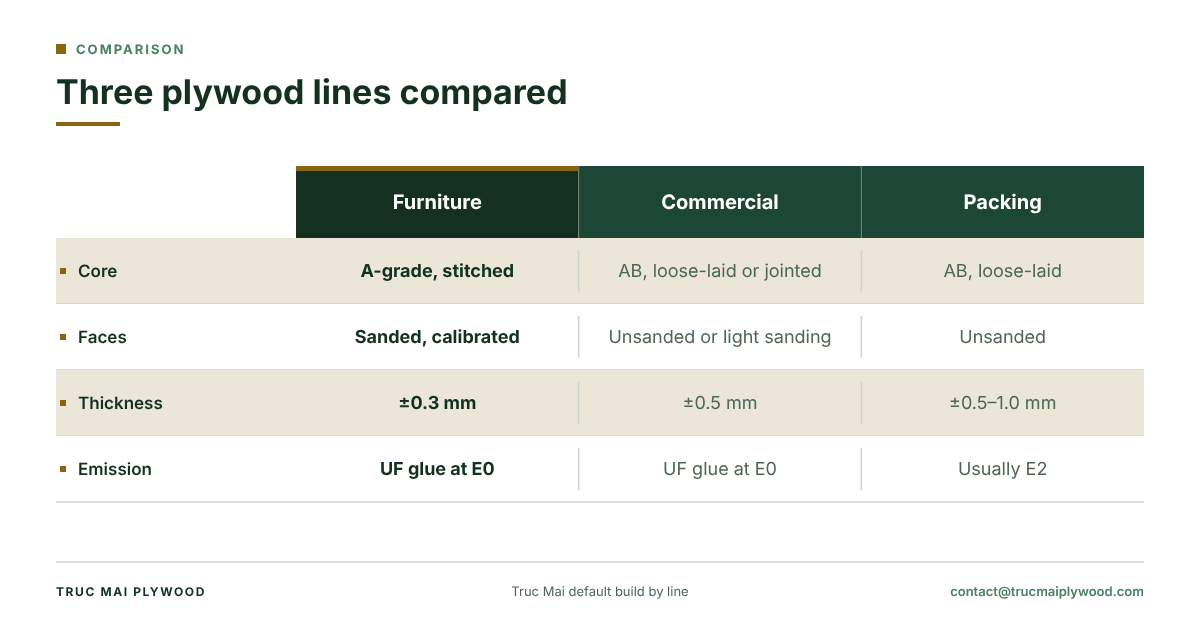
Vietnamese plywood grades: three lines, three builds
Vietnamese plywood grades are set by line, not by one national standard. A furniture line, a commercial line and a packing line differ in five places: core grade, core joining, face preparation, thickness tolerance and default emission. Read the five together; a grade name without them is not a specification.
| Line | Core grade and joining | Faces | Thickness tolerance | Default emission | Typical uses |
|---|---|---|---|---|---|
| Furniture / interior | A-grade core, stitched | Sanded and calibrated, polished on request | ±0.3 mm | UF glue at E0 | Cabinets, wardrobes, shelving, UV-ready panels |
| Commercial | AB core, loose-laid or jointed | Unsanded or lightly sanded | ±0.5 mm | UF glue at E0 | Interior fit-out, general panels, laminate substrates |
| Packing | AB core, loose-laid | Unsanded | ±0.5–1.0 mm | Usually E2 | Crates, pallets, boxes, export packing |
Length and width tolerance is ±2 mm on every line. Sheet sizes are 1220 × 2440 mm (4 × 8 ft), 1220 × 2280 mm and 1250 × 2500 mm, with custom sizes up to 1250 × 2500 mm.
Vietnamese plywood grades on paper and in the pack
Letter grades such as A, AB, B or BB/CC describe a face or a core, never the whole panel. “AB grade” on a quotation can mean an AB face on an A core or an A face on an AB core. Ask the supplier to write the face, back and core grades as three separate words; the grade letters themselves are explained in face grade letters.
How does a furniture-grade core differ from a commercial-grade core?
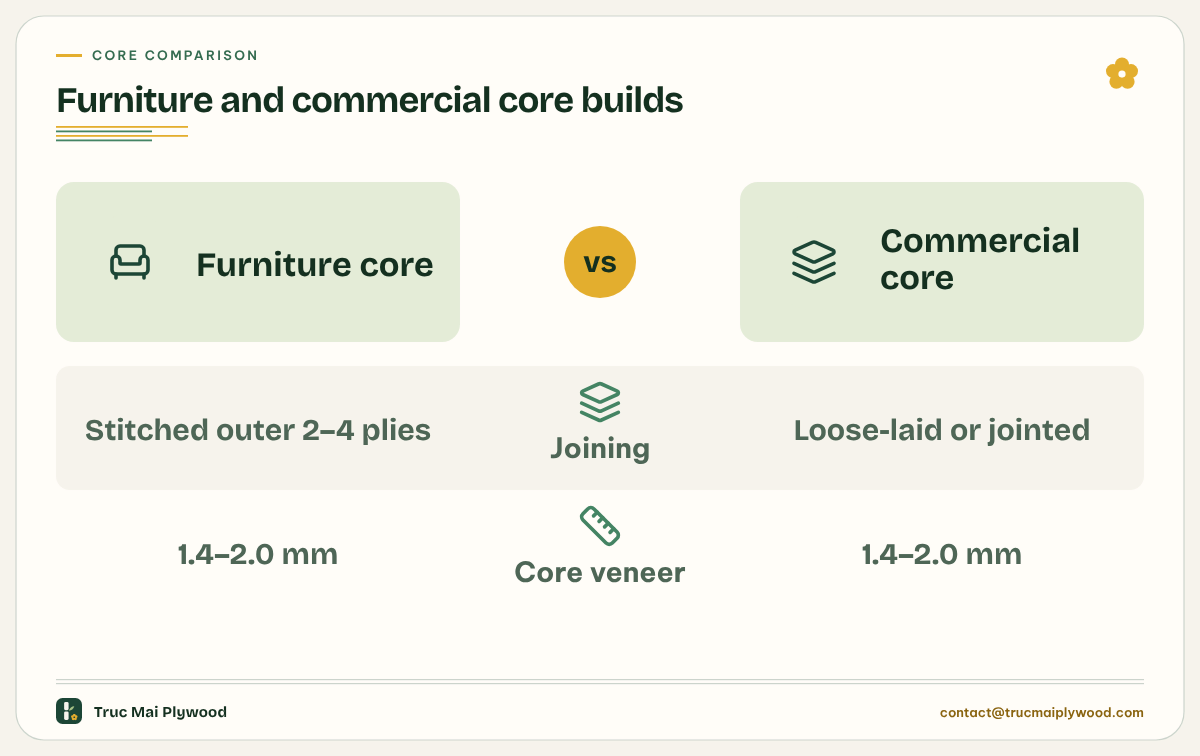
A furniture-grade core is A-grade veneer, stitched so that the core sheets meet edge to edge without gaps or overlaps, and the faces are sanded to a calibrated thickness. A commercial core is AB-grade veneer, loose-laid or jointed, which leaves small gaps and overlaps that are fine under a laminate but show through a thin face or a lacquer.
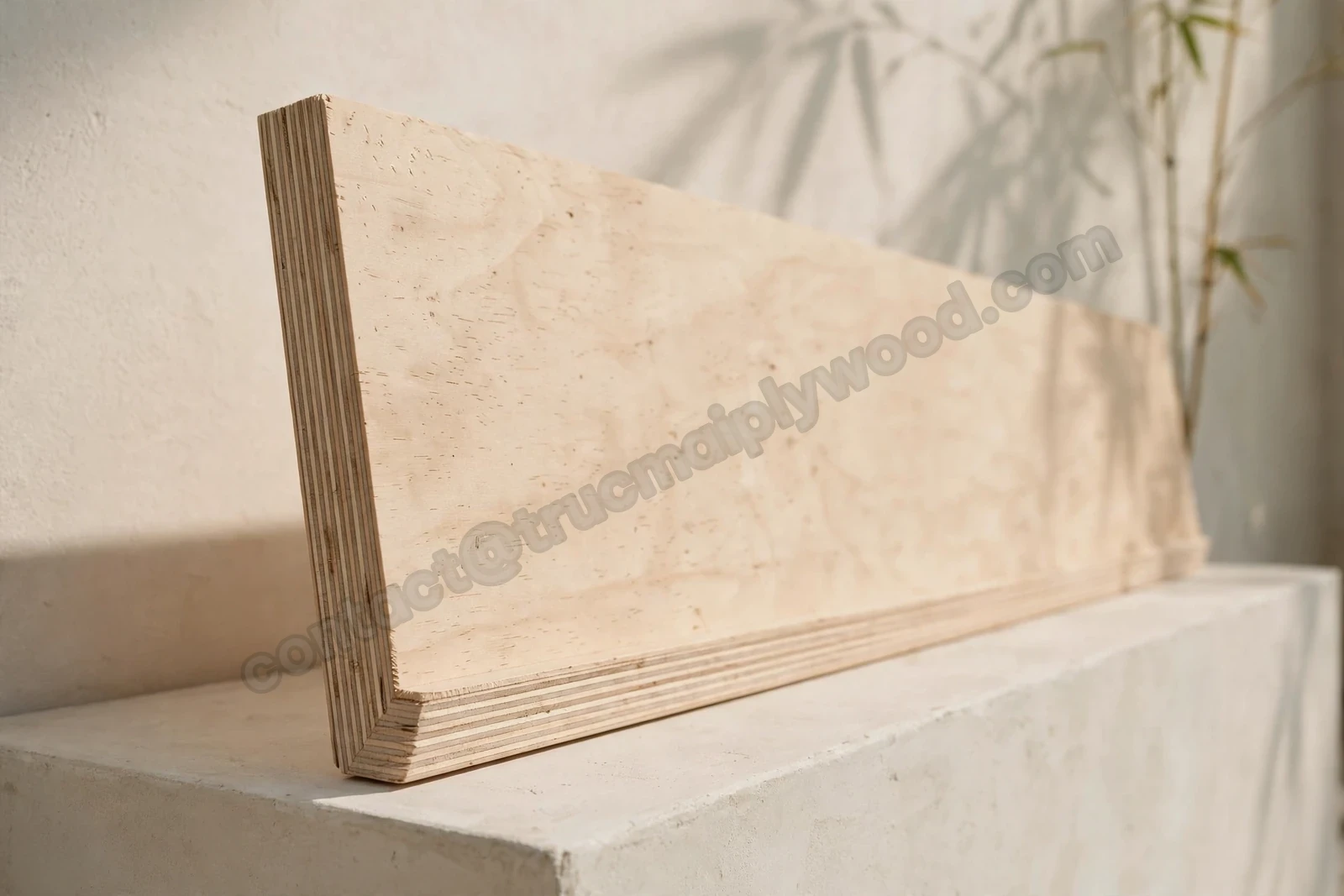
Stitching is the visible difference. On a furniture core the stitching runs across and along the sheet, and usually the outer two to four plies under the face are stitched; all plies can be stitched on request. Those outer plies decide what the face looks like, which is why they get the work first.
| Feature | Furniture core | Commercial core | What the buyer sees |
|---|---|---|---|
| Veneer grade | A | AB | Fewer splits and knot holes in A |
| Joining | Stitched, outer 2–4 plies or all | Loose-laid or jointed | Gaps and overlaps in AB show on the edge |
| Core veneer | 1.4–2.0 mm | 1.4–2.0 mm | Same thickness; quality differs |
| Sanding | Both faces sanded and calibrated | Unsanded or lightly sanded | Thickness spread across the sheet |
| Flatness | Better, from even core | Acceptable for fixed panels | Matters for doors and large carcass parts |
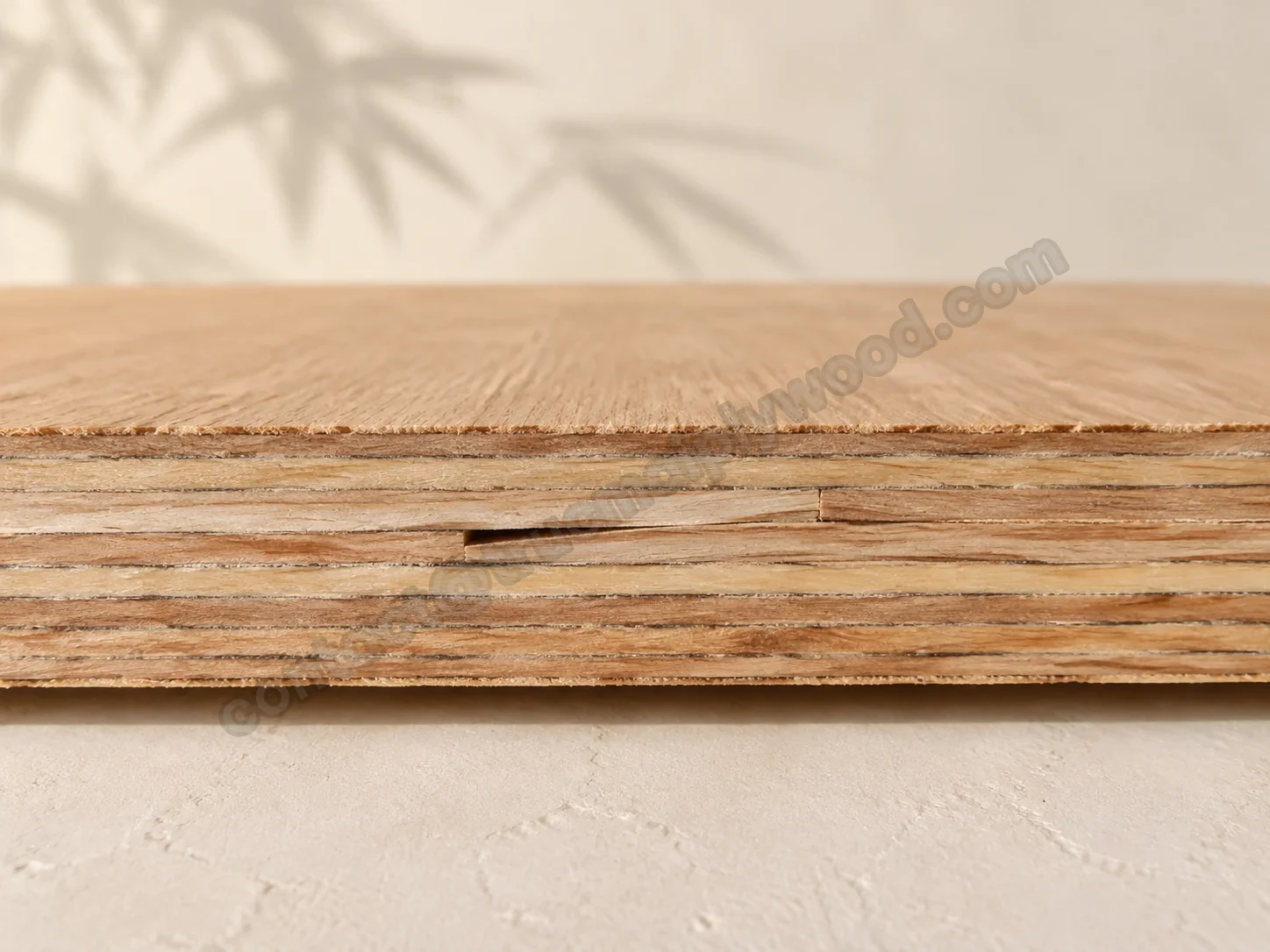
A core gap is a small void inside the panel where two core veneers did not meet; an overlap is a double layer where they lap. Both are normal in commercial and packing builds. In furniture they cause telegraphing through thin faces, dips under high-gloss finishes and weak spots for edge screws, which is what the stitched core avoids.
What thickness tolerance comes with each grade?
Each line carries its own tolerance: ±0.3 mm on sanded and calibrated furniture panels, ±0.5 mm on commercial panels and ±0.5–1.0 mm on packing panels. Truc Mai writes the tolerance on each order within ±0.3–0.5 mm for furniture and commercial work, and never promises a tighter figure than ±0.3 mm.
Tolerance follows from the build. A furniture panel is sanded on both faces after pressing, which removes thickness variation; a commercial or packing panel goes from the press to trimming with little or no sanding, so the core’s own variation stays in the sheet. That is also why a furniture panel costs more: the sanding line takes time and some wood.
Tolerance matters most where panels meet: drawer runners, edge banding, CNC nesting with fixed tool depths and laminate pressing. A buyer who glues HPL or melamine paper on a commercial panel usually accepts ±0.5 mm; a buyer who edge-bands carcass parts needs the ±0.3 mm of the furniture line. The cabinet grade plywood guide lists the tolerances cabinet makers usually write.
How is the face grade fixed before production?
The face grade is fixed against an approved sample. The buyer receives a sample of the exact build, approves it, and the face and back grades are written on the order as a pair. Production is then compared with that sample, not with a grade name that each mill reads its own way.
Face veneer is thin: 0.2–0.5 mm, usually 0.3 mm for Europe. Within one species it varies in colour, figure and small features from log to log. A grade letter cannot describe all of that; a sample can. That is why Truc Mai quotes face and back as pairs, for example “white poplar EV face / poplar back”, and keeps the approved sample as the reference for repeat orders.
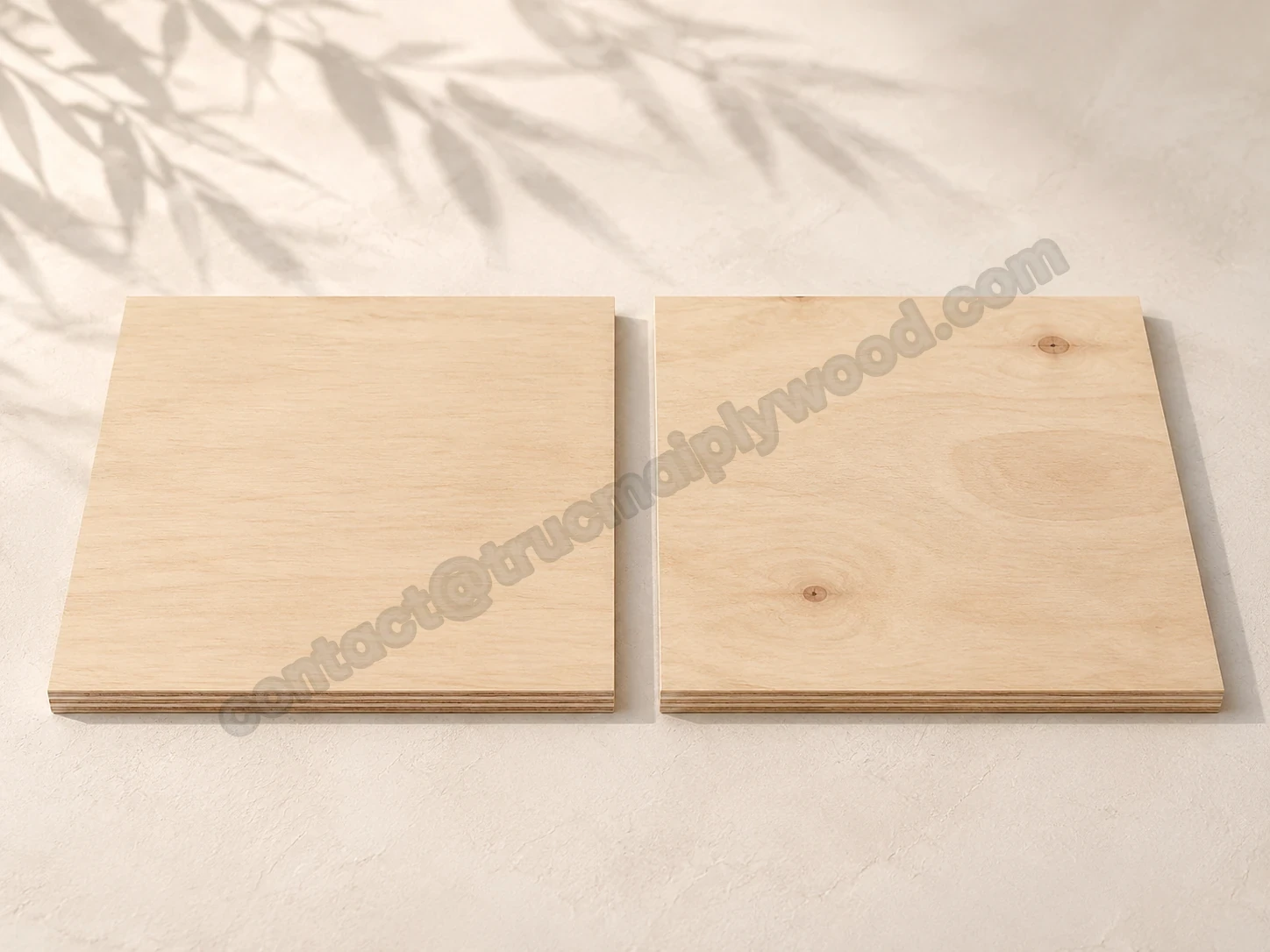
New buyers receive free samples and book their own courier, and the courier cost can be credited against a real order. The samples guide explains which face and core combinations to put in one sample set and how the approved sample fixes the grade for every container that follows.
Why do two offers with the same grade name differ?
Because a grade name does not name the construction. Two “18 mm furniture grade” offers can differ in core grade, joining method, face preparation, glue system and tolerance, and each of those changes the price. The cheaper offer is often the same name on a commercial build.
Compare offers line by line, not by price per sheet:
- Core. Species and grade: Styrax, Acacia, Eucalyptus or combined; A or AB.
- Joining. Stitched (which plies), jointed or loose-laid.
- Faces. Species, grade pair and preparation: sanded and calibrated, or unsanded.
- Glue and emission. Glue type and emission class as two separate lines.
- Tolerance. Thickness and the length and width tolerance.
- Sheet and packing. Size, plies, pack count and protection.
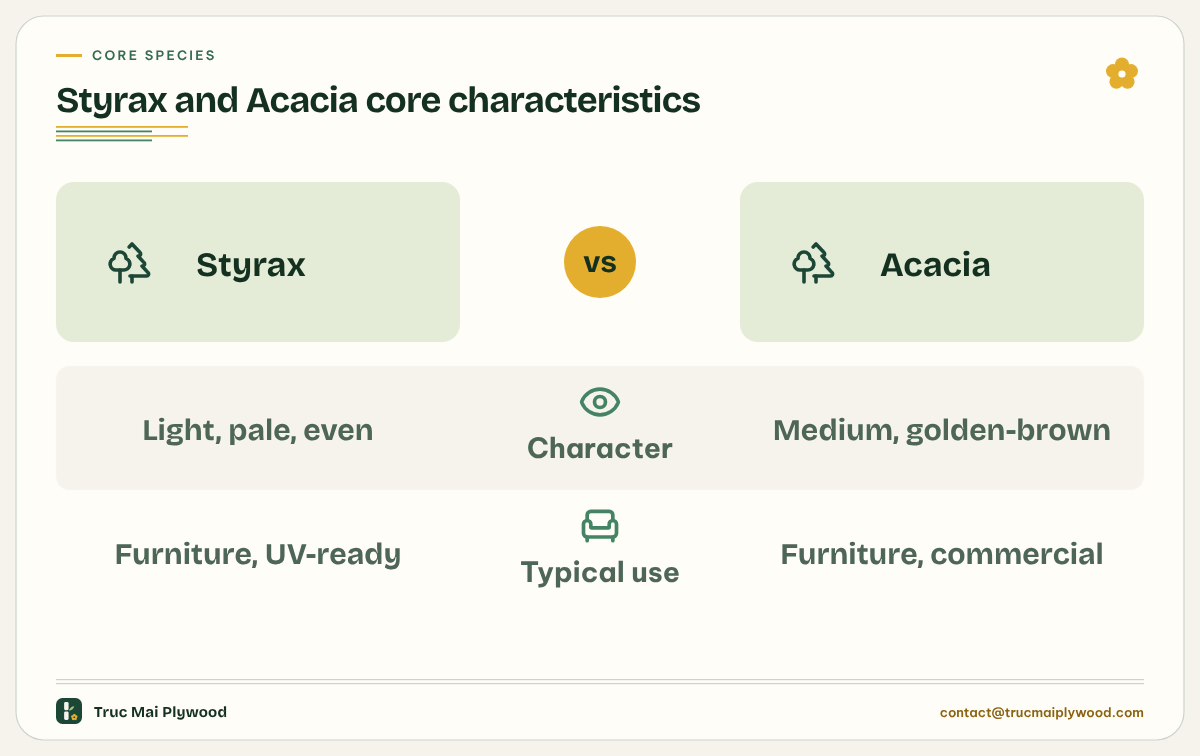
Core species changes more than the price. A furniture buyer moving from an Acacia core to a Styrax core usually gets a better face, a lighter sheet and more m³ per container. In the 40HC planning figure at 18 mm, 1220 × 2440 mm, a Styrax core loads about 53 m³ at 26.8 kg a sheet against about 47 m³ at 31.1 kg for Acacia. Two offers that differ only in core species are not the same product.
What emission class does packing-grade plywood usually carry?
Packing-grade plywood usually carries E2 emission, because packing panels are built for crates and pallets rather than indoor furniture and the glue is chosen for cost. Furniture and commercial panels default to UF glue at E0 emission. A lower emission class can be written on any order, and it then becomes a line of its own.
Glue and emission are two separate lines. The default at Truc Mai is UF glue at E0 emission, which gives about 6 hours boil resistance; a 12-hour boil for outdoor exposure needs melamine-fortified glue, and emission is then usually E1. Writing “E0 glue” mixes the two and is a common source of disputes.
The market sets the floor. In the United States, 40 CFR 770.10 limits hardwood plywood with a veneer core to 0.05 ppm of formaldehyde. In the EU, Regulation (EU) 2023/1464 bars furniture and wood-based articles from the market after 6 August 2026 if they release more than 0.062 mg/m³ under its chamber test. Packing used only around goods is a different case from panels sold as articles, so state the use on the enquiry.
The emission class per order page explains how E0 and E1 are written and tested.
What wood is Vietnamese plywood made from?
Vietnamese plywood cores are plantation hardwoods: Eucalyptus, Acacia and Styrax, plus Pine, used alone or combined to balance price, weight and appearance. Vietnamese mills do not use poplar or birch cores; those species appear only as faces. Gurjan, okoume and bintangor are face veneers too.
| Core | Character | Typical use | 18 mm planning weight |
|---|---|---|---|
| Styrax | Light, pale, even | Furniture, UV-ready panels | About 26.8 kg a sheet |
| Acacia | Medium weight, golden-brown | Furniture and commercial | About 31.1 kg a sheet |
| Eucalyptus | Heavier, harder | Commercial, packing, where strength per sheet matters | About 34.8 kg a sheet |
| Combined | Species laid together | Balancing face, weight and price | Between the above |
Weights are planning figures for 1220 × 2440 × 18 mm panels from the mill’s 40HC model, not weighed loads. A combined core can put a lighter species under the face and a denser one in the middle, which is how one price point carries a better face.
Faces cover the full range: EV (engineered veneer), poplar and bleached poplar, birch, okoume, bintangor, pine, eucalyptus, gurjan and sapele, and others on request. Birch is an imported face on a Vietnamese core, so the panel is birch-faced plywood, not all-birch.
Which defects should a plywood order write limits for?
Write limits for the defects that change your use, and leave the rest to the sample. For furniture that means core gaps and overlaps under the face, face knots and patches, splits, sanding-through, warp and thickness spread. For packing it means delamination and gross voids; face appearance hardly matters.
| Defect | Where it comes from | Matters for | How to write it |
|---|---|---|---|
| Core gap or overlap | Loose-laid or jointed core | Furniture, high-gloss finishes | “Stitched core, outer plies” or “no gaps under face” |
| Face knot or patch | Natural veneer features | Visible furniture faces | Face grade pair plus approved sample |
| Split or open joint in face | Drying or handling | Visible faces | “No open splits” on the face, back per sample |
| Sanding-through | Thin face over uneven core | Lacquered or UV faces | Calibrated core, face veneer thickness |
| Thickness spread | Unsanded panels | Edge banding, CNC, laminating | Tolerance per order, measured points |
| Warp or bow | Unbalanced build, moisture | Doors, large panels | Balanced build, flat storage |
| Delamination | Glue line failure | All lines | Glue type and boil test hours |
Bond quality has a European yardstick. EN 314-2 “specifies requirements for bonding classes of veneer plywood according to their end uses”. The test methods sit in a companion part, EN 314-1. A buyer who needs a bond class for humid conditions should write the class on the order rather than rely on “WBP” as a word.
How do I check plywood quality when the container arrives?
Check against the order and the approved sample, not against a general idea of good plywood. Open packs from the front, middle and back of the container, measure thickness at several points per sheet, look at both faces and all four edges, and record what you find against each written line.
- Count and label. Check pack count, sheets per pack and pack labels against the packing list.
- Thickness. Measure with a calibrated gauge at the corners and middle of several sheets per pack.
- Faces. Lay sheets flat in daylight and compare face and back with the approved sample.
- Edges. Look along all four edges for gaps, overlaps and delamination.
- Flatness. Lay a straight edge across the sheet; note bow and twist.
- Record. Photograph pack labels and any defect with a ruler in frame, and send the record to the mill.
The mill runs the same checks before loading. How those checks are recorded and compared with the reference sample on a repeat order is on the repeat spec control page.
Is Vietnamese plywood CARB compliant?
A Vietnamese panel is CARB compliant only when its mill is certified and the panel is in scope. Truc Mai is certified CARB Phase 2 and TSCA Title VI by ICTT Corporation (TPC-43), certificate CARB/EPA 26053, for hardwood plywood with a veneer core from 3 to 25 mm. Panels of 30 and 40 mm are outside that scope.
The certificate covers the product type, not a grade name. Furniture, commercial and packing panels from 3 to 25 mm can all be produced to it when the order asks for it. A packing panel at E2 is a different glue system from the certified one, so write “CARB P2 / TSCA Title VI” on the order line when the panels go to the US. The CARB P2 files page shows how the certificate appears on labels and documents.
Is Vietnamese plywood waterproof?
Standard Vietnamese furniture and commercial plywood is for interior use. UF glue at E0 emission gives about 6 hours boil resistance, enough for dry and slightly humid rooms. A 12-hour boil needs melamine-fortified glue. Truc Mai makes no marine or structural claims; panels for boats or load-bearing uses should be bought to those standards elsewhere.
“Waterproof” is not a grade. Ask instead for the glue type and the boil-test hours, and match them to where the panel will live: a kitchen carcass, a bathroom vanity and an exterior crate need three different answers. For humid interiors the exterior glue panels are the usual step up.
How does Vietnamese plywood compare with birch plywood?
Vietnamese birch-faced plywood puts an imported birch face on a Vietnamese hardwood core, so it looks like birch on the face and edge-banded parts, but it is not all-birch plywood with thin birch plies throughout. For hidden carcass parts and laminate substrates the difference rarely matters; for exposed edges and high-load shelves it does.
Compare like with like. An all-birch panel has many thin, even plies and a uniform pale edge; a birch-faced panel shows the core species in the edge and usually fewer, thicker core plies: 18 mm Vietnamese panels usually have 11 to 13 plies, most often 11. The birch-faced plywood page explains which cores suit a birch face.
Which grade should you order for your product?
Order by what the panel becomes. Visible furniture parts, painted or lacquered faces and edge-banded carcasses need the furniture line. Laminated, HPL- or melamine-faced panels and fit-out boards are usually right on the commercial line. Crates, pallets and transport packing belong on the packing line.
| End product | Line | Core | Tolerance | Note |
|---|---|---|---|---|
| Kitchen and wardrobe carcasses | Furniture | A-grade, stitched | ±0.3 mm | Styrax or combined core for a light sheet |
| UV-coated or lacquered fronts | Furniture | A-grade, stitched | ±0.3 mm | UV-ready: both faces prepared for your coating |
| Laminate or HPL substrate | Commercial | AB, jointed | ±0.5 mm | Calibration helps the pressing line |
| Shop fittings, partitions | Commercial | AB | ±0.5 mm | Face grade per sample |
| Export crates and pallets | Packing | AB, loose-laid | ±0.5–1.0 mm | Usually E2; plywood is outside ISPM 15 |
Mixing lines in one container is common: a container usually carries one or two products, and three to six can be mixed by agreement. The commercial panels by container page shows how commercial and furniture lines are combined in one load.
What does a grade line look like on the order?
A grade line names the face, back and core grades separately, the joining method, the sanding, the tolerance and the glue with its emission class. Written once and kept with the approved sample, it is copied onto every repeat order.
18 mm plywood, furniture line. Styrax core, A-grade, stitched outer plies. White poplar EV face / poplar back, per approved sample. Both faces sanded and calibrated. ±0.3 mm thickness, ±2 mm length and width. UF glue at E0 emission. 1220 × 2440 mm. 1×40HC, FOB Hai Phong.
Send the line to the quotation desk or by email to contact@trucmaiplywood.com with the end product, and ask for a free sample of the same build. The furniture and interior plywood range lists the faces and cores that line can carry; the packing grade panels page covers the crate line.
Questions buyers ask
Is Vietnamese plywood good quality?
Yes, when the grade fits the use. A furniture-line panel with an A-grade stitched core and sanded faces at ±0.3 mm suits cabinets; a packing-line panel at ±0.5–1.0 mm suits crates and should not be bought for furniture.
What wood is Vietnamese plywood made from?
The cores are plantation Eucalyptus, Acacia, Styrax or Pine, alone or combined. Faces range from local species to imported veneers such as birch, okoume, bintangor and EV.
Is Vietnamese plywood made in China?
Truc Mai panels are pressed and finished in Ha Hoa, Vietnam, on Vietnamese plantation cores. Some face veneers are imported, for example EV, which is made from plantation poplar in China.
Why is Vietnamese plywood cheaper than European plywood?
Plantation core wood grows close to the mills and labour costs less, so the same build can be priced lower. A low price for a different build is a different product, not a bargain.
Does Vietnamese plywood contain formaldehyde?
Panels glued with UF resin release some formaldehyde. Truc Mai's default is UF glue at E0 emission, and its CARB P2 and TSCA Title VI certification covers hardwood plywood with a veneer core from 3 to 25 mm.
Is Vietnamese plywood waterproof?
Standard UF-glued panels are for interior use, with about 6 hours boil resistance. A 12-hour boil needs melamine-fortified glue, and Truc Mai makes no marine or structural claims.
What is the difference between face grade and core grade?
The face grade describes the visible veneer: knots, patches, colour. The core grade describes the inner plies: gaps, overlaps and how they are joined, which decides flatness and screw holding.
Can I order furniture faces on a commercial core?
Yes, as a written combination. The quotation then names the core grade and tolerance separately, so the panel is not sold as furniture grade.
How many plies does 18 mm Vietnamese plywood have?
Usually 11 to 13, most often 11, depending on the core veneer thickness. Thin 3 to 5 mm panels are always 5 plies.
Is Vietnamese plywood the same as birch plywood?
No. Vietnamese birch-faced plywood has an imported birch face on a Vietnamese hardwood core; it is not all-birch plywood and should be compared as birch-faced.
How do I check plywood quality when the container arrives?
Open packs from the front, middle and back, measure thickness at several points per sheet, look at both faces and all four edges, and compare against the approved sample and the written grade.
What emission does packing plywood usually have?
Usually E2, because packing panels are built for cost and for crates rather than indoor furniture. A lower emission class can be written on the order.