
To import plywood from Vietnam to the USA, an importer works through five layers: the AD/CVD orders on hardwood and decorative plywood, the ordinary tariff line, the Lacey Act declaration, the ISF filed 24 hours before loading, and the CARB P2 and TSCA Title VI formaldehyde rules. Truc Mai supplies CARB P2 certified panels with the papers each layer asks for, and the days at sea run from 20 to 45 by coast.
How do you import plywood from Vietnam to the USA?
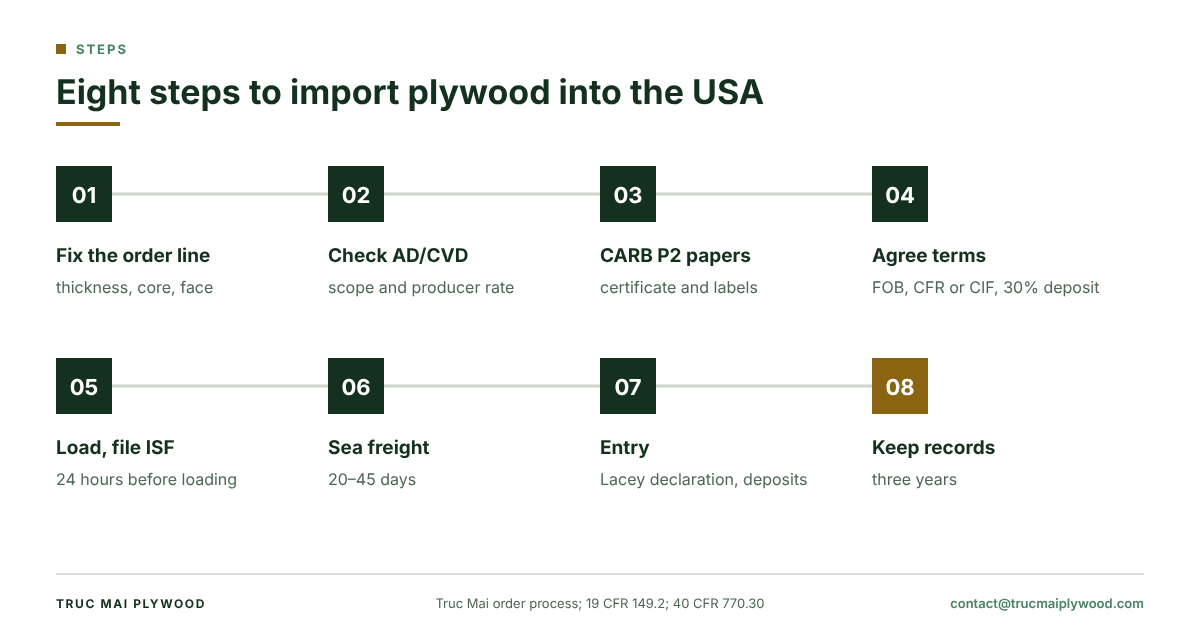
You import plywood from Vietnam to the USA by fixing the specification and tariff line, checking the AD/CVD orders, collecting the CARB P2 and origin papers, filing the ISF 24 hours before loading, making the Lacey Act declaration at entry, and clearing customs. The importer of record answers for each step.
The mill’s part is the paper. Truc Mai supplies CARB P2 certified panels on FOB Hai Phong, CFR or CIF terms and sends draft shipping documents for approval after loading; the importer or its broker files with US authorities.
| Step | What happens | Who acts | What the mill supplies |
|---|---|---|---|
| 1 | Fix the order line, thickness and tariff line | Importer and broker | Samples, specification, species |
| 2 | Check the AD/CVD orders for the producer | Importer and broker | Producer name and product description |
| 3 | Confirm CARB P2 and TSCA Title VI papers | Importer | Certificate CARB/EPA 26053, labelled packs |
| 4 | Agree terms: FOB, CFR or CIF, 30% deposit | Importer and mill | Proforma invoice |
| 5 | Load and file the ISF 24 hours before loading | Importer or broker | Manufacturer, origin, HTSUS data |
| 6 | Sea freight, 20–45 days | Carrier | B/L |
| 7 | Entry, Lacey declaration, duties and deposits | Importer or broker | Invoice, packing list, species and origin data |
| 8 | Keep records | Importer | Copies of papers |
What AD/CVD rates apply to hardwood plywood from Vietnam?
Commerce’s final determinations of 21 July 2026 put the estimated dumping margin for the Vietnam-wide entity at 90.12%, with a cash deposit rate of 84.95% after the subsidy offset, and the countervailing duty rate for all other producers at 47.68%. Individual companies have their own entries in the notices, so the rate depends on the producer.
Hardwood and decorative plywood AD/CVD Vietnam: the case numbers
In hardwood and decorative plywood AD/CVD Vietnam terms, the cases are A-552-851 for antidumping and C-552-852 for countervailing duty.
The antidumping notice is Federal Register document 2026-14614, which lists 90.12 and 84.95 for the Vietnam-wide entity and the cash deposit instruction. The countervailing notice is Federal Register document 2026-14613, where “All Others” carries 47.68 percent ad valorem. The case numbers are A-552-851 for antidumping and C-552-852 for countervailing duty.
The International Trade Commission then voted. Its notice of 9 September 2026 determines that a US industry is materially injured by imports of hardwood and decorative plywood from China, Indonesia and Vietnam, and excludes softwood structural plywood.
These rates are stated here as context, neutrally, and are not a reason to choose a supplier. They change: the order notice, the cash deposit instruction and any later review set what CBP collects, so the importer and broker re-check the current rate for the producer on the day of entry.
Which products fall outside the AD/CVD scope?
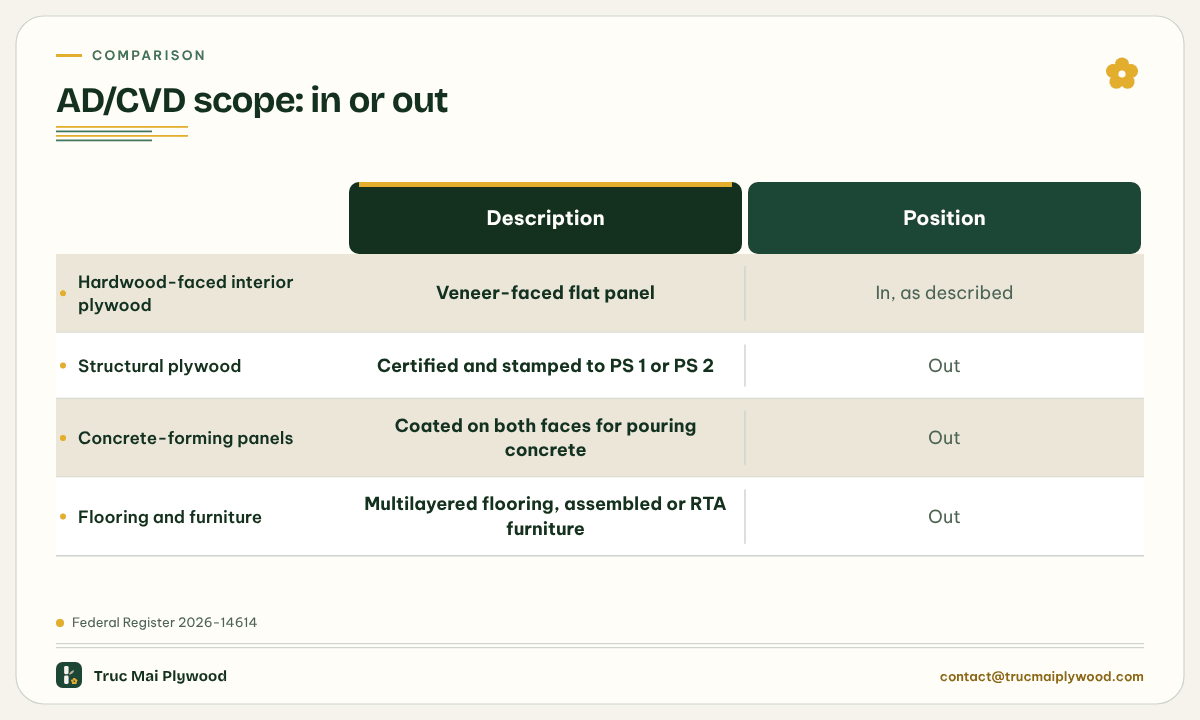
The scope excludes structural plywood certified and stamped to PS 1 or PS 2, phenolic film-faced plyform, multilayered wood flooring, fully assembled and ready-to-assemble furniture, finished table tops and countertops, and certain LVL door and window components. Interior and commercial hardwood-faced plywood panels are what the scope describes.
The scope text in Federal Register document 2026-14614 defines hardwood and decorative plywood as a flat, multilayered plywood or other veneered panel with at least one face or back veneer of hardwood, softwood or bamboo. It lists the exclusions item by item: structural plywood is excluded when it is “certified, manufactured, and stamped” to PS 1-09, PS 2-09, PS-1-22, PS 2-10 or PS 2-18.
Truc Mai makes non-structural interior and commercial plywood: veneer-faced, UV-ready, melamine-, HPL- and paper-overlay-faced panels and packing plywood. It does not make structural plywood or film-faced plyform. A panel that fits the scope description is treated as subject merchandise, so a buyer should ask the broker to classify the exact product and check the scope before the first order.
| Product | In or out of the scope description |
|---|---|
| Hardwood-faced interior or commercial plywood | In, as described |
| Structural plywood certified and stamped to PS 1 or PS 2 | Out |
| Phenolic film-faced plyform | Out |
| Multilayered wood flooring | Out |
| Fully assembled or ready-to-assemble furniture | Out |
What is the import duty on plywood from Vietnam to the USA?
Three layers of duty can apply to a US plywood entry. The first is the ordinary rate for the HTSUS line, which depends on the face species and the panel. The second is the AD/CVD cash deposit when the product is in scope. The third is any other measure in force on the entry date. The broker adds them up before the order.
The ordinary tariff line sits under HTSUS heading 4412. The scope notice lists the subheadings in which hardwood and decorative plywood is “primarily entered”, such as 4412.31, 4412.33, 4412.34 and 4412.39, so the exact ten-digit line is fixed by the broker from the face species and the build.
An import duty is only one cost. The cash deposit on an in-scope entry is a percentage of the entered value, which makes it the largest figure by far when it applies. Quote and compare on a landed basis: price, freight, ordinary duty, deposit and fees together.
What does CARB P2 certified mean for imported panels?
CARB P2 certified means the hardwood plywood meets the 0.05 ppm formaldehyde limit and a third-party certifier has approved the producer. In the United States CARB Phase 2 and EPA TSCA Title VI use the same limit for hardwood plywood with a veneer core, and the panels must be labelled as certified.
CARB P2 plywood import USA: what the importer needs
For a CARB P2 plywood import USA lot, the importer needs the producer’s certificate, labelled packs and the supplier’s written statement.
The federal limit is in 40 CFR 770.10: “for hardwood plywood made with a veneer core or a composite core, 0.05 parts per million (ppm) of formaldehyde”, measured by ASTM E1333. Two more rules matter to an importer:
- Labelling. Under 40 CFR 770.45, panels or bundles must be labelled with the panel producer’s name, the lot number, the number of the TSCA Title VI third-party certifier and a statement that the products are TSCA Title VI certified.
- Records. 40 CFR 770.30 has the importer hold, for three years, the bills of lading, invoices or comparable documents, together with the supplier’s written statement that the products comply with TSCA Title VI.
Truc Mai holds CARB Phase 2 and TSCA Title VI certification in its own name from ICTT Corporation, an approved third-party certifier (TPC-43): certificate CARB/EPA 26053, mill ICTT-26053, hardwood plywood with veneer core, 3–25 mm and 3–15 plies. Panels of 30 mm and 40 mm are outside that scope and are not called certified. No formaldehyde result in ppm is published for Truc Mai panels here; the certificate is the evidence, and the CARB P2 test reports page shows what the buyer receives.
What must the Lacey Act declaration say for plywood?
The Lacey Act declaration must give the scientific name of the plant, the value and quantity of the import, and the country where the plant was harvested. For a plywood panel that means the species of the face and the core, and the country each was taken from.
The text is in 16 U.S.C. 3372(f): a declaration “that contains” the scientific name including the genus and species, a description of the value and the quantity with the unit of measure, and “the name of the country from which the plant was taken”. Where the species used varies and is unknown, the declaration names each species that may have been used.
The importer files the declaration, and the mill supplies the data. Truc Mai keeps species and origin records for the Vietnamese core and the face veneer, the same records that back its EUDR file set, so a US importer can fill the declaration without chasing the supplier. A face veneer made from poplar grown outside Vietnam is declared with its own species and country.
Who files the ISF for a plywood container?
The importer, or the broker acting for it, files the Importer Security Filing. The importer data goes in at least 24 hours before the cargo is loaded on the vessel at the foreign port. The manufacturer, ship-to party, country of origin and HTSUS number come from the supplier, so the mill must send them before loading.
The rule is in 19 CFR 149.2: manufacturer or supplier, ship-to party, country of origin and commodity HTSUS number are due “no later than 24 hours before the cargo is laden aboard the vessel at the foreign port”. The container stuffing location and consolidator follow later, and in no event later than 24 hours before arrival in a US port.
The mill supplies those data before loading, so the importer’s broker can file inside the 24 hours.
Which documents does the mill send for a US-bound container?
The mill sends a commercial invoice, packing list, bill of lading, certificate of origin, phytosanitary and fumigation papers and insurance under CIF, with the CARB/EPA certificate and the species and origin data for the Lacey declaration. Certificate files go to the buyer before the order is confirmed; draft shipping documents follow loading.
| Paper | When it arrives | Used for |
|---|---|---|
| CARB/EPA 26053 certificate | Before order confirmation | TSCA Title VI file, supplier statement |
| Species and origin data | Before loading | Lacey declaration |
| Producer and HTSUS data | Before loading | ISF |
| Draft invoice, packing list, B/L | After loading, for approval | Entry |
| Certificate of origin, phytosanitary, fumigation | With the set | Entry, plant health |
Solid-wood pallets, battens and dunnage must carry the approved treatment mark. 7 CFR 319.40-3 requires a mark that includes the ISO two-letter country code and the treatment type, HT for heat treatment or MB for methyl bromide fumigation. The plywood itself is outside ISPM 15, which exempts wood packaging made wholly of processed wood material such as plywood. The whole set is explained in documents needed to import plywood.
How many days at sea from Hai Phong to the US West and East Coast?
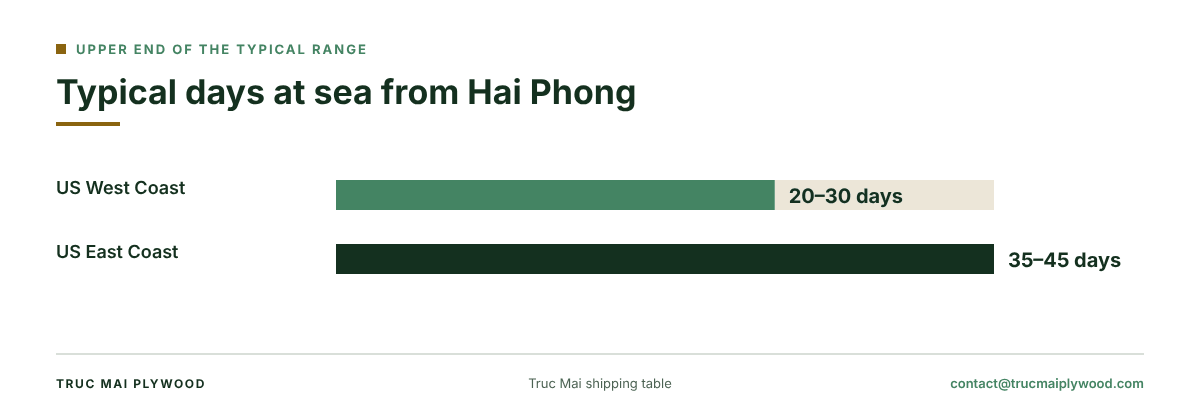
Typically 20–30 days from Hai Phong to the US West Coast and 35–45 days to the East Coast. Production takes 15–45 days after the 30% deposit, so a first order reaches a US port in roughly 35 to 90 days from the deposit, depending on coast, quantity and schedule.
| From Hai Phong to | Typical days at sea |
|---|---|
| US West Coast | 20–30 days |
| US East Coast | 35–45 days |
Days at sea vary by carrier and route. Add the window for ISF, entry and the cash deposit, and plan the AD/CVD check before the order, not after the container is at sea.
What does plywood shipping cost from Vietnam to the USA depend on?
Plywood shipping cost from Vietnam to the USA is a container rate, so it is cut by how much panel fits in the box. On Styrax core a 40HC holds about 53 m³, on Acacia about 47 m³ and on Eucalyptus about 43 m³ (planning figures), so the freight per m³ is lower on the lighter core. Carrier rates change by week and are not quoted here.
Freight is only one line. The landed cost adds ordinary duty, the AD/CVD cash deposit when the product is in scope, the ISF and entry fees, and inland haulage. Ask for the same specification from each supplier and compare on a landed basis. The m³ planning table for every thickness is in m³ per 40HC.
What are the MOQ and payment terms for a first US order?
A first US order is one 40HC at minimum. The 30% deposit is paid when the order is confirmed, and the 70% balance once the buyer has the scanned B/L, by T/T or irrevocable L/C at sight. The mill quotes FOB Hai Phong, CFR or CIF, so an importer with its own US forwarder can keep the booking. Most containers carry one or two products, and three to six can share one by agreement.
A new US buyer pays only the courier for free samples, and that courier cost is credited on a real order. Certificate files, including the CARB/EPA 26053 certificate, are sent before the order is confirmed, and draft shipping documents go to the buyer for approval after loading. See MOQ, payment and FOB for the standard terms.
What records does the US importer keep?
For three years the importer holds the bills of lading, invoices or comparable documents carrying the supplier’s written TSCA Title VI statement, and keeps the records that name the panel producer, the production date and the supplier ready for the EPA on request. The rule is 40 CFR 770.30, quoted above.
A practical file per container holds the certificate CARB/EPA 26053, a photo of the labelled pack, the invoice and packing list with the producer’s statement, the ISF record, the species and origin data used for the Lacey declaration, and the AD/CVD position the broker confirmed for that entry. If an authority asks, the importer answers from one folder.
Why does the thickness range of the certificate matter?
The CARB/EPA certificate covers hardwood plywood with veneer core from 3 to 25 mm and 3 to 15 plies, so thicker panels are not described as certified. A US order that mixes 18 mm carcass panels with 30 mm shelf stock needs a separate emission line for the thick panels.
Panels of 30 mm and 40 mm are made in the range but sit outside that scope, which is why the order line states the thickness for each product and the emission certificate for each. A buyer who needs a thick panel for the US market should raise it before the order, so that the paperwork and the product match from the start. The emission class per order page shows how the line is written for each build.
What should a US order line say?
A US order line adds the thickness convention (18 mm or a true 19.05 mm), the emission line and the port terms to the normal specification. Written once, it is copied onto every repeat order.
18 mm plywood, cabinet carcasses. Styrax core, A-grade, stitched. UF glue, CARB P2 and TSCA Title VI certified, certificate CARB/EPA 26053. Birch-faced or poplar EV face, species and origin data for the Lacey declaration. 1220 × 2440 mm, ±0.3 mm sanded and calibrated. Packs labelled with producer, lot and certifier number. 1×40HC, FOB Hai Phong, CFR or CIF.
Send that line through the quotation desk or email it to contact@trucmaiplywood.com, and ask for the CARB/EPA certificate file with the free sample, so the US paperwork is checked before the deposit.
What should a US importer check before the first order?
Check four things before paying a deposit: whether the exact product is inside the AD/CVD scope and what cash deposit applies to the producer, the tariff line, the CARB P2 papers and labels, and the data for the ISF and the Lacey declaration. Write the answers on the order.
- Ask the broker to classify the panel and confirm the AD/CVD position for the producer.
- Read the CARB/EPA certificate scope against the thickness range you order.
- Fix the species and origin data for the Lacey declaration.
- Agree the ISF timing with the broker, so the data reaches them before loading.
- Agree the terms: FOB, CFR or CIF, 30% deposit, 70% against the B/L.
Questions buyers ask
What AD/CVD rates apply to hardwood plywood from Vietnam?
In the final determinations of 21 July 2026, Commerce set a dumping margin of 90.12% with a cash deposit of 84.95% for the Vietnam-wide entity, and a countervailing subsidy rate of 47.68% for all others. Individual company rates can differ, so the broker checks the rate for the exact producer.
Which products fall outside the AD/CVD scope?
The scope excludes certified and stamped structural plywood, phenolic film-faced plyform, multilayered wood flooring, fully assembled and ready-to-assemble furniture, finished table tops and countertops, and certain LVL door and window components.
What does CARB P2 certified mean for imported panels?
The panels meet the 0.05 ppm formaldehyde limit for hardwood plywood with a veneer core and are certified by an approved third-party certifier. Truc Mai holds certificate CARB/EPA 26053 for 3–25 mm panels.
Is CARB P2 the same as TSCA Title VI?
They are two names for the same limit in practice. California's CARB Phase 2 rule and EPA's TSCA Title VI rule use the 0.05 ppm limit for hardwood plywood, and one third-party certificate can cover both.
How many days at sea from Hai Phong to the US West and East Coast?
Typically 20–30 days to the US West Coast and 35–45 days to the East Coast. The time varies by carrier and route.
Which documents does the mill send for a US-bound container?
Commercial invoice, packing list, B/L, certificate of origin, phytosanitary and fumigation papers, insurance under CIF, the CARB/EPA certificate and the species and origin data for the Lacey declaration.
What are the MOQ and payment terms for a first US order?
One 40HC. A 30% deposit confirms the order and the 70% balance follows once the scanned B/L is issued, by T/T or irrevocable L/C at sight; delivery is FOB Hai Phong, CFR or CIF.
When must the ISF be filed?
At least 24 hours before the cargo is loaded on the vessel at the foreign port. The mill supplies the manufacturer, the country of origin and the HTSUS number for it.
What does the Lacey Act declaration contain?
The scientific name of the plant, the value and quantity of the import, and the country where the plant was harvested.
Do the panels need ISPM 15 treatment?
Plywood is outside ISPM 15. Solid-wood pallets, battens and dunnage shipped with it must carry the approved treatment mark.
Does Truc Mai plywood meet CARB P2 at 30 mm or 40 mm?
No. The certificate covers 3–25 mm. Panels of 30 mm and 40 mm are outside its scope and are not described as CARB P2 certified.
Does Truc Mai make structural plywood for the US market?
No. Truc Mai makes non-structural interior and commercial plywood. Structural plywood stamped to PS 1 or PS 2 is outside its range.