
Mill · Visiting Ha Hoa
Visit a plywood factory in Vietnam: one day at the Truc Mai mill in Ha Hoa
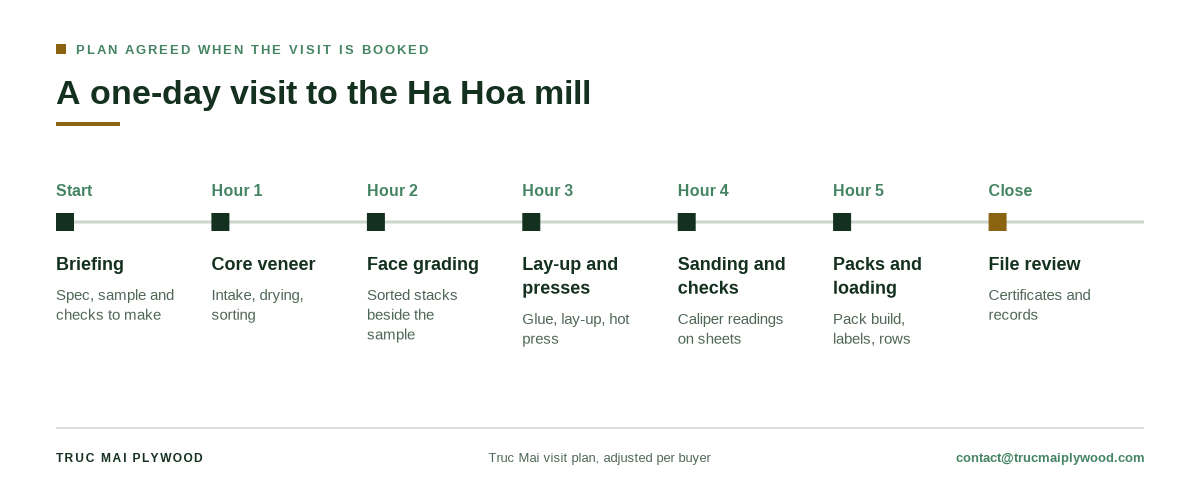
A visit to the Truc Mai plywood mill in Ha Hoa, Phu Tho, takes one day and shows a buyer the whole chain: core veneer from nearby plantations, face grading, presses, sanding with thickness checks and loaded packs. The buyer can also read the FSC-C196493, ISO 9001:2015 and EUDR geolocation files on site.
This page is a visit plan and an audit checklist in one: where to start, what to look at on each line, which numbers to expect, which red flags matter and what to take away in writing. It is written for a buyer who is deciding whether to place a first container, or whether to move a monthly programme, and wants to see for himself that the panels are pressed where the quotation says they are.

- 1 dayenough to walk the line from core veneer to loaded packs
- 7 stopsbriefing, core veneer, face grading, presses, sanding, packs, file review
- ~5,000 m³pressed in an average month, about 60,000 m³ a year
- ±0.3–0.5 mmthickness tolerance to check with your own caliper
The plan is agreed when the visit is booked and adjusted to the buyer's product and questions.
Certificates
Which certificate originals can a buyer read during a visit?
FSC, CARB P2, ISO 9001 and ISO 14001, plus EU file sets.
- FSC 100% FSC-C196493 · SA-COC-014545
- CARB P2 and TSCA Title VI CARB/EPA 26053 · TPC-43
- ISO 9001:2015 W2012 · WCERT
- ISO 14001:2015 W2012E · WCERT
Before the visit, look the FSC code up in the FSC database, find the CARB listing at the California Air Resources Board, read the federal rule under the US formaldehyde standards and the EU file set against Regulation (EU) 2023/1115.
At a glance
What does a one-day visit to a plywood mill in Ha Hoa cover?
A one-day visit covers seven stops in the order the panel is made: briefing, core veneer, face grading, lay-up and presses, sanding and thickness checks, packs and loading, and a review of the files. About five hours on the line, the rest for the briefing and the files.
Walking the mill in process order is what makes a visit an audit and not a tour. Each stop asks one question: is this step done here, and can I measure what comes out of it? A buyer who follows a single spec through all seven stops ends the day with a picture of the whole panel and a list of notes to compare with the quotation.
Ha Hoa is in Phu Tho province, north-west of Hanoi. The route, the pick-up point and the driving time depend on where the buyer lands and are confirmed when the visit is booked.
| Stop | What you see | What to ask or measure | Take away |
|---|---|---|---|
| Briefing | The spec, the sample and the day's checks | Which of your lines are running today | List of stops and questions |
| Core veneer | Intake, drying and sorting of core veneer | Thickness against 1.4–2.0 mm; species and lot | Photos and lot notes |
| Face grading | Face veneer sorted beside the sample | Tone, knots and splits against your sample | Grade pair noted |
| Lay-up and presses | Glue spreading, lay-up, pre-press and hot press | Glue type and emission class on today's batch | Batch record |
| Sanding and checks | Sanded panels and caliper readings | Your own caliper on three sheets | Readings |
| Packs and loading | Pack build, labels and rows | Count on label against packing list | Pack photos |
| File review | The originals behind the scans and the order records | One batch traced back to its veneer lots | Notes and copies |
By product line
What should a visitor look at for each product line?
Look at the step that decides your line: the face grading table for furniture panels, the thickness readings for commercial panels, the pack build for packing grade, flatness for thin panels and the cut plan for cut-to-size orders.
A buyer of 18 mm furniture plywood and a buyer of 4 mm thin panels should not make the same visit. The first spends the most time at grading and sanding; the second at the veneer store and the press, because thin veneer is scarce and a 4 mm panel uses 1.3 mm core veneer.
| Line | Spend most time at | Ask for | Tolerance to check |
|---|---|---|---|
| Furniture and interior | Face grading and sanding | A sample against a production sheet | ±0.3 mm |
| Commercial | Core veneer and presses | Core grade (AB) on today's batch | ±0.5 mm |
| Packing grade | Pack build | A pack opened and counted | ±0.5–1.0 mm |
| Thin 3–6 mm | Veneer store and press | Ply count: 3–5 mm are always five plies | As agreed per thickness |
| Cut to size | The saw and the pack | The cut plan: 2, 3, 4 or 6 panels per sheet | Length and width ±2 mm |
Steps
How does a buyer visit a plywood factory in Vietnam, step by step?
Seven steps turn a visit into an audit: decide what you need to learn, send the spec and sample, agree the route, then walk the line, measure, review the files and write the notes before you leave.
- Decide what the visit must settle
Write down the two or three doubts that stop an order: is the face the same as the sample, does thickness hold, is the pack as described. Check: each doubt has a stop on the plan that can settle it.
- Send the spec and the sample first
Send the eight spec lines and your sample before the visit, so the mill can have the matching batch on the line. Check: the sample reference is on the plan.
- Agree the route and the day
The route from Hanoi, the pick-up point and the day are confirmed in writing when the visit is booked. Check: you have a name and a mobile number for the day.
- Start with the briefing
The day opens with the plan, the spec and the sample. Check: the line you came to see is running that day.
- Walk the line in process order
Core veneer, face grading, lay-up and presses, sanding, packs. Check: at each stop, ask to see the step on your own batch, not a demonstration piece.
- Measure with your own tools
Bring a caliper and take readings on three sheets from the middle of a stack, and compare a production sheet with your sample. Check: readings sit inside the tolerance on the order.
- Review the files and write the notes
Read the originals behind the scans, trace one batch from packing list to veneer lots, and agree the notes before leaving. Check: the notes name the spec reference and the sample.
Photos
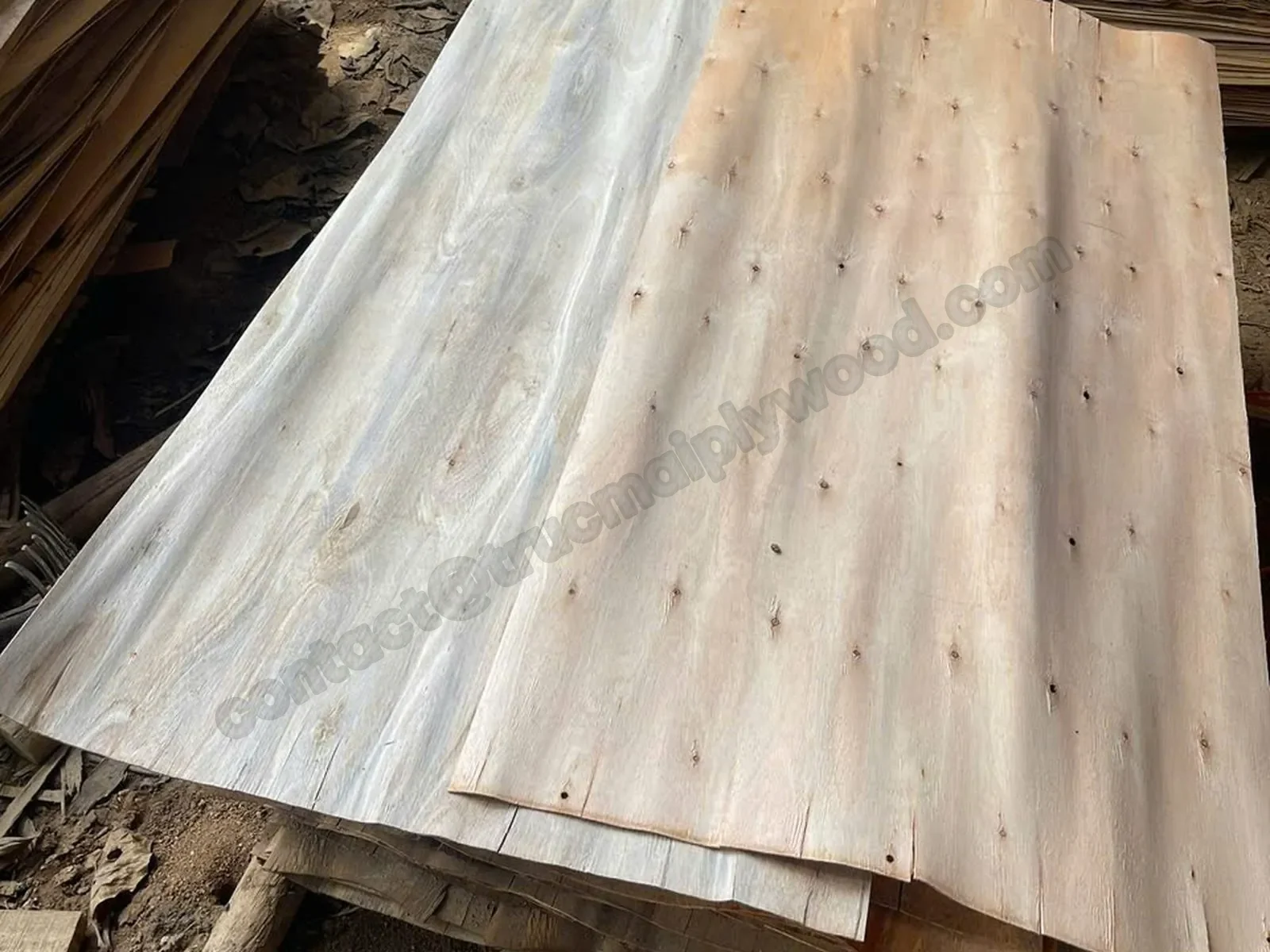
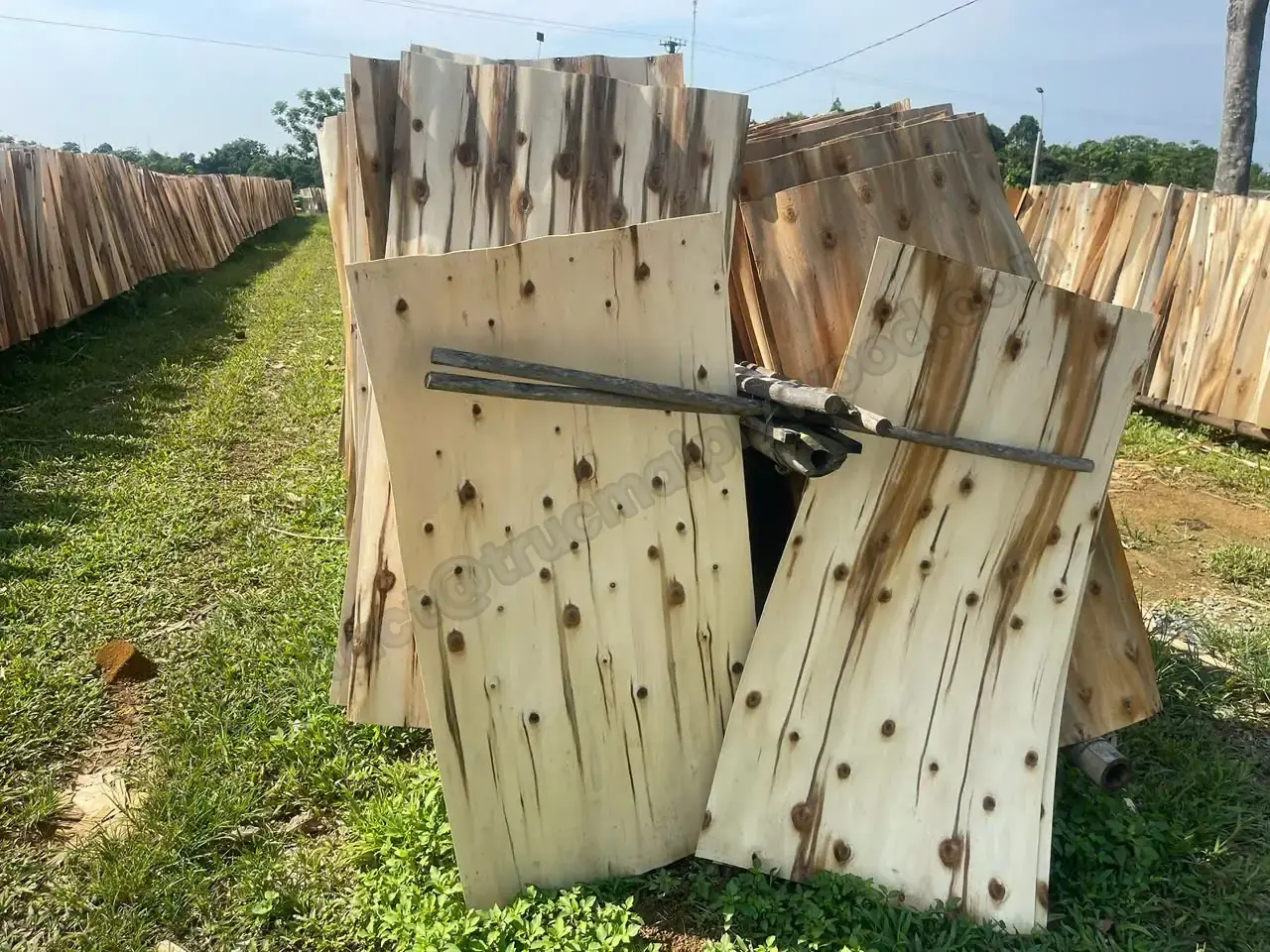
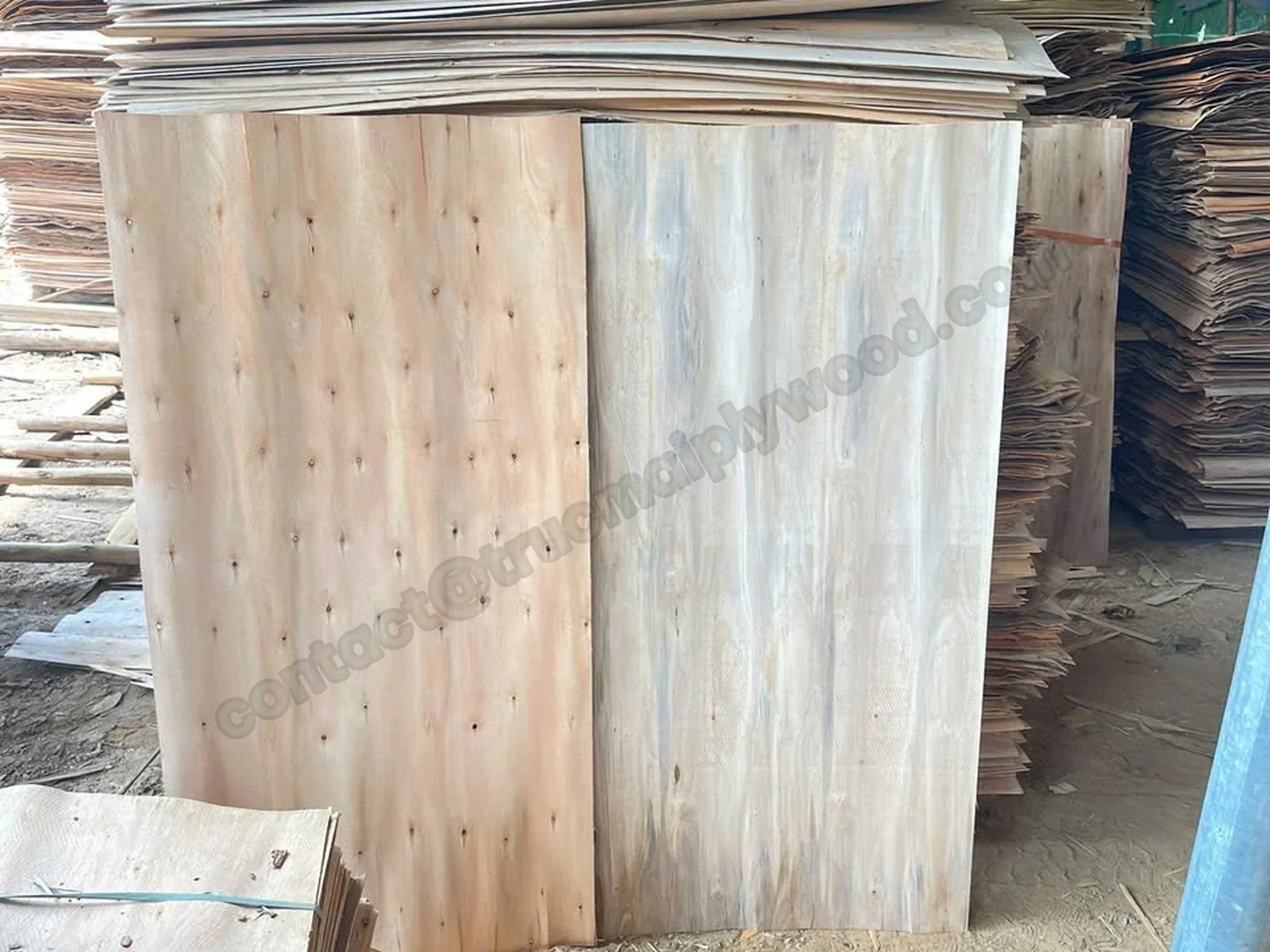
What do the first stops of a plywood mill look like?
The first stops show wood, not panels: core veneer stacked in a shed, veneer sheets with their drying marks and the plantation hills that the wood comes from. A buyer who sees these knows the line starts at veneer.
The photographs show core veneer and thickness measurement as they look in plywood mills; the plantation scene is an illustration of the hills of northern Vietnam, not a photograph of a specific plot.

Red flags
Which red flags on a factory visit should make a buyer ask more?
Six red flags are worth a follow-up question: no veneer on site, presses idle on a normal day, a sample made somewhere else, a stack that cannot be opened, a spec that differs from the sheets and a tour that skips a stop. None proves a problem, but each needs an answer in writing.
The question behind every red flag is the same one: is the panel in my quotation made here? A mill that presses its own panels can show every stage on a normal working day, and a trader that buys finished sheets usually cannot.
| Red flag | What it can mean | What to ask |
|---|---|---|
| No veneer or presses on site, only finished panels | The panels are bought in | Show me the veneer store and the press for my spec |
| Presses idle on a normal working day | Orders are small or made elsewhere | Which presses make my spec and when? |
| The sample comes from another plant | The mill does not press the spec | Where was the sample pressed, and when? |
| A pack cannot be opened | The count or face is not what the label says | Open one pack and count the sheets |
| Sheets differ from the spec | Thickness or core is not as quoted | Read three sheets with my caliper |
| The tour skips a stop | A step is done off site | Can I see that step on my batch? |
Numbers
Which numbers should a visitor expect to find on the line?
Expect six numbers on the line: core veneer of 1.4–2.0 mm, face veneer of 0.2–0.5 mm and 11–13 plies in an 18 mm panel. Then a thickness tolerance of ±0.3–0.5 mm, packs about 1,000 mm high and at most 18 packs in a 40HC on Styrax core.
The numbers are the ones the mill writes on its quotations, so any difference on the line is a difference from the quotation. A buyer who brings them as a card can check each one against what is in front of him.
| Station | Number | How to check |
|---|---|---|
| Core veneer | 1.4–2.0 mm | Caliper on three sheets from different stacks |
| Face veneer | 0.2–0.5 mm, usually 0.3 mm | Ask for the thickness record of the lot |
| 18 mm panel | 11–13 plies, most often 11 | Count the plies on the edge |
| Sanded panel | ±0.3–0.5 mm per order | Caliper on the edge, three sheets |
| Pack | About 1,000 mm high | Tape on a pack; count against the label |
| 40HC on Styrax core | 18 packs at most | Loading plan against the packing list |
Audit checklist
Plywood factory audit checklist: which ten checks are worth making in one day?
Ten checks cover most of what a buyer needs to know: the veneer store, the grading table, a press record, three caliper readings, a ply count, a pack count, the sample match, the loading plan, the files and one traced batch.
A checklist keeps the day from becoming a tour. Tick the checks you can make yourself and write down the ones you were shown but could not test; the second list is the one to follow up in writing after the visit.
| Check | What it proves | How |
|---|---|---|
| Veneer store | The line starts at veneer | Walk it; ask where the lot for your spec is |
| Grading table | Faces are sorted before lay-up | Watch a stack sorted beside the sample |
| Press record | Glue and emission class are recorded per batch | Read the record for today's batch |
| Three caliper readings | Thickness holds | Your own caliper, three sheets from the middle |
| Ply count | The build is as quoted | Count on the edge of an 18 mm panel |
| Pack count | The label tells the truth | Open one pack and count |
| Sample match | The production sheet equals the sample | Compare under daylight |
| Loading plan | The container is planned, not improvised | Read the plan for the next load |
| File review | The paperwork exists and is current | Read the originals and copies |
| One traced batch | The chain from veneer to pack is unbroken | Packing list back to veneer lots |
What you hold
What should a buyer take away from a visit?
A buyer should leave with four things in writing: the notes of the day, the caliper readings, the sample reference that was compared and a list of any open questions with a date for the answer.
- Notes of the day What was shown at each stop and what was not
- Readings Your own caliper readings with the sheet and stack they came from
- Sample reference The sample and the production sheet it was compared with
- Open questions Each with an owner and a date
Files
Which files can a buyer review during a visit?
Four sets of files can be read at the mill: the originals behind the scans, the EU due-diligence file, the batch records and the pack-check sheets. Copies of the ones a buyer needs go with the quotation.
- Originals behind the scans
The four documents behind the scans, with issuer and numbers to check afterwards.
Origin records and plot geolocation for the core and the face veneer.
- Batch records
Glue, emission class and press notes for the batch you follow.
- Pack-check sheets
Counts, thickness readings and edge notes of earlier containers.
Region and volume
Why can plywood manufacturers in Phu Tho Vietnam, around Ha Hoa, make plywood at a lower cost?
Mills in Ha Hoa work next to plantation forest, so core wood is cheap to bring in, and skilled labour costs less, which lets the same quality be priced lower. The mill presses around 60,000 m³ a year, about 5,000 m³ in an average month.
Plantation wood is the reason the cores are Eucalyptus, Acacia, Styrax and Pine. For a buyer the useful conclusion is narrow: the wood does not travel far, and the mill's volume is large enough that a monthly container is a small part of it. Output and lead times by volume are on their own pages.
Before you travel
Which six things should a buyer arrange before travelling to Ha Hoa?
Six arrangements make the day work.
A date and the route, confirmed in writing, with a name and a mobile number for the day.
The spec in eight lines and a sample, sent before the visit.
A caliper, a tape and a torch for your own readings.
A list of the doubts the visit must settle, one per stop.
A request to see one batch of your spec traced from packing list to veneer.
Time at the end for the files and for agreeing the notes.
FAQ
Factory visit questions from container buyers
Direct answers on what a visit shows, what to check and what to bring.
Should you visit a plywood factory in Vietnam before ordering?
It is worth it for a first container or a monthly programme, because one day shows whether the panels are pressed where the quotation says. A visit does not replace a check of the loaded packs, but it settles the question of who makes the panel.
How can a buyer confirm that a plywood mill makes its own panels?
By watching each stage on a normal working day: veneer in the store, faces sorted, presses running, sanded panels measured and packs built. Trace one batch from the packing list back to its veneer lots; a trader cannot do that.
Which checks are worth making on the lines in one day?
Three caliper readings, a ply count on an 18 mm panel, one pack opened and counted, a production sheet compared with your sample and one batch traced back to veneer. Together they take a few hours.
Which certificate files can a buyer review during a visit?
The originals behind the scans in the mill's name, the EU due-diligence file with core and face origin records, and the batch and pack-check records. Copies of the files a buyer needs go with the quotation.
Why can mills in Ha Hoa source core wood at lower cost?
Plantation forest grows next to the mills, so the core wood is not hauled far, and skilled labour costs less. The mill can therefore price the same quality lower.
Can a visit include approving the reference sample?
Yes. Send the sample first, and on the day compare it with a production sheet under daylight. Buyer and mill each keep one sample with the same reference after the visit.
How long does a visit take?
One day. About five hours on the line for seven stops, plus the briefing and the file review. The route from Hanoi and the driving time are confirmed when the visit is booked.
Can a third-party inspector visit instead of the buyer?
Yes. An optional third-party inspector can attend the pack check, and the same checklist applies: counts, thickness readings and the face against the sample.
What should I send before the visit?
The spec in eight lines (application, face and back, core, glue and emission, thickness and tolerance, sheet size, packing, quantity) and a sample of the face. The mill then has a matching batch on the line.
What does a visit not show?
A visit shows how the mill works on the day, not every future container. For that, the written spec, the kept sample and the pack-check sheet of each load carry the result forward.
Book a visit
Ask for a visit date
Send the spec, a sample and the dates you can travel; the plan for the day comes back with the route and the stops for your line.
Spec in eight lines, sample, preferred dates and the people travelling.