
Mill · Lead times
Plywood production lead time: 15–45 days to load, then the days at sea
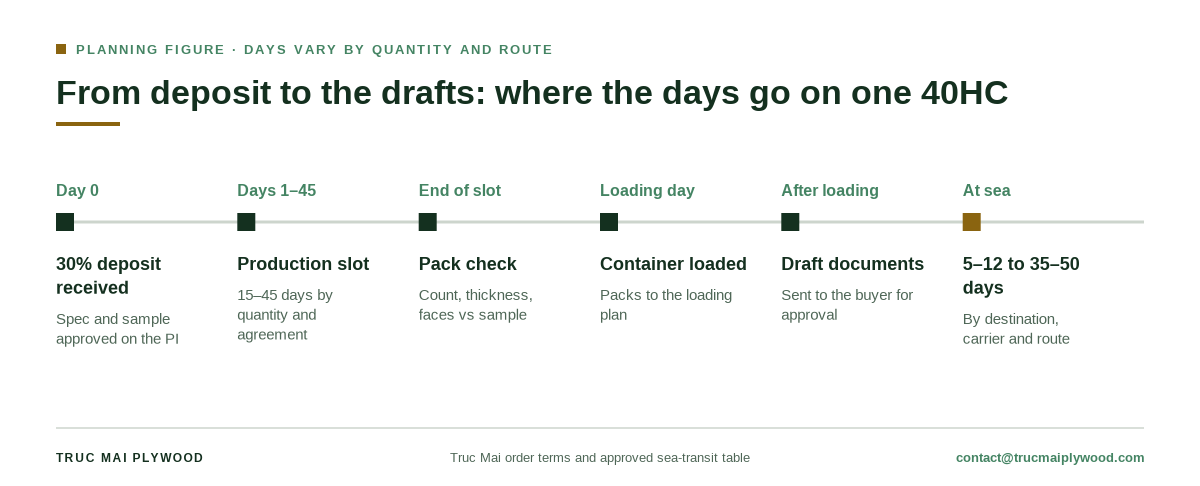
Plywood production lead time at Truc Mai is 15–45 days from the 30% deposit to a loaded 40HC, then 5–12 days at sea to South-East Asia and up to 35–50 days to West Africa. Where an order sits in the production range depends on quantity, the number of products, the thickness and how complete the spec is. For plywood lead time Vietnam buyers can count on, the days at sea are added after loading.
This page is for the buyer who is working backwards from a date: a delivery to a customer, a production start or a trade-fair season. It splits the time into the clocks that run one after the other, shows what moves an order toward the short or the long end, and gives the sea days by destination from the mill's approved table. The monthly rhythm of repeat buyers is on monthly container programmes, and the mill's output is on monthly output.
- 15–45 daysproduction after the 30% deposit
- 30–40 daystypically at sea to Northern Europe
- 35–45 daystypically at sea to the US East Coast
- 4 mmpanels can take longer: good thin veneer is scarce
Planning figure: days at sea vary by carrier and route; booking waits, port handling and inland transport are extra.
Certificates
Which certificate files are ready before the production clock starts?
FSC, CARB P2, ISO 9001 and ISO 14001, plus EU file sets.
- FSC 100% FSC-C196493 · SA-COC-014545
- CARB P2 and TSCA Title VI CARB/EPA 26053 · TPC-43
- ISO 9001:2015 W2012 · WCERT
- ISO 14001:2015 W2012E · WCERT
Before the deposit, a buyer can look up FSC-C196493 in the FSC database, read the listing at the California Air Resources Board against the US formaldehyde standards, and match the EU file set to Regulation (EU) 2023/1115. The packaging test follows Regulation (EU) 2025/40, the system ISO 9001.
At a glance
How long to produce a container of plywood, and what plywood lead time should a buyer plan?
A plywood order runs on four clocks one after the other: approval, production, loading and sea. Truc Mai fixes the second clock at 15–45 days after the 30% deposit, the buyer's approvals set the first, and the carrier and route set the last.
Lead time is not one number, and quotes that give one number rarely say which clock they mean. The clock the mill controls is production, from the confirmed slot to a counted and measured pack. Before it, the buyer controls how fast the sample is approved and the deposit sent; after it, the loading day and the sea days decide when the container is in the buyer's port.
| Clock | Starts | Ends | Range | Who sets it |
|---|---|---|---|---|
| Approval | RFQ sent | Sample approved, PI signed, 30% deposit paid | Set by the buyer's approvals and courier time | Buyer |
| Production | Deposit received and slot confirmed | Packs counted and measured at the pack check | 15–45 days | Mill, by quantity and agreement |
| Loading and drafts | Pack check passed | Container loaded, draft documents approved | Set by the loading date and the buyer approving the drafts | Mill and buyer |
| Sea | Container leaves Hai Phong | Container reaches the destination port | 5–12 to 35–50 days, by destination | Carrier and route |
By volume
How does the lead time change with volume: one 40HC, several containers or a monthly slot?
One container on a known spec sits at the short end of the 15–45 day range; several containers in one order, a first order, a long product list or 4 mm panels sit toward the long end, and a programme call-off is planned against a reserved slot.
The exact days for a given quantity are written in the quotation and confirmed in writing with the deposit, because they depend on production conditions at that time. The pattern below is how the range is used when quoting; it is not a second set of numbers.
| Order | Tends toward | Why |
|---|---|---|
| One 40HC, known spec, one or two products | Short end | One line to build and one sample to match |
| First order, new spec | Middle to long end | The first container sets the baseline, with a sample and a full pack check |
| Several 40HC in one order | Long end | More production days for the same spec |
| Monthly programme call-off | Planned against a reserved slot | The call-off date is written before the deposit |
| Three to six products in one container | Long end | Each product is a separate line to build, sample and check |
| 4 mm panels | Longer | Good thin veneer is scarce; 4 mm uses 1.3 mm core veneer |
| Cut-to-size panels | Add the cutting time | The sheet is split into 2, 3, 4 or 6 panels before packing |
Inside the production clock
What happens between the deposit and the loading day?
Seven steps run inside the 15–45 days; the build itself is described on how our plywood is made, and each step here ends with a check a buyer can ask about.
- Slot confirmed
The deposit receipt carries the production slot in writing. Check: the slot date is on the paper, not agreed by message.
- Core and face veneer ready
Core logs are peeled and the veneer dried; face veneer is sorted for the grade pair. Check: the face veneer used matches the grade of the approved sample before lay-up.
- Lay-up and pressing
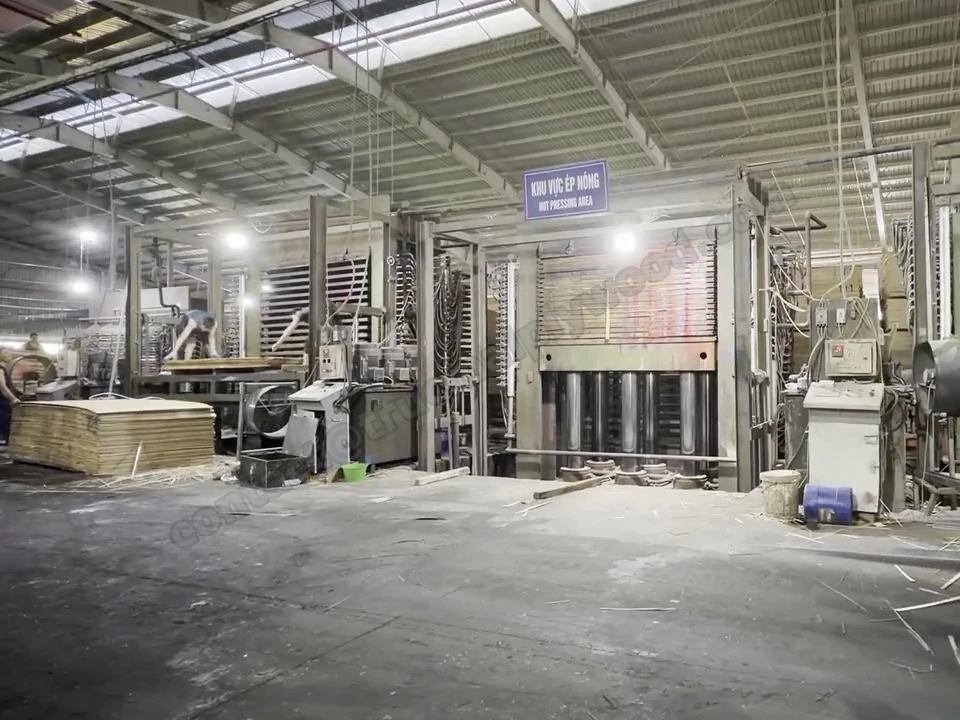
Veneers are glued, laid crosswise and hot-pressed. Check: glue type and emission class match the two lines on the order.
- Sanding and trimming
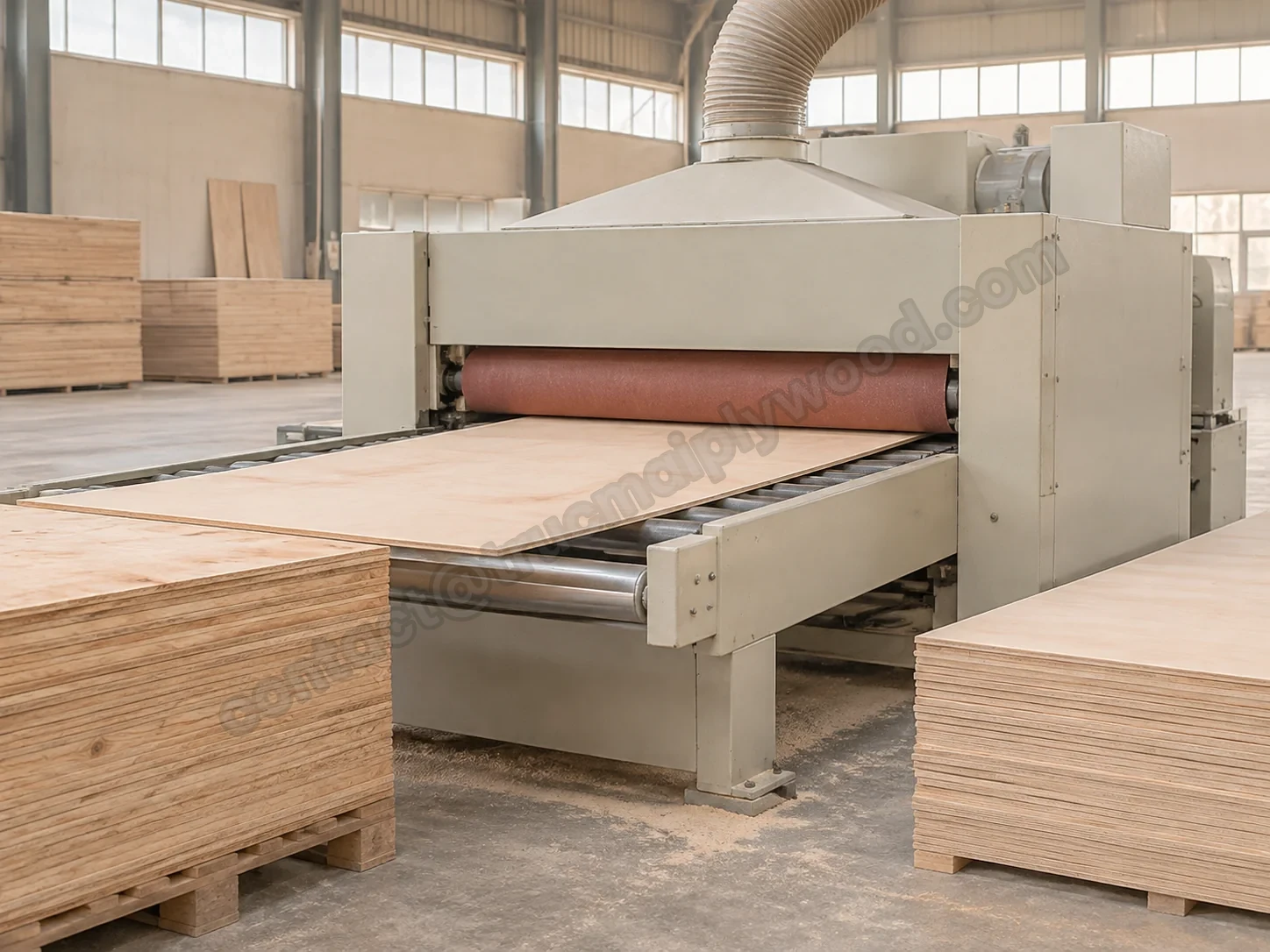
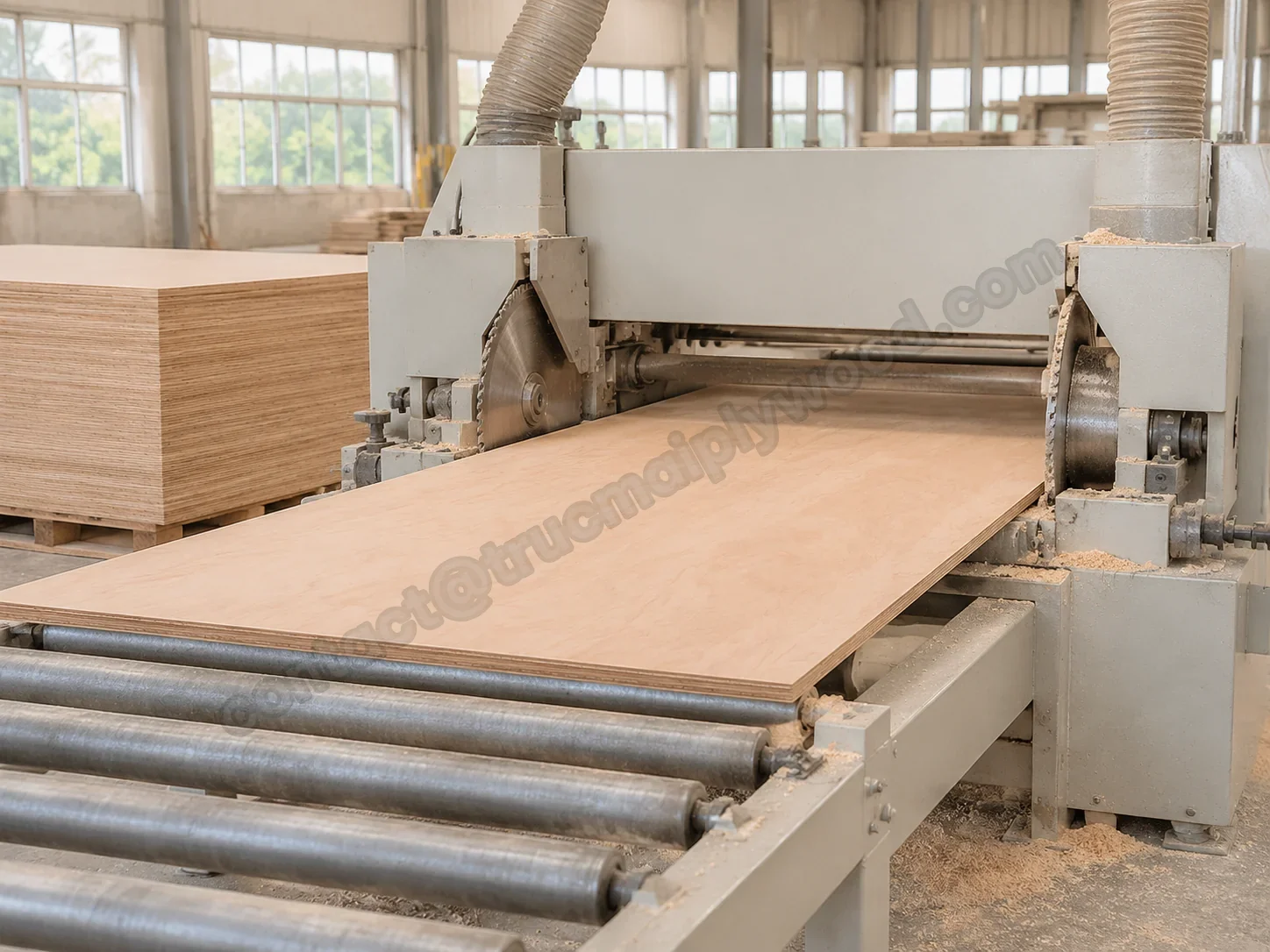
Panels on sanded lines are sanded and calibrated to thickness, then trimmed to sheet size. Check: thickness within the tolerance written on the order.
- Sorting and packing
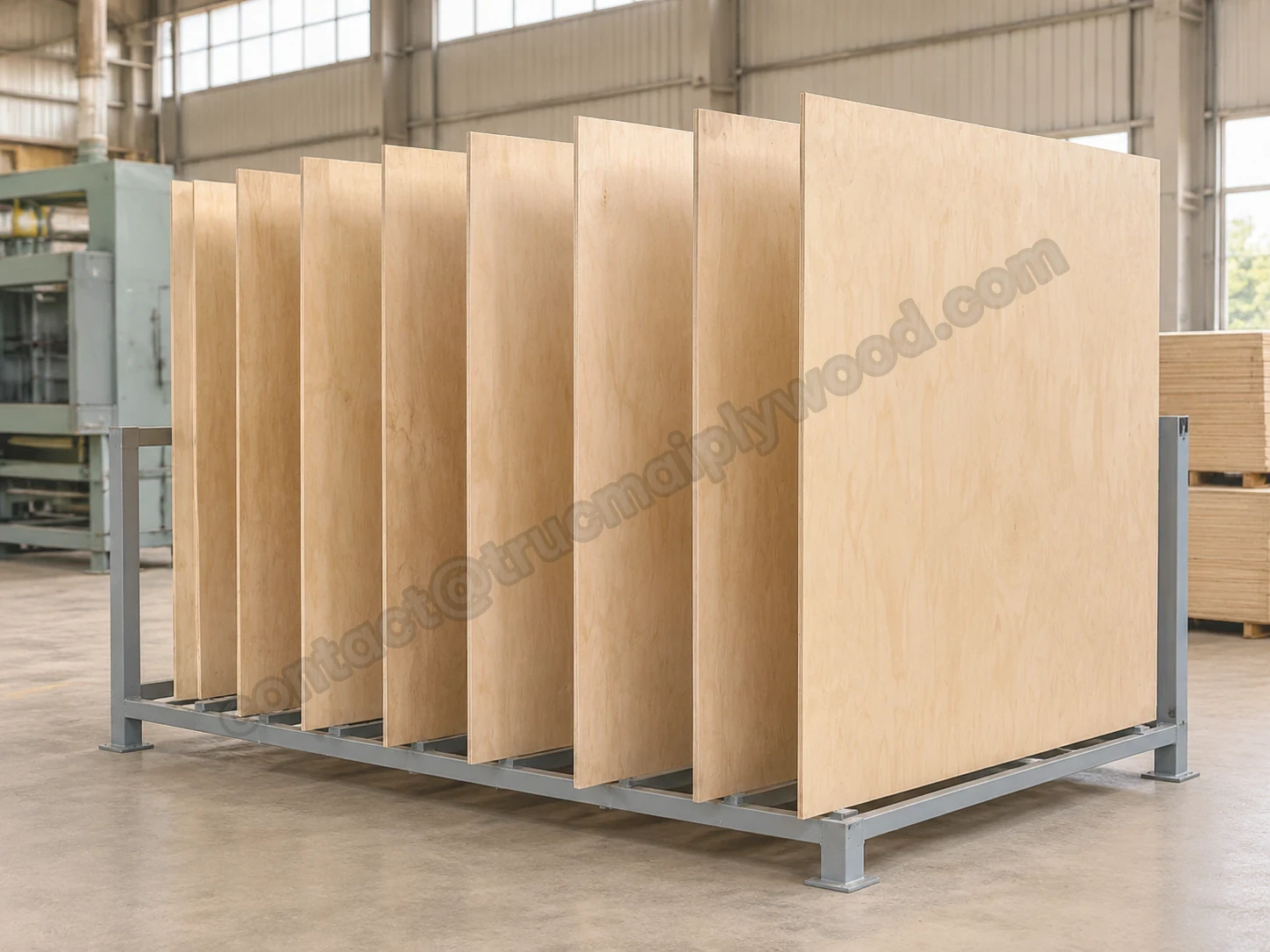
Panels are sorted by face grade against the sample and built into packs. Check: pack count follows the loading plan.
- Pack check
Sheets are counted, thickness is measured and faces are compared with the approved sample. Check: a buyer's inspector can attend.
- Loading
Packs are loaded to the plan; this ends the production clock. Check: container, seal and pack count on the loading record.

Time and process
Where do the days go: a timeline and two stages that set the pace?
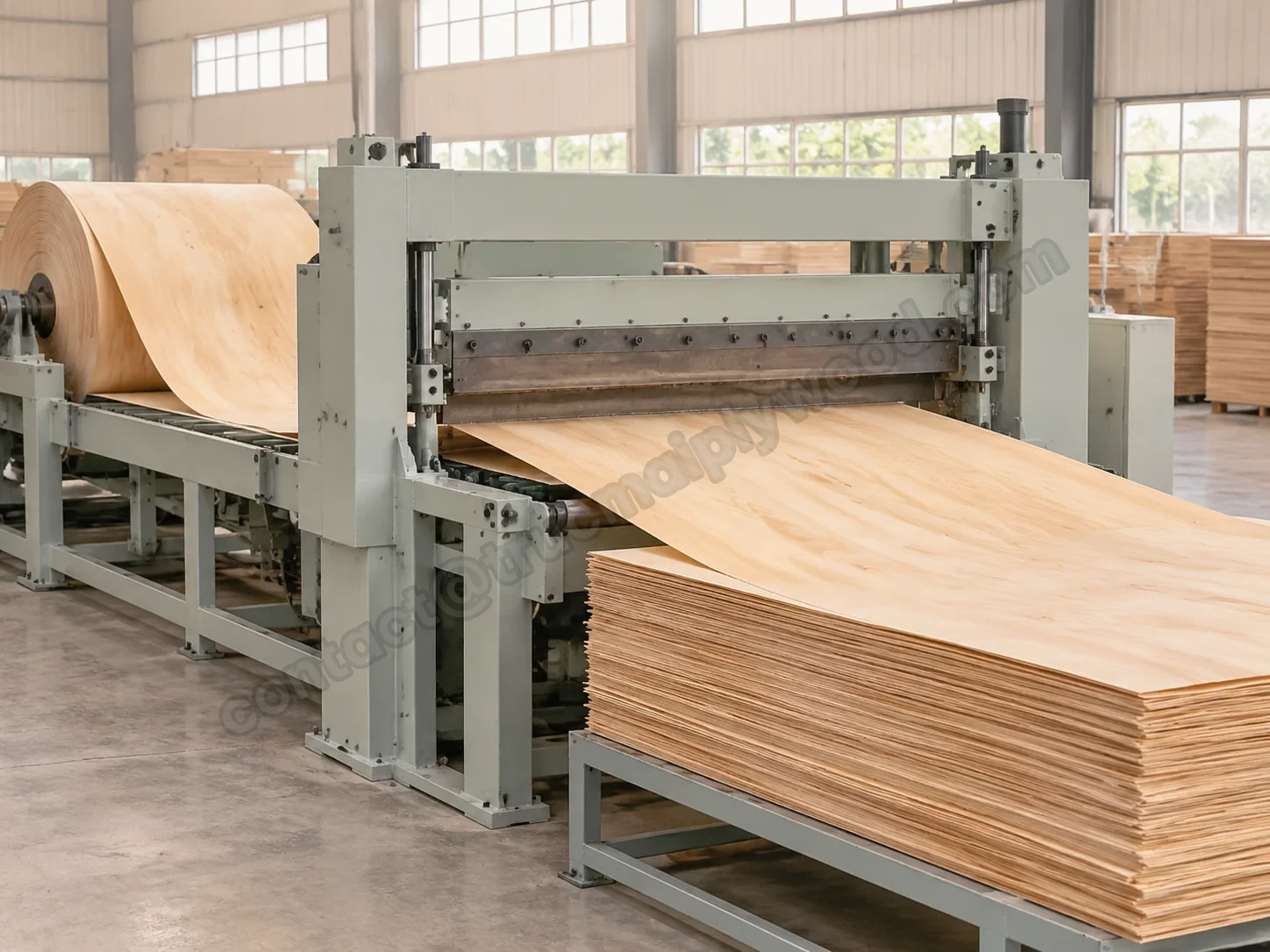
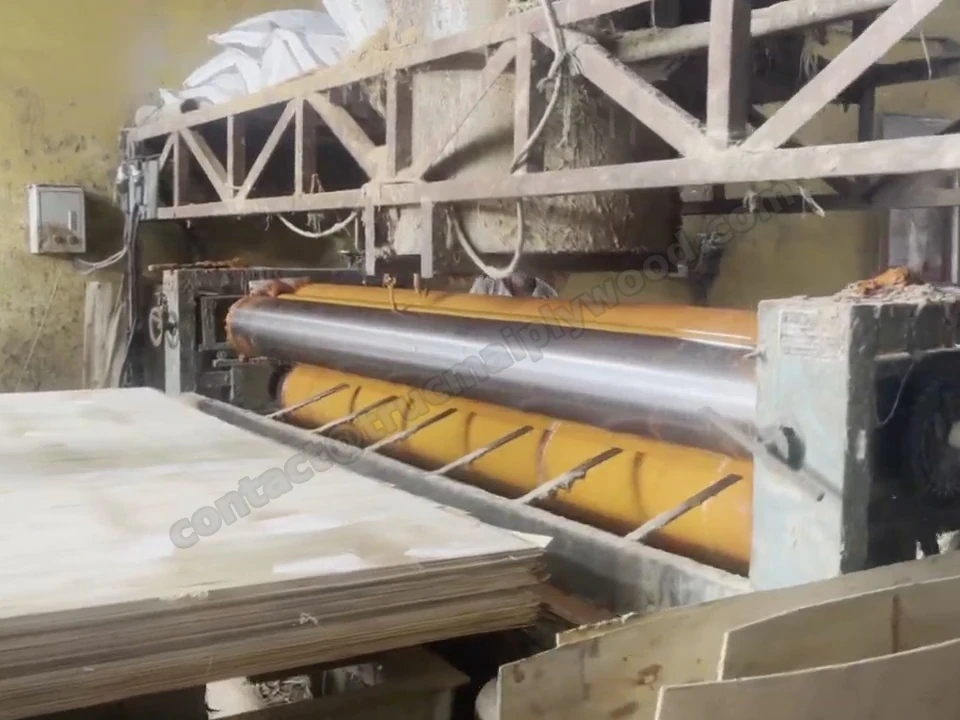
The days go to the stages that cannot be hurried: veneer drying, pressing and the pack check; the paperwork after loading is the shortest part.
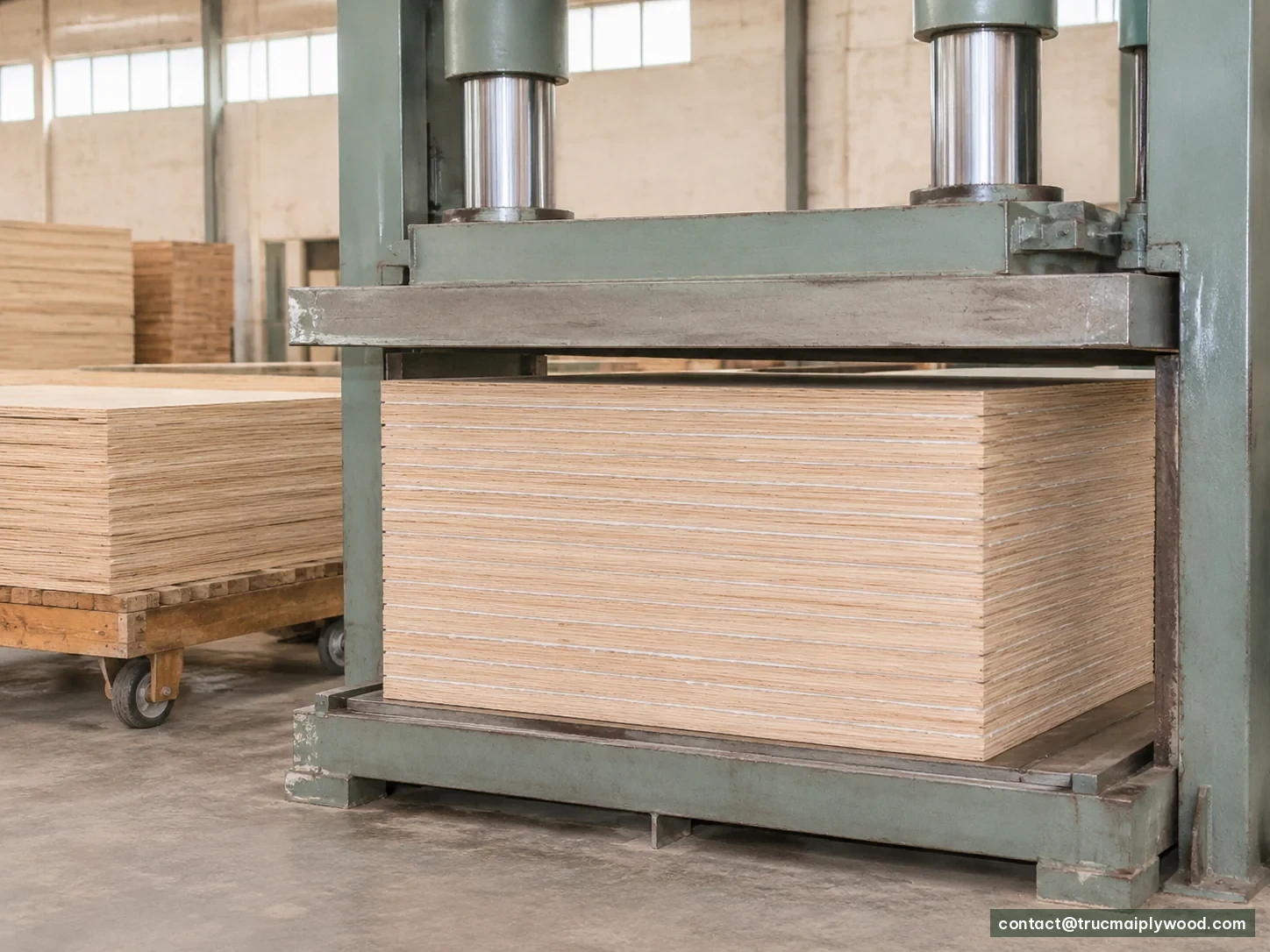
Glued lay-ups are pressed under heat and pressure, and sanding then calibrates the panels to the written thickness. Both sit inside the 15–45 days. The timeline shows the clocks in order, from the deposit to the sea days.
Why orders run late
What makes a plywood order late, and how is it avoided?
Orders run late for reasons visible at the start: a spec still changing, a sample approved after the deposit, a thin panel ordered late, a mix changed after planning, or a deposit that arrives later than the date the buyer counted from.
| Delay | Cause | Prevention |
|---|---|---|
| Production starts late | Deposit paid after the date the buyer planned from | Count the clock from the deposit date, not from the PI date |
| Spec changed during production | Face grade or thickness tolerance revised after the slot | Close the spec before the deposit; changes go through a new proforma invoice |
| 4 mm panels not ready | Good thin veneer is scarce | Order 4 mm panels first and early |
| Container re-planned | Products added after planning | Mix fixed on the proforma invoice |
| Documents hold the cargo | Certificate or EUDR files not requested before confirmation | Ask for the file set before confirmation |
| Sea days longer than expected | Carrier and route, not the mill | Use the range for the destination, not the minimum |
Numbers
How many days at sea from Hai Phong, and what is added to the production days?
The days at sea from Hai Phong run from 5–12 days to South-East Asia to 35–50 days to West Africa; add the production range of 15–45 days to the figure for the destination to plan from deposit to port.
| Destination | Days at sea |
|---|---|
| South-East Asia | 5–12 |
| Middle East | 15–25 |
| US West Coast | 20–30 |
| Mediterranean | 25–35 |
| Northern Europe | 30–40 |
| US East Coast | 35–45 |
| West Africa | 35–50 |
Sea days vary by carrier and route and leave out booking waits, port handling and inland transport.
Buyer guide
Plywood lead time Vietnam to destination: how can supplier and buyer cut it on an international order?
Lead time is cut mostly before the deposit: a closed spec, an early sample, a complete RFQ, the certificate files in hand and a call-off date that respects the 15–45 days. The mill cannot shorten the sea days, but it can keep the production days at the short end when the order is simple.
The levers are in the buyer's hands more than most buyers expect. The same panel ordered as one line, in a standard sheet size, with the sample approved before the deposit, runs as short as the range allows.
| Lever | What to do | Effect |
|---|---|---|
| Complete RFQ | State all eight lines the first time | No second round of questions before the PI |
| Early sample | Approve the face pair before the deposit | Production does not wait for a grade decision |
| Fewer products | One or two products per container | Short end of the range |
| Standard sheet | 1220 × 2440, 1220 × 2280 or 1250 × 2500 mm | No cutting step |
| Thin panels first | Place 4 mm early | Avoids the scarce thin veneer |
| Call-off date | Confirm 15–45 days before the loading date wanted | The slot exists when it is needed |
What you hold
What does a buyer hold to track the clock?
A buyer can follow the production clock with four written points: the slot date on the deposit receipt, the pack-check sheet, the loading record and the draft documents.
- Slot date On the deposit receipt, in writing
- Pack-check sheet Counts, thickness readings and face notes before loading
- Loading record Container, seal and pack count on the day
- Draft documents Sent for approval after loading, then the B/L
Paper on the clock
When does each document arrive relative to the clock?
Documents arrive at three points: before the order is confirmed, after loading and after payment; the full list is on papers per container.
The order's certificate files, so the buyer can check them before the deposit.
The spec, the tolerance, the delivery term and the slot, fixed in one document.
Sent to the buyer for approval; the draft shows the seal number and gross weight.
- Bill of lading
The 70% balance is paid against the scanned B/L; the originals or a telex release follow.
Pace
Why is the plywood production lead time for one container 15–45 days at a mill of about 5,000 m³ a month?
The production time is the time an order takes through the stages in sequence, not a queue behind the mill's output: one 40HC of 18 mm panels is about 53, 47 or 43 m³, about 1% of the around 5,000 m³ the mill produces in an average month.
Veneer has to be peeled and dried, pressed, sanded and sorted, and each product on the order is its own run. That is why the range depends on quantity and on the number of products more than on the mill's total pace. Output by month and by line is on monthly output.
Work backwards
Which six steps give a loading date from the date you need the panels?
Count back from the date the panels are needed at the destination, one clock at a time.
Take the date the panels must be in the destination port.
Subtract the days at sea for the route, using the upper end of the range.
Subtract 15–45 days of production; use 45 for a first order, several products or 4 mm.
Allow the days for the drafts to be approved after loading.
The result is the latest date for the deposit and the confirmed slot.
Subtract the days for the sample and the PI; that is the latest date for the RFQ.
FAQ
Lead time questions from container buyers
Direct answers on production days, sea days and what moves them.
How long does a first 40HC take from deposit to loading?
Production takes 15–45 days after the 30% deposit, by quantity, production conditions and agreement. A first order with a new spec tends to the middle or long end because the sample and the pack check set the baseline.
Why can 4 mm plywood take longer to produce?
Good thin veneer is scarce. A 4 mm panel is five plies with 1.3 mm core veneer, and the veneer that is flat and sound enough for it is harder to find than for thicker panels.
How many days at sea from Hai Phong to Northern Europe or the US East Coast?
Northern Europe is typically 30–40 days and the US East Coast 35–45 days. The days vary by carrier and route.
How can a plywood supplier cut lead time on international orders?
By keeping the order simple: a complete RFQ, an approved sample before the deposit, one or two products, a standard sheet size and a call-off date that respects the production range. The mill cannot shorten the days at sea.
Does mixing thicknesses in one container change the lead time?
It can. Each product or thickness line is built, sampled and checked separately, so a container with three to six lines usually sits toward the long end. The mix is fixed on the proforma invoice before the slot is confirmed.
When are draft shipping documents sent after loading?
After loading, to the buyer for approval. The buyer checks the seal number and gross weight on the draft, and the 70% balance is then paid against the scanned B/L.
Does the lead time include the days at sea?
No. The 15–45 days run from the 30% deposit to a loaded container. Sea days are added from Hai Phong and vary by route.
When do certificate files arrive?
Before the order is confirmed, so the buyer can check them before paying the deposit. They are not on the production clock.
Can a repeat order be faster?
A repeat order on a known spec, with the sample already approved, usually sits at the short end of the range. A programme writes the call-off date so the slot is ready.
Where is the confirmed production date written?
On the deposit receipt, as the slot confirmed in writing. Ask for it before relying on a date.
Book a slot
Send the date you need the panels
Send the eight RFQ lines, the destination port and the date the panels must be there; the quotation comes back with the production days and the sea days for the route.
Application, core, glue and emission, face and back, thickness and tolerance, sheet size, packing, quantity, port and the date needed.