
Resources · mm to inch converter
6mm to inch and every plywood thickness in inches
6 mm is 0.236 in, a little under 1/4 in (6.35 mm). 18 mm is 0.709 in, nearest 23/32 in, not 3/4 in (19.05 mm). This converter gives every Truc Mai thickness from 3 to 40 mm in decimal inches and 32nds, with the ±0.3 mm tolerance written per order shown as ±0.012 in.
It is for a US or Canadian buyer who thinks in inches and orders in millimetres. Metric sheets are pressed to metric thicknesses, so an order written as “3/4 in” is really an 18 mm or 19 mm question; the converter and table make that choice explicit before the RFQ.
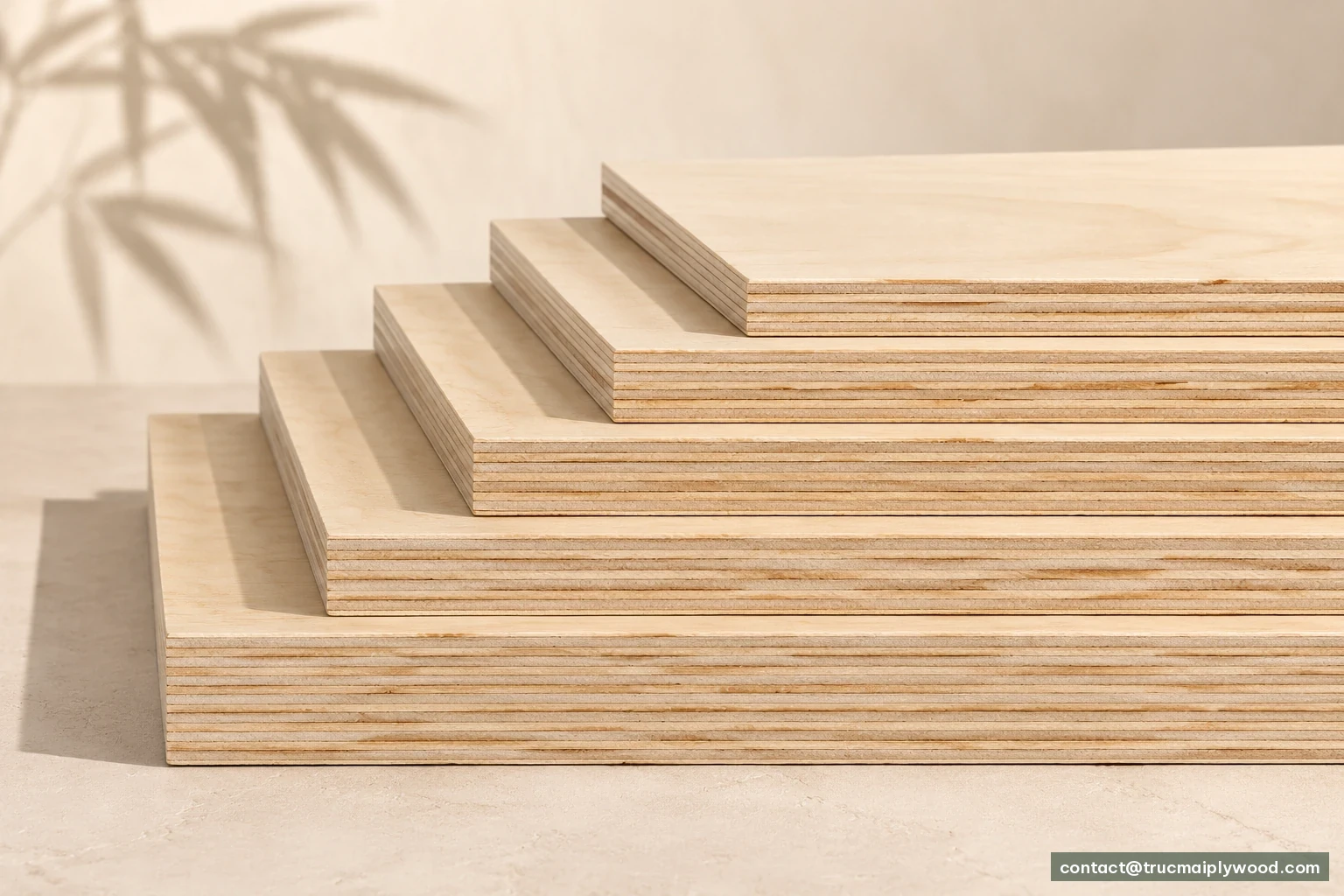
- 0.236 in6 mm
- 0.709 in18 mm, nearest 23/32 in
- ±0.3–0.5 mmtolerance written per order
- 5 pliesevery 3–5 mm sheet
Conversions are exact (1 in = 25.4 mm); sheet counts per 40HC are planning figures, not a loading record.
Converter
6mm to inch, and any plywood thickness from mm to inches
Type a thickness in millimetres and the tolerance on your order; the converter returns decimal inches, the nearest 32nd, and the thinnest and thickest sheet the tolerance allows. The last field converts inches back to millimetres.
The nearest-32nd line is a count: 23 means 23/32 in. Reduce it yourself where it divides (16/32 is 1/2 in). The difference line shows how far the metric sheet is from that fraction; a negative value means the metric sheet is thinner.
Reference table
Plywood thickness chart: ply thickness in mm and inches, 3–40 mm
The twelve thicknesses the mill makes, 3, 4, 5, 6, 9, 12, 15, 18, 21, 25, 30 and 40 mm, in inches. No panel is thinner than 3 mm.
Two columns matter for a North American order. The tolerance band shows what a caliper may read on arrival: an 18 mm calibrated furniture panel at ±0.3 mm reads 0.697–0.720 in. The scope column shows which thicknesses fall inside the formaldehyde certificate CARB/EPA 26053, hardwood plywood with veneer core, 3–25 mm and 3–15 plies; 30 and 40 mm are outside it. Details in CARB P2 test reports.
For 6 mm, 2,988 sheets fit one 40HC on Styrax core in the planning model, 18 packs of 166.
| Thickness | Decimal inches | Nearest 32nd | ±0.3 mm band (in) | ±0.5 mm band (in) | In the 3–25 mm scope | Sheets per 40HC |
|---|---|---|---|---|---|---|
| 3 mm | 0.118 in | 1/8 in | 0.106–0.130 | 0.098–0.138 | yes | 5,994 |
| 4 mm | 0.157 in | 5/32 in | 0.146–0.169 | 0.138–0.177 | yes | 4,500 |
| 5 mm | 0.197 in | 3/16 in | 0.185–0.209 | 0.177–0.217 | yes | 3,600 |
| 6 mm | 0.236 in | 1/4 in | 0.224–0.248 | 0.217–0.256 | yes | 2,988 |
| 9 mm | 0.354 in | 11/32 in | 0.343–0.366 | 0.335–0.374 | yes | 1,998 |
| 12 mm | 0.472 in | 15/32 in | 0.461–0.484 | 0.453–0.492 | yes | 1,494 |
| 15 mm | 0.591 in | 19/32 in | 0.579–0.602 | 0.571–0.610 | yes | 1,188 |
| 18 mm | 0.709 in | 23/32 in | 0.697–0.720 | 0.689–0.728 | yes | 990 |
| 21 mm | 0.827 in | 13/16 in | 0.815–0.839 | 0.807–0.846 | yes | 846 |
| 25 mm | 0.984 in | 31/32 in | 0.972–0.996 | 0.965–1.004 | yes | 720 |
| 30 mm | 1.181 in | 1 3/16 in | 1.169–1.193 | 1.161–1.201 | no | 594 |
| 40 mm | 1.575 in | 1 9/16 in | 1.563–1.587 | 1.555–1.594 | no | 450 |
| Inch thickness | Millimetres | Nearest mill thickness | Difference |
|---|---|---|---|
| 1/8 in | 3.18 mm | 3 mm | -0.17 mm |
| 1/4 in | 6.35 mm | 6 mm | -0.35 mm |
| 3/8 in | 9.52 mm | 9 mm | -0.52 mm |
| 1/2 in | 12.70 mm | 12 mm | -0.70 mm |
| 5/8 in | 15.88 mm | 15 mm | -0.88 mm |
| 3/4 in | 19.05 mm | 18 mm | -1.05 mm |
| 1 in | 25.40 mm | 25 mm | -0.40 mm |
How the numbers work
How does the mm to inch converter work?
Inches = millimetres ÷ 25.4. Nearest 32nd = round(mm ÷ 25.4 × 32). Tolerance band = (mm ± tolerance) ÷ 25.4. Inches to mm = inches × 25.4.
The inch is defined as exactly 25.4 mm; see NIST for the SI conversion factors. Nothing in the conversion is rounded except the display, so 18 mm is 0.70866 in before it is shown as 0.709.
A 1220 × 2440 mm sheet is 0.8 mm wider and 1.6 mm longer than a 4 × 8 ft sheet, well inside the ±2 mm length and width tolerance, which is why the two are traded as the same size. Thin sheets from 3 to 6 mm are covered on thin panels.
- Definition 1 inch = 25.4 mm exactly (NIST)
- Thicknesses 3–40 mm, listed as 12 values; nominal
- Tolerance ±0.3 mm on sanded and calibrated furniture panels, ±0.5 mm commercial, ±0.5–1.0 mm packing grade
- Plies 3–5 mm always 5 plies; 18 mm usually 11–13, most often 11
- Sheet size 1220 × 2440 mm = 48.03 × 96.06 in; 4 × 8 ft = 1219.2 × 2438.4 mm
Questions
Plywood thickness in inches: questions
How thick is 6 mm in inches?
6 mm is 0.236 in, nearest 8/32 = 1/4 in, which is 6.35 mm. The metric sheet is 0.35 mm thinner than 1/4 in.
Is 18mm plywood the same as 3/4?
No. 3/4 in is 19.05 mm; 18 mm is 0.709 in, nearest 23/32 in (18.26 mm). Write the metric thickness on the order and, if a hardware fit depends on it, the inch figure you need.
How far can an 18 mm sheet vary from nominal?
The tolerance is written per order: ±0.3 mm on sanded and calibrated furniture panels (0.697–0.720 in) and ±0.5 mm on commercial panels (0.689–0.728 in). Packing grade is ±0.5–1.0 mm.
Which metric thicknesses does the mill make?
3, 4, 5, 6, 9, 12, 15, 18, 21, 25, 30 and 40 mm: 0.118 to 1.575 in. No panel is thinner than 3 mm; 3–5 mm sheets are always 5 plies.
What is 12 mm plywood in inches?
12 mm is 0.472 in, nearest 15/32 in (11.91 mm). 1/2 in is 12.70 mm, so a 12 mm sheet is 0.70 mm thinner than 1/2 in.
How many 6 mm sheets fit in a 40HC?
2,988 sheets of 1220 × 2440 mm on Styrax core in the planning model, 18 packs of 166, about 53.4 m³. Acacia core carries 2,656 and Eucalyptus 2,400.
Quotation
Send your thickness with the quotation request
Send the metric thickness, the inch figure your product needs and the tolerance. The reply confirms the build and plies.