
Okoume vs poplar plywood is primarily a choice of face appearance and finishing route, not a choice of core strength. Okoume gives a warmer pink-brown veneer; poplar offers a pale base for paint and light interiors. Compare approved face samples on the same core, thickness and adhesive specification before ordering.
What is the difference between okoume vs poplar plywood?
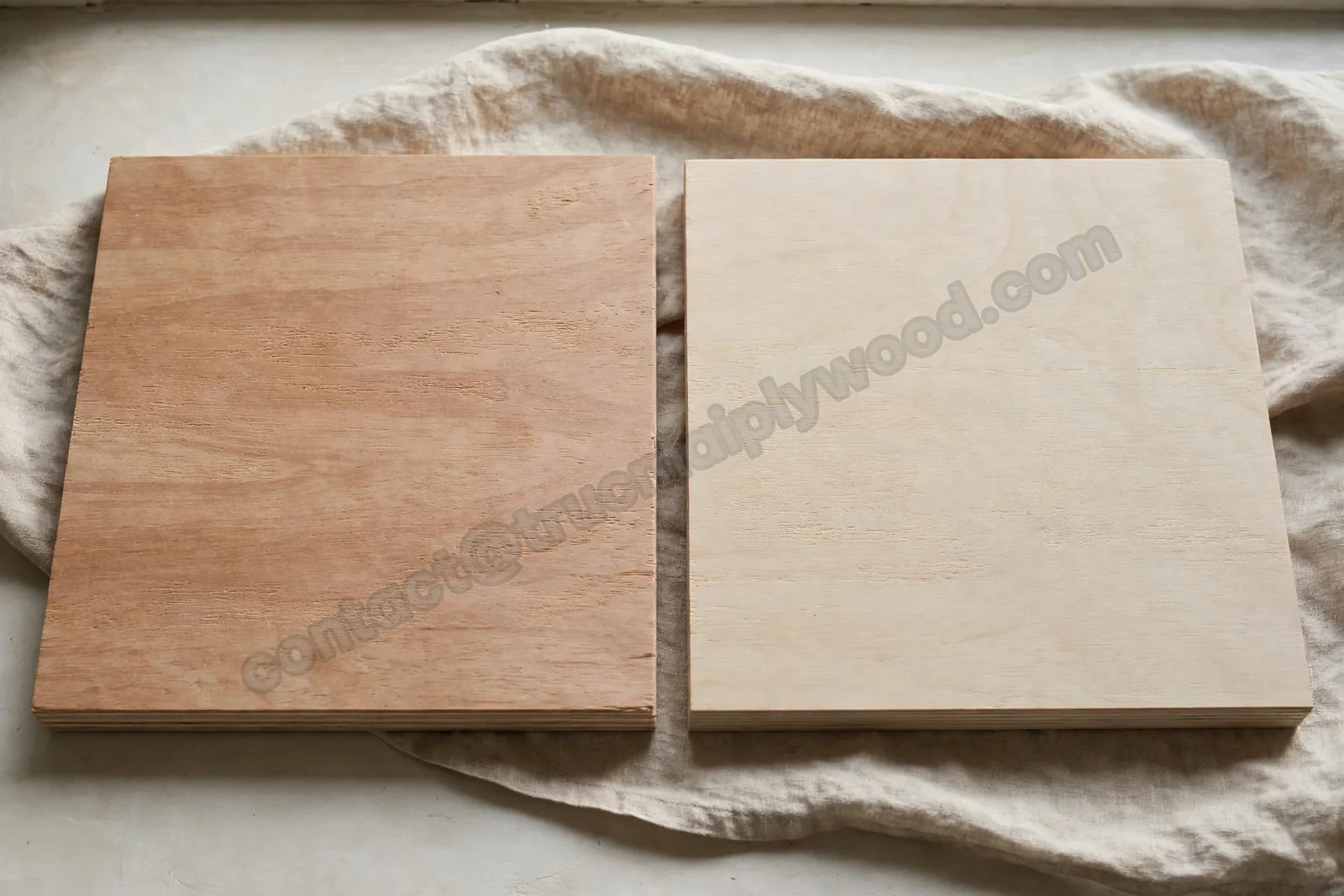
Okoume has a warm, often pink-brown face; poplar has a lighter cream-to-pale-yellow face. For furniture and interior plywood, that visible difference is usually the first purchasing decision. Both names can describe a face veneer on a core made from other species, so the face name alone does not identify the panel’s density, bonding or suitability for a particular job.
A buyer comparing Okoume-faced plywood with Poplar plywood should hold the hidden construction constant. Ask for matching core, nominal thickness, face grade, back grade, sanding, glue and emission specification. Otherwise a difference in stiffness, weight or machining can come from the core rather than the visible veneer.
| Buying criterion | Okoume face | Poplar face | What to put on the order |
|---|---|---|---|
| Natural colour | Warm pink, peach or light reddish-brown | Cream, ivory or pale straw | Approved colour-range sample |
| Grain impression | Gentle, often broad, flowing figure | Subtle, usually quieter figure | Approved grain and patch limits |
| Clear finishing | Warm tone remains prominent | Pale appearance stays central | Stain and clear-coat trial |
| Opaque paint | Primer and colour blocking deserve attention | Pale base is convenient for light paint | Full primer and paint schedule |
| Decorative selection | Doors, visible furniture faces, interior trim | Cabinet parts, painted joinery, light interiors | Face/back grade pair |
| Panel weight | Set mainly by the specified core | Set mainly by the specified core | Core species and target weight |
| Procurement comparison | Compare like-for-like construction | Compare like-for-like construction | Identical technical RFQ lines |
This comparison concerns veneer-faced commercial and furniture panels. It does not treat an okoume-faced panel as an all-okoume board, or a poplar face as evidence of a poplar core.
Which face colour works better for visible furniture?
Okoume is the more natural starting point for a warm timber look, while poplar is the more neutral starting point for a light finish. The difference matters most on exposed door panels, drawer fronts, end panels and interior linings where several sheets must read as one installation.
For a clear-coated surface, inspect the sample from standing distance as well as close up. Colour is affected by veneer selection, sanding, adhesive bleed-through, lighting and the finishing system. A panel that looks evenly coloured before finishing may show stronger contrast after a clear sealer. Match the actual finishing process, not just the uncoated sample.
For painted parts, the underlying colour becomes less important once the primer gives full coverage. Surface consistency, joins and the quality of sanding then become more useful differentiators. The best plywood for interiors is therefore the construction that meets the finish and application, rather than whichever species looks better in an uncoated photograph.
Which face is better for painting or staining?
Poplar is generally the easier visual base for pale opaque paint, and okoume is a useful choice for warm transparent finishes. Neither face removes the need for a controlled finishing trial. The coating system and veneer preparation decide the final surface.
A practical comparison uses four pieces cut from the actual proposed production panel: one left raw, one primed, one with the full opaque finish and one with the chosen stain or clear coat. Inspect for raised grain, patches, telegraphing of core features and colour differences across the sheet. Test edges separately because the exposed plies absorb coating differently from the face.
Sanding should be specified, not assumed. Truc Mai Plywood offers sanded and calibrated furniture faces, with polishing on request. Its UV-ready option means the faces are prepared for the buyer’s UV coating process. It is not a factory-applied UV finish. If the buyer’s finishing line uses a high-gloss coating, the accepted sample should be run through that line before the production specification is frozen.
For cabinet-grade plywood, surface preparation and the allowed repairs are often more important to a paint result than a general species label. The same applies to lacquered shelving and painted interior panels. Request face photos in flat light, close views of repairs and a sample large enough to show joins.
How do face grades change the comparison?
Face grade controls the acceptable visual defects; species alone does not. A clean poplar face can outperform a poorly matched okoume face on a painted job, while a carefully selected okoume veneer can be worth choosing for an exposed clear-coated door.
The ISO 2426-2:2020 hardwood plywood appearance standard sets a framework for visual classification of hardwood plywood surface veneers. Its scope is appearance, not adhesive durability or formaldehyde emission. In international trade, labels such as A/B, B/BB and BB/CC may instead be mill-specific commercial descriptions. An approval sample and written defect criteria give those descriptions operational meaning.
Specify the face and back as a pair. For example, the exposed face might need tight colour matching and limited patches, while the back can allow more colour variation. For a reversible panel, both faces may need the same appearance. Keep the same reference sample when asking for a revised quote; otherwise a change in the grade can be mistaken for a species effect.
Look particularly at veneer joints near panel edges, filled knots, open splits, overlaps, knife marks and sanding-through. A long wardrobe side shows defects differently from a narrow drawer component. Agree the acceptance criteria for the intended cut pattern, then inspect representative sheets before approving the run.
Does an okoume or poplar face make the panel lighter?
The core is the main driver of whole-panel weight in a face-veneered plywood sheet. Thin face veneers influence the surface, but most of the panel thickness and mass sit in the inner plies. Compare complete panel weights at the same nominal size and thickness rather than using the face species as a proxy for density.
Available core choices include Styrax, Acacia, Eucalyptus, Pine and combinations of these species. A lighter core can simplify handling of cabinet components and improve the volume carried per container. A denser core may be chosen for other machining and construction priorities. A face change can be made without changing the core, which is useful when a furniture buyer wants two decorative finishes on a common component specification.
Which core construction should go beneath each face?
Use the same core beneath both faces when colour and finishing are the questions being tested. For a furniture programme, an A-grade stitched core with sanded faces gives a more controlled basis for machining and finishing than an unselected loose-laid commercial core.
Stitching aligns and holds core veneers across and along the sheet. It helps control gaps and overlaps before pressing, which matters when a wide decorative surface is later sanded or finished. Truc Mai’s furniture construction commonly stitches the outer core layers; additional stitching can be specified for a particular order.
Commercial-grade panels may use jointed or loose-laid AB core construction with lighter face preparation. Such panels can be suitable for concealed components or packaging-related uses where a furniture-grade show face adds little value. The selection should follow the end use, not an assumption that every order needs the same grade.
If a CNC programme cuts many narrow rails, check the exposed edges and screw-holding behaviour of the actual construction. For wide cabinet sides, check flatness and surface preparation. For thin door skins, prioritise a clean, consistent face and the lamination process used by the door maker. The Okoume door skins page covers that narrower application.
What thicknesses and sheet sizes can buyers specify?
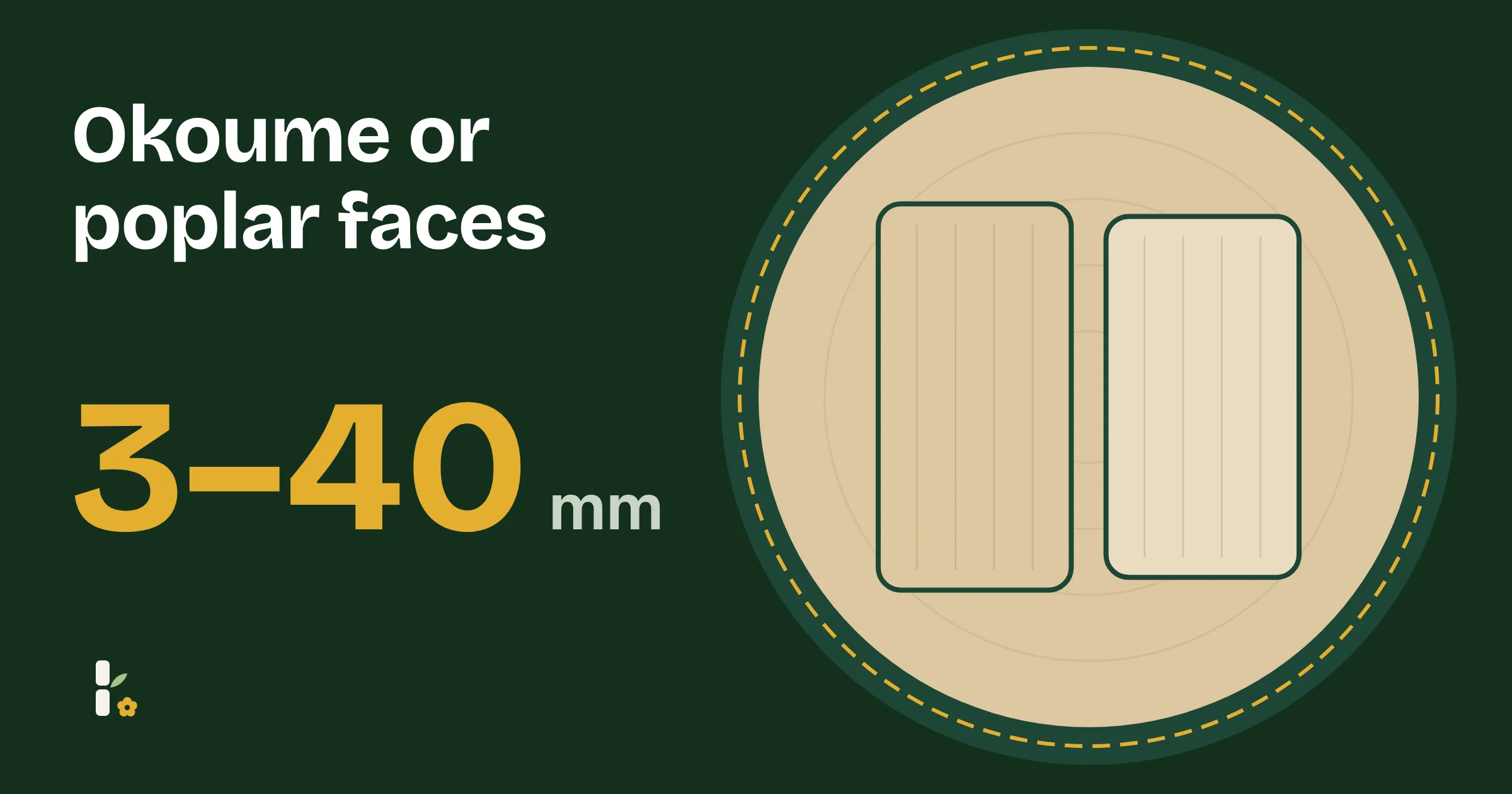
The standard selection includes 1220 × 2440 mm and 1250 × 2500 mm sheets, with 1220 × 2280 mm available for furniture components. The regular thickness range is 3–40 mm. A buyer should select size and thickness around the cutting layout and finished part, then specify the core and face.
Thin furniture panels need a different construction from thick cabinet sides. At 3–5 mm, the mill uses five plies; at 18 mm, the usual construction is 11–13 plies, most often 11. For calibrated furniture panels, a thickness tolerance of ±0.3 mm can be written into the order. Commercial and packing specifications use different tolerance bands.
Face veneer is typically a fraction of the panel thickness, so a change from okoume to poplar does not automatically require a different nominal sheet. What changes is the surface specification and sometimes the available veneer selection. The buyer should provide the required face orientation, grain direction and finishing allowance with the cutting drawing.
Can the mill supply cut-to-size okoume or poplar panels?
Yes. Cut-to-size panels can be produced from the agreed parent sheet and packed with labels that match the buyer’s cutting schedule. Common arrangements include two lengthwise pieces, three parts, four quarters or six pieces; the exact dimensions follow the cutting drawing and sheet selected.
For example, a 1220 × 2440 mm parent can be divided lengthwise into nominal 610 × 2440 mm halves. A three-part furniture format can use nominal 1200 × 800 mm pieces, while a four-part pattern can target nominal 1220 × 610 mm pieces. The finished cutting dimensions and saw allowance are agreed before production.
A cut list should identify finished width and length, grain direction, face side, part number, permitted edge quality, packaging group and quantity. It should also distinguish finished part dimensions from rough blanks that the buyer will machine again. This prevents a panel that is technically the right species and thickness from arriving with the grain running across the wrong dimension.
How does the face choice affect the order’s cost structure?
The face affects the veneer selection and finishing workload; the core, grade and machining specification affect the rest of the panel. The useful commercial comparison is therefore between two otherwise identical constructions, not two generic product names.
Start by asking for the same core, sheet size, thickness, face/back grade, adhesive and emission class, sanding and packing. Then request an okoume-faced option and a poplar-faced option against that shared specification. This isolates the change that matters to the furniture line. It also makes later substitution discussions clearer because the specification records what can change and what must remain fixed.
Freight efficiency belongs in the same decision. A light core can increase the usable cubic metres per container, while a heavier core can fill the weight allowance first. For an importing programme, the delivered economics should be evaluated from the full construction and load plan, not the face name alone.
How many sheets and cubic metres fit in a 40HC?
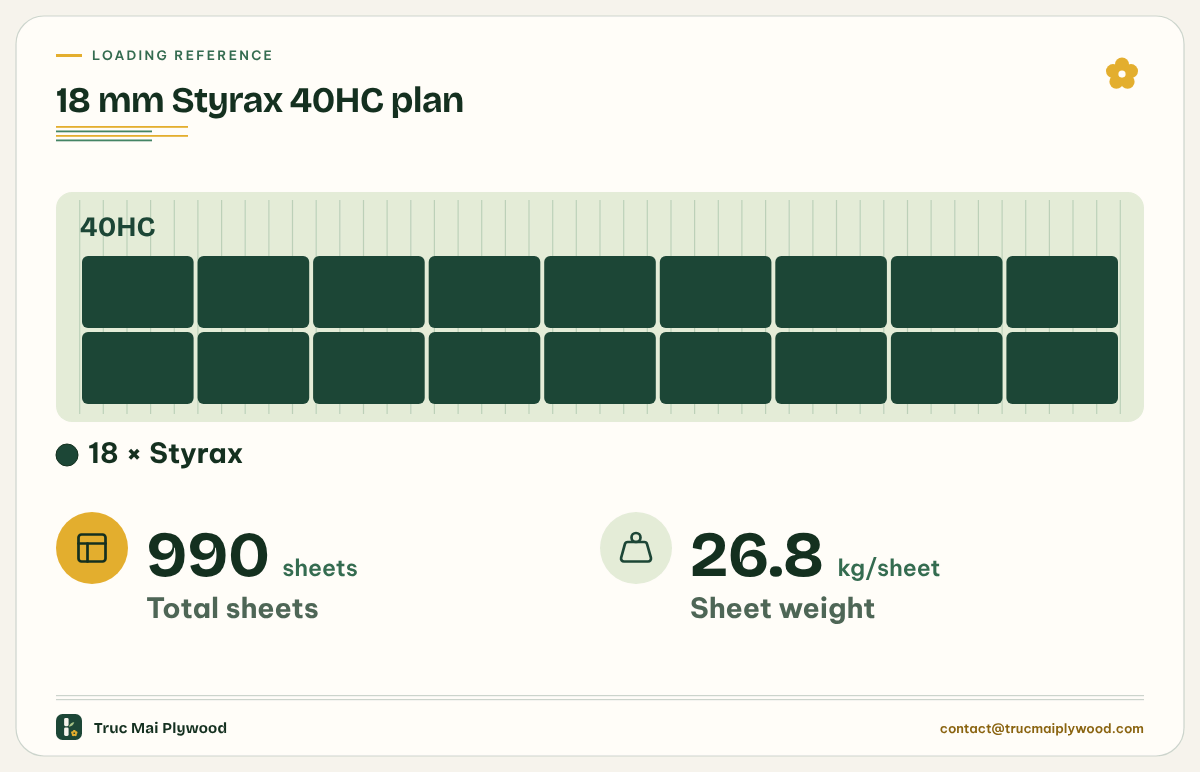
The 40HC planning model below gives the exact calculated rows supplied for 1220 × 2440 mm panels at 12, 15, 18 and 21 mm. It is a panels-only model with packs approximately 1,000 mm high, a 28,000 kg cargo planning payload, and reference densities of Styrax 500, Acacia 580 and Eucalyptus 650 kg/m³. Pack counts are 18, 16 and 15 respectively; sheet counts per pack are rounded down from pack height and then weight-capped. Carrier and route booking limits govern the shipment plan.
| Core | Thickness (mm) | Sheet size (mm) | Packs | Sheets/pack | Weight-capped | Total sheets | m³ | kg/sheet | Total kg |
|---|---|---|---|---|---|---|---|---|---|
| Styrax | 12 | 1220x2440 | 18 | 83 | No | 1494 | 53.4 | 17.9 | 26680 |
| Acacia | 12 | 1220x2440 | 16 | 83 | No | 1328 | 47.4 | 20.7 | 27510 |
| Eucalyptus | 12 | 1220x2440 | 15 | 80 | Yes | 1200 | 42.9 | 23.2 | 27860 |
| Styrax | 15 | 1220x2440 | 18 | 66 | No | 1188 | 53.0 | 22.3 | 26520 |
| Acacia | 15 | 1220x2440 | 16 | 66 | No | 1056 | 47.2 | 25.9 | 27350 |
| Eucalyptus | 15 | 1220x2440 | 15 | 64 | Yes | 960 | 42.9 | 29.0 | 27860 |
| Styrax | 18 | 1220x2440 | 18 | 55 | No | 990 | 53.0 | 26.8 | 26520 |
| Acacia | 18 | 1220x2440 | 16 | 55 | No | 880 | 47.2 | 31.1 | 27350 |
| Eucalyptus | 18 | 1220x2440 | 15 | 53 | Yes | 795 | 42.6 | 34.8 | 27690 |
| Styrax | 21 | 1220x2440 | 18 | 47 | No | 846 | 52.9 | 31.3 | 26440 |
| Acacia | 21 | 1220x2440 | 16 | 47 | No | 752 | 47.0 | 36.3 | 27270 |
| Eucalyptus | 21 | 1220x2440 | 15 | 45 | Yes | 675 | 42.2 | 40.6 | 27430 |
These are derived planning figures, not mill loading records. The table holds the face species outside the calculation because the planning density belongs to the core. Real sheets and packaging are weighed for the final load plan. The fuller m³ per 40HC by thickness resource explains how to interpret mixed-thickness consignments.
For a fair okoume-versus-poplar decision, use the same row of this table when both faces share the same core. Switching the surface veneer without changing the core does not justify treating the two offers as different full-core materials. Request a packing breakdown by product line when the container combines different faces or dimensions.
What bonding and emission documents should accompany the panels?
Specify bonding performance and formaldehyde emission separately. Face species does not establish either result. For furniture plywood, the adhesive system, full panel construction and intended market determine the supporting documents that belong in the purchase file.
The US EPA’s formaldehyde guidance identifies a 0.05 ppm emission limit for regulated hardwood plywood with veneer core or composite core. The operative requirements appear in 40 CFR Part 770. Truc Mai holds CARB Phase 2 and TSCA Title VI third-party certification for hardwood plywood with veneer core within its certified 3–25 mm range; its certificate number is CARB/EPA 26053.
For European purchasing, distinguish an emission requirement from a moisture-related bond requirement. A resin name or a boil-resistance description is not a substitute for the specified emission result. The adhesive and emission class should appear as separate RFQ lines, alongside the intended indoor application.
When a buyer needs an FSC 100% order, the claim should appear on the eligible product’s sales documents. The FSC chain-of-custody standard sets out the certificate-code and product-claim information on sales documents. The mill’s FSC licence code is FSC-C196493; the corresponding chain-of-custody certificate is SA-COC-014545. Buyers can use the FSC licence verification route to check the record.
What origin evidence is needed for an EU furniture order?
An EU order needs traceability for the core timber and the decorative face veneer, not only the country in which the finished panel was pressed. A face imported from another country introduces a separate origin trail that should remain attached to the plywood batch documentation.
For EUDR due diligence, the file set can include wood species identification, production origin, plot geolocation and supporting harvest and transport records. The EU importer uses the dossier in its own due-diligence process. Keep the core and face records distinguishable, especially when the same furniture panel programme alternates between different decorative veneers.
The mill supplies origin records and geolocation files for both the Vietnamese core and face veneer. For a buyer reviewing several face options, a practical approach is to request the origin file index with each proposed construction, then match the final file set to the approved order and shipment documentation. See face veneer origin files for the document trail.
How should a buyer compare samples before choosing a face?
Compare paired samples built to the same core and thickness, and run both through the intended finishing process. This is the quickest way to separate genuine surface differences from construction differences.
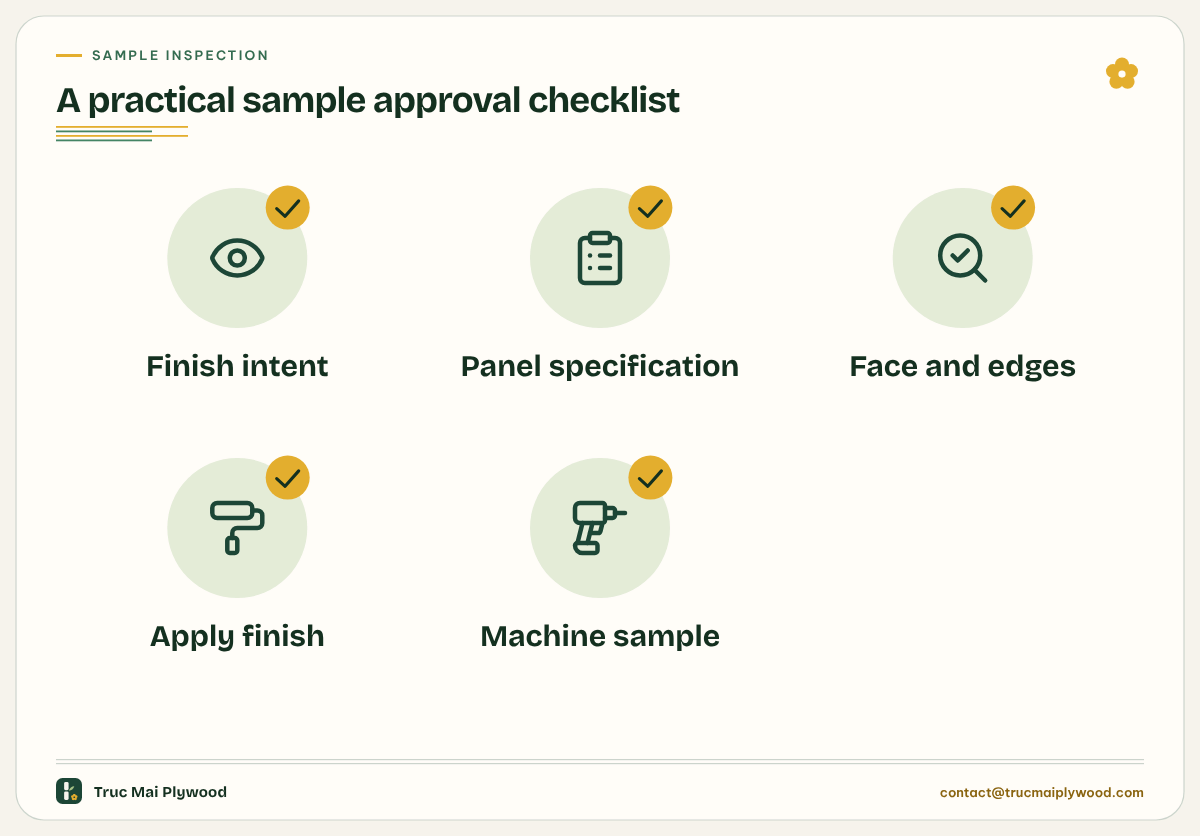
- Define the application. State whether the face will remain visible, receive clear lacquer, be painted or be covered by another finish.
- Hold the construction constant. Specify core species, thickness, adhesive and emission requirement, face/back grade and sanding level.
- Inspect raw appearance. Compare colour range, grain, joints, patches and edge condition under the lighting used for acceptance.
- Run the finish. Apply the actual primer, stain, lacquer or paint, including the planned sanding between coats.
- Machine representative parts. Cut, drill and edge-finish samples with the tools and feeds intended for production.
- Approve the reference. Keep the signed face sample, finished sample and written defect limits with the purchase specification.
The ordering plywood samples process lets a buyer test the proposed build before ordering. Send photographs of the approved finish and the defects that would cause rejection. Those are easier to apply consistently at production inspection than a single broad grade label.
Which face belongs on doors, cabinets and interior linings?
Choose okoume for a visible warm veneer effect and poplar for pale interiors or a light painted finish, while specifying the panel construction separately for each application. This application-first decision makes the species choice useful to the joinery team.
| Application | Starting face choice | Main acceptance check |
|---|---|---|
| Natural-finish door skin | Okoume | Colour and grain continuity after clear finish |
| Pale painted wardrobe | Poplar | Primer coverage and surface repairs |
| Cabinet carcass | Either | Core quality, thickness and edge machining |
| Decorative wall lining | Okoume or poplar | Matching across adjacent sheets |
| Drawer parts | Either | Flatness, cutting quality and face/back balance |
| Interior trim | Match the intended finish | Grain direction and finished-edge appearance |
Avoid using the face name as shorthand for a service class. The finish, adhesive bond, core and installation conditions must be specified for the actual application. A furniture panel ordered for dry interiors should be evaluated as such, rather than compared with a differently certified product made for another use.
What should the purchase specification say?
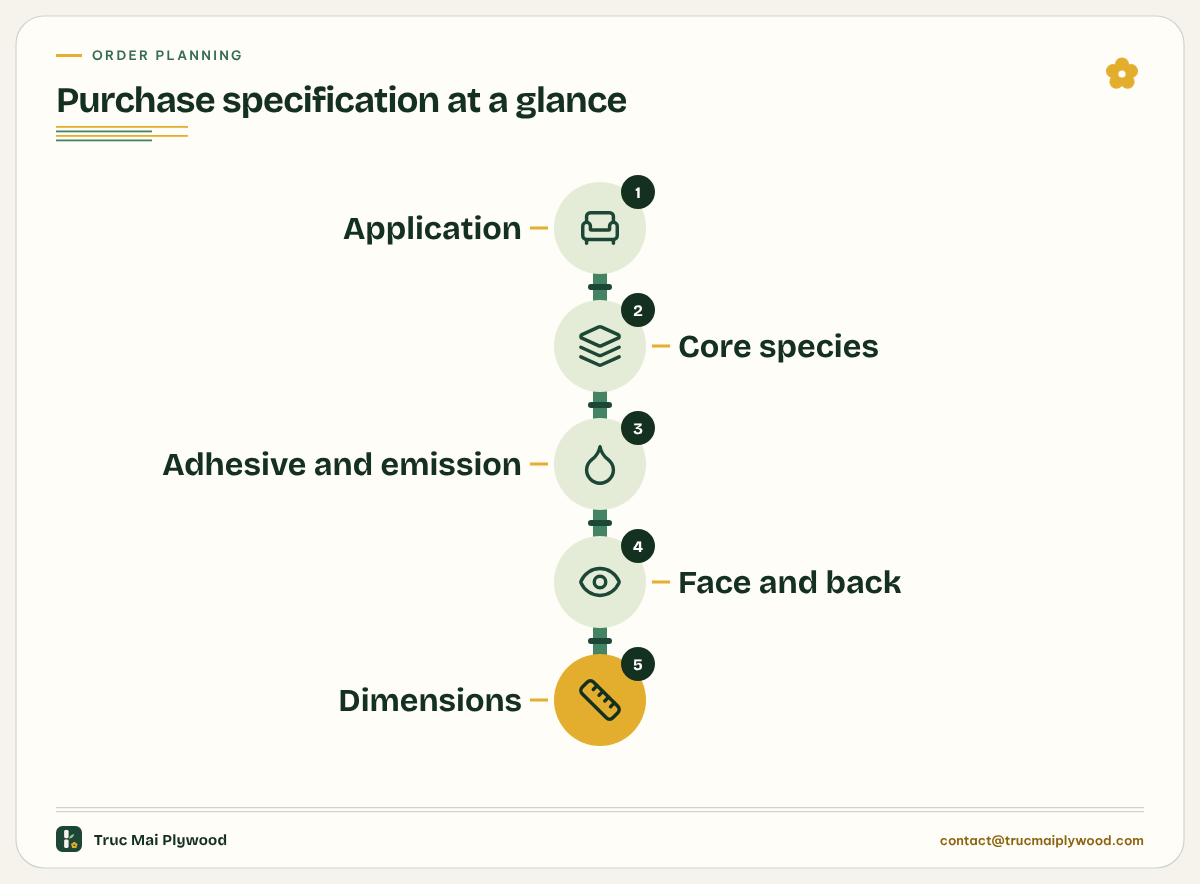
Write the intended application first, followed by a complete construction and face specification. That gives the supplier enough information to prepare comparable samples, a consistent production order and an accurate packing plan.
Use the following sequence in the RFQ:
- Application: door skins, visible furniture, painted cabinet parts or interior lining; state the finishing process.
- Core: Styrax, Acacia, Eucalyptus, Pine or an agreed combination; specify core joining and expected machining behaviour.
- Adhesive and emission: name the required adhesive system and the applicable emission specification as separate entries.
- Face and back: okoume or poplar, approved grade pair, colour range, repair limits and sanding preparation.
- Dimensions: parent sheet or finished cut sizes, thickness, tolerance, grain direction and labels.
- Packing and quantity: packs, mixed products, container quantity, destination port and required shipment documents.
Attach the approved raw and finished samples to the order reference. Ask the supplier to identify any proposed substitution explicitly, including whether it changes only the face or also the core, adhesive, thickness or grade. This is particularly important when the same furniture programme contains painted components and natural-finish components.
The plywood RFQ checklist can be used to send these lines in a consistent format. Request a quotation and matching face samples for the selected construction, with the cut list and destination port included from the outset.
Send your specification to contact@trucmaiplywood.com or through the quotation form.
Questions buyers ask
Is okoume plywood always pink?
No. Okoume commonly shows a warm pinkish or salmon-brown cast, but veneer lots vary in colour and grain. Approve a physical sample for colour-critical work.
Is bleached poplar the same as ordinary poplar?
No. Bleached poplar has been processed to give a more uniform pale face; ordinary poplar retains more natural variation. Specify which appearance is required.
Can I order a different face on each side?
Yes. Specify a face/back combination, including the appearance expected on the visible side and the permitted back defects, in the approved sample.
Does okoume face mean okoume core?
No. Okoume-faced plywood describes its surface veneer. The inner plies may be Styrax, Acacia, Eucalyptus, Pine or a combination.
Can poplar-faced plywood be used for a cabinet carcass?
Yes. Poplar-faced furniture plywood can serve cabinet parts when its core construction, thickness, bonding and finish match the application.
What should be checked before a paint trial?
Check face repairs, sanding marks, veneer joins, edge absorbency and primer compatibility. Trial the complete finishing schedule on the approved panel.
Can a face species establish formaldehyde compliance?
No. Formaldehyde compliance is established for the regulated panel construction and adhesive system, with the relevant certificate or test evidence.
Can the factory supply labelled cut pieces?
Yes. Cut-to-size furniture panels can be packed with labels matched to an agreed cut list and panel orientation.
How do I compare two samples under lighting?
Place both panels under the actual workshop and installation lighting, then inspect dry, after primer and after the planned topcoat.
Does FSC certification cover every order?
No. FSC 100% is specified for eligible products and identified by the appropriate claim on sales documents.