
The best plywood for interior work is a specification, not a brand: a face chosen for the job, a light even core, UF glue at E0 emission and sanded faces at ±0.3 mm. Buy one panel for every job instead and wardrobe doors show the core, wall panels cost more than needed and the container carries fewer m³.
Which plywood is best for interior work?
The best plywood for interior work is a sanded hardwood panel specified for its job: a face chosen for the finish, such as white poplar EV, birch-faced, okoume or melamine, on a light Styrax or stitched A-grade core, bonded with UF glue at E0 emission, and calibrated to ±0.3 mm. The job, not the brand, decides each line.
Interior plywood is bought for very different parts. A wardrobe door is seen up close, edged and handled every day. A wall lining panel is fixed once and seen from a few metres away. A shop counter takes knocks. A ceiling panel is light work but must stay flat overhead. One panel for all four either overspends on the wall or underspends on the door.
So the question has two halves. The first is the build every interior panel shares: a dry-room glue line with low emission, a flat sanded face and a predictable thickness. The second is the face, core and thickness that each job adds on top. This guide takes the shared build first, then each job, and ends with a spec line per job that a buyer can send.
Truc Mai is a Vietnamese mill in Ha Hoa, Phu Tho that makes furniture, interior and commercial plywood, around 60,000 m³ a year. Its furniture and interior plywood range is the reference for the builds below.
Which face and core suit exposed furniture and wardrobe panels?
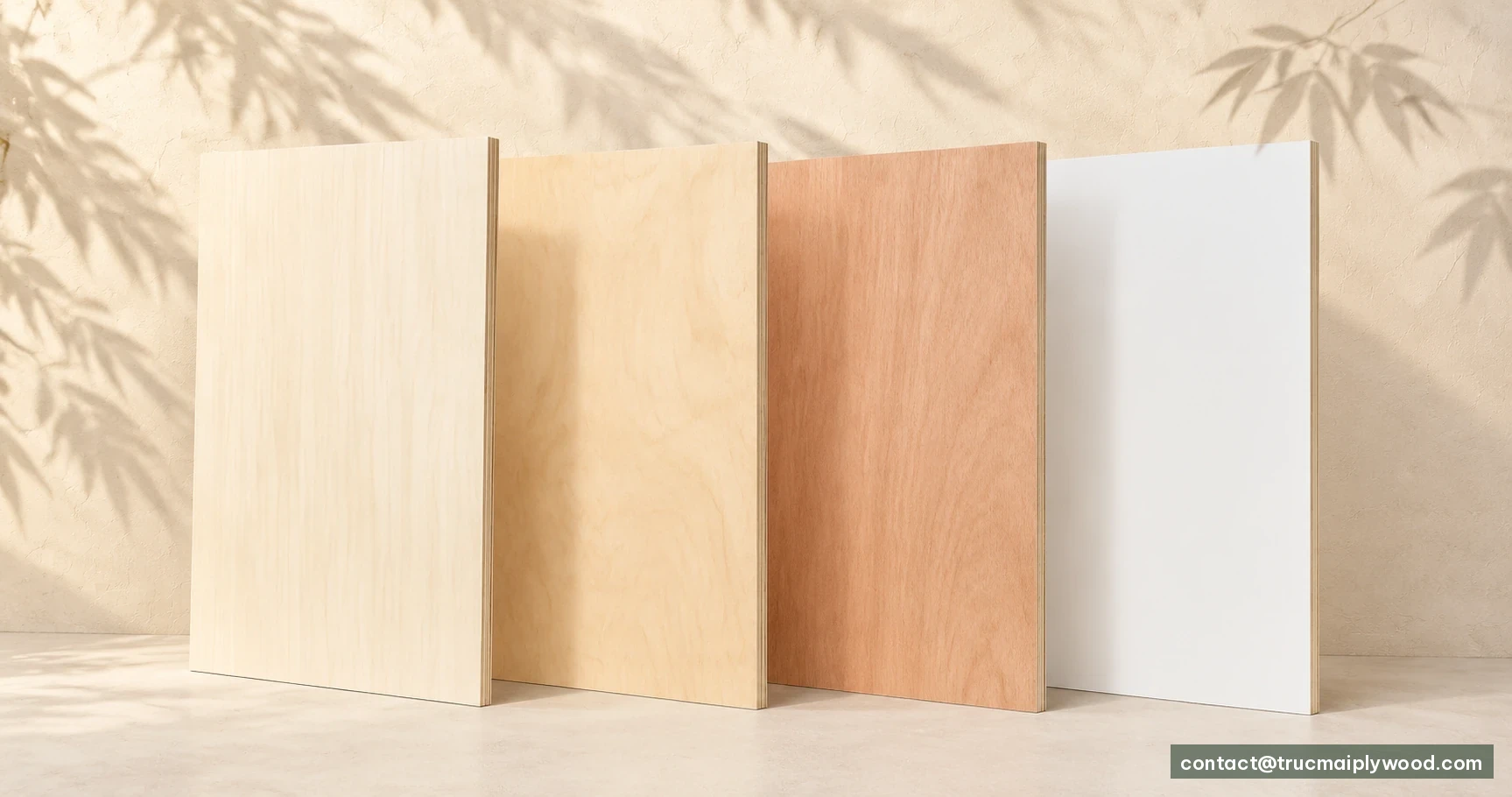
Exposed furniture and wardrobe panels suit a face with an even colour and grain, such as white poplar EV, birch-faced or bleached poplar, on a stitched A-grade core of Styrax or combined species. The core must be tight and gap-free, because a wardrobe edge is seen and edge-banded, and a void under the face shows through a lacquer.
The furniture line at Truc Mai builds its panels with an A-grade core, stitched, and sanded faces. Core stitching runs across and along the sheet; usually the outer 2–4 plies are stitched, and all plies can be stitched on request. That is what keeps the outer layers flat under a thin face veneer and a coat of lacquer.
| Face | Look | Suits |
|---|---|---|
| White poplar EV | Very even pale cream, straight grain | Wardrobe doors, painted or clear-lacquered fronts |
| Birch-faced | Pale, soft figure | Exposed furniture, open shelving |
| Bleached poplar | Near-white, soft grain | Light Scandinavian-style fronts |
| Okoume | Pinkish-beige, ribbon figure | Warm-toned panels, stained finishes |
| Melamine decor | Uniform colour or woodgrain print | Carcasses and interiors that need no finishing |
The EV face is worth a word. Engineered veneer is made from plantation poplar (Populus deltoides), reconstituted into sheets of 2500 × 1300 mm, 0.3 or 0.4 mm thick, and FSC 100% is available. The US federal definitions in 40 CFR 770.3 describe engineered veneer as “a type of veneer that is created by dyeing and gluing together leaves of veneer in a mold to produce a block”, which is why one sheet matches the next. See white poplar EV faces.
Interior plywood grades: face, back and core
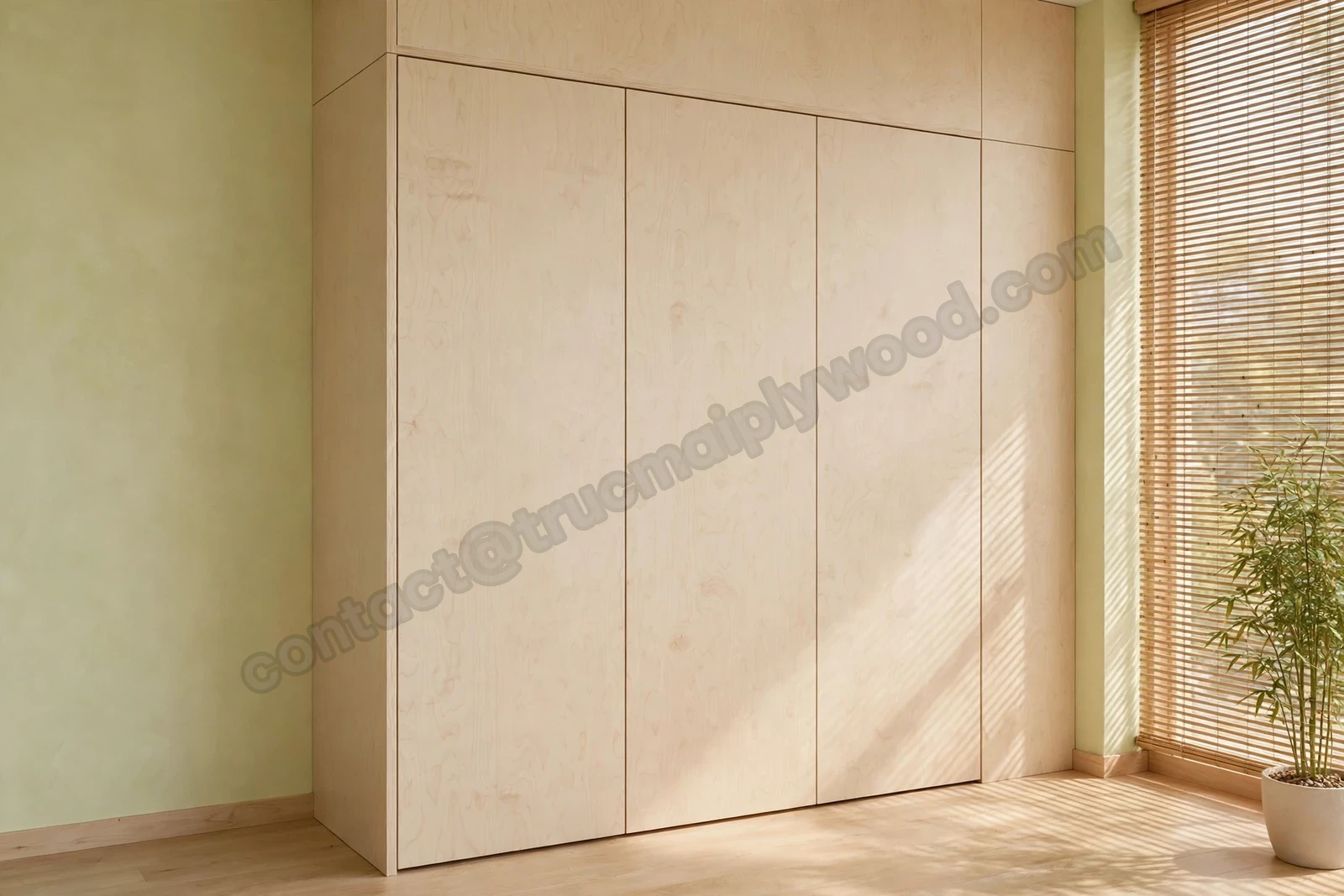
Interior plywood grades are written as a pair of face and back grades plus a core grade, not as one letter. The face grade is agreed against an approved sample and written on the order; the back can be a lower grade where it is hidden; and the core grade, A or AB, decides how flat and gap-free the panel is under the face.
| Line | Furniture and interior | Commercial |
|---|---|---|
| Core | A grade, stitched | AB, loose-laid or jointed |
| Faces | Sanded and calibrated | Unsanded or lightly sanded |
| Thickness tolerance | ±0.3 mm | ±0.5 mm |
| Typical use | Doors, fronts, exposed shelving | Hidden carcass parts, wall backing |
A buyer who orders “AA” or “BB” from two mills can get two different panels, because grade letters are not used the same way everywhere. The reliable method is a sample: the face is graded against it, and the order names that sample. The face grading line shows how faces are sorted before pressing.
The pair matters most on doors and on parts seen from both sides. A wardrobe side that is visible inside and out wants two good faces; a carcass back can take a sound but plainer back. Writing the back grade separately is where most of the saving on an interior order sits.
Best plywood for interior walls and ceilings
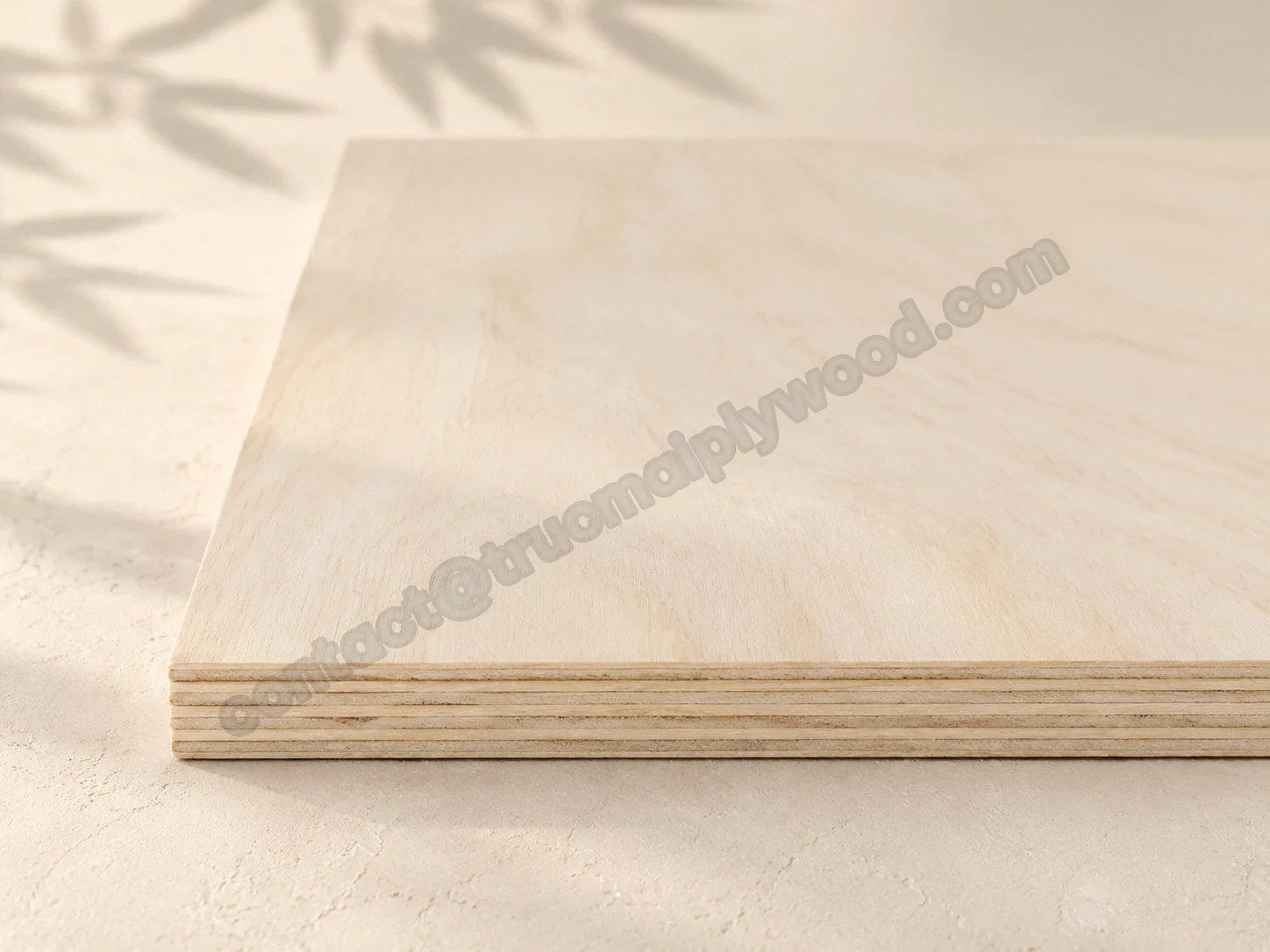
The best plywood for interior walls and ceilings is a sanded veneer panel on a light core, usually 9 or 12 mm, with a face chosen for the finish: white poplar EV or birch-faced for a clear finish, a plainer poplar for paint. For a wall that needs no finishing on site, a melamine-faced panel is the faster choice.
Wall lining is seen at a distance and fixed to a frame, so it does not need the tightest furniture grade on the back. It does need a stable, flat panel that does not bow between battens, and an even face from sheet to sheet, so a wall of many panels reads as one surface. Order the whole wall from one face batch.
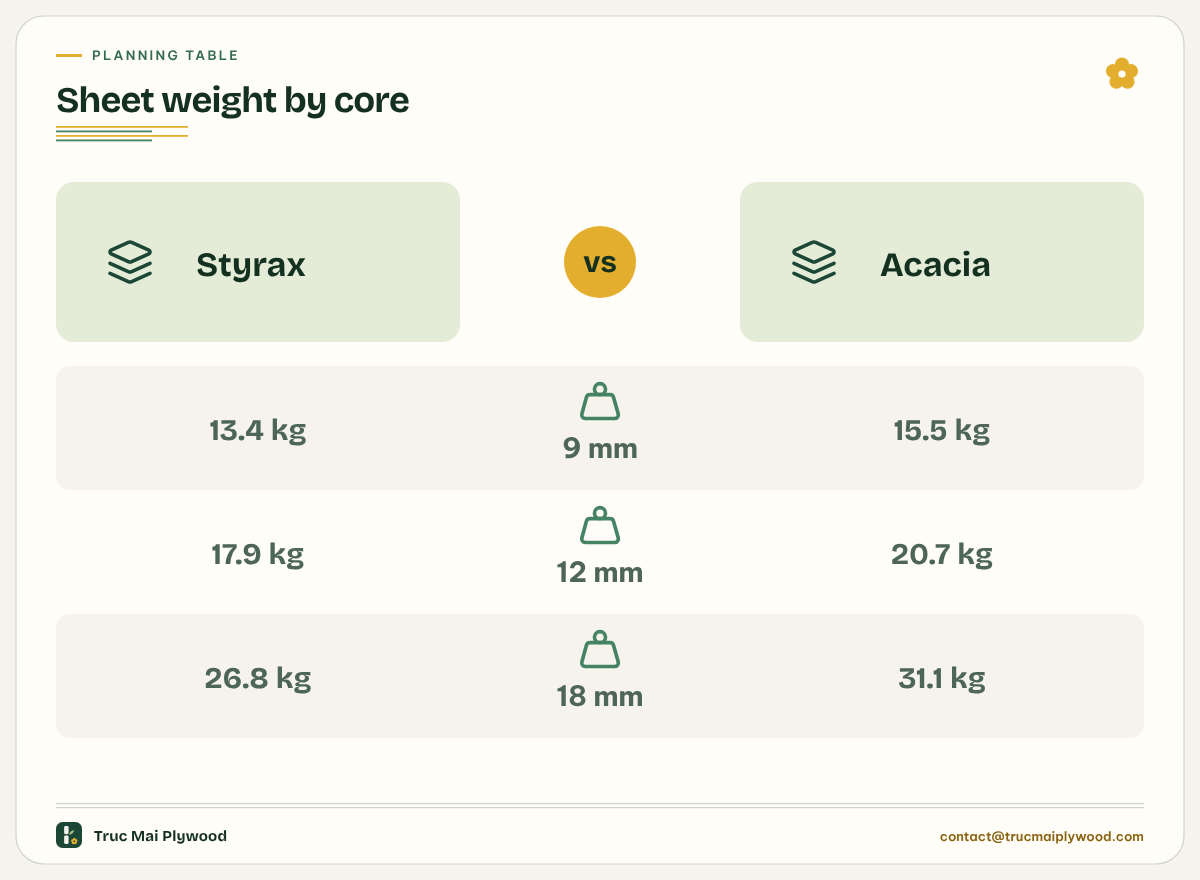
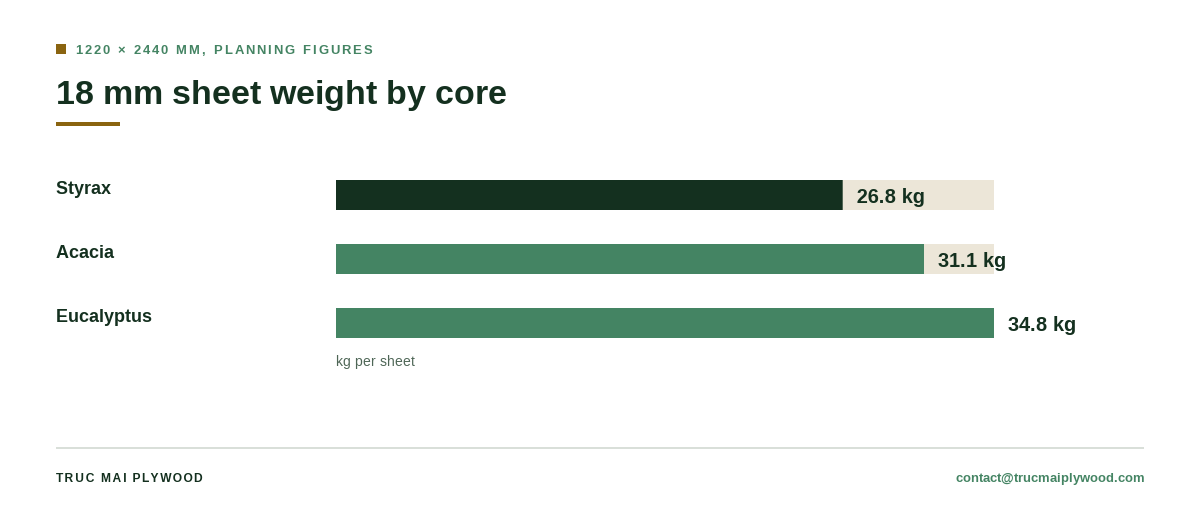
Weight matters overhead. A Styrax core has the lowest reference density of the mill’s cores, 500 kg/m³ in the planning model, so a ceiling panel on Styrax is the lightest to lift and fix. At 9 mm, a 1220 × 2440 mm Styrax sheet is about 13.4 kg in the planning table; on Eucalyptus, 17.4 kg.
| Thickness, 1220 × 2440 mm | Styrax, kg per sheet | Acacia, kg per sheet | Eucalyptus, kg per sheet |
|---|---|---|---|
| 9 mm | 13.4 kg | 15.5 kg | 17.4 kg |
| 12 mm | 17.9 kg | 20.7 kg | 23.2 kg |
| 18 mm | 26.8 kg | 31.1 kg | 34.8 kg |
Planning figures from the packing model, not weighed sheets. For walls that will be seen at a raking light, choose a sanded face and specify it on the order.
Plywood for shop fit-out and retail interiors
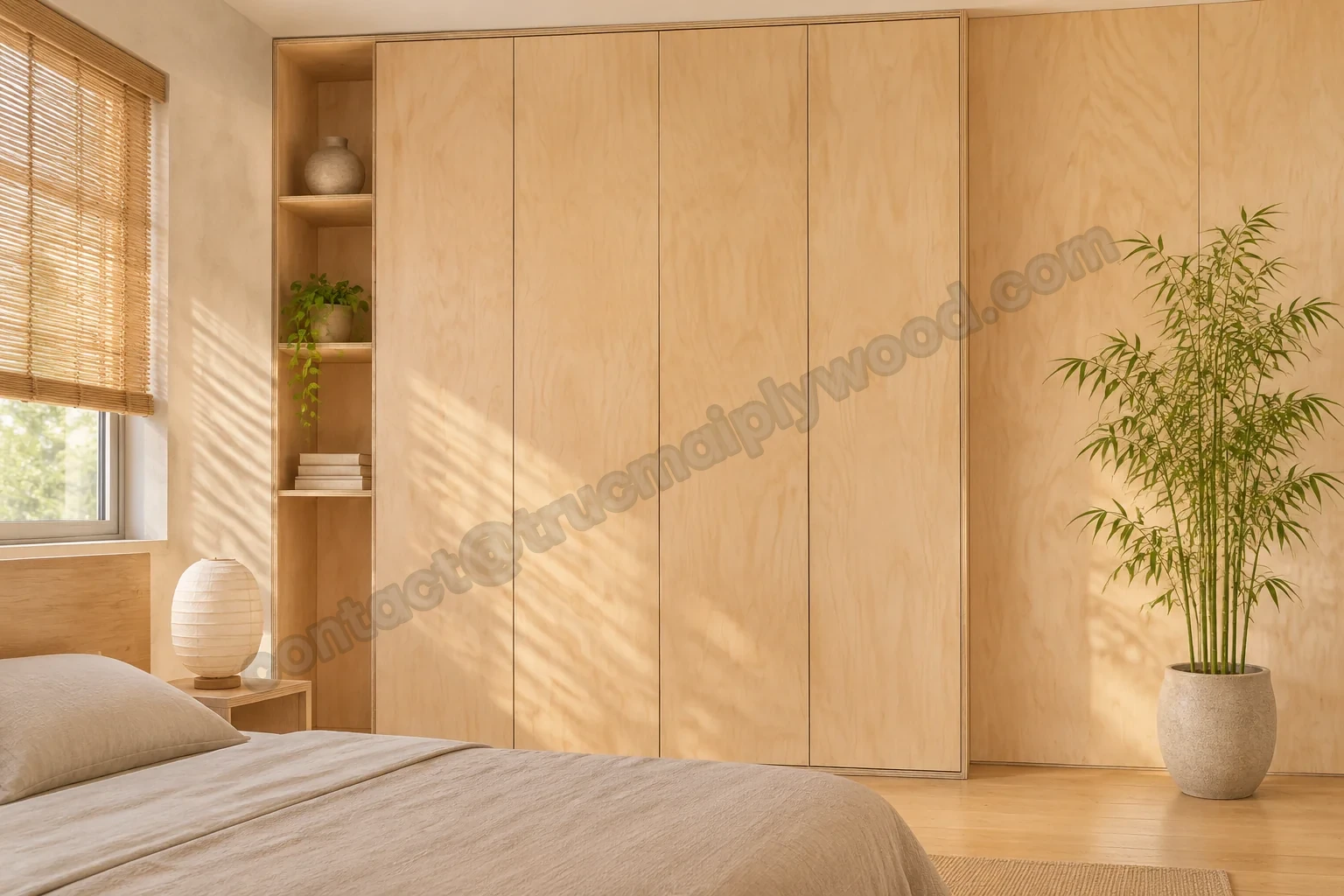
Shop fit-out takes two kinds of panel: finished surfaces that take wear, such as counters and display fronts, and hidden structure behind them. HPL-faced plywood suits counters and shelving edges that take knocks; melamine-faced or sanded veneer suits display walls; commercial grade suits the hidden carcass.
Fit-out projects are short and exact. The panels arrive, are cut, and go in within days, so thickness consistency matters as much as the face: a joinery shop set to one thickness wastes time on every sheet that is off. Calibrated panels at ±0.3 mm save that time.
| Fit-out part | Face | Core and grade |
|---|---|---|
| Counter tops and fronts | HPL | Stitched A-grade core |
| Display walls | Sanded veneer or melamine | Styrax for weight |
| Shelving | Melamine both sides | A-grade core |
| Hidden carcass | Sanded or lightly sanded veneer | Commercial AB core |
The HPL-faced plywood page lists the HPL builds; mixing HPL counters with melamine shelving in one container is covered under the container section below.
Is UF glue at E0 emission enough for interior furniture and wall lining?
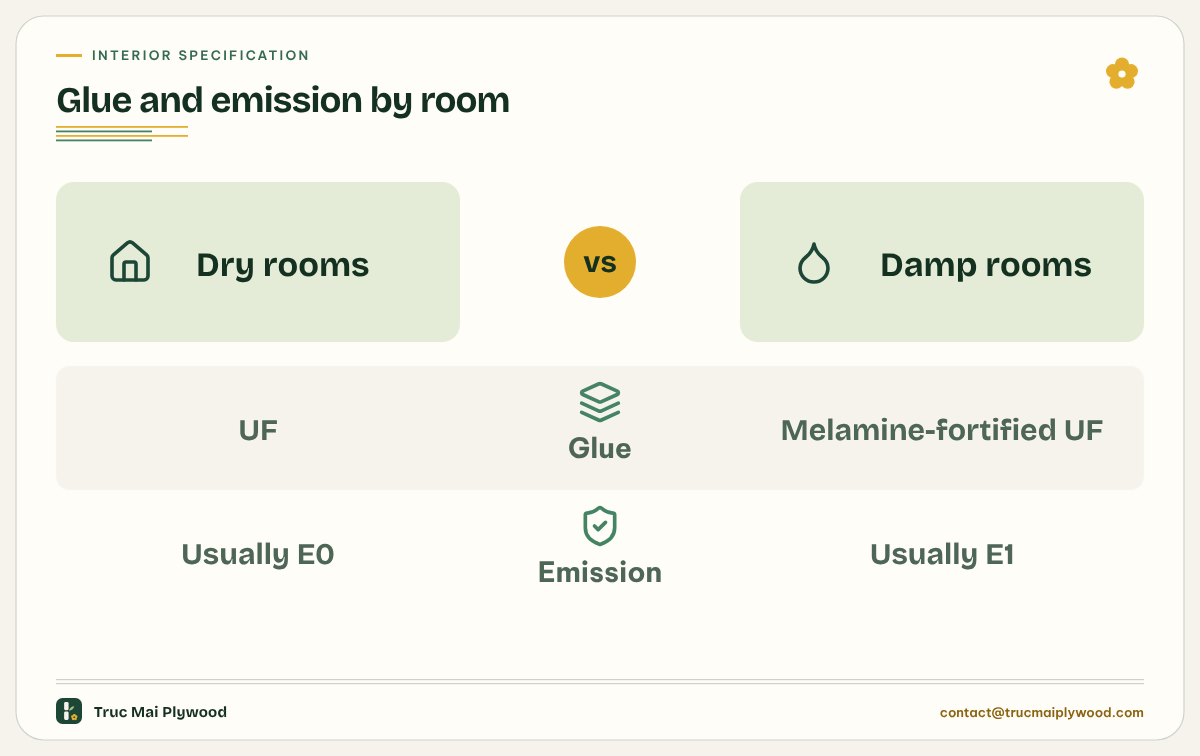
Yes. UF glue at E0 emission is the default for interior furniture and wall lining in dry rooms. It holds about six hours in a boil test. Rooms that see damp, such as bathrooms and laundry areas, take a melamine-fortified glue that holds 12 hours; emission is then usually E1, so that is written as its own line.
Glue type and emission class are two separate lines on an order. “UF glue at E0 emission” says what bonds the plies and how much formaldehyde the panel may release; “E0 glue” mixes the two and leaves both open. A buyer who writes both lines gets the same panel on every container.
European buyers often check bond quality against EN 314-2, which “specifies requirements for bonding classes of veneer plywood according to their end uses”, per BSI. An interior panel in a dry room is the mildest end use; write the bonding class you need on the order if your market asks for it.
| Room | Glue | Emission, usually |
|---|---|---|
| Bedrooms, living rooms, offices, shops | UF | E0 |
| Bathrooms, laundry rooms, damp storage | Melamine-fortified UF | E1 |
Interior plywood is not an outdoor product, whichever glue it carries. For use under cover outside, the exterior glue panels page explains what changes. Truc Mai does not make marine, formwork or structural plywood.
Is birch-faced plywood made of birch all the way through?
No. Birch-faced plywood from a Vietnamese mill has an imported birch face veneer on a Vietnamese hardwood core of Eucalyptus, Acacia, Styrax or combined species. Vietnamese plywood has no birch or poplar cores. The name describes the face, which is what the buyer sees and finishes.
For interior work this is usually the point. The birch face gives the pale, fine look buyers want on exposed furniture and shelving, and the hardwood core underneath is stitched and sanded so the face stays flat. The edge shows the core, so for exposed edges choose a pale core, such as Styrax, or plan an edge band.
A buyer looking for an all-birch, many-ply panel for exposed edges is asking for a different product. The birch-faced plywood page explains what the face-on-core build offers, and the Baltic birch substitute guide covers when it replaces an all-birch sheet.
Can interior panels come UV-ready or melamine-faced from the mill?
Yes. Interior panels can come melamine-faced or HPL-faced, finished at the mill, or UV-ready: sanded and calibrated with both faces prepared for the buyer’s own UV coating. The mill does not apply the UV coat. A paper-overlay face is also available for parts that will be painted.
| Surface from the mill | What the buyer does next |
|---|---|
| Sanded veneer | Stains, oils, lacquers or paints at the factory |
| UV-ready | Runs its own UV line on both faces |
| Melamine-faced | Cuts and edge-bands; no finishing |
| HPL-faced | Cuts and edge-bands; for wear surfaces |
The choice follows the factory, not the panel. A factory with a UV line wants UV-ready faces it can coat in one pass. A factory without a finishing line saves the most with melamine. A fitter who paints on site wants a plain sanded or paper-overlay face. The melamine-faced panels page lists the decors.
What thickness tolerance can be written for sanded interior panels?
Sanded and calibrated interior panels can carry a thickness tolerance of ±0.3 mm, written per order. Commercial-grade panels carry ±0.5 mm, and packing grade ±0.5–1.0 mm. Length and width are held to ±2 mm. Truc Mai does not write a tighter thickness tolerance than ±0.3 mm.
Tolerance is what makes a panel fit a machine. A CNC router, an edge-bander and a hinge drill are all set to one thickness. A sheet that is thicker leaves a proud edge band; one that is thinner leaves a gap at the hinge cup. On an interior line that runs hundreds of sheets a day, the cost of a loose tolerance appears as rework, not on the invoice.
The tolerance also has to repeat. ISO 9001:2015 certified quality management for plywood manufacturing (certificate W2012) is the system behind it: the agreed figure is written on the order and checked on the line, so the tenth container matches the first.
Which thickness suits each interior part?
Interior parts usually take 18 mm for carcasses, shelves and doors, 15 mm for lighter furniture, 9 or 12 mm for wall lining and ceilings, and 3–6 mm thin panels for drawer bottoms, backs and curved work. Truc Mai presses 3 to 40 mm, listed as 3, 4, 5, 6, 9, 12, 15, 18, 21, 25, 30 and 40 mm.
| Part | Usual thickness | Note |
|---|---|---|
| Carcass sides, shelves, doors | 18 mm | Usually 11–13 plies, most often 11 |
| Lighter furniture, drawer sides | 12 or 15 mm | Lighter sheet |
| Wall lining, ceilings | 9 or 12 mm | Fixed to battens |
| Backs, drawer bottoms | 3–6 mm | Thin panels from 3 to 5 mm are always 5 plies |
| Table tops, heavy shelving | 21 or 25 mm | Stiffer span |
Thin interior panels have a lead-time quirk: 4 mm panels use 1.3 mm core veneer, and good thin veneer is scarce, so 4 mm can take longer. The thin panels page covers 3–6 mm builds.
Why does a Styrax core fit more m³ into a 40HC than an Acacia core?
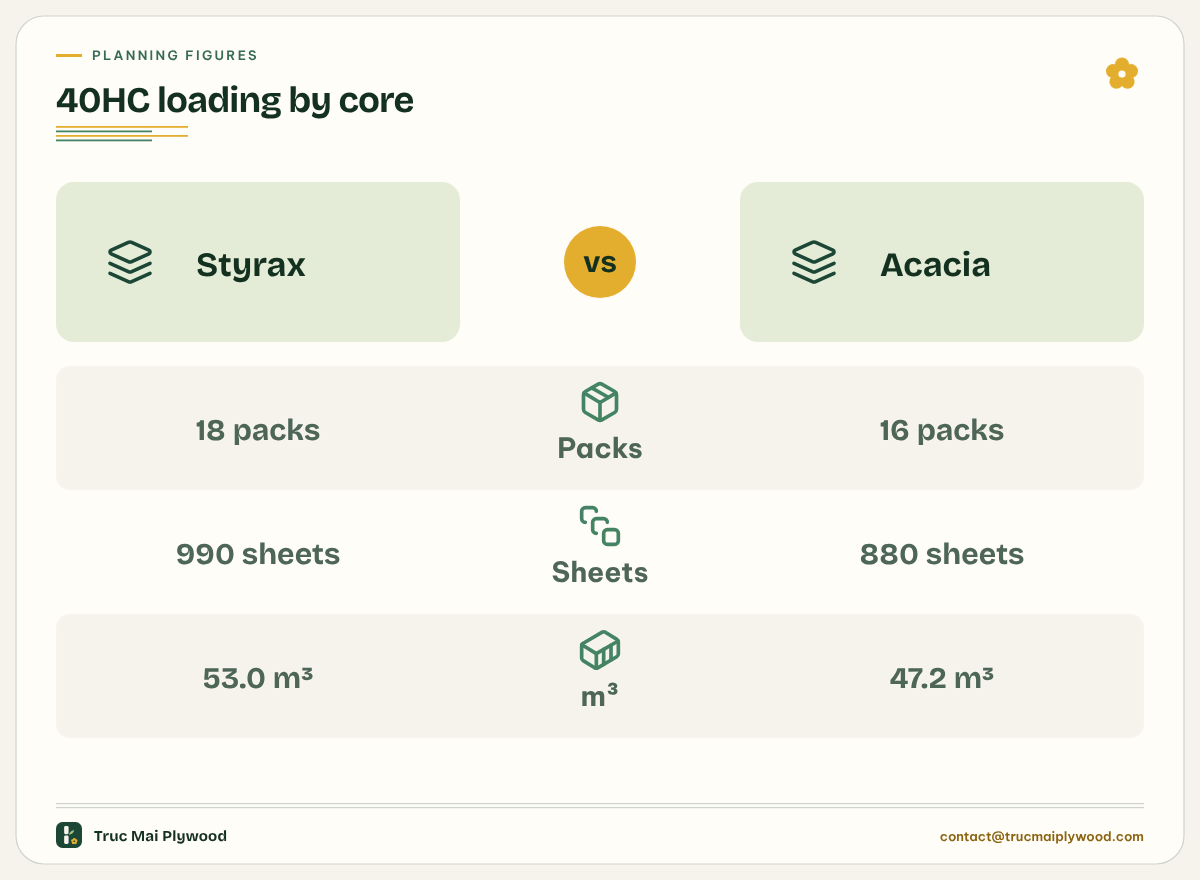
A Styrax core fits more m³ into a 40HC because it is lighter: 500 kg/m³ against 580 for Acacia in the planning model. More packs fit under the payload, so at 18 mm a Styrax load is about 53.0 m³ against 47.2 m³ for Acacia, as planning figures. A furniture buyer moving to Styrax usually gets a better face, a lighter sheet and more m³.
| Core, 18 mm, 1220 × 2440 mm | Sheets per 40HC | m³ | Planning basis |
|---|---|---|---|
| Styrax | 990 sheets | 53.0 m³ | 18 packs, planning figure |
| Acacia | 880 sheets | 47.2 m³ | 16 packs, planning figure |
| Eucalyptus | 795 sheets | 42.6 m³ | 15 packs, planning figure |
Computed with the 40HC planning model: packs about 1,000 mm high and a 28,000 kg planning payload; they are not packing-list records. The full model, every thickness and both sheet sizes are on the container load calculator.
For interior work the lighter core has a second benefit: it is pale. Styrax gives a light, even edge under pale faces such as EV, birch or bleached poplar, and it is easier to lift on site.
Which formaldehyde paperwork comes with interior panels for EU and US orders?
A wardrobe or wall lining sits in a room people breathe in, so the emission line matters more than the face. For the US, interior sheets of 3 to 25 mm fall under certificate CARB/EPA 26053; 30 and 40 mm do not. For the EU, the class is written on each order and the EUDR file set travels with the lot.
United States. Interior panels of veneer-core hardwood plywood may not exceed 0.05 ppm formaldehyde, the figure set in 40 CFR 770.10.
ICTT Corporation issued the certificate to mill ICTT-26053, covering 3–15 plies. The CARB P2 test reports page sets out what the buyer receives.
European Union. Regulation (EU) 2023/1464 puts formaldehyde into REACH Annex XVII as entry 77; from 6 August 2026 wood-based articles and furniture placed on the EU market may release no more than 0.062 mg/m³ in the chamber test. The emission class per order page explains how the class is written.
Origin and FSC. EU lots carry EUDR data with plot geolocation for both the Vietnamese core and the face veneer, so the importer can file its own statement. FSC 100% is available under licence code FSC-C196493 for products on the current schedule.
An interior designer who specifies the label is asking for what the FSC label page describes: “All materials used come from responsibly managed, FSC-certified forests”.
What can go wrong when one plywood is used for every interior part?
Using one plywood for every interior part goes wrong in both directions. A furniture-grade panel on hidden wall backing spends money nobody sees. A commercial panel on wardrobe doors shows core gaps through the lacquer, takes edge bands badly and varies in thickness on the CNC. Two or three builds in one container cost less than one compromise.
The usual failures are easy to trace back to one line on the order:
- Show-through. A loose-laid core under a thin face shows as ripples under gloss lacquer. Fix: stitched A-grade core for exposed parts.
- Edge-band gaps. Thickness off by more than the band allows. Fix: ±0.3 mm calibrated panels.
- Colour jumps. Faces from different batches on one wall. Fix: one face batch, graded against a sample.
- Damp-room swelling. UF glue in a laundry room. Fix: melamine-fortified glue for damp rooms.
- Overweight ceilings. A dense core overhead. Fix: Styrax core for ceilings.
One spec line per interior job
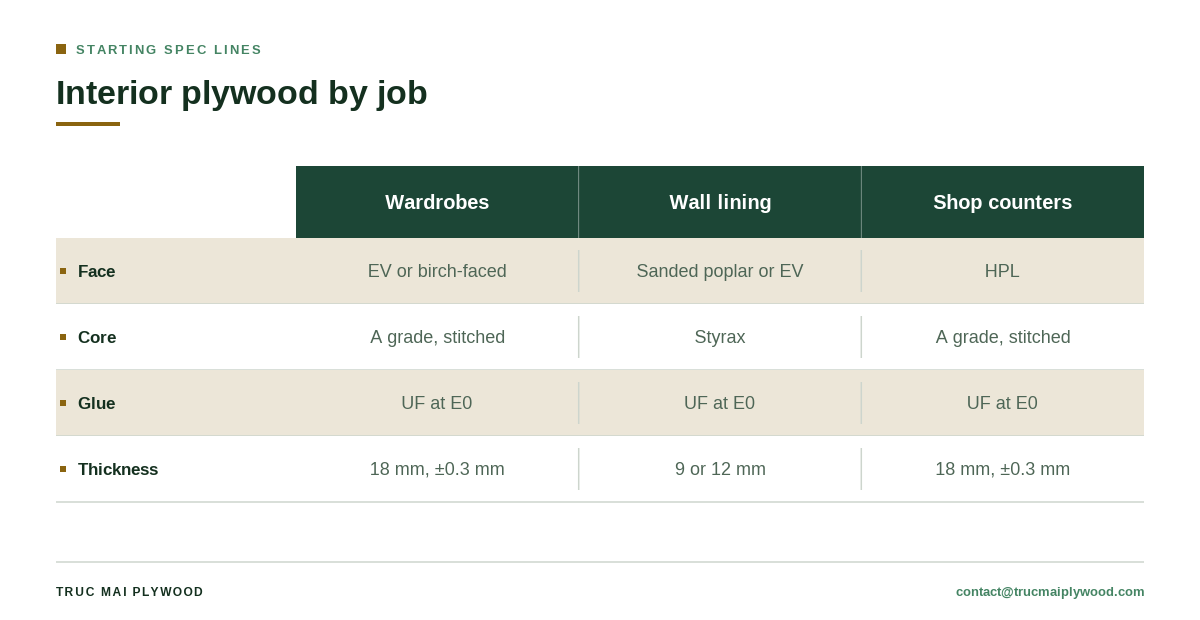
Each interior job gets its own spec line: face, core, glue and emission, thickness and tolerance, sheet size. The table below gives a starting line per job that a buyer can adapt and send, with the build the mill presses for it.
| Job | Face | Core | Glue and emission | Thickness and tolerance |
|---|---|---|---|---|
| Wardrobes and doors | White poplar EV or birch-faced, sanded | Styrax or combined, A grade, stitched | UF at E0 | 18 mm, ±0.3 mm |
| Kitchen and bathroom carcasses | Melamine both sides | A grade, stitched | Melamine-fortified UF, usually E1 | 18 mm, ±0.3 mm |
| Wall lining | Sanded poplar or EV | Styrax | UF at E0 | 9 or 12 mm |
| Ceilings | Sanded poplar | Styrax | UF at E0 | 9 mm |
| Shop counters | HPL | A grade, stitched | UF at E0 | 18 mm, ±0.3 mm |
| Hidden carcass and backing | Lightly sanded | AB, commercial | UF at E0 | 12–18 mm, ±0.5 mm |
The kitchen line is set out in more depth in plywood for kitchen cabinets, and laminate costs in laminated plywood price.
How to order interior panels by the container
Order interior panels by the container: one 40HC as the minimum, one or two products as the usual load, and three to six products by agreement. Production takes 15–45 days after a 30% deposit; the 70% balance is paid against the scanned bill of lading by T/T or irrevocable L/C at sight.
Sheet sizes are 1220 × 2440 mm (4 × 8 ft), 1220 × 2280 mm for furniture parts, and 1250 × 2500 mm, the European format; custom sizes up to 1250 × 2500 mm. Cut-to-size orders split one sheet into 2, 3, 4 or 6 panels before packing, which suits fit-out jobs that want parts, not sheets; see panels cut at the mill.
Start with samples. New buyers receive free samples and book their own courier, and that cost can be credited against a real order. Send the job list and the spec lines above to the quotation desk or to contact@trucmaiplywood.com, and ask for one sample per face you are considering.
Questions buyers ask
Which plywood is best for interior furniture?
A sanded panel with a face chosen for the finish, such as white poplar EV, birch-faced or okoume, on a stitched A-grade core, with UF glue at E0 emission and thickness held to ±0.3 mm.
Which plywood is best for interior walls?
For wall lining, a sanded veneer face that suits the finish on a light core, usually 9 or 12 mm. Where the wall is a finished surface with no further coating, a melamine-faced panel saves the finishing step.
Is UF glue at E0 emission enough for interior use?
Yes, for dry interior rooms. UF glue holds about six hours in a boil test; for damp rooms a melamine-fortified glue holds 12 hours, and emission is then usually E1.
Is birch-faced plywood birch all the way through?
No. Birch-faced plywood from Vietnam has an imported birch face veneer on a Vietnamese hardwood core. Vietnamese plywood has no birch or poplar cores.
What thickness tolerance can sanded interior panels carry?
±0.3 mm on sanded and calibrated furniture panels; commercial grade is ±0.5 mm. Length and width are held to ±2 mm.
Can interior panels come finished from the mill?
They can come melamine-faced or HPL-faced. UV-ready panels have both faces prepared for the buyer's own UV coating; the mill does not apply the UV.
Why does a Styrax core load more m³ per container?
Styrax is lighter, 500 kg/m³ in the planning model against 580 for Acacia, so more packs fit under the payload: about 53.0 m³ against 47.2 m³ at 18 mm, as planning figures.
Which formaldehyde papers come with interior panels for the US?
Truc Mai is CARB P2 and TSCA Title VI certified, certificate CARB/EPA 26053, for hardwood plywood with a veneer core from 3 to 25 mm. The federal limit is 0.05 ppm under 40 CFR 770.10.
Which formaldehyde rule applies to interior panels in the EU?
REACH entry 77 limits furniture and wood-based articles to 0.062 mg/m³ from 6 August 2026. Glue type and emission class are written as two lines on every order.
What is the minimum order for interior plywood?
One 40HC. A container usually carries one or two products, and three to six can be mixed by agreement.
Which sheet sizes are available for interior panels?
1220 × 2440 mm, 1220 × 2280 mm for furniture parts, and 1250 × 2500 mm; custom sizes up to 1250 × 2500 mm, and cut-to-size panels of 2, 3, 4 or 6 per sheet.