
Melamine faced plywood · Ha Hoa, Phu Tho, Vietnam
Melamine plywood by the 40HC: one decor, one calibrated core, the same sheet every month
Truc Mai melamine plywood is a decor paper pressed on a calibrated plywood core, sold by the full 40HC. This page is for kitchen cabinet and wardrobe factories that reorder one melamine spec every month: the furniture-line build behind the paper, how the container fills, and what is written once so the next load matches the last.
The sheet under the paper is the mill's furniture-line build: an A-grade core stitched across and along the sheet, both faces sanded and calibrated to ±0.3 mm, UF glue at E0 emission. Truc Mai presses around 5,000 m³ of plywood in an average month at Ha Hoa, Phu Tho, so a monthly melamine order is a fixed slot in that output, not a special run.
This page covers coloured and woodgrain melamine faced plywood. The plain white carcass sheet has its own page, and the wider laminated plywood range, including HPL and paper overlay, sits one level up.
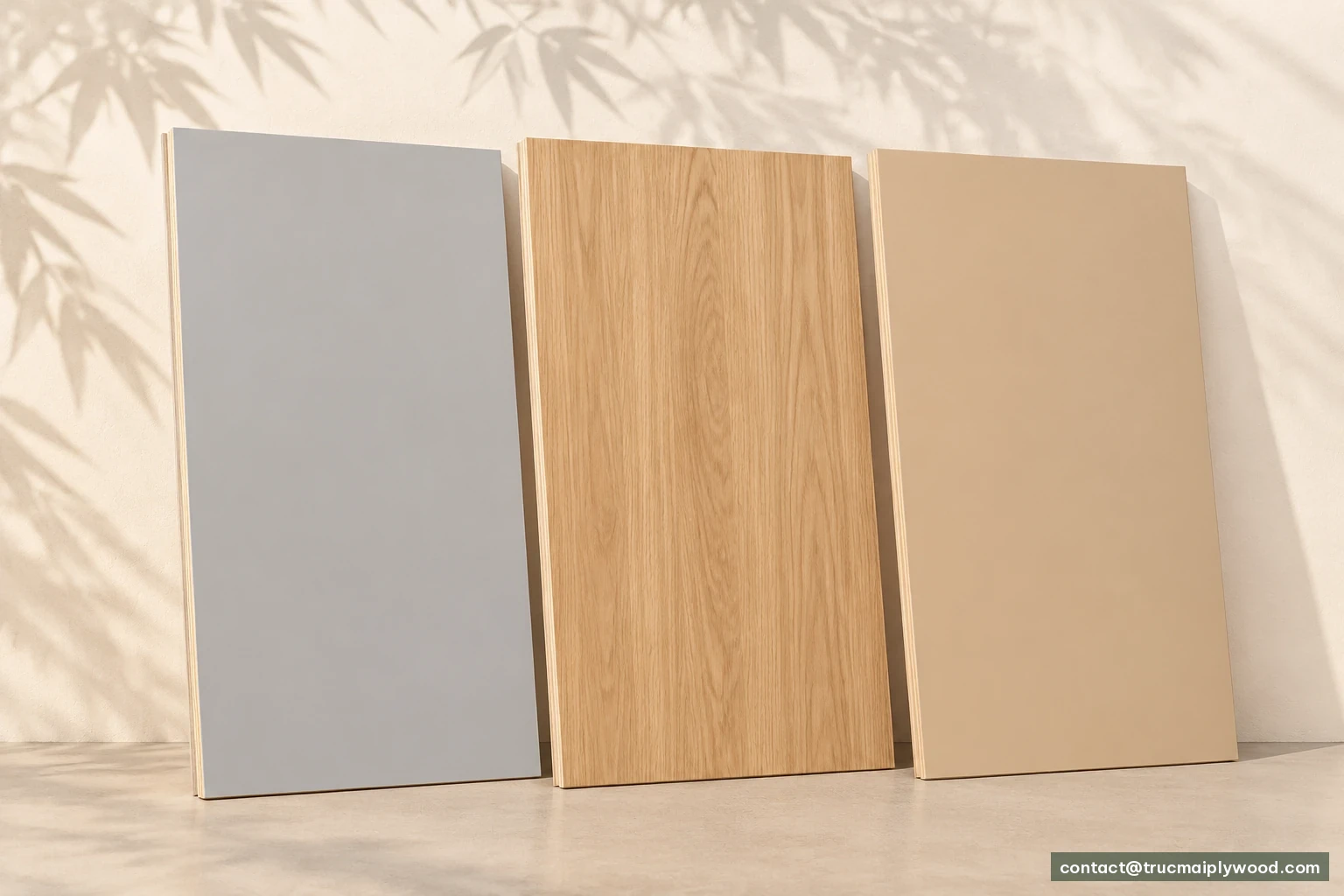
- Melamine decor paper, one or both sidesFace
- Stitched A-grade core, ±0.3 mmSubstrate
- 990 sheets on Styrax (planning)18 mm per 40HC
- CARB P2 / TSCA, 3–25 mmUS scope
- Same decor code, same written specReorder
On the order
Can the same melamine spec be supplied every month?
Yes, because the parts that make a melamine sheet change from load to load are each a written line: decor code, texture, faced sides, core species, thickness, tolerance and glue. A reorder names only the thickness mix and the loading month; everything else is copied from the first approved order.
A melamine programme fails on drift, not on a bad first load. The decor comes back a shade warmer, the core changes species and the edge turns from cream to brown, or a sheet from a different press lot is a little thicker and the carcass joints step. Each of those is caught by a line on the order and a reference sample kept on both sides.
The decor is fixed by its paper code plus a sample panel. Paper lots vary slightly in print and gloss, so a new lot is laid next to the reference panel under the same light before it is pressed. If it reads differently, the sheet waits; it is not shipped and argued about later.
The substrate is fixed by the furniture-line build. Core species, stitching, sanding and the ±0.3 mm tolerance are the same on every load, so a reordered carcass side fits the shelf pins drilled for the last one. That is the point of buying melamine plywood from a mill that presses its own plywood: the core is not bought in from whoever had stock that month.
Volume is the last thing to fix. At around 5,000 m³ in an average month, one or two 40HC of melamine-faced carcass sheet a month is a steady line in the plan. Say how many containers a month and in which months, and the mill books the paper and core veneer for them.
Photographs of melamine-faced packs from the Ha Hoa mill will be added to this block as they are taken. White carcass sheet, bought on its own, is set out on the white melamine faced panels page.
Specification
Which melamine-faced plywood spec do cabinet and wardrobe factories usually order?
Most cabinet and wardrobe lines order an 18 mm sheet faced on both sides with one decor, on a Styrax or combined core, sanded and calibrated to ±0.3 mm before pressing, with UF glue at E0 emission. These are the lines that go on a melamine plywood order.
Melamine faced plywood is plywood with a decor paper soaked in melamine resin pressed onto its face under heat and pressure, so the resin cures into a hard, closed, washable surface that needs no paint or lacquer. The plywood under it carries the load, holds the screws and decides whether the sheet stays flat.
Truc Mai writes thickness tolerance per order at ±0.3–0.5 mm by line; every laminated sheet is built on the ±0.3 mm end of that range.
The substrate is calibrated, not just sanded. A thin melamine paper copies the surface below it, so the face is sanded to an even thickness across the whole sheet before the paper goes on. That is what keeps a row of carcass sides the same thickness where they meet a shelf or a back panel.
Say whether the thickness on the order is the finished thickness with the papers or the substrate under them. Hinge plates and shelf pins are set to the finished sheet, so most cabinet lines write the finished figure, and the line is then copied unchanged onto every reorder.
Melamine plywood sheets for carcasses are usually 15 or 18 mm. Drawer sides and small parts take 9 or 12 mm, and backs 3–6 mm, often faced on one side only with a white or matching decor.
- Decor Paper code, texture and gloss level, approved on a sample panel
- Faced sides Both sides one decor; decor plus white; or decor plus balancing paper
- Substrate face pair Sound natural poplar or eucalyptus, sanded flat; hidden under the paper
- Core species Styrax, Acacia, Eucalyptus or a combined core
- Core build A-grade core, outer 2–4 plies stitched, all plies on request
- Plies 18 mm usually eleven to thirteen; five up to 5 mm
- Thickness 3, 4, 5, 6, 9, 12, 15, 18, 21 and 25 mm; 30 and 40 mm to order
- Thickness tolerance ±0.3 mm on the calibrated substrate
- Sheet 1220 × 2440, 1220 × 2280 or 1250 × 2500 mm, ±2 mm
- Glue and emission UF glue at E0 emission by default; two separate lines
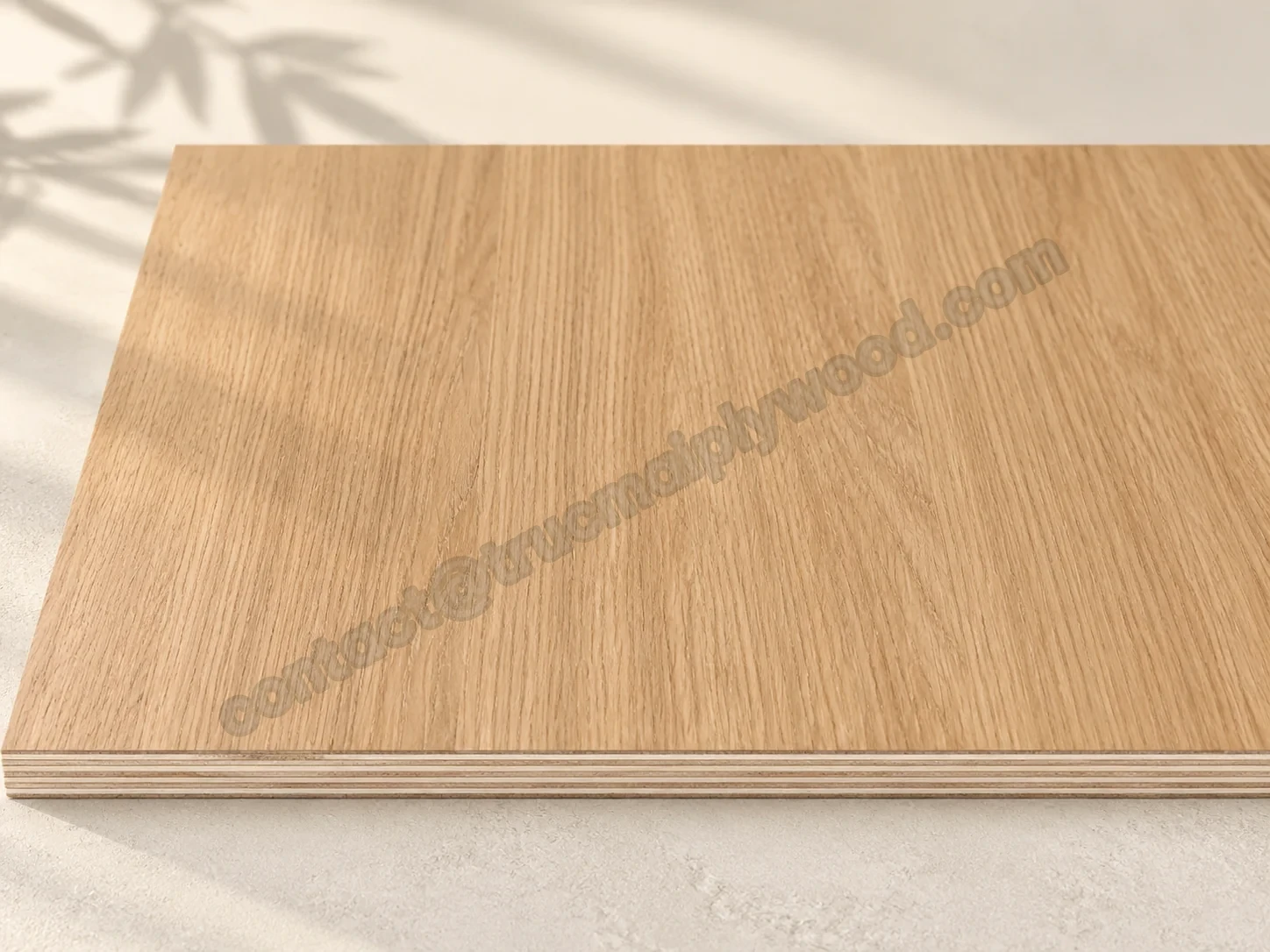
Faced sides
Which face configuration goes on a melamine plywood order?
Melamine plywood is not graded A, B or C like a veneer face; the paper is uniform. What the order chooses is which sides carry which paper, because that decides where the part can be used and whether it stays flat.
Always write both sides. A sheet pressed with paper on one face and nothing on the other is out of balance: the resin shrinks as it cures and pulls that face, so a long part cut from it can bow. The balancing paper exists to stop that.
Woodgrain and solid-colour decors are handled the same way at the press, but woodgrains add one line: grain direction. Say whether the grain runs along the length of the sheet, which is the usual way, or across it for parts that are cut sideways.
Texture is part of the decor. A matt smooth paper, a fine-structure surface and a deeper wood-pore texture can carry the same print and still look different under a kitchen light, so the sample panel, not a printed swatch, is the reference.
- Same decor both sides
One decor on face and back, the same texture and gloss on both. Wardrobe sides, shelves, partitions and doors: any part seen from both sides or exposed to the room on both.
- Decor face, white back
A colour or woodgrain on the show side, plain white melamine on the inside face. Kitchen carcasses and cabinets where the inside is white and only the outside or front edge shows the decor.
- Decor face, balancing paper back
Decor on one side; a plain, cheaper balancing paper on the other that only keeps the sheet flat. Parts fixed against a wall or another panel, such as backs and plinths, where the reverse is never seen.
- Decor one side, bare back
Melamine on one face, sanded veneer on the other. Only for thin backs that are nailed or glued in place; a free-standing part faced this way will bow.
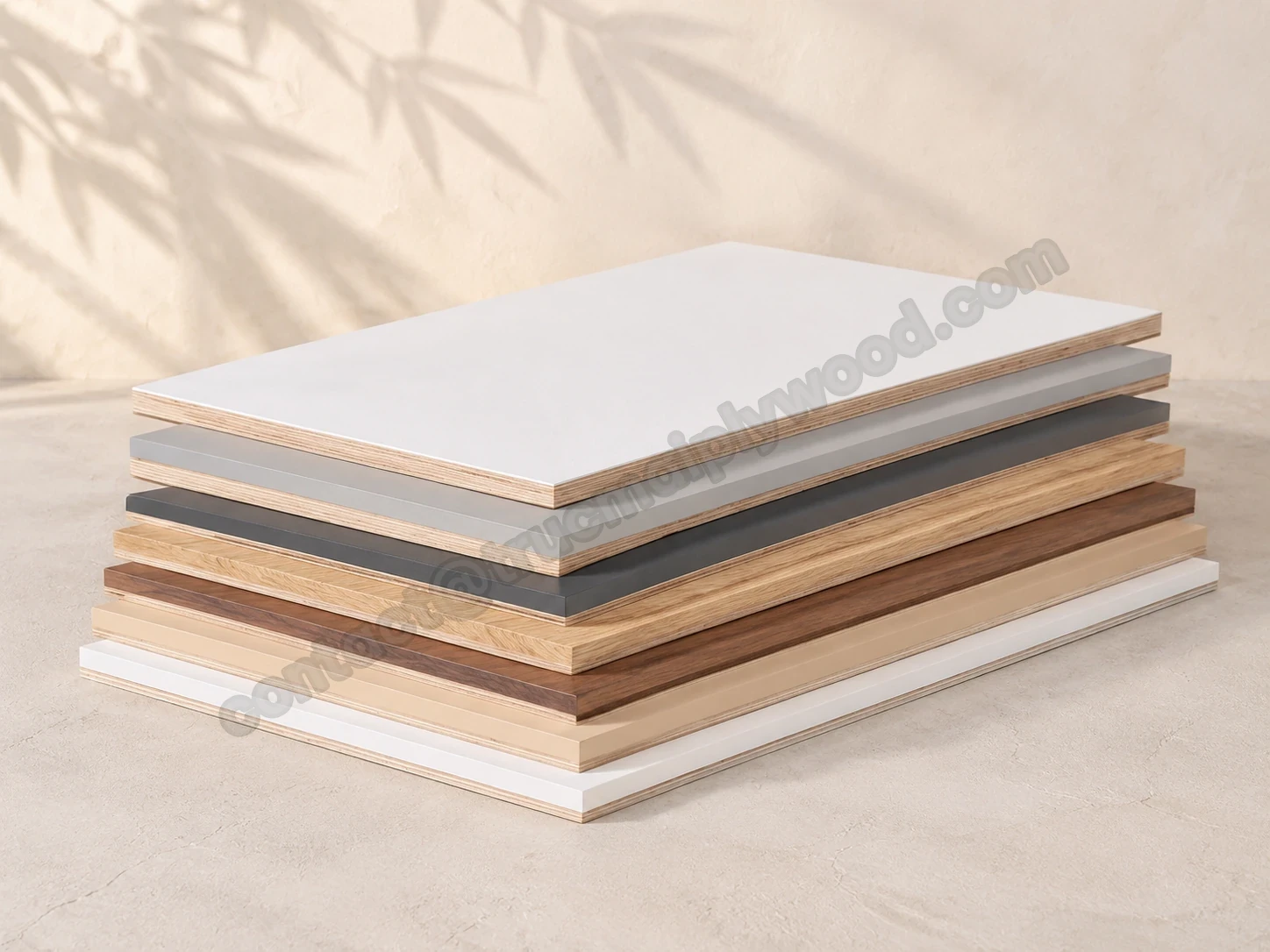
Core
Which core and thickness suit kitchen cabinet and wardrobe carcasses?
For kitchen and wardrobe carcasses, an 18 mm sheet on a Styrax or combined core is the usual choice: flat, light and the fullest container. Acacia or Eucalyptus suits doors, shelves and parts that take screws near the edge; 15 mm suits shelves and partitions in lighter units.
A Styrax core is the pale, even core that most melamine programmes run on. Its edge is almost cream, so a raw cut on a melamine sheet looks clean before banding, and its low weight keeps an 18 mm sheet manageable for one person on an assembly line. The white Styrax core page explains the species in more detail.
Acacia and Eucalyptus earn their weight where screws and hinges sit close to the edge or where a shelf takes a heavy load. Under melamine they also resist dents better, because a hard bed behind the paper stops a knock from pushing the surface in.
Thickness follows the part. An 18 mm carcass side carries hinges and shelf pins comfortably; 15 mm shelves save weight on spans of normal kitchen width; 9 or 12 mm suits drawer sides; 3–6 mm backs sit in a groove. Keep the core the same across all thicknesses of one programme so the cut edges match.
The core is a written line and is checked at lay-up on every container. A core change on a reorder would change the sheet weight, the edge colour and the screw holding, so the mill does not substitute a species without asking.
| Core under melamine | Reference density | 18 mm sheet, 1220 × 2440 mm | Behaviour under the paper | Choose it for |
|---|---|---|---|---|
| Styrax | 500 kg/m³ | 26.8 kg (planning) | Even, light; a clean bed under thin papers | Carcass sides, tops, bottoms; flat-pack parts |
| Acacia | 580 kg/m³ | 31.1 kg (planning) | Harder bed, better screw holding | Doors, shelves, carcasses with runners near the edge |
| Eucalyptus | 650 kg/m³ | 34.8 kg (planning) | Hardest, heaviest; loads by weight | Office and shop furniture that takes knocks |
| Combined | Per order | Per order | Harder outer plies, lighter centre | A balance of edge hardness and sheet weight |
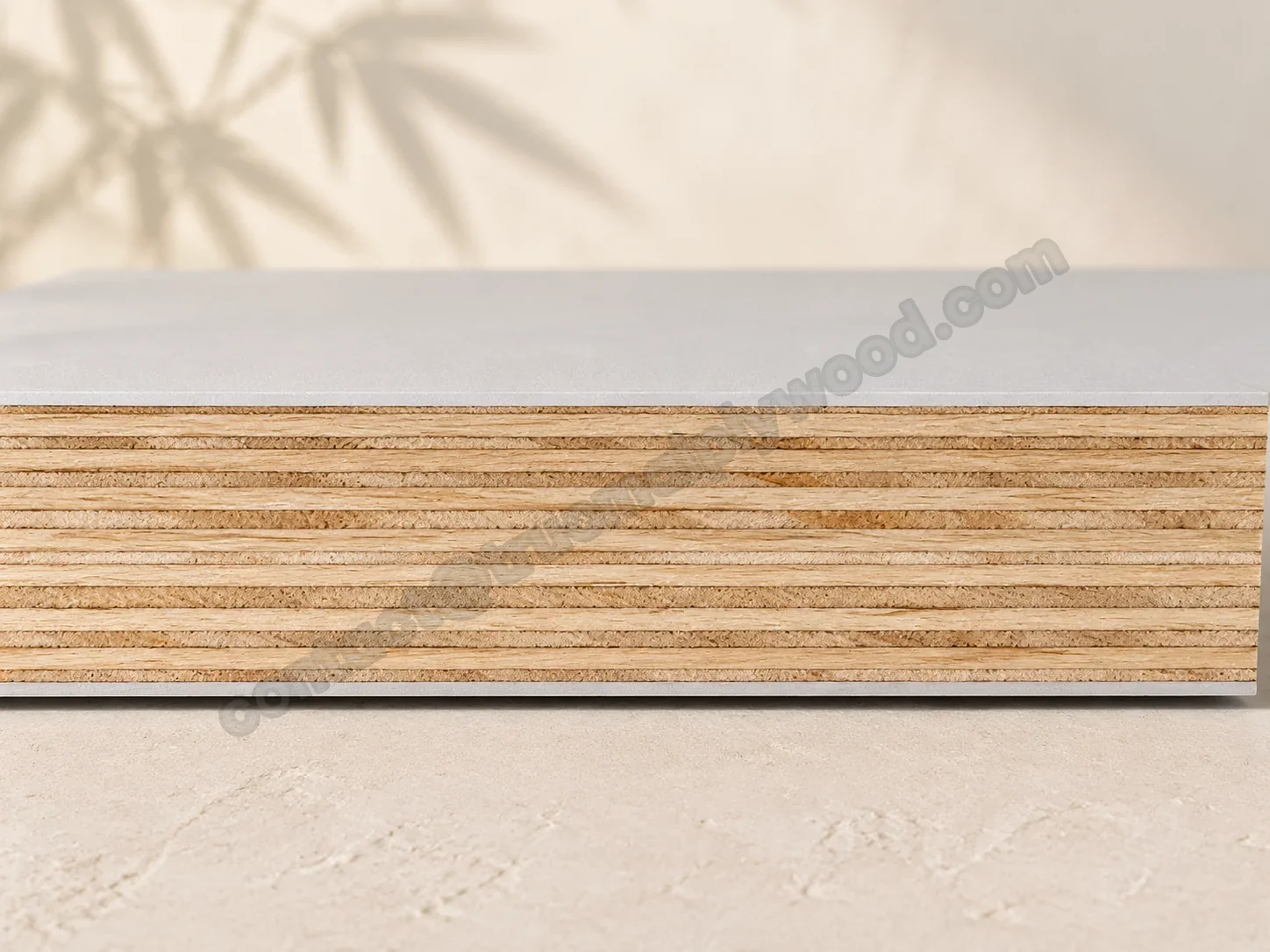
Glue and emission
Is the melamine plywood CARB P2 certified for US cabinet lines?
Yes, for 3–25 mm: the plywood under the melamine is hardwood plywood with veneer core, the product type certified to CARB P2 and TSCA Title VI under certificate CARB/EPA 26053. 30 and 40 mm sheets are outside that scope.
Glue type and emission class are two separate lines on the order: the default is UF glue at E0 emission, and a melamine-fortified glue for damp rooms usually gives E1. The melamine paper on the face does not change either line; it is the glue in the core that is chosen.
Emission class per order explains how the class is written for EU lots, and the CARB P2 test reports page shows what a US order receives with the sheet.
| Glue line | Emission | Boil resistance | Melamine plywood use |
|---|---|---|---|
| UF | E0 | About six hours | Dry kitchen and wardrobe carcasses, the default |
| Melamine-fortified UF | Usually E1 | Twelve hours | Sink units, bathroom vanities |
| UF, 3–25 mm, US orders | CARB P2 and TSCA Title VI | About six hours | US cabinet and furniture lines |
Sizes
Which melamine plywood sheets, sizes and thicknesses go on one container?
Melamine plywood is pressed in 1220 × 2440 mm, 1220 × 2280 mm or 1250 × 2500 mm, and nothing larger. Most cabinet programmes put one size and two or three thicknesses of one decor in each container.
Choose the sheet size by your cutting list, not by habit. A tall wardrobe side comes out of a 1220 × 2280 mm sheet with little waste; the 1220 × 2280 mm panels page shows which parts suit it. If your line cuts a part that only fits the long sheet, keep 1220 × 2440 or 1250 × 2500 mm.
Parts can also be cut before packing. Panels cut at the mill arrive as 2, 3, 4 or 6 parts per sheet, which saves a saw pass at your end and fills the container with parts instead of offcut.
- 1220 × 2440 mm 4 × 8 ft, the usual sheet for US cabinet lines
- 1220 × 2280 mm Shorter furniture sheet; carcass sides with less offcut
- 1250 × 2500 mm European format for EU kitchen and wardrobe lines
- Cut at the mill 2, 3, 4 or 6 parts per sheet, packed by part
| Thickness | Typical melamine part | Faced sides |
|---|---|---|
| 3–6 mm | Cabinet backs, drawer bottoms | Usually one side, balancing or bare back |
| 9–12 mm | Drawer sides, small partitions | Both sides |
| 15 mm | Shelves, light partitions | Both sides |
| 18 mm | Carcass sides, tops, bottoms, doors | Both sides, the bulk of most loads |
| 21–25 mm | Worktop cores, thick shelves | Both sides, pressed to order |
Uses
Where does melamine plywood for kitchen cabinets and wardrobes earn its place?
Melamine plywood earns its place in carcasses, shelves and partitions that need a finished, washable face and a core that holds screws and stays light. Where the part takes daily knocks on its face, HPL is the harder choice.
Melamine plywood is an interior panel. Truc Mai does not make film-faced, formwork, structural or marine plywood.
For a kitchen cabinet plywood specification that covers doors, carcasses and drawers together, the cabinet makers' spec guide lists which thickness and face goes where. Many lines take melamine for carcasses and a painted or veneered face for doors; both can come on one container.
- Kitchen cabinet carcasses
18 mm, decor or white outside and white inside, on Styrax or a combined core; sink units on melamine-fortified glue.
- Wardrobes and closets
Both-sides decor on sides, shelves and partitions; the 1220 × 2280 mm sheet often fits tall sides with less offcut.
- Office and shop furniture
Desks, pedestals and shelving on an Acacia or Eucalyptus core that keeps screws tight after the furniture is moved.
- Flat-pack and RTA parts
Parts cut at the mill and packed by part, on a light Styrax core that keeps carton weights down.
- Bathroom vanities
Melamine-fortified UF glue in the core for a twelve-hour boil line, with every cut edge banded.
Compare
Melamine plywood or melamine board, HPL or bare plywood?
Melamine plywood is the right buy for carcasses that need a finished face, light weight and good screw holding. Melamine particleboard is cheaper but heavier and weaker at the edge; HPL faced plywood is harder but dearer and heavier; bare plywood suits a factory that finishes its own faces.
The same melamine paper can go on plywood or on particleboard, so two sheets can look identical in a showroom. The difference is inside: the cross-laid veneer of plywood holds a hinge screw that has been taken out and put back, and a cut edge that meets water swells less. The plywood or MDF for furniture lines guide sets out the wider panel choice.
HPL faced plywood carries a laminate several times thicker than a melamine paper. It resists scratches and knocks on worktops and counters, but it costs more per sheet and adds weight, so it is used where the face takes wear, not on carcass sides that nobody touches.
A factory with its own short-cycle press can buy the bare calibrated sheet and press its own papers; that is usually cheaper per part. A factory without one gets a finished sheet that only needs cutting and edge banding, which removes a whole process from its line.
| Panel | Face | Screw holding at the edge | Wet edge | Best buy for |
|---|---|---|---|---|
| Melamine plywood | Decor paper, closed and washable | Good, cross-laid plies | Swells little | Carcasses, shelves, wardrobes |
| Melamine particleboard | The same decor paper | Weaker; screws strip on reuse | Swells badly | Low-cost carcasses that are never moved |
| HPL faced plywood | Thick laminate, much harder | Good | Swells little | Counters, doors and tops that take wear |
| Bare sanded plywood | Veneer, finished by you | Good | Swells little | Factories with their own lamination or paint line |
| White melamine plywood | Plain white paper | Good | Swells little | Interiors of carcasses, white programmes |
Checks
What is checked differently on a melamine faced sheet?
A melamine face is checked for the decor and for what shows through it. The rest of the routine is the mill-wide repeat spec control.
How arrival checks work and how the reference sample is kept is set out under repeat spec control.
The substrate is checked for thickness across the sheet after calibration sanding, before any paper goes on.
A new paper lot is laid beside the reference panel under the same light; a lot that reads warmer, cooler or glossier is held.
Pressed sheets are viewed in raking light for telegraphing, dry spots and pressure marks.
A test cut checks that the paper bonds cleanly at the edge without chipping.
Certificates
Which certificates cover melamine plywood?
FSC, CARB P2, ISO 9001 and ISO 14001, plus EU file sets.
- FSC 100% FSC-C196493 · SA-COC-014545
- CARB P2 and TSCA Title VI CARB/EPA 26053 · TPC-43
- ISO 9001:2015 W2012 · WCERT
- ISO 14001:2015 W2012E · WCERT
Container
How many 18 mm melamine-faced sheets fit in a 40HC?
About 990 sheets of 18 mm on a Styrax core, 880 on Acacia and 795 on Eucalyptus, as planning figures for 1220 × 2440 mm. Sheet counts and weights are planning figures from our packing model, panels only, not a loading record; the carrier and route decide the final payload.
A melamine load on Styrax is volume-capped: the box is full before it is heavy. Each decor travels in its own packs with the face protected, so several decors of one build load like one product. Thin backs usually go at the door end. For other mixes use the 40HC load calculator; loading a 40HC shows how packs are placed.
| Thickness | Styrax core: sheets | Styrax: m³ | Acacia core: sheets | Acacia: m³ |
|---|---|---|---|---|
| 6 mm | 2,988 | 53.4 | 2,656 | 47.4 |
| 9 mm | 1,998 | 53.5 | 1,776 | 47.6 |
| 12 mm | 1,494 | 53.4 | 1,328 | 47.4 |
| 15 mm | 1,188 | 53.0 | 1,056 | 47.2 |
| 18 mm | 990 | 53.0 | 880 | 47.2 |
| 25 mm | 720 | 53.6 | 640 | 47.6 |
Terms
Terms for melamine plywood by the container
Full containers direct from the mill; these terms apply unless the contract says otherwise.
Full terms are on MOQ, payment and FOB. A new decor needs an approved sample panel before its first container; a reorder of an approved decor does not.
- Minimum order One 40HC
- Production time 15–45 days after the 30% deposit, by quantity and agreement
- Payment 30% deposit; 70% against the scanned B/L by T/T, or irrevocable L/C at sight
- Delivery terms FOB Hai Phong, CFR or CIF
- Documents Invoice, packing list, B/L, certificate of origin, phytosanitary, fumigation, order certificates
- Price Quoted per order against the written specification
How to order
What to send for a melamine plywood quotation
Four things are particular to a melamine order.
Deposit, documents and balance follow from enquiry to loading.
Name each decor by paper code, texture and gloss, or send a sample.
Write the faced sides: both decor, decor and white, or decor and balancing paper.
Give core, finished thickness mix and sheet size per container.
Approve the sample panel; one stays at the mill.
FAQ
Melamine plywood questions from cabinet and wardrobe buyers
Why is a melamine face pressed on plywood instead of on particleboard?
For weight, screw holding and moisture behaviour. A melamine plywood carcass on Styrax core weighs about 26.8 kg per 18 mm sheet in the Truc Mai planning model, holds hinges and runners in its cross-laid plies and swells far less at a wet edge than particleboard does.
Can one 40HC carry several melamine decors?
Yes. A container usually carries one or two products, and three to six can be mixed by agreement. Several decors on the same core and thickness count as one build with separate packs, each pack labelled by decor code so it can be picked at your warehouse.
Is the melamine pressed on one side or both?
Either, and the order says which. Carcass sides and shelves are faced on both sides; a part with one hidden face takes the decor on one side and a balancing paper on the other, so the sheet stays flat after cutting.
What thickness tolerance does melamine plywood carry?
The substrate is sanded and calibrated to ±0.3 mm before the paper is pressed, which is the tightest tolerance Truc Mai writes. Commercial-line panels are ±0.5 mm; they are not used under melamine because a thin paper shows every dip in the face below it.
Which face veneer sits under the melamine paper?
A sound natural poplar or eucalyptus face pair, sanded flat. The paper hides the veneer completely, so paying for a higher face grade buys nothing; what matters is a face with no open defects, overlaps or sanding dips.
How is a melamine decor matched on a reorder?
By decor code and by the approved sample. The decor code, surface texture and gloss go on the written order; the mill keeps one sample panel and you keep the other, and a new paper lot is compared with that sample under the same light before pressing.
Does melamine plywood come in 1220 × 2280 mm?
Yes. The mill presses 1220 × 2440, 1220 × 2280 and 1250 × 2500 mm sheets and nothing larger. The 1220 × 2280 mm sheet is the shorter furniture size that many carcass cutting lists fit with less offcut.
Can melamine plywood be cut to carcass parts before shipping?
Yes. Cut-to-size orders split one sheet into 2, 3, 4 or 6 panels and pack them by part before loading. The cut edges arrive bare and are edge-banded at your factory.
What glue line does melamine plywood use for kitchen carcasses?
UF glue at E0 emission for dry rooms. For sink units and bathroom vanities the core can be glued with melamine-fortified UF, which holds twelve hours in a boil test instead of about six; the emission line is then usually E1.
How much does a melamine face add to the container load?
Very little. The planning figures use the substrate: 990 sheets of 18 mm on Styrax, 880 on Acacia and 795 on Eucalyptus per 40HC, panels only. The papers are a thin layer, so the load stays inside the same plan.
What faults does a buyer check first when a melamine pack is opened?
Telegraphing, edge chipping and bow. Look along a sheet in raking light for lines or dents coming through the paper, make a fresh saw cut to check the bond at the edge, and lay a sheet flat on the floor to see that it does not rock.
When should a buyer take bare sanded plywood instead of melamine plywood?
When the factory has its own short-cycle press or lamination line, or when parts are painted. The bare furniture-line panel is then the cheaper buy per part, and the decor is pressed or the paint applied at your end.
Quotation
Request a melamine plywood quotation
Send the decors, faced sides, core, thickness mix, sheet size and containers per month, and Lucy replies with a written specification and price. Write to contact@trucmaiplywood.com or use the quotation form.
Decor paper on a stitched A-grade core calibrated to ±0.3 mm, 3–40 mm, one decor or several per container.