
Laminates for plywood are decorative or protective faces pressed onto the sheet: melamine-impregnated paper, high-pressure laminate (HPL), paper overlays and a few plastic films. Each suits a different job, but the core under the face decides the sheet weight and how many m³ fit in a 40HC. Truc Mai presses melamine, HPL and paper-overlay faces on its own cores.
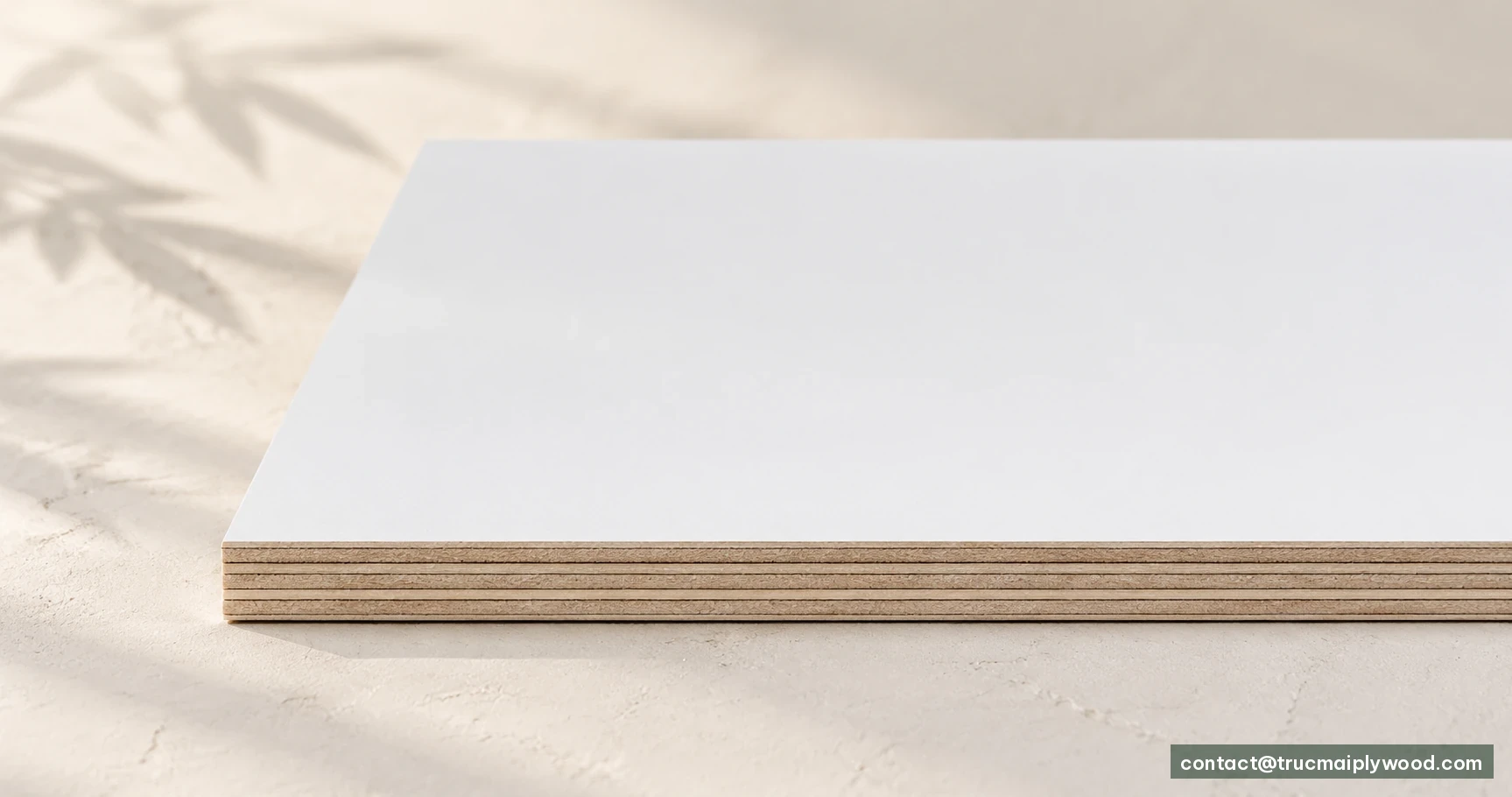
What are the different types of laminates for plywood?
The laminates pressed on plywood fall into three groups: melamine-impregnated decor paper pressed straight onto the sheet; pre-made laminates such as high-pressure laminate (HPL) and continuous pressure laminate (CPL) glued on as sheets; and films and papers such as paper overlay, kraft, PET, PVC and acrylic. Each trades cost against wear and moisture resistance.
The word “laminate” is used loosely in the panel trade, so it helps to fix the terms first. A laminate in this sense is a surface material: a decor paper, a resin-paper sheet or a plastic film. Plywood is the platform under it. “Laminated plywood” in a quote usually means plywood with one of these faces, not a different kind of plywood.
| Laminate | What it is | How it goes on the plywood |
|---|---|---|
| Melamine paper (LPL) | Decor paper soaked in melamine resin | Pressed directly onto the sheet with heat and pressure |
| HPL | Several resin-soaked papers pressed into a hard sheet | Glued onto the plywood as a finished sheet |
| CPL | Like HPL, made on a continuous press, usually thinner | Glued onto the plywood as a sheet |
| Paper overlay | Resin-impregnated paper that hides the grain | Pressed onto the sheet; paintable or ready to use |
| Kraft paper face | Brown or coloured kraft with resin | Pressed onto the sheet for packing or utility use |
| PET, PVC, acrylic | Plastic films or sheets with a decor or gloss | Glued or laminated onto the sheet |
Truc Mai presses melamine, HPL and paper-overlay faces on its own cores, and also supplies UV-ready panels for buyers who coat in their own factory. The plastic films sit outside that range; a buyer who needs them usually laminates in a second factory on a plain, sanded panel.
How do melamine, HPL and paper-overlay faces differ in use?
Melamine paper is the cost-efficient decor face for cabinet carcasses, shelving and interior fit-out. HPL is the hard-wearing face for worktops, shop counters and surfaces that take knocks. Paper overlay gives a smooth, uniform base for paint or a plain finish where the grain must disappear.
| Measure | Melamine paper | HPL | Paper overlay |
|---|---|---|---|
| Wear and scratch resistance | Good for furniture surfaces | Highest of the three | Moderate; depends on finish |
| Impact resistance | Moderate | High | Moderate |
| Moisture at the face | Resists splashes | Resists splashes | Resists splashes when sealed |
| Look | Solid colours, woodgrains, stones | Wide decor range, textures | Plain, uniform, paintable |
| Typical use | Carcasses, shelves, wardrobes | Worktops, counters, shopfitting | Painted furniture, signage, linings |
| Relative cost of the face | Lower | Higher | Lower to moderate |
| Pressing | One step at the mill | Glued on as a sheet | One step at the mill |
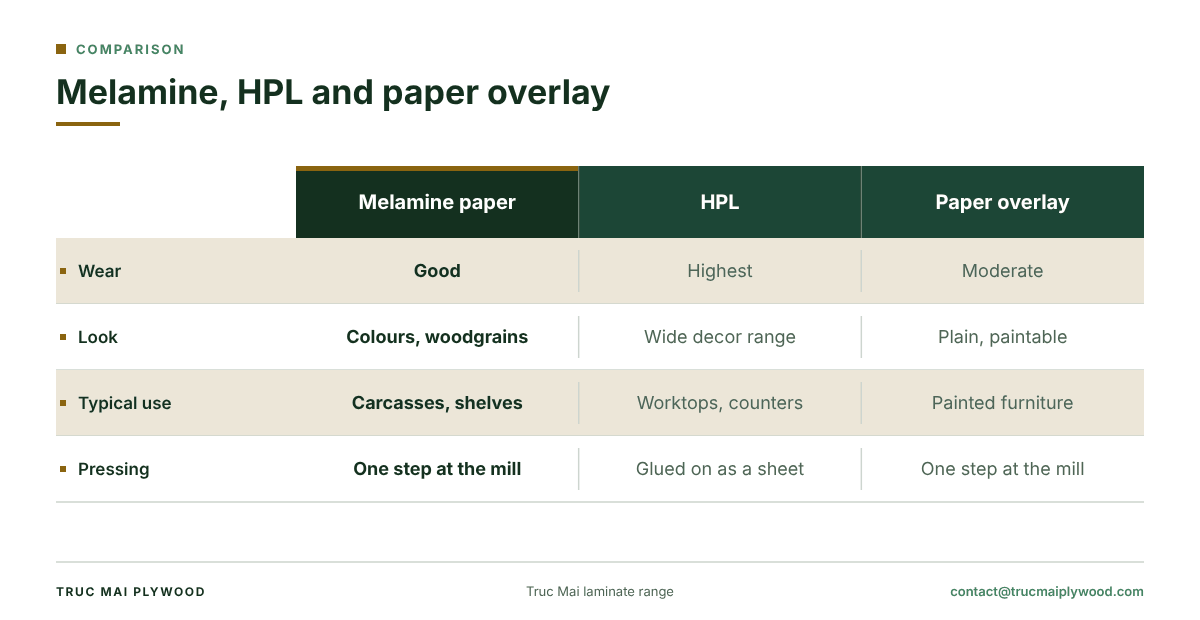
The choice starts from the end use, not from the face. A cabinet carcass that is never touched after assembly does not need HPL; a shop counter that takes keys, bags and cleaning every day does. A painted furniture front needs a surface that hides grain, which melamine paper does not offer in paintable form.
The melamine faced plywood page and the HPL faced plywood page cover each finished sheet, with cores and thicknesses.
What is melamine faced plywood?
Melamine faced plywood is plywood with a decor paper, soaked in melamine resin, pressed straight onto its face under heat and pressure. The resin cures into a hard, closed surface that carries the decor: a solid colour, a woodgrain or a stone print. It is the most common laminate for furniture panels.
Because the paper is pressed directly, the face is only as flat as the sheet under it. Any step between core plies, any open joint or any patch that sits proud shows through as a line or a bump in raking light. That is why melamine work starts with a sanded, calibrated platform with a stitched core, and why the thickness tolerance is written on the order: ±0.3 mm on sanded and calibrated furniture panels.
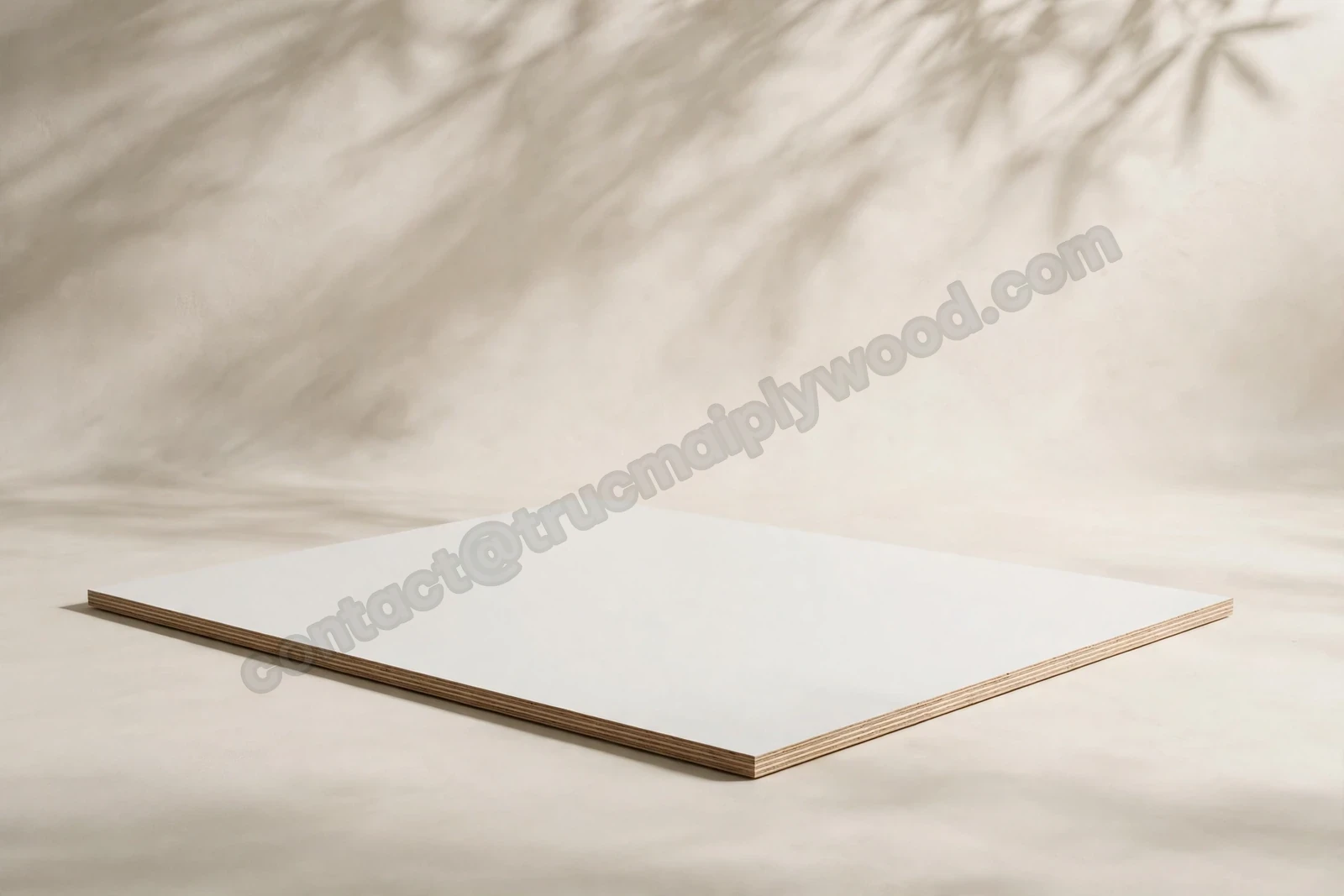
White is the workhorse. White melamine-faced plywood fills cabinet carcasses, wardrobe interiors and shelving, where the buyer wants a clean, wipeable surface with no finishing step. The white laminated plywood page covers that sheet.
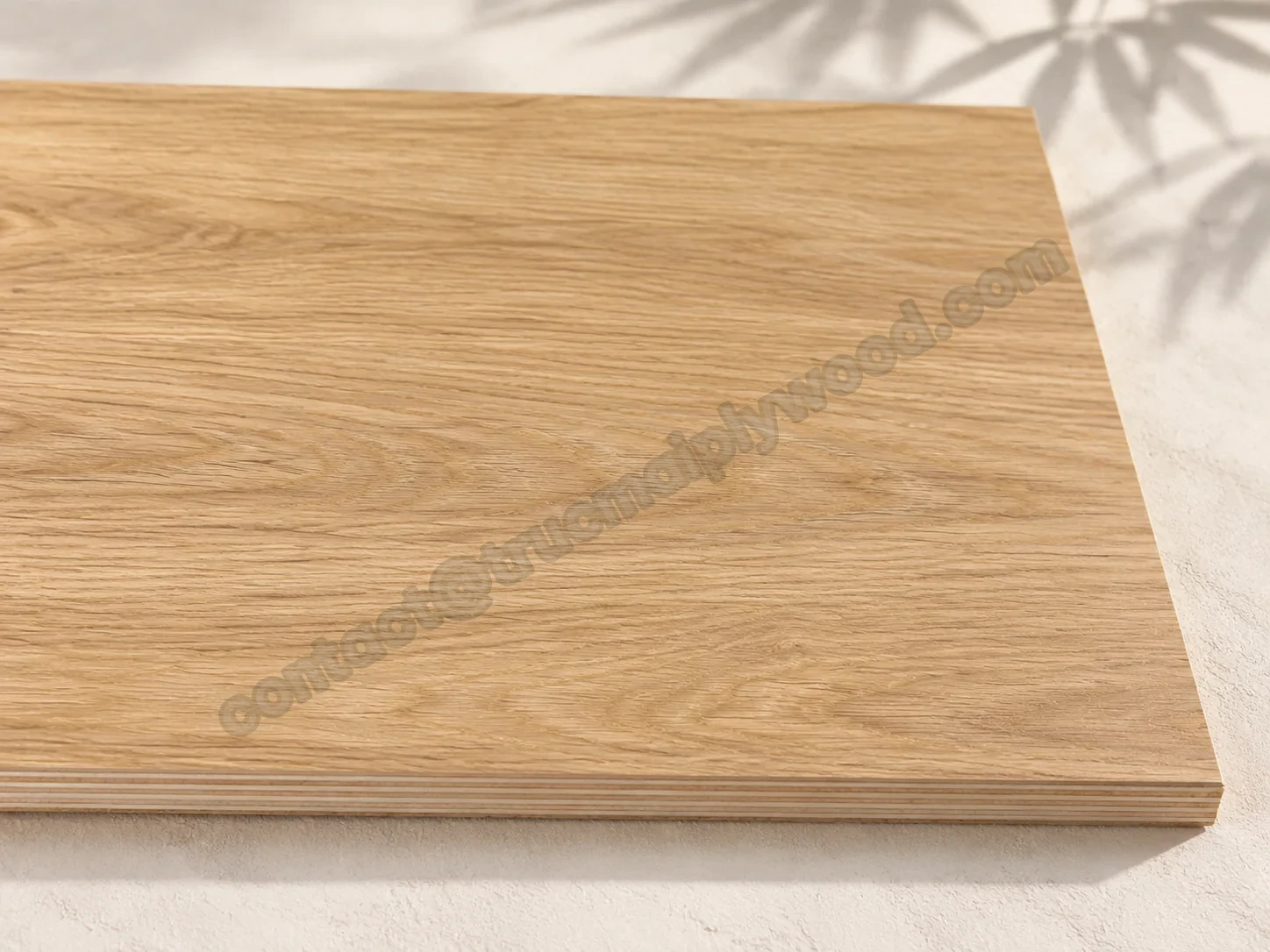
Woodgrain melamine decors imitate oak, walnut and other species with a printed paper, often with an embossed texture that follows the print. They give a wood look without a real veneer and without lacquering.
What is HPL on plywood, and when is it worth the cost?
HPL, high-pressure laminate, is a hard sheet made by pressing several resin-soaked kraft papers under a decor paper at high pressure. It is glued onto plywood as a finished sheet. It is worth its higher cost wherever the surface takes wear, impact or heat: worktops, counters, desks, school and shop furniture.
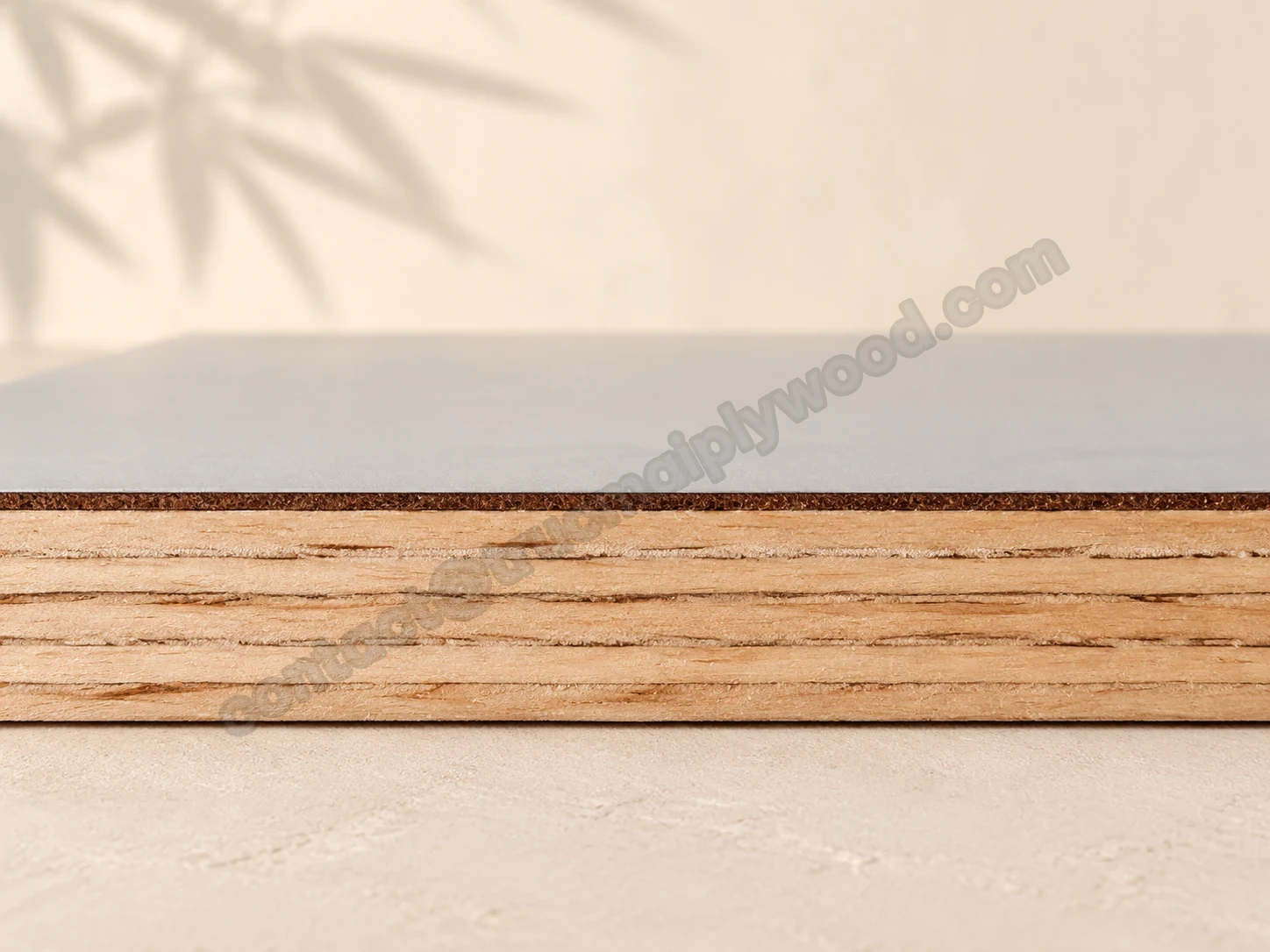
On the edge of an HPL-faced sheet the laminate shows as a thin, hard line, often with a dark core from the kraft papers under the decor. That line is part of the design decision: some buyers band the edge, others leave a dark line visible as a detail.
The international standard for HPL is EN 438 in Europe, with ISO 4586 as its counterpart. Those standards describe the laminate sheet itself. When HPL is glued onto plywood, the panel’s flatness, glue bond and emission come from the plywood and the adhesive used to apply the laminate.
CPL, continuous pressure laminate, is made on a continuous belt press rather than in single press openings. It is usually thinner and less costly than HPL and is used where a rigid laminate is wanted at a lower price step, such as door and furniture panels.
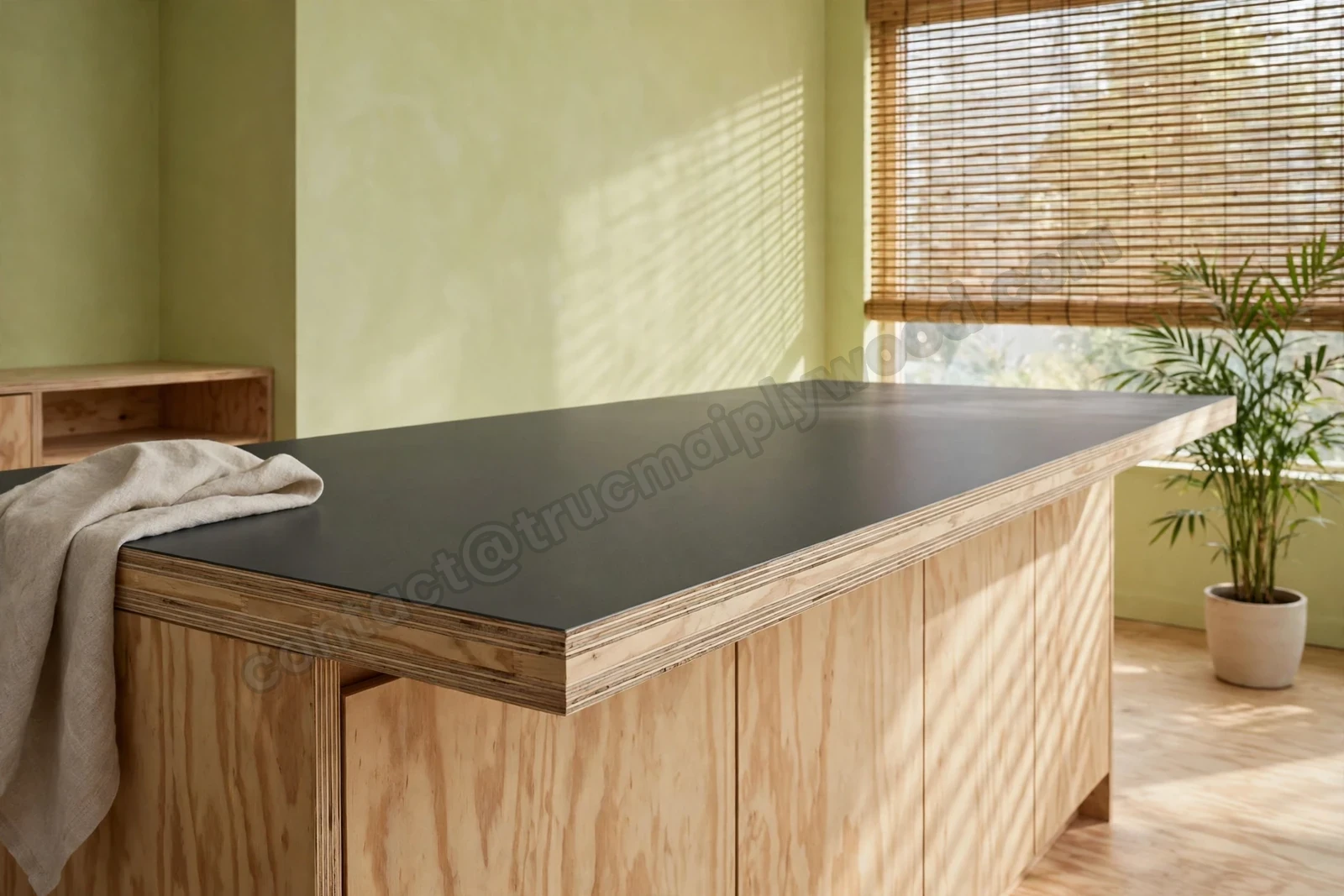
What is paper overlay plywood?
Paper overlay plywood is plywood faced with a resin-impregnated paper that covers the veneer grain and gives a uniform, smooth surface. The overlay can be a ready-to-use plain face or a base for paint. It costs less than HPL and gives a cleaner paint surface than a veneer face.
Two kinds are common. A medium-density overlay is a thicker paper face that hides grain completely and takes paint well, used for painted furniture, signs and linings. A thinner decorative overlay is pressed as the final face, often in a plain colour. Kraft-paper faces, brown or coloured, sit at the utility end and appear on packing and display panels.
The overlay changes how the face looks and how it takes paint; it does not change the glue line in the panel. A paper overlay on a panel with UF glue at E0 emission is still an interior panel, and the overlay does not make it an exterior or structural product. Truc Mai does not make film-faced, formwork, structural or marine plywood.
Which core under a laminate gives the lightest sheet and the most m³ per 40HC?
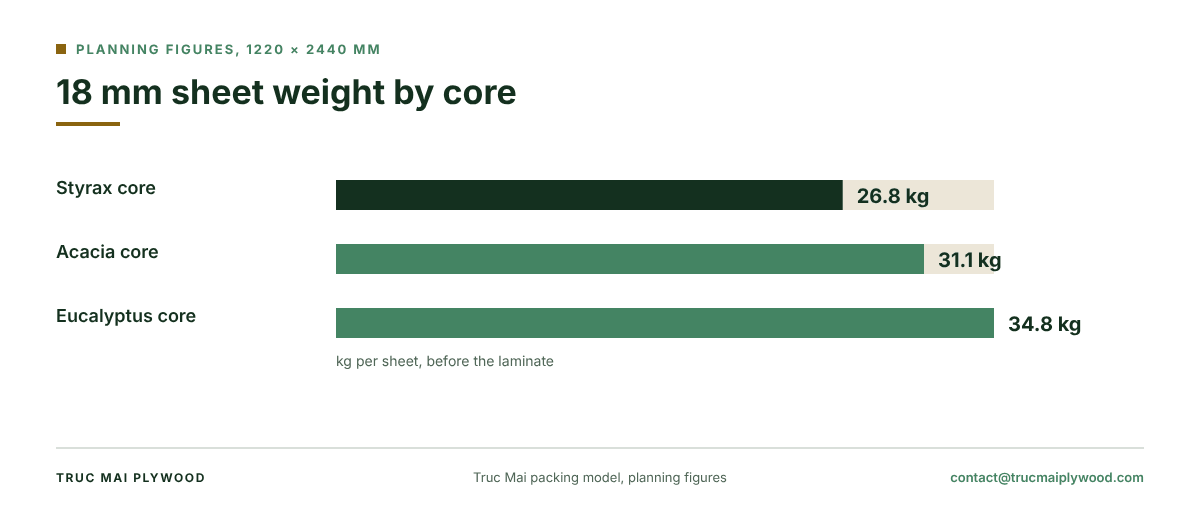
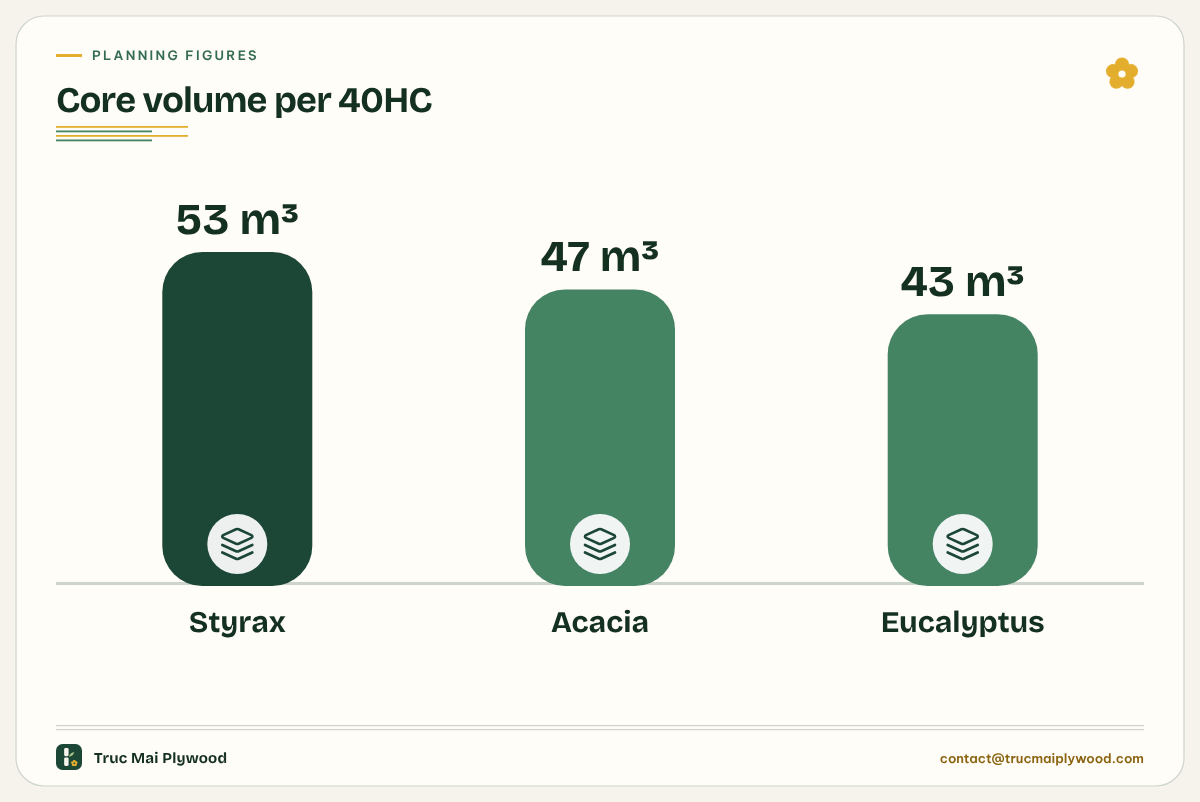
A Styrax core gives the lightest sheet and the most volume per container: at 18 mm in 1220 × 2440 mm, about 26.8 kg a sheet and about 53 m³ per 40HC, as planning figures. Acacia gives about 31.1 kg and 47 m³, eucalyptus about 34.8 kg and 43 m³, because heavier cores reach the payload first.
| 18 mm core, 1220 × 2440 mm | Weight per sheet | Sheets per 40HC | Volume per 40HC |
|---|---|---|---|
| Styrax | 26.8 kg | 990 sheets | 53 m³ |
| Acacia | 31.1 kg | 880 sheets | 47 m³ |
| Eucalyptus | 34.8 kg | 795 sheets | 43 m³ |
All three rows are planning figures from the mill’s packing model for panels only, at a 28,000 kg planning payload; real sheets are weighed before final loading, and the carrier and route set the real limit. A laminate face adds a little weight to each sheet, which matters most on the heavier cores that are already close to the payload.
The core also decides how the face looks. A lighter, even core lets a thin melamine paper lie flat, while a core with large density changes can telegraph through. A furniture buyer moving from an acacia to a Styrax core usually gets a better face, a lighter sheet and more m³ per container. The m³ per 40HC table gives every thickness.
Which thickness range can laminate-faced plywood be ordered in?
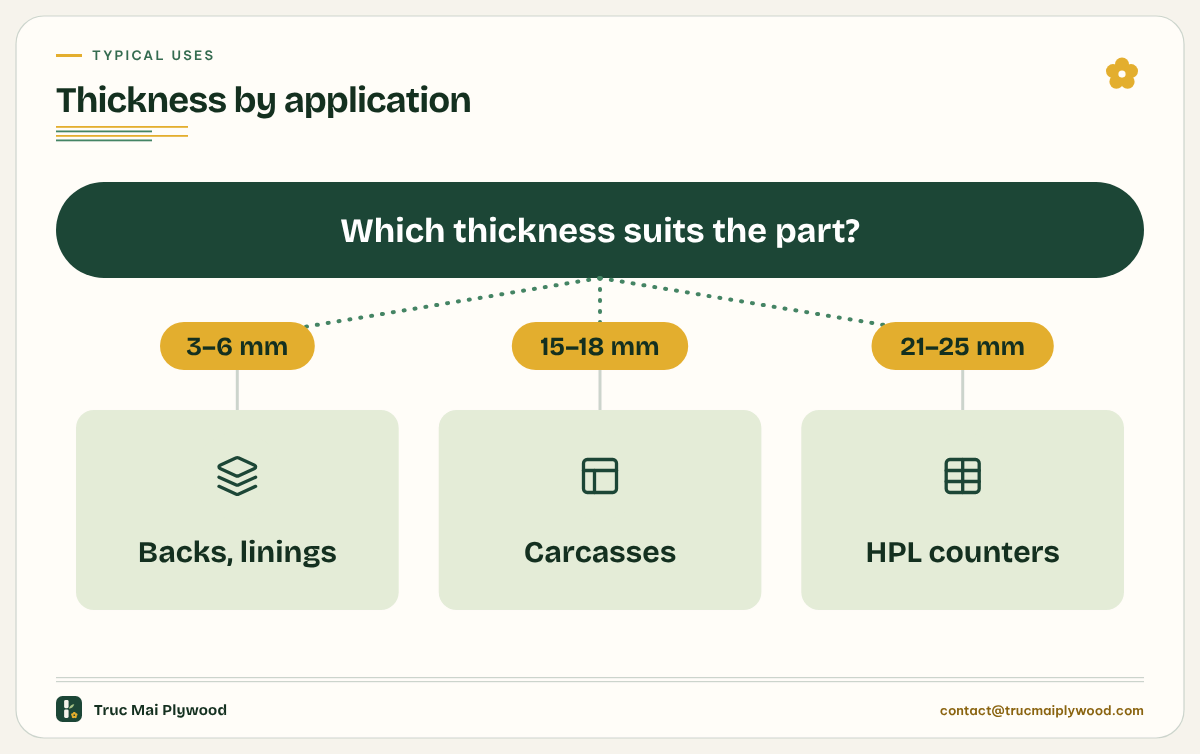
Laminate-faced plywood is ordered on the same listed thicknesses as plain panels: Truc Mai lists 3, 4, 5, 6, 9, 12, 15, 18, 21, 25, 30 and 40 mm. The laminate-faced thickness is agreed per order, and a buyer who needs CARB P2 and TSCA Title VI certification keeps the platform inside 3–25 mm.
Thin sheets need care. Panels of 3–5 mm are always 5 plies, and a thin sheet with a laminate on one face only bows more easily than a thick one. Pressing a balancing face on the back keeps it flat. Good thin veneer is also scarce, so 4 mm platforms can take longer to schedule.
| Thickness | Typical laminate use | Note |
|---|---|---|
| 3–6 mm | Backs, drawer bottoms, linings | Balance both faces; 3–5 mm are 5 plies |
| 9–12 mm | Doors, drawer sides, shelves | Common for melamine on both faces |
| 15–18 mm | Carcasses, shelves, worktop bases | 18 mm usually 11–13 plies |
| 21–25 mm | Worktops, counters with HPL | Top of the 3–25 mm CARB scope |
| 30–40 mm | Thick tops and benches | Outside the 3–25 mm CARB scope |
Sheet sizes are 1220 × 2440 mm, 1220 × 2280 mm for furniture parts and 1250 × 2500 mm in the European format. Nothing larger is pressed; bigger panels are cut from standard sheets instead.
What emission class does the core under a melamine face carry?
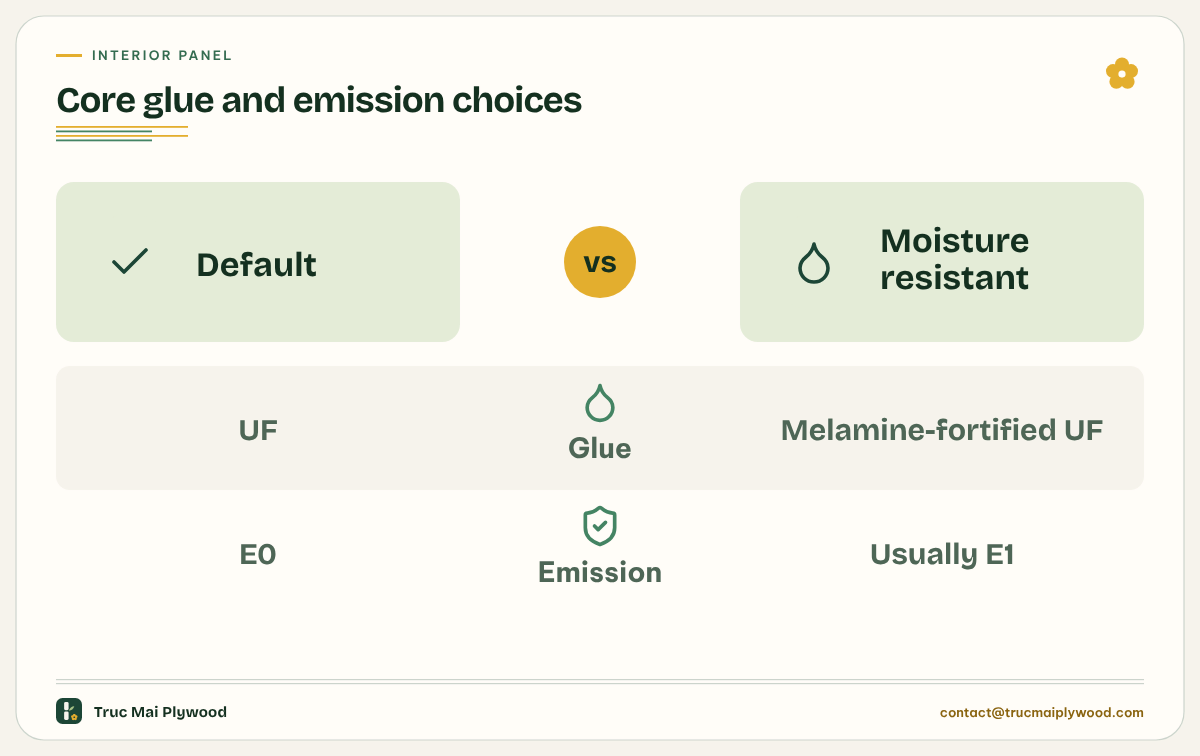
The core carries the emission class written on the order, and the default at Truc Mai is UF glue at E0 emission. The melamine face adds its own cured resin layer on top, but the emission line on the order describes the panel build. Glue type and emission class are always two separate lines.
A laminate face is often described as “sealing” the panel, and it does slow emission from the covered face. But the edges stay open until they are banded, and a cut panel exposes the core at every cut. That is why the order fixes the emission of the plywood itself, not of the decor.
When a buyer needs better moisture resistance, for example a panel that must pass a 12-hour boil, the glue moves to a melamine-fortified UF and the emission class is then usually E1, again on its own line. Packing-grade panels usually carry E2 emission, so the emission line is checked whenever a decor face goes onto a lower grade.
For EU furniture the panel sits under Regulation (EU) 2023/1464, which bars furniture and wood-based articles from the EU market after 6 August 2026 if their formaldehyde release exceeds 0.062 mg/m³ under the test conditions of its Appendix 14. The test is run on the article, so a laminate-faced panel is judged as a whole.
Does a laminate face change the US formaldehyde rules for the panel?
A melamine, HPL or paper face does not turn the panel into a different composite wood product. The plywood platform is hardwood plywood with a veneer core, and its federal limit is 0.05 ppm. The separate “laminated product” rules in the US apply when a wood veneer, not a paper or plastic laminate, is fixed to a platform.
The federal limit is in 40 CFR 770.10: for hardwood plywood made with a veneer core or a composite core, 0.05 parts per million (ppm) of formaldehyde. Truc Mai holds CARB Phase 2 and TSCA Title VI certification for that product, certificate CARB/EPA 26053, for veneer-core panels from 3–25 mm.
The definition in 40 CFR 770.3 describes a laminated product as “a product in which a wood or woody grass veneer is affixed” to a particleboard, MDF or veneer core or platform. A melamine paper or HPL sheet is not a wood veneer, so a melamine-faced plywood sheet is read as certified plywood with a decor face.
The finished good is the buyer’s step. A cabinet maker who builds kitchen units from certified laminate-faced panels labels the finished goods as TSCA Title VI compliant under its own name. The Phase 2 formaldehyde limits page reads the whole line.
Does a UV-ready panel come with the UV coat already applied?
No. A UV-ready panel from Truc Mai has both faces sanded and prepared for the buyer’s own UV coating, but the mill does not apply the UV coat. The buyer’s line applies and cures it, which lets the buyer choose the gloss, the colour and the number of coats for its own product.
UV coating is a different route from a laminate. Instead of pressing a paper or a sheet onto the face, the buyer rolls a liquid lacquer onto a real wood veneer or a primed face and cures it under ultraviolet lamps in seconds. The wood grain stays visible, which is the point for buyers who want a real veneer look with a hard finish.
The preparation is what the mill sells. A UV line shows every flaw on the face: sanding marks, patches, open grain, glue bleed. UV-ready panels are sanded and calibrated on both faces with a face grade agreed against an approved sample, so the coating line receives a sheet it can finish without rework.
| Route | Who finishes the face | What shows | Typical buyer |
|---|---|---|---|
| Melamine paper | The mill, in one press | Printed decor | Cabinet carcass makers |
| HPL or CPL | The mill or the buyer, glued sheet | Decor laminate | Worktop and counter makers |
| Paper overlay | The mill | Plain or painted surface | Painted furniture makers |
| UV-ready veneer | The buyer, on its UV line | Real wood veneer | Furniture makers with a UV line |
What is the best laminate for plywood, and when is a veneer face better?
The best laminate for plywood depends on the wear: melamine for cabinet carcasses and shelves, HPL for worktops and counters, paper overlay for surfaces that will be painted. Choose a laminate when the surface must be uniform, wipeable and finished on arrival; choose a real veneer face when the look of wood matters and the buyer has a finishing line. Laminates remove the finishing step; veneers keep the wood but need lacquer, oil or a UV coat.
The decision usually splits a piece of furniture rather than choosing for all of it. A kitchen unit may use white melamine for the carcass, a woodgrain melamine or HPL for the doors, and a UV-coated veneer panel for an open shelf that shows. One container can carry several of these by agreement: three to six products can be mixed in a 40HC, and one or two is the usual load.
Truc Mai’s veneer faces cover EV, poplar and bleached poplar, birch, okoume, bintangor, pine, eucalyptus, gurjan and sapele, with others on request. The veneer or laminate faces page compares the two routes by cost and finishing time.
How do edges and cut-outs behave on laminate-faced plywood?
The laminate protects the face; the edge is plywood. Every cut shows the core plies, so the edge needs banding, a solid lipping or a visible-ply finish chosen on purpose. A void-free, stitched core gives a clean edge for banding glue and a neat line where the plies show.
Three edge points belong on the order. The core grade decides whether voids appear at the cut: an A-grade, stitched core leaves fewer gaps under an edge band than a loose-laid core. The face-to-core bond decides whether the laminate chips at the saw. And the tolerance decides whether the edge band sits flush on every panel, which is why ±0.3 mm on sanded and calibrated panels matters to a banding line.
HPL needs its own saw practice: a fine-toothed blade and support close to the cut, or the hard laminate chips on the exit side. Melamine paper is thinner and cuts more easily, but shows chipping on low-grade cores. Cut-to-size orders split one sheet into 2, 3, 4 or 6 panels before packing, which moves the cutting step to the mill.
How should a laminate-faced plywood order line read?
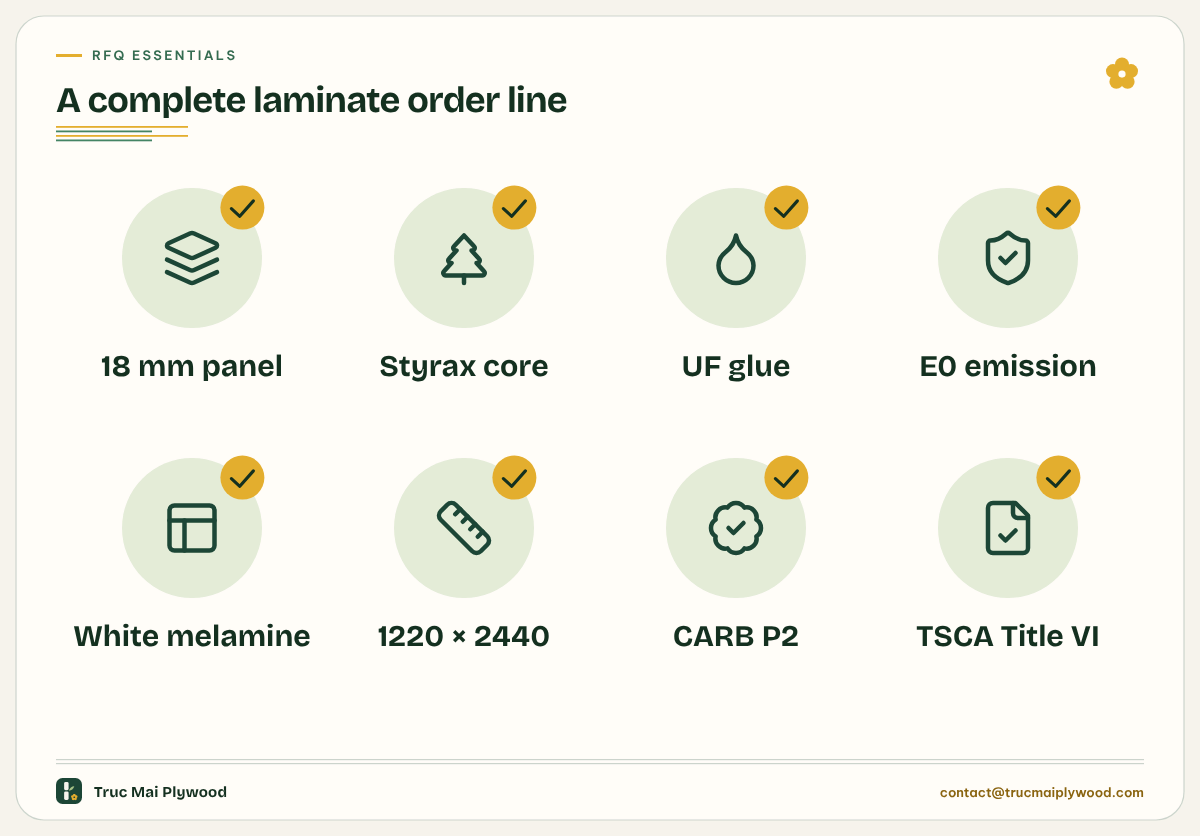
Write the platform first and the face second: core and grade, thickness and tolerance, glue and emission, then the laminate type, decor, finish and whether the back is the same or a balancing face. Add the sheet size, packing and quantity, and copy the line onto each repeat order.
18 mm plywood, laminate faced. Styrax core, A-grade, stitched, sanded and calibrated, ±0.3 mm. UF glue at E0 emission. White melamine face / white melamine back. 1220 × 2440 mm. CARB P2 and TSCA Title VI certified platform, certificate CARB/EPA 26053. Export packing. 1×40HC, FOB Hai Phong.
Before the deposit, ask for a sample of that exact build, cut it, and look at three things: the face flatness in raking light, the edge for voids, and the thickness at several points against the written tolerance. New buyers receive free samples and book their own courier; the courier cost can be credited against a real order.
What do laminate faces mean for a repeat container programme?
A laminate face makes a repeat order easier to keep identical than a veneer face, because a decor paper is printed to the same pattern each time while a veneer changes with each log. The work on a repeat is to keep the platform the same: core, grade, glue, emission and tolerance.
What changes most between containers is not the decor but the sheet under it. A buyer who lets the core float between Styrax and eucalyptus to chase a price gets sheets that weigh about 8 kg more each at 18 mm and fill the container by weight before space. Fixing the core on the order line fixes the sheet weight, the container fill and the cost per m³.
The decor code belongs on the order too, with an approved sample kept on both sides. Decor papers come in batches, and a slight colour shift between batches is easier to catch against a kept sample than against memory. Send the order line to the quotation desk or by email to contact@trucmaiplywood.com, and the laminate-faced plywood page lists the faces and cores the line can carry.
Questions buyers ask
What is the most common laminate for plywood in furniture?
Melamine-impregnated decor paper, pressed directly onto the sheet. It covers solid colours and woodgrain decors at a lower cost than HPL and suits cabinet carcasses, shelving and interior fit-out.
Is HPL stronger than melamine on plywood?
Yes, for wear and impact. HPL is a pre-made laminate of several resin-soaked papers pressed at high pressure, so it is thicker and harder than a single melamine paper; it costs more and is glued on as a sheet.
Can laminate be pressed on both faces of plywood?
Yes. Pressing the same or a matching balancing face on the back keeps the sheet flat; a laminate on one face only can make the panel bow.
Does a UV-ready panel come with the UV coat already applied?
No. UV-ready means both faces are sanded and prepared for the buyer's own UV coating line; Truc Mai does not apply the UV coat.
Which core suits a melamine-faced plywood sheet?
A smooth, void-free core with sanded faces, so the thin paper does not show the plies through it. Styrax, acacia and eucalyptus cores are all used; Styrax gives the lightest sheet.
What is paper overlay plywood?
Plywood faced with a resin-impregnated paper that hides the veneer grain and gives a uniform surface, either ready to use or as a base for paint.
Can laminate-faced plywood be CARB P2 certified?
The plywood platform under the laminate is the certified composite wood product. Truc Mai's certificate CARB/EPA 26053 covers veneer-core hardwood plywood from 3–25 mm.
Is laminate-faced plywood waterproof?
The laminate face resists splashes, but the edges and the core glue decide moisture resistance. The default UF glue suits interior use; a 12-hour boil needs melamine-fortified glue.
How many laminate-faced sheets fit in a 40HC?
As a planning figure, about 990 sheets of 18 mm on a Styrax core in 1220 × 2440 mm, about 53 m³. Heavier acacia and eucalyptus cores fill the payload first.
Is a plywood laminate the same as laminated veneer lumber?
No. A laminate is a face pressed on a panel; laminated veneer lumber (LVL) is a beam or strip made of veneers glued with the grain running the same way.