
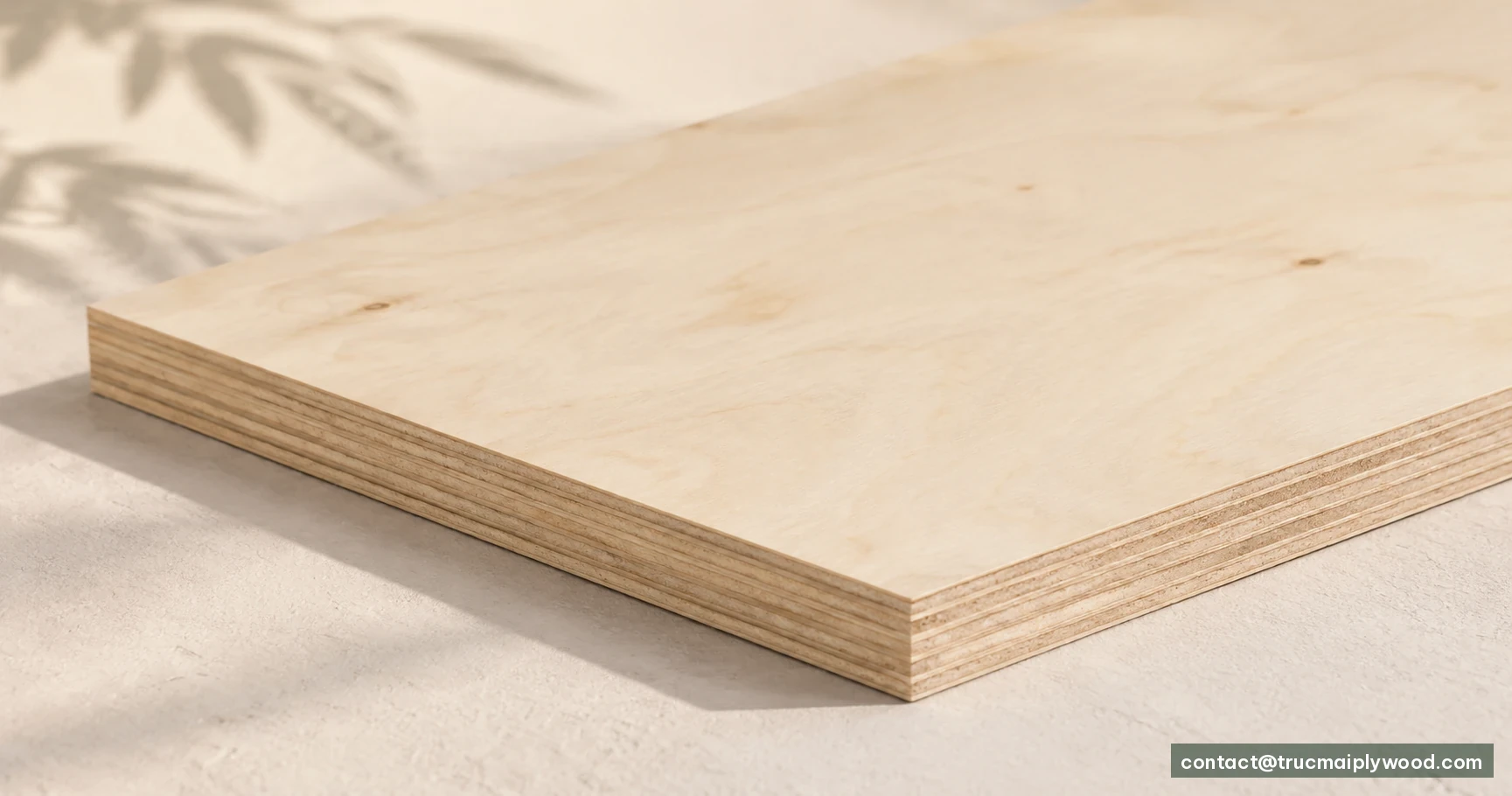
Phase 2 formaldehyde compliance means a hardwood plywood panel meets 0.05 ppm under the ASTM E1333 chamber method, is made by a mill certified by an approved third-party certifier, and carries the label that says so. Truc Mai holds CARB P2 and TSCA Title VI certificate CARB/EPA 26053 for veneer-core panels from 3–25 mm.
What does compliant for formaldehyde Phase 2 mean for hardwood plywood?
Compliant for formaldehyde Phase 2 means a hardwood plywood panel was made by a mill certified by an approved third-party certifier, tested under ASTM E1333 at or below 0.05 ppm, and labelled as compliant. The phrase covers three things at once: a limit, a certification and a label, and a panel needs all three.
The words on a cabinet box or a purchase order, “compliant for formaldehyde Phase 2”, come from the California Air Resources Board’s airborne toxic control measure for composite wood products, codified at 17 CCR 93120. Phase 2 is the second, tighter set of emission standards in that measure. The federal rule, TSCA Title VI in 40 CFR part 770, later set the same numbers for the whole United States.
For a plywood buyer the useful reading is narrow. A Phase 2 claim belongs to a product type, a thickness range and a mill. Truc Mai holds CARB Phase 2 and TSCA Title VI certification in its own name, certificate CARB/EPA 26053, for hardwood plywood with veneer core from 3–25 mm and 3–15 plies. Anything outside that range is not part of the claim, however good the glue.
The rest of this page reads the limit as one line on a US order: what the number is, who checks it, what the label must say, and how it sits next to the EU limit that uses different units.
What is the Phase 2 formaldehyde limit for veneer-core plywood?
The Phase 2 limit for hardwood plywood with a veneer core is 0.05 ppm of formaldehyde, measured by the ASTM E1333 large-chamber method. The same 0.05 ppm applies to hardwood plywood with a composite core, and it is also the federal TSCA Title VI limit.
The federal text is short. 40 CFR 770.10 states that for hardwood plywood made with a veneer core or a composite core the standard is 0.05 parts per million (ppm) of formaldehyde. The same section gives 0.11 ppm for medium-density fiberboard, 0.13 ppm for thin medium-density fiberboard and 0.09 ppm for particleboard.
| Composite wood product | Phase 2 and TSCA Title VI limit | Test basis |
|---|---|---|
| Hardwood plywood, veneer core | 0.05 ppm | ASTM E1333 |
| Hardwood plywood, composite core | 0.05 ppm | ASTM E1333 |
| Particleboard | 0.09 ppm | ASTM E1333 |
| Medium-density fiberboard | 0.11 ppm | ASTM E1333 |
| Thin medium-density fiberboard | 0.13 ppm | ASTM E1333 |
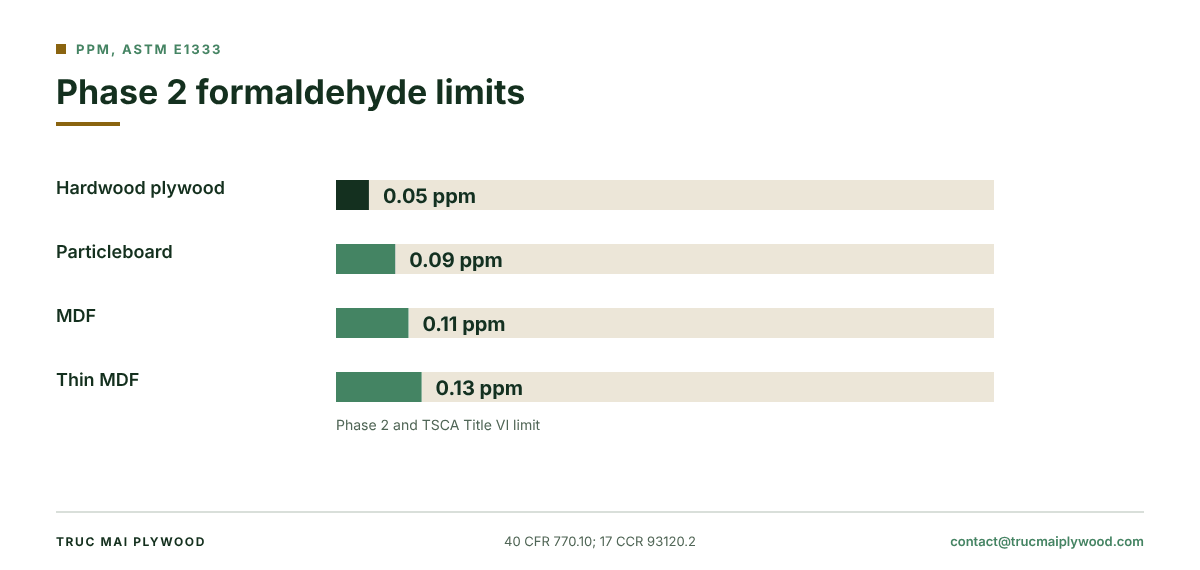
The number is a chamber result, not a content figure. It describes how much formaldehyde a conditioned panel releases into the air of a test chamber under fixed conditions, which is why a panel’s glue, its pressing and its storage before the test all matter.
How did Phase 2 formaldehyde emissions limits step down from Phase 1?
CARB introduced the limits in two phases, and the CARB Phase 2 formaldehyde limits are the second, lower set. Phase 1 set 0.08 ppm for hardwood plywood and higher limits for particleboard and MDF; Phase 2 tightened every product, to 0.05 ppm for hardwood plywood. The Phase 2 dates ran from 2010 for veneer-core plywood to 2012 for thin MDF and composite-core plywood.
Table 1 of 17 CCR 93120.2 sets the Phase 1 values at 0.08 for both hardwood plywood types, 0.18 for particleboard and 0.21 for MDF and thin MDF. Its Phase 2 values are 0.05 for both hardwood plywood types, 0.09 for particleboard, 0.11 for MDF and 0.13 for thin MDF.
| Product | Phase 1 | Phase 1 from | Phase 2 | Phase 2 from |
|---|---|---|---|---|
| Hardwood plywood, veneer core | 0.08 ppm | 1 January 2009 | 0.05 ppm | 1 January 2010 |
| Hardwood plywood, composite core | 0.08 ppm | 1 July 2009 | 0.05 ppm | 1 July 2012 |
| Particleboard | 0.18 ppm | 1 January 2009 | 0.09 ppm | 1 January 2011 |
| MDF | 0.21 ppm | 1 January 2009 | 0.11 ppm | 1 January 2011 |
| Thin MDF | 0.21 ppm | 1 January 2009 | 0.13 ppm | 1 January 2012 |
Phase 1 is history for a buyer today; no panel sold in the United States can rely on it. It is still worth knowing because older specifications and some supplier sheets say “CARB” without a phase, and a bare “CARB” can mean a panel tested to the earlier, looser line.
Which products do the Phase 2 limits cover?
The limits cover three composite wood products: hardwood plywood with a veneer or composite core, particleboard and medium-density fiberboard, including thin MDF. They apply whether the product is sold as a panel, as a component part or inside a finished good such as a cabinet or a table.
The federal definitions in 40 CFR 770.3 describe hardwood plywood as a hardwood or decorative panel that is intended for interior use and made of layers or plies of veneer joined by an adhesive. Veneer is defined as a sheet of wood with a maximum thickness of 6.4 millimeters, including engineered veneer.
Two consequences follow for furniture and interior plywood. First, the face species does not change the product type: a white poplar EV face, a birch face or an okoume face on a veneer core is still hardwood plywood with a veneer core. Second, the core matters: a panel with a veneer core and a panel with an MDF or particleboard core are different products with different limits, even if the faces look the same.
What the definition leaves out is just as practical. Panels made to structural standards are outside the hardwood plywood definition, and Truc Mai does not make them: no film-faced, formwork, structural or marine plywood.
Is E0 emission the same thing as CARB P2?
No. E0 is an emission class written on the order, while CARB P2 is a certification of a mill’s products under a defined test method, an approved third-party certifier and a label. A panel can be pressed at E0 emission without being CARB P2 certified, so the order needs both lines when the panel goes to the US.
The confusion is common because both phrases describe low formaldehyde. But they answer different questions. “E0” tells the mill which glue formulation and press schedule to use. “CARB P2 and TSCA Title VI certified” tells a US customs broker, a retailer and an inspector that the panel belongs to a certified product type from a certified mill, with quarterly testing by the certifier behind it.
| Line on the order | What it is | Who stands behind it | Where it shows |
|---|---|---|---|
| UF glue | Adhesive system | The mill | Order and test report |
| E0 emission | Emission class of the build | The mill, with test reports | Order line |
| CARB P2 and TSCA Title VI | Certified product and mill | Third-party certifier, TPC-43 | Panel label and invoice |
| REACH 0.062 mg/m³ | EU market limit | The EU importer | EU order line |
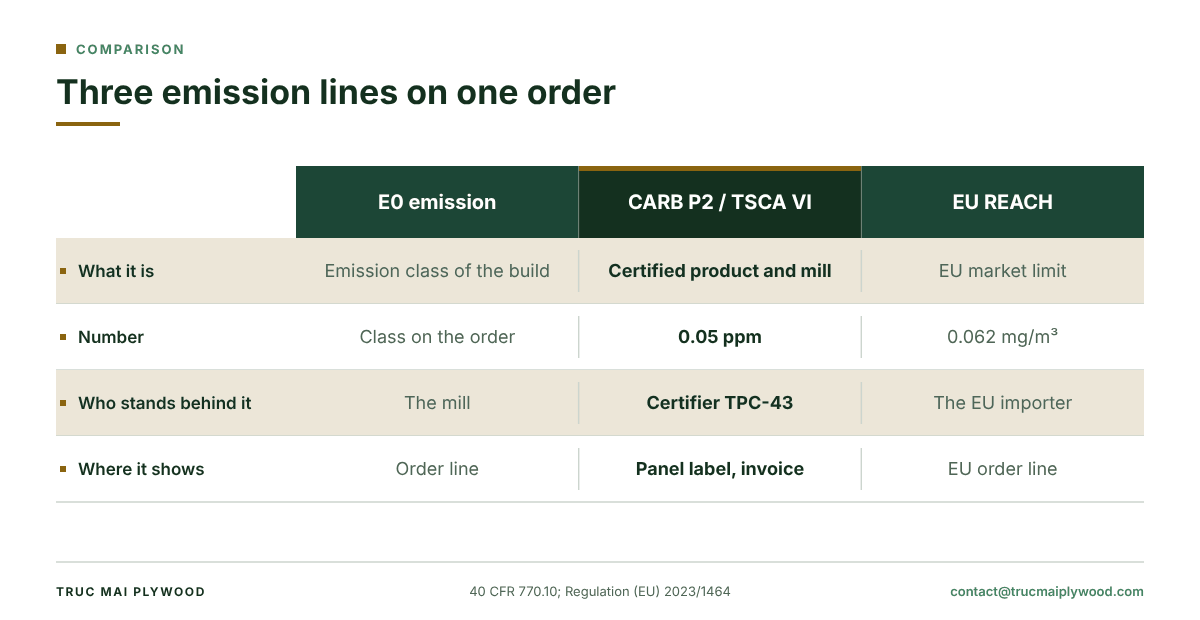
The practical rule is to keep the lines apart. A US order from Truc Mai reads “UF glue at E0 emission” as the build and “CARB P2 and TSCA Title VI certified, certificate CARB/EPA 26053” as the compliance line. Neither replaces the other.
Which glue does a CARB P2 certified Vietnamese plywood order use by default?
A CARB P2 order from Truc Mai uses UF glue at E0 emission by default, which gives about 6 hours of boil resistance for interior furniture and cabinet panels. Glue type and emission class are two separate spec lines: the order says “UF glue at E0 emission”, never “E0 glue”.
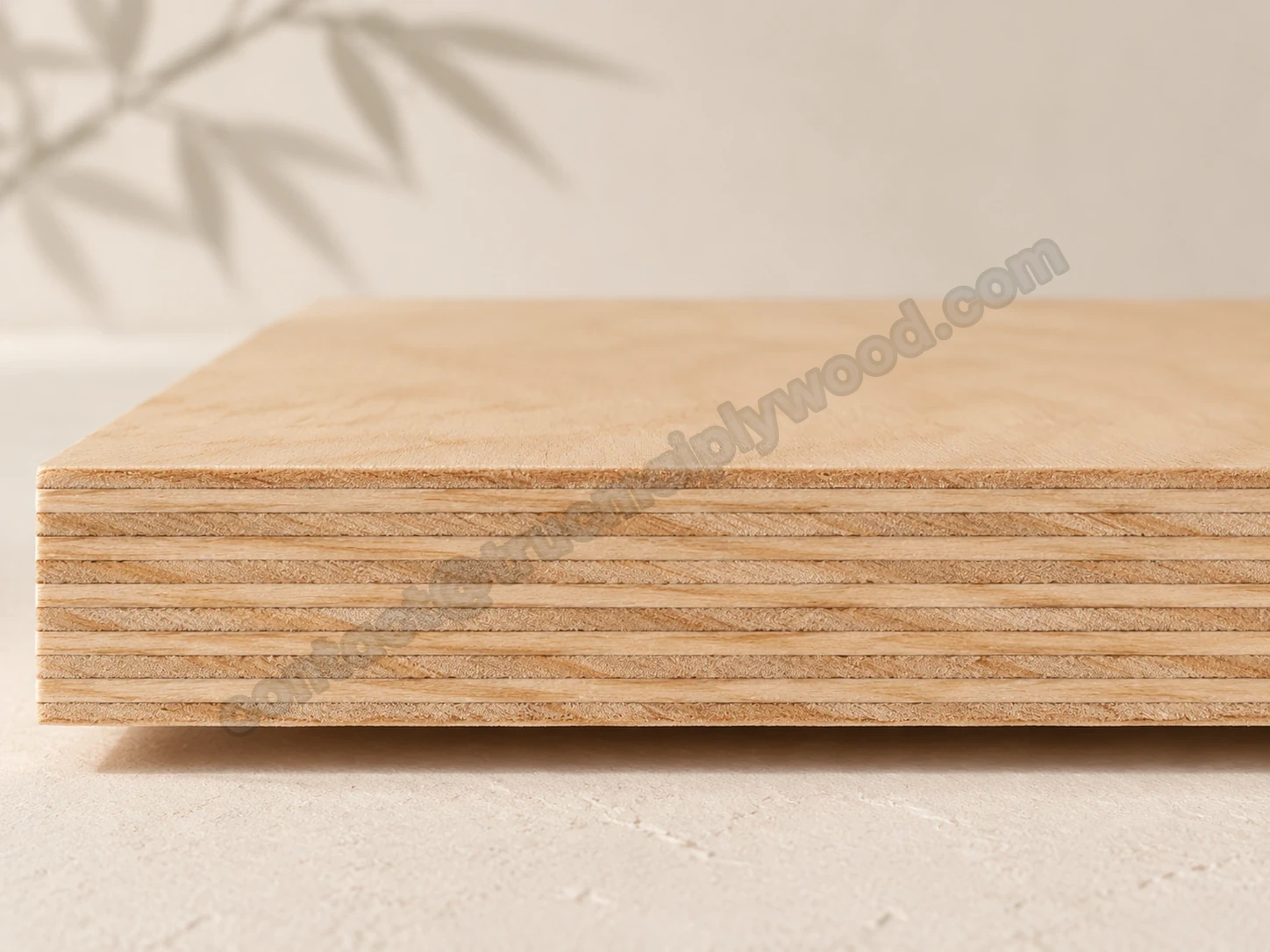
UF, or urea-formaldehyde, is the standard adhesive for interior hardwood plywood. It cures pale, which keeps the glue lines light on a sanded edge, and it is pressed hot at about 110–120 °C. The emission level of the finished panel depends on the resin formulation, the press schedule and the conditioning of the sheets after pressing, which is why the mill writes the emission class as its own line.
When a buyer needs more moisture resistance, for example a panel that must pass a 12-hour boil for outdoor use, the glue moves to a melamine-fortified UF. The emission class is then usually E1, again on its own line, and the buyer checks with the certificate scope before calling that build CARB P2 certified. The emission class per order page shows how the two lines are written.
The face does not change the glue line. A bintangor, okoume or birch face is pressed with the same adhesive system as the core, so the Phase 2 claim follows the panel build, not the face species.
How did CARB Phase 2 become the federal TSCA Title VI rule?
TSCA Title VI took the CARB Phase 2 numbers and applied them across the United States. The federal emission standards apply to composite wood products made or imported in the United States on or after 1 June 2018, and after 22 March 2019 panels have to be labelled as TSCA Title VI compliant.
The applicability date is written into 40 CFR 770.10, which applies the standards to products “on or after June 1, 2018”. The EPA page on the formaldehyde emission standards explains that until March 22, 2019 products could be labelled as either CARB ATCM Phase II or TSCA Title VI compliant.
For an importer, the federal rule added three things to the CARB system. It applies in every state, not only California. It adds import certification: the importer certifies that the composite wood products are compliant. And it requires an EPA-recognised third-party certifier, which is why a CARB-approved certifier also appears on the EPA list.
In practice a mill like Truc Mai holds one certificate that names both: CARB Phase 2 and TSCA Title VI, under CCR sections 93120–93120.12 and 40 CFR part 770, with one certificate number, CARB/EPA 26053.
Who certifies a mill for Phase 2, and what does the certificate cover?
An approved third-party certifier certifies the mill. It checks the mill’s quality control, takes panels for testing and issues a certificate that names the product type, the thickness range and the ply count. Truc Mai’s certifier is ICTT Corporation, TPC-43, for hardwood plywood with veneer core, 3–25 mm, 3–15 plies.
| Certificate line | Truc Mai entry |
|---|---|
| Certificate number | CARB/EPA 26053 |
| Mill number | ICTT-26053 |
| Third-party certifier | ICTT Corporation, TPC-43 |
| Product type | HWPW-VC, hardwood plywood with veneer core |
| Thickness range | 3–25 mm |
| Ply range | 3–15 plies |
| Rules | 17 CCR 93120–93120.12 and 40 CFR part 770 |
The scope rows are the part to read. The certificate covers veneer-core hardwood plywood; it does not turn any product the mill makes into a certified product. A buyer who sees “CARB P2 certified” on a quote should be able to match the panel in the quote against each row of this table.
The certifier’s number can be checked against the EPA list of recognised third-party certifiers, and the certificate itself is sent before the order is confirmed. The CARB P2 files page shows what arrives with each container.
Which Truc Mai panels sit inside the 3–25 mm scope?
Every listed thickness from 3 mm to 25 mm sits inside the scope: 3, 4, 5, 6, 9, 12, 15, 18, 21 and 25 mm veneer-core panels. The 30 mm and 40 mm panels are outside the 3–25 mm range, so they are never sold or labelled as CARB P2 or TSCA Title VI certified.
| Thickness | Inside the CARB/EPA 26053 scope? | Note |
|---|---|---|
| 3, 4, 5 mm | Yes | Always 5 plies |
| 6 mm | Yes | Plies per order |
| 9, 12, 15 mm | Yes | Veneer core |
| 18 mm | Yes | Usually 11–13 plies, most often 11 |
| 21, 25 mm | Yes | Veneer core |
| 30, 40 mm | No | Outside the 3–25 mm range |
The ply range matters too. The certificate covers 3–15 plies, which includes the thin panels at 5 plies and the 18 mm panels at 11–13 plies. A US buyer who needs a thick panel for a table top or a bench should plan it as two laminated sheets of certified thickness, or treat the 30 or 40 mm panel as uncertified and check what the end use allows.
This is one of the places where an honest scope line on the quote saves a container. A thick panel shipped with a CARB P2 label it is not entitled to is a customs and retailer problem, not a paperwork detail.
What must the Phase 2 panel label say?
The federal label on a panel or bundle names the panel producer, the lot number, the number of the TSCA Title VI third-party certifier and a statement that the product is TSCA Title VI certified. Finished goods made from the panels carry the fabricator’s own label with the production month and year.
40 CFR 770.45 requires panels or bundles of panels to be labelled with “the panel producer’s name, the lot number, the number of the EPA TSCA Title VI TPC” and a statement that the products are TSCA Title VI certified. A panel producer number may be used instead of a name, as long as the producer can be identified on EPA’s request.
For a Truc Mai container, that means the label carries the mill number and the certifier number, so a buyer or inspector can trace a bundle to the certificate. Where panels are not labelled one by one, a bundle label and a method that links the panels to it is allowed by the same section.
Downstream, the fabricator’s label is the buyer’s job. A cabinet maker who turns certified panels into kitchen units labels the finished goods, or the boxes they ship in, with its name, the month and year of production and a TSCA Title VI compliant statement.
Does a laminated or overlaid panel need its own Phase 2 check?
Only a wood veneer overlay does. A wood veneer pressed onto a certified platform makes a “laminated product” under the federal rule, with its own producer duties unless an exemption applies. A melamine, HPL or paper overlay is not a wood veneer, so the certified plywood platform under it carries the Phase 2 claim.
The federal definition in 40 CFR 770.3 describes a laminated product as “a product in which a wood or woody grass veneer is affixed” to a particleboard, medium-density fiberboard or veneer core or platform. 40 CFR 770.4 exempts laminated products made with a phenol-formaldehyde resin, or with a resin with no added formaldehyde, on a compliant platform.
For a buyer of laminate-faced plywood from Truc Mai, the order reads the platform first: veneer-core plywood, thickness inside 3–25 mm, UF glue at E0 emission, certified under CARB/EPA 26053. The overlay is then a face line. A buyer who adds a decorative wood veneer in its own factory should check the laminated product rules with its own certifier.
Can an ASTM ppm result be converted to the EU 0.062 mg/m³ limit?
No. An ASTM E1333 result in ppm and the EU chamber result in mg/m³ come from different test conditions, and the two cannot be converted by a fixed factor. A US order carries the Phase 2 line; an EU order carries its own line against 0.062 mg/m³, tested under the EU method.
The EU limit is set by Regulation (EU) 2023/1464, which adds formaldehyde to REACH Annex XVII as entry 77. From 6 August 2026, furniture and wood-based articles may not be placed on the EU market if they release more than 0.062 mg/m³ under the test conditions of its Appendix 14.
The Appendix 14 conditions are fixed: 23 °C, 45% relative humidity and a loading of 1 m²/m³ in the chamber. ASTM E1333 runs its own conditions. Multiplying a ppm figure by a molar conversion produces a number with the right units and the wrong meaning, because the chamber, the loading and the conditioning differ.
So an order for both markets has two emission lines, each with its own method. Truc Mai writes them separately and never converts one into the other. The EU 0.062 mg/m³ limit page covers the EU side in full.
Which documents come with a CARB P2 plywood order shipped to the US?
A CARB P2 order to the US travels with the CARB P2 and TSCA Title VI certificate, emission test reports for the agreed configuration, labelled panels or bundles, and the shipping set: commercial invoice, packing list, B/L, certificate of origin, phytosanitary and fumigation papers, and insurance under CIF.
- Certificate. CARB/EPA 26053, mill ICTT-26053, certifier TPC-43, sent before the order is confirmed.
- Test reports. The emission test reports for the agreed configuration, as part of the order’s certificate documents.
- Labels. Panel or bundle labels with the producer or mill number, lot number, certifier number and the TSCA Title VI statement.
- Invoice wording. The compliance line copied from the order onto the commercial invoice, so the broker sees it.
- Shipping papers. Commercial invoice, packing list, B/L, certificate of origin, phytosanitary and fumigation papers, and insurance under CIF.
- Import certification. The importer’s own TSCA Title VI import certification, which the importer or its broker makes.
Draft shipping documents go to the buyer for approval after loading, before the originals are released. The US import steps set the formaldehyde certification next to the Lacey Act declaration and the duty lines on hardwood and decorative plywood from Vietnam.
How should the Phase 2 line read on a US purchase order?
Write the build and the compliance as separate lines: core and thickness, glue, emission class, then “CARB P2 and TSCA Title VI certified” with the certificate number and the label request. Copy the same lines onto every repeat order so that the panel, the label and the file stay identical.
18 mm plywood, furniture interior. Styrax core, A-grade, stitched, 11 plies. UF glue at E0 emission. CARB P2 and TSCA Title VI certified, certificate CARB/EPA 26053, HWPW-VC, bundle labels with lot number and TPC-43. Birch face / poplar back. 1220 × 2440 mm, ±0.3 mm sanded and calibrated. Emission test reports with the certificate documents. 1×40HC, FOB Hai Phong.
Three checks before the deposit keep the line honest. Is every thickness on the order inside 3–25 mm? Is the product a veneer-core panel? Does the order ask for labels on panels or bundles? If all three answers are yes, the Phase 2 line is a fact, not a hope.
Send the line to the quotation desk or to contact@trucmaiplywood.com. The furniture and interior plywood range lists the faces and cores that fit inside the certificate.
Questions buyers ask
What is the CARB Phase 2 limit for hardwood plywood?
0.05 ppm of formaldehyde for hardwood plywood with a veneer core or a composite core, measured by ASTM E1333. The same number is the federal TSCA Title VI limit in 40 CFR 770.10.
What are the Phase 2 limits for particleboard and MDF?
Particleboard 0.09 ppm, MDF 0.11 ppm and thin MDF 0.13 ppm. Hardwood plywood has the lowest limit of the four products at 0.05 ppm.
Is E0 emission the same thing as CARB P2?
No. E0 is an emission class written on the order; CARB P2 is a certification of the mill's products under a test method and an approved third-party certifier, with a label on the panel.
Which Truc Mai panels are CARB P2 and TSCA Title VI certified?
Hardwood plywood with veneer core from 3–25 mm and 3–15 plies, under certificate CARB/EPA 26053, mill ICTT-26053, certifier TPC-43. Panels of 30 and 40 mm are outside that scope.
Who certified Truc Mai for CARB Phase 2?
ICTT Corporation, an approved third-party certifier listed as TPC-43, certified Truc Mai in its own name.
Does a melamine-faced panel need its own CARB certificate?
The plywood platform under the overlay is the certified composite wood product. The finished good made from it carries the fabricator's own TSCA Title VI label.
Can a ppm result be compared with the EU 0.062 mg/m³ limit?
No. The ASTM ppm result and the EU chamber result in mg/m³ come from different methods, and a ppm figure is never converted into mg/m³.
What glue does a CARB P2 plywood order from Truc Mai use?
The default is UF glue at E0 emission. A 12-hour boil for outdoor use needs melamine-fortified glue, and the emission class is then usually E1, written as its own line.
When did the federal TSCA Title VI limits start to apply?
The emission standards in 40 CFR 770.10 apply to composite wood products made or imported in the United States on or after 1 June 2018.
Does Phase 2 apply to plywood used outdoors?
The federal definition of hardwood plywood covers panels intended for interior use. Structural plywood made to the PS 1 and PS 2 standards is outside that definition, so an exterior or structural panel is checked against its own rules.
Does Truc Mai publish a ppm figure for its panels?
No. The certificate number and scope are published; emission test reports for the agreed configuration travel with the order documents.