
The best plywood for kitchen cabinets is an 18 mm panel on a stitched A-grade core, calibrated to ±0.3 mm, with UF glue at E0 emission for dry runs and melamine-fortified glue for sink and dishwasher zones. Get the glue wrong under the sink and the carcass swells; get the core wrong and doors show it.
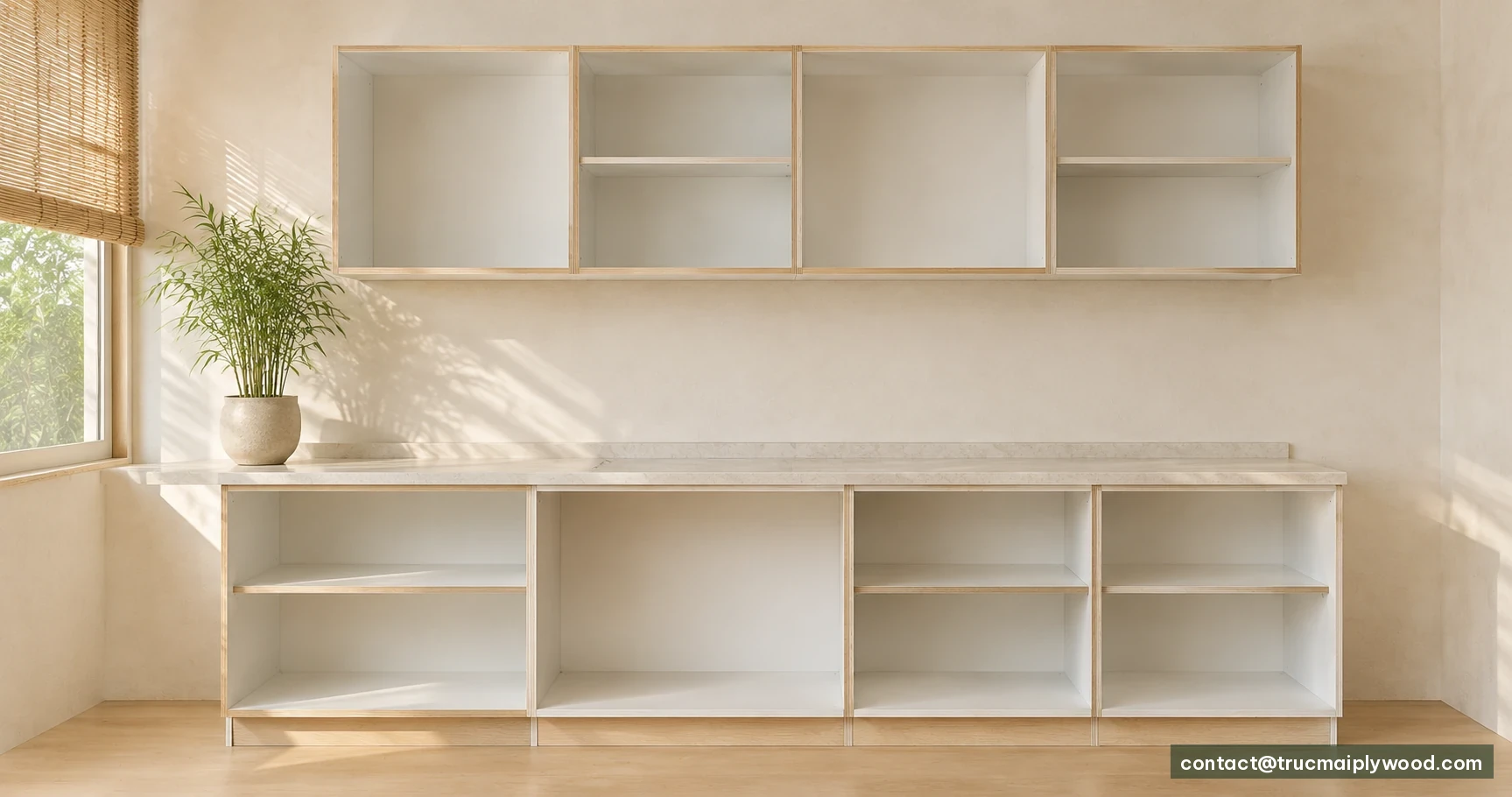
Which plywood is best for kitchen cabinets?
The best plywood for kitchen cabinets is an 18 mm hardwood panel on a stitched A-grade core, sanded and calibrated to ±0.3 mm, faced in melamine or a sanded veneer, with UF glue at E0 emission for dry cabinets and melamine-fortified glue for the sink and dishwasher zone. The core and glue matter more than the face.
A kitchen is the hardest room in a home for furniture. Carcasses carry worktops and stone, hinges are opened thousands of times, and the cabinet under the sink sees steam, leaks and wet cloths. A panel that is fine in a wardrobe can fail in a kitchen in one place only, which is usually the sink run.
So a cabinet factory makes four choices, and each has its own section below: the glue line for each zone, the thickness for each part, the core build that keeps the carcass flat and holds screws, and the face that finishes it. The last sections cover tolerance, container fill and what to write on the order.
Truc Mai presses furniture and interior plywood in Ha Hoa, Phu Tho, around 60,000 m³ a year. Its furniture line builds every panel with an A-grade, stitched core and sanded faces; see furniture and interior plywood.
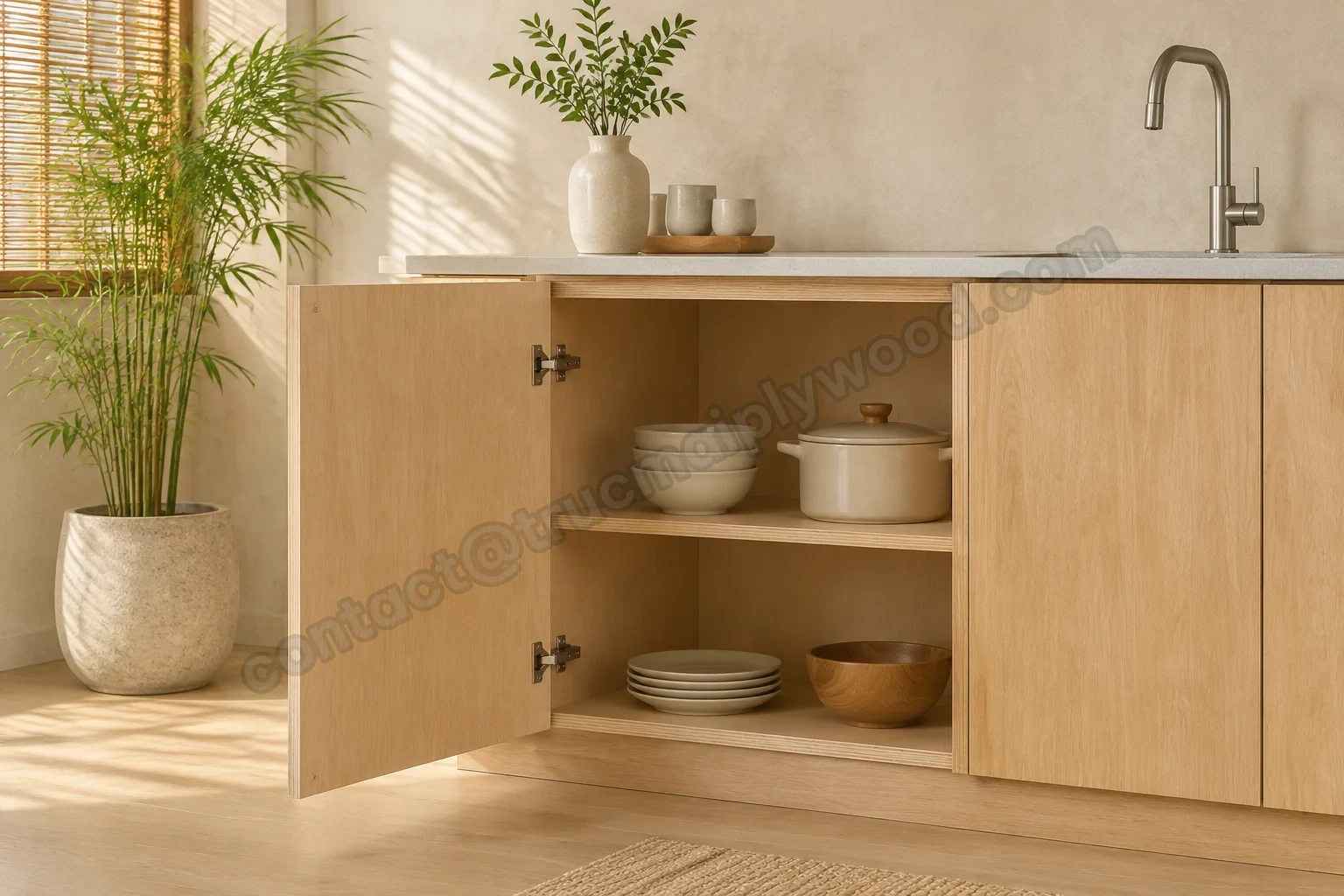
Which glue suits kitchen cabinet plywood, UF at E0 or melamine-fortified?
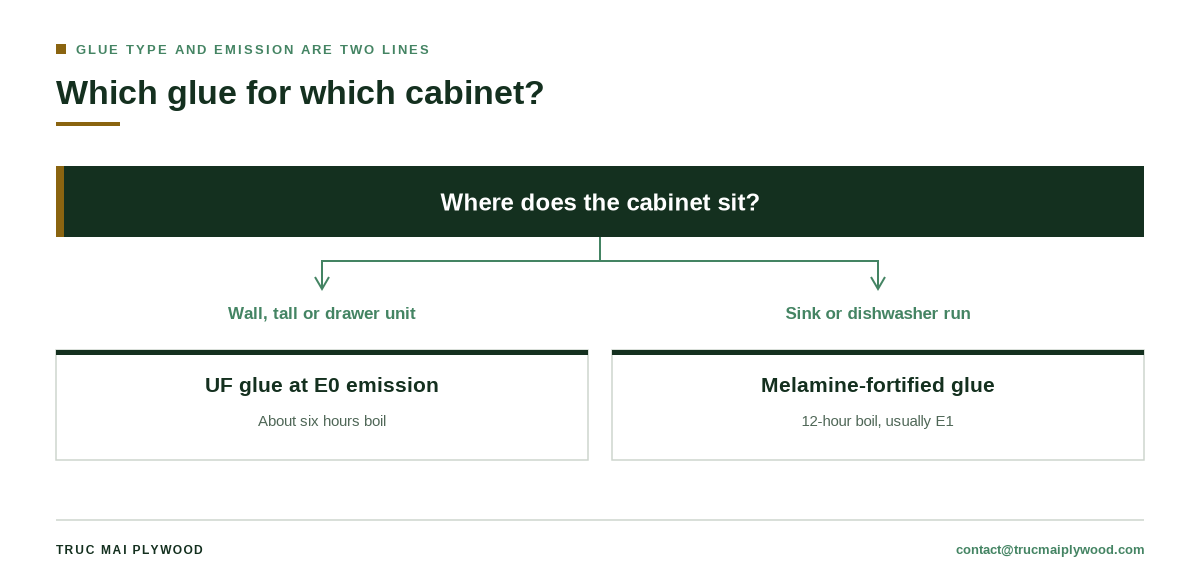
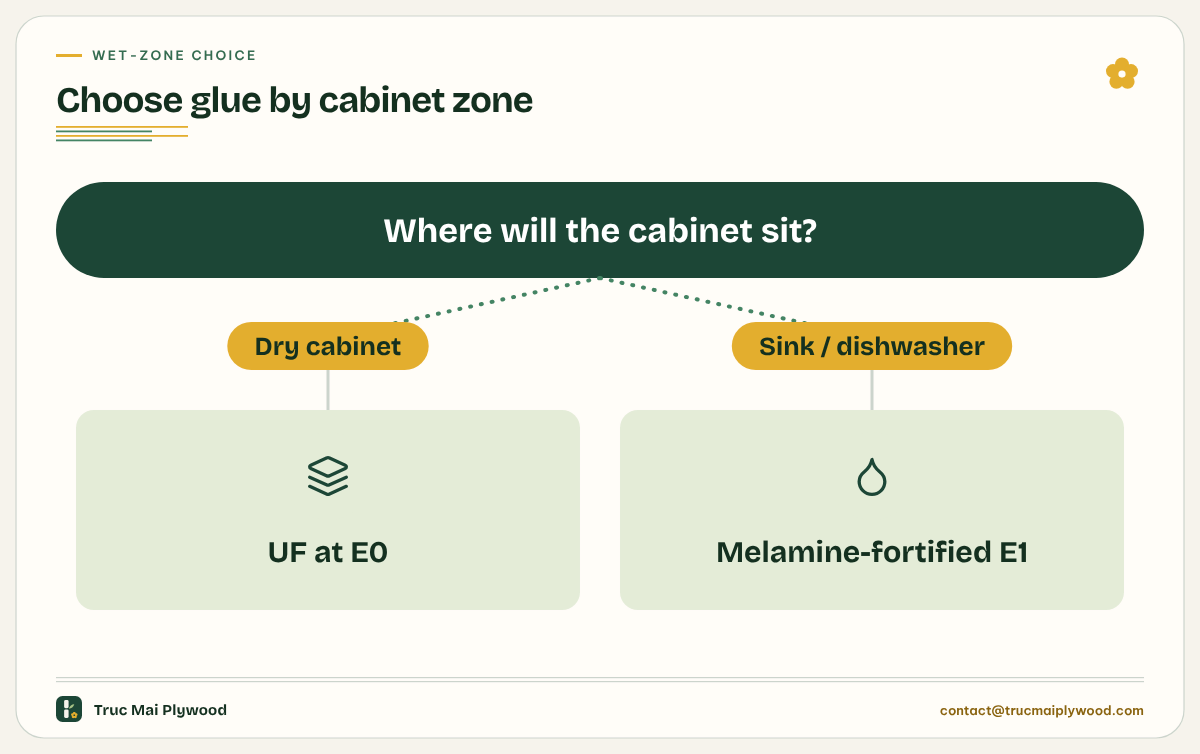
UF glue at E0 emission suits kitchen cabinets in dry runs: wall units, drawers and tall cabinets away from water. It holds about six hours in a boil test. Cabinets under the sink and beside the dishwasher suit melamine-fortified glue, which holds a 12-hour boil; emission is then usually E1, written as its own line.
| Zone | Glue | Boil resistance | Emission, usually |
|---|---|---|---|
| Wall units, tall units, drawers | UF | About six hours | E0 |
| Sink and dishwasher base units | Melamine-fortified | 12 hours | E1 |
A kitchen order can carry both. The sink-run carcasses are a separate line, often only a few packs, and ride in the same container as the dry-run panels. Writing glue type and emission class as two lines, “UF glue at E0 emission” or “melamine-fortified glue, E1”, leaves nothing to guess on the next order.
European buyers often specify bond quality against EN 314-2, which “specifies requirements for bonding classes of veneer plywood according to their end uses”, per BSI. Name the class your market expects next to the glue line. The emission class per order page shows how the class is written.
Waterproof plywood for kitchen cabinets: what glue can and cannot do
Waterproof plywood for kitchen cabinets does not exist as a glue choice alone. A stronger glue line keeps the plies together when the panel gets wet; it does not stop water entering the core through a raw edge or a drilled hole. A sink cabinet stays sound when the glue, the face and the sealed edges all do their part.
Three lines protect a sink cabinet. The glue, melamine-fortified, holds the plies through damp. The face, melamine or a sealed veneer, keeps water off the surface. And the edges, banded or sealed at the factory, close the end grain where water would otherwise wick in. Hinge and connector holes near the sink are the weak point; seal them too.
What the mill does not make matters as well. Truc Mai does not make marine plywood, and kitchen panels are interior panels. For use outdoors under cover, see exterior glue panels, which explains what changes in the build.
What thickness of plywood is best for kitchen cabinets?
18 mm is the best thickness for kitchen carcass sides, shelves and doors: it holds hinge screws and connectors and spans a shelf without sagging. Backs and drawer bottoms take thin panels of 3–6 mm, drawer sides 12 or 15 mm, and heavy shelving or tall-unit sides 21 or 25 mm.
| Cabinet part | Thickness | Why |
|---|---|---|
| Carcass sides, bottoms, tops | 18 mm | Holds hinges and connectors |
| Shelves | 18 mm; 21 or 25 mm for long spans | Resists sag |
| Doors | 18 mm | Stiff, takes hinge cups |
| Drawer sides | 12 or 15 mm | Lighter drawer |
| Backs, drawer bottoms | 3–6 mm | Thin panels, 5 plies from 3 to 5 mm |
Truc Mai presses 3 to 40 mm, listed as 3, 4, 5, 6, 9, 12, 15, 18, 21, 25, 30 and 40 mm. A kitchen order usually draws on four of those thicknesses, and they can share one container.
18mm cabinet plywood: the reference panel
The 18 mm panel is the one a cabinet line is built around: the CNC, the edge-bander and the hinge drill are set to it. That is why its tolerance matters most, and why the 18 mm hardwood plywood page is the one to read with this guide.
How many plies does an 18 mm cabinet panel usually have?
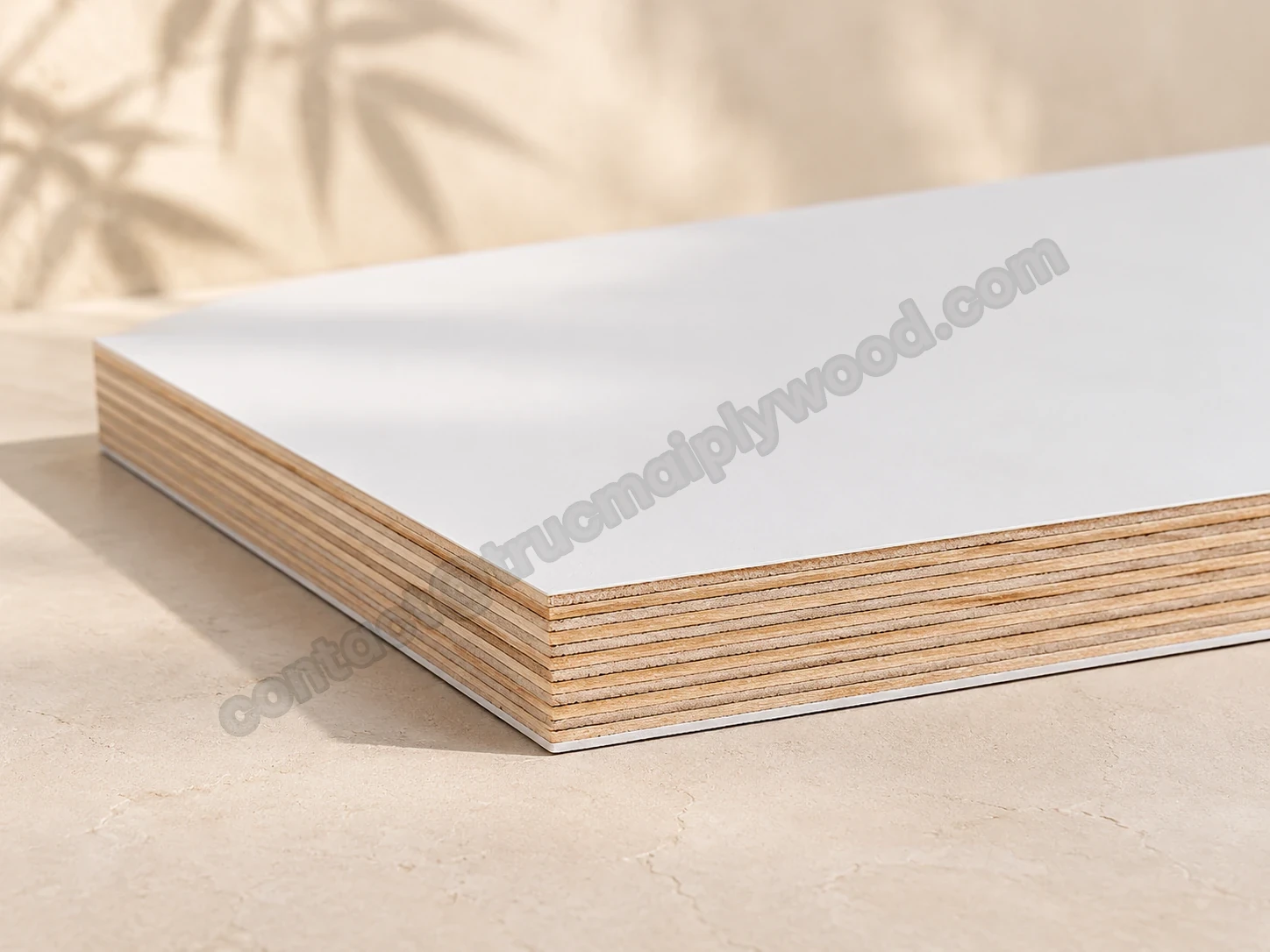
An 18 mm cabinet panel at Truc Mai usually has 11–13 plies, most often 11. Core veneer is usually 1.4–2.0 mm thick and face veneer 0.2–0.5 mm, so the ply count follows the veneer the build uses. More plies of thinner veneer give a more even edge; the count is written on the order where it matters.
Ply count is a proxy, not a goal. What a cabinet maker needs is a core with no voids and no overlaps, layers that alternate grain direction evenly, and a balanced build so the sheet stays flat. An 11-ply panel with a stitched A-grade core outperforms a 13-ply panel with a loose-laid core on every one of those.
Count the plies on a sample edge, and keep the sample. A reorder that arrives with a different count or a different edge colour is the first sign that the build changed.
Does a stitched core matter for cabinet carcasses?
Yes. A stitched core keeps the core veneers butted tight, with no gaps or overlaps, so the carcass stays flat, the edge shows no voids after cutting, and screws and connectors bite into solid wood. Stitching runs across and along the sheet; usually the outer 2–4 plies are stitched, and all plies on request.
A loose-laid core, where veneer pieces are laid next to each other without joining, is cheaper and fine for hidden or packing work. In a cabinet it shows in three ways: a void where a hinge screw goes, a gap in the edge after the CNC cuts a part, and a slight ripple under a melamine or lacquered face.
| Core build | Cabinet result | Where it belongs |
|---|---|---|
| A grade, stitched | Flat carcass, solid edges, firm screw hold | Carcasses, doors, shelves |
| AB, loose-laid or jointed | Lower cost; voids possible | Hidden backing, commercial work |
Truc Mai’s furniture line uses the stitched A-grade core by default; commercial panels use the AB core. Name the build on the order rather than a grade letter alone, as set out in plywood grades for cabinets.
What thickness tolerance can a cabinet factory write on its order?
A cabinet factory can write ±0.3 mm on sanded and calibrated panels. Commercial grade carries ±0.5 mm. Length and width are held to ±2 mm. Truc Mai writes the tolerance per order and does not claim a tighter thickness tolerance than ±0.3 mm.
Why it matters: a hinge cup drilled to a depth on an 18 mm door goes through, or sits proud, on a door that is far off thickness; an edge band set to 18 mm leaves an overhang on a thin sheet and a step on a thick one. A tolerance that is written and checked costs little and saves rework on every cabinet.
The tolerance repeats because the system behind it is certified: ISO 9001:2015 quality management for plywood manufacturing, certificate W2012, issued by WCERT. The figure is on the order, checked on the line and kept on reorders.
Melamine faced plywood for kitchen cabinets
Melamine faced plywood suits kitchen cabinet carcasses and interiors: it arrives finished on both faces, wipes clean, and needs only cutting and edge banding. White is the most ordered decor for carcasses; woodgrain and colour decors suit doors. The core and glue under the melamine decide how the cabinet handles damp.
The melamine paper takes the shape of what is under it. A flat, sanded, stitched core gives a flat decor; a loose core shows through as a shadow under a raking kitchen light. That is why melamine carcass board is built on the furniture-line platform, not the commercial one.
| Face | Best cabinet part | Finishing at the factory |
|---|---|---|
| White melamine | Carcasses, shelves, interiors | Edge band only |
| Woodgrain or colour melamine | Doors, visible ends | Edge band only |
| HPL | Worktop substrates, high-wear doors | Edge band only |
| Sanded veneer | Painted or lacquered doors | Full finishing line |
The white melamine-faced plywood and melamine-faced panels pages list the builds; laminated plywood price explains what one or two laminated sides cost.
Laminated plywood for kitchen cabinets: one side or two
Carcass sides are seen inside and often outside, so they take two laminated faces. A back panel or drawer bottom can be laminated on one face only. Two faces also balance the sheet, which keeps long sides flat in a heated kitchen.
Which face suits painted or veneered kitchen doors?
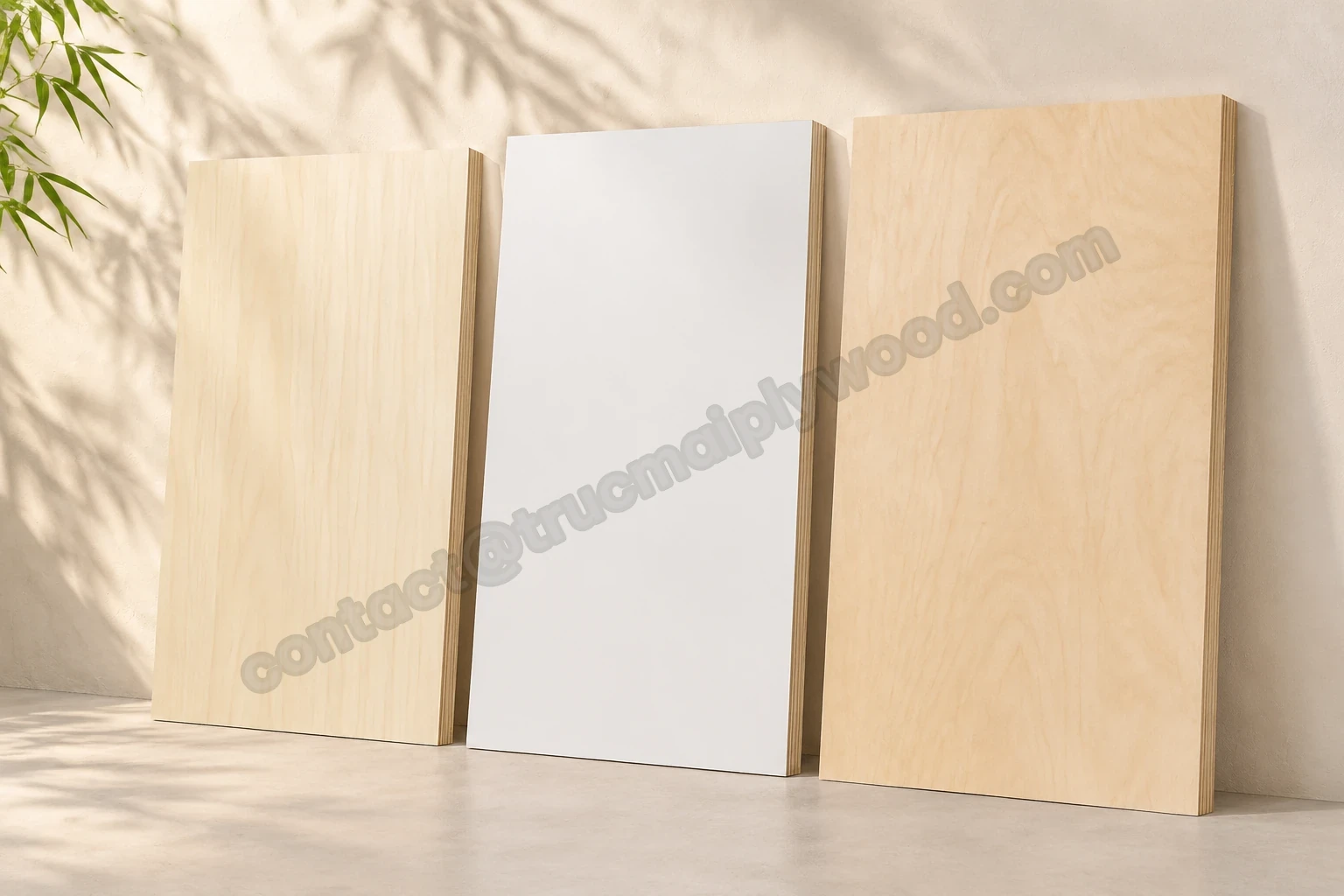
Painted kitchen doors suit a smooth, even face such as poplar or white poplar EV, sanded so paint lies flat. Clear-finished doors suit birch-faced, okoume or EV faces graded against a sample. UV-ready panels arrive with both faces prepared for the buyer’s own UV coating; the mill does not apply UV.
The EV face is engineered veneer: plantation poplar (Populus deltoides) reconstituted into sheets of 2500 × 1300 mm, 0.3 or 0.4 mm thick, so door after door matches. Because every leaf comes from a pressed block, the grain repeats, which suits a run of matching cabinet doors; see the engineered veneer sheet.
Poplar kitchen cabinets: what the name means
“Poplar kitchen cabinets” from a Vietnamese mill means a poplar face on a hardwood core; Vietnamese plywood has no poplar or birch cores. Natural and bleached poplar faces are both available, the bleached face for near-white doors. The poplar-faced plywood page covers the face.
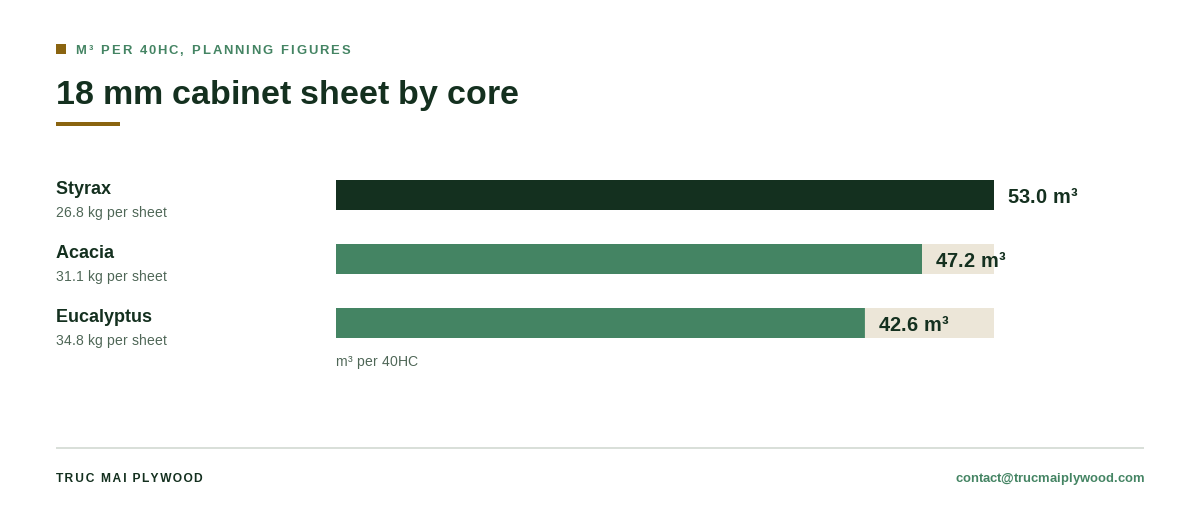
Which core gives a lighter cabinet sheet and more m³ per container?
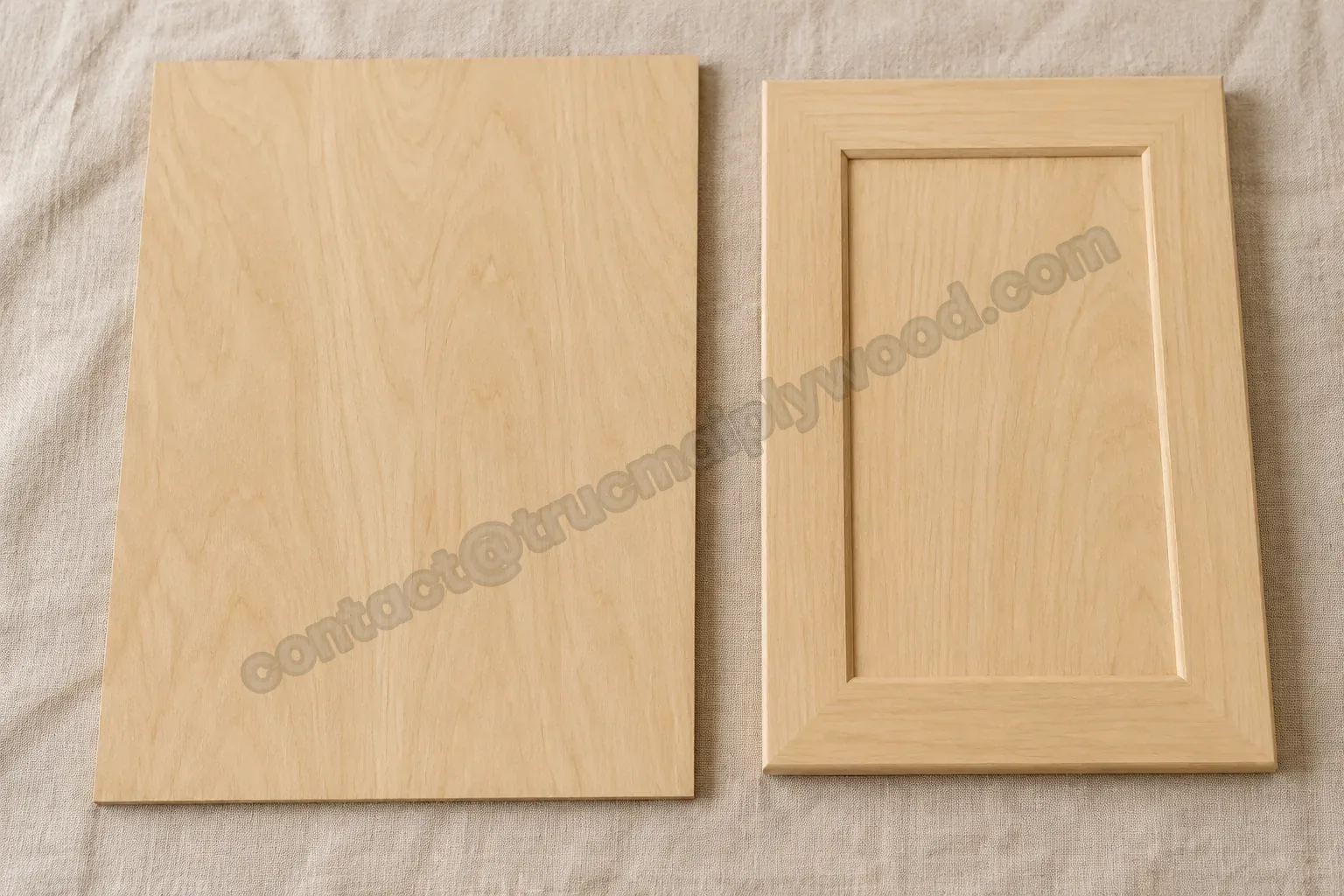
Styrax gives the lighter cabinet sheet and the most m³ per container: an 18 mm Styrax sheet of 1220 × 2440 mm is about 26.8 kg, and a 40HC holds about 53.0 m³ as a planning figure. Acacia gives 31.1 kg and 47.2 m³; Eucalyptus 34.8 kg and 42.6 m³. A furniture buyer moving from Acacia to Styrax usually gets a better face too.
| Core, 18 mm | kg per sheet | Sheets per 40HC | m³ per 40HC |
|---|---|---|---|
| Styrax | 26.8 kg | 990 sheets (18 × 55 sheets) | 53.0 m³ |
| Acacia | 31.1 kg | 880 sheets (16 × 55 sheets) | 47.2 m³ |
| Eucalyptus | 34.8 kg | 795 sheets (15 × 53 sheets) | 42.6 m³ |
Planning figures from the 40HC planning model, packs about 1,000 mm high and a 28,000 kg planning payload; not packing-list records. Other thicknesses: container load calculator.
Eucalyptus still has a place in a kitchen: it is the hardest core and holds screws best. A combined core, harder veneers on the outside and lighter ones inside, gives some of both.
Plywood vs MDF for kitchen cabinets
Plywood is the choice for kitchen carcasses where screw holding, weight and damp resistance count; MDF is chosen for painted door fronts that need a perfectly smooth, profiled surface. Many kitchens use both: plywood boxes, MDF or plywood doors. Truc Mai makes plywood, so this guide covers the plywood side.
| Need | Plywood carcass | Note |
|---|---|---|
| Hinge and connector screws | Cross-laid veneer holds screws in both directions | Stitched core gives solid edges |
| Weight | Styrax core is the light option | 26.8 kg per 18 mm sheet, planning figure |
| Damp under the sink | Melamine-fortified glue line | Seal edges and holes |
| Smooth paint finish | Sanded EV or poplar face | UV-ready on request |
Which certificates come with kitchen cabinet plywood?
Cabinet boxes are closed spaces, so the glue line is the first compliance question. Every cabinet thickness from 3 to 25 mm sits inside certificate CARB/EPA 26053 for the US; the EU class goes on each order with the EUDR file set; and an FSC 100% claim is possible for scheduled products.
United States. Cabinet makers selling in the US work to 40 CFR 770.10, where veneer-core hardwood plywood has an emission standard of 0.05 ppm formaldehyde. The certificate is issued by ICTT Corporation, mill ICTT-26053, for 3–15 plies; 30 and 40 mm panels are outside the scope.
European Union. A fitted kitchen is furniture, and Regulation (EU) 2023/1464 caps furniture at 0.062 mg/m³ formaldehyde in the chamber test from 6 August 2026, so the class on the order matters.
FSC and origin. The licence code is FSC-C196493, certificate SA-COC-014545, for FSC 100% only.
A kitchen brand that wants the tree label on its cabinets is buying the claim the FSC label page spells out: “All materials used come from responsibly managed, FSC-certified forests”. EU lots carry EUDR data with plot geolocation for both the Vietnamese core and the face veneer.
How to order kitchen cabinet plywood by the container
Order kitchen cabinet plywood as one 40HC with one line per part: carcass board, sink-run board, door panels and thin backs. A container usually carries one or two products, and three to six can be mixed by agreement. Production takes 15–45 days after a 30% deposit; the 70% balance is paid against the scanned bill of lading.
| Line | Carcass board | Sink-run board |
|---|---|---|
| Size | 1220 × 2440 mm, 18 mm, ±0.3 mm | 1220 × 2440 mm, 18 mm, ±0.3 mm |
| Core | Styrax, A grade, stitched | Styrax or combined, A grade, stitched |
| Glue and emission | UF glue at E0 emission | Melamine-fortified glue, E1 |
| Face / back | White melamine both sides | White melamine both sides |
| Certificates | CARB P2 for US lots; EUDR file set for EU lots | Same |
| Quantity | Most of the 40HC | A few packs in the same 40HC |
Delivery terms are FOB Hai Phong, CFR (CNF) or CIF; the balance is paid by T/T or irrevocable L/C at sight. Sheet sizes are 1220 × 2440 mm, 1220 × 2280 mm and 1250 × 2500 mm, and cut-to-size orders split one sheet into 2, 3, 4 or 6 panels.
Ask for a sample of each build with the quote; new buyers receive free samples and book their own courier, credited against a real order. Send the lines to the quotation desk or to contact@trucmaiplywood.com.
Questions buyers ask
Is plywood good for kitchen cabinets?
Yes. A stitched-core plywood carcass holds screws and hinges well, stays flat across long spans and, with the right glue, tolerates the damp around a sink.
Which glue is best for kitchen cabinet plywood?
UF glue at E0 emission for dry runs, which holds about six hours in a boil test. Sink and dishwasher cabinets take melamine-fortified glue, which holds 12 hours; emission is then usually E1.
What thickness of plywood is best for kitchen cabinets?
18 mm for carcass sides, shelves and doors; 3–6 mm thin panels for backs and drawer bottoms; 12 or 15 mm for drawer sides.
How many plies does 18 mm cabinet plywood have?
Usually 11–13 plies, most often 11, on Truc Mai's 18 mm panels.
What tolerance should a cabinet factory write on its plywood order?
±0.3 mm on sanded and calibrated panels, written per order. Truc Mai does not write a tighter figure.
Is melamine-faced plywood good for kitchen cabinets?
Yes, for carcasses and interiors: it arrives finished on both faces and cleans easily. The edges still need banding, and the core and glue under the melamine decide how it handles damp.
Which core gives the lightest cabinet sheet?
Styrax, at 500 kg/m³ in the planning model. An 18 mm Styrax sheet of 1220 × 2440 mm is about 26.8 kg, against 31.1 kg on Acacia and 34.8 kg on Eucalyptus.
Is waterproof plywood needed for kitchen cabinets?
No panel glue makes a cabinet waterproof. Melamine-fortified glue resists damp better than UF, and sealed edges and faces keep water out of the core.
Are Truc Mai cabinet panels CARB P2 certified?
Yes, within scope: certificate CARB/EPA 26053 covers hardwood plywood with a veneer core from 3 to 25 mm.
What is the minimum order for kitchen cabinet plywood?
One 40HC. Carcass board, door panels and thin backs can share it, three to six products by agreement.
Can cabinet panels be cut to size at the mill?
Yes. Cut-to-size orders split one sheet into 2, 3, 4 or 6 panels before packing.