
A laminated plywood price is set by five things: the core under the laminate, one or two laminated sides, melamine paper or HPL, the thickness, and how many m³ fill one 40HC. Compare quotes on those lines, not on the name, or a cheaper sheet arrives with a heavier core and fewer m³ per box.
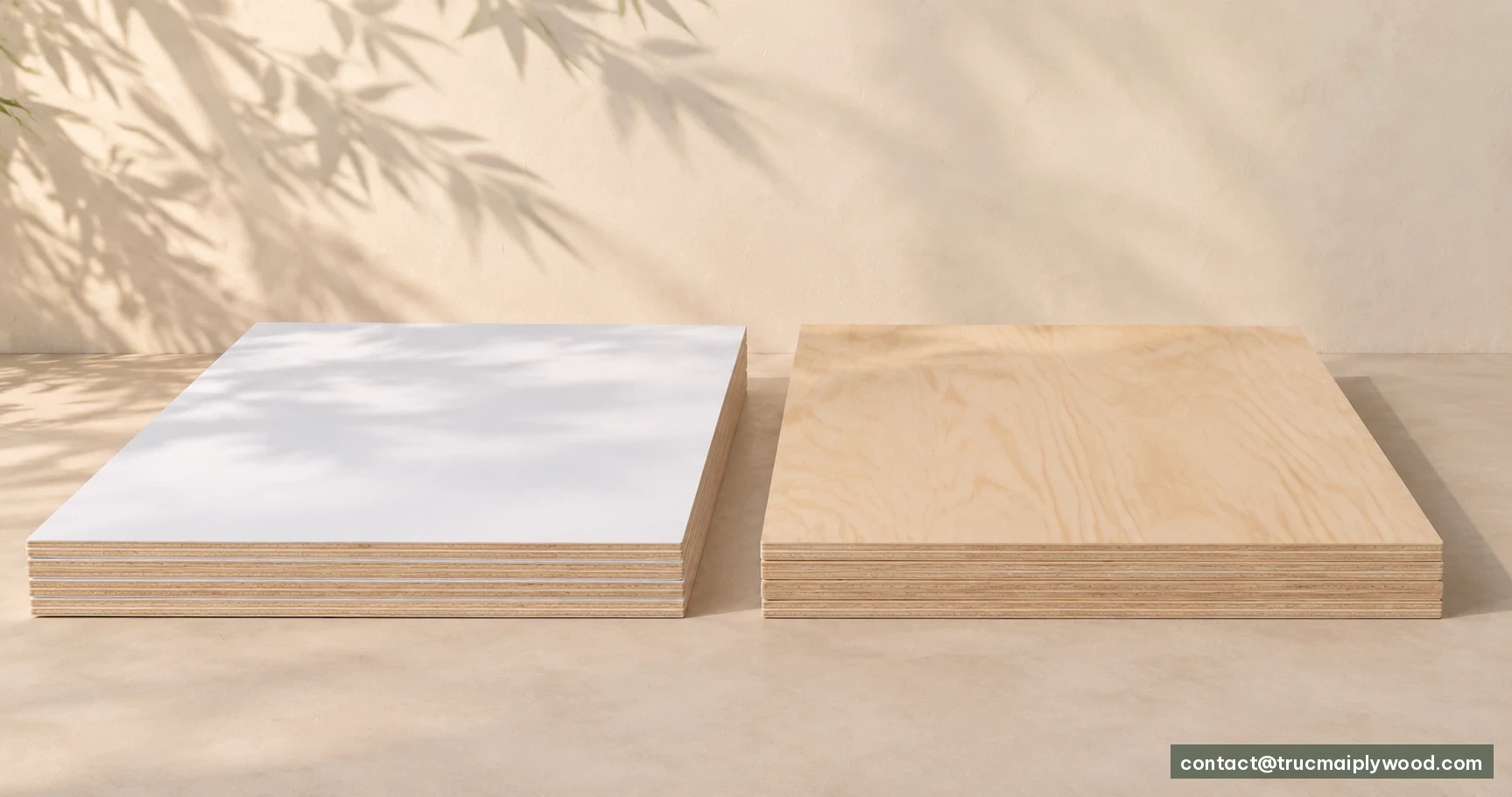
What decides the FOB Hai Phong cost of laminated plywood per m³?
The FOB Hai Phong cost of laminated plywood per m³ is decided by the plywood core under the laminate, the number of laminated sides, the laminate type (melamine paper or HPL), the thickness and the m³ that fit in one 40HC. Core and container fill matter as much as the decor: they set weight and freight per m³.
A laminated sheet is two purchases in one. The first is a plywood platform: a core species, a core grade, a glue line and a thickness tolerance. The second is a surface: a decor paper pressed onto the face, or a high-pressure laminate (HPL) bonded to it. Most quotes name the second and say little about the first, which is why two offers for “18 mm melamine plywood” can sit far apart and both be honest.
The five lines below are the ones that move the price. Each section of this guide takes one of them.
| Cost line | What it changes | Where to write it on the RFQ |
|---|---|---|
| Core species | Sheet weight, m³ per 40HC, screw holding | Core: Styrax, Acacia, Eucalyptus or combined |
| Laminated sides | Laminate cost, balance of the sheet | Face / back: laminate one side or both |
| Laminate type | Material cost, wear resistance | Melamine paper or HPL, decor code |
| Thickness | Plies, veneer, sheets per pack | Thickness and tolerance, e.g. 18 mm ±0.3 mm |
| Container plan | Freight and paperwork per m³ | 1 × 40HC, one spec or a mix |
Truc Mai presses laminate-faced panels on the same lines as its veneer plywood, around 60,000 m³ a year, and quotes FOB Hai Phong, CFR (CNF) or CIF. There is no published price list: every figure starts from the specification, and the laminate-faced plywood range shows what can be ordered.
Laminated plywood price per sheet against per m³
A laminated plywood price per sheet and a price per m³ describe the same panel in two units. Mills quote per m³ because the core, glue and pressing cost scale with volume; retailers sell per sheet because a fitter buys sheets. Convert one to the other before comparing two offers, or the cheaper-looking number may be the dearer panel.
One 1220 × 2440 × 18 mm sheet holds about 0.0536 m³ of plywood, so one m³ is about 18.7 such sheets. A per-sheet price multiplied by 18.7 gives the per-m³ figure for that size and thickness; a per-m³ price divided by 18.7 gives a raw FOB value per sheet, before freight, duty and local costs.
The conversion changes with thickness, which is the first trap in a mixed RFQ. A thin 9 mm sheet holds half the volume of an 18 mm sheet, but it does not cost half as much to laminate: the decor paper covers the same area whichever the thickness. Per m³, the laminate weighs more heavily on a thin panel than on a thick one.
That is why a buyer who orders by the sheet should still ask for the m³ figure, and a buyer who budgets by the m³ should ask for the sheet count. The plywood pricing guide explains the same conversion for veneer-faced panels.
Does a one-side laminate cost less than a two-side laminate?
Yes, a one-side laminate costs less than a two-side laminate in material, because it uses one decor sheet instead of two. The saving is smaller than it looks: the back still needs a defined face, and a panel that will be seen or cut on both sides, such as a cabinet side or shelf, needs two laminated faces anyway.
One side laminated plywood price: where the saving holds
A one-side sheet suits parts with one visible face: wall cladding fixed to a frame, the inside of a drawer bottom, a back panel. The other side can stay as sanded veneer. The order should state the back face plainly, for example “back: sanded poplar, B grade”, so the mill and the buyer mean the same sheet.
Double sided laminated plywood price: what it buys
A two-side sheet costs more but solves two problems at once. Both faces are finished, so a carcass side or an open shelf needs no extra work at the factory. And the sheet is balanced: the same surface on both sides pulls the same way as the panel takes up or loses moisture.
Balance is the reason many furniture buyers order two sides even where one is hidden. A laminate on one face and bare veneer on the other can move differently in a dry heated room, and a long panel then shows it as a slight bow. Ask the mill how it balances a one-side sheet, and write the answer on the order.
| Layout | Laminate cost | Typical part | What to write |
|---|---|---|---|
| One side | One decor sheet | Wall cladding, drawer bottom, back panel | Back face species and grade |
| Two sides, same decor | Two decor sheets | Carcass sides, shelves, partitions | Decor code for both faces |
| Two sides, two decors | Two decor sheets | Doors with a different inner face | Face decor and back decor |
Melamine plywood price: what the decor paper adds
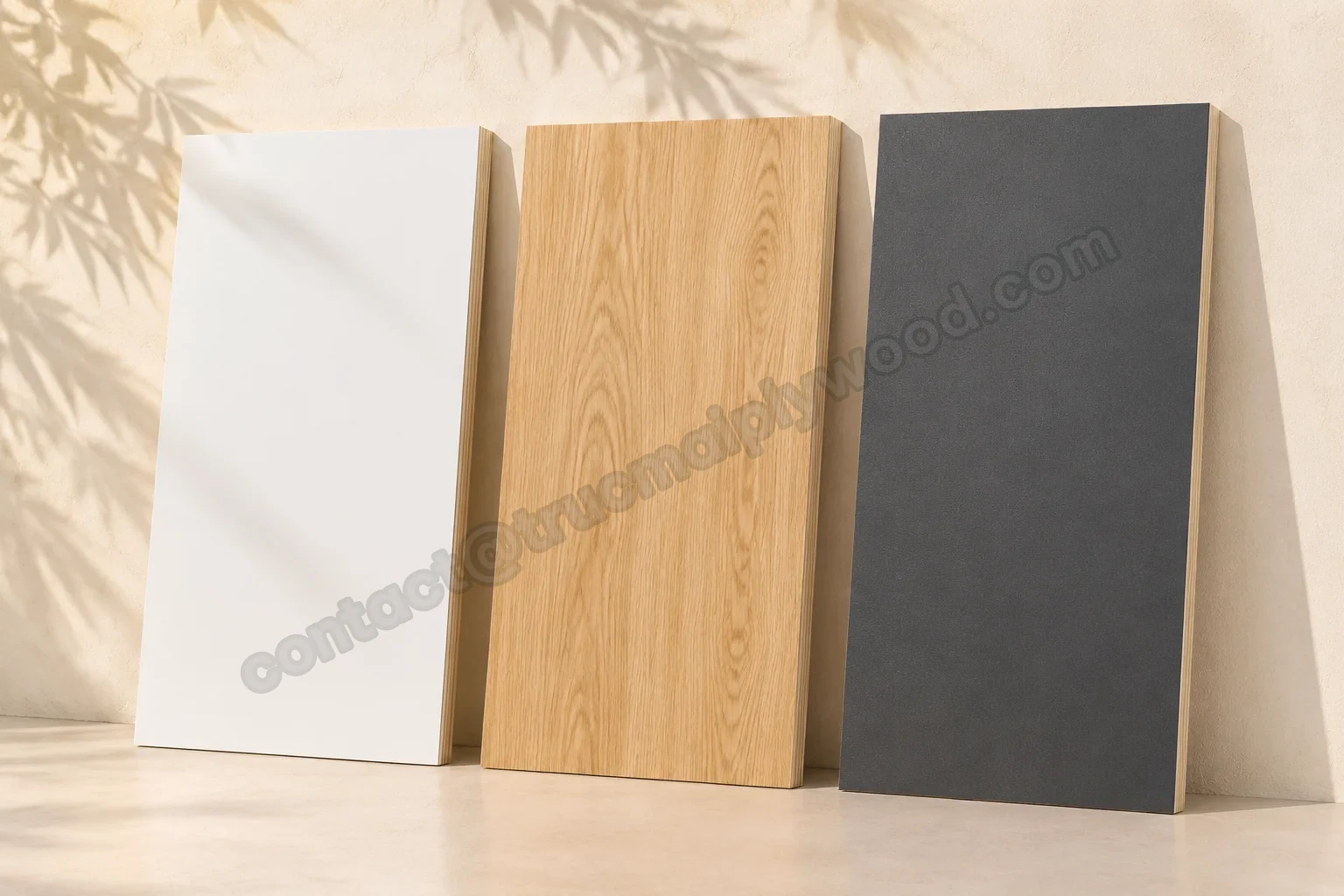
The melamine plywood price is the plywood platform plus a resin-impregnated decor paper pressed onto it under heat. The paper itself adds less to the cost than the platform underneath, so the core grade, the sanding and the thickness tolerance decide most of the difference between two melamine quotes.
Melamine paper takes the shape of what is under it. A dip in the core or an open joint in the face veneer shows through the decor as a shadow, and a gloss decor shows it most. That is why a melamine panel needs a better platform than a painted one: the sanding and calibration happen before the paper goes on.
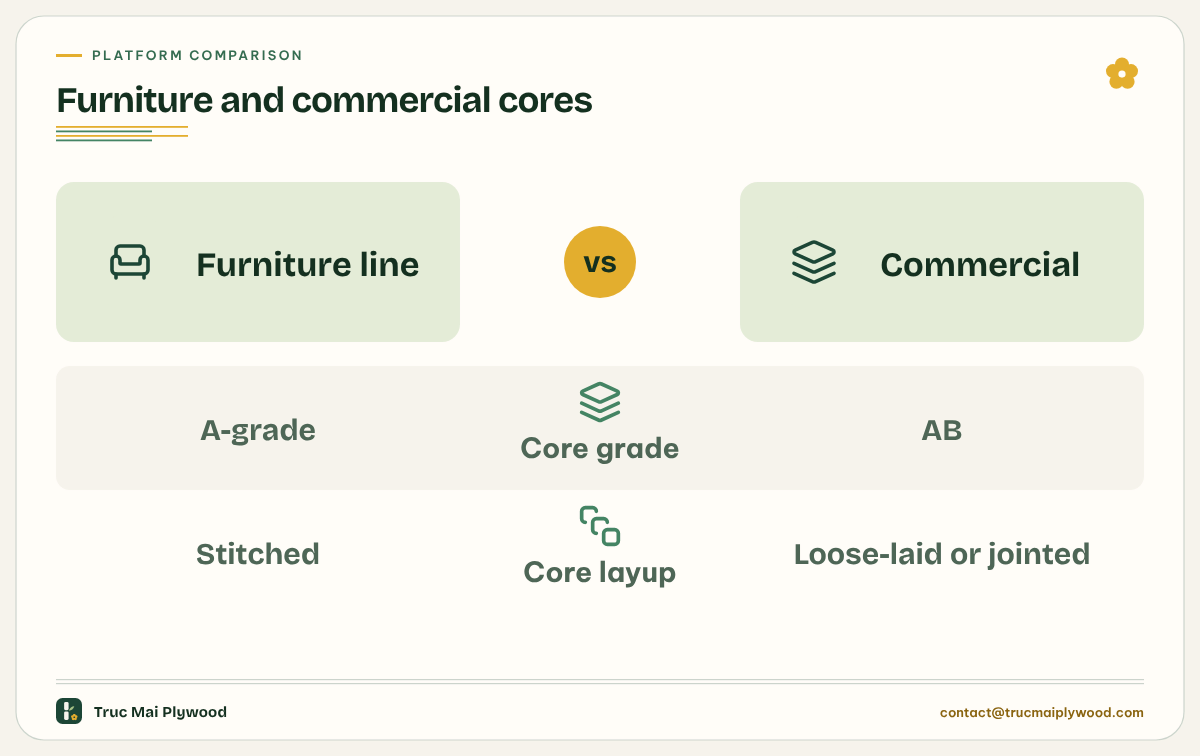
Truc Mai’s furniture line builds the platform with an A-grade, stitched core and sanded faces, calibrated to ±0.3 mm. Commercial panels use an AB core, loose-laid or jointed, at ±0.5 mm. A melamine sheet on a commercial platform costs less and suits parts where the surface is not under a raking light; a melamine sheet on a furniture platform is the one that keeps a flat, even decor across a kitchen run.
The melamine-faced panels page lists decors and builds, and the white melamine-faced plywood page covers the most ordered decor, where any flaw in the platform shows first.
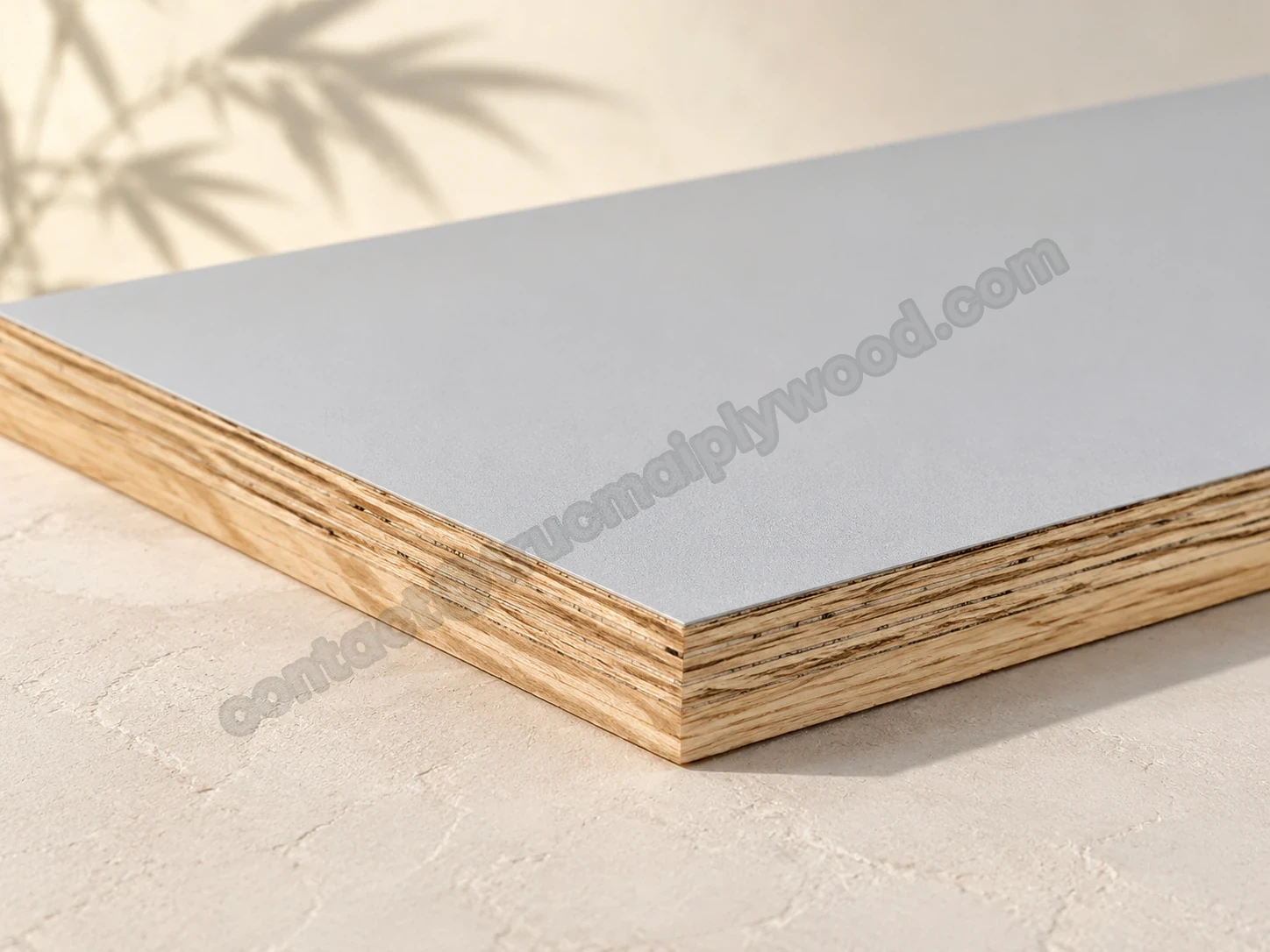
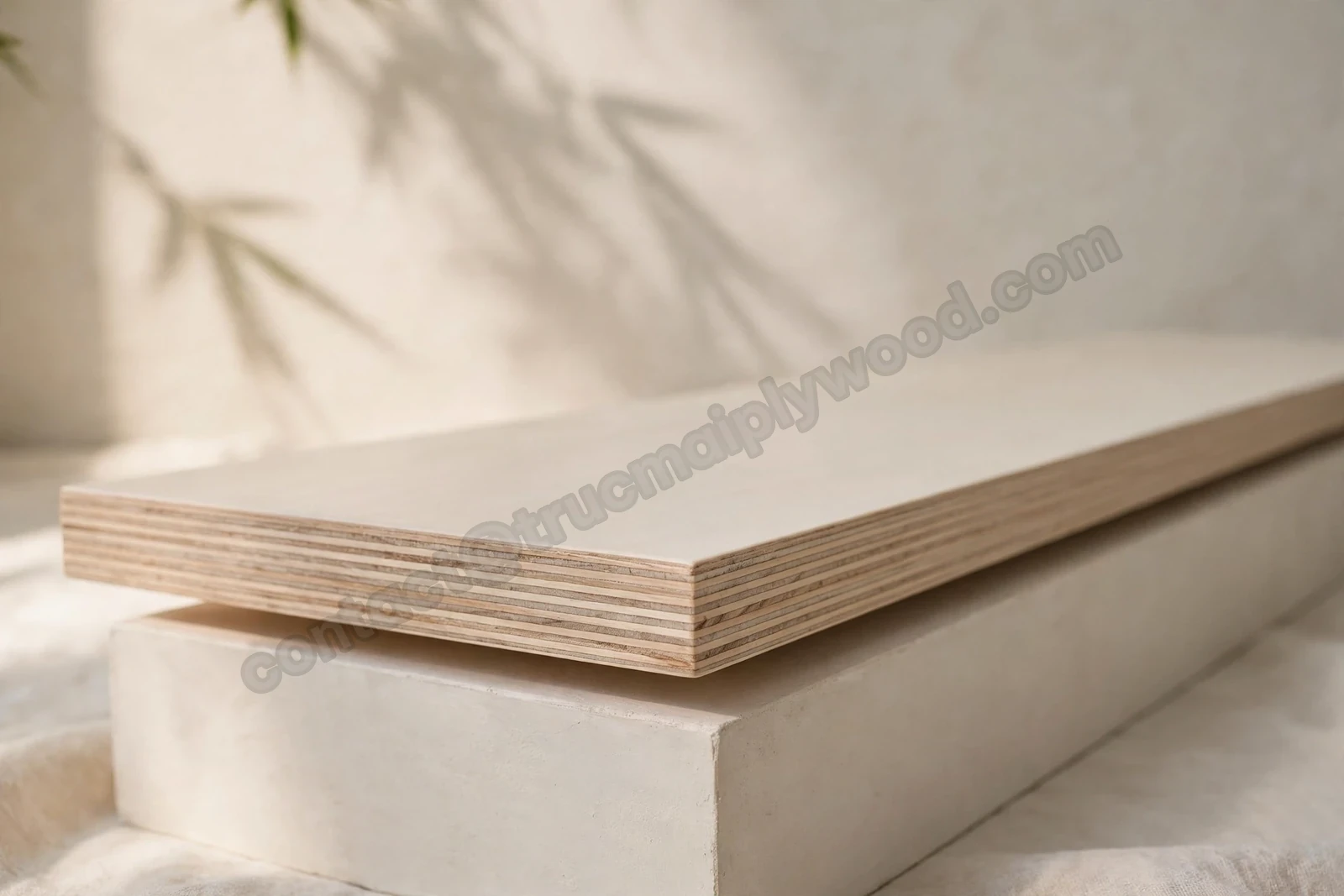
HPL plywood price: why a high-pressure laminate costs more
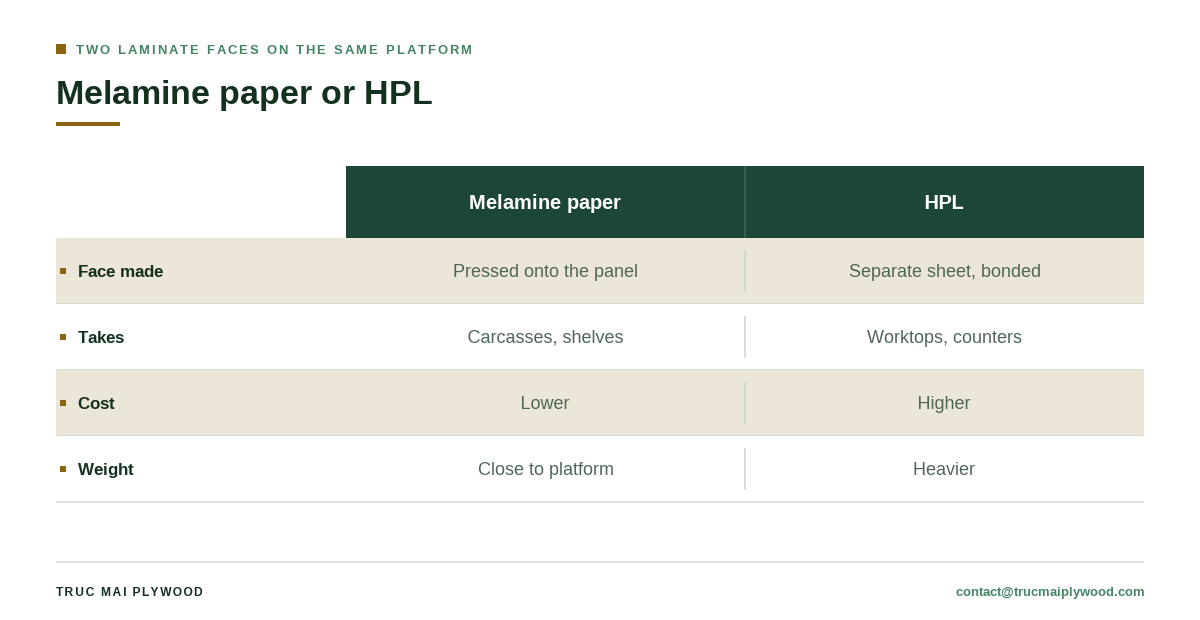
The HPL plywood price is higher than a melamine price on the same platform because high-pressure laminate is a separate, thicker sheet, made in its own press and then bonded to the plywood with an adhesive. The buyer pays for the laminate sheet, the bonding step and a heavier panel, in exchange for a face that takes more wear and impact.
HPL earns its cost on worktops, shop counters, lab benches, and doors that are knocked every day. On a carcass side or a wardrobe interior, melamine usually does the same job for less. A common order splits the two: HPL on the parts that take wear, melamine on the rest, in one container.
| Feature | Melamine paper | HPL |
|---|---|---|
| How the face is made | Decor paper pressed straight onto the panel | Laminate sheet made separately, then bonded |
| Wear and impact | For carcasses, shelves, wardrobe interiors | For worktops, counters, doors that take knocks |
| Cost on the same platform | Lower | Higher |
| Sheet weight | Close to the bare platform | Heavier: the laminate adds weight |
| Where it fits | Most furniture parts | Surfaces that take daily wear |
The HPL-faced plywood page sets out the HPL builds the mill presses.
Is melamine-faced plywood cheaper than veneer-faced plywood?
Melamine-faced plywood is often cheaper than veneer-faced plywood with a premium face, such as birch or okoume, and often dearer than a plain poplar or engineered veneer face with no laminate. The answer turns on the face it replaces: a decor paper is cheaper than an imported hardwood veneer, but the laminating step is an extra cost over a sanded veneer sheet.
The comparison also depends on what happens after delivery. A veneer-faced sheet bought for a painted or lacquered finish still needs that finish at the factory: sanding, sealing, coating, drying. A melamine sheet arrives finished. A furniture factory that compares “sheet price” alone misses the cost of the line that finishes the veneer.
There is a middle route. Truc Mai supplies UV-ready panels, with both faces prepared for the buyer’s own UV coating; the mill does not apply the UV. That suits a factory that already runs a UV line and wants a real wood face. Where the factory has no finishing line, laminate is usually the cheaper finished face.
| Face | Finished at delivery? | Price position |
|---|---|---|
| Plain poplar or EV veneer, sanded | No | Lowest of the veneer faces |
| Melamine decor paper | Yes | Above plain veneer, below premium veneer |
| Birch-faced or okoume veneer, sanded | No | Higher: the face veneer costs more |
| HPL | Yes | Highest of the finished faces |
How many m³ of 18 mm laminated panels fit in one 40HC?
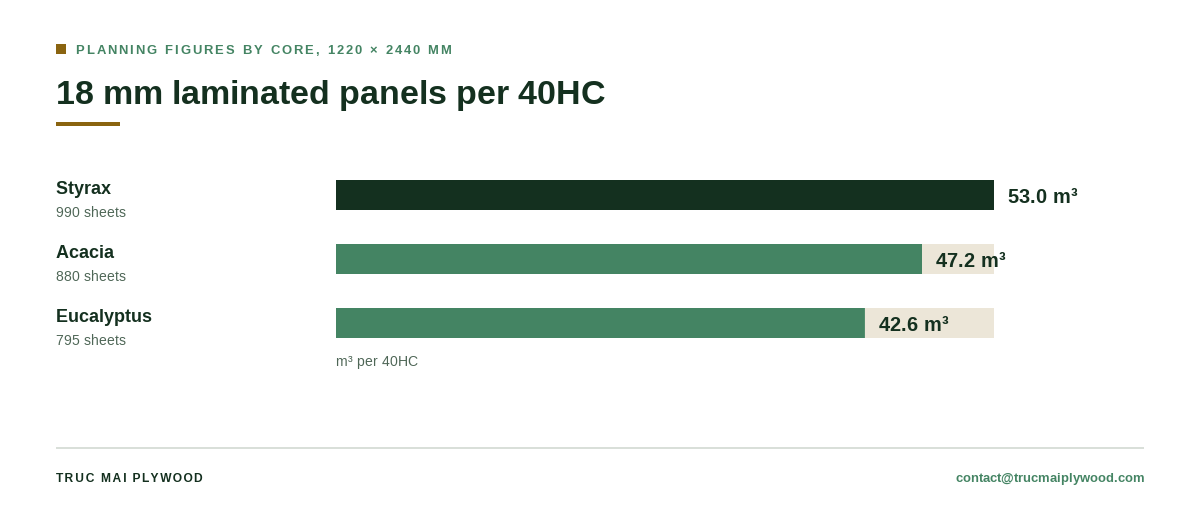
On a Styrax core, 18 mm panels of 1220 × 2440 mm fill about 53.0 m³ of one 40HC as a planning figure: 990 sheets in 18 packs of 55. On Acacia the planning figure is 880 sheets and about 47.2 m³; on Eucalyptus 795 sheets and about 42.6 m³. These are computed loads for bare panels, not packing-list records.
The difference between the cores is the single biggest freight lever in a laminated order. The same container, the same freight invoice and the same document set are spread over 53.0 m³ on Styrax and 42.6 m³ on Eucalyptus. Per m³, that container cost is about 24% higher on the Eucalyptus load.
| Core, 18 mm, 1220 × 2440 mm | Sheets per 40HC | Packs | m³ | kg per sheet |
|---|---|---|---|---|
| Styrax | 990 sheets | 18 × 55 sheets | 53.0 m³ | 26.8 kg |
| Acacia | 880 sheets | 16 × 55 sheets | 47.2 m³ | 31.1 kg |
| Eucalyptus | 795 sheets | 15 × 53 sheets | 42.6 m³ | 34.8 kg |
Planning figures, panels only, from the 40HC planning model: packs about 1,000 mm high and a 28,000 kg planning payload. A laminate adds weight to each sheet, so the heavier cores reach the payload sooner. Weigh real laminated sheets before the final loading plan.
Other thicknesses follow the same model; the container load calculator runs any core and thickness, and m³ per 40HC by thickness explains why the fill stays close across thicknesses.
How does the core change the cost of a laminated sheet?
The core changes the cost of a laminated sheet three ways: the price of the core veneer itself, the sheet weight that decides how many m³ ride in a container, and the flatness that decides how good the decor looks. A light, even core can lower the delivered cost per m³ even when its sheet price is not the lowest.
Truc Mai builds cores from Eucalyptus, Acacia or Styrax, or combined species laid together to balance price, weight and appearance. There is no rubberwood core. The planning model uses reference densities of 500 kg/m³ for Styrax, 580 for Acacia and 650 for Eucalyptus, which is where the different container fills come from.
For a furniture buyer, moving from Acacia to Styrax usually gives a lighter sheet, more m³ per container and a better face. Eucalyptus is the heavier, harder core; it holds screws well and suits parts that are fixed and refixed. A combined core puts the harder species where the screws go and the lighter one in between.
| Core | Reference density | Effect on a laminated order |
|---|---|---|
| Styrax | 500 kg/m³ | Lightest sheet, most m³ per 40HC |
| Acacia | 580 kg/m³ | Middle weight and fill |
| Eucalyptus | 650 kg/m³ | Heaviest sheet; weight caps the load first |
Thickness and the laminated plywood price per m³
Thickness moves the laminated plywood price per m³ in two directions. A thin panel carries more laminate per m³, because the decor covers the same area on less wood. And very thin panels need thin core veneer, which is scarcer: 4 mm panels use 1.3 mm core veneer and can take longer to produce.
Truc Mai presses panels from 3 to 40 mm, listed as 3, 4, 5, 6, 9, 12, 15, 18, 21, 25, 30 and 40 mm. Thin panels from 3 to 5 mm are always 5 plies. An 18 mm panel usually has 11–13 plies, most often 11. More plies mean more glue lines and more handling, which is part of why thickness is never a straight multiplication of the 18 mm price.
18mm laminated plywood price: why 18 mm is the reference
Most laminated quotes are anchored at 18 mm because carcass sides, shelves and doors are made from it. It is also the thickness where the laminate is the smallest share of the m³ cost, so a quote at 18 mm shows the platform price most clearly. Ask for the 18 mm price first, then for the steps to 15, 12 and 9 mm.
Tolerance is part of the price too. Furniture platforms sanded and calibrated to ±0.3 mm cost more to make than commercial platforms at ±0.5 mm, and the difference matters for laminated sheets that will be edge-banded on a machine set to one thickness.
Why can two quotes for laminated plywood with the same name differ?
Two quotes for laminated plywood with the same name differ because the name hides the construction: core grade, joining method, face preparation under the laminate, glue system, emission class and tolerance. “18 mm melamine plywood” can describe a stitched A-grade core at ±0.3 mm or a loose-laid core at ±0.5 mm.
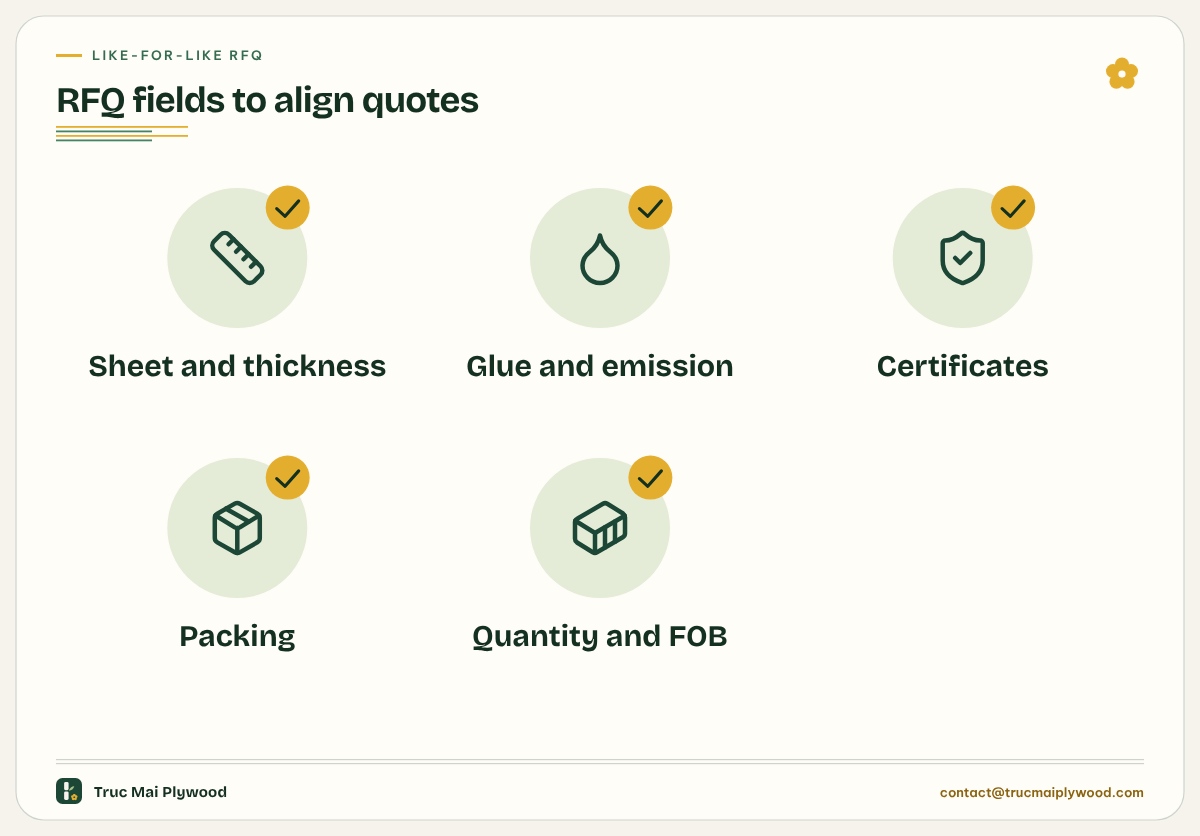
The way to compare is to put both quotes on the same lines. Start every RFQ from the application, then core, glue and emission, face, sheet size, packing and quantity. A quote that cannot answer one of those lines is a quote for a different panel.
- Application. Kitchen carcass, wardrobe, shop counter, wall cladding.
- Core. Species and grade, stitched or loose-laid.
- Glue and emission. Two separate lines: for example UF glue at E0 emission.
- Face. Melamine paper or HPL, decor code, one side or two.
- Sheet. 1220 × 2440 mm, 1220 × 2280 mm or 1250 × 2500 mm, thickness and tolerance.
- Packing. Pack size, protection, labels.
- Quantity. Containers, and whether the load is one spec or mixed.
Glue and emission deserve their own line. The default glue at Truc Mai is UF at E0 emission, with about six hours of boil resistance. A panel for a damp room can take melamine-fortified glue, which holds a 12-hour boil; emission is then usually E1. Both are written on the order, and emission class per order shows how.
What payment and delivery terms apply to a laminated plywood order?
A laminated plywood order at Truc Mai runs on the standard terms: minimum one 40HC, production in 15–45 days after a 30% deposit, and the 70% balance against the scanned bill of lading by T/T or irrevocable L/C at sight. Delivery terms are FOB Hai Phong, CFR (CNF) or CIF only.
The term changes what the price includes, not the panel. FOB Hai Phong covers the goods loaded on board at the port; CFR adds the ocean freight to the destination port; CIF adds the freight and the insurance. The International Chamber of Commerce notes that under Incoterms 2020 the Institute Cargo Clauses (C) remain the default level of cover for CIF, so a buyer who wants wider cover asks for it in writing.
| Term | Truc Mai standard |
|---|---|
| Minimum order | One 40HC |
| Production | 15–45 days after the deposit |
| Deposit | 30% by T/T |
| Balance | 70% against the scanned B/L, by T/T or irrevocable L/C at sight |
| Delivery terms | FOB Hai Phong, CFR (CNF) or CIF |
The schedule is the same on every container. The full sequence, from the deposit to the balance, is set out in deposit and balance terms.
Which certificates and files come with a laminated plywood quote?
Laminating a sheet does not strip its paperwork. A melamine or HPL quote can name the same CARB P2 and TSCA Title VI scope as a sanded sheet, an FSC 100% claim where the build is on the schedule, and an EUDR file with plot geolocation for EU lots. These are documents, not a surcharge line on the price.
United States. A laminated platform of veneer-core plywood still answers to 40 CFR 770.10, which caps that panel type at 0.05 ppm formaldehyde.
Truc Mai’s certificate for the US is CARB/EPA 26053, issued by ICTT Corporation to mill ICTT-26053 for 3–25 mm and 3–15 plies. A 30 or 40 mm laminated sheet falls outside it.
Paper and plastic laminates differ from a wood face here. In 40 CFR 770.3, the term laminated product is reserved for a sheet where “a wood or woody grass veneer is affixed” to a platform, so melamine paper on plywood is read as a plywood panel with an overlay. Write the overlay and the platform on the RFQ so the US scope is read correctly.
European Union. For a laminated panel sold into the EU, Regulation (EU) 2023/1464 sets the ceiling: 0.062 mg/m³ of formaldehyde in the test chamber for wood-based articles, applying from 6 August 2026. Each EU lot also comes with EUDR origin data for the core and any wood face, ready for the importer’s due-diligence statement.
FSC. Truc Mai’s chain-of-custody certificate is SA-COC-014545, licence code FSC-C196493, and it licenses FSC 100% only.
The FSC label page states the meaning of an FSC 100% label: “All materials used come from responsibly managed, FSC-certified forests”. For melamine or HPL builds the claim appears on the invoice only when the product is on the schedule, so raise it at enquiry.
Quality and environmental management are certified too: ISO 9001:2015 (W2012) and ISO 14001:2015 (W2012E), both for the manufacture of plywood.
What does a full 40HC of one laminated spec save?
A full 40HC of one laminated spec saves on changeovers, packing and paperwork: one decor run, one pack size, one label set and one line on every document. A container usually carries one or two products, and three to six can be mixed by agreement, but each extra spec adds a changeover and a smaller run.
The saving is not a published discount; it is the cost the mill does not incur. Every decor change means a new paper on the line and a new set of packs. A load of six decors in small runs costs more per m³ to make than a load of one decor, and it takes longer to load and check.
Mixing still has a place. A cabinet maker often needs white carcass board, a woodgrain door decor and an HPL worktop substrate in one delivery. The economical way is to group them: one or two main specs fill most of the container, and the small lines ride with them.
| Container plan | Changeovers | Best for |
|---|---|---|
| One spec | One | A factory with one carcass decor |
| One or two products | Few | Carcass board plus a door decor |
| Three to six products, by agreement | Several | A distributor or a mixed kitchen order |
The loading guide shows how mixed packs are placed.
How to write a laminated plywood RFQ that prices like for like
Write a laminated plywood RFQ as one spec line per product: application, size, thickness and tolerance, core, glue and emission, face and back laminate, decor codes, packing and quantity. A mill can then quote a figure for the panel you will receive, and a second mill’s figure can be laid beside it on the same lines.
| Line | Example for a kitchen carcass |
|---|---|
| Application | Kitchen carcass sides and shelves |
| Sheet | 1220 × 2440 mm, 18 mm, ±0.3 mm |
| Core | Styrax, A grade, stitched |
| Glue and emission | UF glue at E0 emission |
| Face / back | White melamine paper, both sides |
| Certificates | CARB P2 for US lots; EUDR file set for EU lots |
| Packing | Packs about 1,000 mm high, edge protection |
| Quantity | 1 × 40HC, FOB Hai Phong |
Send the line to the quotation desk or to contact@trucmaiplywood.com with the decor references, and ask for a free sample of the same build with the quote. The plywood RFQ guide covers the other lines a first order needs.
Questions buyers ask
Why does Truc Mai not publish a laminated plywood price list?
Because the price follows the build: core, sides, laminate, thickness and container fill. A list without those lines would compare unlike panels, so every quote is written against a specification.
Is a one-side laminated sheet always cheaper than a two-side sheet?
It carries one laminate instead of two, so the material cost is lower. The back still needs a defined face, and a carcass panel seen on both sides needs two laminated faces anyway.
Is HPL-faced plywood more expensive than melamine-faced plywood?
Usually yes, because a high-pressure laminate is a thicker, separately made sheet that is bonded to the plywood, while melamine paper is pressed straight onto the panel. HPL is chosen where the face takes wear.
How many sheets of 18 mm laminated plywood fit in one 40HC?
On a Styrax core the planning figure is 990 sheets of 1220 × 2440 mm, about 53.0 m³; on Acacia 880 sheets and on Eucalyptus 795. Laminated sheets are a little heavier, so weigh real sheets before loading.
Does the core species change the price of laminated plywood?
Yes. The core sets the sheet weight and the m³ that fit one container, so it moves both the panel cost and the freight cost per m³.
What is the minimum order for laminated plywood?
One 40HC. A container usually carries one or two products, and three to six can be mixed by agreement.
Which delivery terms can a laminated plywood quote use?
FOB Hai Phong, CFR (CNF) or CIF. The panel price is the same; the term decides who pays the freight and the insurance.
How are laminated plywood orders paid?
A 30% deposit starts production, and the 70% balance is paid against the scanned bill of lading by T/T or irrevocable L/C at sight.
Does a CARB P2 certificate cover laminated sheets?
Truc Mai's CARB P2 and TSCA Title VI certificate CARB/EPA 26053 covers hardwood plywood with a veneer core from 3 to 25 mm. Write the platform thickness on the RFQ so the scope can be confirmed.
Can I get a free sample of a laminated sheet before ordering?
Yes. New buyers receive free samples and book their own courier, and the courier cost can be credited against a real order.
How long does a laminated plywood order take to produce?
Production runs 15–45 days after the 30% deposit, depending on quantity, production conditions and agreement.